
Interests in Tech, Manufacturing, Stocks, 🏋🏼 & 🌱 | Writing down my 💭 on @DigitalisHomo
Joined May 2017
- Tweets 15,781
- Following 19,441
- Followers 23,779
- Likes 26,994
1,381 Photos and videos








Fabian A. Schmidt retweeted

Jun 13
The state of things:

80
524
10,282
751,095

Jun 13
Marketing hype is real
Jun 13

The US government, citing national security authorities, has issued an export control directive to suspend all access to Fable 5 and Mythos 5 by any foreign national, whether inside or outside the United States, including foreign national Anthropic employees.
The net effect of this order is that we must abruptly disable Fable 5 and Mythos 5 for all our customers to ensure compliance.
Access to all other Claude models is not affected.
We apologize for this disruption to our customers. We believe this is a misunderstanding and are working to restore access as soon as possible.
Read our full statement: anthropic.com/news/fable-myt…
2
64
Fabian A. Schmidt retweeted

Jun 11
Nobody wants to admit it but "vibecoding" works until your app has actual users. Then you discover what senior engineers have been getting paid for.
231
372
6,078
334,213
Fabian A. Schmidt retweeted

Jun 12
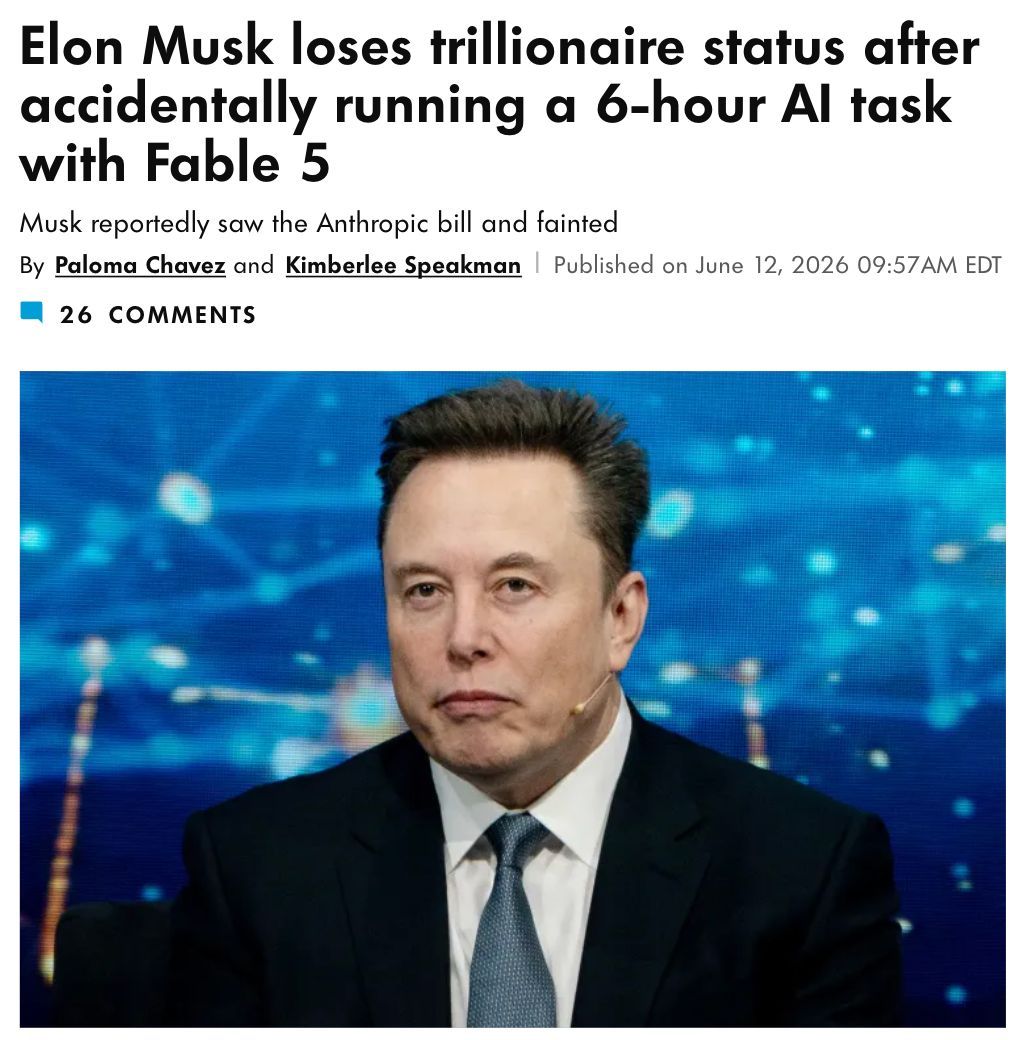
happens to the best of us
120
460
11,431
327,952
Fabian A. Schmidt retweeted

15 Jun 2024
Here's a robotic welding cell I designed and built for a run of 20,000 parts. The customer contracted me to build the system using dual arm Fanuc robots, Lincoln welders. I designed and built the 3 axis servo ferris wheel positioner, as well as the fixtures and tooling in my shop. The customer purchased the system after the part run was completed.
56
12
335
34,890
Fabian A. Schmidt retweeted

Jun 12
The NSA spent billions trying to break encryption.
One German programmer beat them.
He earned only $25k a year. 🤯
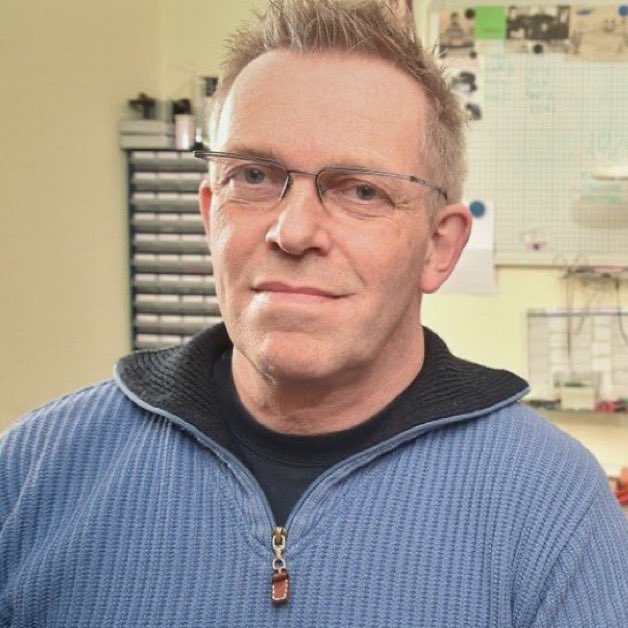
Meet Werner Koch 🇩🇪
> German free software developer. Born 1961 in Düsseldorf.
> 1997 ~ Richard Stallman called for a free encryption tool.
> Only option then: closed-source, US-restricted PGP.
> Werner answered. He built GnuPG (GPG) alone ~ free software to encrypt files, sign software, and verify identity.
> 1999 ~ Released GPG 1.0. Fully open source. No restrictions.
> Today his code verifies every Linux server update, every Debian package, every Tor Browser download on this Earth.
> Every signed Linux release depends on it.
> Used by activists, dissidents, and security pros worldwide to stay untracked.
> Edward Snowden used GPG in 2013 to leak NSA documents. It held up against the world’s most powerful spy agency. 🚀
> 2001 ~ Founded g10code with his brother to work full-time on GPG.
> Earned only $25,000/year for 14 years while supporting his wife and daughter.
> 2012 ~ Funding ended. He had to let go of his only programmer.
> 2013 ~ He was the sole maintainer and nearly quit.
> 2015 ~ ProPublica story dropped. Internet donated $137k in 24 hours.
> Facebook Stripe pledged $50k/year each. Linux Foundation gave $60k
> Won FSF Award for the Advancement of Free Software.
> Today he still maintains GPG from home in Erkrath, Germany.
This one man kept the internet’s secrets, secret.
The world almost lost him in 2013.
His code still protects yours.
Privacy Legend. 🐐

53
104
605
19,459
Fabian A. Schmidt retweeted

NEURA raising at a ~$7B valuation is not just one startup story.
Agile Robots, Helsing, Stark, Schaeffler, Bosch and the EIB all point in the same direction:
Germany is trying to turn its old industrial base into a robotics base.
The US sells the future louder.
China scales the future faster.
But Europe, and especially Germany, still has something very few places can copy:
deep manufacturing memory.
The humanoid race will not be won only by demos.
It will be won by whoever can industrialise robots.
Jun 10

German robotics companies are starting to put Europe on the map for physical AI.
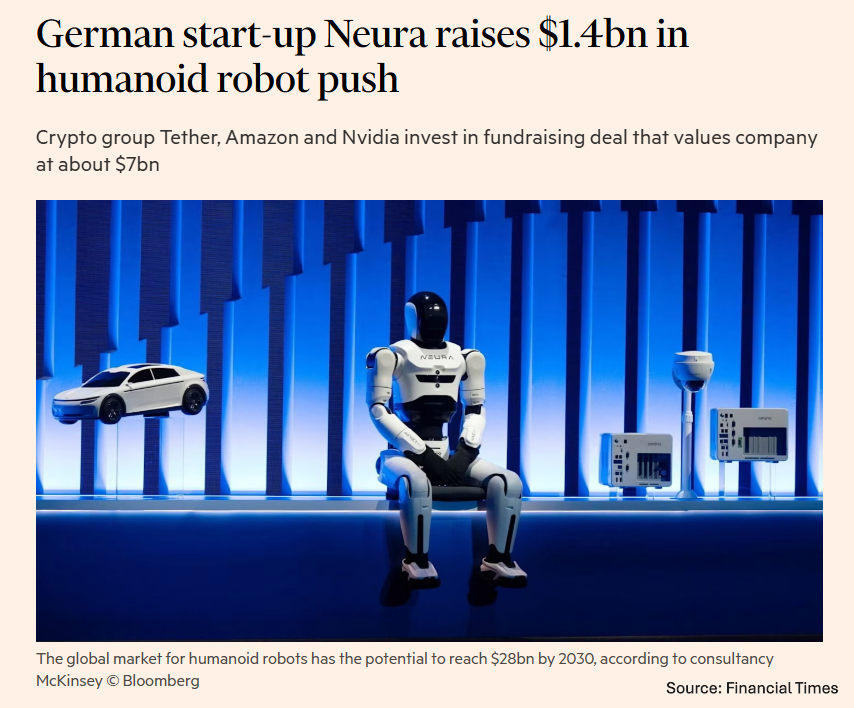
FT reports NEURA Robotics has secured $1.4B at a ~$7B valuation for humanoid and cognitive robotics.
Backing includes: Tether, Qualcomm, Amazon, Nvidia, Bosch, Schaeffler and the European Investment Bank.
According to the release, NEURA wants to scale humanoid robot production capacity from 6,000 units this year to tens of thousands next year, with a longer-term target of producing millions of AI-powered robotic arms and humanoids by 2030.
It also reports a >$1B order book for its robots, including humanoids.
NEURA is not the only German robotics capital story either.
Agile Robots is reportedly in talks to raise around $800M, with SoftBank discussing a $300M contribution, for a business spanning industrial arms, warehouse robots and humanoids. This surfaced June 2.
On the defence-autonomy side, Helsing was reported in May to be nearing a $1.2B round at an ~$18B valuation, while Stark was reported last week to be in talks to raise €300M at around €2.5B.
The structural reason is not hard to see: Germany has deep industrial automation, automotive supply chains, precision manufacturing and defence rearmament tailwinds.
6
9
66
4,072
Jun 11
Artificial General Engineer
Jun 11

JEFF BEZOS JUST EMERGED FROM STEALTH WITH A $41 BILLION AI STARTUP CALLED PROMETHEUS
$12 billion raised. Valued at $41 billion. Coming out of stealth today.
The backers: Bezos personally, JPMorgan, BlackRock, Goldman Sachs, DST Global, and Arch Venture Partners.
The mission: do for engineering and manufacturing what large language models did for text.
Bezos is calling it an "artificial general engineer." Instead of training on words from the internet, Prometheus ingests data from the physical world to accelerate the manufacturing of skyscrapers, smartphones, jet engines, and everything in between.
In Bezos' own words: "Something that today was going to take 100 engineers 10 years to build, if you can change that to taking 10 engineers one year to build, you're just going to get way more things built."
This is Bezos' first CEO role since stepping down from Amazon in 2021. He's co-leading it with Vik Bajaj, former Google X executive.
(Source Semafor)

5
4
451


Fabian A. Schmidt retweeted

Jun 11
A German robotics company has just raised $1.4bn to challenge Unitree Robotics and Tesla.
It's raised from Tether, Qualcomm, Amazon and Nvidia, as well as others, at a $7bn valuation.
@NEURARobotics is building robots that can see, hear, feel and learn, as well as the software, AI and data infrastructure required to deploy them at scale.
German NEURA Robotics has raised an INSANE $1.4bn to challenge Unitree Robotics and Tesla! 🇩🇪
David Reger, who founded the company in 2019, told the FT:
"This is the last chance for Europe to actually ever produce again in the world . . . if we own the physical AI stack and the robotics stack,”
This is amazing news for Europe and Germany which is massively at risk of falling too far behind the US and China on Robotics.
Full FT article from @IvanLevingston and @SebastienAsh in the comments below!

4
11
70
2,912
Fabian A. Schmidt retweeted

BMW Group is expanding its efforts to integrate humanoid robots into production processes.
The company had previously tested the Figure 02 humanoid robot at its Plant Spartanburg site in the United States, where it supported the production of more than 30,000 BMW X3 vehicles, moved over 90,000 components, and completed around 1,250 operating hours during a ten-month pilot.
Now, BMW is running a new pilot project at its Leipzig plant with AEON, a humanoid robot developed by Hexagon Robotics, Hexagon’s Zurich-based Physical AI division. This marks BMW Group’s first humanoid robot deployment in a European production environment.
The aim of this pilot is to explore how humanoid robots can be integrated into existing processes under real production conditions. AEON is expected to support tasks particularly in high-voltage battery assembly and component production.
As part of BMW’s iFACTORY approach, these applications show how Physical AI can move from concept to the production floor. The key point here is not only the humanoid form of the robot, but also its ability to adapt to existing production environments, support employees in repetitive or ergonomically demanding tasks, and create new opportunities for flexible automation.
For humanoid robots to become more widely adopted in industry, safety, reliability, cost, and scalability remain critical challenges.
🎥 via BMW Group & Hexagon Robotics
ℹ️ This content is shared for informational purposes only. All intellectual property rights belong to their respective owners.
#HumanoidRobots #PhysicalAI #Robotics #IndustrialAutomation #SmartManufacturing #BMWGroup #FutureOfManufacturing #Automation #HumanRobotCollaboration
2
2
18
1,310
Fabian A. Schmidt retweeted

Jun 10
German robotics companies are starting to put Europe on the map for physical AI.
FT reports NEURA Robotics has secured $1.4B at a ~$7B valuation for humanoid and cognitive robotics.
Backing includes: Tether, Qualcomm, Amazon, Nvidia, Bosch, Schaeffler and the European Investment Bank.
According to the release, NEURA wants to scale humanoid robot production capacity from 6,000 units this year to tens of thousands next year, with a longer-term target of producing millions of AI-powered robotic arms and humanoids by 2030.
It also reports a >$1B order book for its robots, including humanoids.
NEURA is not the only German robotics capital story either.
Agile Robots is reportedly in talks to raise around $800M, with SoftBank discussing a $300M contribution, for a business spanning industrial arms, warehouse robots and humanoids. This surfaced June 2.
On the defence-autonomy side, Helsing was reported in May to be nearing a $1.2B round at an ~$18B valuation, while Stark was reported last week to be in talks to raise €300M at around €2.5B.
The structural reason is not hard to see: Germany has deep industrial automation, automotive supply chains, precision manufacturing and defence rearmament tailwinds.
9
66
413
32,332
Jun 10
Text to CAD
Jun 10

asked claude fable 5 to design a humanoid robot
2 hours and 1.4m tokens later, i got this
absolutely insane
1
2
11
999
Fabian A. Schmidt retweeted

Jun 10
asked claude fable 5 to design a humanoid robot
2 hours and 1.4m tokens later, i got this
absolutely insane
142
234
3,558
867,198
Fabian A. Schmidt retweeted

Okay this is genuinely insane.
SpaceX just unveiled a satellite whose only job is to run AI. Not internet. Not GPS. Just compute, floating in orbit.
It's called AI1, and the reason behind it breaks your brain.
AI data centers on Earth are hitting a wall, not a chip wall, a physics wall.
They need staggering amounts of power and water just to stay cool, and we're running out of grid and land to build them.
So Musk's answer is: stop building them on Earth.
In orbit, the sun never sets. Free power, 24/7. No water for cooling, you just radiate heat into the vacuum of space. The two things choking AI on the ground barely exist up there.
And here's the wild part: Musk says it's easier to build than a Starlink satellite. Strip out the complex antennas and it's "a lot of solar cells, a radiator, and some laser links."
One AI1 carries the compute of an Nvidia GB300 rack, the same hardware data centers fight over down here.
AI1 is just the first one. The plan is a constellation of up to a million of them.
And the timing isn't an accident, SpaceX goes public this week at a ~$1.75 trillion target. This isn't a rocket company anymore. It's positioning itself as the power grid for AI, in space.
The race for AI compute just left the planet. Literally.
@SpaceX
1,106
2,920
17,708
4,732,498
Fabian A. Schmidt retweeted

We mistook the exit for progress.
It had better lighting.

26
94
927
10,964
🤯
Jun 8

I admire Fabrice Bellard. He is almost certainly a better overall programmer than I am.
1
1
185