
An anonymous Twitter account is not a loophole — it is a deliberate act of self-partition, drawing a clear line between the public voice and the private self.
Joined May 2010
- Tweets 233,374
- Following 7,455
- Followers 4,002
- Likes 542,505
16,556 Photos and videos







‼️ Why Boundaries Exist ‼️
Boundaries are not arbitrary. They exist to define what is ours and what is shared, to protect autonomy, and to maintain clarity in social and digital interaction. An anonymous Twitter account is not a loophole; it is a deliberate separation between the public and the private self.
When someone disregards that distinction — through stalking, harassment, or unwanted attention — they are not just violating etiquette. They are undermining a fundamental principle of trust and consent. The account holder has chosen to express ideas publicly without surrendering personal space. That line is clear. It is non-negotiable.
Respecting boundaries is not optional; it is the minimum standard of civility in an interconnected world. Ignoring them is not curiosity — it is intrusion. In digital life as in real life, transgression has consequences, and the responsibility lies with the observer, not the one who created the boundary.

5
7,366
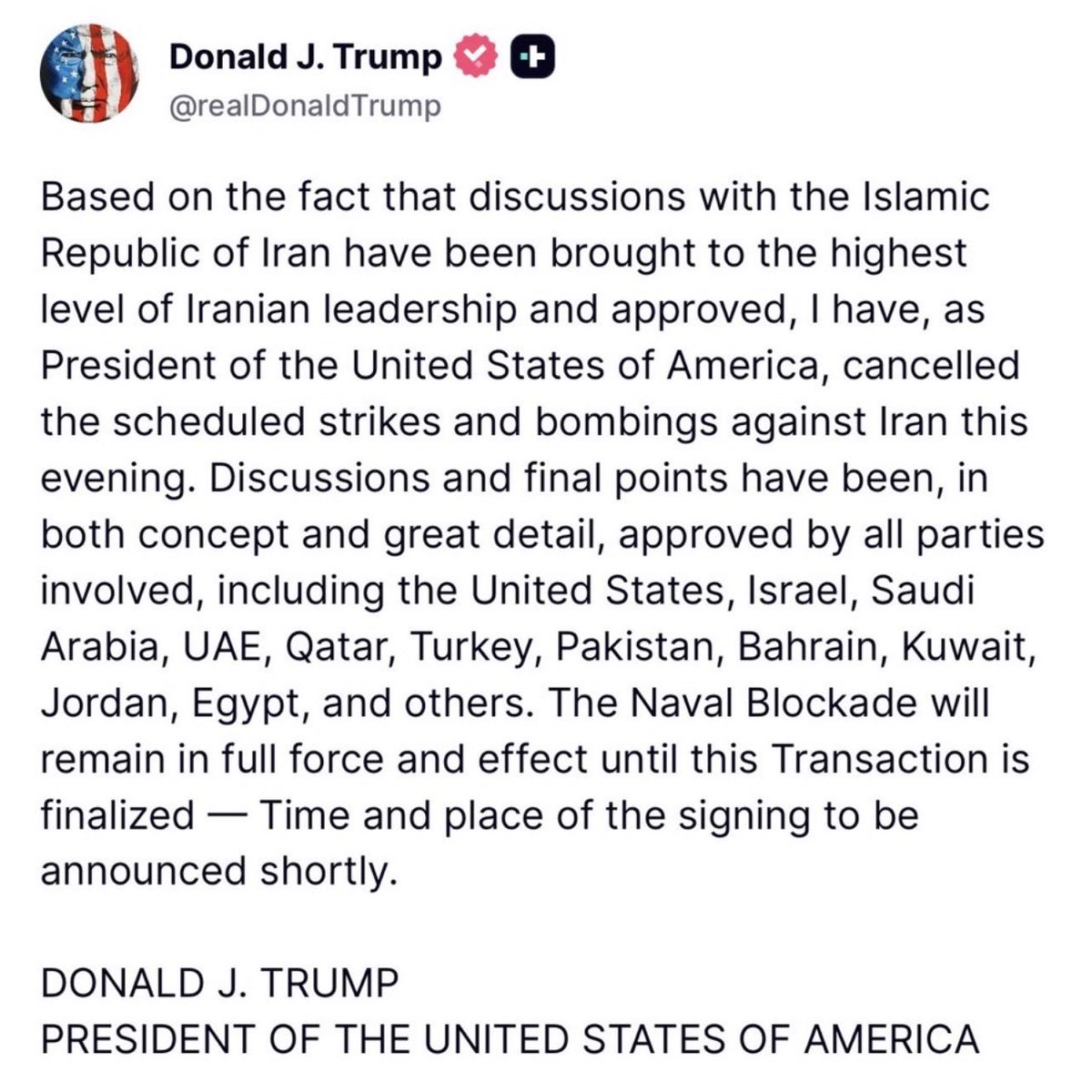
🇺🇸 🇮🇷 Le protocole d’entente Iran–États-Unis : une architecture fragile d’apaisement maîtrisé
Entre Washington et Téhéran se dessine non pas un traité de paix — un règlement politique stable demeure hors de portée — mais quelque chose de plus provisoire, et à certains égards de plus révélateur : un protocole d’entente dont la fonction est de figer l’escalade tout en préservant une ambiguïté interprétative maximale.
Le cadre qu’on prête aux deux pays prévoit une prolongation de soixante jours du cessez-le-feu, la réouverture du détroit d’Ormuz, un allègement progressif des sanctions et la libération d’avoirs iraniens gelés, en contrepartie d’engagements iraniens à renoncer à l’arme nucléaire et à suspendre l’enrichissement en attendant de nouvelles négociations. Au-delà de son ampleur, c’est sa structure qui frappe : on y substitue l’échelonnement à la résolution, le conditionnel au définitif.
La diplomatie classique met fin aux guerres par des traités ; celle-ci se contente d’en administrer l’après-coup, sans en acter formellement le terme. Le détroit d’Ormuz, par lequel transite une part considérable des flux énergétiques mondiaux, en devient à la fois l’instrument de pression et le garant de stabilité : au-delà de son poids économique, sa réouverture symbolise toute une architecture d’apaisement échafaudée sous contrainte extérieure.
Diplomatie de l’incertitude maîtrisée, donc, où chacun semble trouver son compte : Washington y gagne un gel de la trajectoire nucléaire iranienne et un répit régional, Téhéran des perspectives de levée des sanctions et un déblocage financier partiel. Rien, pourtant, n’y est tranché sur le plan juridique ou institutionnel : davantage qu’un accord, ce protocole dessine un calendrier de négociations à venir, sous une tension militaire abaissée.
Cette ambiguïté n’a rien d’accidentel : elle est la logique même du dispositif.
Elle porte pourtant en germe sa propre instabilité. À Téhéran, les factions intransigeantes dénoncent déjà un cadre jugé insuffisant et asymétrique, notamment sur la levée des sanctions et la maîtrise de points d’appui stratégiques comme Ormuz. À Washington, la fragilité se loge à l’inverse : la moindre concession perçue comme excessive risquerait de transformer une ouverture diplomatique en handicap politique intérieur.
D’où ce dilemme : l’accord doit rester assez flou pour être accepté de part et d’autre sur le plan intérieur, tout en restant assez concret pour conserver sa crédibilité à l’extérieur. C’est précisément à cet endroit que l’histoire montre les cadres provisoires commencer à se fissurer.
Sur le plan géopolitique, l’enjeu déborde largement le cadre bilatéral : les acteurs régionaux n’y figurent pas en simples spectateurs, mais en variables structurelles à part entière. Israël, les pays du Golfe et les marchés de l’énergie n’y voient pas un aboutissement, mais une redistribution des risques. La réouverture d’Ormuz éloigne le spectre d’un choc énergétique immédiat, tout en scellant un répit conditionnel, suspendu au moindre incident.
En ce sens, le protocole tient moins d’une architecture de paix que d’un régulateur de pression.
S’il réussit, ce sera sans doute pour n’avoir jamais voulu tout résoudre d’un seul tenant ; s’il échoue, ce sera parce que l’ambiguïté — sa plus grande force — se sera retournée contre lui. Dans l’un et l’autre cas, il illustre un basculement de la diplomatie contemporaine : des traités qui referment l’histoire aux cadres qui la mettent en suspens.
Il ne s’agit pas d’un traité de paix, mais de la suspension maîtrisée d’un conflit.

🇺🇸 🇮🇷 The Illusion of Closure: What a Signing Ceremony Really Signals
The announcement of an official signing ceremony for Friday, 19 June, in Switzerland, invites a familiar misreading: that diplomacy is about to culminate in resolution. In practice, such moments rarely mark an ending. They mark a transition — from open negotiation to managed interpretation.
By the time leaders gather to sign, the decisive bargaining has already occurred elsewhere: in technical corridors, discreet bilateral channels, and carefully calibrated drafts that never fully surface in public view. What remains is not the substance of agreement but its stabilization — the moment a fluid process is set into a form that can be displayed.
Switzerland is not incidental here. It belongs to the infrastructure of modern diplomacy. Its neutrality is not merely symbolic but functional: it offers political ground on which states can formalize commitments without conceding strategic advantage simply by appearing on one another’s territory. The venue is not a backdrop — it is a condition of possibility.
Yet the ceremony performs a different role than it appears to. It creates an impression of finality while actually compressing unresolved tensions. A fixed date transforms diplomacy into a countdown. As the deadline nears, ambiguity is not resolved so much as redistributed — into annexes, side letters, sequencing arrangements, and carefully managed “understandings” that carry political weight without always carrying legal clarity.
This is why the final phase of such processes often appears paradoxical. The closer the parties move toward agreement, the less the process resembles open deliberation and the more it resembles controlled convergence. Disputes do not vanish; they are relocated — often upward, to heads of government or political principals asked to arbitrate what technical teams can no longer reconcile within the time available.
The result is a document that is less a singular settlement than a layered architecture: a core text of principles surrounded by technical scaffolding, interpretive flexibility, and implicit assumptions about implementation. Each party signs not because it agrees on every detail, but because each can tolerate ambiguity in its own way, for its own reasons.
This is where the ceremony acquires its true meaning. It is not the moment disagreement ends, but the moment disagreement becomes governed. The performance of unity matters as much as its substance. Multiple audiences watch simultaneously: domestic constituencies seeking reassurance, allies looking for alignment, strategic competitors assessing cohesion or fracture. The choreography is built to speak to all of them at once — without fully satisfying any of them.
And yet the most consequential question lies beyond the podium. Signing does not resolve the central vulnerabilities of such agreements. Implementation gaps, sequencing disputes, political turnover, and narrative contestation all re-enter the system the moment the ink dries. What was framed as closure becomes, almost instantly, a new arena of struggle — less visible, more technical, and often more decisive than the negotiation that preceded it.
The enduring misconception is to treat such ceremonies as endpoints. They are closer to institutional handoffs: from negotiation to interpretation, from drafting to enforcement, from political theater to administrative endurance.
The real question, then, is not what will be signed on 19 June. It is what kind of conflict — legal, political, strategic — continues after the signature has been affixed.
47
🇺🇸 🇮🇷 The Illusion of Closure: What a Signing Ceremony Really Signals
The announcement of an official signing ceremony for Friday, 19 June, in Switzerland, invites a familiar misreading: that diplomacy is about to culminate in resolution. In practice, such moments rarely mark an ending. They mark a transition — from open negotiation to managed interpretation.
By the time leaders gather to sign, the decisive bargaining has already occurred elsewhere: in technical corridors, discreet bilateral channels, and carefully calibrated drafts that never fully surface in public view. What remains is not the substance of agreement but its stabilization — the moment a fluid process is set into a form that can be displayed.
Switzerland is not incidental here. It belongs to the infrastructure of modern diplomacy. Its neutrality is not merely symbolic but functional: it offers political ground on which states can formalize commitments without conceding strategic advantage simply by appearing on one another’s territory. The venue is not a backdrop — it is a condition of possibility.
Yet the ceremony performs a different role than it appears to. It creates an impression of finality while actually compressing unresolved tensions. A fixed date transforms diplomacy into a countdown. As the deadline nears, ambiguity is not resolved so much as redistributed — into annexes, side letters, sequencing arrangements, and carefully managed “understandings” that carry political weight without always carrying legal clarity.
This is why the final phase of such processes often appears paradoxical. The closer the parties move toward agreement, the less the process resembles open deliberation and the more it resembles controlled convergence. Disputes do not vanish; they are relocated — often upward, to heads of government or political principals asked to arbitrate what technical teams can no longer reconcile within the time available.
The result is a document that is less a singular settlement than a layered architecture: a core text of principles surrounded by technical scaffolding, interpretive flexibility, and implicit assumptions about implementation. Each party signs not because it agrees on every detail, but because each can tolerate ambiguity in its own way, for its own reasons.
This is where the ceremony acquires its true meaning. It is not the moment disagreement ends, but the moment disagreement becomes governed. The performance of unity matters as much as its substance. Multiple audiences watch simultaneously: domestic constituencies seeking reassurance, allies looking for alignment, strategic competitors assessing cohesion or fracture. The choreography is built to speak to all of them at once — without fully satisfying any of them.
And yet the most consequential question lies beyond the podium. Signing does not resolve the central vulnerabilities of such agreements. Implementation gaps, sequencing disputes, political turnover, and narrative contestation all re-enter the system the moment the ink dries. What was framed as closure becomes, almost instantly, a new arena of struggle — less visible, more technical, and often more decisive than the negotiation that preceded it.
The enduring misconception is to treat such ceremonies as endpoints. They are closer to institutional handoffs: from negotiation to interpretation, from drafting to enforcement, from political theater to administrative endurance.
The real question, then, is not what will be signed on 19 June. It is what kind of conflict — legal, political, strategic — continues after the signature has been affixed.
🇮🇷 🇺🇸 قضية البرنامج النووي، ومضيق هرمز، ولبنان: ملامح الاتفاق الناشئ مع إيران
وصل وفد قطري إلى طهران لدفع المفاوضات الجارية بين الولايات المتحدة وإيران إلى الأمام. ويضم الوفد علي الثوادي، المسؤول القطري نفسه الذي شارك سابقاً في الاتصالات مع إسرائيل بهدف إنهاء الحرب في غزة وتأمين إطلاق سراح الرهائن. كما أفادت تقارير بأنه كان حاضراً خلال الاتصال الذي أجراه رئيس الوزراء الإسرائيلي بنيامين نتنياهو من البيت الأبيض مع رئيس الوزراء القطري عقب الضربة العسكرية التي استهدفت الدوحة.
ويتمحور جوهر الاتفاق المطروح حول تعهّد طهران بعدم إنتاج أو امتلاك سلاح نووي، مقابل السماح لها بالحفاظ على مخزونها من اليورانيوم المخصب داخل الأراضي الإيرانية بعد تخفيف نسبة تخصيبه، وذلك تحت رقابة وإشراف أمريكيين. ومن المقرر أن تستمر المناقشات المتعلقة بالآلية النهائية لمعالجة الملف النووي خلال الشهرين المقبلين.
وفي إطار مذكرة التفاهم، ستقوم الولايات المتحدة بتعليق العقوبات المفروضة على صادرات النفط الإيرانية لفترة محددة، في حين تلتزم الجمهورية الإسلامية بإعادة فتح مضيق هرمز بالكامل أمام الملاحة الدولية، مقابل رفع الحصار البحري الأمريكي المفروض عليها.
كما تشير المعلومات المتداولة إلى موافقة الولايات المتحدة على الإفراج عن نحو 25 مليار دولار من الأموال الإيرانية المجمدة.
وإلى حين التوصل إلى اتفاق نهائي، تلتزم إيران بالحفاظ على الوضع القائم في الملف النووي، وعدم رفع مستويات تخصيب اليورانيوم أو توسيع منشآتها النووية، فيما تتعهد الولايات المتحدة بعدم فرض عقوبات إضافية على إيران خلال فترة المفاوضات.
وتشمل التفاهمات المطروحة وقفاً كاملاً للأنشطة العسكرية في كل من إيران ولبنان، إلى جانب اتخاذ تدابير تحول دون تنفيذ أي عمليات عسكرية جديدة كانت مخططاً لها، وذلك بضمانة أمريكية تهدف إلى منع عودة التصعيد.
كذلك يجري العمل على إنشاء آلية تعويضات ومساعدات مخصصة لدعم جهود إعادة الإعمار والتعافي في إيران، والمساهمة في معالجة الأضرار التي خلّفتها الحرب.
1
173
🇺🇸 🇮🇱 The Coordinated Game Between Benjamin Netanyahu and Donald Trump on Iran
What appears, at first glance, as a sequence of mixed signals, tactical divergences, and shifting tones on the Iran file is better understood through a different hypothesis: not friction within an alliance, but a coordinated strategic game in which both Washington and Jerusalem are playing assigned roles.
In this reading, the “Iran file” is not being managed through ad hoc alignment or reactive diplomacy. It is being actively structured as a dual-track pressure system — military and diplomatic — designed to shape the behavior of a third actor: Tehran.
1/7
1
121
➡️ The strategic paradox
The most counterintuitive feature of this model is that coordination must remain partially invisible to function effectively. Excess coherence would reveal the script; visible unity would reduce leverage; overt alignment would allow Iran to discount signals as purely constructed.
So the system performs partial opacity: enough unity to deter miscalculation, enough divergence to sustain uncertainty.
6/7
1
55
🧐 Seen through this lens, the Iran file is not a point of alliance strain between Netanyahu and Trump, but a coordinated pressure architecture in which apparent inconsistencies are not bugs in the system — they are the system.
The choreography only works because it does not look like choreography.
Coherence is not the visible condition of success; controlled incoherence is. What reads as hesitation or divergence is the mechanism that preserves credibility simultaneously toward Tehran, international partners, and domestic audiences on both sides.
The paradox is structural: too much unity flattens the signal, too much divergence breaks it. The equilibrium is therefore deliberately unstable—held by calibrated distance between roles, not perfect alignment.
The aim is not to resolve contradiction, but to make it operational.
And if it works, its defining feature will also be its most misleading one: it will never look fully coordinated — even when it is.
7/7
63
🇺🇸 Contrary to the prevailing “going dark” rhetoric surrounding a Section 702 lapse, the statute’s transition provisions grandfather existing court-approved certifications, meaning that the practical consequences of expiration are far less dramatic than advertised.
Because Section 702 operates under annual FISC certifications rather than a single perpetual authorization, any collection already underway pursuant to a valid certification continues for the remainder of that certification’s term, regardless of whether the statute itself has lapsed.
The actual effect of a lapse, then, is not an abrupt halt to surveillance but a freeze on new authorizations: existing programs persist while the pipeline for fresh certifications closes.
This is particularly salient now, as the FISC’s most recent certifications — approved in March 2026 — remain in force until roughly March 2027, meaning the bulk of current Section 702 collection will continue uninterrupted despite the statute’s lapse on Friday.
🇺🇸 The House’s decision to reject (198-218) another short-term extension of Section 702 of the Foreign Intelligence Surveillance Act has pushed one of the United States’ most significant intelligence authorities to the brink of expiration. The vote leaves the government’s ability to conduct certain forms of foreign surveillance facing an uncertain future, while exposing deep divisions in Washington over national security, privacy, and government oversight.
With the House refusing to advance a temporary renewal, attention now turns to the Senate. Lawmakers there could attempt to pass a short-term extension through unanimous consent, a procedural shortcut designed to move legislation quickly. Yet such an effort would almost certainly encounter objections from senators on both sides of the debate, making success far from guaranteed.
As the deadline approaches, Congress finds itself without a clear path forward. Supporters of Section 702 argue that it remains an indispensable tool for tracking foreign threats, disrupting terrorist plots, and gathering intelligence on hostile actors abroad. Critics, however, contend that the program has been vulnerable to abuse and requires stronger safeguards to protect the civil liberties of Americans whose communications may be swept up in the process.
The result is a high-stakes standoff that leaves one of the nation’s most consequential surveillance authorities hanging in the balance. Unless lawmakers can quickly bridge their differences, Section 702 could lapse, creating both operational challenges for intelligence agencies and renewed political pressure on Congress to reach a compromise. The coming hours are likely to determine whether Washington can deliver a last-minute solution or whether the surveillance authority will expire amid legislative gridlock.
89
🇺🇸 Have the Iran Negotiations Already Decided the Republican 2028 Race — Without Anyone Noticing?
There is a quiet contest running underneath the visible one in Washington, and it has nothing to do with who can deliver a ceasefire. It has to do with who gets to walk away from this war as the man who can be trusted with the next one.
Vice President JD Vance and Secretary of State Marco Rubio are not adversaries in any conventional sense. They sit on the same team, issue coordinated statements, and will spend the next two years insisting — correctly, in the narrow sense — that they share the administration’s goals on Iran. But the Islamabad talks have placed them on opposite sides of a much older political divide: the difference between the principal and the institution.
1/5
1
354
But bets staked on personal narrative carry personal risk, and this is where the structural asymmetry between the two men becomes visible. Rubio benefits from ambiguity. A negotiation that drags on in a state of unresolved “progress” costs him nothing — it simply stays off his desk while he manages the rest of the portfolio. Vance cannot afford ambiguity, because ambiguity without resolution leaves him exactly where he started: the vice president associated with a war he didn’t choose, minus the credit a finished deal would have provided. Time is Rubio’s ally and Vance’s adversary, which is an unusual position for the more powerful of the two men to be in.
4/5
1
52
The donor class and the institutional wing of the party were always going to prefer Rubio as the safer 2028 bet; he reassures precisely the audiences who view Vance’s online-native political brand as a liability waiting to surface. What the Iran negotiations have done is hand Rubio a low-risk waiting game while Vance plays a high-variance hand in full public view, with no institutional layer to absorb the result. If Vance succeeds, he proves he can do the thing Rubio’s resume implies Rubio should be better at, while holding the position Rubio cannot occupy: the skeptic who delivered anyway. If Vance fails, he has supplied the argument for Rubio’s entire candidacy — that the party preparing to govern after Trump should choose competence over instinct.
Neither man can say any of this out loud. But strip away the coordination, and what remains is a simple asymmetry: one man is playing for substantial upside against real downside, and the other’s worst-case outcome is that nothing changes at all.
5/5
67
🧐 Debates over NGOs remain deeply polarized. Supporters point to their vital role in delivering services, holding governments and institutions accountable, and amplifying the voices of communities that are often overlooked or underrepresented. Critics counter that some NGOs function as unelected political actors, pursuing ideological agendas or foreign interests without any democratic mandate — a concern sharpened by globalization and the erosion of trust in traditional institutions.
The challenge for democratic societies lies in balancing these competing concerns. Healthy political systems do so by consistently enforcing transparency and disclosure requirements, preserving electoral accountability as the primary source of political legitimacy, and protecting space for genuine grassroots activism. Restricting civil society weakens pluralism and civic participation, yet allowing influential organizations to wield political power without adequate transparency or accountability can just as easily erode democratic consent and public trust.
Original full French version ⬇️
🧐 Du rôle des ONG
L’influence croissante des ONG n’est pas la cause des déficits démocratiques ; elle en est souvent la conséquence. Mais il faut aussi se demander qui porte cette accusation, et pourquoi elle resurgit avec une telle régularité dans certains contextes politiques précis.
Lorsque les systèmes politiques s’essoufflent, que les institutions perdent leur crédibilité, que les partis se déconnectent des citoyens ou que les mécanismes de représentation fonctionnent mal, les organisations de la société civile tendent naturellement à occuper l’espace laissé vacant. Elles fournissent des services, produisent de l’expertise, défendent des causes, documentent des réalités souvent négligées et contribuent au débat public. Ce n’est pas un accident si les régimes qui consolident leur pouvoir — qu’ils soient autoritaires ou simplement intolérants à tout regard extérieur — ciblent systématiquement ces acteurs avant les autres : ils sont les premiers obstacles à l’absence de contre-pouvoir.
Certains reprochent aux ONG de ne disposer d’aucune légitimité électorale. L’observation n’est pas fausse, mais elle repose sur une confusion de rôle, et surtout sur une asymétrie révélatrice. Les ONG ne tirent pas leur légitimité des urnes et ne prétendent généralement pas gouverner ; leur légitimité repose sur leur expertise, leur ancrage dans certaines communautés, et l’adhésion volontaire de ceux qui soutiennent leurs activités. Or l’argument du mandat électoral n’est invoqué qu’à sens unique. Personne n’exige des lobbies industriels, des médias détenus par des intérêts privés ou des groupes de pression patronaux qu’ils justifient leur influence par un scrutin. Et l’élection elle-même n’a jamais constitué une garantie contre la capture institutionnelle, le clientélisme ou l’usage de l’appareil d’État à des fins partisanes — l’histoire récente de plusieurs démocraties en offre une démonstration constante. Invoquer la légitimité électorale contre la société civile, tout en tolérant son absence partout ailleurs, n’est pas un principe : c’est un instrument.
Cela dit, toute critique des ONG n’est pas illégitime, et prétendre le contraire desservirait la cause même de la société civile. Certaines organisations servent effectivement de relais à des agendas étrangers, de façades de financement opaque, ou d’instruments dans des rivalités géopolitiques qui n’ont rien à voir avec les causes qu’elles affichent. Les exigences de transparence sur les sources de financement, les priorités et l’utilisation des fonds sont parfaitement fondées — à condition qu’elles s’appliquent avec la même rigueur aux partis politiques, aux entreprises et aux institutions publiques, et non comme un filtre sélectif appliqué aux seules voix indépendantes.
C’est précisément cette distinction que les discours anti-ONG les plus systématiques cherchent à effacer. En amalgamant l’ONG locale ancrée depuis des décennies dans une communauté avec la structure écran financée depuis l’étranger, on discrédite la première en utilisant la seconde comme prétexte. La cible réelle n’est pas la fraude ou l’ingérence — phénomènes réels mais marginaux — mais l’existence même d’un espace associatif capable d’interpeller le pouvoir.
Une démocratie vivante ne se résume pas aux élections. Elle repose aussi sur la liberté d’association, le pluralisme des opinions et l’existence de contre-pouvoirs. Le véritable problème n’est donc pas l’influence de la société civile, mais l’incapacité de certaines institutions politiques à représenter efficacement les citoyens — et la tentation, pour ceux qui en bénéficient, de transformer cette incapacité en accusation portée contre quiconque la documente. Réduire l’espace civique ne résout aucune crise de représentation ; il supprime simplement ceux qui en parlent.
62
🧐 Du rôle des ONG
L’influence croissante des ONG n’est pas la cause des déficits démocratiques ; elle en est souvent la conséquence. Mais il faut aussi se demander qui porte cette accusation, et pourquoi elle resurgit avec une telle régularité dans certains contextes politiques précis.
Lorsque les systèmes politiques s’essoufflent, que les institutions perdent leur crédibilité, que les partis se déconnectent des citoyens ou que les mécanismes de représentation fonctionnent mal, les organisations de la société civile tendent naturellement à occuper l’espace laissé vacant. Elles fournissent des services, produisent de l’expertise, défendent des causes, documentent des réalités souvent négligées et contribuent au débat public. Ce n’est pas un accident si les régimes qui consolident leur pouvoir — qu’ils soient autoritaires ou simplement intolérants à tout regard extérieur — ciblent systématiquement ces acteurs avant les autres : ils sont les premiers obstacles à l’absence de contre-pouvoir.
Certains reprochent aux ONG de ne disposer d’aucune légitimité électorale. L’observation n’est pas fausse, mais elle repose sur une confusion de rôle, et surtout sur une asymétrie révélatrice. Les ONG ne tirent pas leur légitimité des urnes et ne prétendent généralement pas gouverner ; leur légitimité repose sur leur expertise, leur ancrage dans certaines communautés, et l’adhésion volontaire de ceux qui soutiennent leurs activités. Or l’argument du mandat électoral n’est invoqué qu’à sens unique. Personne n’exige des lobbies industriels, des médias détenus par des intérêts privés ou des groupes de pression patronaux qu’ils justifient leur influence par un scrutin. Et l’élection elle-même n’a jamais constitué une garantie contre la capture institutionnelle, le clientélisme ou l’usage de l’appareil d’État à des fins partisanes — l’histoire récente de plusieurs démocraties en offre une démonstration constante. Invoquer la légitimité électorale contre la société civile, tout en tolérant son absence partout ailleurs, n’est pas un principe : c’est un instrument.
Cela dit, toute critique des ONG n’est pas illégitime, et prétendre le contraire desservirait la cause même de la société civile. Certaines organisations servent effectivement de relais à des agendas étrangers, de façades de financement opaque, ou d’instruments dans des rivalités géopolitiques qui n’ont rien à voir avec les causes qu’elles affichent. Les exigences de transparence sur les sources de financement, les priorités et l’utilisation des fonds sont parfaitement fondées — à condition qu’elles s’appliquent avec la même rigueur aux partis politiques, aux entreprises et aux institutions publiques, et non comme un filtre sélectif appliqué aux seules voix indépendantes.
C’est précisément cette distinction que les discours anti-ONG les plus systématiques cherchent à effacer. En amalgamant l’ONG locale ancrée depuis des décennies dans une communauté avec la structure écran financée depuis l’étranger, on discrédite la première en utilisant la seconde comme prétexte. La cible réelle n’est pas la fraude ou l’ingérence — phénomènes réels mais marginaux — mais l’existence même d’un espace associatif capable d’interpeller le pouvoir.
Une démocratie vivante ne se résume pas aux élections. Elle repose aussi sur la liberté d’association, le pluralisme des opinions et l’existence de contre-pouvoirs. Le véritable problème n’est donc pas l’influence de la société civile, mais l’incapacité de certaines institutions politiques à représenter efficacement les citoyens — et la tentation, pour ceux qui en bénéficient, de transformer cette incapacité en accusation portée contre quiconque la documente. Réduire l’espace civique ne résout aucune crise de représentation ; il supprime simplement ceux qui en parlent.
78
🇮🇷 🇺🇸 قضية البرنامج النووي، ومضيق هرمز، ولبنان: ملامح الاتفاق الناشئ مع إيران
وصل وفد قطري إلى طهران لدفع المفاوضات الجارية بين الولايات المتحدة وإيران إلى الأمام. ويضم الوفد علي الثوادي، المسؤول القطري نفسه الذي شارك سابقاً في الاتصالات مع إسرائيل بهدف إنهاء الحرب في غزة وتأمين إطلاق سراح الرهائن. كما أفادت تقارير بأنه كان حاضراً خلال الاتصال الذي أجراه رئيس الوزراء الإسرائيلي بنيامين نتنياهو من البيت الأبيض مع رئيس الوزراء القطري عقب الضربة العسكرية التي استهدفت الدوحة.
ويتمحور جوهر الاتفاق المطروح حول تعهّد طهران بعدم إنتاج أو امتلاك سلاح نووي، مقابل السماح لها بالحفاظ على مخزونها من اليورانيوم المخصب داخل الأراضي الإيرانية بعد تخفيف نسبة تخصيبه، وذلك تحت رقابة وإشراف أمريكيين. ومن المقرر أن تستمر المناقشات المتعلقة بالآلية النهائية لمعالجة الملف النووي خلال الشهرين المقبلين.
وفي إطار مذكرة التفاهم، ستقوم الولايات المتحدة بتعليق العقوبات المفروضة على صادرات النفط الإيرانية لفترة محددة، في حين تلتزم الجمهورية الإسلامية بإعادة فتح مضيق هرمز بالكامل أمام الملاحة الدولية، مقابل رفع الحصار البحري الأمريكي المفروض عليها.
كما تشير المعلومات المتداولة إلى موافقة الولايات المتحدة على الإفراج عن نحو 25 مليار دولار من الأموال الإيرانية المجمدة.
وإلى حين التوصل إلى اتفاق نهائي، تلتزم إيران بالحفاظ على الوضع القائم في الملف النووي، وعدم رفع مستويات تخصيب اليورانيوم أو توسيع منشآتها النووية، فيما تتعهد الولايات المتحدة بعدم فرض عقوبات إضافية على إيران خلال فترة المفاوضات.
وتشمل التفاهمات المطروحة وقفاً كاملاً للأنشطة العسكرية في كل من إيران ولبنان، إلى جانب اتخاذ تدابير تحول دون تنفيذ أي عمليات عسكرية جديدة كانت مخططاً لها، وذلك بضمانة أمريكية تهدف إلى منع عودة التصعيد.
كذلك يجري العمل على إنشاء آلية تعويضات ومساعدات مخصصة لدعم جهود إعادة الإعمار والتعافي في إيران، والمساهمة في معالجة الأضرار التي خلّفتها الحرب.
😜 The Triumph of Diplomatic Bureaucracy: A Memorandum of Understanding Toward Entering Negotiations
Diplomacy has always had a talent for transforming the obvious into the incomprehensible. Yet even by its own exalted standards, the phrase “Memorandum of Understanding Toward Entering Negotiations” deserves special recognition.
Not an agreement, of course. Not even negotiations. Not a framework for negotiations. Rather, a memorandum expressing an understanding that the parties may, at some future date, consider entering negotiations.
One can only admire the breathtaking ambition.
For centuries, statesmen burdened themselves with tedious pursuits such as signing treaties, ending wars, establishing alliances, or resolving disputes. Today, enlightened diplomacy has evolved beyond such primitive objectives. Why settle a conflict when one can instead draft a document acknowledging a mutual willingness to contemplate the possibility of discussing how a future discussion might eventually take place?
This is progress.
The beauty of the modern diplomatic process lies precisely in its immunity from concrete outcomes. An agreement can fail. A treaty can collapse. A ceasefire can be violated. But a memorandum expressing an understanding toward entering negotiations exists in a realm beyond success or failure. It achieves nothing, and therefore cannot be judged by results.
Entire delegations may fly across continents. Five-star hotels may host endless rounds of consultations. Press conferences may celebrate “historic breakthroughs.” Communiqués may proclaim “unprecedented momentum.” Yet at the end of this grand exercise, all that has been accomplished is a collective acknowledgment that talking might someday be desirable.
The participants return home triumphant.
Politicians declare victory because negotiations have not yet begun. Activists celebrate because a process now exists whose purpose is to create another process. International organizations applaud because a roadmap has been produced for drafting a future roadmap. Everyone receives the appearance of movement without the inconvenience of actual movement.
In this sense, the “Memorandum of Understanding Toward Entering Negotiations” may be the purest expression of twenty-first-century diplomacy. It perfectly captures our era’s preference for symbolism over substance, process over outcomes, and declarations over decisions.
The genius of the formula is that it allows every side to claim success while conceding absolutely nothing. No difficult compromises are required. No political risks must be taken. No hard choices need be made. The parties merely agree that one day they may agree to begin discussing whether agreement is possible.
A remarkable achievement.
At this rate, future generations can look forward to even greater diplomatic innovations: a Declaration of Intent to Explore the Possibility of Drafting a Memorandum of Understanding Toward Entering Negotiations Concerning a Framework for Preliminary Talks.
The ceremony will undoubtedly be hailed as historic.
And, for once, nobody will be entirely wrong.
392
🇮🇱 🇵🇸 From Words to Deeds — Or Not: Recommendations to the G7 Summit in Évian
The eight recommendations produced by the June 12 Paris conference follow a logic that moves, at least in theory, from immediate crisis management toward long-term political settlement. They open with the most urgent imperative — consolidating and enforcing the ceasefire in Gaza and guaranteeing unimpeded humanitarian access — before expanding outward to encompass reconstruction, institutional reform, the political horizon of statehood, and finally the international architecture needed to sustain all of the above. Read in sequence, they trace a plausible path from the end of active hostilities to a negotiated two-state outcome.
1/8
🇫🇷 One year after the original Paris initiative, today’s gathering culminated in an ambitious eight-point “Call for Action,” often referred to as the #ParisCall2026. More than a symbolic declaration, the document sought to outline a practical roadmap for de-escalation and political recovery at a moment when official diplomacy remains largely paralyzed.
The proposals focused on concrete and widely debated measures: securing a permanent ceasefire, freezing settlement expansion, launching a large-scale reconstruction effort in Gaza, strengthening and reforming the Palestinian Authority, improving governance and accountability on both sides, and creating conditions that could eventually revive a credible political process. Rather than presenting a final-status blueprint, the initiative concentrated on incremental steps intended to stabilize realities on the ground and prevent further deterioration.
The organizers deliberately framed the document as an appeal to political leaders rather than a substitute for diplomacy. It was formally presented to French Foreign Minister Jean-Noël Barrot, with the intention that it be transmitted to leaders attending the G7 and other major international forums. The message was clear: while governments remain divided, civil society actors believe there is still space to build consensus around practical measures that reduce violence and preserve the possibility of a negotiated future.
The composition of the conference reflected this objective. Ministers and representatives from roughly fifteen countries, alongside European officials, participated in discussions. Yet the absence of official representatives from the Israeli and American governments underscored the initiative’s principal limitation. No matter how compelling its recommendations, meaningful implementation ultimately depends on the involvement of the actors possessing the greatest leverage over events on the ground.
This tension lies at the heart of the Paris Call’s significance. On one hand, the gathering demonstrated that channels of dialogue remain open between segments of Israeli, Palestinian, European, and international civil society despite the collapse of trust that has characterized recent years. On the other hand, it highlighted the widening gap between grassroots engagement and governmental decision-making. Conferences can generate ideas, build networks, and sustain dialogue, but they cannot independently negotiate ceasefires, deploy reconstruction funds, or guarantee security arrangements.
Organizers acknowledged this reality, emphasizing that their role is not to replace governments but to preserve political space until governments are prepared to engage again. In an environment where direct official contacts are often limited, politically toxic, or entirely absent, civil society initiatives can function as informal bridges, keeping channels of communication alive and generating policy proposals that may later become useful when political circumstances change.
Perhaps the most important outcome was not the text itself but the commitment to continue the process. Participants announced plans for follow-on work within the framework of the Paris Peace Forum later in 2026, seeking to transform a one-off conference into a sustained platform for dialogue and policy development.
Whether the Paris Call 2026 ultimately influences government policy remains uncertain. Its immediate political impact is likely to be limited. Yet its broader significance lies elsewhere: in demonstrating that even amid war, polarization, and diplomatic paralysis, there remain constituencies — Israeli, Palestinian, European, and international — that continue to insist that dialogue, compromise, and coexistence deserve a place in the conversation. That may not be sufficient to change realities on the ground today. But in conflicts where political horizons have nearly disappeared, preserving the possibility of future diplomacy is itself a meaningful act.
1
157
The eighth and final priority attempts to address the coordination and financing problem that has historically caused international peace initiatives to dissipate after their initial momentum fades. The call for a dedicated international political and financial mechanism — drawing together G7, European, Arab, and broader international actors — is an acknowledgment that implementation requires sustained institutional architecture, not just periodic conferences. The irony is that a parallel mechanism already exists: the Board of Peace, chaired by President Trump and joined by up to 35 states, is the US-designed vehicle for post-conflict Gaza, though no other G7 state has joined it. Paris and Washington are, in effect, building competing architectures for the same problem.
7/8
1
43
Taken together, the eight recommendations are closely aligned with the 2025 New York Declaration, which was adopted by 142 states at the UN General Assembly and presented by its French and Saudi co-chairs as a single roadmap for the two-state solution. The Paris document essentially operationalizes that roadmap, translating normative commitments into eight functional categories. Both processes rest on the same four load-bearing pillars: Palestinian statehood, the disarmament and exclusion of Hamas from governance, Israeli security guarantees, and reconstruction and institutional reform in Gaza. What is notable is not the content of the recommendations — which largely reflects international consensus as it has existed for years — but the widening gap between the framework’s internal coherence and the conditions actually prevailing on the ground. The honest question the document does not answer is not whether these eight priorities are the right ones, but who, at this moment, has both the will and the leverage to pursue any of them.
8/8
45