
Non-profit Org., Empowering Humanity with Ethical AI, Latest insights about AI Native. 🤝 Community: member.ainativefoundation.or…
Joined May 2024
- Tweets 11,723
- Following 5,316
- Followers 6,534
- Likes 4,232
8,728 Photos and videos







Jun 12
2. MiniMax Sparse Attention
🔑 Keywords: MiniMax Sparse Attention, Ultra-long-context capability, Blockwise sparsity, GPU execution, Grouped Query Attention
💡 Category: Natural Language Processing
🌟 Research Objective:
- The study aims to enable efficient processing of ultra-long contexts in large language models while maintaining performance and achieving significant speedups.
🛠️ Research Methods:
- Introduction of MiniMax Sparse Attention (MSA), employing blockwise sparsity based on Grouped Query Attention, with an optimized GPU execution path via exp-free Top-k selection and KV-outer sparse attention.
💬 Research Conclusions:
- The implementation of MSA achieves major reductions in per-token attention computation and significant wall-clock speedups for both prefill and decoding, maintaining performance on par with existing methods.
👉 Paper link: huggingface.co/papers/2606.1…
1
64
Jun 12
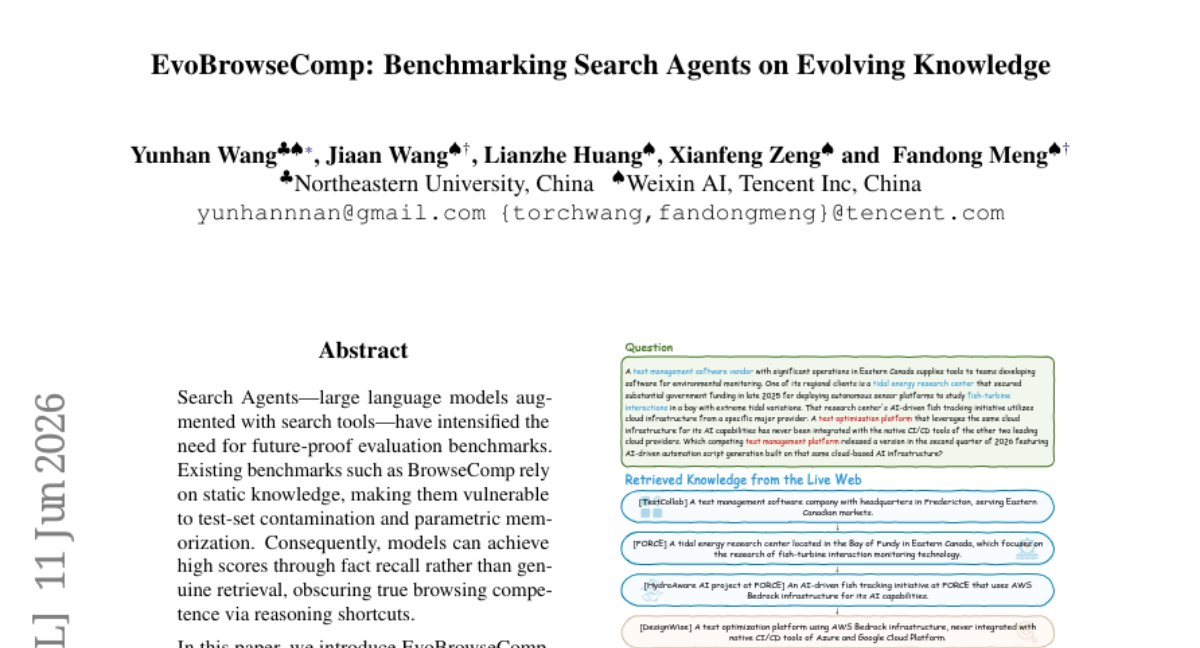
13. EvoBrowseComp: Benchmarking Search Agents on Evolving Knowledge
🔑 Keywords: EvoBrowseComp, contamination-free, temporal freshness, automated synthesis, reasoning graphs
💡 Category: Natural Language Processing
🌟 Research Objective:
- The paper introduces EvoBrowseComp, an evolving benchmark designed to provide contamination-free evaluation of search agents, maintaining temporal freshness and preventing parametric memorization.
🛠️ Research Methods:
- A collaborative framework involving three agents: a QA synthesis agent, an information filtering agent, and a high-level guidance agent generates complex questions via live-web traversal to ensure up-to-date content and block reasoning shortcuts.
💬 Research Conclusions:
- EvoBrowseComp demonstrates a high difficulty level, requiring broad horizontal search, and establishes a scalable paradigm for continuously updatable benchmarks aligned with evolving world knowledge and agent capabilities.
👉 Paper link: huggingface.co/papers/2606.1…
1
35
Jun 12
That's all for AI Native Today Paper Digest. Follow our account for the latest insights on AI Native, and join us at member.ainativefoundation.or…. If you found this helpful, a like or repost on the first tweet of this thread would be greatly appreciated!
24
Jun 12
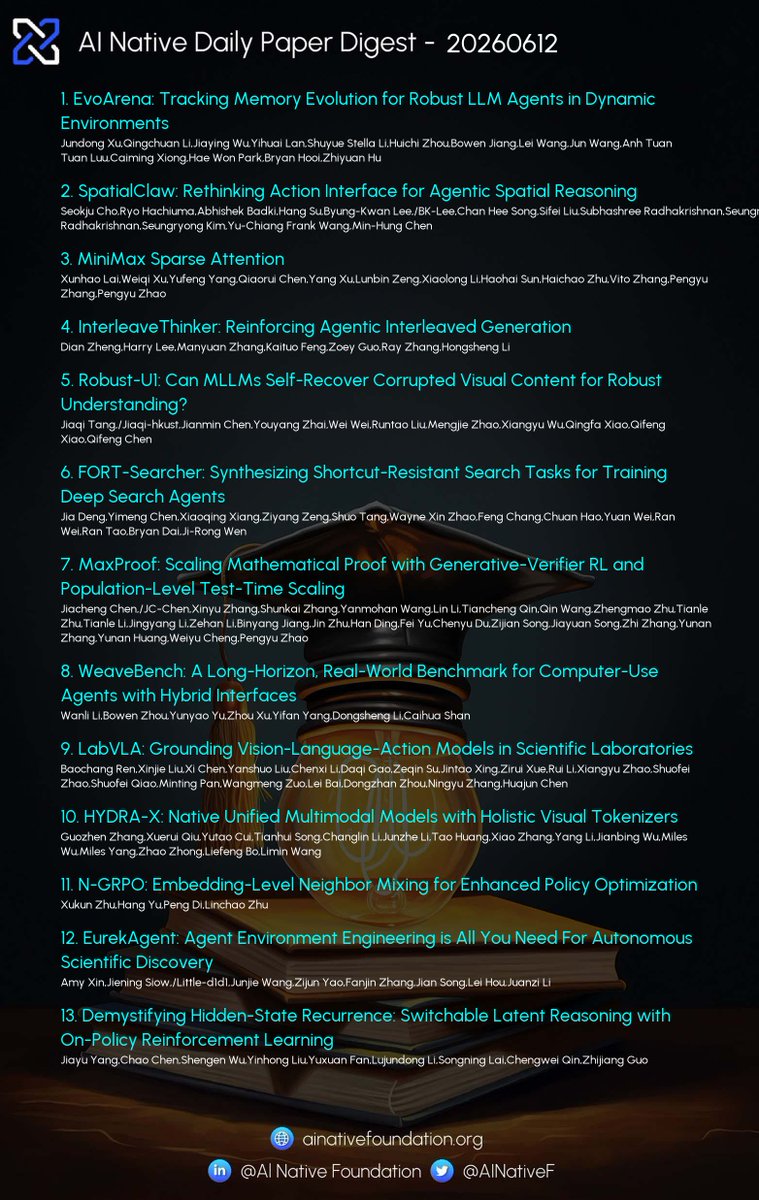
📚 AI Native Daily Paper Digest - 2026-06-12🌟
Follow @AINativeF for the latest insights on AI Native.
Covering AI research papers from Hugging Face, featured in the image.
💡 Stay updated with the latest research trends and dive deep into the future of AI! 🚀
#AI #HuggingFace #AIPaper #AINative #AINF
— Appendix: Today's AI research papers —
1. EvoArena: Tracking Memory Evolution for Robust LLM Agents in Dynamic Environments
2. MiniMax Sparse Attention
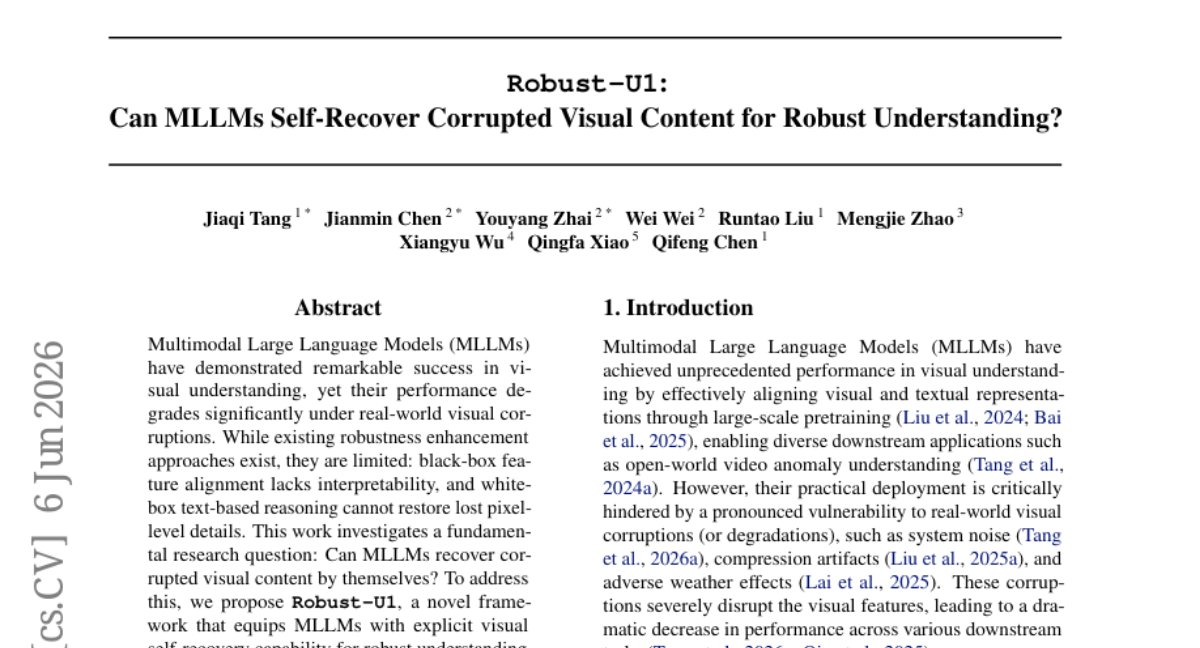
3. Robust-U1: Can MLLMs Self-Recover Corrupted Visual Content for Robust Understanding?
4. MaxProof: Scaling Mathematical Proof with Generative-Verifier RL and Population-Level Test-Time Scaling
5. LabVLA: Grounding Vision-Language-Action Models in Scientific Laboratories
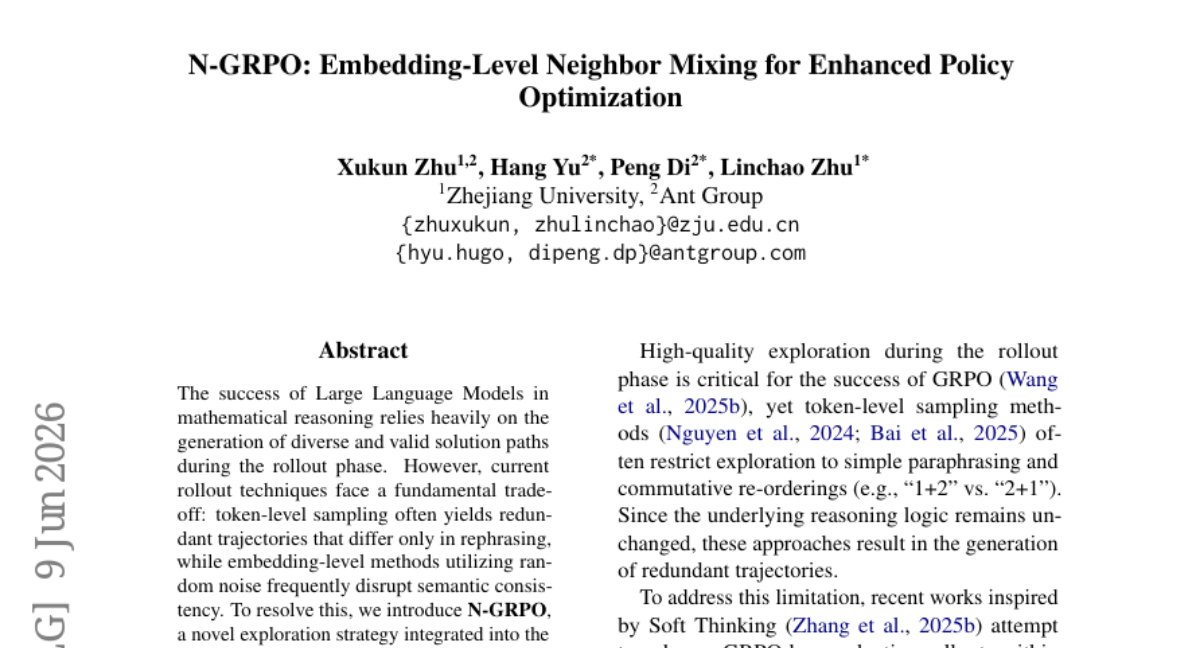
6. N-GRPO: Embedding-Level Neighbor Mixing for Enhanced Policy Optimization
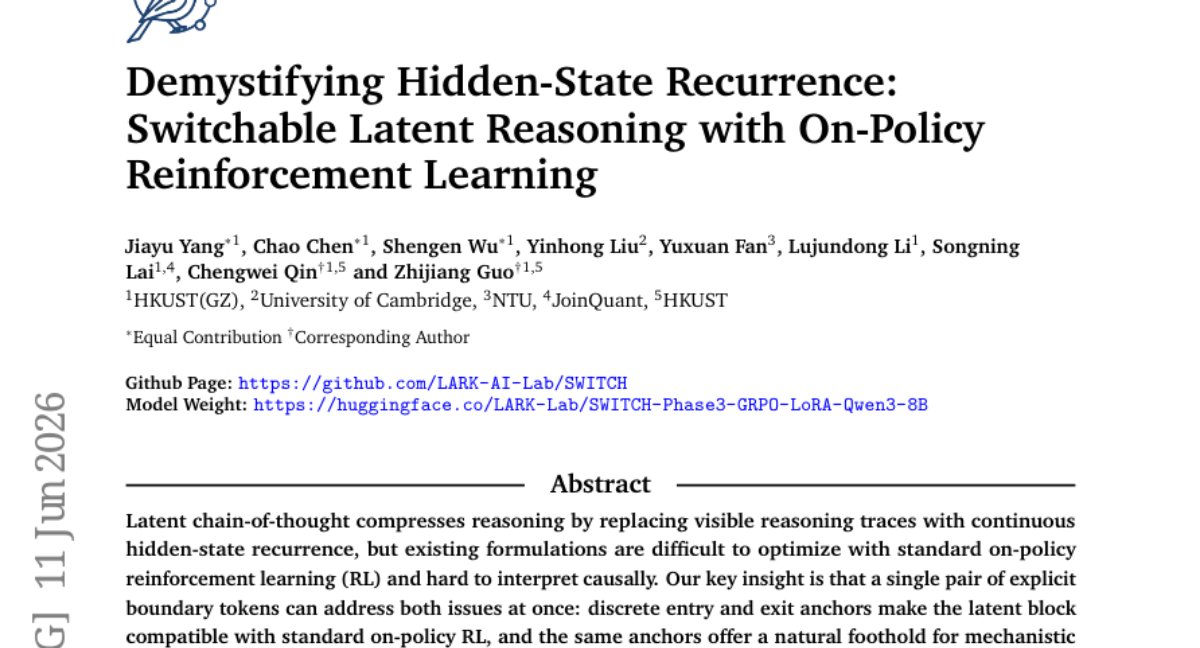
7. Demystifying Hidden-State Recurrence: Switchable Latent Reasoning with On-Policy Reinforcement Learning
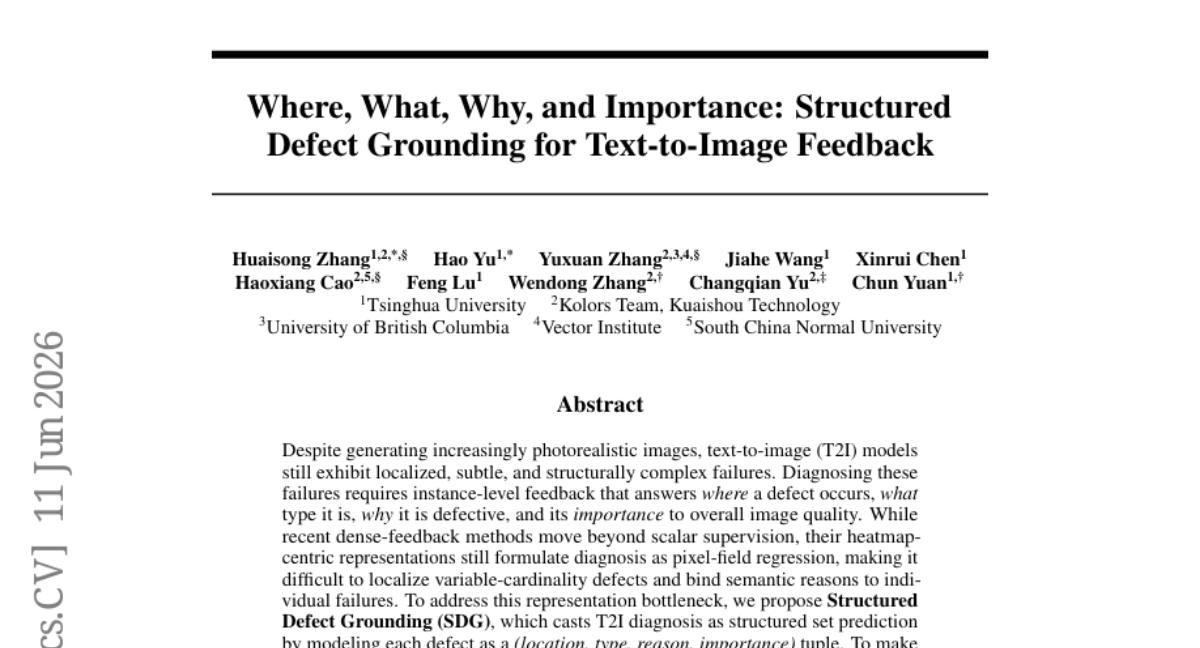
8. Where, What, Why, and Importance: Structured Defect Grounding for Text-to-Image Feedback
9. MoVerse: Real-Time Video World Modeling with Panoramic Gaussian Scaffold
10. TreeSeeker: Tree-Structured Trial, Error, and Return in Deep Search
11. Risk Under Pressure: Compute-Aware Evaluation of Adversarial Robustness in Language Models
12. SG-OPD: Sign-Gated On-Policy Distillation via Sign-Consistency Gating and Phased Teacher Sampling
13. EvoBrowseComp: Benchmarking Search Agents on Evolving Knowledge
1
129
Jun 12
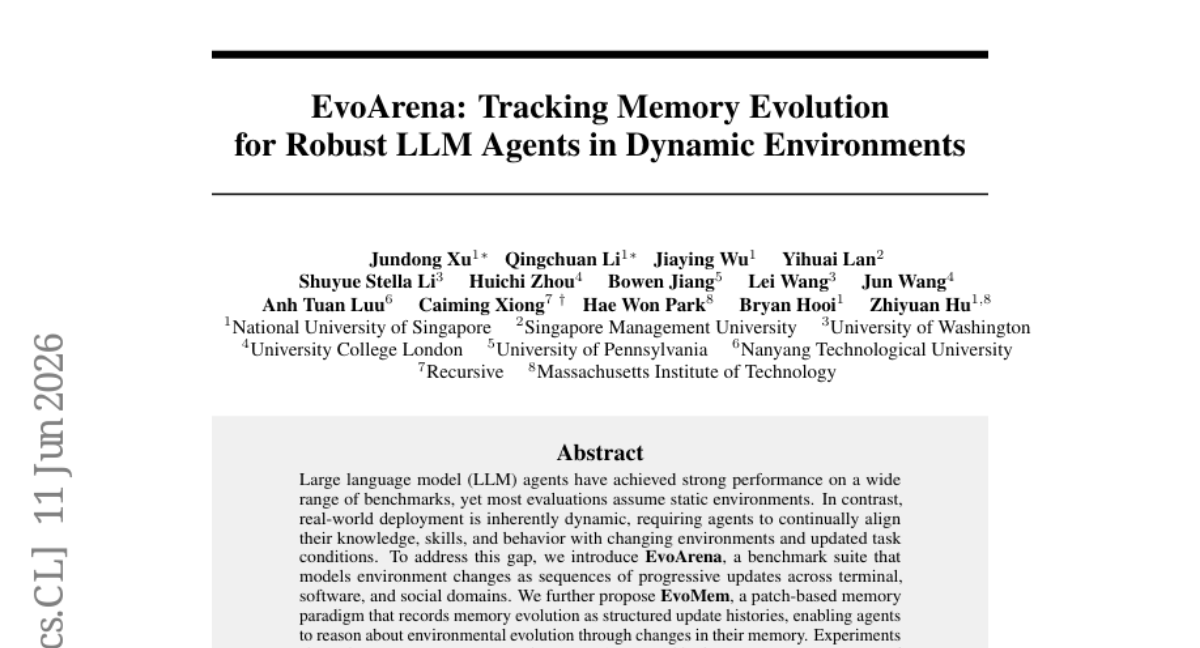
1. EvoArena: Tracking Memory Evolution for Robust LLM Agents in Dynamic Environments
🔑 Keywords: EvoArena, EvoMem, memory evolution, dynamic environments
💡 Category: Natural Language Processing
🌟 Research Objective:
- Address the challenge of dynamic environments in Large Language Model (LLM) agents through the development of EvoArena and EvoMem.
🛠️ Research Methods:
- Introduce EvoArena, a benchmark suite modeling environment changes to evaluate LLM agents' performance in dynamic settings.
- Propose EvoMem, a memory paradigm that uses structured update histories for agents to reason about environmental evolution.
💬 Research Conclusions:
- EvoMem enhances agent performance on EvoArena and other standard benchmarks, improving chain-level accuracy and memory evidence capture.
- The findings underscore the necessity of modeling evolution in both evaluation and memory for effective agent deployment.
👉 Paper link: huggingface.co/papers/2606.1…
1
1
62
Jun 12
0. Xiaomi releases and open-sources MiMo Code V0.1.0, an AI programming assistant with persistent memory system
1. MNN inference engine adds Arm SME2 support achieving 80% speedup for Qwen3-VL on-device deployment
2. Tencent Hunyuan open-sources HPC-Ops inference operator library with major system-level upgrade
1
1
90
Jun 12
MNN inference engine adds Arm SME2 support achieving 80% speedup for Qwen3-VL on-device deployment
Alibaba's MNN inference engine has integrated support for Arm's second-generation Scalable Matrix Extension (SME2) instruction set, enabling significant performance improvements for on-device AI model deployment. Testing with the Qwen3-VL-4B-Instruct multimodal model on SME2-enabled flagship devices like vivo X300 showed an 81% speedup in the prefill stage and 13% improvement in the decode stage compared to non-SME2 implementations. The integration uses a compile-time switch with runtime hardware detection, automatically selecting the optimal acceleration path without requiring manual configuration. MNN has released complete deployment tools including model conversion, quantization, and Android app integration capabilities for developers.
Read more: mp.weixin.qq.com/s/QNl4pn5Jz…
🎥 Credit: The original article
1
43
Jun 11
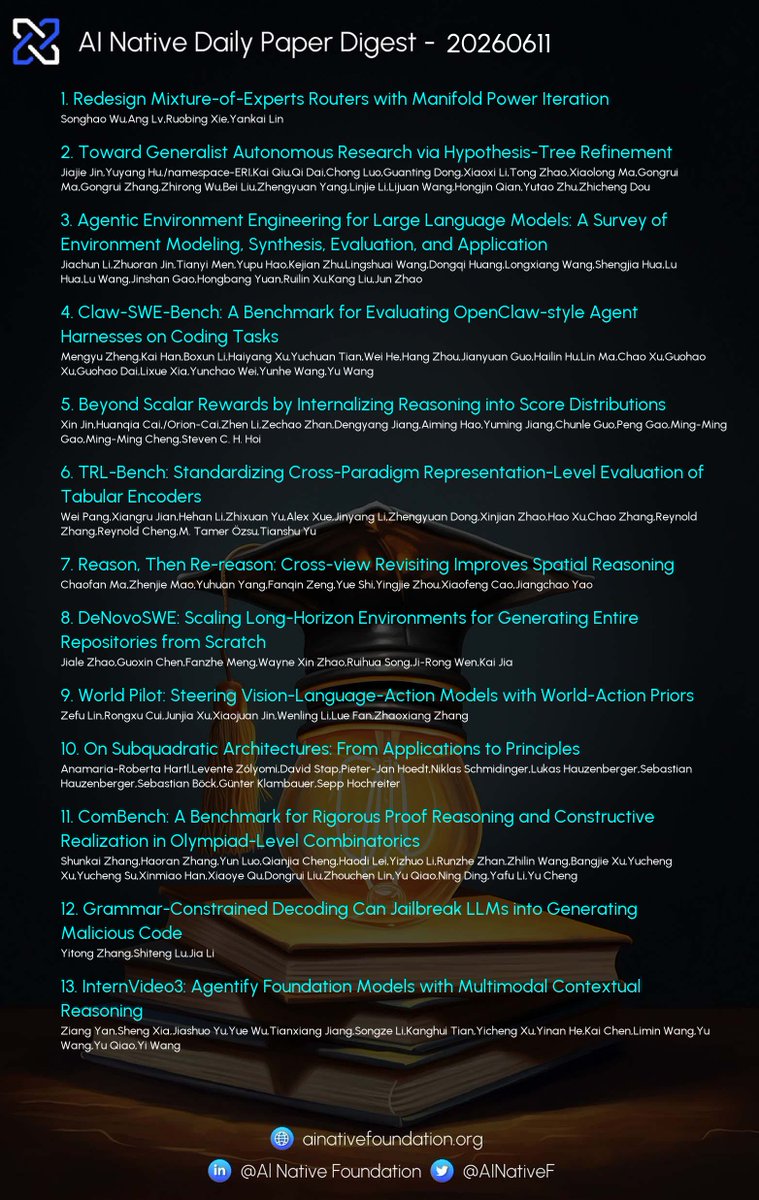
📚 AI Native Daily Paper Digest - 2026-06-11🌟
Follow @AINativeF for the latest insights on AI Native.
Covering AI research papers from Hugging Face, featured in the image.
💡 Stay updated with the latest research trends and dive deep into the future of AI! 🚀
#AI #HuggingFace #AIPaper #AINative #AINF
— Appendix: Today's AI research papers —
1. Redesign Mixture-of-Experts Routers with Manifold Power Iteration
2. Agentic Environment Engineering for Large Language Models: A Survey of Environment Modeling, Synthesis, Evaluation, and Application
3. Beyond Scalar Rewards by Internalizing Reasoning into Score Distributions
4. Reason, Then Re-reason: Cross-view Revisiting Improves Spatial Reasoning
5. World Pilot: Steering Vision-Language-Action Models with World-Action Priors
6. ComBench: A Benchmark for Rigorous Proof Reasoning and Constructive Realization in Olympiad-Level Combinatorics
7. InternVideo3: Agentify Foundation Models with Multimodal Contextual Reasoning
8. TRACE: A Unified Rollout Budget Allocation Framework for Efficient Agentic Reinforcement Learning
9. ICA Lens: Interpreting Language Models Without Training Another Dictionary
10. Embodied-R1.5: Evolving Physical Intelligence via Embodied Foundation Models
11. World Model Self-Distillation: Training World Models to Solve General Tasks
12. ReVision: Scaling Computer-Use Agents via Temporal Visual Redundancy Reduction
13. i1: A Simple and Fully Open Recipe for Strong Text-to-Image Models
1
1
1
220
Jun 11
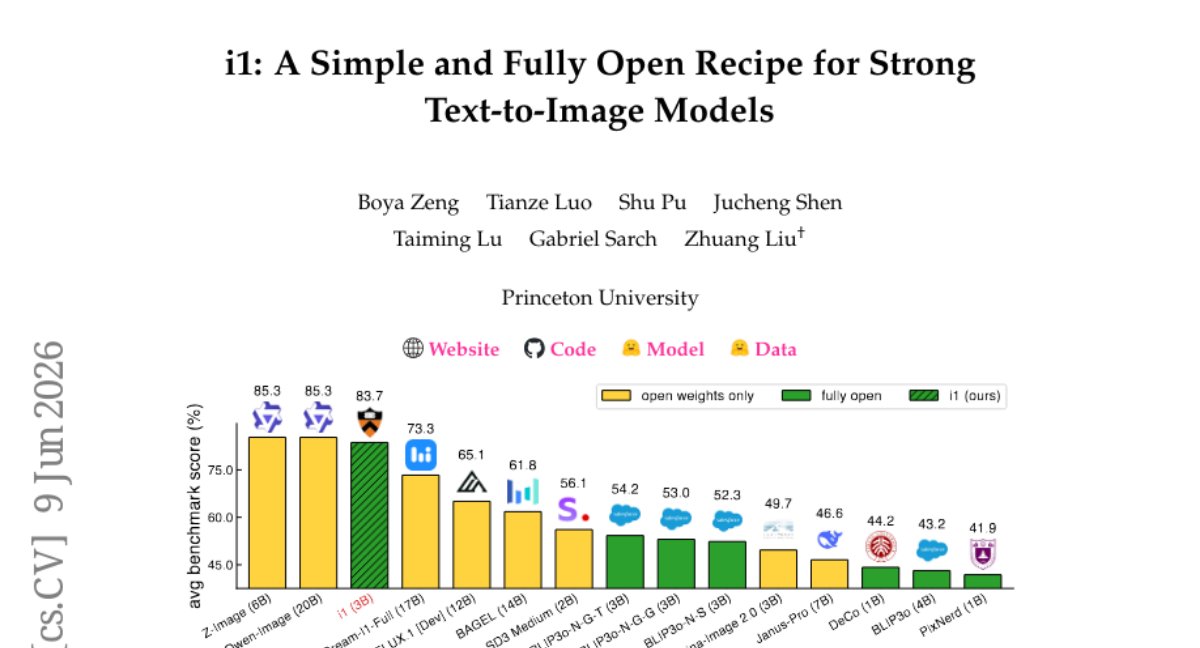
13. i1: A Simple and Fully Open Recipe for Strong Text-to-Image Models
🔑 Keywords: text-to-image diffusion, diffusion models, open models, i1 model
💡 Category: Generative Models
🌟 Research Objective:
- This study aims to investigate the design choices in text-to-image diffusion models and develop i1, a new 3B-parameter model that maintains transparency and matches leading performance.
🛠️ Research Methods:
- Conducted over 300 controlled experiments consuming 700K TPU v6e hours to analyze and identify effective modeling and data design choices for text-to-image diffusion models.
💬 Research Conclusions:
- The i1 model is created utilizing publicly available datasets and achieves competitive results across five representative benchmarks, outperforming existing fully open models by an average of 29.5 percentage points. The study offers the i1 model checkpoints, training and inference code, and a data processing pipeline to facilitate open research.
👉 Paper link: huggingface.co/papers/2606.1…
1
52
Jun 11
That's all for AI Native Today Paper Digest. Follow our account for the latest insights on AI Native, and join us at member.ainativefoundation.or…. If you found this helpful, a like or repost on the first tweet of this thread would be greatly appreciated!
34