
Lawyer | @FedSoc | Fmr. Cato | Dedicated to advancing the rule of law and a legal culture grounded in principle rather than power | Opinions my own
Joined March 2024
- Tweets 148
- Following 251
- Followers 121
- Likes 4,555
16 Photos and videos




May 29
I am thrilled to announce that I have joined @FedSoc’s team as its Practice Groups Fellow. I fell in love with FedSoc long before law school. It’s hard to think of an organization that has had a greater impact promoting fidelity to the Constitution and the rule of law. It’s an honor to now have the opportunity to contribute to its mission.
4
2
26
4,990
May 21
Cato has filed an amicus brief at the U.S. Supreme Court in Khatibi v. Lawson. We urge the Court to grant cert and reaffirm that the government-speech doctrine is not a tool to compel private speech.
supremecourt.gov/DocketPDF/2…
1
110
Alex Xenos retweeted

Apr 21
Congress imposed strict limits on refrigerant production but let the EPA decide who gets to produce—handing an agency a power that belongs to Congress. SCOTUS should revive nondelegation and make Congress own the hard choices, argue Cato’s Thomas A. Berry, Brent Skorup, and Alexander Xenos.
Learn more: ow.ly/v8LE50YNyaO
1
6
11
1,777
Alex Xenos retweeted

Apr 21
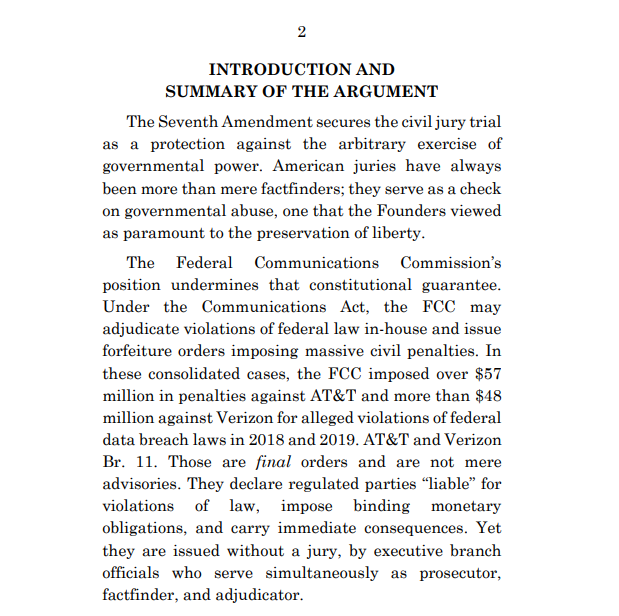
Today the Supreme Court will hear arguments in FCC v. AT&T, a challenge to federal agencies' authority to impose final orders and civil penalties ($100M here) without a jury trial. Cato filed an amicus brief in the case defending the right to a jury:
cato.org/legal-briefs/fcc-v-…
Apr 21

US Supreme Court to assess FCC power to fine in clash with wireless carriers reuters.com/sustainability/b…
1
5
10
1,423
Alex Xenos retweeted

Apr 21
You can read the full @CatoInstitute brief by @bskorup, @AMXenos, and me on the right to a jury trial in the Supreme Court case FCC v. AT&T here:
cato.org/sites/cato.org/file…
2
3
421
Alex Xenos retweeted
Apr 21
This morning the Supreme Court will hear arguments in consolidated cases challenging the @FCC's authority to impose massive civil penalties without a jury trial. After an administrative proceeding in front of an agency judge and without a jury, FCC issued final forfeiture orders against @ATT and @Verizon, finding them liable for alleged violations of federal data-protection rules and assessing penalties totaling more than $100 million combined.
Although these cases are about the FCC, the stakes extend far beyond telecommunications policy. If the FCC wins, it would allow agencies across the federal government to impose binding judgments first and offer a jury trial only later, if the government chooses to pursue collection. That reverses the constitutional order.
The Seventh Amendment protects the right to a civil jury trial in “suits at common law.” As the Supreme Court recently reaffirmed in SEC v. Jarkesy, government actions seeking civil penalties are historically analogous to common-law actions in debt—cases that were tried before juries. The jury is not merely a procedural formality. It is a structural protection against arbitrary government power, ensuring that ordinary citizens stand between the state and the imposition of punishment, whether that punishment is criminal or civil in nature.
Yet under the Communications Act, the FCC investigates alleged violations, makes factual findings, determines liability, and imposes binding monetary penalties all in-house, without a jury. These forfeiture orders are not advisory. They declare companies “liable,” create a debt to the United States, and carry immediate consequences, including reputational harm and future regulatory exposure.
That is why @CatoInstitute has filed an amicus brief supporting the carriers in the case, co-authored by @bskorup and @AMXenos, in which we argue that the FCC’s forfeiture scheme violates the Seventh Amendment right to a jury.
In response, the government argues that the statute offers a supposed escape hatch: a company can refuse to pay and wait for the Department of Justice to bring a collection action in federal court, where a jury trial would be available. But as we explain in our brief, that “choice” is illusory. To preserve even the possibility of a jury trial, a company must openly defy a final agency order, risk additional regulatory retaliation, and endure years of uncertainty. Unsurprisingly, it appears no company has ever taken that option. Companies instead pay and seek review in a court of appeals—where no jury is available and where factual review is deferential to the agency.
Our brief makes another, structural point. The government cannot have it both ways on the statute of limitations. To preserve penalties under the five-year statutory limit, the government treats the FCC’s forfeiture proceeding as “enforcement.” But when faced with the Seventh Amendment, it claims the same proceeding is merely “initial.” A process that is final enough to preserve penalty claims cannot simultaneously be too preliminary to trigger the jury right.
We urge the Court to adopt a straightforward rule: when an agency proceeding culminates in final agency action and is treated as enforcement sufficient to preserve civil penalties, it constitutes the adjudication of a legal claim for money. In such cases, the Seventh Amendment requires a jury before liability is conclusively determined. A later, optional enforcement suit cannot retroactively cure a Seventh Amendment violation. At the Founding, the jury’s role was antecedent—not remedial. Because the carriers’ liability was determined before they had access to a jury, the Supreme Court should rule that their Seventh Amendment rights were violated.
1
8
24
28,717
Apr 17
In our latest Supreme Court amicus brief, filed in RMS v. EPA, we emphasize the importance of the non-delegation doctrine to the Constitution’s separation of powers.
cato.org/legal-briefs/rms-ge…
2
1
204
Apr 13
Looking Back at Atlas Shrugged: A Great Novel, a Sharp Critique, and One Costly Flaw
open.substack.com/pub/alexxe…
41
Apr 10
In January, I coauthored Cato’s amicus brief in Relentless v. U.S. Dept. of Commerce at the First Circuit. We argued that if an agency claims the power to compel private parties to fund a regulatory program, Congress must clearly authorize that power. The power of the purse belongs to Congress, not administrative agencies. Agencies cannot, by implication, finance their own regulatory ambitions.
cato.org/legal-briefs/relent…
2
1
164
Mar 25
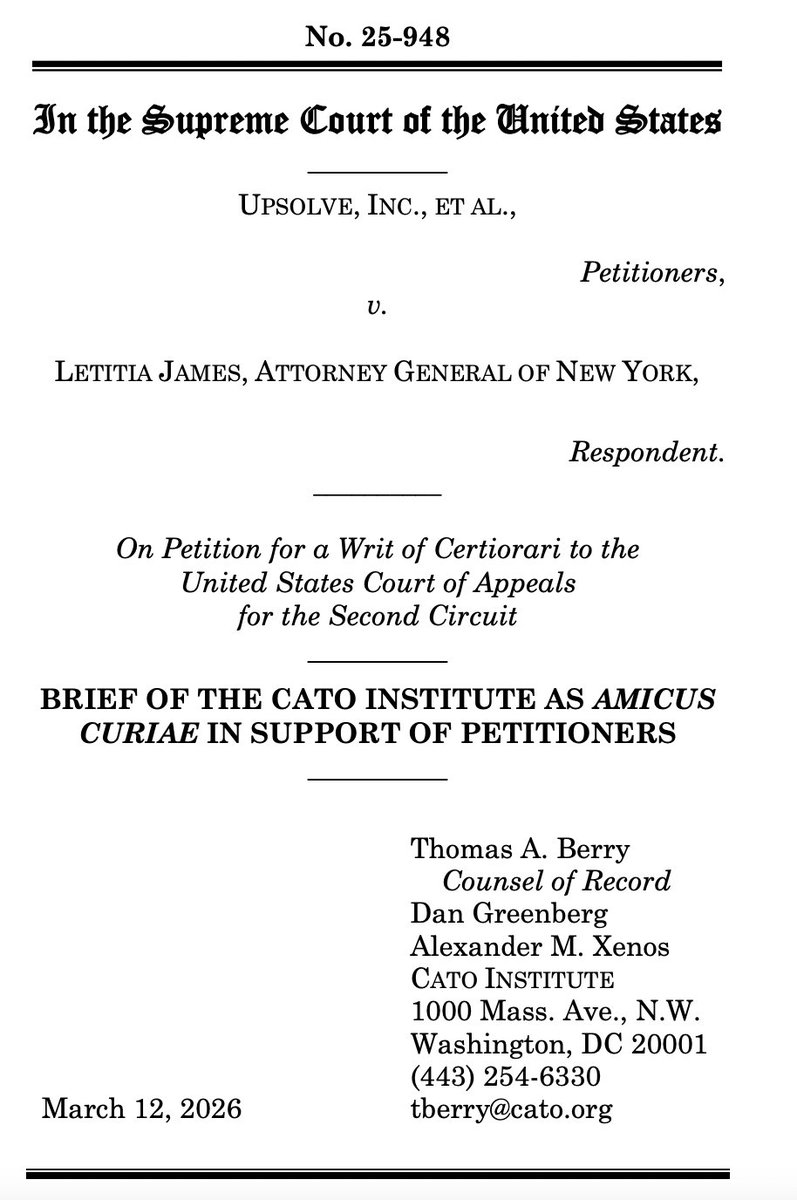
Earlier this month, the Cato Institute filed an amicus brief supporting the cert petition in Upsolve v. James.
Our brief argues that New York’s application of its unauthorized-practice-of-law statute is a content-based restriction on speech. The government cannot escape strict scrutiny by saying it is regulating the speech’s “purpose” rather than its content.
cato.org/legal-briefs/upsolv…
1
48
Mar 25
This case, in short, rests on straightforward First Amendment doctrine: When a law prohibits speech based on the topic or message expressed, that is a content-based restriction subject to strict scrutiny. Cato asks the Court to grant review and make clear that speech does not lose First Amendment protection merely because it concerns professional advice.
29
Alex Xenos retweeted
Mar 19
You can read the full @CatoInstitute brief in Upsolve v. James here, co-authored with my colleagues Dan Greenberg and Alex Xenos.
cato.org/sites/cato.org/file…
2
2
4
225
Alex Xenos retweeted
Mar 19
Like all states, New York prohibits the unauthorized practice of law (UPL). But New York’s overzealous application of its UPL laws could squelch an innovative nonprofit and thereby make the crisis of access to legal aid even worse. Now the Supreme Court has a chance to hear an important First Amendment challenge that would vindicate the right to give basic legal advice and provide crucial relief in access to justice.
In consumer debt actions, New York allows defendants sued for alleged unpaid debts to use a one-page, state-created answer form that streamlines responses through a series of checkboxes. The nonprofit group Upsolve seeks to train nonlawyer volunteers to help low-income individuals complete these forms at no cost. Those volunteers would neither represent anyone in court nor draft legal filings. They want to speak only to provide basic advice on how to fill out the form. Yet New York’s UPL regime criminalizes this speech because it constitutes individualized legal advice, transforming a conversation into a crime based solely on its content.
New York’s UPL laws operate entirely on the basis of speech content. If Upsolve and its volunteers advise someone about financial strategies for managing debt, that’s lawful; if they advise someone about the legal implications of debt or alleged debt, that’s a crime. The district court held that this content-based speech restriction triggers “strict scrutiny,” the most skeptical form of judicial review. And the district court blocked enforcement of New York’s UPL laws against Upsolve, holding that the laws’ justifications in this context did not satisfy strict scrutiny. But the Second Circuit reversed, holding that only “intermediate scrutiny” should apply because the UPL laws regulate on the basis of the “purpose, focus, and circumstance” of the speech rather than its content.
Now, Upsolve has asked the Supreme Court to take its case, and Cato has filed an amicus brief in support of that petition.
Our brief makes four key points. First, we explain that New York’s restriction is content-based under established precedent. The Ninth Circuit erred in holding that UPL laws are content-neutral because they focus on the “purpose, focus, and circumstance” of speech. That reasoning creates a distinction without a difference: it would allow states to suppress speech on any topic subject to occupational licensing. The US Supreme Court rejected that approach in a prior opinion, National Institute of Family and Life Advocates v. Becerra (2018), explaining that speech does not receive less constitutional protection merely because it is spoken by a professional or concerns a regulated field. The Second Circuit’s rule threatens First Amendment protections far beyond the legal profession. Any licensed profession could invoke the same framework to suppress disfavored speech while claiming to regulate conduct. But there is no licensing shield against First Amendment scrutiny.
Second, we present the public-choice context that makes this case important. Restrictions on the unauthorized practice of law were historically championed by incumbent lawyers seeking to limit competition. This case exemplifies how occupational licensing can serve as a device for rent-seeking rather than for consumer protection. Third, we document the access-to-justice crisis these restrictions produce. Millions of Americans face civil legal problems without any professional help, and programs like Upsolve’s are precisely the kind of innovation that such categorical prohibitions suppress. The debt-collection crisis in New York City demonstrates that the city is particularly in need of Upsolve’s services.
This case, in short, rests on straightforward First Amendment doctrine: When a law prohibits speech based on the topic or message expressed, that is a content-based restriction subject to strict scrutiny. The government cannot evade the strict scrutiny this restriction requires by characterizing that restriction as targeting the speech’s “purpose” or “function.”
The Supreme Court should grant review and make clear that speech does not lose First Amendment protection merely because it concerns professional advice.
4
17
32
3,948
Mar 18
Recently, the Cato Institute filed an amicus brief in FCC v. AT&T at the U.S. Supreme Court. We argue that the FCC's forfeiture scheme violates the Seventh Amendment.
The jury is not a mere procedural formality. It is a structural safeguard against arbitrary government power, ensuring that ordinary citizens stand between the state and the imposition of punishment.
The Seventh Amendment is violated the moment the federal government conclusively determines legal liability without a jury. A later, optional enforcement suit cannot retroactively cure that violation. At the Founding, the jury’s role was antecedent, not remedial.
cato.org/legal-briefs/fcc-v-…
1
3
7
383
Mar 1
My latest, published in DC Journal and syndicated via InsideSources.
Politically charged language from the judiciary undermines its credibility. When a president acts lawlessly, and they often do, rule accordingly. But don’t give us an op-ed with it.
dcjournal.com/judges-should-…
1
1
462
Alex Xenos retweeted

Feb 23
Judges Should Leave the Political Rhetoric to Pundits. "When the Trump administration acts lawlessly, and it often does, rule accordingly. Don’t give us an op-ed with it."
dcjournal.com/judges-should-…
1
1
106
18 Dec 2025
Great piece by @mfcannon in @NationalAffairs - Advocates for single-payer often trash the ‘free-market’ American health-care system. But it’s not a free market—gov’t dominates 84% of spending & inflates costs via regs & price controls.
nationalaffairs.com/publicat…
1
2
13
1,031
Alex Xenos retweeted
8 Dec 2025
You can read our @CatoInstitute brief by @bskorup, Alex Xenos, and me urging the Court to overrule Humphrey's Executor and strike down the removal restrictions here:
cato.org/legal-briefs/trump-…
2
5
987
9 Dec 2025
Excellent post @VolokhC by Prof. @IlyaSomin, which references our amicus brief.
reason.com/volokh/2025/12/04…
3
3
802
Alex Xenos retweeted

4 Dec 2025
In this post, I urge the Supreme Court to hear case of Canna Provisions v. Bondi, and use this opportunity to reverse its awful decision in Gonzales v. Raich (which egregiously expanded federal power, and authorized awful War on Drugs abuses): reason.com/volokh/2025/12/04…
8
18
86
11,796