Alan Moses Computational Biology Lab at @UofT
Joined August 2017
- Tweets 9
- Following 13
- Followers 97
- Likes 1
Photos and videos
Moses Lab retweeted

I'm excited to share our new preprint "Vermeer: Autoregressive generative modeling of microscopy predicts protein localization," a collaboration between @MSFTResearch and @insitubiology!
Preprint: biorxiv.org/content/10.64898…
Protein localization is fundamental to protein function, but experimental imaging, a key technique to study localization, cannot scale to the entire human proteome across all biological contexts.
To address this challenge, we introduce Vermeer, an autoregressive generative model trained on Human Protein Atlas data @ProteinAtlas. Vermeer synthesizes fluorescence microscopy images of proteins conditioned on cell morphology reference stains and protein sequence embeddings (ESM-C).
Vermeer can leverage latent information about protein localization in the ESM embeddings to generalize to proteins the model has never seen during training. (1/n)
2
17
65
19,445
Moses Lab retweeted

Apr 17
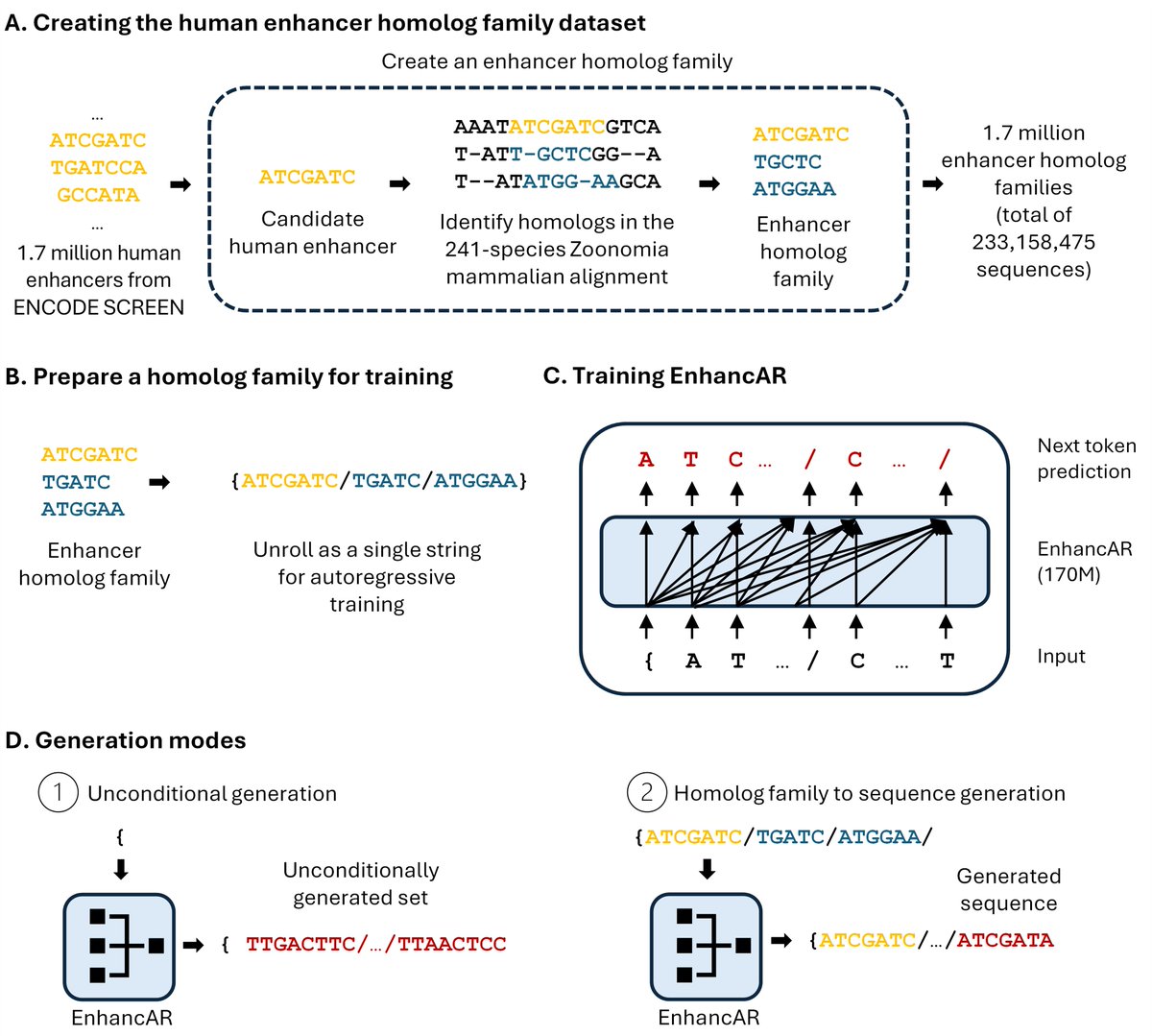
Designing enhancers is key for gene therapy but limited by a lack of experimental data. To overcome this, we developed EnhancAR, a generative model trained on 1.7M enhancer homolog families (~230M sequences) to leverage functional information conserved over evolution.
3
25
117
22,258
Moses Lab retweeted

Feb 5
Announcing our preprint: Predicting evolutionary rate as a pretraining task improves genome language model representations: biorxiv.org/content/10.64898…
Genome language models (gLMs) have the potential to further understanding of regulatory genomics without requiring labeled data...
4
24
85
26,804
Moses Lab retweeted

26 Apr 2024
Very happy to share what I've been working on in Barcelona with @BenLehner ! We made many (>400k) mutations in a disordered peptide and the globular domain it interacts with to gain a comprehensive map of how specificity is encoded in a partially fuzzy protein interaction (1/n)
26 Apr 2024

Excited to share @taraneh_z's preprint: A complete map of specificity encoding for a partially fuzzy protein interaction biorxiv.org/content/10.1101/…
1
17
47
9,001
Moses Lab retweeted

17 Mar 2024
Looks interesting:
"A Functional Map of the Human Intrinsically Disordered Proteome" 🍝 by @IPritisanac, @ReidAlderson, @KolaricJess, ..., @JulieFormanKay1, @AMosesLab
doi.org/10.1101/2024.03.15.5…
18
74
7,858

Do current genomic language models (pre-trained on whole genomes) learn a foundational understanding of biology in the non-coding region of human genomes?
A new evaluation led by @AmberZqt suggests not yet!
1/N
paper: biorxiv.org/content/10.1101/…
9
58
237
50,665
Moses Lab retweeted

21 Jan 2024
Really like the idea from this paper -- biorxiv.org/content/10.1101/…
Also, I like the accuracy of the study, e.g authors compare model trained with their procedure (train on augmented data finetune on real) not only with baseline model (train on real) but on finetuned baseline model
1
6
25
6,200

8 Sep 2017
Hi Twitter! This is mostly an automated bot that will publish content directly from our website and blog.