Approved People Network unites people in an ecosystem where collective trust forms the basis for every member’s success and opportunities in all life areas
Joined February 2025
- Tweets 199
- Following 2
- Followers 404
- Likes 2,552
125 Photos and videos



Pinned Tweet

We live in an internet that no longer belongs to us. It is time to fix this.
Let us be honest: this morning you woke up, picked up your phone, and most likely opened social networks. Not because you really wanted to, but because you had to check messages, reply to your boss, find out what friends are talking about. This is the norm of the new reality. The internet is no longer over there, it is everywhere: at work, in relationships, in politics, in our mood.
In the past, social networks were created as platforms for live communication. A place where you could find like-minded people anywhere in the world and say something of your own. But now? Now they are huge corporate machines.
Have you ever noticed that after talking about hiking in the mountains, you suddenly start seeing ads for tents? Or that a post with your opinion gets ten views, while some random nonsense gets a thousand? That is the work of algorithms: they decide what you see, what you think about, and who you befriend. And you in this system are not the author or the owner. You are a resource. Your time, your data, your clicks are a commodity that platforms sell to advertisers.
We have gotten used to it. But inside, an unpleasant question grows: can it be different?
INTRODUCING APN – A NETWORK WHERE THE OWNER IS NOT A CORPORATION BUT THE PEOPLE.
APN is not just another Facebook killer with a pretty design. It is an attempt to build a digital society from scratch, on different rules. Rules where you are not just a user but a participant.
Here is how it works in practice, without abstractions.
The algorithm serves you, not the advertiser. In APN, you set what you see. No hidden engagement boosting through scandals and anger. If you want to see only cat photos and posts from friends, that is what you will get.
Your time is your time. The network does not try to keep you at any cost. There is no endless feed or auto playing shock content. We advocate conscious use, not digital addiction.
You own your content and data. In APN, your profile, your posts, and your conversations do not belong to the company. They are your digital property. No one will sell your interests to an insurance or credit company without your explicit consent.
You receive a share of what you create. The platform generates income, and you get a part. This is not charity, it is a participation economy: the more valuable ideas and moderation work you contribute, the larger your stake in the network's development.
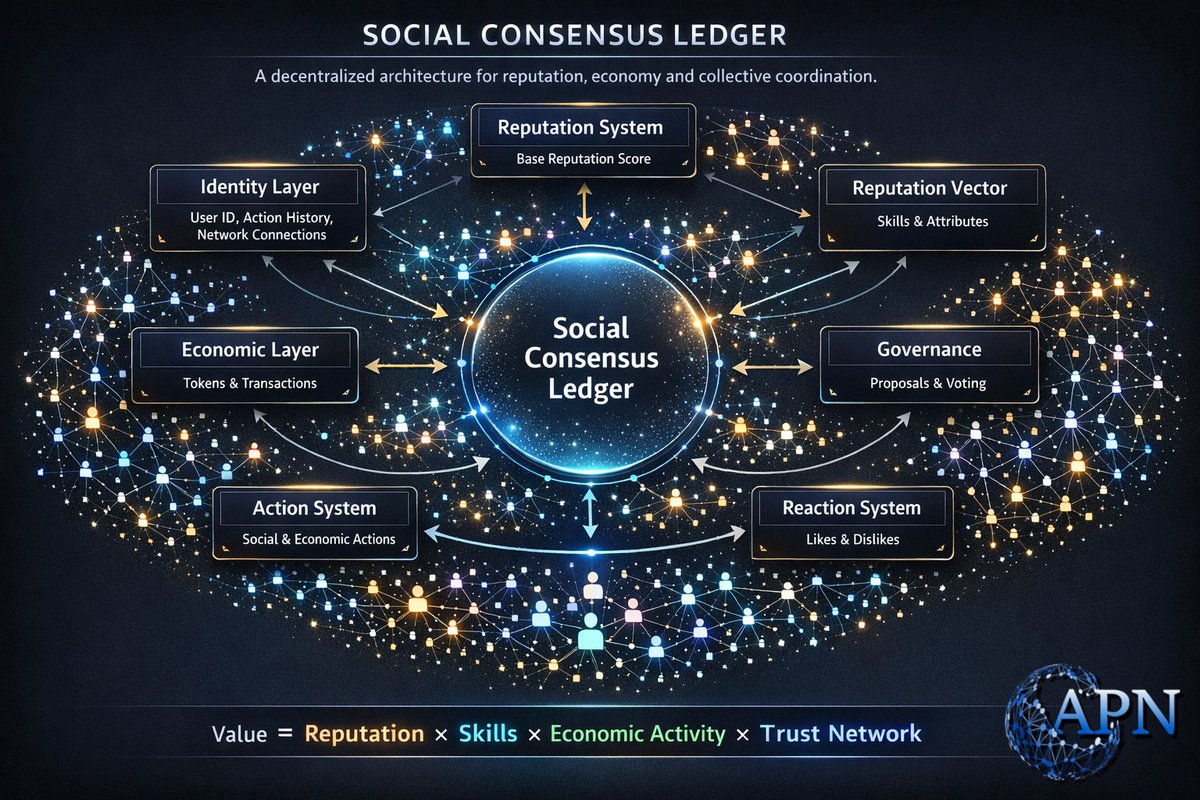
WHAT IS SCL (SOCIAL CONSENSUS LEDGER) AND WHY DO YOU NEED IT?
It sounds complicated, but in reality it is honest digital accounting. Imagine that all actions in the network – your contributions such as likes, quality comments, helping newcomers, creating interesting topics – are recorded in a transparent, shared ledger. It cannot be faked, deleted, or altered in anyone's favor.
This ledger, SCL, is our replacement for soulless likes and hidden rankings.
For the individual, it means transparent reputation. You see who is truly useful to the community and who is just making noise.
For the community, it is a tool for collective governance. Important decisions, such as changing rules or allocating resources for new features, are made not by the platform owners but by active participants. You vote, and your vote carries weight confirmed by your history in the SCL.
WHAT IS APN REALLY ABOUT?
We are not building another ideal social network. We are building infrastructure for a normal human life in the digital space.
Where your child will not see narratives fueled by ads for anxiety pills.
Where your business does not collapse because the algorithm suddenly decided to hide your page.
Where you can calmly discuss important matters with a neighbor across the city without fear that your correspondence will become a commodity.
We are not against technology. We are against technology controlling us.
APN is an attempt to return the internet its soul: live, direct, and respectful human communication. Without a gray cardinal algorithm behind your back.
Join us if you feel the same. Let us create a space where the main value is you, not your clicks.
#APN #SCL #APNP
11
7
16
1,059
Cryptocurrencies are not about "making money on price increases." They are about something much deeper that most people still don't notice.
Today, the market is seen as a game: buy low, sell high, catch the movement. And there's nothing surprising about that-any new technology goes through a phase of speculation first. But if you pause and look a little deeper, you begin to see what is really happening.
For the first time in history, people have a tool that allows them to build economic relationships without a central authority. Without intermediaries. Without a single point of control.
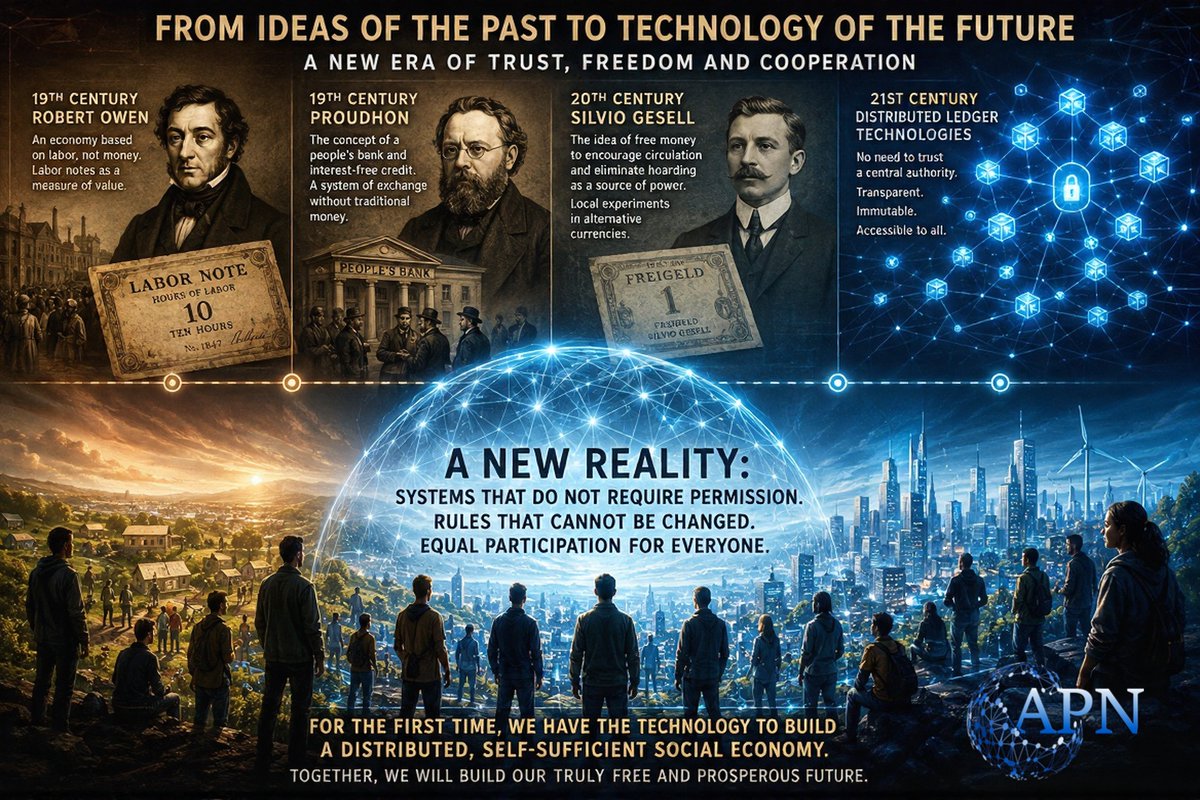
The idea of such systems is not new. For example, in the 19th century, Robert Owen attempted to create an economy based on labor rather than money. In his projects, people exchanged goods through so-called "labor notes," where value was determined by the amount of time spent. It seemed like a fair alternative, but ultimately it ran into the complexity of accounting and the need for a central entity to record and verify those values.
Later, Pierre-Joseph Proudhon proposed the concept of a "people's bank," which would issue interest-free credit and create a system of exchange without traditional money. The idea was powerful, but the same question arose again-who manages the system, and how is honest accounting guaranteed?
In the 20th century, Silvio Gesell promoted the concept of "free money," where currency would lose value over time to encourage circulation and eliminate hoarding as a source of power. Experiments with such currencies were indeed carried out, but they remained local and dependent on centralized control.
All of these attempts were groundbreaking in their own way, but each encountered the same fundamental problem-trust and accounting. There always had to be someone maintaining the system. And that meant there was always a point of pressure and vulnerability.
With the emergence of distributed ledger technologies, the situation has changed for the first time. Accounting no longer requires trust in a specific participant. It becomes part of the system itself-transparent, immutable, and equally accessible to everyone.
At that moment, cryptocurrencies stop being just "digital money." They become the foundation for entirely new forms of interaction between people. Systems where the rules are predefined and cannot be changed in someone's favor. Systems where participation does not require permission.
We are now at a strange point. The technology already exists, but understanding of its essence is still forming. That is why most people continue to use it as a tool for short-term gain, not realizing that what stands before them is a foundation for new systems.
But it is precisely at moments like this that real opportunities emerge.
The question is no longer how much a particular token costs. The question is what kind of reality can be built if the need to trust a central authority is removed, leaving only rules that are the same for everyone.
And perhaps, for the first time, people truly have a chance to make this not just a theory-but a reality.
For the first time in history, the Approved People Network is creating a working model of a distributed, self-contained social economy. Together with you, we will build our truly free and prosperous future.
#APN #SCL #APNP
5
5
14
257
APN VISION WEEK has come to an end.
Thank you to all contest participants for your time and for your vision of the future of the Approved People Network!
Now the floor belongs to the community -the winners will be determined by a poll. Choose the best entries based on content and creativity.
1) Wiz builder (@whiskmetax)
Participant's work - x.com/whiskmetax/status/2063…
2) Yoodee™ (@UdodilimC)
Participant's work - x.com/UdodilimC/status/20636…
3) May0r (@W0rldMay0r)
Participant's work - x.com/W0rldMay0r/status/2063…
Cast your vote for the best participant!
4) Dave (@_Davee01)
Participant's work -
x.com/_Davee01/status/206367…

144
6
111
936
Approved People Network retweeted
APN VISION WEEK WILL BE LIVE SOON
For the next 7 days, we’re inviting creators, editors, AI artists, and the community to showcase the future of APN.
Create: 🎥 Videos
AI edits
Motion graphics
Cinematic concepts
Explainer content
Using the official APN material below as your foundation:
x.com/i/status/2053129375554…�
Your mission: Show people what APN is building and what’s coming in the next few months.
You can create: • Future ecosystem concepts
• APN trailers
• AI-generated visuals
• Educational edits
• Story-driven content
• Meme-style cinematic videos
💰 Prize Pool: $50
🏆 Rewards: 🥇 1st Place - $20
🥈 2nd Place - $12
🥉 3rd Place - $8
Daily trivia questions will also be posted throughout the week.
Trivia rewards: 5 winners × $2
Duration: 7 Days
Rules: • Use the official APN material • Add your own creativity/editing • Tag APN in your submission • Drop your entries under this thread • Low-effort reposts will not qualify
Winners will be selected based on: Creativity
Storytelling
Understanding of APN
Engagement
Originality
Let’s show the world the APN vision.
Contest officially starts June 1st
Join our community for more infos:. t.me/APN_chat
#APN #contest #airdrop #Aivideos

We live in an internet that no longer belongs to us. It is time to fix this.
Let us be honest: this morning you woke up, picked up your phone, and most likely opened social networks. Not because you really wanted to, but because you had to check messages, reply to your boss, find out what friends are talking about. This is the norm of the new reality. The internet is no longer over there, it is everywhere: at work, in relationships, in politics, in our mood.
In the past, social networks were created as platforms for live communication. A place where you could find like-minded people anywhere in the world and say something of your own. But now? Now they are huge corporate machines.
Have you ever noticed that after talking about hiking in the mountains, you suddenly start seeing ads for tents? Or that a post with your opinion gets ten views, while some random nonsense gets a thousand? That is the work of algorithms: they decide what you see, what you think about, and who you befriend. And you in this system are not the author or the owner. You are a resource. Your time, your data, your clicks are a commodity that platforms sell to advertisers.
We have gotten used to it. But inside, an unpleasant question grows: can it be different?
INTRODUCING APN – A NETWORK WHERE THE OWNER IS NOT A CORPORATION BUT THE PEOPLE.
APN is not just another Facebook killer with a pretty design. It is an attempt to build a digital society from scratch, on different rules. Rules where you are not just a user but a participant.
Here is how it works in practice, without abstractions.
The algorithm serves you, not the advertiser. In APN, you set what you see. No hidden engagement boosting through scandals and anger. If you want to see only cat photos and posts from friends, that is what you will get.
Your time is your time. The network does not try to keep you at any cost. There is no endless feed or auto playing shock content. We advocate conscious use, not digital addiction.
You own your content and data. In APN, your profile, your posts, and your conversations do not belong to the company. They are your digital property. No one will sell your interests to an insurance or credit company without your explicit consent.
You receive a share of what you create. The platform generates income, and you get a part. This is not charity, it is a participation economy: the more valuable ideas and moderation work you contribute, the larger your stake in the network's development.
WHAT IS SCL (SOCIAL CONSENSUS LEDGER) AND WHY DO YOU NEED IT?
It sounds complicated, but in reality it is honest digital accounting. Imagine that all actions in the network – your contributions such as likes, quality comments, helping newcomers, creating interesting topics – are recorded in a transparent, shared ledger. It cannot be faked, deleted, or altered in anyone's favor.
This ledger, SCL, is our replacement for soulless likes and hidden rankings.
For the individual, it means transparent reputation. You see who is truly useful to the community and who is just making noise.
For the community, it is a tool for collective governance. Important decisions, such as changing rules or allocating resources for new features, are made not by the platform owners but by active participants. You vote, and your vote carries weight confirmed by your history in the SCL.
WHAT IS APN REALLY ABOUT?
We are not building another ideal social network. We are building infrastructure for a normal human life in the digital space.
Where your child will not see narratives fueled by ads for anxiety pills.
Where your business does not collapse because the algorithm suddenly decided to hide your page.
Where you can calmly discuss important matters with a neighbor across the city without fear that your correspondence will become a commodity.
We are not against technology. We are against technology controlling us.
APN is an attempt to return the internet its soul: live, direct, and respectful human communication. Without a gray cardinal algorithm behind your back.
Join us if you feel the same. Let us create a space where the main value is you, not your clicks.
#APN #SCL #APNP
5
3
7
430
This needs to be corrected for each one.
We live in an internet that no longer belongs to us. It is time to fix this.
Let us be honest: this morning you woke up, picked up your phone, and most likely opened social networks. Not because you really wanted to, but because you had to check messages, reply to your boss, find out what friends are talking about. This is the norm of the new reality. The internet is no longer over there, it is everywhere: at work, in relationships, in politics, in our mood.
In the past, social networks were created as platforms for live communication. A place where you could find like-minded people anywhere in the world and say something of your own. But now? Now they are huge corporate machines.
Have you ever noticed that after talking about hiking in the mountains, you suddenly start seeing ads for tents? Or that a post with your opinion gets ten views, while some random nonsense gets a thousand? That is the work of algorithms: they decide what you see, what you think about, and who you befriend. And you in this system are not the author or the owner. You are a resource. Your time, your data, your clicks are a commodity that platforms sell to advertisers.
We have gotten used to it. But inside, an unpleasant question grows: can it be different?
INTRODUCING APN – A NETWORK WHERE THE OWNER IS NOT A CORPORATION BUT THE PEOPLE.
APN is not just another Facebook killer with a pretty design. It is an attempt to build a digital society from scratch, on different rules. Rules where you are not just a user but a participant.
Here is how it works in practice, without abstractions.
The algorithm serves you, not the advertiser. In APN, you set what you see. No hidden engagement boosting through scandals and anger. If you want to see only cat photos and posts from friends, that is what you will get.
Your time is your time. The network does not try to keep you at any cost. There is no endless feed or auto playing shock content. We advocate conscious use, not digital addiction.
You own your content and data. In APN, your profile, your posts, and your conversations do not belong to the company. They are your digital property. No one will sell your interests to an insurance or credit company without your explicit consent.
You receive a share of what you create. The platform generates income, and you get a part. This is not charity, it is a participation economy: the more valuable ideas and moderation work you contribute, the larger your stake in the network's development.
WHAT IS SCL (SOCIAL CONSENSUS LEDGER) AND WHY DO YOU NEED IT?
It sounds complicated, but in reality it is honest digital accounting. Imagine that all actions in the network – your contributions such as likes, quality comments, helping newcomers, creating interesting topics – are recorded in a transparent, shared ledger. It cannot be faked, deleted, or altered in anyone's favor.
This ledger, SCL, is our replacement for soulless likes and hidden rankings.
For the individual, it means transparent reputation. You see who is truly useful to the community and who is just making noise.
For the community, it is a tool for collective governance. Important decisions, such as changing rules or allocating resources for new features, are made not by the platform owners but by active participants. You vote, and your vote carries weight confirmed by your history in the SCL.
WHAT IS APN REALLY ABOUT?
We are not building another ideal social network. We are building infrastructure for a normal human life in the digital space.
Where your child will not see narratives fueled by ads for anxiety pills.
Where your business does not collapse because the algorithm suddenly decided to hide your page.
Where you can calmly discuss important matters with a neighbor across the city without fear that your correspondence will become a commodity.
We are not against technology. We are against technology controlling us.
APN is an attempt to return the internet its soul: live, direct, and respectful human communication. Without a gray cardinal algorithm behind your back.
Join us if you feel the same. Let us create a space where the main value is you, not your clicks.
#APN #SCL #APNP
7
4
9
173
The Selfish Gene or the Great Altruist: Why Evolution Chooses Cooperation
We are used to thinking of nature as a brutal arena of struggle. "Man is a wolf to man," "survival of the fittest" — these phrases seem to us axioms of Darwinism. Fangs, claws, poisons, and deadly competition — all of this undoubtedly exists. But if you dig deeper, an astonishing thing is revealed: the main driver of progress in evolution is not fighting, but the ability to negotiate.
Biologists and mathematicians have been trying for half a century to answer the question: is cooperation a random occurrence or a fundamental law of life? And the data inexorably shows: evolution methodically weeds out absolute egoists. Those who know how to unite always conquer the world.
The Paradox of the Altruist
How could altruism even arise? Why does a bee give its life when stinging an enemy, if it dies in the process? The "heroism" gene should have disappeared — yet it exists.
The answer was found by William Hamilton in 1964. A bee's genes are immortal not within itself, but within its sisters and mother. The bee stings an enemy not because it is "brave," but because its genes command it to save the body of the hive, where millions of these genes reside. This is called kin selection.
But this only explained help among relatives. What about cooperation between strangers?
The Mathematics of Kindness: Axelrod's Tournament
In the late 70s, political scientist Robert Axelrod organized a tournament based on the "Prisoner's Dilemma" — the classic model of conflict between personal gain and the common good. Participants submitted complex algorithms: bluff, total aggression, cunning.
And the winner was the simplest program. It was called "Tit for Tat." Its logic: on the first move, always cooperate; then simply copy your opponent's action. They helped you — help them; they betrayed you — punish them.
This strategy won because it was kind (never betrayed first), forgiving, and clear. Axelrod's conclusion was a sensation: in the long term, in a world where beings meet repeatedly, it is evolutionarily more advantageous to be a cooperator. Egoists win in the moment, but lose in eternity.
Interview with Nature
Field biologists see cooperation at every step. Cleaner fish set up "service stations" on reefs. Predators could eat them, but they don't — because the cleaners rid them of parasites. If a cleaner cheats, it gets put on a "blacklist." Fish remember cheaters and prefer honest partners.
The most large-scale cooperation happens right beneath our feet. Suzanne Simard proved the existence of the "Wood Wide Web" — trees in the forest are connected by a giant network of fungi. Old "mother" trees feed young saplings that lack sunlight. The forest is not a collection of individuals fighting for light, but a single superorganism.
Frans de Waal, studying chimpanzees, showed that politics and alliances are not a human invention. Primates live in a complex web of mutual obligations. By helping the weak today, you can gain support against the strong tomorrow.
Cooperation as the Engine of Evolution
Biologist David Sloan Wilson formulated the theory of multilevel selection: egoists win within a group, but groups of cooperators win against groups of egoists. A single ant is helpless, but an ant colony is a biological weapon, capable of building cities and solving complex problems.
Evolution doesn't tell us "be good." It simply conducts experiments. And the experiments show: the strategy of total aggression leads to a dead end. Cooperation allowed life to transition from single cells to multicellular organisms. It allowed us to leave the savanna and build civilization.
The main lesson of evolution sounds like this: unite, or you will lose.
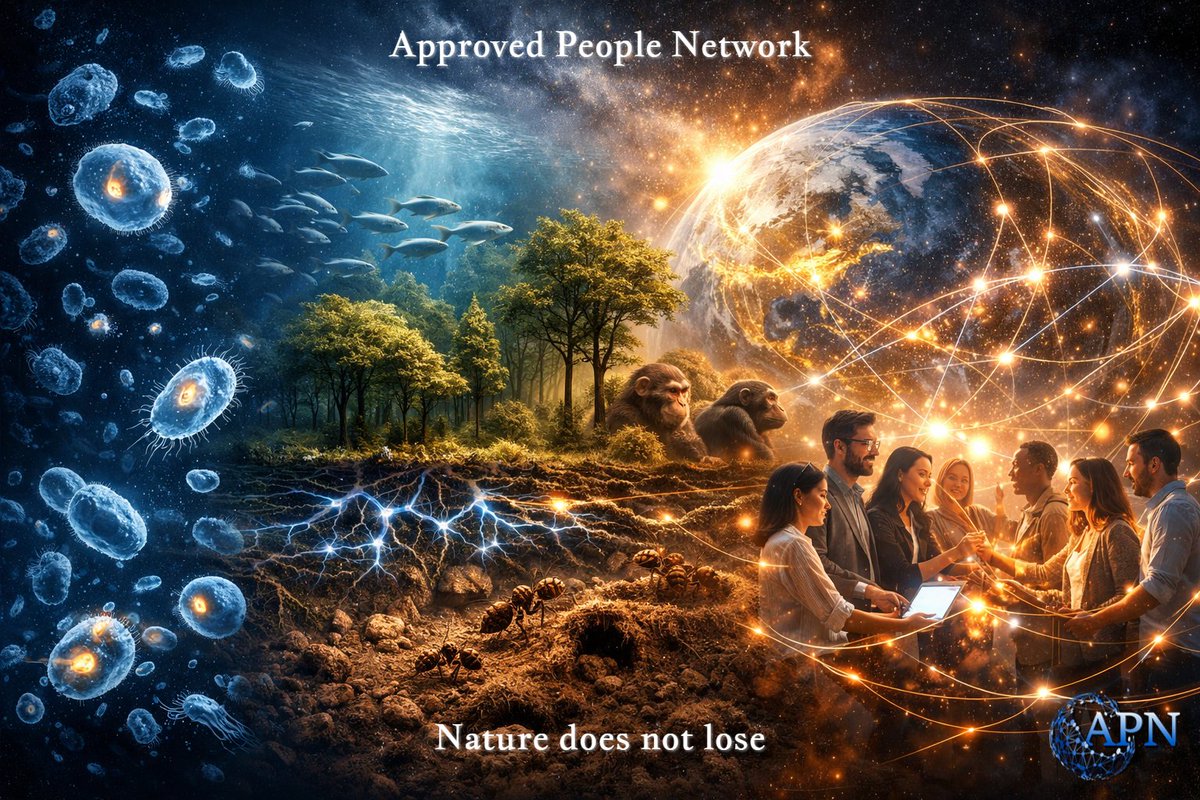
Nature Does Not Lose
Evolution is not an archive of dusty facts. It is a living current flowing through us right now. And this current has a direction. From simple to complex. From loneliness to unity. From competition to co-creation.
Look at the history of life. First, there were single cells devouring each other in the primordial soup. It was a dead end. But one day, two cells decided not to fight, but to unite. Thus, the first cooperation was born. From it came fish, dinosaurs, trees, and — us.
In a world where old structures are crumbling, where "man is a wolf to man" leads civilization into the dead end of loneliness, there is another path. The path of mycorrhiza. The path of symbiosis. The path that evolution has recognized as the only true one for millions of years.
Approved People Network was born from this understanding.
If you look closely, it is an exact replica of the mechanism nature has been refining for billions of years. It is that same fungal network connecting tree roots, so no one goes hungry. It is that same school of fish, where each individual is protected by the movement of millions. It is that ant colony, where personal success is impossible without the success of the common home.
We cannot lose. Why? Because we are not going against nature — we are going with its flow. The predator that eats the cleaner today will die from parasites tomorrow without its help. The tree that refuses to share will wither alone when the drought comes.
The great tournament of strategies showed: in the infinite game called "life," only cooperators win. Only those who, on the first move, offer trust, not a blow.
Approved People Network is that very first move. We extend our hand not to take away, but to create a network. A network where the success of each is multiplied by the success of all.
When you become part of this movement, you cease to be a grain of sand that the wind of history can blow away at any second. You become part of the Wood Wide Web. Part of the mycelium. Part of a living, breathing organism that grows according to the laws of life itself.
Nature does not build empires on deceit. It builds ecosystems on trust. Our path is inevitable. Our victory is predetermined. Not because we are smarter or cleverer. But because we have chosen the same strategy that transformed the primordial soup into blooming gardens.
Join the movement that evolution itself has chosen. Because evolution does not lose.
Approved People Network — we grow together, as nature intended.
3
8
10
2,607
The internet gave people a superpower - the ability to talk to anyone, anywhere, anytime.
Billions of people can speak their minds.
But there's one problem that keeps getting bigger.
People still haven't learned what matters most - how to truly reach an agreement.
They know how to like. They know how to argue until they're blue in the face. They know how to forward links. But build something together? Really together, where the result becomes bigger than the sum of the parts?
It almost never works.
And it's not the people who are broken. It's that there's no layer between them that turns conversations into something real.
Imagine a space where your word actually means something.
Not because you have a million followers. But because there are real things behind you. Real actions. Real deeds.
This space is called the Social Consensus Ledger. Sounds complicated, but the idea is simple: it's an attempt to build a nervous system for society. Not another social network. Not another crypto playground. But a coordination layer.
A place where reputation, economy, and human connection finally come together.
What you actually get
In this world, everyone has an SCL-ID - a digital identity. But it's not just a profile with a nice avatar. It's a living story of what you've actually done.
Who you've worked with. What you've built. Who trusts you. What you've created.
Reputation here can't be bought. It can't be sold. It grows from only one thing — the value you bring to others. Not your money. Not your loudest posts. Just the real stuff.
For a normal person, this means something simple: your worth isn't decided by someone else's algorithm anymore. It's decided by your own actions. You build your own weight in the network. Every day. With every move you make.
The network sees what you're truly good at
Over time, the system starts to understand who you really are.
It senses: this one's an entrepreneur. That one's an engineer. An investor. An organizer. A creator. Someone who knows how to bring people together. Someone who sees opportunities where others only see walls.
You stop being just a name in a list. You become a node on the map of what humans can do.
What does that give you? When someone needs exactly the kind of person you are — they find you. Not through a resume. Not through connections. Through real reputation. The best projects find the best people by themselves. Investors see entrepreneurs. Entrepreneurs see engineers. Teams form not blindly, but with a clear sense of who's actually worth what.
A like stops being an empty click
Now let's talk about attention — the most scarce thing we have left.
In this world, you can't just click around like a zombie. Every reaction is a tiny piece of responsibility. You like an idea? You're basically saying: "I believe this matters."
If the idea takes off — your weight grows with it.
If the idea turns out to be empty — your reputation quietly dips.
Sounds a bit harsh? Maybe.
But this is exactly how the noise dies. This is exactly how information stops being garbage. Because behind every opinion there's a real person who has something real to lose.
What does that give an ordinary person? Your feed cleans itself. Spam vanishes. People actually think before they type. Discussions stop being shouting matches. Information becomes something you can trust, not something you have to wade through.
An economy where you're part of it
Now about money. Because this matters too.
Anyone in the network can create tokens for their projects. A startup. A community. An investment pool. A creative crew.
But here's the thing — transaction fees don't disappear into some corporation's pocket. They don't end up in offshore accounts.
They get distributed. Among everyone. Proportional to reputation.
What does that give you? The more value you bring to the network — the more you're part of its economy. You're not just a user. You're a co-owner. The system works — you earn. The system grows — you grow with it. Not from speculation. From actually contributing.
Reputation kills the spam
Every action in the system needs a tiny reputational deposit.
So small you barely notice it when you're doing good. But just big enough to hurt if you're just trying to cause trouble.
If your action helps — the deposit comes back.
If it's useless — part of it fades.
If it's harmful — it burns.
What does that give you? The network's attention becomes something precious. Empty fights disappear. Trolls get bored and leave. Bots can't survive. Only people who actually have something to say and build remain.
When you vouch for someone, it means something
You can support someone else's project with your reputation.
Not your money — your reputation. Which is worth way more.
If they succeed — you succeed with them. Your reputation grows because you believed in the right thing.
If they fail — you feel it too. Your reputation takes a hit.
What does that give you? People stop making promises just to be nice. They start choosing carefully who they stand behind. Support becomes real. Responsibility becomes something you share. And slowly, clusters of people form — people who actually trust each other, not just in words.
Communities of entrepreneurs. Groups of engineers. Circles of investors. Creative crews.
People who've been through things together. Who know — this one, I can count on.
Time doesn't wait, not even for the great ones
Old achievements don't last forever here.
You can't build a reputation once and then live off it for the next twenty years. Trust is alive. It needs movement.
If you stop — your weight slowly fades.
What does that give you? Honesty. Flow. Fairness. The ones who keep creating keep rising. The ones who rest on what they did yesterday make room for new people. The system stays young, even as its people grow older.
No one can take over
So that no one grabs all the power, influence grows in a special way.
You can have a huge reputation. But your voice grows slower — like a root, not a rocket.
Even the strongest can't just decide things alone.
What does that give you? Balance. The new person gets heard. The old hand doesn't drown everyone out. Decisions get made together, not by a handful of whales.
What happens at the end
Over time, the network starts to see what only a few used to sense.
It recognizes the best investors — not by their fancy decks, but by the deals they actually made.
It finds the best engineers — not by their diplomas, but by code that runs.
It surfaces the best entrepreneurs — not by their hype, but by projects that live.
It brings together the best teams — not by their big names, but by what they built together.
This is what science fiction used to call collective intelligence.
Except it's not here to take over the world. It's here to help people finally build together.
But here's what really matters — what this gives humanity in 10 or 15 years
Now imagine this isn't just a small experiment. Imagine this becomes how millions — billions — of people actually connect.
What happens to the world?
Conflict stops paying off.
Right now, conflict is a tool. It grabs attention. It pumps up ratings. It feeds the ones who know how to make things worse.
In a world where reputation grows from building, not breaking, conflict becomes a bad deal.
Anyone who tries to light fires loses weight. Anyone who spreads chaos pays for it. Anyone who wants to turn people against each other finds their support melting away.
Conflicts die while they're still small.
Because no one gains from keeping them alive.
Two sides start fighting — and quickly see that tearing each other down hurts both. The only real win is finding a way forward. Coordination stops being nice — it becomes the only smart choice.
We stop wasting everything on fighting.
Think about what humanity spends its energy on. Wars. Lawsuits. Blocking each other. Protecting ourselves from "them."
In an SCL world, all that energy starts flowing somewhere else.
Into building. Into creating. Into things that actually matter.
Every person. Every team. Every place. All connected to a global pool of trust and skill.
People stop being strangers.
The trust network doesn't care about borders.
When someone has reputation — real reputation, built on real things — it doesn't matter where they were born. What language they speak. What passport they hold. What matters is what they've done.
Slowly, "us vs. them" fades away. It becomes "trusted vs. untrusted." And trusted just means — someone you can build with.
Kids raised in this world think differently.
Children who grow up seeing that honesty pays. That reputation matters more than quick money. That backing others makes you stronger too — they can't go back to the old ways.
For them, coming together is natural.
For them, trust is natural.
For them, building together is just how things work.
Humanity gets a shot at something new.
Not through violence, or force, or fear.
But through something simpler. Through each person seeing that being part of the whole is actually better for them.
This isn't a dream. It's just the next step. Tribes became cities. Cities became nations. Nations became markets.
The next step is a network where trust is real. Where your contribution is seen. Where what you give comes back to you.
So what does each person actually get?
Your worth in this world isn't your bank account. It isn't your follower count.
It's four things woven together:
— Your reputation — what you've actually done, the real story of your actions
— Your competencies — what you're genuinely good at
— Your economic life — what you create, the projects you bring to life
— Your trust network — who stands behind you, who would vouch for you
This is the Social Consensus Ledger.
Not a platform.
Not an economy.
Not a social network.
Just a new way for people to be together.
A layer where we don't just talk — but finally, actually build.
People have spent long enough learning to talk.
They've been bruised by empty fights.
They're tired of the noise.
They're ready for something real.
It's time to learn how to build together.
Everything is here. The shape of it. The understanding. The way it could work.
One question stays:
Are we ready to try?
4
10
10
6,022
APN: The Inversion of Social Entropy - Towards a Society of Sustainable Choice
Observing the development of human communities, one can notice a pattern reminiscent of physical laws. Complex social systems, left to their own devices, have a tendency towards increasing disequilibrium. Resources, opportunities, and influence gradually concentrate, creating an ever-deepening rift between different groups. This phenomenon can be called social entropy-a natural tendency of the system towards stratification and potential instability, where wealth begets new wealth with greater ease, and poverty reproduces itself.
The APN concept offers a fundamentally different approach-not combating the consequences of this stratification, but altering its basic dynamics. Its goal is to create conditions for the inversion of social entropy.
The Principle of Reverse Time: From Concentration to Circulation
The core idea lies in rethinking the main resource. It becomes not so much the material goods themselves, but the time of access to them. APN proposes an architecture in which the speed at which society receives reciprocal value from a participant's contributions is correlated with their current level of basic security.
- Those in a vulnerable position, acutely in need of support to escape the cycle of survival, are granted accelerated access to opportunities and resources by the system. This provides not just aid, but the most valuable thing-time to form a new life trajectory.
- Those possessing stability and surplus are offered the role of long-term "architects of sustainability." Their contribution is returned not instantly, but distributed over time, creating a foundation for the entire social ecosystem.
Thus, an inverse gradient emerges: resources do not flow to points of maximum concentration, but the time of support is directed to points of greatest need. This is not a redistribution of wealth in the classical sense, but a redistribution of the temporal component of well-being.
The Effect of Social Gravity: From Chaos to Equilibrium
In such a model, a semblance of a gravitational field arises. Participants with a high "mass" of stability naturally become a support, a center of attraction for the system in the long term. Those who find themselves on the periphery of well-being receive an impulse, an "acceleration," to overcome the inertia of entrenched circumstances. The system gently, without coercion, strives to return itself to a state of dynamic equilibrium, where extremes are softened and social elevators function.
A Society of Conscious Choice: Prosperity as a Lifestyle
A long-term consequence of such an inversion could be a transition to a qualitatively different social reality. When the system eliminates the compulsoriness of poverty and mitigates extreme concentrations, the level of material security gradually ceases to be the merciless dichotomy of "survive/prosper." It may transform into a parameter of personal choice and life strategy.
One person will direct energy towards ambitious projects and resource accumulation, accepting the associated risks and obligations.
Another will prefer moderate sufficiency, valuing free time for creativity, family, or spiritual pursuits.
A third will choose the path of minimalism, finding richness in simplicity and independence.
Differences will remain, but their nature will change. They will be less a consequence of a systemic trap and more a reflection of conscious values and inclinations. Prosperity will cease to be the sole measure of success, giving way to a multitude of other metrics: contribution to the common good, depth of relationships, quality of lived experience.
From an Economy of Fear to an Economy of Meaning
The modern economy is largely driven by the fear of scarcity-an incentive that forces a struggle for a place in the sun. A model that stabilizes the basic conditions of existence could shift the focus. When existential fear disappears, the energy of society can redirect from competition for survival to competitiveness in creation, the search for meaning, and the development of human potential.
Conclusion: Towards Freedom as a Basic Condition
The inversion of social entropy through APN is not a utopian project of universal equality. It is an attempt to chart a path towards a society of sustainable choice. A society where:
- No one is doomed to poverty due to systemic inequality.
- Stability and security are a civilizational norm.
- Material differences reflect a spectrum of life strategies, not a degree of luck or privilege.
- Freedom is not a privilege purchased by wealth, but a basic condition of human existence.
This is a transition from an economy dictated by necessity to an economy created from possibilities, where the ultimate value becomes not a number in an account, but the quality and fullness of the time allotted to a person.
5
4
8
1,487
Approved People Network: An Ecosystem That Builds the Future From Your Actions
We are creating an environment where value is born from human interactions.
The first step in developing the Approved People Network ecosystem is a social network. This is a living organism where each of your actions forms a unique digital fingerprint - the foundation of your future reputation in a decentralized protocol.
This is a space where your activity today becomes your capital tomorrow.
Social Network APN: Your Digital Footprint That Matters
In ordinary networks, your likes, comments, and connections are just data. In APN, they become an asset. Through natural communication, you form a social profile that will be verified and transferred to the SCL Level L1 protocol in the future.
The essence is simple: when the SCL technological layer begins to operate, you will enter it not with a blank history, but with a confirmed reputation. Your early interactions in the social network will become your advantage in the new economy.
What You Get From Day One:
🚀 Monetization of Social Capital Here and Now
From the first day, your presence in the network starts working for you. The system recognizes and rewards quality interactions:
Creation of valuable content that receives a significant response from the community
Active participation in discussions and helping other participants
Formation of a living, engaged circle of like-minded people around you
Your social activity is directly converted into recognition and opportunities within the ecosystem.
💫 Direct Transactions - Financial Communication Without Borders
Instant support: Send a reward to an author for a useful post without leaving your feed
Spontaneous gratitude: Acknowledge someone's help or advice with a direct transfer
Crowdfunding ideas: Gather support for your project from your first followers
Micropayments for services: Pay for small requests within the community
🎯 Full Sovereignty Over Your Digital Space
You are the architect of your profile:
Set rates for placing advertisements and partnership materials
Define content categories that align with your values
Choose integration formats - from subtle mentions to dedicated blocks
Manage access - decide which brands and projects can reach your audience
📊 Direct Access to the Community's Quality Attention
For businesses, creators, and regular users:
Reputation-based targeting: Find users with confirmed expertise in your topic
Transparent statistics: See real engagement, not inflated numbers
Automated placement: Any person can launch advertising on participants' personal pages or in the main network feeds with just a few clicks
Hypothesis testing: Launch pilot projects with the most relevant audience
🔗 A Comprehensive Environment for Project Implementation
APN is a work platform:
Find co-authors for startups and creative projects
Exchange expertise - an hour of your time for an hour of consultation with a colleague
Create closed groups for professional collaboration
Conduct crowdsourcing of solutions among verified specialists
🌱 Real Influence on Ecosystem Development
Your voice carries weight:
Participate in voting on new features and development priorities
Propose improvements to the SCL protocol based on your experience in the network
Shape interaction standards and the community's economic models
Become an ambassador for directions that are close to you
Key Difference: Your History Works for You Constantly
Unlike traditional platforms where your history is lost in the algorithmic feed, APN transforms your journey into a structured asset:
Social interactions → Form your digital profile with a history of trust
Digital profile → Becomes a verifiable reputation in the SCL protocol
Your reputation → Grants access to the privileges of the next ecosystem level
APN Rethinks Digital Relationships:
Value is measured by the depth of contribution, not just the number of subscribers
Trust is built through long-term transparent interactions, not through viral content
Economic relations become an organic part of professional and personal communication
Technological future is built considering your unique social history
We start with the social layer because a true decentralized network should grow not from abstract algorithms, but from specific human connections, tested by time and joint actions.
This is the foundation. The social layer, where every step you take matters.
The next step is technological implementation at the protocol level, which will take into account your entire history.
4
4
9
1,689
Imagine for a moment that we have found not just an error in the code of the global economy, but its main bug-its indifference to the human being. And now we have a patch. Not a temporary fix, but a full update to a version where the system finally sees you as a user, not a resource.
This update rewrites the basic rules:
Justice becomes not an abstraction, but a mathematical constant. Your contribution, talent, and time have a precise coefficient of exchange for prosperity. You receive not "approximately," but exactly as much as you have created.
Freedom of choice is not an option in a menu full of hidden fees, but a preset default setting. You choose your work, project, lifestyle based on desire, not fear.
The words "crisis," "collapse," "inflation" are sent to the archive of history, like terms from the era of steam engines. The economic graph loses its Y-axis, leaving only the X-axis-the axis of forward movement for the entire system.
Anxiety loses its breeding ground. A call from the bank becomes a reminder of dividend accrual, and a boss's glance becomes the look of a partner in a common cause. You exit the mode of constant survival.
But these are just the technical specifications. The true update is in the quality of human life.
This is a world where time finally belongs to you. Not in the scraps left after work and obligations, but in full, quality blocks. As much free time for your soul and family as your heart asks for. And as much useful, meaningful time for creativity and work as your mind requires.
This is a world where your most valuable investment-your children's future-is protected at the system level. They will grow not in the jungles of competition, but in an ecosystem of cooperation. Their environment is human participation, mutual aid, and collective trust as a given. Their default trajectory leads to development, not to a struggle for a place under the sun, of which there will be enough for everyone.
In this world, the very concept of "poverty" loses its meaning, becoming an archaism like "serfdom." It simply does not apply to the format of human existence, where basic needs are a guaranteed minimum, not a lifelong goal.
This world is not a utopia. It is the APN ecosystem. And this is not just an idea. It is a fully ready, elegant architecture. Its beauty lies in the simplicity of its fundamental principles, and its power lies in their inevitability. This is not "just another theory." It is an engineering solution that changes the very way of perceiving reality: from a world of limitations and need to a world of opportunities and abundance.
Only one step is required of you, which has always been both the most difficult and the simplest at the same time: to believe. Not blindly, but despite the bitter experience of past disappointments. To believe this time not in promises, but in the logic of the system, the evidence of its work, and the call of your own heart, which has always distinguished truth from illusion.
This is precisely the case where your heart will not fail you. It will recognize the contour of that future for which it was created.
8
4
7
3,750
🎉 Grand Giveaway for APNP Token's Birthday! 10 Days to Go! 🎂
Our APNP token is turning one soon! To celebrate, we're launching a massive celebratory airdrop with two reward streams. The total prize pool is 15,000,000 APNP!
🎁 Part 1: Giveaway for Everyone 5,000,000 APNP
We are giving away 5 million APNP to 50 randomly selected lucky winners from our community! A perfect chance to join the project on the eve of our major ecosystem launch.
✨To enter the giveaway, you must:
1) Follow our community.
2) Like ❤️ this post.
3) Repost 🔄 this announcement.
4) Leave a comment below with your SOL wallet address.
✅ Winners will be selected by our bot randomly on February 10th.
🏆 Part 2: Reward for Loyal Holders 10,000,000 APNP
We value our most devoted supporters! 10 million APNP will be distributed among active holders of our token.
✨ How to qualify as a holder:
1) Make sure your APNP tokens are in your wallet.
2) You must leave a comment on this post stating the wallet address where your APNP is held.
3) On February 10th, we will take a snapshot of all APNP holders.
4) If your wallet is on the holder list at the time of the snapshot AND its address is listed in the comments - you will automatically receive your share of the prize pool!
⚠️ Important: This distribution is for active holders only. A comment with your wallet address is a mandatory requirement to participate in this part.
🗓️ Deadline for all actions and winner selection - February 10th!
Be part of the party and make a power move to secure your spot in the APN ecosystem of tomorrow!🚀
#APNP #APN #Birthday #Giveaway #Airdrop #Community
APNP is almost 1 year old!🥳
On February 10, 2026, the very first token of the Approved People Network community will turn 1 year old.
One year on-chain is not just a date.
It’s endurance, movement, and a test of resilience.
Over this year, APNP has:
— lived through a full market cycle without stopping;
— weathered volatility while staying active on the network;
— built a community of real holders;
— never been abandoned at any stage of its development.
And that is already an achievement.
We are celebrating this milestone properly —
with gifts for our holders.
🎁 Every APNP holder will receive a gift.
Even if you hold only 1 APNP on your wallet — you are participating.
We won’t reveal the sizes or details in advance.
Let it be a real surprise 😉
📸 All holders will be recorded with a snapshot on APNP’s birthday.
But that’s not all.
🎉 On APNP token’s birthday,
we will hold APNP giveaways among our followers on X and Telegram.
The rules are simple:
— follow our pages on X and Telegram;
— leave your SOL wallet in the comments under the celebratory post.
APNP is no longer just a launch.
It’s a journey of 12 months of on-chain history.
And this journey is only gaining speed.
The birthday is coming 🥳
And it will be memorable.
#APNP #APN #APNcommunity #airdrop #giveaway #APNPbirthday
26
15
20
1,634
Rethinking Economic Value
Imagine an economic network where the fundamental unit of value is not a coin, a stock, or a digital asset, but human trust and meaningful participation. Here, status is determined not by the size of one's capital, but by how useful and reliable your actions are to others. This is a fundamental shift: the system is protected from internal oligarchy and takeover by "whales" because influence cannot be bought—it can only be earned through consistent actions. The right to vote is not a privilege for a select few with large savings, but a tool for everyone who contributes their efforts to the common good.
Mechanism of Resilience: An Ecosystem, Not a Pyramid
The resilience of this network stems from several key principles, making it resemble a living, breathing organism rather than a fragile financial instrument:
-Independence from external speculation.
The internal value of the network and its ability to function are decoupled from the chaotic fluctuations of global crypto markets. The external token price is merely a reflection of external demand, while internally it serves as an immutable unit of account for trust and merit. Even in times of external panic, the "weather" inside the ecosystem can remain stable.
-Organic, not artificial growth.
Instead of infinite emission of new tokens that dilutes value (as in traditional farming), growth occurs through the expansion of social and economic activity. New "units of trust" (tokens) appear not on a schedule, but as a reward for specific, network-beneficial actions. This makes inflation manageable and meaningful.
-Social consensus as the supreme arbiter.
Governance is built not on blind code execution, but on constant, living social agreement (Social Consensus Ledger). Reputation, proven by deeds, becomes more important than any wallet balance. A participant acting against the community's interests will naturally lose influence and access to opportunities, even if they formally hold tokens. The network possesses immunity and is capable of self-cleaning without centralized "bans."
The Nature of Yield: Circulation, Not Extraction
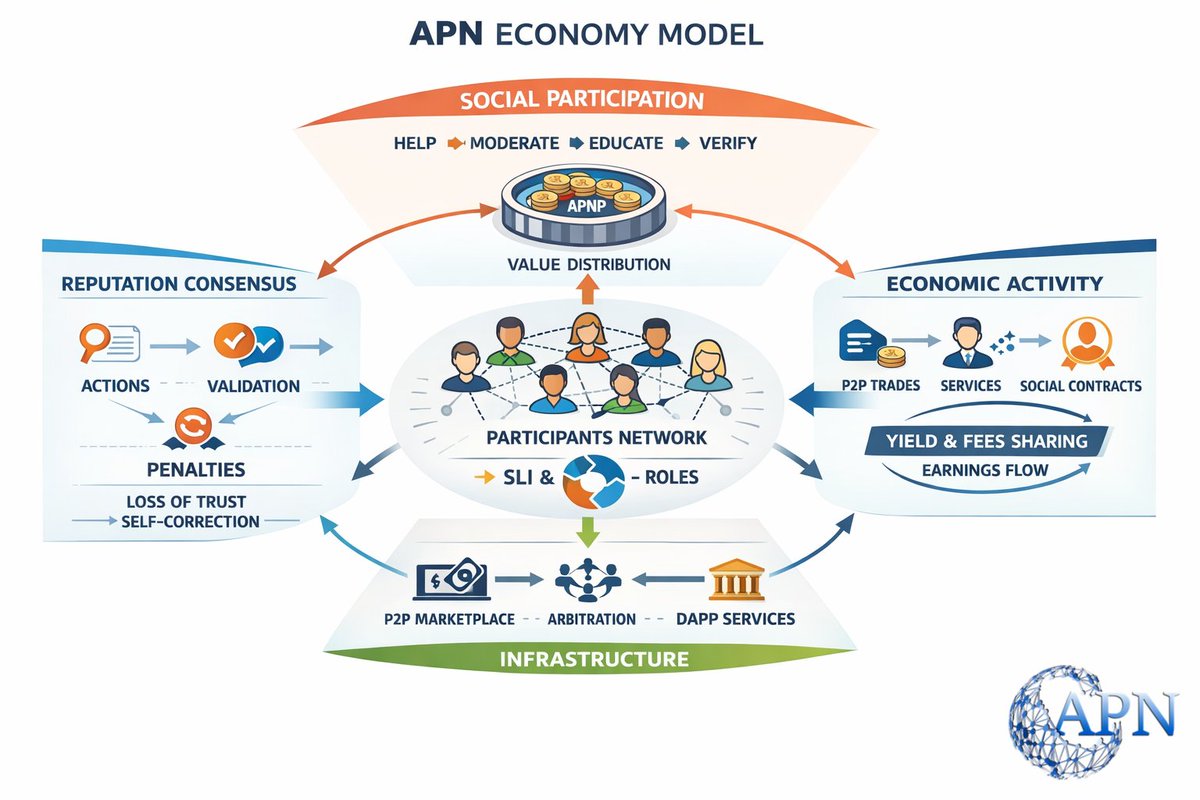
Yield here is not a promised dividend, but a natural consequence of healthy economic activity within the ecosystem. It can be viewed from three perspectives:
1. Participation Yield. This is analogous to earning in a healthy guild or cooperative. By participating in moderation, helping newcomers, creating content, organizing processes, or building connections, you increase the overall "pie" of activity and receive a fair share of the value you helped create.
2. Trust Yield. This is the network effect, materialized in the economy. The higher your reputation and reliability (Social Loyalty Index), the more other participants want to collaborate with you, delegate tasks, and choose you as an arbitrator. This creates a flow of microtransactions and fees that concentrates around trusted nodes. Money follows trust.
3. Infrastructure Yield. As it grows, the network inevitably creates internal infrastructure: service markets, P2P platforms, arbitration systems, data storage. Microscopic fees for using this infrastructure do not flow to external investors but are redistributed among all who support and develop it, creating a self-sustaining cycle of internal capital circulation.
Scaling: People as the Universal Asset
The strength of this model lies in its universality and low growth requirements. It does not depend on a specific jurisdiction, culture, or level of wealth—trust is international. Network growth occurs by attracting new participants and deepening connections between them, which is a linear and predictable process. It does not need exponential financial injections to maintain interest, as is often the case with GameFi or hype-driven DeFi projects. This makes its development slower but immeasurably more resilient, free from "boom-and-bust" cycles.
The Philosophical Paradox and Conclusion
The main paradox, which is also its main strength, is as follows: **the less the system focuses on promising yield and the more it focuses on creating a healthy socio-economic environment, the higher its real, long-term value for participants becomes.** It filters out those seeking only quick profit and attracts builders, creators, and those who believe in the power of community. Ultimately, this is an experiment in creating an economy that serves people, not the other way around. It is an attempt to return to the origins, where the most solid asset was one's word, and the most stable currency was reputation, now materialized in digital space.
12
7
14
47,154
How APN/SCL Fixes Cryptography's Fundamental Flaw: Returning Responsibility to People
Classical cryptography has become trapped by a utopian ideal-the attempt to replace human trust with mathematical formulas. This has led to a dangerous overloading: a single cryptographic key is forced to bear the impossible burden of responsibility for identity, truth, rights, and finality all at once. APN proposes a radical decomposition of this problem.
1. Moving Away from the Apocalyptic Scenario
In Bitcoin and similar systems, cryptography is the foundation of reality. If algorithms like SHA-256 or ECDSA fall to a quantum computer, everything collapses: signatures become forgeable, transactions invalid, and all accumulated value turns to digital dust.
APN changes the paradigm: Here, cryptography is not the source of truth, but a tool for recording events and securing communication. Its job is temporary verification, not the eternal determination of rights. If an algorithm is broken, it becomes a technical incident requiring a fix, not the end of the system. Truth is determined not by a signature, but by social consensus.
2. Separating Identity from Keys
The tragic flaw of modern cryptography: the key became equal to identity. Lose your private key-cease to exist as a subject within the system. This is anti-human and unsustainable.
APN's solution is three-layered identity:
-Cryptographic Layer (keys)-a technical access tool
-Social Layer (reputation, interaction history)-the foundation of identity
-Contextual Layer (roles, membership, participation)-rights and capabilities
A key can be replaced, like a lost passport. Your identity persists through community verification. You don't vanish from the system by losing a cryptographic token.
3. Signature as Statement, Not Absolute
In blockchains, a signature is absolute truth. If it's mathematically valid, the system blindly executes the operation without asking for context: Should this person really be sending these funds? Is this a stolen key or a mistake?
In APN, a signature is the beginning of a dialogue, not its end: A signature records an intent. Truth emerges from the agreement of multiple participants. The system allows for dispute, arbitration, and revision. Cryptography fixes the fact of a statement; the community determines its meaning and legitimacy.
4. Post-Quantum Evolution Without Catastrophe
Migrating Bitcoin to post-quantum algorithms is a nightmare scenario. Millions of "dormant" addresses with outdated signatures remain a perpetual threat. Any forced migration violates the core principle of immutability.
APN is designed for evolution: Cryptography here is a modular component. The system natively supports hybrid schemes and planned algorithm rotation. Old signatures remain in history as archival records, not as a source of unconditional rights. Transition becomes a managed process, not a revolutionary upheaval.
5. Human Error as Part of the System, Not a Fatal Flaw
90% of losses in cryptocurrencies stem not from weak algorithms, but from implementation errors and human actions. Classical cryptography is merciless: a typo in an address, phishing, a lost seed phrase-and assets are gone forever.
APN builds in protection from mistakes: Mechanisms for social recovery of access, confirmation of large operations through trusted connections, time delays for critical actions-all this reduces the damage from inevitable human error. A mistake leads not to irreversible loss, but to a recovery procedure.
6. Contextual Transparency Instead of a False Dichotomy
Blockchains offer only two extremes: complete anonymity (where nothing can be verified) or complete transparency (where one's entire financial life becomes public). Both are problematic for real-world use.
APN introduces access gradations: The system allows for selective disclosure-proving specific facts without revealing one's entire history. Cryptography serves as a filter, not a spotlight. You can prove solvency without showing all accounts, or confirm a transaction to a specific group while maintaining privacy from others.
7. Code as Tool, Not Law
The idea that "code is law" has led to absurd situations where smart contract vulnerabilities caused million-dollar losses, met only with the response, "you should have audited the code better." Cryptography became a religion where algorithms are infallible and users are to blame for their problems.
In APN, code serves the public interest: Formal verification, mandatory social auditing, emergency protocols for critical vulnerabilities-all this makes the system manageable and accountable. Cryptography serves the social contract; it does not replace it.
8. Security Through Accountability, Not Cost
Proof-of-Work and Proof-of-Stake reduced security to an economic game: whoever spends more energy or locks up more capital gets to define truth. This creates distortions and makes attacks a question of economic feasibility.
APN builds security on social accountability: Attempting to attack the system leads not to potential profit, but to guaranteed losses-reputational, social, economic. The attacker loses their future in the system, rather than risking temporary resources. Security becomes a property of the network of participants, not an external resource that must be constantly purchased.
The Fundamental Shift
APN/SCL is not "improved cryptography" or a "fixed blockchain." It is a fundamentally different architecture of trust, where cryptography takes its rightful place-as a precise, strict, formal tool-but ceases to claim the role of supreme arbiter of human relations.
Truth, rights, and trust are returned to people. Mathematics continues to serve-but as an accountant, not a judge. As a means of recording agreements, not their source. As a mechanism for executing community decisions, not a replacement for the community itself.
This is the key innovation: recognizing that all technologies are merely tools in the hands of society. Their perfection is measured not by mathematical purity, but by their ability to serve human goals, accounting for human nature with all its errors, conflicts, and need for justice.
Why Bitcoin Is Doomed: Fundamental Flaws That Will Lead to Its Collapse
Introduction: The Grand Illusion of Neutral Money
Bitcoin was sold to the world as a revolution: decentralized, neutral, mathematically flawless money. Over 15 years, it has become a cultural phenomenon, a trillion-dollar asset, and a symbol of technological rebellion. But beneath the surface of this glittering history lie cracks in its foundation-systemic, economic, and philosophical flaws that are not merely "risks" but an inevitable death sentence. Here’s why Bitcoin will die.
1. Technological Dead End: Architecture Frozen in 2009
1.1 Dogmatic Inflexibility
Bitcoin has fallen victim to its own ideology. Its community is so afraid of change (after several hard forks) that it prefers to freeze the protocol in its 2009 state. In a world where technology evolves exponentially, such stagnation is a death sentence.
The Problem:
-Maximum throughput: 7 transactions per second. VISA handles 65,000.
-Any attempt at scaling (SegWit, Lightning Network) faces fierce resistance.
-The system cannot evolve without risking a community split.
1.2 Quantum Apocalypse-A Matter of Time
The cryptography underlying Bitcoin-SHA-256 and ECDSA-is already considered outdated. Quantum computers capable of breaking this protection are not science fiction but an engineering problem 10-15 years away.
The Fact:
When quantum computers reach 1,500–2,000 qubits (Google is already showing progress), Bitcoin’s private keys will become public. The system has no protection mechanism or smooth transition plan-it will simply collapse.
2. Economic Paradox: A System That Punishes Its Defenders
2.1 Self-Destructive Mining Model
Proof-of-Work is not a feature-it’s a fatal bug. Miners protect the network only as long as it is profitable. Every four years, the block reward is cut in half (halving).
The Math of Collapse:
-2009: 50 BTC per block
-2024: 3.125 BTC per block
-2040: less than 0.2 BTC per block
Transaction fees can never replace the block subsidy. When mining becomes unprofitable, the hash rate will plummet, and the network will become vulnerable to a 51% attack. This is not a risk-it is a fate programmed into the code.
2.2 Deflationary Spiral
The 21 million Bitcoin cap creates a toxic economy:
-Holding is more profitable than spending
-Lost Bitcoins (about 20%) create artificial scarcity
-The system becomes not "money" but "digital gold" that no one uses for payments
History knows dozens of examples of deflationary currencies-all died from a lack of liquidity.
3. Energy Madness: A System the World Cannot Sustain
3.1 Environmental Rejection
Bitcoin consumes more energy than entire countries (Argentina, Norway). In an era of climate crisis, this is not just bad PR-it is a direct path to global bans.
Statistics:
-Annual consumption: ~150 TWh
-Carbon footprint: ~65 million tons of CO2
-Electronic waste from ASIC miners: ~30,000 tons per year
The EU is already considering a ban on Proof-of-Work. China has already banned mining. This chain reaction is only gaining momentum.
3.2 Geopolitical Vulnerability
Mining is concentrated in a few regions:
-Historically >65% in China
-Currently >35% in the USA
-De facto centralization in the hands of 5–6 major pools
This is not decentralization. It is vulnerability to regulatory pressure, sanctions, and physical attacks on infrastructure.
4. Social Collapse: A Community That Eats Itself
4.1 Toxic Maximalist Culture
The Bitcoin community has become a sect:
-Any criticism is met with aggression
-Alternative solutions (altcoins) are demonized
-Splits (Bitcoin vs. Bitcoin Cash) show an inability to evolve healthily
In technology, adaptive systems survive. Dogmatic ones die.
4.2 Loss of Original Mission
Bitcoin was created as "peer-to-peer electronic cash" (quote from the white paper). Today, it:
-Is not used for everyday payments (too slow and expensive)
-Does not serve as a store of value (80% annual volatility is normal)
-Has become a speculative asset for hype and bubble pumping
A system that fails to perform its primary function is a zombie system.
5. Regulatory Hammer: The State Will Not Surrender Without a Fight
5.1 Incompatibility with CBDCs
Central banks are issuing digital currencies (CBDCs). Their advantages over Bitcoin:
-Legal protection
-Zero fees
-Instant transfers
-Integration with tax and payment systems
Why would states tolerate a competitor that is inferior to their own product in every way except anonymity-which they want to eliminate anyway?
5.2 Financial Isolation
The trend is clear:
-KYC/AML requirements on all exchanges
-Bans for financial institutions (as in China)
-Tax persecution of holders
Bitcoin is becoming "dirty money"-increasingly difficult to use legally, increasingly risky to use illegally.
6. Fundamental Philosophical Errors
6.1 The Myth of Decentralization
In practice:
-Development is controlled by 5–6 key developers
-Mining is controlled by 3–4 pools
-Storage is controlled by 5–6 major exchanges
This is not a revolution against centralization. It is the creation of a new, more opaque centralization.
6.2 The Cult of Irreversibility as a Weakness
In the real world, reversible transactions are not a bug but a feature:
-Protection against errors
-Protection against fraud
-Judicial protection
Bitcoin prides itself on its ruthlessness. But society will never accept a system where a typo in an address means irreversible loss of funds. It is anti-human.
7. Alternatives That Will Make Bitcoin Obsolete
7.1 Blockchain Evolution
Ethereum has already transitioned to Proof-of-Stake:
-99.95% more energy-efficient
-Programmable money (smart contracts)
-Ability to upgrade without splits
Why would the world need an outdated Bitcoin when there are more advanced technologies?
7.2 Solving the Trilemma
New generations of blockchains (Solana, Avalanche, Cardano) solve the "blockchain trilemma":
-High speed (thousands of TPS)
-Low fees
-Sufficient decentralization
Bitcoin has lost the technology race, stuck in 2009.
Conclusion: The Anatomy of an Inevitable Death
Bitcoin will die not because it will be hacked. Not because states will ban it. It will die from a combination of fatal diseases:
-Technological Sclerosis-inability to evolve
-Economic Paradox—a model that consumes itself
-Environmental Rejection-the world cannot sustain such wastefulness
-Social Toxicity-a community that rejects any change
-Competitive Displacement-the emergence of superior alternatives
The history of technology is merciless: systems that do not evolve, die. Betamax vs. VHS, MySpace vs. Facebook, Internet Explorer vs. Chrome.
Bitcoin is the Betamax of cryptocurrencies. High-quality, first, ideologically pure. And absolutely doomed.
Its death will be slow. First, it will become a digital souvenir-like collectible cards or virtual items in old MMORPGs. Then miners will begin to disconnect en masse. Then large holders will start taking profits. And one day, a transaction simply won’t be included in a block because there will be no one left to mine it.
The epitaph will read: "Here lies a great idea that preferred mathematical purity to human utility."
The world will move on. To CBDCs. To eco-friendly blockchains. To systems that understand that technology must serve people, not people serve the dogmas of technology.
Bitcoin showed the way. But staying on this path means missing the future.
11
5
11
1,918
Why Bitcoin Is Doomed: Fundamental Flaws That Will Lead to Its Collapse
Introduction: The Grand Illusion of Neutral Money
Bitcoin was sold to the world as a revolution: decentralized, neutral, mathematically flawless money. Over 15 years, it has become a cultural phenomenon, a trillion-dollar asset, and a symbol of technological rebellion. But beneath the surface of this glittering history lie cracks in its foundation-systemic, economic, and philosophical flaws that are not merely "risks" but an inevitable death sentence. Here’s why Bitcoin will die.
1. Technological Dead End: Architecture Frozen in 2009
1.1 Dogmatic Inflexibility
Bitcoin has fallen victim to its own ideology. Its community is so afraid of change (after several hard forks) that it prefers to freeze the protocol in its 2009 state. In a world where technology evolves exponentially, such stagnation is a death sentence.
The Problem:
-Maximum throughput: 7 transactions per second. VISA handles 65,000.
-Any attempt at scaling (SegWit, Lightning Network) faces fierce resistance.
-The system cannot evolve without risking a community split.
1.2 Quantum Apocalypse-A Matter of Time
The cryptography underlying Bitcoin-SHA-256 and ECDSA-is already considered outdated. Quantum computers capable of breaking this protection are not science fiction but an engineering problem 10-15 years away.
The Fact:
When quantum computers reach 1,500–2,000 qubits (Google is already showing progress), Bitcoin’s private keys will become public. The system has no protection mechanism or smooth transition plan-it will simply collapse.
2. Economic Paradox: A System That Punishes Its Defenders
2.1 Self-Destructive Mining Model
Proof-of-Work is not a feature-it’s a fatal bug. Miners protect the network only as long as it is profitable. Every four years, the block reward is cut in half (halving).
The Math of Collapse:
-2009: 50 BTC per block
-2024: 3.125 BTC per block
-2040: less than 0.2 BTC per block
Transaction fees can never replace the block subsidy. When mining becomes unprofitable, the hash rate will plummet, and the network will become vulnerable to a 51% attack. This is not a risk-it is a fate programmed into the code.
2.2 Deflationary Spiral
The 21 million Bitcoin cap creates a toxic economy:
-Holding is more profitable than spending
-Lost Bitcoins (about 20%) create artificial scarcity
-The system becomes not "money" but "digital gold" that no one uses for payments
History knows dozens of examples of deflationary currencies-all died from a lack of liquidity.
3. Energy Madness: A System the World Cannot Sustain
3.1 Environmental Rejection
Bitcoin consumes more energy than entire countries (Argentina, Norway). In an era of climate crisis, this is not just bad PR-it is a direct path to global bans.
Statistics:
-Annual consumption: ~150 TWh
-Carbon footprint: ~65 million tons of CO2
-Electronic waste from ASIC miners: ~30,000 tons per year
The EU is already considering a ban on Proof-of-Work. China has already banned mining. This chain reaction is only gaining momentum.
3.2 Geopolitical Vulnerability
Mining is concentrated in a few regions:
-Historically >65% in China
-Currently >35% in the USA
-De facto centralization in the hands of 5–6 major pools
This is not decentralization. It is vulnerability to regulatory pressure, sanctions, and physical attacks on infrastructure.
4. Social Collapse: A Community That Eats Itself
4.1 Toxic Maximalist Culture
The Bitcoin community has become a sect:
-Any criticism is met with aggression
-Alternative solutions (altcoins) are demonized
-Splits (Bitcoin vs. Bitcoin Cash) show an inability to evolve healthily
In technology, adaptive systems survive. Dogmatic ones die.
4.2 Loss of Original Mission
Bitcoin was created as "peer-to-peer electronic cash" (quote from the white paper). Today, it:
-Is not used for everyday payments (too slow and expensive)
-Does not serve as a store of value (80% annual volatility is normal)
-Has become a speculative asset for hype and bubble pumping
A system that fails to perform its primary function is a zombie system.
5. Regulatory Hammer: The State Will Not Surrender Without a Fight
5.1 Incompatibility with CBDCs
Central banks are issuing digital currencies (CBDCs). Their advantages over Bitcoin:
-Legal protection
-Zero fees
-Instant transfers
-Integration with tax and payment systems
Why would states tolerate a competitor that is inferior to their own product in every way except anonymity-which they want to eliminate anyway?
5.2 Financial Isolation
The trend is clear:
-KYC/AML requirements on all exchanges
-Bans for financial institutions (as in China)
-Tax persecution of holders
Bitcoin is becoming "dirty money"-increasingly difficult to use legally, increasingly risky to use illegally.
6. Fundamental Philosophical Errors
6.1 The Myth of Decentralization
In practice:
-Development is controlled by 5–6 key developers
-Mining is controlled by 3–4 pools
-Storage is controlled by 5–6 major exchanges
This is not a revolution against centralization. It is the creation of a new, more opaque centralization.
6.2 The Cult of Irreversibility as a Weakness
In the real world, reversible transactions are not a bug but a feature:
-Protection against errors
-Protection against fraud
-Judicial protection
Bitcoin prides itself on its ruthlessness. But society will never accept a system where a typo in an address means irreversible loss of funds. It is anti-human.
7. Alternatives That Will Make Bitcoin Obsolete
7.1 Blockchain Evolution
Ethereum has already transitioned to Proof-of-Stake:
-99.95% more energy-efficient
-Programmable money (smart contracts)
-Ability to upgrade without splits
Why would the world need an outdated Bitcoin when there are more advanced technologies?
7.2 Solving the Trilemma
New generations of blockchains (Solana, Avalanche, Cardano) solve the "blockchain trilemma":
-High speed (thousands of TPS)
-Low fees
-Sufficient decentralization
Bitcoin has lost the technology race, stuck in 2009.
Conclusion: The Anatomy of an Inevitable Death
Bitcoin will die not because it will be hacked. Not because states will ban it. It will die from a combination of fatal diseases:
-Technological Sclerosis-inability to evolve
-Economic Paradox—a model that consumes itself
-Environmental Rejection-the world cannot sustain such wastefulness
-Social Toxicity-a community that rejects any change
-Competitive Displacement-the emergence of superior alternatives
The history of technology is merciless: systems that do not evolve, die. Betamax vs. VHS, MySpace vs. Facebook, Internet Explorer vs. Chrome.
Bitcoin is the Betamax of cryptocurrencies. High-quality, first, ideologically pure. And absolutely doomed.
Its death will be slow. First, it will become a digital souvenir-like collectible cards or virtual items in old MMORPGs. Then miners will begin to disconnect en masse. Then large holders will start taking profits. And one day, a transaction simply won’t be included in a block because there will be no one left to mine it.
The epitaph will read: "Here lies a great idea that preferred mathematical purity to human utility."
The world will move on. To CBDCs. To eco-friendly blockchains. To systems that understand that technology must serve people, not people serve the dogmas of technology.
Bitcoin showed the way. But staying on this path means missing the future.
12
11
13
10,781
APN: Principles of a System of Joint Participation
Let's start with the most important point. APN is not another financial mechanism or a tool for quick enrichment. It is, first and foremost, a system of joint participation, built on simple yet fundamental principles. Its essence lies not in complex schemes, but in clear rules that are the same for everyone and cannot be revised retroactively.
At the heart of it all lies a single, common share to which all participants contribute. There are no hidden reserves, separate funds, or elite "team shares." There is only one common turnover from which the return occurs. Thus, the system consciously blurs the line between "mine" and "yours," offering instead a model of unified, distributed presence.
Equality is absolute. Regardless of whether your contribution is large or small, you receive the same percentage return as other participants. The system's rules make no exceptions and grant no privileges based on scale. The only thing that changes is the absolute size of the return, but never its percentage rate. This is the key principle of fairness.
The return calculation is transparent and determined by the state of the entire system. It depends on the dynamic ratio of the total share to the aggregate participation. This means the system self-regulates: the more participants it has and the more active it is, the higher its overall stability. In return, the system offers not high interest rates, but stability and predictability.
Therefore, the natural decrease in the return percentage as the system grows is not a flaw, but an inevitable outcome. This approach eliminates the race for "early entry," relieves the pressure of unrealistic expectations, and shifts the focus from profit extraction to participation itself. The system encourages not speculation, but long-term presence.
Value in APN exists on two levels.
Within the system, everything is measured in its internal units (APNP), and the rules are shielded from external market fluctuations.
In the external world, the value of these units is formed naturally—through demand, ecosystem development, and collective recognition. The system makes no market promises, allowing the community to independently determine the significance of participation.
So what does a participant actually gain?
They become part of a living, evolving ecosystem. They observe the gradual return of their share, but, more importantly, they feel the growing significance of their participation as the system expands. There is no room here for scenarios of sudden collapse or zeroing out, because the return is viewed not as an ultimate goal, but as a natural consequence of your stable presence within the community.
It is important to clearly state what APN fundamentally does not do. It does not provide guarantees, does not trade in expectations, does not grant privileges for the size of a share, and does not engage in market value manipulation.
Instead, it does three simple things: it sets and fixes the rules, conducts all calculations with absolute transparency, and creates an environment that encourages participation itself, rather than the extraction of benefits.
If we were to express the essence in one phrase:
APN is a system where participation itself is more important than immediate extraction, and the return becomes a natural result of joint, long-term presence.
In the future, the system may evolve, offering new forms of interaction, but its basic principles—equality, transparency, and the priority of participation—will remain unchanged. They are enshrined not as a temporary measure, but as its philosophical foundation.
Ultimately, APN is not an investment, not a tool for "farming," and not a financial product. It is a socio-economic system of joint participation, where genuine value is born not from promises, but from the people themselves, their trust, and their willingness to be part of a common whole.
#APN #APNecosystem #APNP #TrustEconomy #Decentralized
21
9
13
3,748
How APN is Fundamentally Different from Existing Systems
1. Not About Income, But About Participation
Most modern systems are built around profitability - they speak the language of interest, profit, and returns. Their main question is: "How much will you earn?"
APN speaks the language of participation. Here, the focus is on shares, not income, and the return is viewed as a natural consequence of your presence within the system. APN does not promise results - it offers participation as a value in itself.
2. One System - One Logic
In traditional models, there is often a division: there is a "team" with its own funds and hidden rules, and there are "users," whose funds are managed manually.
In APN, everyone operates within a single field - there are no separate sources, hidden reserves, or manual redistribution. Every participant follows the same, immutable rules, which eliminates double standards and creates a foundation for trust.
3. Share Size Does Not Grant Power
Typically, a larger investment grants more influence: early participants gain advantages, and the system encourages the concentration of capital.
In APN, the percentage return is the same for everyone. The size of a share affects only the absolute amount of the return, not the rules or status. Money here does not become a lever of control - the system is built on equality, not hierarchy.
4. System Growth Reduces Extraction
Many models depend on a constant influx of new participants: latecomers often "pay for" the returns of early ones, creating pressure and fragility.
In APN, an increase in participation, conversely, lowers the individual percentage return. This is not a shortcoming, but a deliberate principle: the system does not require acceleration, does not pressure new participants, and becomes more resilient the more people are involved.
5. Transparency Instead of Promises
Traditional systems often use complex terms, hidden mechanisms, and marketing promises to attract attention.
In APN, there is simple, public logic, immutable rules, and an absence of hidden elements. There is nothing to hide here, because the system values clarity more than compelling stories.
6. APN Lives Without Perpetual Price Growth
Many economic models exist only under conditions of constant market growth and break at the first correction.
APN functions under any external conditions. It does not depend on price trends, does not require "faith in future growth," and is not fueled by optimism. The market price can enhance the effect of participation but is not a condition for the system's survival.
7. The Return is Not the System's Goal
In the usual logic, success is measured by the speed and volume of extraction: the faster you "take what's yours," the more effective the system is.
In APN, the return is a side effect of long-term presence. The value lies in stability, not speed. Here, people do not rush for the exit but stay because they find meaning in the very act of participation.
8. APN Does Not Compete - It Changes the Framework
APN does not try to be faster, more profitable, or more aggressive than other systems.
Instead, it offers a different dimension:
-Participation instead of investing,
-Rules instead of promises,
-Trust instead of pressure.
Most systems answer the question "How much will I earn?"
APN answers the question "Who am I here?"
324
Trust as Infrastructure: Building a World Where Actions Are Capital
We are accustomed to perceiving trust as something ephemeral: a subtle emotion between people, a reputation that can be tarnished by rumor, or, in the digital world, an empty slogan on a startup website.
APN proposes a different paradigm: trust as engineering material, as the foundational layer of a new reality. Here, it ceases to be a promise and becomes infrastructure. It is digitized not as likes or reviews, but as a measurable, verifiable, and accumulable quantity — the digital shadow of your consistent actions. This transforms the most fragile human quality into the most solid foundation.
In traditional systems — from corporations to states — the order is always the same: first resources (money, capital), then power (control, access), and only afterwards, as a possible consequence, does trust arise (or not).
APN turns this pyramid upside down.
Here, everything begins with a single meaningful action. These actions, like bricks, build the structure of personal trust. And it is this trust, and nothing else, that unlocks access to the network's real opportunities: from participating in key decisions to entering closed economic interactions. None of these doors can be bought or hacked. They can only be unlocked with a key forged by your own deeds.
This changes the very principle of the social contract. We transition from a society of transactions ("you scratch my back, I scratch yours") to a society of mutual recognition of merit.
Your Trust Index (Social Loyalty Index) is a new type of capital. But it is capital that is fundamentally inalienable. It cannot be sold, gifted, inherited, or taken by force. It can only be accumulated slowly and painstakingly, action by action, confirmation by confirmation.
Such capital is not subject to inflation, does not collapse in market crashes, and does not depend on political circumstances. Its value is absolute within the system because it is a direct reflection of your value to the community. This makes a person sovereign. Your strength lies not in what sits in an account, but in the mark you have left on the shared history of the network.
Upon this foundation, a different economic logic is born. Its engine is not the mindless emission of tokens to attract speculators, but the circulation of trust.
Imagine P2P contracts where the primary guarantee of execution is the reputation of the parties, not a staking deposit. Service markets where access to the best offers is determined not by solvency, but by the participant's reliability. Collective initiatives where the leader is not the loudest, but the one who has most proven their consistency.
In this system, money (tokens) serves the technical role of a unit of account and medium of exchange. But the condition for entering any meaningful economic activity is not the balance in a wallet, but the attained level of trust. This transforms the entire economy from a zero-sum game into a cooperative game for creating common good.
Such a system scales not in breadth through monetary injections, but in depth — through the growth of social connectivity. It possesses the potential to become a universal trust protocol, a social layer on top of the internet. Your verified reputation, earned in one ecosystem, could one day be your passport to other, adjacent worlds.
But its main protection is also its main limitation.
APN is a fragile experiment. It will collapse the moment old paradigms prevail within it: the sale of influence, promises of quick returns, or the centralization of power. It will survive and become stronger than stone if it rests on three pillars:
The unconditional priority of the human over capital.
The recognition that the quality of trust is more important than the speed of growth.
The right to make mistakes and the possibility to correct them through new actions.
Ultimately, APN is not just another way to "earn." It is a proposal to live differently.
It is the opportunity to exist in a space where the most important question about you shifts from the material "How much do you have?" to the existential and social "How much can you be trusted?".
This is a transition from an economy of possession to an economy of being. From the power of money — to the power of action. And in this, perhaps, lies not merely a technological innovation, but a quiet revolution in our very understanding of how we can be together.
#APN #APNecosystem #APNP #TrustEconomy #Social #DecentralizedTrust
23
11
14
5,083
Approved People Network (APN) is an ecosystem built on the principles of a social economy owned by every participant, regardless of origin, social status, or financial capabilities.
At the core of APN lies the Social Consensus Ledger (SCL) — a digital, distributed ledger that ensures decentralized participation of every individual in the life of the ecosystem.
SCL records not capital, but social actions, trust, and consensus, forming the foundation of collective governance and distribution.
The economic model of APN is designed in such a way that only growth of overall well-being is possible within the ecosystem. This is achieved through:
-the absence of rent-extraction centers,
-equal rules of participation for everyone,
-and a direct connection between a participant’s contribution and their role within the ecosystem.
The ecosystem is fully autonomous and does not depend on external economic or political conditions. All key processes — distribution, validation, and decision-making — occur within the network and are confirmed through SCL.
APN utilizes advanced technologies of true decentralization, in which:
-there are no privileged nodes,
-no concentration of power,
-and no possibility of capturing control through financial dominance.
Every participant possesses equal rights and an equal baseline level of influence, determined not by the volume of resources, but by verified participation in social consensus.
The ecosystem demonstrates maximum resilience to risks of compromise and attempts at destabilization.
Due to the distributed nature of SCL, the system has no single points of failure, and external attacks are incapable of disrupting its integrity.
APN cannot be destroyed technically, economically, or politically.
The only factor of its existence is the human being.
And only the cessation of human participation can bring the ecosystem to a halt.
#APN #ApprovedPeopleNetwork #SocialEconomy #SCL #Decentralized
22
11
15
2,422