
Joined March 2020
- Tweets 1,486
- Following 230
- Followers 152
- Likes 3,320
63 Photos and videos









AdamJordan retweeted

Jan 29
It just seems implausible this is what we are made of, essentially, nanotechnology about a billion years beyond anything we can design or make ourselves.
1,631
6,689
53,028
8,575,688
AdamJordan retweeted

Jan 26
Depreciating hardware against personal income is one of the best tax advantages normal working people have. Instead of getting a tax break for tens of thousands of dollars through depreciation, I now get the privilege of paying 10.4% extra tax on NEW money invested solely into this project. Not allowing any synergies with the Chia ecosystem. Best of all, we all get to bear the burden of California by paying taxes to it even when we don't live there. Great job @silicondotnet
1
1
1
96
AdamJordan retweeted

Jan 26
waiting on @chia_project network to fix this so i can go back to moving XCH to @Circuit_DAO and sweeping the $BYC pairs on @dexie_space
its not broken or anything.
i'm just not ever doing that
2
1
9
615
Jan 19
Lately all I see on my timeline are flat out lies by accounts I have never followed or seen before, or AI slop. Meanwhile I don’t even see the posts by the few people I follow…
21
Jan 5
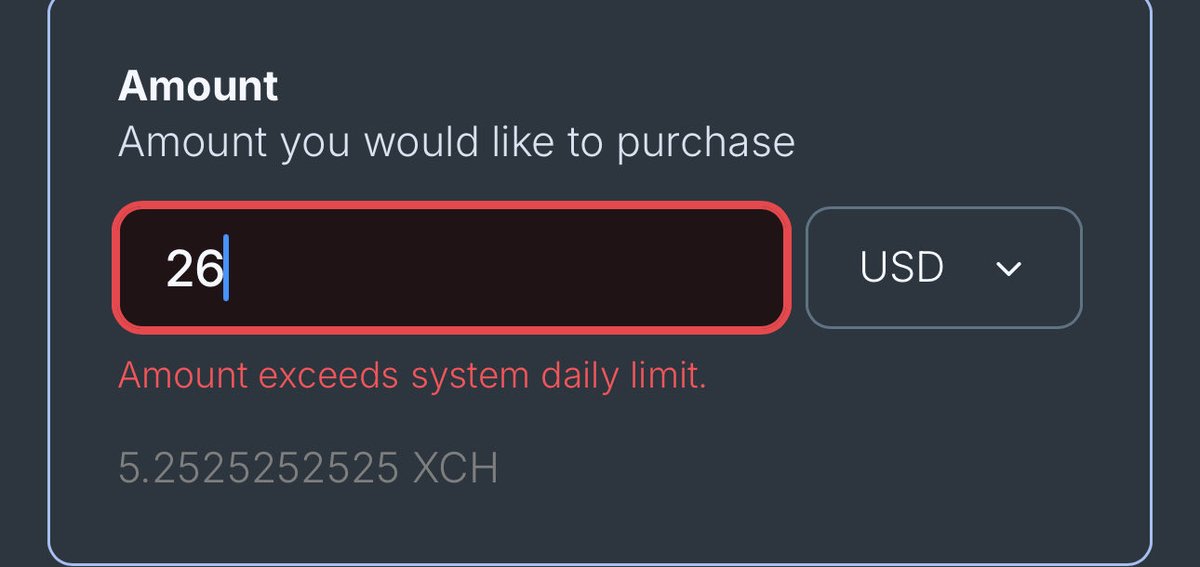
Is anyone able to buy XCH through ACH yet this week? Still getting this message even though no daily buys.
1
41
15 Nov 2025
What would it take for Chia to equal Cardano in terms of adoption, technology, and decentralization?
It was interesting in hear Bram and Charles briefly meet and discuss blockchain tech on a space a few days ago. Cardano is very similar to Chia and if for no other reason than it's older than Chia I would ask how compatible the two are in terms of smart contract development and use cases. I largely see Cardano as having almost no adoption but very similar in technology as Chia. Is this an issue with UTXO and does Chia suffer the same fate or is @hoffmang a genius at honing in on real world use cases (rather than focusing on mostly protocol development)? Given @bramcohen said he almost knew nothing of the papers or research @IOHK_Charles was bringing up in spaces, I can't help but think there could be a beneficial collaboration between the two.
I can't be the only one thinking this...
2
140
AdamJordan retweeted

27 Oct 2025
Actually, obligatory:
Two economists are walking in a forest when they come across a pile of shit.
The first economist says to the other “I’ll pay you $100 to eat that pile of shit.”
The second economist takes the $100 and eats the pile of shit.
They continue walking until they come across a second pile of shit.
The second economist turns to the first and says “I’ll pay you $100 to eat that pile of shit.”
The first economist takes the $100 and eats a pile of shit.
Walking a little more, the first economist looks at the second and says, "You know, I gave you $100 to eat shit, then you gave me back the same $100 to eat shit. I can't help but feel like we both just ate shit for nothing."
"That's not true", responded the second economist. "We increased the GDP by $200!"
26 Oct 2025

Every dollar spent on food stamps creates $1.50 in economic activity.
Only the economically illiterate want to cut food stamps.
1,317
8,836
86,117
18,358,856
24 Sep 2025
Ironic how Russia may have (partially) started this war due to Ukraine looking to develop their o&g production and take EU market share from them. Now the US continues to take market share and is positioned the best in the world to scale up production even more. Given this, Russia cannot continue this war indefinitely or they will continue to haemorrhage money and market share. They must think they can capture more territory before agreeing to a deal where Ukraine gets serious security guarantees. Then sanctions come off, pipelines get turned back on, etc. and they can tap into the newly aquired gas reserves in the Kharkiv and Donbas regions. You can see Russia is pushing to take Kharkiv and if that happens the war, for them, can end.
24 Sep 2025

🇺🇸🇪🇺 RIP EUROPE:
"America is now ready to completely replace all Russian gas supplied to Europe, as well as all Russian oil products...
We have the capacity. We are ready to meet their needs."
— US Energy Secretary Chris Wright
2
264

6 Sep 2025
DOA
6 Sep 2025

On Tempo, permissionlessness, L1 vs L2
Tempo will be a permissionless chain. On day 1, anyone will be able to deploy a token, and anyone will be able to transact on the chain. Some projects think that attracting real-world usage and serious institutions requires giving up on base layer neutrality. We do not think that, and that's not how we're building Tempo.
The plan for Tempo is to have permissionless validation and permissionless smart contract deployment as well as permissionless usage: just like Bitcoin, Ethereum, Solana, etc. We’ll start with a permissioned validator set to get going and decentralize further from there.
We’re building in features to make it easy for entities interacting with the blockchain (like asset issuers, money transmitters, etc.) to comply with their relevant obligations, but the base layer will remain neutral. This is a principle we feel incredibly strongly about (see: paradigm.xyz/2022/09/base-la…).
As many parts of the mainstream world look to adopt crypto, we think there is a risk that they adopt permissioned systems. Our goal with Tempo is to help onboard them onto crypto rails that solve specific payments needs while still being truly permissionless.
—
Why L1 rather than an Ethereum L2?
At Paradigm, we are heavily invested, both intellectually and literally, in the Ethereum ecosystem. We will continue to help it scale, and invest in and support companies building on Ethereum. We are also extremely excited about single-sequencer L2s for many use cases, including trading.
But building a network for global payments will require bringing together thousands of partners that may not trust us, or Stripe, or anyone as a platform. We think a decentralized validator set—for the chain itself—is a necessary requirement for those partners, and to ensure that the chain is unquestionably neutral in the long run.
From an operational perspective, we feel urgency to build for the demand that’s coming and want fewer dependencies, including on the rate of Ethereum L1 progress. With Tempo, we tried to remove all crypto tribalism and alignment games from our thinking and just focus on building the right product for crypto payments.
At a technical level, we are prioritizing attributes like fast finality (L2s are generally only as final as the underlying L1), multiple validators (vs. single sequencer), and custom transaction lanes and gas pricing. Some of these are technically possible for an L2, but could be complex, slow to implement, and/or introduce many external dependencies. Tempo is stablecoin-focused, so interoperability through native issuance is more relevant to us than the native bridge to Ethereum that L2s have.
We aren’t Bitcoin, Ethereum, or Tempo maximalists. We’re maximalists for permissionless crypto. We want Ethereum L1 to scale, and we want L2s to thrive. We love Bitcoin as a monetary asset. We find substance in Solana, Hyperliquid, and many other ecosystems. We want to ensure real-world payment flows happen on crypto rails, and that’s why we’re building Tempo.
1
1
313
3 Sep 2025
Chia Inc. will become the first public XCH treasury, strategy company. After the IPO, shareholders will buy the stock to get exposure to XCH. Similar to Microstrategy, using cash flow from their software services to acquire more XCH. Their holdings and yield on the holdings will eclipse the revenue generated from software services and will allow them to use leverage to buy even more XCH and push to price of XCH higher.
3
3
24
1,516
26 Aug 2025
My initial concerns were actually valid and eventually fixed.
5 Jan 2025

I think I see what you mean.. if the service built on the "proof of service" is something like GPU compute where the payee can tell if the service part is running at an expected benchmark.. it's all good bc they can, like you said, get penalized if they are fraudulently marking "valid shares" for a mirror when not valid. When I was reading the DIP it kept on making me think of storage which I think is harder to benchmark if you are the payee but could possibly be done correctly I suppose.
Sorry for asking such a pointed question but it's hard enough to wrap my head around this concept and hopefully it helps others understand too. Anyway, I'm sure there will be more to come and more breakthroughs regarding the actual service part after this is built.
175
AdamJordan retweeted

8 Aug 2025
Great clip on the Federal Reserve.
Show this to everyone you know.
1,127
25,583
59,934
3,419,084
22 Jul 2025
Is Ethereum making a comeback? Good interview with Lubin. youtu.be/VtE9EsITIps?si=zxJ3…
205
9 Jul 2025
Follow up comparing Ethereum 2030 protocol roadmap vs Chia. Puts into perspective the different approaches and IMO bodes well for Chia given the current potential for state channels. Also, many blockchains are perusing the Ethereum vision using ZK rollups and hardly anyone, with exception to Cardano, is focusing on state channels. If Chia can pull this off, it will be in a league of it's own.
9 Jul 2025
Comparing Georgios Konstantopoulos’ proposed SNARK-based Proof of Work (zkPoW) system with statelessness for Ethereum against the use of state channels as a scaling solution.
Evaluating both approaches based on scalability, efficiency, decentralization, privacy, economic implications, and implementation considerations.
1. SNARK-based zkPoW with Statelessness
Concept: Replaces Ethereum’s Proof of Stake (PoS) with a zkPoW consensus mechanism using SNARK proofs to verify transaction batches off-chain, integrated with statelessness to reduce node storage needs. Proposers generate proofs using a decentralized prover network (e.g., inspired by Succinct), with adaptive difficulty and ZK-EVM ASICs driving efficiency.
Timeline: Estimated 4.5-6 years (2025-2031) for full implementation on Ethereum.
2. State Channels
Concept: An off-chain scaling solution where transactions between parties are conducted off-chain within a multi-signature or smart contract channel, with only the final state settled on-chain. This reduces on-chain load while maintaining security via the underlying blockchain.
Comparison 1. Scalability
zkPoW with Statelessness:Benefit: Enhances L1 throughput to 10,000 TPS by eliminating re-execution and leveraging IVC, as per the 2023 Stanford study. Statelessness allows higher gas limits and faster blocks (e.g., 0.5-1 second), reducing L2 dependency.
Limitation: Initial rollout may face bottlenecks during the 6-year transition, with full scalability contingent on prover network adoption and ASIC proliferation.
State Channels: Benefit: Enables near-instantaneous off-chain transactions (e.g., Lightning handles 1 million TPS theoretically), ideal for high-frequency use cases like payments. Only final states are recorded on-chain, reducing load (per Rapid Innovation, 2024-09-19).
Limitation: Scalability is limited to channel participants; opening/closing channels adds on-chain costs, and network-wide adoption requires widespread channel infrastructure.
Winner: State channels offer immediate scalability for specific use cases, while zkPoW promises broader L1 scalability long-term.
Comparison 2. Efficiency (Energy and Compute)
zkPoW with Statelessness: Benefit: IVC reduces wasted energy compared to traditional PoW, potentially achieving 50-70% efficiency gains over pre-Merge Ethereum PoW. Statelessness minimizes node compute needs, per Ethereum’s 2024 Roadmap.
Limitation: ASIC development and prover network operations may increase energy use initially, though adaptive difficulty could mitigate this.
State Channels: Benefit: Highly energy-efficient as most work occurs off-chain, with minimal on-chain settlement (e.g., Lightning uses <1% of Bitcoin’s energy, per 2023 Cambridge data).
Limitation: Channel management (e.g., opening, disputes) incurs periodic on-chain costs, and scaling to millions of channels requires robust off-chain infrastructure.
Winner: State channels are more efficient short-term; zkPoW could match or exceed this post-2031 with optimization.
Comparison 3. Decentralization
zkPoW with Statelessness: Benefit: Statelessness lowers node entry barriers (e.g., 50,000 nodes vs. 10,000 today), and a decentralized prover network (e.g., Succinct-inspired) distributes trust. However, ASIC centralization risks (e.g., 3-5 manufacturers) could emerge.
Limitation: Transition governance and hardware reliance may concentrate power during rollout.
State Channels: Benefit: Preserves blockchain decentralization, with channels managed peer-to-peer, avoiding new consensus layers.
Limitation: Requires channel hubs or watchtowers for scalability, potentially centralizing control (e.g., Lightning hubs in 2024).
Winner: State channels maintain existing decentralization better; zkPoW’s long-term decentralization depends on ASIC diversity.
Comparison 4. Privacy
zkPoW with Statelessness: Benefit: ZK proofs enable confidential transactions and smart contracts, unlocking institutional use cases (e.g., Chainlink’s 2025 ZKP applications), with proofs hiding transaction details.
Limitation: Privacy is contingent on proof design; MEV distribution may still expose patterns.
State Channels:Benefit: Off-chain transactions are private between participants, with only final states public, suitable for payments (e.g., Lightning privacy features).
Limitation: Privacy is limited to channel participants; external interactions require on-chain exposure.
Winner: zkPoW offers broader privacy for complex dApps; state channels excel in peer-to-peer privacy.
Comparison 5. Economic Implications
zkPoW with Statelessness: Benefit: Reduced gas fees ($0.50-$1 vs. $10-$50) and a new prover revenue stream ($5-10 billion annually) could boost ecosystem growth. ZK-EVM ASICs may create a $10-20 billion industry (Gartner, 2024).
Limitation: High initial R&D costs ($50-100 million) and potential staking reward loss ($10 billion) during transition.
State Channels:Benefit: Low operational costs for users, with fees paid off-chain, and no major protocol overhaul needed. Celer Network targets billions of TPS at minimal cost.
Limitation: Channel funding locks capital, and hub operators may charge fees, reducing user savings.
Winner: State channels are economically viable now; zkPoW’s benefits accrue long-term with higher ecosystem investment.
Comparison 6. Implementation and Adoption
zkPoW with Statelessness: Benefit: Leverages Ethereum’s mature ecosystem ($400 billion TVL) and ZK rollup experience (e.g., zkSync), with a clear path via hybrid models.
Limitation: 6-year timeline, governance challenges, and ASIC adoption risks (e.g., chain splits).
State Channels: Benefit: Quick deployment (1-2 years for new networks), with proven models (e.g., Lightning, Raiden). Open protocols like Celer encourage developer adoption.
Limitation: Requires user education and infrastructure (e.g., channel hubs), with adoption lagging (e.g., Lightning’s 15,000 nodes vs. Bitcoin’s 100,000).
Winner: State channels are faster to implement; zkPoW’s complexity delays adoption.
7. Use Case Suitability
zkPoW with Statelessness:Strength: Ideal for complex dApps (DeFi, NFTs, AI on-chain) requiring high throughput and privacy, leveraging Ethereum’s $400 billion ecosystem.
Weakness: Less suited for simple payments due to L1 focus.
State Channels: Strength: Perfect for high-frequency, low-value transactions (e.g., micropayments, gaming), as seen with Lightning’s 2024 adoption.
Weakness: Struggles with multi-party or stateful dApp interactions.
Winner: Depends on use case—zkPoW for dApps, state channels for payments.
1
210
9 Jul 2025
Does anyone even care about Ethereum advancements? Prover networks and statelessness is next level shit. Smh.
95
9 Jul 2025
Comparing Georgios Konstantopoulos’ proposed SNARK-based Proof of Work (zkPoW) system with statelessness for Ethereum against the use of state channels as a scaling solution.
Evaluating both approaches based on scalability, efficiency, decentralization, privacy, economic implications, and implementation considerations.
1. SNARK-based zkPoW with Statelessness
Concept: Replaces Ethereum’s Proof of Stake (PoS) with a zkPoW consensus mechanism using SNARK proofs to verify transaction batches off-chain, integrated with statelessness to reduce node storage needs. Proposers generate proofs using a decentralized prover network (e.g., inspired by Succinct), with adaptive difficulty and ZK-EVM ASICs driving efficiency.
Timeline: Estimated 4.5-6 years (2025-2031) for full implementation on Ethereum.
2. State Channels
Concept: An off-chain scaling solution where transactions between parties are conducted off-chain within a multi-signature or smart contract channel, with only the final state settled on-chain. This reduces on-chain load while maintaining security via the underlying blockchain.
Comparison 1. Scalability
zkPoW with Statelessness:Benefit: Enhances L1 throughput to 10,000 TPS by eliminating re-execution and leveraging IVC, as per the 2023 Stanford study. Statelessness allows higher gas limits and faster blocks (e.g., 0.5-1 second), reducing L2 dependency.
Limitation: Initial rollout may face bottlenecks during the 6-year transition, with full scalability contingent on prover network adoption and ASIC proliferation.
State Channels: Benefit: Enables near-instantaneous off-chain transactions (e.g., Lightning handles 1 million TPS theoretically), ideal for high-frequency use cases like payments. Only final states are recorded on-chain, reducing load (per Rapid Innovation, 2024-09-19).
Limitation: Scalability is limited to channel participants; opening/closing channels adds on-chain costs, and network-wide adoption requires widespread channel infrastructure.
Winner: State channels offer immediate scalability for specific use cases, while zkPoW promises broader L1 scalability long-term.
Comparison 2. Efficiency (Energy and Compute)
zkPoW with Statelessness: Benefit: IVC reduces wasted energy compared to traditional PoW, potentially achieving 50-70% efficiency gains over pre-Merge Ethereum PoW. Statelessness minimizes node compute needs, per Ethereum’s 2024 Roadmap.
Limitation: ASIC development and prover network operations may increase energy use initially, though adaptive difficulty could mitigate this.
State Channels: Benefit: Highly energy-efficient as most work occurs off-chain, with minimal on-chain settlement (e.g., Lightning uses <1% of Bitcoin’s energy, per 2023 Cambridge data).
Limitation: Channel management (e.g., opening, disputes) incurs periodic on-chain costs, and scaling to millions of channels requires robust off-chain infrastructure.
Winner: State channels are more efficient short-term; zkPoW could match or exceed this post-2031 with optimization.
Comparison 3. Decentralization
zkPoW with Statelessness: Benefit: Statelessness lowers node entry barriers (e.g., 50,000 nodes vs. 10,000 today), and a decentralized prover network (e.g., Succinct-inspired) distributes trust. However, ASIC centralization risks (e.g., 3-5 manufacturers) could emerge.
Limitation: Transition governance and hardware reliance may concentrate power during rollout.
State Channels: Benefit: Preserves blockchain decentralization, with channels managed peer-to-peer, avoiding new consensus layers.
Limitation: Requires channel hubs or watchtowers for scalability, potentially centralizing control (e.g., Lightning hubs in 2024).
Winner: State channels maintain existing decentralization better; zkPoW’s long-term decentralization depends on ASIC diversity.
Comparison 4. Privacy
zkPoW with Statelessness: Benefit: ZK proofs enable confidential transactions and smart contracts, unlocking institutional use cases (e.g., Chainlink’s 2025 ZKP applications), with proofs hiding transaction details.
Limitation: Privacy is contingent on proof design; MEV distribution may still expose patterns.
State Channels:Benefit: Off-chain transactions are private between participants, with only final states public, suitable for payments (e.g., Lightning privacy features).
Limitation: Privacy is limited to channel participants; external interactions require on-chain exposure.
Winner: zkPoW offers broader privacy for complex dApps; state channels excel in peer-to-peer privacy.
Comparison 5. Economic Implications
zkPoW with Statelessness: Benefit: Reduced gas fees ($0.50-$1 vs. $10-$50) and a new prover revenue stream ($5-10 billion annually) could boost ecosystem growth. ZK-EVM ASICs may create a $10-20 billion industry (Gartner, 2024).
Limitation: High initial R&D costs ($50-100 million) and potential staking reward loss ($10 billion) during transition.
State Channels:Benefit: Low operational costs for users, with fees paid off-chain, and no major protocol overhaul needed. Celer Network targets billions of TPS at minimal cost.
Limitation: Channel funding locks capital, and hub operators may charge fees, reducing user savings.
Winner: State channels are economically viable now; zkPoW’s benefits accrue long-term with higher ecosystem investment.
Comparison 6. Implementation and Adoption
zkPoW with Statelessness: Benefit: Leverages Ethereum’s mature ecosystem ($400 billion TVL) and ZK rollup experience (e.g., zkSync), with a clear path via hybrid models.
Limitation: 6-year timeline, governance challenges, and ASIC adoption risks (e.g., chain splits).
State Channels: Benefit: Quick deployment (1-2 years for new networks), with proven models (e.g., Lightning, Raiden). Open protocols like Celer encourage developer adoption.
Limitation: Requires user education and infrastructure (e.g., channel hubs), with adoption lagging (e.g., Lightning’s 15,000 nodes vs. Bitcoin’s 100,000).
Winner: State channels are faster to implement; zkPoW’s complexity delays adoption.
7. Use Case Suitability
zkPoW with Statelessness:Strength: Ideal for complex dApps (DeFi, NFTs, AI on-chain) requiring high throughput and privacy, leveraging Ethereum’s $400 billion ecosystem.
Weakness: Less suited for simple payments due to L1 focus.
State Channels: Strength: Perfect for high-frequency, low-value transactions (e.g., micropayments, gaming), as seen with Lightning’s 2024 adoption.
Weakness: Struggles with multi-party or stateful dApp interactions.
Winner: Depends on use case—zkPoW for dApps, state channels for payments.
302