
Engineer | 💬 Engineering, Software, Sciences, History | 💼 : @CERN, @HumanBrainProj, Startups, @Woven_Toyota, @SKAO | ❤️: Happy husband and father of three
Joined December 2009
- Tweets 6,142
- Following 292
- Followers 251
- Likes 4,232
410 Photos and videos
















So follow-up on that 😉:
- The development of the language continue
- I missed my self-deadline for 2025. It is not ready yet. Mainly due to me being (very) picky on compiler performance.
- I will continue to work on that in 2026 since it triggered quite a lot of interest.
326
If you ever heard about Rakuten management practices in Japan, that should surprise absolutely nobody.
A Donkey under Ketamine would probably have better vision and leadership capabilities.
next.ink/brief_article/rakut…
54
Actually, both formats are bad and it is an insult to human intelligence that they are still so widespread in 2026.
JSON has still the excuse of design simplicity, Protobuf does not even has that for itself.

Makes sense. JSON has far more repeated/predictable bytes because every item duplicates the same keys, which is exactly the kind of redundancy LZ77-family compressors do well.
Protobuf actually has less per field overhead on the wire, that's why it's smaller uncompressed in the first place.
The remaining time gap depends on the data itself. Lots of unique high-entropy values (UUIDs, floats, random strings) and protobuf still wins compressed. Lots of repeated structure with small values and JSON closes the gap or beats it.
Protobuf strips redundancy at encoding time, gzip strips redundancy at compression time. JSON leaves the redundancy in and lets gzip do the work. So you're trading CPU (compress/decompress on every hop) for a payload that started bloated vs. protobuf which is already close to the information-theoretic floor, especially as item count grows.
74
It seems that two kicks in the balls (a russian one in 2022 Iran war in 2026) are a much more efficient way to convince people on electrification than 15y of continuously repeating "the planet is dying".
Quite a depressive fact on human kind.
pv-magazine.com/2026/05/04/h…
49
Artemis II, malgrés tous ses problèmes, me redonnent honnêtement foi dans l'humanité et redonne un sens au mot ambition dans le domaine spatial.
La vrai question qui suit est: Quand l'Europe va-t-elle finalement investir ce qu'il faut pour faire son propre lanceur habité ?
Apr 1

TELLEMENT CONTENT du lancement d’Artemis II 🚀
1.parce que c’est l’aventure de notre génération qui débute, et c’est pas tous les jours que l’on peut dire ça 🌍
2.parce que ce sont des collègues mais surtout des amis chers qui sont maintenant en route pour la Lune 🌕
3.parce que quand l’humain se donne du mal, il peut faire de grandes choses positives, et en ce moment ça fait du bien de se le rappeler ✨
/
SO excited about the launch of Artemis II 🚀
1.because it marks the beginning of our generation’s great adventure, and that’s not something you get to say every day 🌍
2.because they’re not just colleagues, but dear friends now on their way to the Moon 🌕
3.because when humanity truly commits, it can achieve great things, and it feels good to be reminded of that right now ✨
#artemisII #artemis #sls #lune
#artemisII #artemis #sls #lune @NASAArtemis @NASA @csa_asc @asc_csa @astro_reid @AstroVicGlover @Astro_Christina @Astro_Jeremy
1
134
Thank you to do the job that the French public TV service was unable to do.

27

Just a month later and...
🇪🇺 ChatControl is back!
Now they're trying to pass an even more far reaching ChatControl law through the back door, in a form even more intrusive than the originally rejected plan, without needing any of the EU countries votes
The new proposal:
- total mandatory surveillance of ALL text chats, emails and social media in the EU
- obligatory registration of your ID/passport to your chat, email or social media account
- minimum age requirement for chat, email and social media apps of 16 (!)
The only way to stop this law is if EU countries veto it
Read more here by @echo_pbreyer:
patrick-breyer.de/en/chat-co…
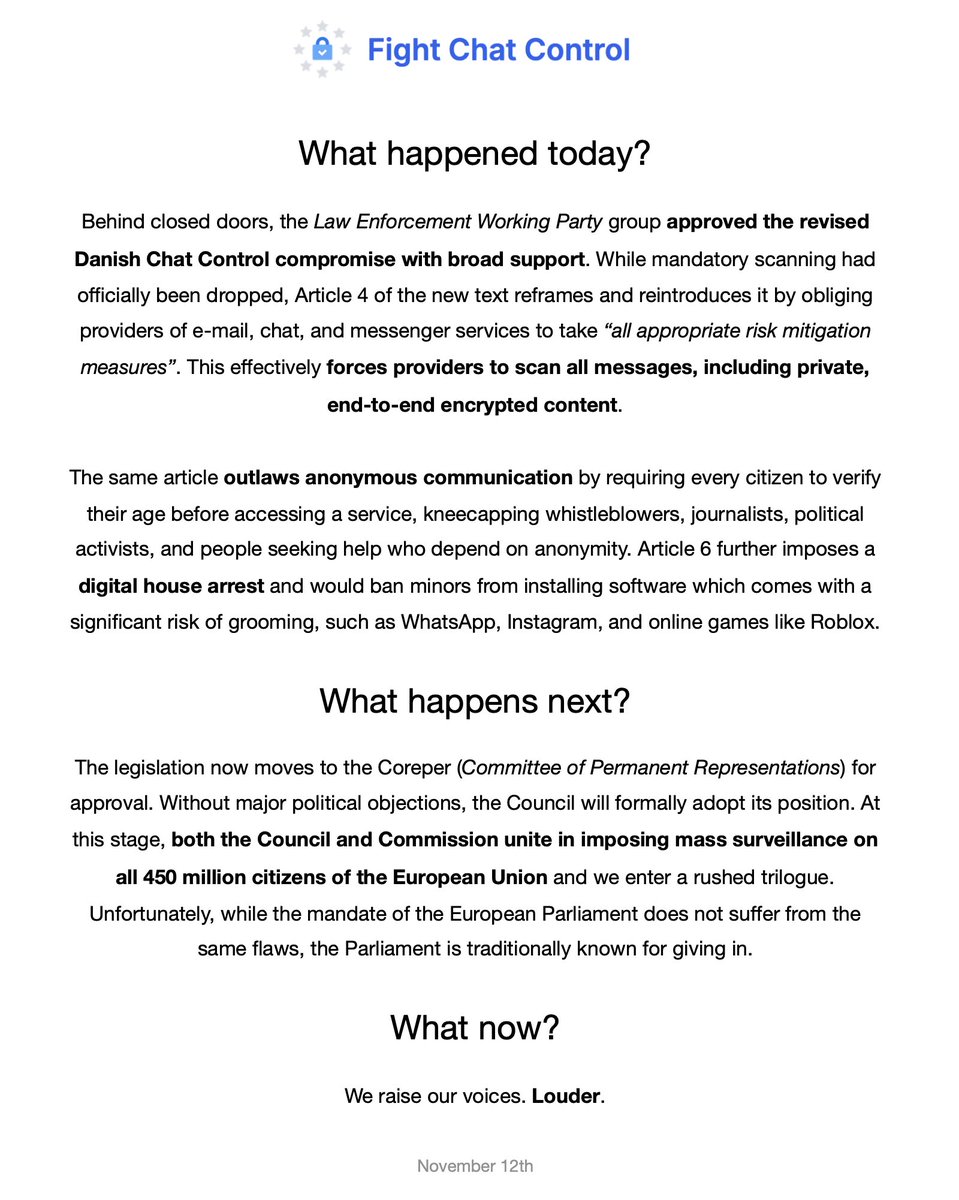

Freedom won today!
🚫 No ChatControl in EU
Now keep this snooping on people's private messages off the 🇪🇺 EU's agenda forever please
528
4,134
14,950
1,852,491
Chat control est une proposition liberticide, antidémocratique et inefficace.
fightchatcontrol.eu/?foo=bar
Le fait de voir le @RNational_off voter en faveur n'est pas étonnant.
Par contre le fait de voir @Renaissance, @lesRepublicains , @partisocialiste voter pour est pitoyable
1/2
6
2
62
@jnbarrot @Eric_R_Lombard @ClaraChappaz La position du gouvernement sur le sujet est une honte pour le pays des droits de l'homme.
Je vous invite fortement à reconsidérer cela.
Le pays devrait utiliser cette occasion pour se démarquer et défendre objectivement ses valeurs.
1
31


Quite a number of municipalities might swing extreme left or extreme right. The election evening will be:
lemonde.fr/politique/live/20…
66
And it is only the beginning, my friend.
Moreover, if I trust the number of Chinese Hybrid available in the showrooms, the choice of some EU constructors to 'get back to ICE' (Hello Stellantis) will turn into the final death trap.
lefigaro.fr/conjoncture/auto…
2
60
This is honestly for this kind of gems that I stay on Twitter.
Mar 19

I found the main plot arc of a bunch of relgious fanatics bringing a hegemonic empire to heel by destroing the flow of their most precious resource after they had assassinated their leader's father far fetched.
30
Pretty gem of a post from @apenwarr on reviews and A.I coding tool
apenwarr.ca/log/20260316
I would say I agree on 98% of it.
30
The fact that hacked YouTube account are switching from crypto-scam to MAGA propaganda is fascinating.
Black hats always use the most lucrative method to capitalize on their hacks.
That brings the question: How are MAGA channels lucrative?
Mar 15

Audacieux la nouvelle direction de ta chaine @EzEdward1 mais t'as raison. il faut savoir évoluer. :d

1
1
1
124