
Joined November 2011
- Tweets 6,800
- Following 626
- Followers 188
- Likes 1,106
13 Photos and videos


Adam McCarthy retweeted

Jun 11
Well, we didn’t vote against it - we voted to discuss it later, and here’s why.
15
21
102
2,620
Adam McCarthy retweeted

Jun 11
Old conservative racism: "Blacks are lazy and on welfare."
New conservative racism: "Immigrants work too hard and are taking our jobs."
I argue that it would be easier for conservatives to give up these fake arguments and just admit they're racist. richardhanania.com/p/should-…
254
95
703
40,910
Adam McCarthy retweeted

#ableg
The Seppies are IMPLODING today!
Today’s rage bait is ‘Carney ‘destroyed Canada’
Nearly every claim in his AI thread is false, fabricated or stripped of context
This is what a foreign-funded disinfo campaign looks like
Let’s go through 5-claims with actual facts
…/2

Jun 10

Carney’s "Canada strong" has already turned out to be "Canada Destroyed".
He promised the "fastest-growing economy in the G7." He delivered the ONLY recession in the G7.
In 2025 he promised “free trade within Canada” by Canada Day. He delivered provinces blocking and vetoing pipelines, and Federal committee meetings describing pipelines as violence against women.
He promised a new approach to "spend less". He delivered $200,000 on inflight catering bills for himself and increased national budget deficits.
He promised unity and elbows-up. He delivered increased food bank lines, increased joblessness, increased homelessness, and multiple provinces seeking independence from confederation.
It’s time to get real and end the charade. This actor wasn’t even a drama teacher. Canada is broken, it’s time to move on.
This video didn’t age well. If this is what he said a year ago and we ended up in a recession, where will we be next year? For Albertans, October 19 is our chance to set a new path towards a brighter future for the next generation.
On Oct 19, vote to save Alberta‘s future. Vote option 2!
4
23
61
1,850
Adam McCarthy retweeted

Jun 8
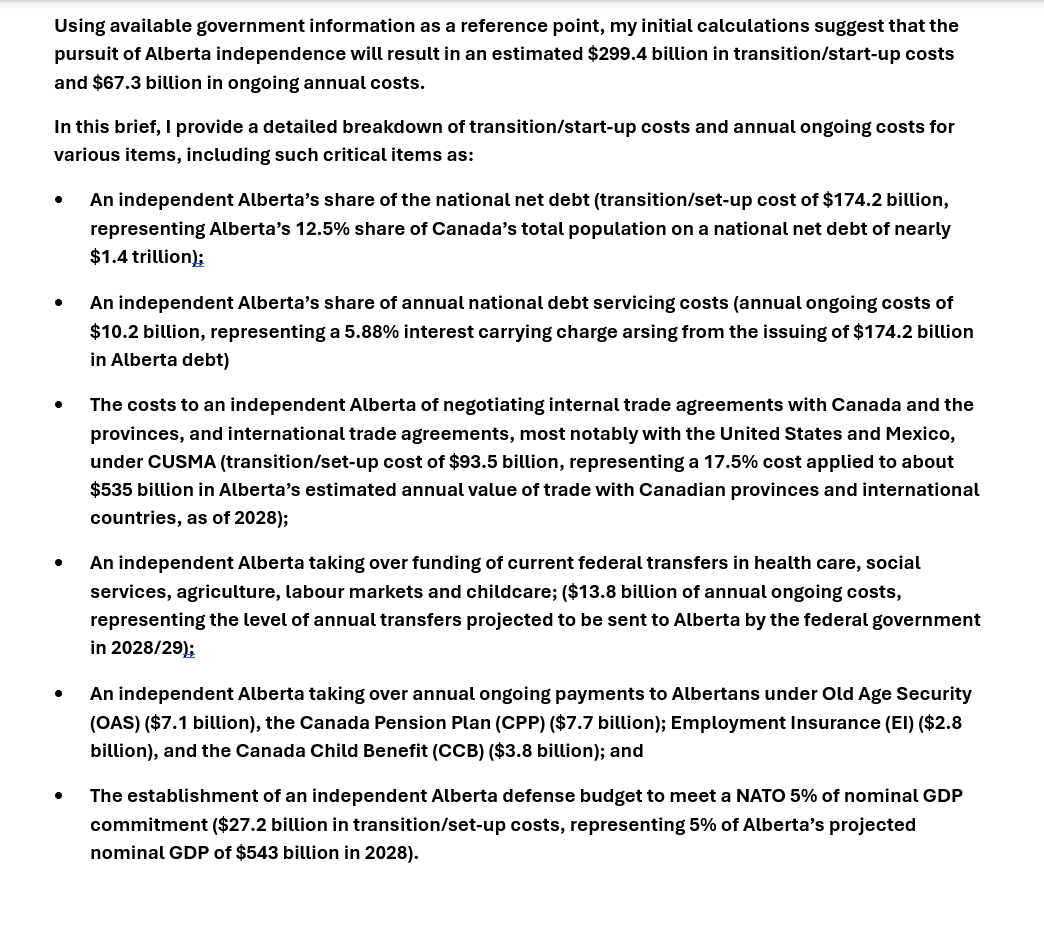
Some new calculations from Former Alberta Finance senior manager Lennie Kaplan.
He estimates that a separate Alberta would require $300 billion in start-up costs, along with $67B annually in ongoing costs.
44
75
133
16,106
Adam McCarthy retweeted

Jun 5
The continued decline in support for separatism is good news.
But a reminder to Alberta patriots: don’t be complacent. Don’t assume this is done!
There are 137 days to go, which is an eternity in politics.
While the separatists have almost never won more than 2% of the vote in 50 years of campaigning, there are a lot of frustrated federalists who think they can cast a risk free vote to “send a message” and gain leverage.
We need to remind those good people that Quebec’s “knife to the throat” strategy has been a huge failure, not a success, with Quebec becoming the poorest large population jurisdiction in North America (measured by per capita GDP,) with the highest taxes and debt. Becoming a big recipient of equalization is not something we Albertans aspire to!
In the 2021 equalization referendum, only 39% of eligible voters cast a ballot, and that was on the same day as a municipal election.
Imagine a similar or lower turnout in October. Hard core separatists, joined by a larger number of “send a message” federalists, could manage to get 20% of eligible voters to show up. On ~40% turnout, that might be all they need to push us into a political and economic crisis.
So please take this seriously. Get involved in one of the pro unity groups, speak to your friends and neighbours.
Make the case for Alberta to lead, not leave.

Only two in 10 Albertans want to hold a binding referendum on whether the province should stay in Canada, according to a new Ipsos poll (via @opinion) bloomberg.com/news/articles/…
268
83
402
34,332
Adam McCarthy retweeted

Jun 5
David - Mitch is our leader. He’s more than earned to spot. Everyone who refuses to follow his strategic and tactical direction is just posturing.
2
1
36
3,546
Adam McCarthy retweeted

Jun 4
Part of Mark Carney's appeal to normals is that he's mean to Liberals.

'He yells': Mark Carney's focus has Liberal MPs bristling .... an unflattering inside look from my colleague @althiaraj: thestar.com/politics/politic… via @torontostar #cdnpoli
29
28
329
49,897
Adam McCarthy retweeted

Powerful comments from @TravisToewsAB and @DrJaredWesley on why Alberta should Lead not Leave on The Current.
Worth your time.
cbc.ca/listen/live-radio/1-6…
2
9
17
2,384
Adam McCarthy retweeted

Never forget.
Never forgive.

Dozens of public health and disease experts have signed an open letter in support of the nationwide anti-racism protests.
"White supremacy is a lethal public health issue that predates and contributes to COVID-19," they wrote.
trib.al/iVynMCH
24
252
2,392
57,299
Adam McCarthy retweeted

A brilliant summary on why the so called separation movement hasn’t done its homework. And frankly is lead by a team of world class morons (excluding the thoughtful Keith Wilson whom I often disagree with but I do respect).
AB needs a better deal. Yup. calgaryherald.com/opinion/co…
237
15
92
44,797
Adam McCarthy retweeted

May 31
As @ikwilson SHOULD know, the question is not whether Alberta has the administrative capacity to take on more functions than it currently performs, because it obviously does. Alberta has a functioning legislature, courts, ministries, municipalities, public agencies, industry expertise, a large tax base, and enough professional, legal, financial, and technical capacity to govern many areas now handled federally.
The problem is that describing independence as Alberta “taking responsibility” for a few services Ottawa currently provides makes the issue sound much cleaner than it is. Border services, passports, immigration, tax collection, national parks, monetary policy, and defence are not just service-delivery files that can be moved from one level of government to another. They are functions of sovereignty, and sovereignty is not created by assigning new responsibilities to existing provincial departments.
Alberta independence would require a negotiated constitutional separation from Canada, and that negotiation would have to deal with citizenship, borders, currency, debt, assets, federal lands, national parks, pensions, trade access, Indigenous treaty rights, federal obligations, defence, international recognition, and the terms on which Canada and other countries would recognize and deal with the new state. None of that proves independence is impossible, but it does mean it is misleading to present the problem as though Alberta only needs to identify the federal services it wants to assume and then keep the money that currently goes to Ottawa.
The $23 billion claim has the same problem. Alberta is often a large net contributor to federal finances, and that is a legitimate grievance, but Alberta does not send $23 billion to Ottawa “through equalization.” Equalization is paid from federal general revenues. Albertans pay federal taxes, as Canadians, and Ottawa spends money across the country through transfers, benefits, payroll, procurement, pensions, infrastructure, Indigenous programs, and national services. If the argument is about Alberta’s net federal fiscal balance, then say that, because it is stronger and more accurate than using equalization as shorthand for everything Albertans resent about Ottawa.
Even then, a net federal fiscal contribution is not the same thing as a clean independence dividend. If Alberta stopped sending certain revenues to Ottawa, federal spending in Alberta would also change, and Alberta would have to replace federal functions, negotiate liabilities and assets, build or duplicate institutions, and absorb whatever transition costs and market uncertainty came with separation. Some people may still think that tradeoff is worth it, but it has to be argued honestly.
Monetary policy shows why this matters. If an independent Alberta used the Canadian dollar, it would not control monetary policy. If it created its own currency, it would need a central bank, reserves, banking supervision, deposit insurance, payment systems, and credibility with citizens, lenders, businesses, and investors. If it tried to negotiate a currency arrangement with Canada, Canada would have its own interests and conditions. None of those options is impossible, but none is just a matter of Alberta being competent enough to take over the file.
Borders are similar. Alberta currently has an international border with the United States. An independent Alberta would also have a border with Canada, and the consequences would depend on negotiated arrangements for goods, people, energy, livestock, rail, trucking, pipelines, ports, labour mobility, customs, immigration, and security. Alberta would not get to declare independence from Canada while simply assuming continued access to Canadian markets, infrastructure, institutions, and citizenship arrangements on whatever terms Alberta prefers. /1
May 29

As @JasonNixonAB knows, Alberta does not need to start a new country from scratch if we become independent.
Alberta independence means the Alberta Government taking responsibility for the few, known services Ottawa currently provides on our behalf.
An independent Alberta would assume and administer functions such as border services, passports, immigration, income tax collection, national parks, monetary policy, and a focused, specialized defence force.
And an independent Alberta would have the means to do it. More than $23 billion per year that currently leaves Alberta for Ottawa through equalization could instead stay here to fund Alberta's expanded responsibilities.
Not to mention the increased revenues from finally unleashing Alberta’s true economic potential by freeing ourselves from Ottawa-imposed constraints.
Alberta has the people, resources, institutions, and economic strength to take over the limited services and roles that Ottawa currently provides.
Independence is about replacing distant federal control with accountable Alberta decision-making—and freeing Albertans and our economy from Ottawa’s control.
30
14
58
27,548
Adam McCarthy retweeted

May 31
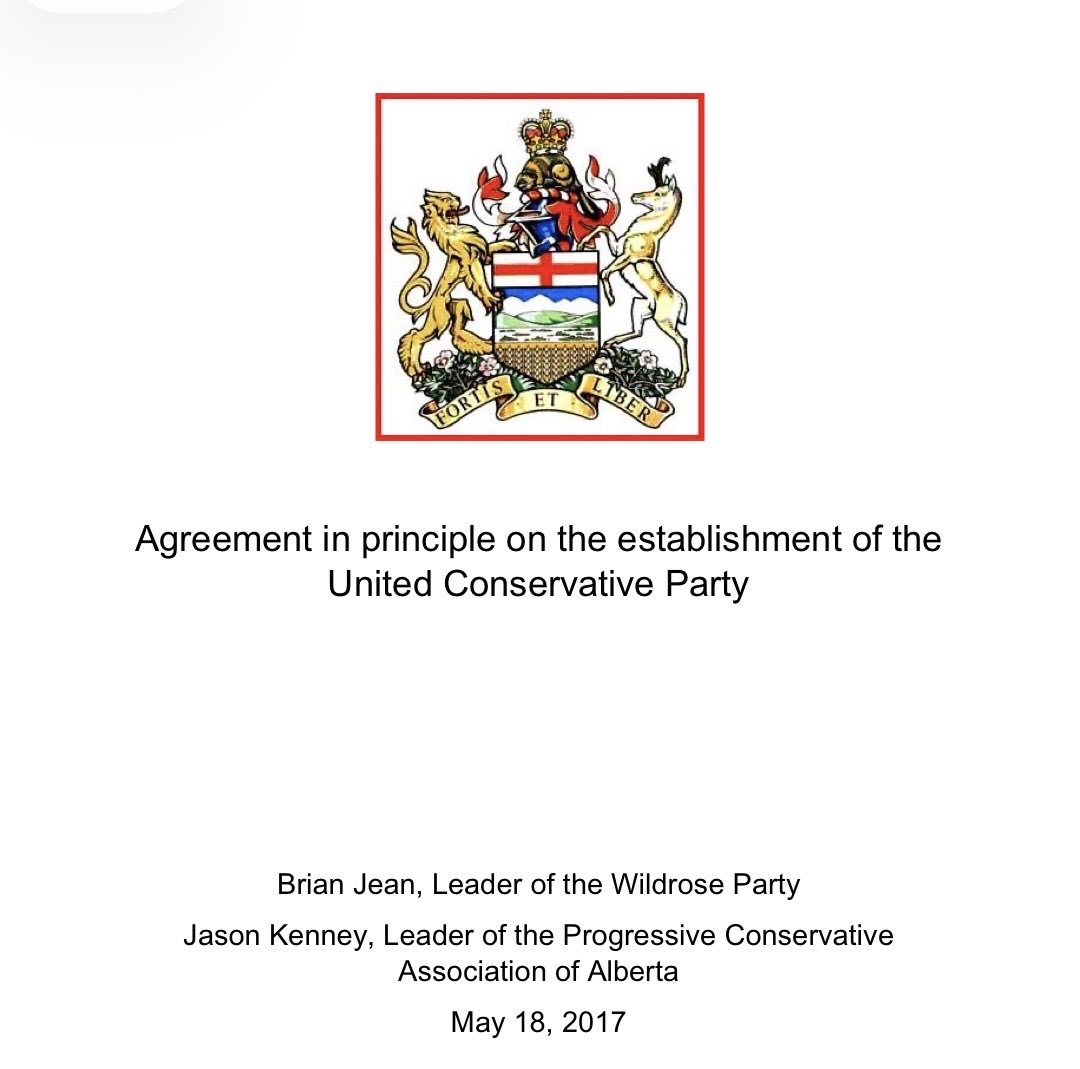
I mean, it’s literally there:

4
14
69
4,080
Adam McCarthy retweeted
May 30
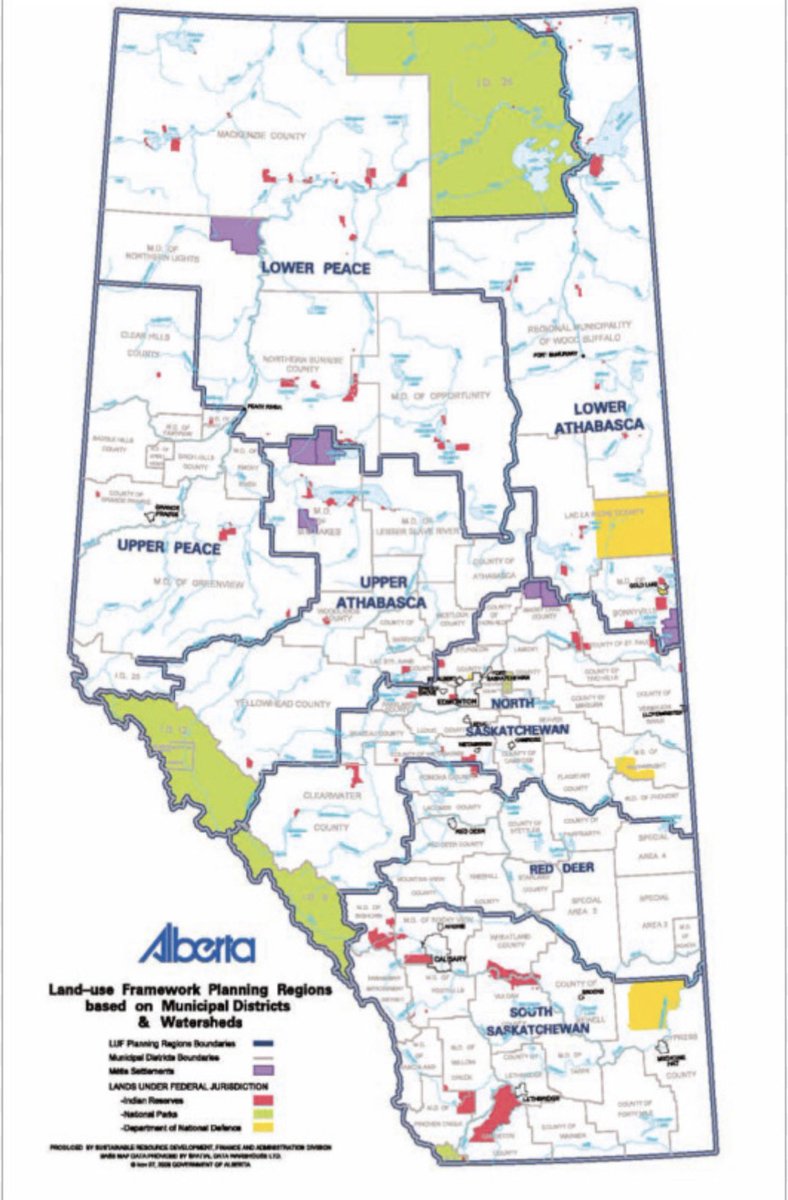
On issue after issue, separatists just wave their magic wand to wish away serious problems with secession.
Myth: “Federal lands and federal building (sic) don’t add up to much”
Fact:
- Wood Buffalo National Park
- Jasper National Park
- Banff National Park
- Waterton National Park
- Elk Island National Park
Together encompass 53,860 sq KM, or 8.2% of Alberta’s land mass
- CFB Cold Lake
- CFB Suffield
- CFB Wainwright
- CFB Edmonton
Together encompass ~12,000 sq KM, or 1.9% of Alberta’s land mass
- 138 Indian Reserves encompassing 6,556 sq KM, or 1% of Alberta’s land mass
- YEG and YYC airport lands, encompassing 49 sq KM
Plus hundreds of other parcels of land, buildings, etc, much of it prime downtown property (eg armouries, RCMP facilities.)
So ~12% of Alberta’s land mass, including some of the most valuable and strategically important in the province. The total value would be in the tens of billions of dollars.
But don’t worry, the separatists say. No biggie. We’ll just keep saying “Canada sucks” and stuff, cause facts are hard.
May 30

Federal lands and federal building don’t add up to much considering the big picture
When Alberta no longer pays for the equalization payments to Canada then the cost for federal buildings and lands will be paid for in no time.
773
234
1,150
293,123
Adam McCarthy retweeted
May 30
This is a selective reading of @jkenney's point.
Kenney was not saying UDI is the normal pathway, or that Canada would automatically refuse to negotiate after a clear referendum result. He was pushing back against a much broader assumption in separatist circles: that Alberta could leave Canada, whether through negotiation or some attempted unilateral route, while Albertans somehow retain all the practical benefits of Canadian citizenship indefinitely.
That is not a small detail. Citizenship carries obligations, liabilities, rights of entry, mobility rights, access to services, diplomatic protection, and long-term responsibilities for the state that grants it. If Alberta tried to break Confederation, especially in a way that caused major economic, constitutional, and political harm to Canada, it is not obvious that Canada would simply say, “No problem, keep the passport, keep the mobility rights, keep the benefits, and pass them down forever.”
@JasonLavigneAB's “two prerequisites” framing also confuses the issue. UDI is not a legal step inside the constitutional process that becomes available once certain boxes are checked. It is a political rupture outside the constitutional process. Alberta could attempt a UDI whenever it had enough political will to try, but that would not make it lawful, constitutional, or internationally recognized.
The Supreme Court’s Secession Reference did not create a UDI escape hatch. It said a clear vote creates an obligation to negotiate within the constitutional framework, not a unilateral legal right to secede. The Court’s discussion of UDI was about political reality, meaning that an unconstitutional declaration might become a fact on the ground if it succeeded and attracted recognition. That is not a legal remedy. It is a warning about what happens when constitutional politics breaks down.
So the citizenship question matters under either scenario. If separation were negotiated constitutionally, citizenship would be part of the negotiation. If Alberta attempted UDI, Canada would have even less reason to preserve the full benefits of Canadian citizenship for people trying to leave outside the constitutional framework.
Separatists keep assuming Alberta could leave Canada while keeping the parts of Canada that remain useful. Kenney’s point is that Canada would also have agency in that process, and the consequences would not be determined by Alberta alone.
May 29

Jason Kenney is at it again talking about an Unilateral Declaration of Independence (UDI) for Alberta.
Keep in mind two VERY important prerequisites before UDI is on the table.
One, a majority of Albertans voted to leave Canada on a binding constitutional referendum.
Two, Canada breaches both the Clarity Act and Reference decesion by the Supreme Court of Canada.
Before UDI is even considered, Canada must prove they cannot negotiate in good faith with Alberta after a peaceful, legal, and democratic process.
Is Kenney assuming that Canada is going to breach their legal obligations? Is he aware of something that we are not? Maybe he's advocating for Canada to violate their legal duty?
It's very odd that Kenney is even thinking and talking like this is a forgone conclusion. Does he have no faith in Canada to follow their own law?
Kenney, you are leaving out a very important part of the Supreme Court decesion, if Canada breaches it's obligations, the court recognized that UDI would be available to Alberta, and internationally recognized.
You should read it. Clearly you haven't.
20
13
77
19,365
Adam McCarthy retweeted

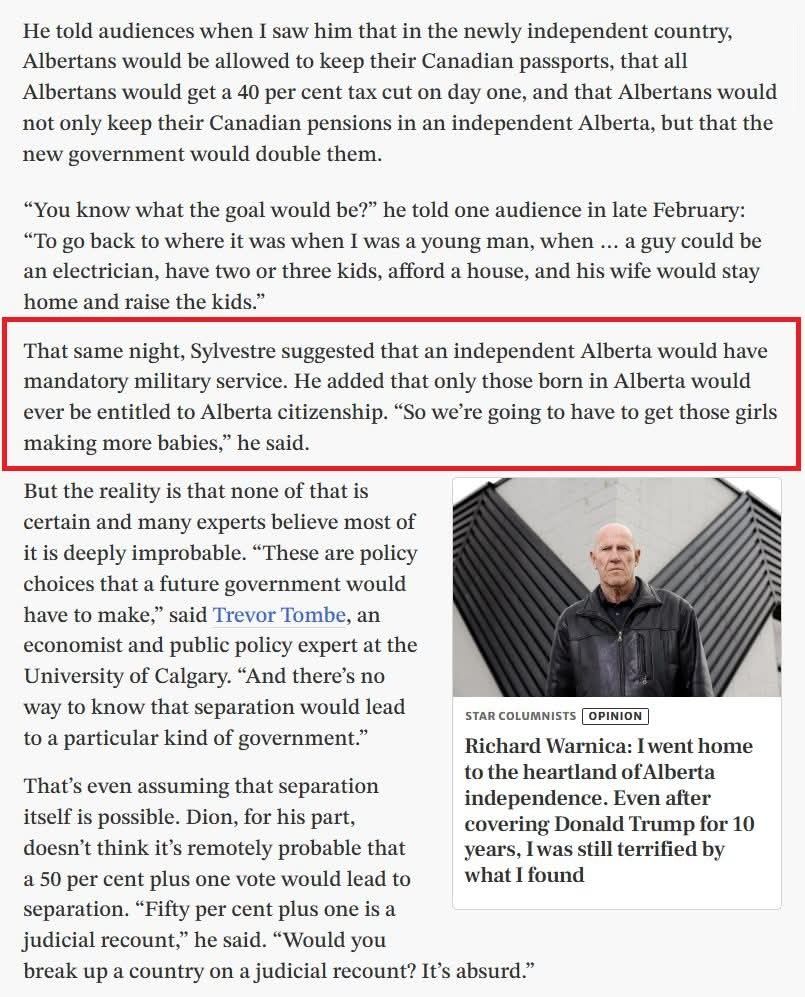
Albertans deserve to know exactly what some of the leading voices behind separation are advocating: mandatory military service, citizenship based on birthplace, and a vision of society that belongs in the past.
At a time when Calgary is attracting talent, investment, and opportunity from across Canada and around the world, the provincial referendum decision is giving oxygen to a movement that creates uncertainty, division, and risk.
Our city needs more homes, more jobs, more infrastructure, and stronger ties with the rest of Canada and the world. Instead, we're being dragged into a debate that threatens investment, undermines confidence, and distracts from the real challenges facing Albertans.
Calgary's future is as a growing, confident Canadian city. We must be focused on building that future, not legitimizing a movement that puts it at risk.
418
424
1,089
291,036
Adam McCarthy retweeted
#ableg
WOW!
The Premier just contradicted her own party president…live on radio.
Rob Smith: The party has NO position on separation
Danielle Smith: I speak for the party. We support staying
@CarrieTait just wrote the best question of 2026 in one sentence
The answer matters
May 27

In light of this interview, should Alberta Premier Danielle Smith remain the Leader of the UCP, or should the UCP's governing board commence the legal process requried under UCP bylaws to hold a binding party referendum on whether or not Ms. Smith should separate from the UCP?
6
60
157
4,916

May 27
Yep. Finally someone points this out.
May 27

"There would be massive start-up costs...We don't have independent courts; those would have to be set up. We don't have border control." -Danielle Smith
I would be thrilled to hear the Premier offer more of these point-by-point rebuttals of all of the separatist claims.
2
34
Adam McCarthy retweeted

What a surprise!
May 27

I heard they don’t spit on Christians in Russia or launder billions of our tax dollars on behalf of corrupt politicians.
I’m excited to report back my findings.
And honestly, the Zionist lore regarding Alexander Dugin (after I replied to him twice on X) is kind of making me want to meet him.
The weird cold-war propaganda is played out. It wasn’t effective during the media’s “russian collusion” era and it’s not effective now. St. Petersburg has always been on my bucket list. Never met a russian I didn’t like. 🤷♀️
16
25
459
14,284
Adam McCarthy retweeted

May 27
This tracks. Progress is a two way street. Like the time Albertans elected a provincial government opposed to Northern Gateway and KXL.
May 27

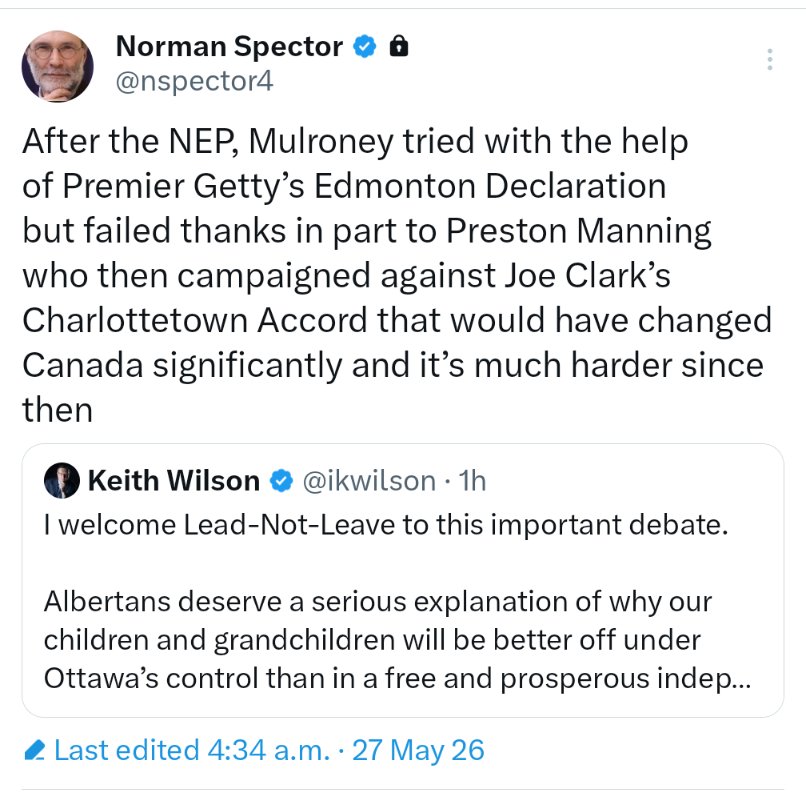
"After the NEP, Mulroney tried with help of Premier Getty’s Edmonton Declaration but failed thanks in part to Preston Manning who then campaigned against Joe Clark’s Charlottetown Accord that would have changed Canada significantly and it’s much harder since then" | @nspector4
2
3
887
May 27
I'm grateful for these good people and their work to make sure we keep our country together.

This morning @TravisToewsAB @jfdinning @PGarritty @trevortombe @andrew_leach @jengerson @DrJaredWesley and I launched Lead not Leave.
Read our joint statement here.
1/6
leadnotleave.ca
25