
Biz Adjunct, Love Twilight. Tweets liked by Ted Lieu, Steven Beschloss, Room Rater, E.L.James, Mark Hamill, J. Wine-Banks, Glenn Kirschner, Слава Україні!
Joined May 2010
- Tweets 145,354
- Following 1,936
- Followers 2,613
- Likes 368,583
10,313 Photos and videos








Pinned Tweet

I've taught economics and business for 20 yrs. Previously? Decades of work experience in banking, HR, owned a consulting firm.
Every STEM and Business teacher should post Hassett's words and ask their students to write 500 words on why he is a POS.
Hint: 70% of GDP = CONSUMERS

Hassett: If the war were to be extended, it wouldn't really disrupt the U.S. economy very much at all. It would hurt consumers, but that's really the last of our concerns right now.
4
4
6
3,541
This is why I'll never leave Twitter (cc @JustJoshinNH )
10h

I was told today by a 17-year-old that there was no way people were writing 10 page papers without Al.
Dude, I was writing 10 page papers without having read the book.
1
7
196
#VoteBlueForever #RejectFascism #Fight4Women #Vaxx retweeted

Jun 14
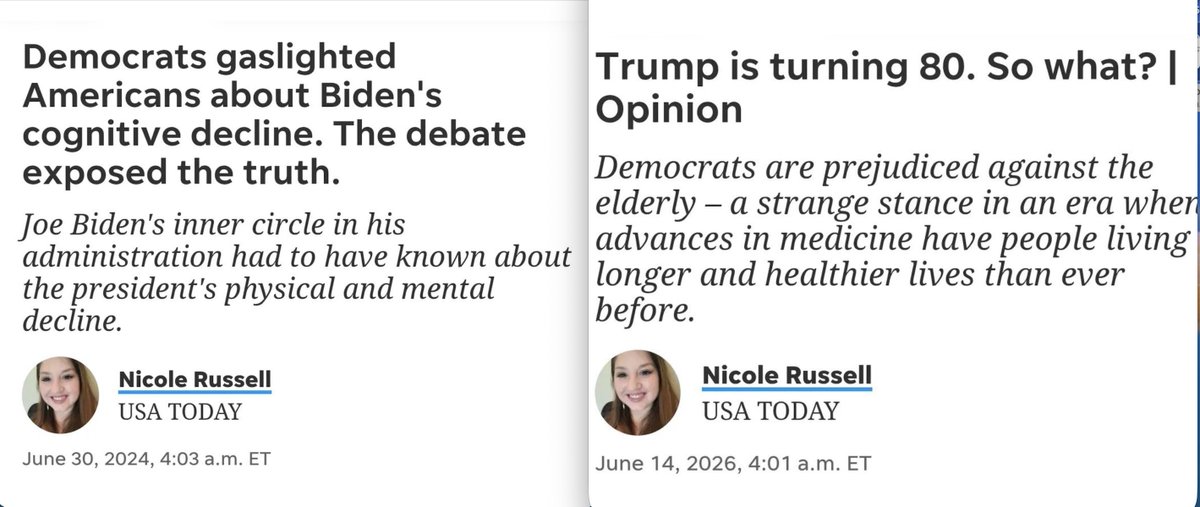
The double standard on the issue of age could not be clearer @russell_nm @USATODAY

7
153
618
14,817

Tweets I wish I'd tweeted


1
17
💯 those of us who were raised in republican homes know that the almighty dollar is more important than any other value.
Jun 13

Never forget that rape and pedophilia weren’t a dealbreaker for MAGA, but grocery prices were.
1
13
Hey, Kat. Maybe do some research. Musk built his empire on the backs of taxpayers by receiving grants and tax breaks. New York State provided an estimated $750 million to $1 billion in subsidies and infrastructure to Elon Musk's companies over the last decade. We want it back!
Jun 12

Why do the liberals feel like they're entitled to Elon Musk's money? I don't get it
2
30
#VoteBlueForever #RejectFascism #Fight4Women #Vaxx retweeted

Jun 13
Trying to put his name everywhere… We should just make him do it in Velcro cause there won’t be one left in 2028 that we won’t remove
1
7
98
Hub the facilities director asks why all the scaffolding when the whole job can be done in an hour by two people in a high lift.
#KennedyCenterRestored
25
#VoteBlueForever #RejectFascism #Fight4Women #Vaxx retweeted

Jun 11
The US is willingly falling behind the rest of the world on renewable energy because idiot Trump has a grudge against wind turbines.
18
48
695
13,693
Prediction; in a couple of years, Nehls will deny ever knowing the man.
Jun 11

Rep Troy Nehls (R-TX): Donald Trump is the greatest thing to happen in this country in 100 years
11
Studies show that the #1 predictor of student success isn't involved parent, lunch, or great teachers. It's attendance! But #1 reason for kids missing school isn't illness. It's a host of reasons: Missed bus, no ride to school. Student needs to stay home and watch siblings, etc.
Jun 11

You want to fix education?
Fix #8: Make attendance mean something again.
Let me break down Fix #8.
We have spent years debating curriculum, methodology, technology, and testing while a significant number of students are simply not in the building. Not struggling in the building. Not disengaged in the building. Not in the building. A child who misses thirty days of school in a year has missed six weeks of instruction, and no curriculum in the world closes that gap if she is not present to receive it. We talk about chronic absenteeism the way we talk about the weather, as something that happens to us rather than something we have the power to address. We have that backwards.
What does it mean in practice?
It means the first unexcused absence triggers a real response and not an automated phone call that nobody listens to. It means someone in the building knows why the child is not there and has a plan to address the barrier, whether that barrier is a bus that does not come, a parent who needs help getting her out the door, a situation at home that makes school feel impossible, or a building that never gave her a reason to want to be there. It means attendance data is looked at weekly and acted on immediately instead of reviewed at the end of the semester when the damage is already done. It means we stop accepting independent study packets as a substitute for being in the room, because a packet completed at home is not the same as a lesson taught by a teacher who can see when the student is lost.
How does this help kids?
Attendance is not a compliance issue. It is a learning issue. Every day a child is not in the building is a day she is not being taught, not building relationships with adults who can help her, not practicing the habit of showing up that she will need for every job she ever holds. Chronic absenteeism is one of the strongest predictors of dropout and it starts early. A student who misses ten percent of kindergarten is already on a trajectory that will follow her through every grade level unless someone intervenes. The intervention has to start with someone noticing and someone caring enough to find out why, and right now too many buildings have too few people with the time and the mandate to do either.
How do we make this happen?
We need attendance policies with real consequences that are applied consistently and humanely, which means understanding the difference between a family in crisis and a family that has decided school is optional and responding to each accordingly. We need counselors and social workers with actual caseloads that allow them to follow up with chronically absent students instead of adding names to a list that nobody gets through. We need schools that are worth attending, where kids have at least one adult who knows their name and notices when they are gone, because belonging is one of the most powerful attendance interventions we have, and it costs nothing except attention. We need to stop making it easy to be absent by accepting every excuse and issuing every waiver, and start asking honestly whether we have made the building a place the child wants to enter.
The goal is not perfect attendance for every student. The goal is a system that treats a missing child as a problem worth solving instead of a number worth recording.
#YouWantToFixEducation
1
30
#VoteBlueForever #RejectFascism #Fight4Women #Vaxx retweeted

Since Trump..
Ebola is back.
Whooping cough is back.
Measles is back.
Inflation is back.
Screw worm is back.
High gas prices is back.
Low wages is back.
Bigotry is back.
Hate is back.
Blatant lying is back.
Corruption is back.
I just want life under a sane president back..
1,760
6,749
18,167
185,534
#VoteBlueForever #RejectFascism #Fight4Women #Vaxx retweeted

His entire cabinet of sociopaths are like, “Whatever, just let him shitpost all day and night… we can continue grifting while he’s preoccupied.” He’s just a useless demented fool and the rest of the vampires just use his power to carry out their own grifting.
4
28
208
3,519
Sign in Lincoln, Nebraska. Pastor Adam Moline. Twitter knows what to do.
goodshepherdlincoln.org/good…

39
For Fs sake. Stop. Just stop. I loved school as ESCAPE abuse from mom. I taught PUBLIC school for 14 years. We kept a very close eye on our students, esp for bullying. F OFF

Elementary school damages some kids. Middle school damages most of them. Little kids are still hopeful and optimistic. But middle school? Brutality, vulgarity, exposure to sex and drugs, bullying. Your sweet, innocent child you raised carefully, put in an environment with the worst elements you can imagine.
And you don’t know about it. Ralph Waldo Emerson said it: parents pay the schoolmaster to teach their child, but it’s the schoolboys who actually educate him. Peer pressure is massive. What your kid won’t tell you about is what everyone else is doing. If you could listen in, you wouldn’t want your child exposed to half of it.
1
61
#VoteBlueForever #RejectFascism #Fight4Women #Vaxx retweeted

This entire website is devoted to convincing people that a demented dotard is a strongman, a midwit conman is a genius, and slot machines are conscious.
It’s just a psyop layer cake. There is no more signal on here.
19
108
528
5,074

May 27

Trump: "You take a look. The Lincoln Memorial -- it was built, I guess, a little after the Lincoln Memorial. It's embarrassing. It was so horrible. It was filthy dirty. It was Biden."
1
41
#VoteBlueForever #RejectFascism #Fight4Women #Vaxx retweeted

May 27
Why buy my book? Because as one reader puts it: “The opening scene alone is a shocker” while another found “situations I recognized from deep red redneck country. You'll worry about who will survive.”
Link in bio. Watch yourself as you walk this road…

7
25
76
1,291
Does anyone realize that this will never happen and that it is just a distraction from the orange moron's THIRD MEDICAL EXAM AND WE STILL DON'T HAVE THE EPSTEIN FILES?
May 26

NEW: Rep. Nancy Mace proposes no property tax for senior citizens.
18
💯
May 25

I don’t give a fuck that Trump went to the hospital. Call me when he goes to the morgue.
1
17