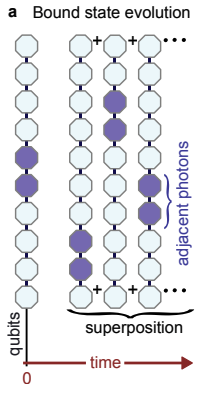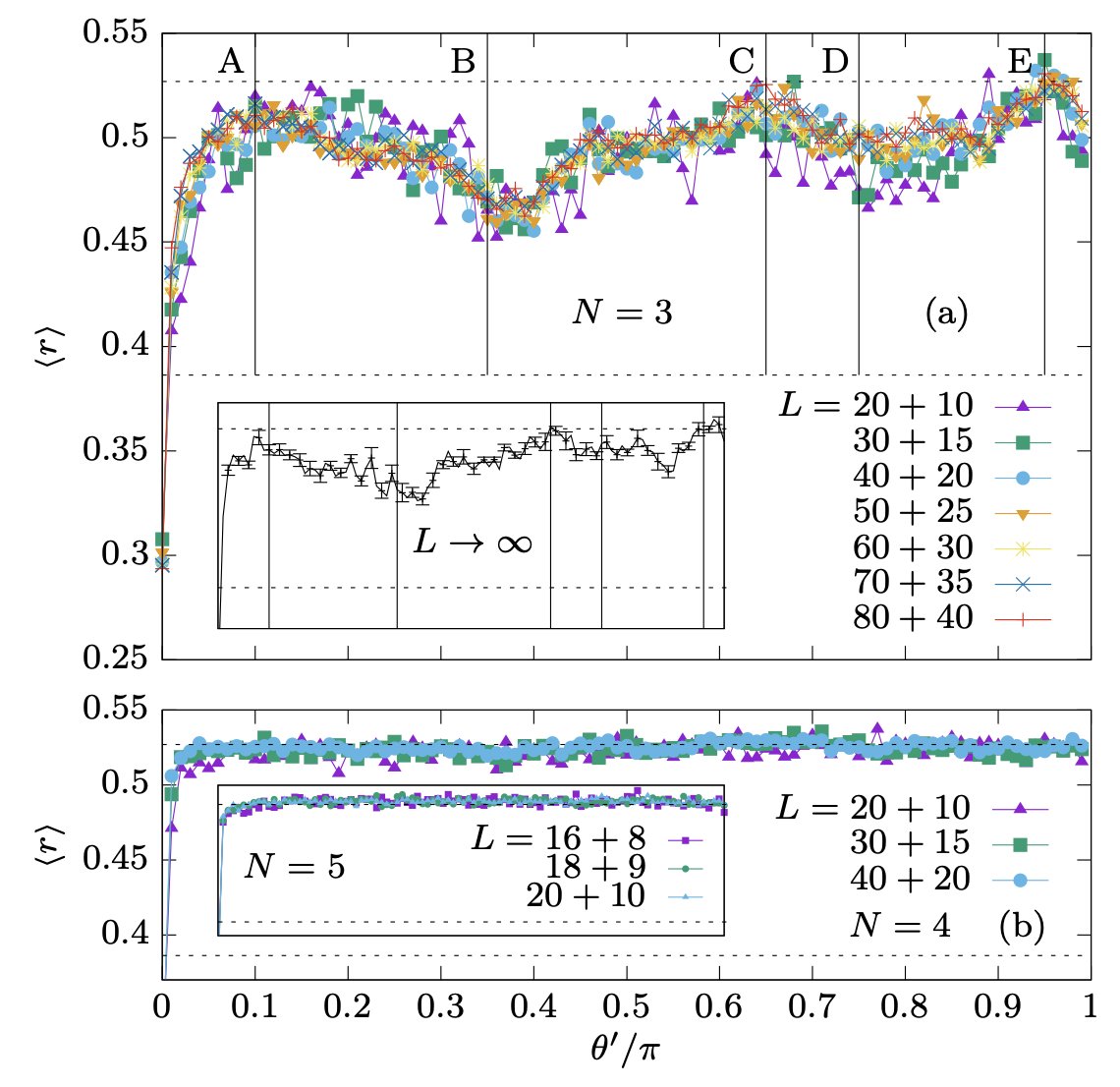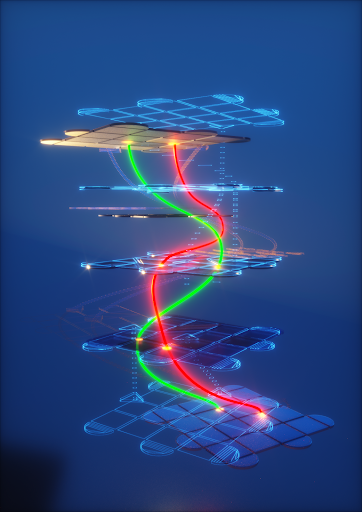
Photons traveling in vacuum do not interact. However, on a superconducting processor, microwave photons can be made to interact and form bound states. In @nature, we report on the surprising stability of these photon bundles.
nature.com/articles/s41586-0…
We just put on arXiv a long haul work on "bending" the time-dynamic of the surface code. We demonstrate error suppression from distance 3 to 5 for three different implementations on Willow. The three offer uniques venues for new hardware.
arxiv.org/abs/2412.14360
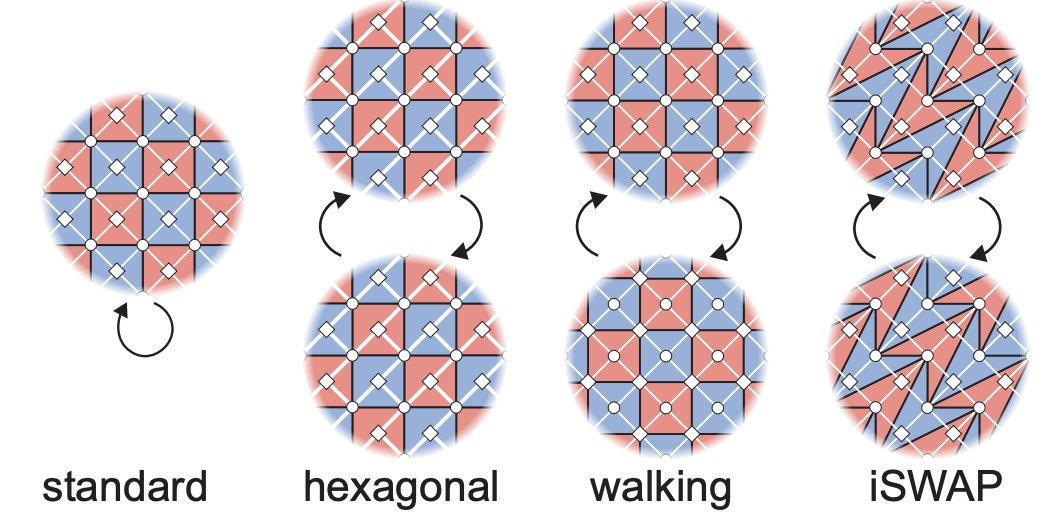
ALT End cycle stabilizer representation for four surface code implementation: Standard, the standard implementation used so far by every experiments. Hexagonal, where the surface code uses only gates on a hexagonal lattice. The end cycles of even and odd are different. The Walking implementation where data and ancilla exchanges roles and the iSWAP implementation that uses an iSWAP instead of a CZ/CNOT, giving the stabilizer the shape of arrowhead.
Two new papers from our team detailing how we optimize our gates and measurements. Our work on beyond-classical computation, Majorana edge modes, non-Abelian braiding and quantum error correction was enabled by these optimizations.
arxiv.org/abs/2308.02321arxiv.org/abs/2308.02079
As an experimentalist, seeing our work studied by other is extremely rewarding! I am really happy to see that our work sparked interest in the community!
We have performed large-scale classical simulations of @GoogleQuantumAI experiment on few-particle bound states in non-integrable XXZ circuits, finding more anomalous features in the dynamics: arxiv.org/abs/2307.13042 Thanks to @LeverhulmeTrust for support
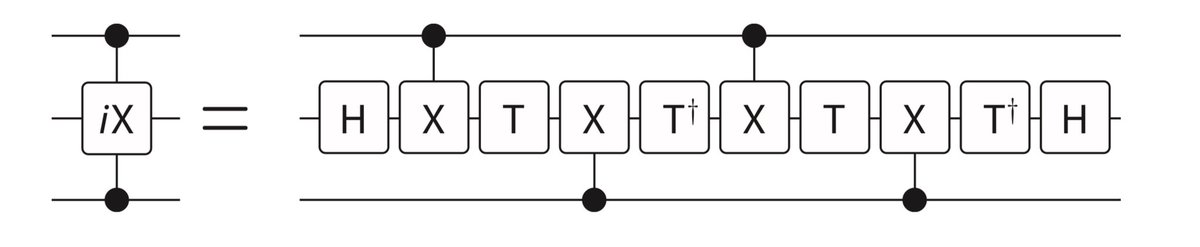
Remember that paper from the end of last year that claimed it could factor 2048 bit integers using 378 qubits? At the time, I mentioned to Tanuj Khattar that a nice starter paper would be to just simulate it and verify it doesn't work. Here's the result: arxiv.org/abs/2307.09651
Very exciting to see @NoahGossQuantum highlighted for his work on qutrit CZ. This work is particularly close to my heart as it’s the culmination of my time at @BerkeleyLab . I really hope that we will see more qutrit results in the future!
The theorist at @GoogleQuantumAI have put together a manuscript detailing when quantum circuit are “classically hard”. They also show that the IBM 127 qubits experiment result is indistinguishable from a 28qubits classical simulation arxiv.org/abs/2306.15970
We prefer XEB at @GoogleQuantumAI :p
Joke aside, I think for elements fidelity everyone has converged to some randomized benchmarking (and variant) and the comparison between plateforme is possible.
Folks, isn't it about time we had a Quantum standard?
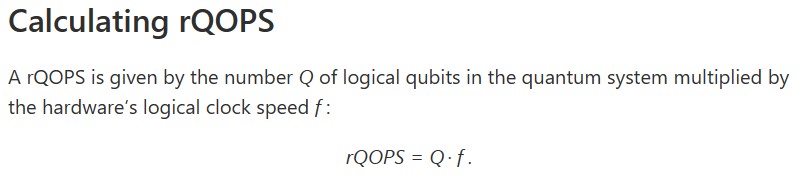
@IBM & @QuantinuumQC use #QuantumVolume & IonQ_Inc uses #AlgorithmicQubits. Now @Azure Quantum has a metric called #rQOPS that counts operations that remain reliable for the duration of a practical quantum algorithm
Analogue simulation with transmons has a nice future! It's really exciting to see SC becomes such a nice platform for quantum simulation. Very nice work from @MIT EQuS group
Check out the latest arXiv submission from MIT EQuS and Lincoln Lab on “Probing entanglement across the energy spectrum of a hard-core Bose-Hubbard lattice” using a 4x4 array of superconducting transmon qubits: arxiv.org/abs/2306.02571.
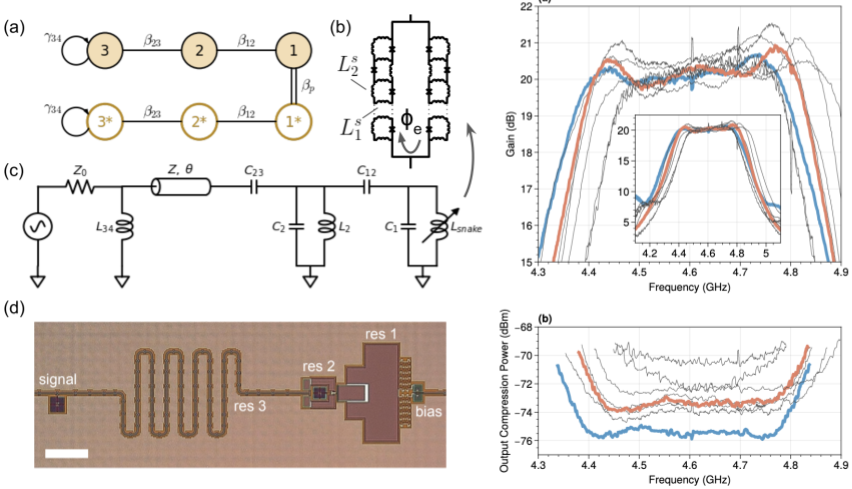
Broadbanding of parametric amplifiers is an impedance matching problem. Check out @GoogleQuantumAI Intern Ryan Kaufman (@TeamHatLab) work on JPA with 500 MHz bandwidth using filter synthesis techniques arxiv.org/abs/2305.17816
Our work on the braiding of non-Abelian anyon (the first experimental realization!) is finally out in Nature.
It's quite amazing to see experiments observing these non-Abelian anyons that have escape experimental probe for so long.
Today in @Nature, @GoogleQuantumAI and collaborators have braided non-Abelian anyons for the first time. Unlike all particles observed so far, the state of two non-Abelian anyons changes when they are swapped, opening an exciting path in quantum computing
nature.com/articles/s41586-0…
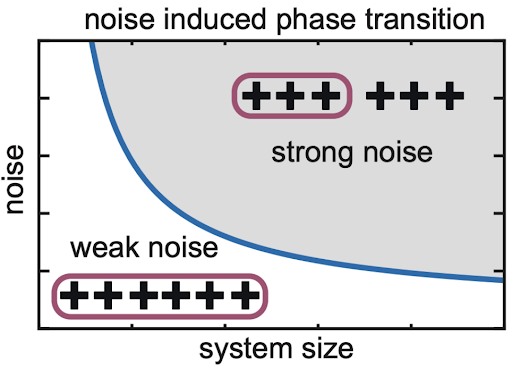
Today on the arXiv, a numerical and theoretical exploration of the Noise Induced Phase Transition we have been looking at in our recent manuscript
arxiv.org/abs/2305.04954
Last week we have put on arXiv a manuscript where we demonstrate beyond classical computations. We also show that having too many qubits w.r.t. the error rate don't give you any advantage. There is a phase transition where you can efficiently emulate noisy quantum hardware
On their new device, @QuantinuumQC performed a beautiful experiment as well creating Abelian Topological order. I will definitely read it! arxiv.org/abs/2305.03766
Last week we have put on arXiv a manuscript where we demonstrate beyond classical computations. We also show that having too many qubits w.r.t. the error rate don't give you any advantage. There is a phase transition where you can efficiently emulate noisy quantum hardware
In our new paper, we answer two questions: can we use the full exponentially large Hilbert space up to a noise limit in random circuit sampling (RCS)? And can we see that boundary experimentally?
We answer yes to both, showing a phase transition in RCS.
arxiv.org/abs/2304.11119
ALT In our new paper, we answer two questions: can we use the full exponentially large Hilbert space up to a noise limit in random circuit sampling (RCS)? And can we see that boundary experimentally?
We answer yes to both, showing a phase transition in RCS.
https://arxiv.org/abs/2304.11119