
Global fund administration platform with $2bn assets, 1,600 private funds and 24,000 high net worth investors
Joined September 2020
- Tweets 616
- Following 119
- Followers 1,193
- Likes 1,618
251 Photos and videos





Jun 11
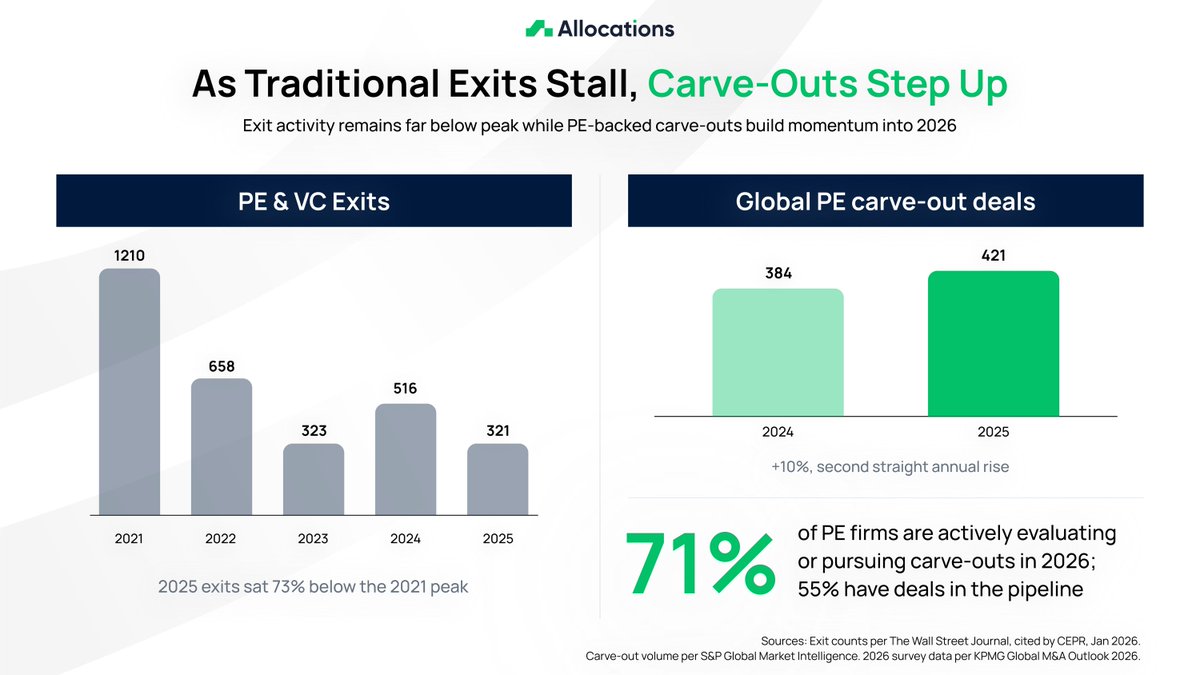
Corporations are restructuring around their core businesses in response to shifting trade flows, energy transition, and AI-driven change. This has driven a surge in PE-backed carve-outs, particularly in North America and across industrials, energy, and utilities, per McDermott Will and Emery's 2026 Private Markets Outlook.
A carve-out is a complex transaction. The target business is being separated from a larger corporate structure, often with shared services, entangled financials, and legacy compliance obligations. PE firms that can move quickly and structure cleanly are the ones winning these deals.
Allocations structures SPVs for complex transactions, giving managers the speed and documentation quality that carve-out deals demand.
6
5
23
306
Jun 9
A single LP writing a large check into a deal still needs the same legal and compliance infrastructure as a fully subscribed SPV. Operating agreements, subscription documents, accreditation verification, Form D, and Blue Sky filings do not disappear because there is only one investor.
Running that manually for a single-investor vehicle is not economical. Skipping it is not an option.
Allocations makes SPV infrastructure accessible and cost-effective at any LP count, including one.
4
7
29
654
Jun 7
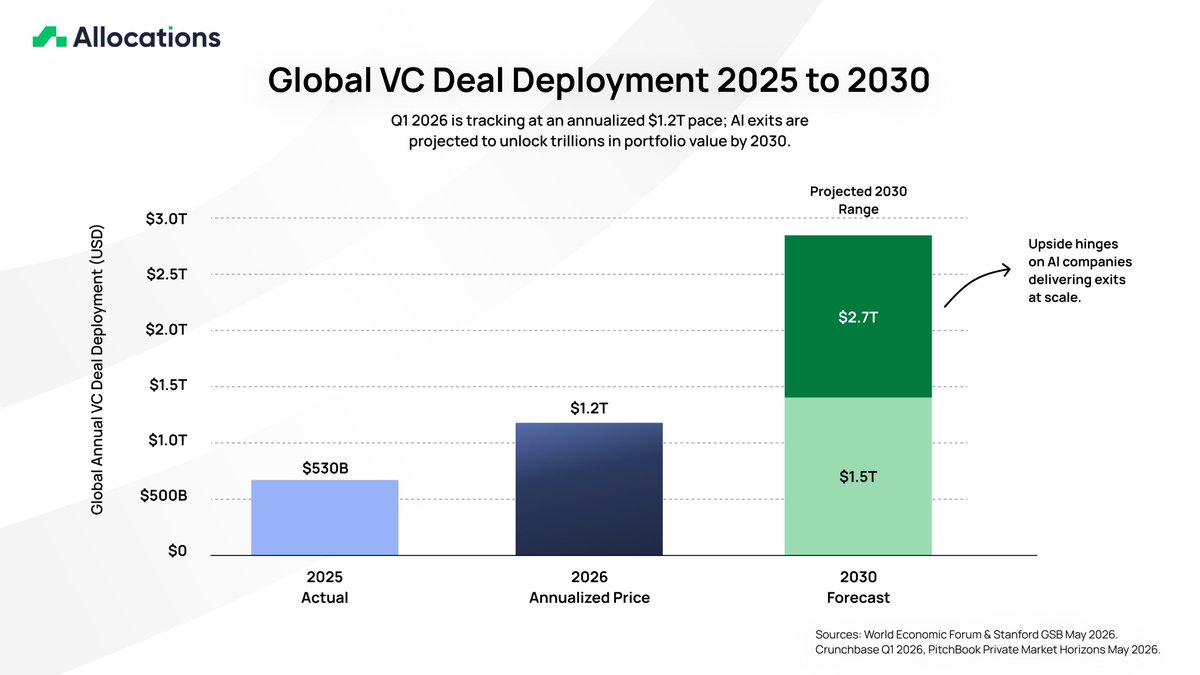
Global VC deployed $512.6 billion in 2025, the third-highest year on record, Q1 2026 alone hit $300 billion across 6,000 companies, putting 2026 on pace to surpass $1 trillion for the full year.
The 2030 trajectory depends on one variable: whether AI companies deliver exits at scale.
Where the capital is locked up:
- 1,920 venture-backed unicorns remain privately held today
- Anthropic filed its confidential S-1 on June 1, 2026, targeting a $1 trillion-plus debut
- OpenAI is preparing to file, targeting a valuation near $1 trillion
The value in this cycle is being built in private markets. Fund managers and angel investors structuring access to these companies do it through SPVs.
Allocations forms and administers SPVs and funds for venture, private equity, and private credit across every stage.
7
5
20
818
Jun 5
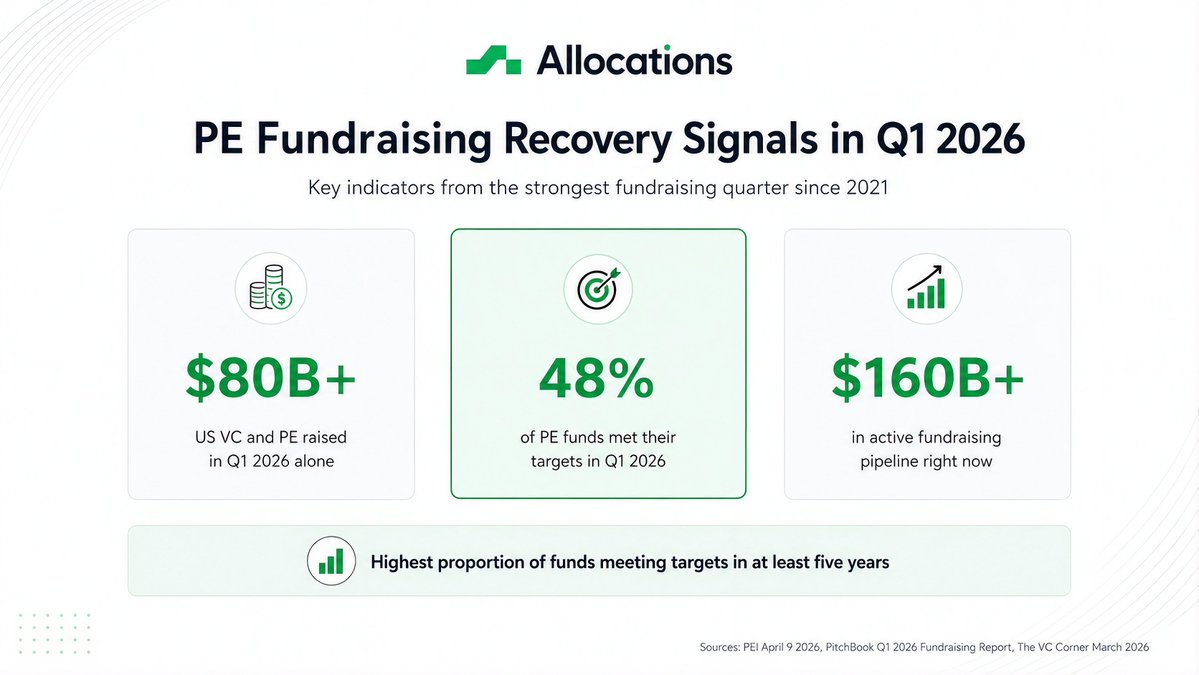
Q1 2026 was the strongest PE fundraising quarter since 2021. $86 billion raised in US PE alone, and nearly half of all funds that closed met their original targets, the highest proportion in at least five years, per PEI.
Concentration is defining the recovery:
- Five firms captured 73.1% of all new VC commitments in Q1 2026
- Funds over $500 million have taken more than 52% of all VC raised over the past four years
For first-time and emerging GPs, LP capital in this environment goes to managers who demonstrate operational credibility alongside investment track record.
Allocations gives emerging GPs the administrative infrastructure to meet institutional LP standards on every deal.
6
5
18
405
Jun 3
LP due diligence in 2026 runs on two tracks. Investment performance is one. Operational infrastructure is the other, and both need to pass before capital moves.
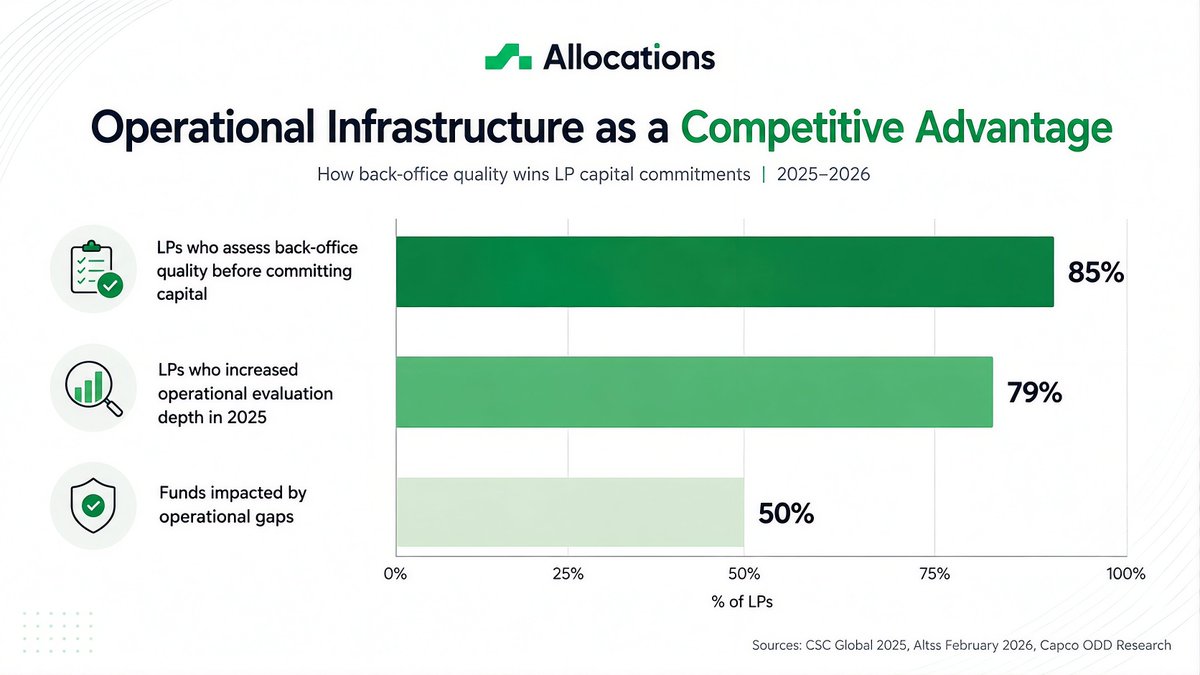
85% of LPs evaluated back-office quality as a standalone criterion in 2025. 79% increased the depth of that evaluation compared to the prior year. DDQ response windows have compressed from 14 days to 7, and the average DDQ now spans 21 sections and 250 questions.
LP evaluation criteria:
• Investor reporting, compliance documentation, and onboarding processes are reviewed before a single dollar is committed.
• Cash management and back-office infrastructure are baseline expectations, not differentiators.
Allocations provides the reporting, compliance, and investor management infrastructure that passes institutional LP scrutiny, regardless of fund size or AUM.
7
5
22
551
Jun 1
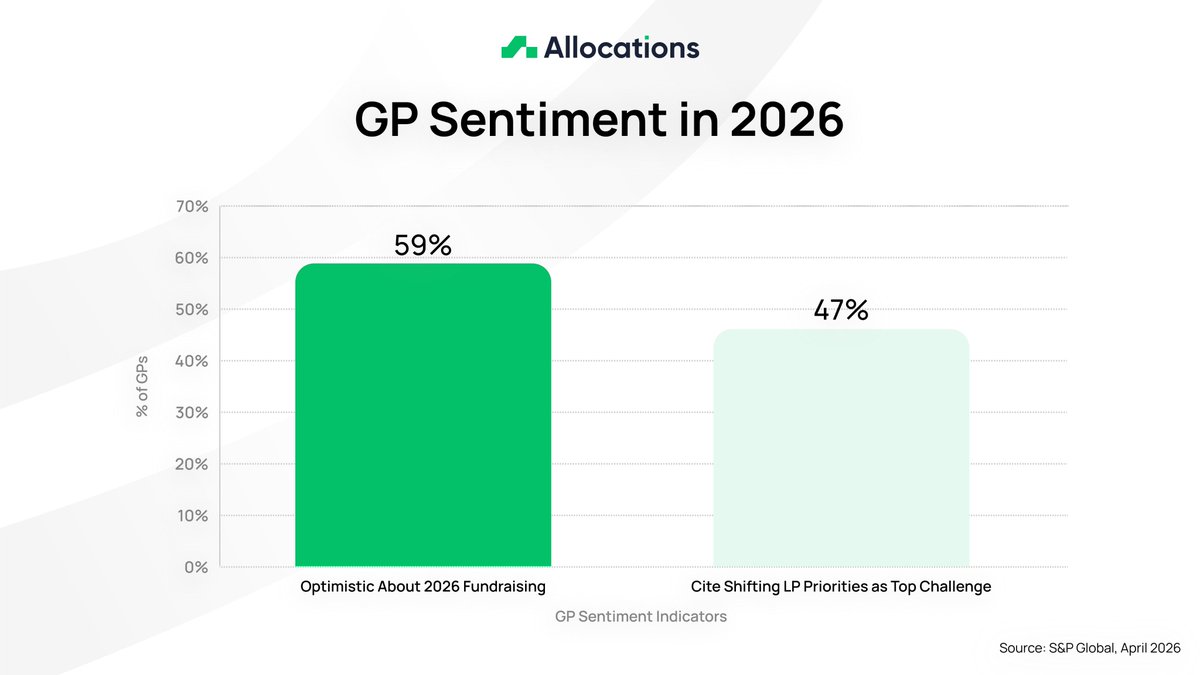
59% of GPs are optimistic about their 2026 fundraising targets, per S&P Global's April 2026 Private Equity Outlook. 47% cite shifting LP priorities as their primary challenge.
The GPs gaining ground are the ones who have updated their approach to match what LPs now expect:
- Operational discipline
- Transparent reporting
- A clear path to distributions
Allocations gives GPs the administrative infrastructure to meet those standards on every deal, from entity formation through to K-1s and final distributions.
6
6
28
750
May 29
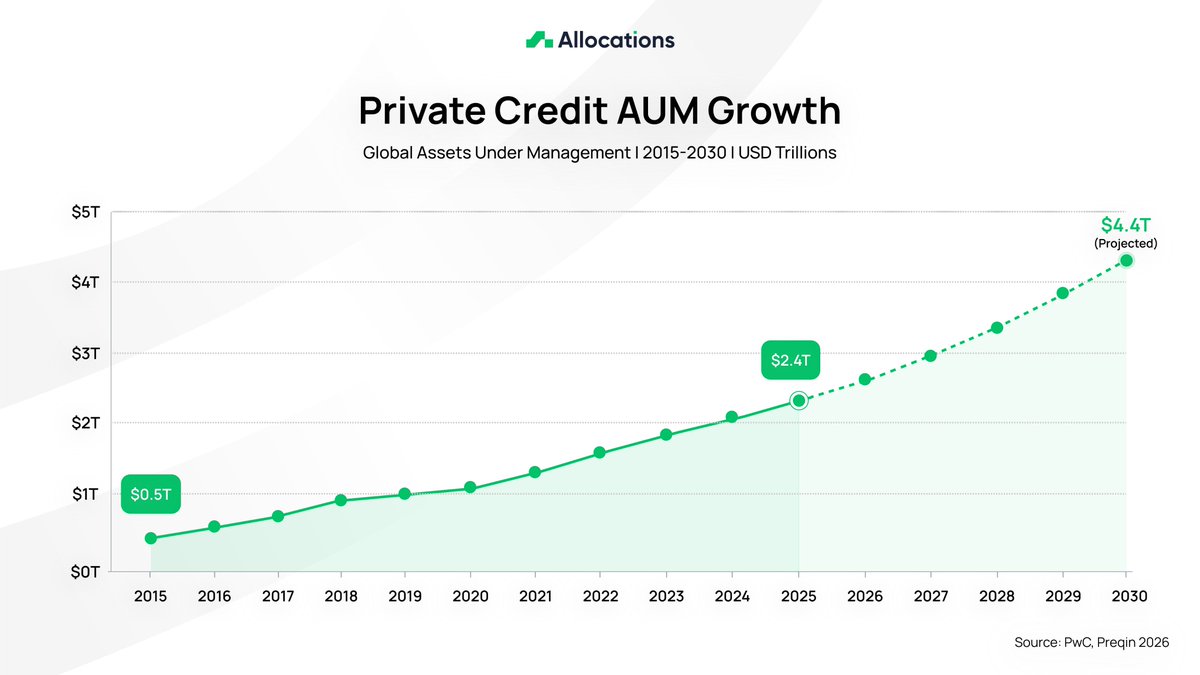
Private credit is no longer a substitute for bank lending. It is now the primary financing mechanism for mid-market buyouts, growth equity deals, and infrastructure transactions.
@Preqin 2026 Global Report describes 2025 as a year of strategic evolution for private credit, setting the stage for a fundraising recovery in 2026. Dedicated credit funds, multi-strategy platforms with credit sleeves, and GP-led credit continuation vehicles are all expanding simultaneously.
Allocations administers private credit SPVs and funds on the same platform as every other asset class, managed within one centralized platform regardless of deal type.
6
4
11
715
May 27
Calculating distributions across hurdle rates, preferred returns, catch-up provisions, and GP carry splits is one of the most error-prone parts of fund administration.
Precision is essential, as allocation outcomes are reflected across every LP in the vehicle.
Allocations automates waterfall calculations and distribution processing, with a clear, auditable record for every payment made across every vehicle.
8
6
14
703
May 21
Institutional LPs run structured due diligence before committing capital. They expect audited financials, clean compliance documentation, and a reporting layer that matches their own internal standards.
Emerging GPs with strong deal flow often lose LP commitments at the due diligence stage because their reporting, compliance documentation, and administrative infrastructure does not meet institutional standards.
Allocations gives emerging GPs the same administrative infrastructure that established managers use, covering entity formation, KYC, compliance filings, investor reporting, and K-1s on a single platform.
6
5
23
856
May 19
Launching an SPV is just the beginning. Everything after close is where the work quietly piles up: capital calls, distribution waterfalls, K-1 preparation, Blue Sky filings, LP reporting, and compliance updates, repeated across every vehicle, every year.
Allocations handles the full post-close administration so fund managers can focus on sourcing and closing deals.
Start your next SPV or fund in 10 minutes.
6
6
17
461
May 18
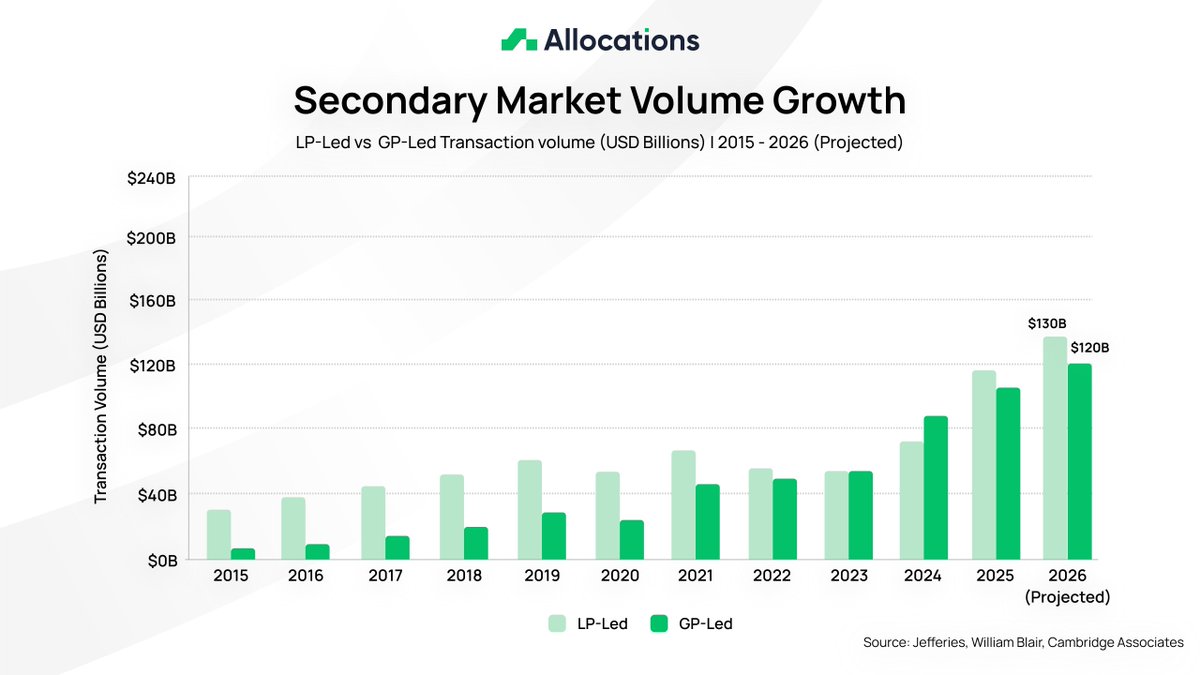
The secondary market now sees GP-led transactions accounting for nearly half of total volume, up from 18% a decade ago. At over $220 billion in 2025, it still represents only 5% of global buyout AUM, with annual volume expected to approach $300 billion within the next two years.
Fund managers navigating this market need entity formation, investor onboarding, compliance, and reporting without coordinating across multiple providers.
Allocations does all of it on a single platform, for SPVs and funds across every asset class.
allocations.com
5
7
16
387
May 13
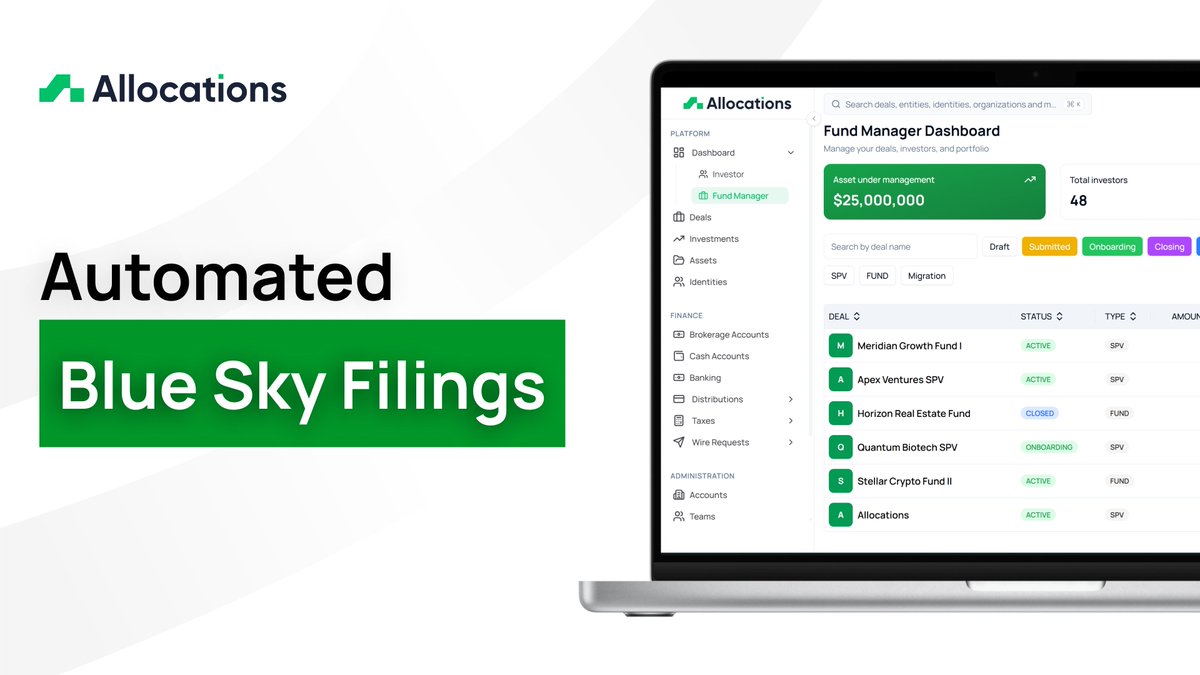
Most GPs do not think about Blue Sky filings until they have already accepted capital from investors across six states. At that point, they are filing notices retroactively, managing five different deadlines, and paying late fees they could have avoided.
Allocations automates Blue Sky notice filings across all applicable states the moment investors are identified. No manual tracking, no missed deadlines.
🔗 allocations.com/bluesky
6
3
17
359
May 11
A real estate GP running SPVs alongside a VC fund manager should not need two different platforms to administer both. The operational overhead of managing separate systems for separate asset classes compounds with every new deal.
Allocations supports venture, real estate, private equity, crypto, and secondaries on a single platform. One workflow, one reporting layer, one compliance process regardless of what is in the deal.
5
2
15
232
May 8
KYC and AML checks done manually take days. For a GP onboarding 20 LPs across an SPV, that is weeks of back-and-forth before the round is even closed.
Allocations builds KYC and AML verification directly into the investor onboarding workflow. Investors complete it in one sitting, and the GP gets a clean, audit-ready record without coordinating a single document by email.
4
4
14
174
Apr 29
A co-investment SPV sits alongside a main fund but runs on a completely separate administrative track: its own entity, its own subscription documents, its own KYC on participating LPs, and its own K-1s at year end. GPs who treat it as an extension of existing fund infrastructure regularly underestimate the setup and ongoing cost.
For a fund running two or three co-investments per year at average check sizes of $5 to $15 million, the formation and administration work is the same as running a separate fund in parallel. Allocations forms and administers co-investment SPVs with the same workflow used for primary fund vehicles, so GPs can offer co-invest access without building a separate operations process for each opportunity.
6
15
190
Apr 27
A traditionally structured SPV takes two to four weeks to form: attorney drafting, state filing, EIN registration, banking setup, subscription document preparation, and investor onboarding each add time in sequence. For a time-sensitive deal, that lag has a direct cost.
Allocations runs entity formation, operating agreement generation, EIN registration, and banking setup through a single platform. Investor onboarding with KYC and subscription processing begins the same day.
6
3
16
245
Apr 26
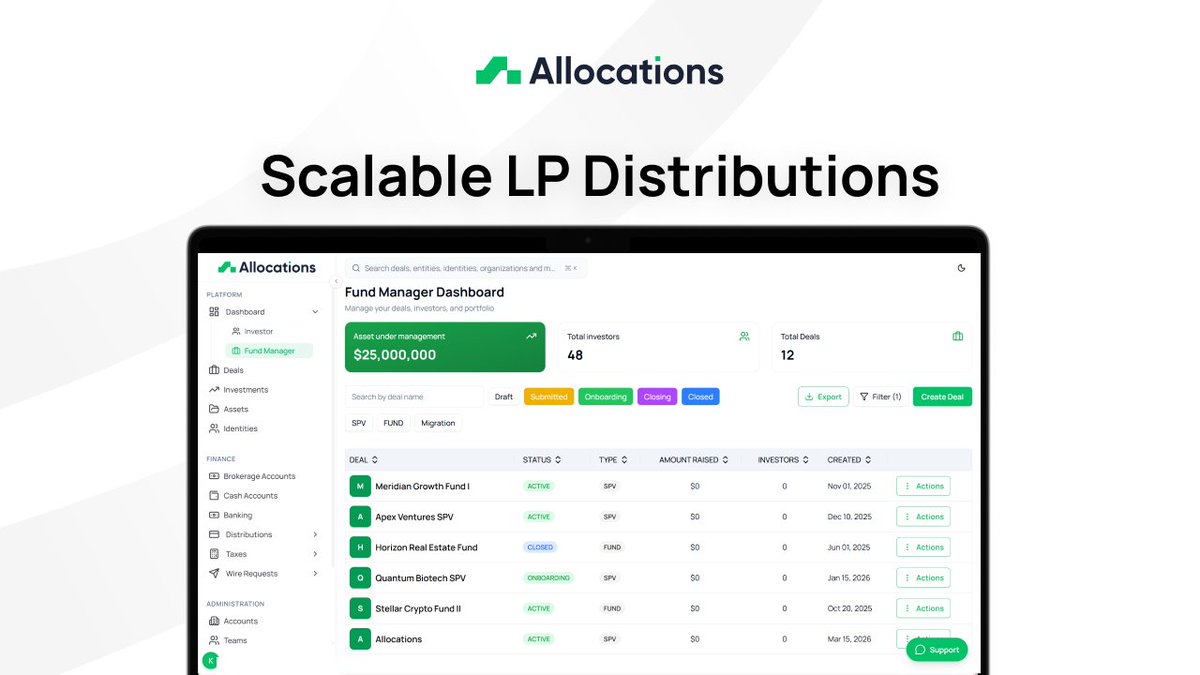
A fund distributing $3 million across 60 LPs with varying entry dates, different share classes, and a tiered waterfall requires LP-level calculation before a single wire is sent. Distributing on a flat pro-rata basis when the fund documents call for a different methodology creates legal exposure. Distributing out of sequence relative to capital account records creates tax reporting errors.
Allocations runs distributions through the same platform that tracks capital calls and ledger entries. Every distribution calculates against the capital account record, wires execute to banking details already on file, and K-1 data captures automatically against each event.
5
13
215
Apr 24
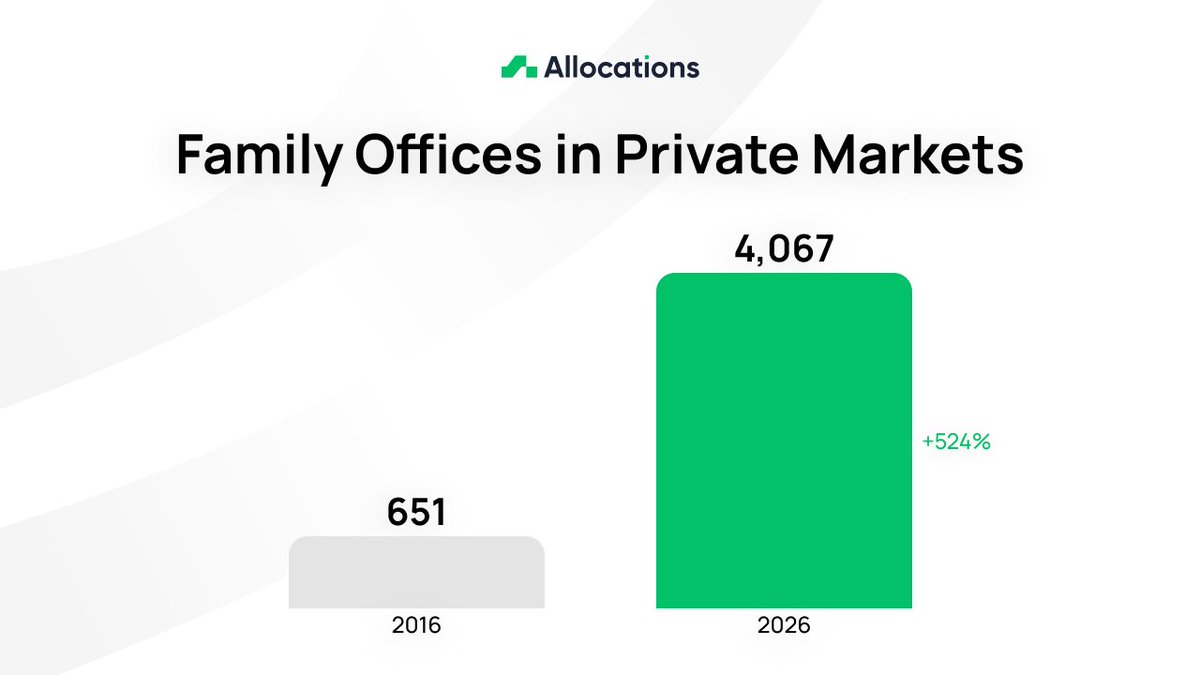
The number of family offices with private markets exposure climbed 524% since 2016, from 651 to 4,067 globally. Direct investments now account for more than 40% of the typical family office PE sleeve, and 76% invest directly into companies rather than through fund vehicles.
Bypassing a fund manager means the family office takes on the formation, investor documentation, annual K-1 preparation, and distribution coordination that a GP would otherwise handle.
Allocations provides the fund administration platform that lets family offices run direct deal programs without building a dedicated internal operations team.
5
2
14
196
Apr 22
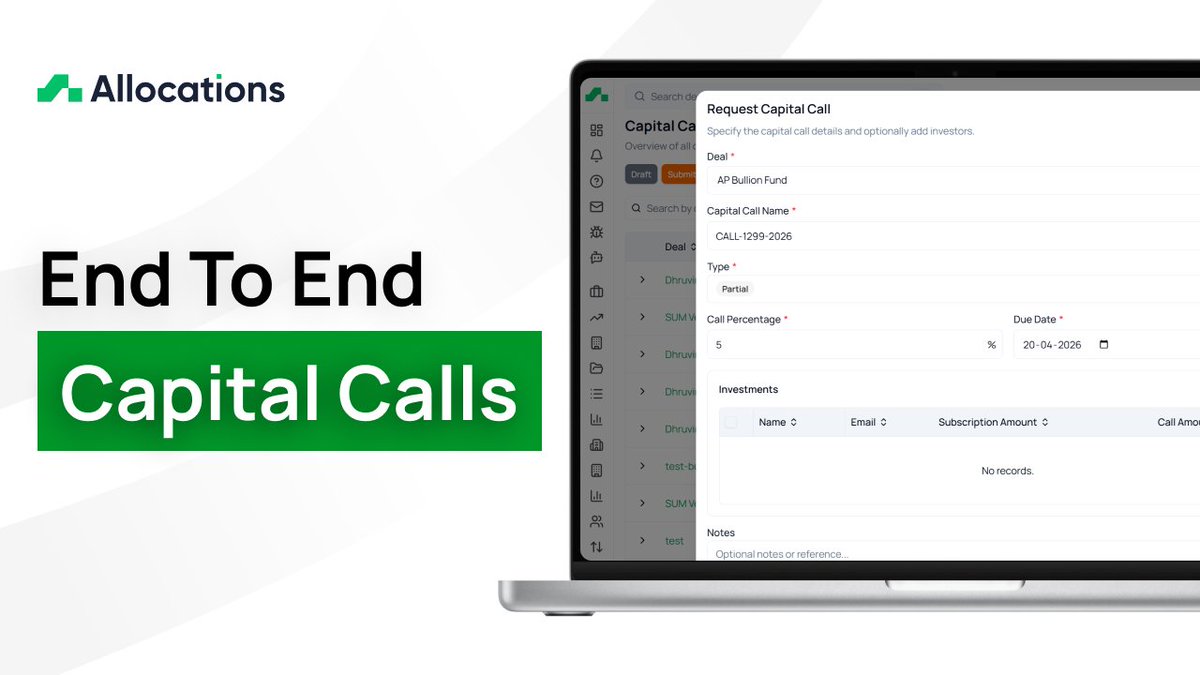
Managing a capital call across 40 LPs means coordinating 40 sets of wire instructions, a follow-up round for late respondents, and a reconciliation process that routinely takes two weeks for a standard drawdown.
Capital account attribution errors compound quietly, creating discrepancies that carry through every quarter that follows.
Allocations issues capital calls, tracks funding, and updates capital accounts through a single LP portal. Distributions run through the same workflow when capital comes back, with K-1 data already captured against every event on the ledger.
5
4
15
230
Apr 20
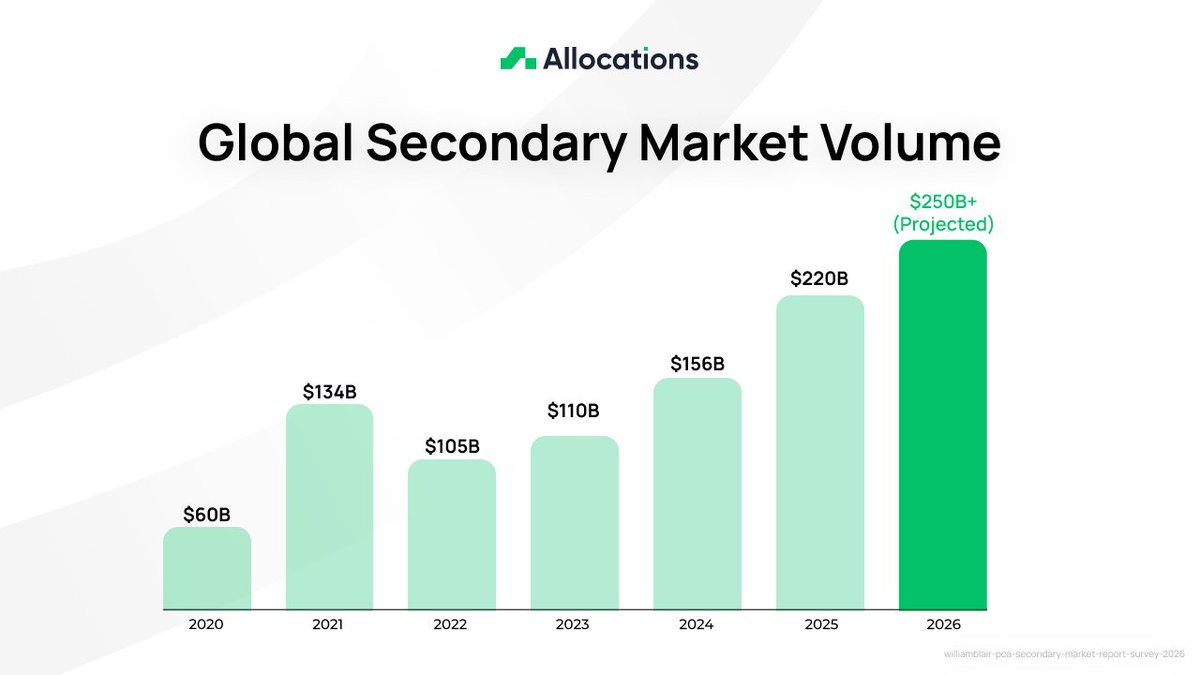
The global secondary market crossed $200 billion for the first time in 2025. GP-led transactions hit $104 billion, up 50% year-over-year. LP-led volume came in at $118 billion, driven by portfolio rebalancing as distribution cycles stretch well past five years. Industry consensus now points to $250 billion in 2026.
Every secondary transaction still runs the same workflow a primary does: entity formation, subscription documents, KYC, capital movement, and K-1s at year end.
Allocations handles all of it across SPVs and funds so managers can participate in secondaries without adding operational overhead.
5
4
16
236