
A decentralized unit of account.
Joined February 2018
- Tweets 2,521
- Following 2,058
- Followers 45,041
- Likes 6,523
311 Photos and videos








Pinned Tweet

22 Jul 2025
➕ Ampleforth, a decentralized unit of account.
$AMPL and elastic supply, explained in minutes.
37
35
153
24,855
Jun 10
Inflation isn't a side effect, it's the policy.
Central banks aim for 3 to 4 percent every year and call it stimulus. What it actually does is quietly tax anyone who saves in fiat.
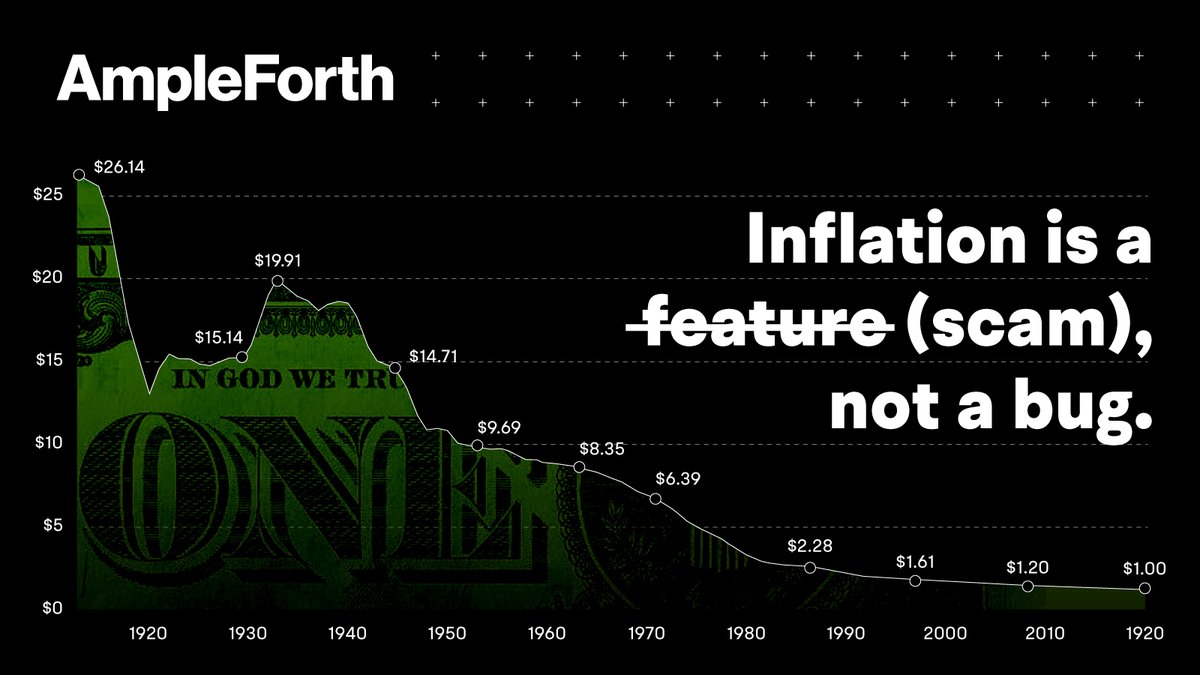
The dollar has lost more than 97 percent of its value since 1913. A hundred bucks tucked away back then buys you about three dollars of stuff today.
That's not a glitch in the system. That is the system, working exactly as designed.
@SPOTprotocol is different. Decentralized, mathematically driven, and built to resist.
5
9
792
May 28
Most DeFi yield is just inflation in a costume.
New tokens get printed, supply gets diluted, and your rewards are quietly paid for by everyone already holding the bag.
The number goes up while the value leaks out the bottom. You've seen it happen.
$AMPL and $SPOT work differently. The yield comes from real network growth and actual on-chain activity, not from some mint function running in the background.
As AMPL demand grows and more people use SPOT, holders earn through rebasing and genuine ecosystem usage. All of it transparent, all of it on-chain.
No inflation or subsidies. Nobody getting quietly diluted to fund your payout. Just real income that reflects real demand.
Zero volatility is a promise someone else has to keep for you. Low volatility is something that holds on its own. And now it actually pays you to hold it.
3
7
18
1,611
May 21
Fiat is a claim, not a thing.
What sits in your account isn't money you hold. It's a promise that someone honors a balance, recorded as a row in a database you don't control. That row can be paused, capped, or rewritten the moment compliance rules shift.
You don't own the balance. You own permission to request it, and permission can be withdrawn. And even when access holds, the value erodes.
Central bank policy and government spending dilute every unit you were told was stable. You carry the worst of both: revocable access to wealth that shrinks while you wait.
$SPOT inverts the arrangement. It is a bearer asset. Holding it is owning it. No issuer between you and your balance, no account to freeze, no fee for the privilege of access. Settlement is final and irreversible. What lands in your wallet stays there, answerable to no one.
@SPOTprotocol has no concept of identity. It doesn't know who you are and was never built to care. That is exactly why it can't be censored, frozen, or clawed back. There is no lever to pull.
Money that depends on permission was never really yours.
6
19
1,179
May 13
Most stablecoins can be paused, blacklisted, or seized.
Tether has frozen over $4.2B in USDT lifetime, with $1.26B in 2025 alone across 4,100 addresses. Over half was burned and never returned.
In March 2026, a sealed U.S. court order forced Circle to freeze 16 unrelated business wallets in one batch, including DFINITY's ckETH bridge. Thousands of users had no connection to the underlying case.
Ethena's USDe is hedged across centralized exchanges. BaFin already shut down EU redemptions.
It only takes one phone call.
These are deliberate features.
@SPOTprotocol has no admin keys, no pause function, no blacklist, no reverse. It cannot be altered or halted by Circle, banks, or us. SPOT doesn't know your name or address. By design.
When control exists, it is eventually used.
SPOT can't be frozen because it was never built to obey.
4
4
24
2,523
May 6
Most tokens hold their supply still and let price absorb every shift in demand. Ampleforth does the opposite.
AMPL is anchored to the 2019 U.S. dollar as its unit of account.
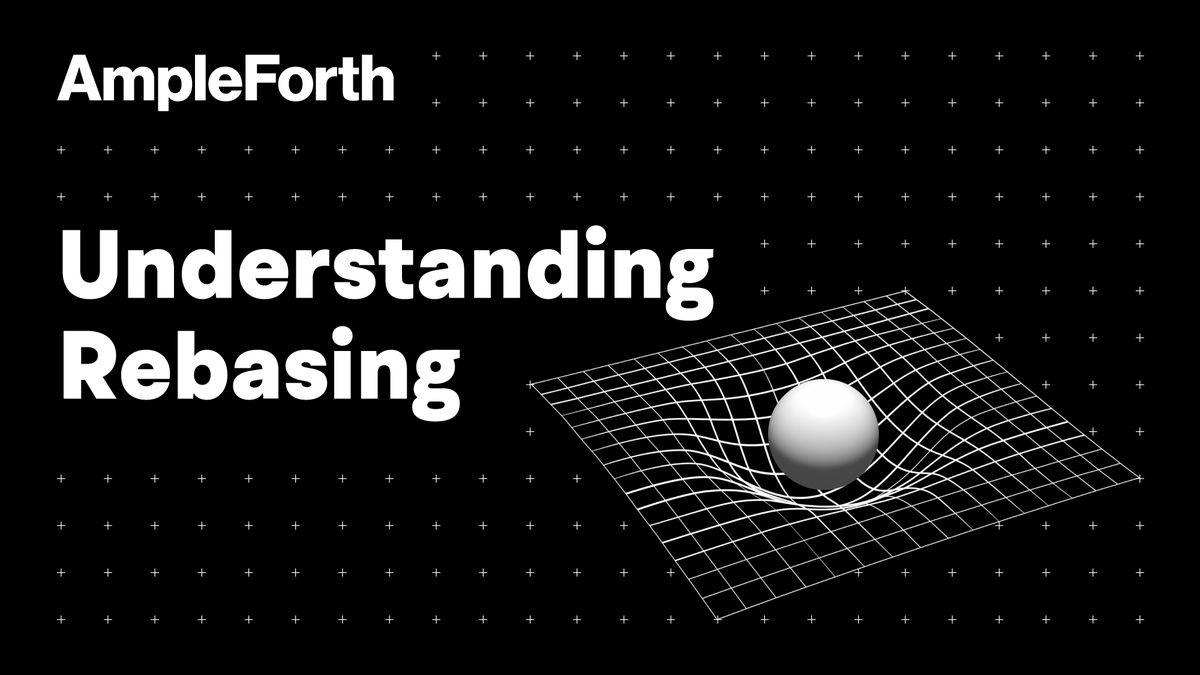
To preserve that anchor, the network rebases once per day, expanding supply when demand runs hot and contracting it when demand cools.
Tokens enter or leave every balance proportionally, so no holder is diluted and none is favored.
The result is a kind of monetary symmetry: your ownership share never changes, but the size of that share, and what it's worth, moves with the network itself.
5
4
18
2,109
Apr 29
$AMPL translates price volatility into supply volatility.
When price rises above target, supply expands. When price falls below target, supply contracts.
Your share of the network never changes. Only your token count adjusts proportionally.
This creates non-dilutive elasticity: a self-correcting mechanism where volatility manifests in quantities rather than price alone.
The Rotation Vault lets you choose your exposure: $SPOT for stability or $stAMPL for amplified rebases.
stAMPL holders get 1.1-1.2x the daily rebase, capturing the volatility premium that SPOT holders exchange for smoothness.
During positive rebases, stAMPL holders gain network ownership as SPOT holders shed volatility.
It's leveraged exposure without borrowing, aligned with AMPL's growth cycles.
Decentralized and algorithmic.
3
4
19
2,021
Apr 24
Most stable assets rely on liquidation markets to stay solvent.
When collateral drops, someone has to get wiped out to keep the system alive.
@SPOTprotocol as a Low Volatility Asset doesn't work that way.
Instead, it's backed by tranched $AMPL derivatives.
AMPL's volatility is split into high and low-risk layers, and SPOT holds the low-volatility senior tranche. It's a direct, redeemable claim on that collateral.
No liquidations, because there's no undercollateralization possible. If you hold 1% of SPOT supply, you can redeem it for 1% of the collateral.
Always.
$SPOT bends but doesn't break.
1
4
17
1,876
Apr 17
Before smart contracts, there was barley.
Ancient Mesopotamians used grain as currency.
When harvests were plentiful, supply expanded and purchasing power fell. In lean years, it contracted and value rose.
Sound familiar?
Cowrie shells, salt, seeds, the world's earliest money was elastic by nature.
We've spent centuries trying to make money rigid.
Gold standards, fixed supply, hard caps...
$AMPL is a return to something older.
A currency that expands and contracts with demand, except this time it's governed by code instead of rainfall.
Elastic money isn't new. It's just finally programmable.
3
6
22
1,902
Apr 10
Most AI agents are trained to track price as the primary signal.
With $AMPL, that instinct breaks.
Balances change daily without a transaction. Supply expands and contracts while price stays anchored.
An AI parsing your portfolio would need to understand that a shrinking balance isn't a loss, but the protocol working as designed.
This means AI can get a cleaner picture of demand by reading the supply instead of just the price.Elastic money isn't harder for AI to understand. It's more honest.
The future of AI in finance might be built on assets that tell the truth.
4
7
27
2,034
Ampleforth retweeted
5 Aug 2025
Ampleforth is the foundation of @SPOTprotocol.
$SPOT is the first truly decentralized, low-volatility asset designed to protect you from inflation.
→ spot.cash
17
18
68
4,773
Ampleforth retweeted
29 Jul 2025
➕ Ampleforth breathes.
Elastic money.
No central authority.
No fixed supply.
$AMPL and rebasing, explained in one minute.
13
23
68
6,305
Mar 19
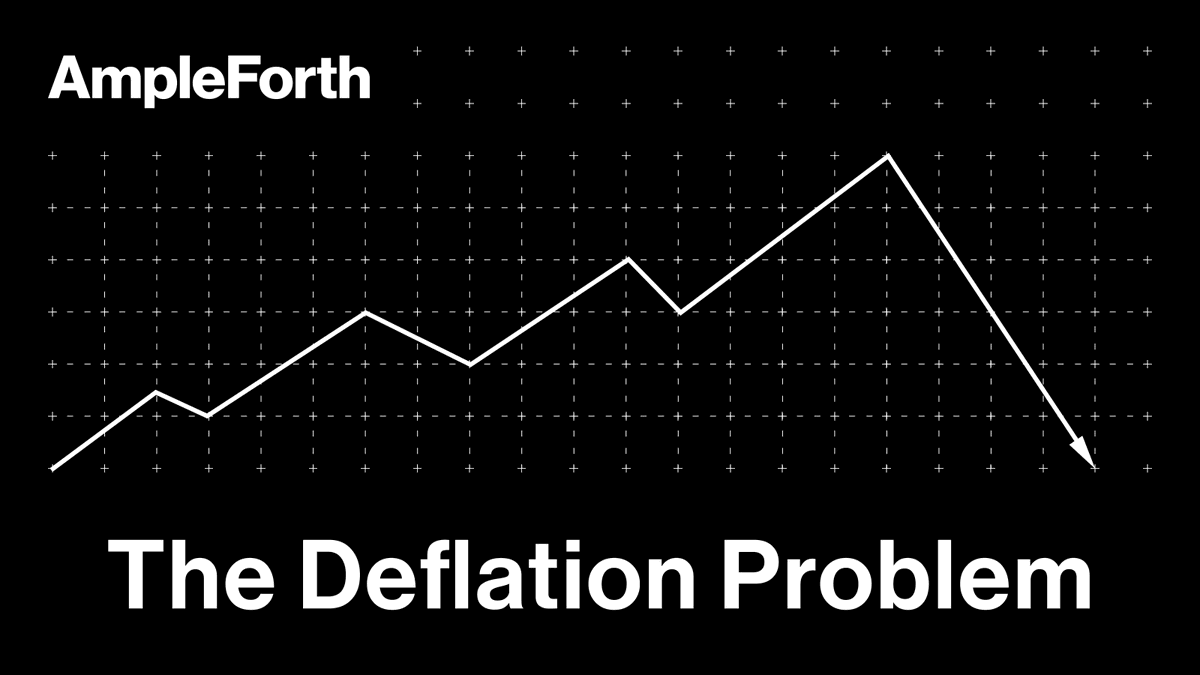
Deflationary assets make poor currencies.
When supply is fixed and demand grows, rational holders don't spend.
Why buy coffee today with something worth more tomorrow? HODL is just the logical response to deflation.
And when nobody spends, pricing breaks. Loans get risky. Contracts become a gamble.
AMPL solves this differently. Instead of fixing supply, it rebases daily.
When price drifts above or below its target, every wallet adjusts proportionally.
You always own the same % of the network.
Volatility moves from price to supply and contracts stay predictable.
That's what makes $AMPL usable as a unit of account.
7
3
22
3,893
Mar 12
Money is never just a medium.
It is also a choice about who gets to decide, who absorbs the cost of change, and who benefits from the system’s design.
That is why credible, neutral monetary instruments matter. The more discretion an asset requires, the more it depends on trust in managers, issuers, or policy makers.
$AMPL does not rely on collateral custodians or active governors to defend a peg. It uses transparent, non-discretionary supply adjustment instead. $SPOT builds on that logic by reducing dependence on fragile monetary assumptions elsewhere in DeFi.
Neutral money matters because systems become stronger when the instrument itself is less political.
8
3
19
3,714
Feb 26
Bitcoin, Ethereum, and AMPL represent three different answers to the same question: what should digital scarcity look like?
Bitcoin fixes supply forever. Only 21 million units will ever exist. That makes it maximally scarce, but it also means every change in demand must be absorbed by price. Volatility is not a side effect of Bitcoin’s design. It is the mechanism.
Ethereum softens this by making the supply policy flexible. Issuance can change, burns can offset inflation, and scarcity becomes a function of usage rather than a hard cap. ETH is not absolutely scarce, but conditionally scarce.
AMPL does not fix supply or optimize issuance. It fixes a purchasing power target and lets supply expand or contract to reflect demand. Scarcity becomes elastic rather than absolute.
$BTC concentrates scarcity in units.
$ETH concentrates it in policy.
$AMPL concentrates it in purchasing power.
They are not competing answers to the same problem, but three distinct philosophies of what digital money should optimize for.
8
4
39
4,347
Feb 18
Market extremes expose monetary design.
In euphoric phases, $AMPL tends to trade above its purchasing power target.
The protocol responds with positive rebases, expanding supply into demand. Instead of forcing price to absorb all upside pressure, AMPL distributes part of that pressure into balances.
Volatility still exists, but it is reorganized across supply rather than concentrated purely in price.
In panic phases, AMPL often trades below the target.
The response is negative rebases, contracting supply as demand collapses. While frequently misunderstood as “loss,” it is actually the system expressing monetary policy: when demand falls, units contract so the discount can compress over time.
There is no peg defense, no collateral liquidation, and no discretionary intervention. The response is mechanical.
Across extremes, AMPL does not attempt to suppress volatility. It routes volatility through supply adjustments.
Fixed-supply assets force all shocks into price. Pegged assets externalize shocks into collateral and liquidations. AMPL internalizes them through rebasing.
The tradeoff is psychological, not structural: balances change visibly. The benefit is policy consistency.
Overall, AMPL behaves less like an equity and more like a monetary system with supply as its control surface.
14
5
39
5,333
Feb 11
Fixed supply is often framed as a neutral monetary design.
In practice, it’s an ideology.
It encodes a belief that money should only optimize for scarcity and long-term appreciation. That works well for assets meant to be held, but it breaks down when you ask money to function as money.
In a fixed-supply system, every increase in demand must express itself through price. Volatility becomes the clearing mechanism. But that dynamic rewards early holders, penalizes late users, and makes everyday economic coordination harder.
While deflation may sound appealing initially, a unit of account that rises in value discourages spending, worsens debt burdens, and makes long-term contracts more brittle.
When money becomes more valuable over time, obligations become heavier, and productive activity is distorted by the expectation of future appreciation. Bitcoin proves fixed supply can succeed as digital scarcity. But scarcity is not the same as monetary suitability.
AMPL is the first asset to ever take the opposite approach.
Instead of fixing supply and letting price absorb shocks, it fixes a purchasing power target and lets supply adapt. This reframes monetary policy as a transparent, rules-based mechanism rather than a narrative about scarcity.
Fixed supply is a powerful idea.
It’s just not a neutral one.
12
4
37
3,394
Jan 29
In traditional systems, monetary policy is discretionary. Committees meet. Assumptions change. Incentives shift. Supply decisions are made by people, under pressure, with incomplete information and political constraints.
Even when well-intentioned, discretion is the point of fragility. Ampleforth removes discretion entirely.
$AMPL does not rely on governors, voters, or emergency interventions. Its supply responds automatically to demand, according to transparent, pre-defined rules. No meetings. No exceptions. No human override. Supply itself is the policy.
Decentralized networks encode choices about power, authority, and control directly into software. AMPL makes one such choice explicit: monetary policy should be mechanical, not managerial.
By fixing a target instead of a supply, AMPL treats volatility as a signal to be redistributed rather than some crisis to be managed. The result isn’t the absence of policy, but policy without discretion.
In the end, AMPL asks a simple question: what if rules were the institution?
13
7
35
3,260
Jan 22
Most financial systems that promise stability rely on control.
They fix prices, enforce pegs, or depend on active management to keep things aligned. As long as conditions are calm, this works.
But when markets change, these systems must intervene: raise rates, deploy reserves, freeze flows, or rewrite rules.
That is not stability. It is maintenance.
$SPOT is part of a new type of system.
Instead of trying to hold outcomes in place, it's designed to adjust automatically.
Supply and incentives respond to demand through rules rather than discretion. No one steps in to “save” the system, because the system is built to move.
That matters because control concentrates failure. When assumptions break, controlled systems face cliffs. Adaptive systems absorb stress gradually.
$SPOT does not promise a rigid peg. It promises resilience.
Stability, in this model, is not something enforced. It is something that emerges.
14
1
35
3,697