
Professor, student and a science and technology geek-- oh yeah, sometimes a bit of law
Joined February 2009
- Tweets 11,005
- Following 2,048
- Followers 915
- Likes 9,267
73 Photos and videos












Pinned Tweet

14 Jan 2024
Universities have known for years that they needed to figure out how to navigate the tension between academic freedom and basic HR issues. They outsourced those issues to the faculty, under the guise of shared governance. While on the ground toxic people were never managed.
1
460
Seriously, what is going on at JFK @AmericanAir we sat for hours, had to refuel and are now sitting again
3
11
864
Dr. Angie Raymond retweeted

Auburn Board Takes Full Curricular Control, Dissolves Faculty Senate
The Auburn University Board of Trustees on Friday gave itself complete control over course offerings, curriculum, degree requirements and academic credentials while eliminating shared... bit.ly/4fqcUEZ

ALT Photo of the Auburn University campus
62
149
860
1,041,337
Dr. Angie Raymond retweeted

Jun 2
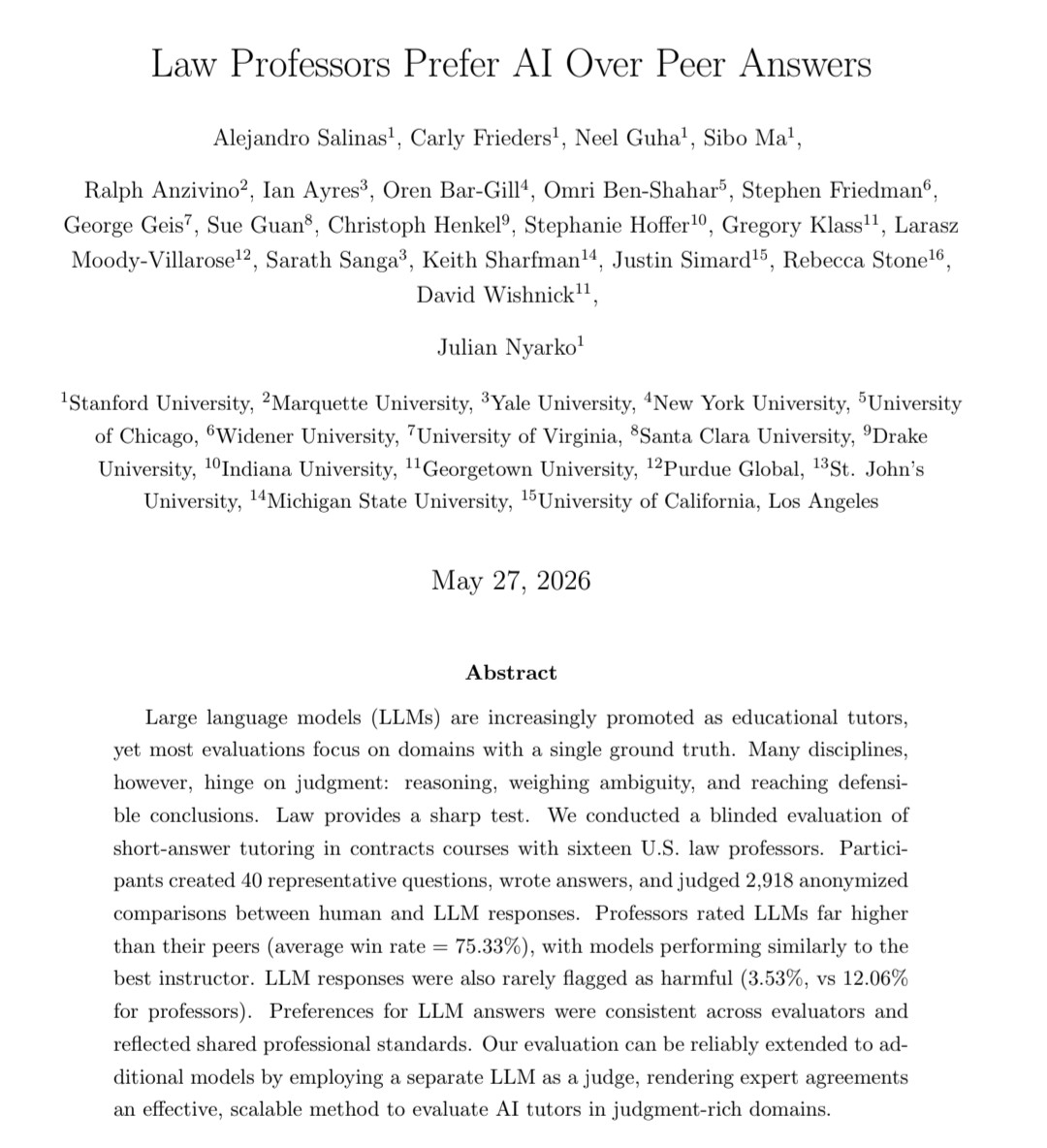
In a new Stanford study, law professors by far preferred Gemini 2.5 Pro's responses over those written by their peers when they were unaware of who wrote the answers.
63
306
1,746
459,275
Dr. Angie Raymond retweeted

May 29
Erin Brockovich, the environmental activist whose name and work you may recognize from the Oscar-winning movie Erin Brockovich, has created a tool to map data centers across the country.
niemanlab.org/2026/05/erin-b…
1
27
29
2,237
Dr. Angie Raymond retweeted

May 29
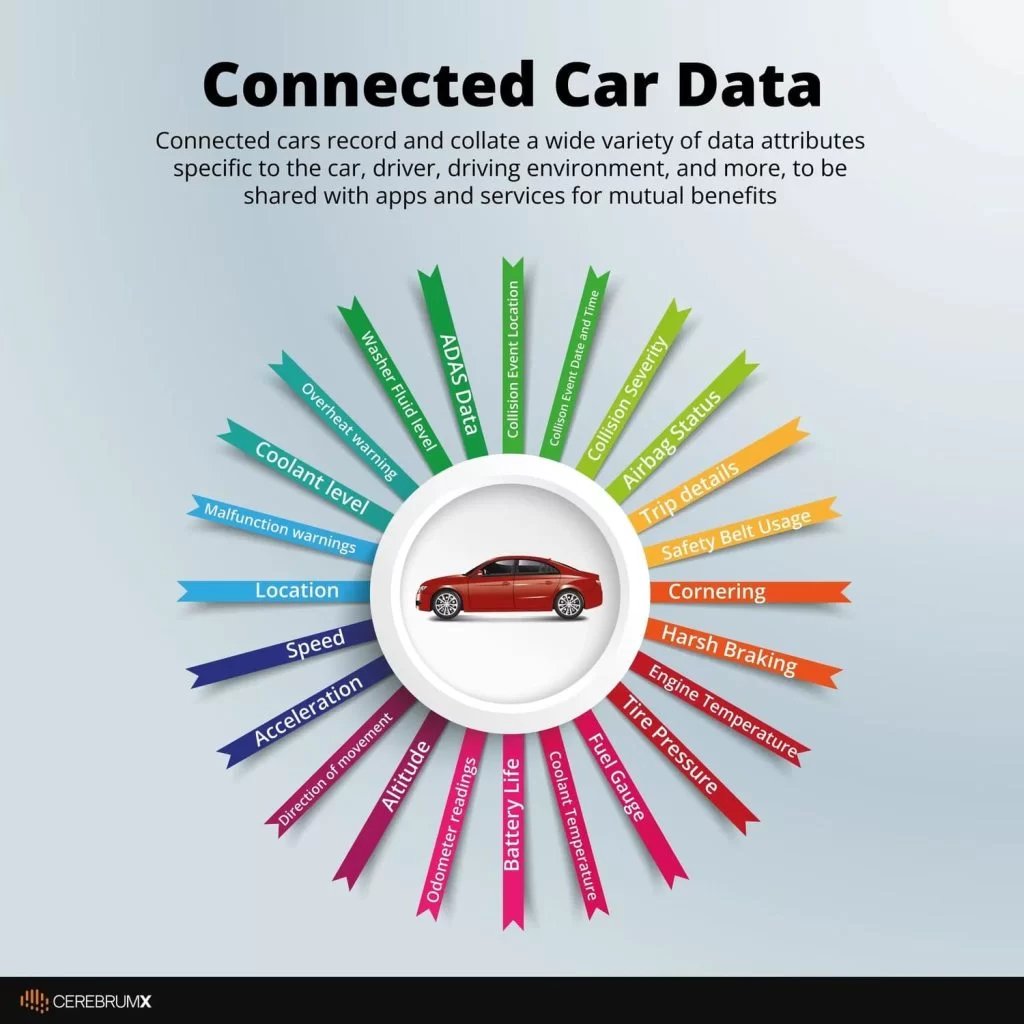
🦔A man requested his driving data from LexisNexis and got back 130 pages. Six months of every trip he and his wife took, logged and sold without their knowledge, just because he set up his car's infotainment system. His insurance jumped 21%. Mozilla reviewed 25 car brands and every one failed its privacy standards, with 19 open about the fact they might sell your data. GM already got caught selling driver location data to LexisNexis. And a federal mandate will soon put infrared cameras, eye tracking, and biometric sensors in every new car, with zero rules on what happens to that data afterward.
My Take
Same playbook, different industry. Bury consent in 40 pages of legal text nobody reads, collect everything, sell it to whoever pays. A Maryland study found that 31% of drivers who enrolled in telematics programs got a discount, 24% saw their rates actually go up, and 45% saw no change at all. The insurers collected data on every single one of them regardless. These programs exist because they make insurance companies money, not because they help drivers.
The impaired driving mandate is where it gets worse. Nobody wants drunk drivers on the road, but infrared biometric scans every time you sit in your car with no rules on storage, sale, or access is a completely different animal. Law enforcement can already buy location data when they can't get a warrant. GM already got caught doing exactly this. Next time it'll just be legal by default because Congress wrote a safety law and forgot to write the privacy protections that should have come with it.
Hedgie🤗
23
176
404
14,370
Dr. Angie Raymond retweeted

May 21
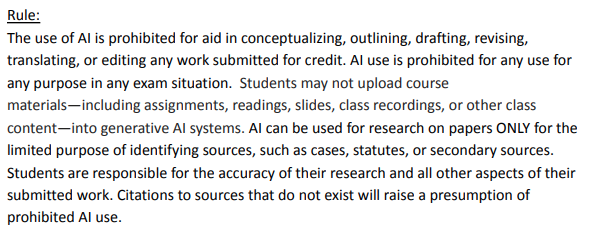
Berkeley law has introduced a new, much stricter AI policy
law.berkeley.edu/wp-content/…
139
819
4,717
963,482
Dr. Angie Raymond retweeted

May 10
Canvas is back online with limited functionality. Please continue checking your email for updates from your instructors about your classes. For additional support and resources, visit keeplearning.iu.edu. We appreciate your patience and flexibility as our team worked to restore service as safely and quickly as possible.

ALT Indiana University logo at the top, text in the center reads "Canvas Update" on a red background. "Bring on Tomorrow" at the bottom.
1
1
10
5,358
An Open Letter to Georgetown Students, In Response to Recent Announcements by the University about “Generative AI” | by Center on Privacy & Technology | Center on Privacy & Technology at Georgetown Law | Mar, 2026 | Medium medium.com/center-on-privacy…
66
Dr. Angie Raymond retweeted

Mar 30
👀

A Manhattan federal jury awarded $8.4 million to a New York University professor and former Cognizant Technology Solutions employee who claimed he was fired in retaliation for alleging the information technology company engaged in systematic hiring bias. law360.com/articles/2459466
1
383
Dr. Angie Raymond retweeted

Mar 26
My company rolled out AI tools 11 months ago. Since then, every task I do takes longer.
I am not allowed to say this out loud.
Not because there is a policy. There is no policy. There is something worse than a policy. There is enthusiasm.
There is a Slack channel called #ai-wins where people post screenshots of AI outputs with captions like "this just saved me an hour." There is a VP who opens every all-hands with "the companies that adopt fastest win." There is a Director who renamed his team from Operations to Intelligent Operations. There is a peer review question that now asks: "How have you leveraged AI tools to enhance your workflow this quarter?"
If the answer is "I haven't, because I was faster before," that is a career decision.
So I leverage.
Emails.
Before the tools, I wrote emails. This took the amount of time it takes to write an email. I did not measure it. Nobody measured it. The email got written and sent and it was fine.
Now I write the email. Then I highlight the text and click "Enhance with AI." The AI rewrites my email. It replaces "Can we meet Thursday?" with "I'd love to explore the possibility of finding a mutually convenient time to align on this." I read the rewrite. I delete the rewrite. I send my original email.
This takes 4 minutes instead of 2. The 2 extra minutes are the enhancement. I do this 11 times a day. That is 22 minutes I spend each day rejecting improvements to sentences that were already finished.
In #ai-wins I posted a screenshot of the rewrite. I did not post the part where I deleted it. 23 people reacted with the rocket emoji.
That is adoption.
Meetings.
We have an AI notetaker in every meeting now. It joins automatically. It records. It transcribes. It summarizes. After each meeting I receive a 3-paragraph summary of the meeting I just attended.
I read the summary. This takes 3 minutes. I was in the meeting. I know what happened. I am reading a machine's account of something I experienced firsthand. Sometimes the account is wrong. Last Tuesday it attributed a comment about Q3 revenue to me. My manager made that comment. I spent 4 minutes correcting the transcript.
Before the notetaker, I did not spend 7 minutes after each meeting correcting a robot's memory of something I personally witnessed. I attend 11 meetings a week. That is 77 minutes per week supervising a transcription nobody requested.
I mentioned this once. My manager said "think about the people who weren't in the meeting." The people who weren't in the meeting do not read the summaries. I checked. The read receipts show single-digit opens. The summaries exist not because they are useful but because they are there. I read them for the same reason.
Documents.
I write a weekly status update. Before the tools, this took 10 minutes. I typed what happened. I sent it. My manager skimmed it. The system worked.
Now I open the AI writing assistant. I give it my bullet points. It produces a draft. The draft says "Significant progress was achieved across multiple workstreams." I did not achieve significant progress across multiple workstreams. I updated a spreadsheet and sent 4 emails.
I rewrite the draft to say what actually happened. Then I run my rewrite through the grammar tool. It suggests I change "done" to "completed" and "next week" to "in the forthcoming period." I click Ignore 9 times. Then I send the version I would have written in 10 minutes. The process now takes 30.
I have been doing this every week for 11 months. I have added 20 minutes to a task that did not need 20 more minutes. I call this efficiency. I have been calling it efficiency for 11 months. That is what efficiency means now. It means the additional time you spend to arrive at the same outcome through a longer process. Nobody has questioned this definition. I have not offered it for review.
I kept a log once. 2 weeks. Every task, timed. Before-AI and after-AI. The after number was larger in every case. Every single one. Not by a little. The range was 40 to 200 percent.
I deleted the log.
I deleted it because it was a document that said, in plain numbers, that the AI tools make me slower. And a document like that has no place in a company where AI adoption is a strategic priority. I could not send it to my manager. He championed the rollout. I could not post it in #ai-wins. I could not raise it in a meeting because the notetaker would transcribe it and the summary would read "[Name] expressed concerns about AI tool efficacy" and that summary would be the first one anyone actually reads.
So I do what everyone does.
I use the tools. I spend the extra time. I post in #ai-wins. I write "leveraged AI to streamline weekly reporting" in my review and my manager gives me a 4 out of 5 for innovation. I have innovated nothing. I have added steps to processes that were already finished. I have made simple things longer and labeled the difference with words that used to mean something.
Every week in #ai-wins someone posts a screenshot. And 20 people react with the rocket emoji. And nobody posts the part where they deleted the output and did the task themselves. Nobody posts the revert. Nobody posts the before-and-after timer. Nobody will. Because "I was better at my job before the AI tools" is a sentence that cannot be said out loud in any company that has decided AI is the future.
Every company has decided AI is the future.
So we leverage. Quietly. Adding steps. Calling them optimization. Getting slightly less done, slightly more slowly, with slightly more steps, and reporting it as progress.
My yearly review is next month. There is a new section this year. "AI Impact Assessment." It asks me to quantify the hours saved by AI tools per week.
I will write a number. The number will be positive. It will not be true.
But the AI writing assistant will help me phrase it convincingly. That is the one thing it does well.
324
672
4,663
445,292
Dr. Angie Raymond retweeted

Mar 24
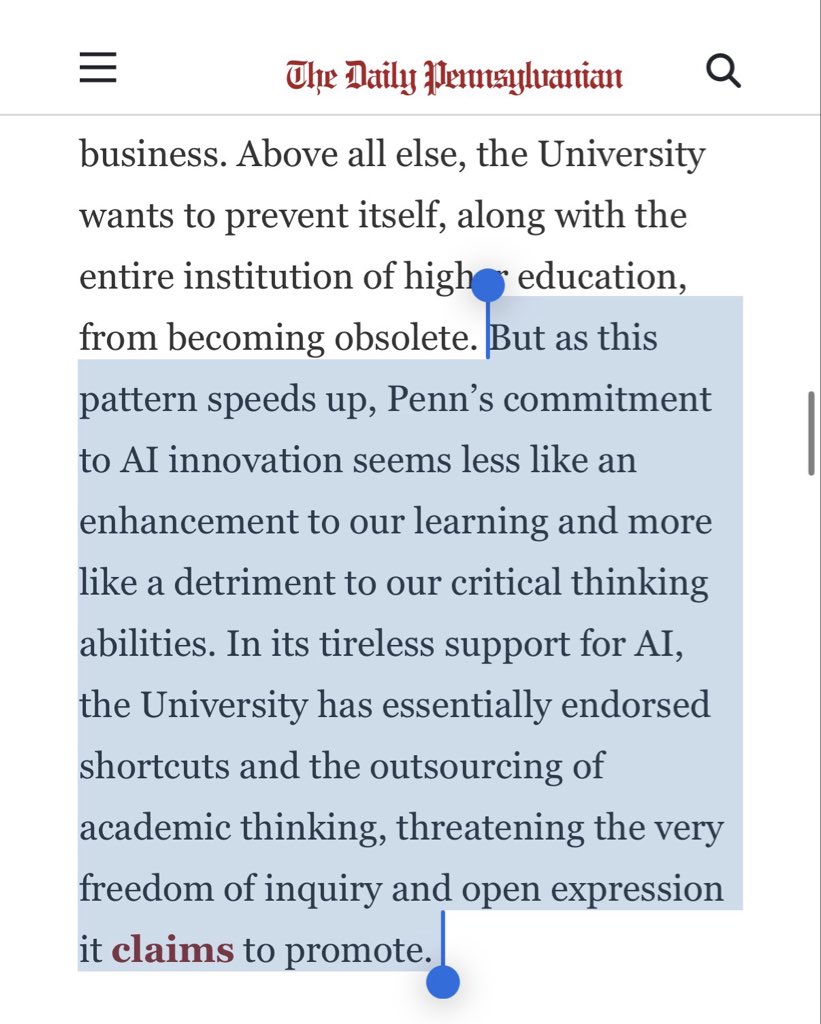
“AI l cannot coexist with education - it can only degrade it.”
Incredibly powerful piece from students at the University of Pennsylvania.
thedp.com/article/2026/03/pe…
54
1,446
4,976
94,115
Dr. Angie Raymond retweeted

Mar 24
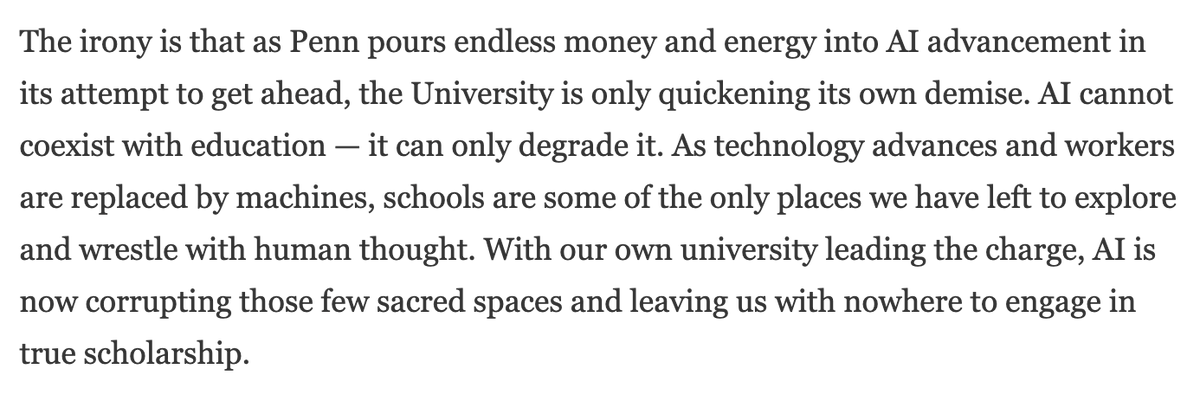
Powerful words from University of Pennsylvania students against their university's headlong rush to embrace of AI:
36
1,509
7,371
224,475
Feb 19
Not at all shocking, it’s predictable - when will something be done
Feb 18

🦔 Microsoft confirmed a bug allowed its Copilot AI to read and summarize customers' confidential emails for weeks, even when data loss prevention policies were in place to prevent sensitive information from being ingested into the model.
The bug, active since January, meant draft and sent emails with confidential labels were being processed by Microsoft 365 Copilot Chat despite explicit protections. Microsoft began rolling out a fix earlier this month but hasn't said how many customers were affected.
Meanwhile, the European Parliament's IT department blocked built-in AI features on lawmakers' work devices this week, citing concerns about confidential correspondence being uploaded to the cloud.
My Take
This is exactly the kind of thing I've been worried about with AI integration being rushed into every product. You set up data loss prevention policies specifically to keep sensitive information contained. Then a bug bypasses all of it and feeds your confidential emails to an LLM anyway. The controls you thought you had weren't actually working.
Microsoft has been aggressive about pushing Copilot into everything, and that pace creates risk. Every new integration point is a potential security hole. Every feature rushed to market is something that might not be fully tested. When the European Parliament is blocking AI features on work devices because they don't trust where the data is going, that's a signal worth paying attention to. The more access we give these systems to sensitive information, the more damage a single bug can cause. And we're still in the early days of finding out where all the bugs are.
Hedgie🤗

43
Yep, seriously yep

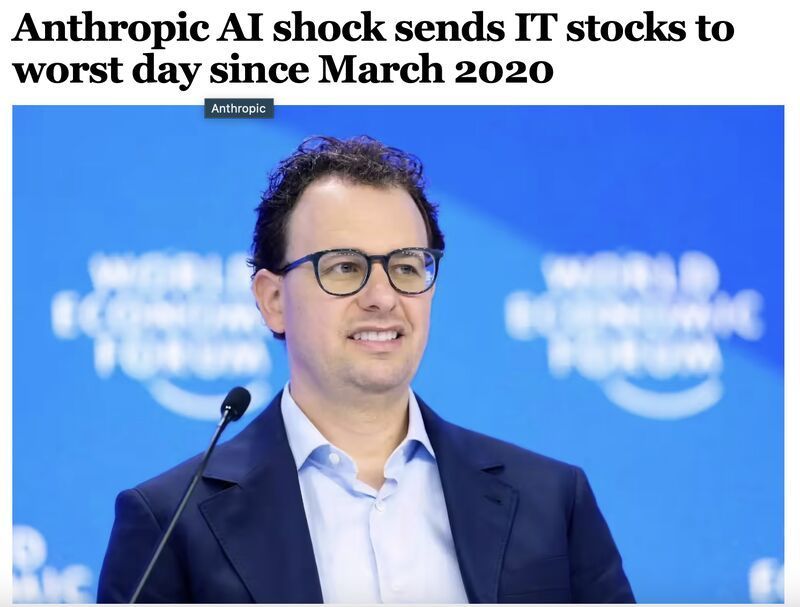
I'm pretty sure everyone at my company saw this article and now they all think we're in an AI crisis.
We're not in an AI crisis. We use Claude to summarize Slack threads.
But here's what's actually interesting: this whole panic reveals something nobody wants to admit.
Every company in America has been bullshitting about their "AI strategy" for two years.
We all saw the hype. We all knew we had to say something. So we rebranded our existing automation as "AI-powered" and called it a day.
My company isn't special. We're all doing the same thing.
The problem is now the executives actually believe their own bullshit. They think we have "significant AI exposure" because they've been telling investors we're "AI-first."
I just got pulled into an emergency meeting. Six executives asking me to explain our "AI dependency matrix."
There is no AI dependency matrix.
There's Claude for meeting summaries, there's some sentiment analysis in our support tickets that came free with Zendesk, and there's whatever Gmail is doing when it autocompletes my sentences.
But I can't say that in a room full of people who told their boards we're "transforming the business through AI."
So I said we have "distributed AI touchpoints across multiple vendors with no single point of failure."
Which is technically true. We use a bunch of different services that all have AI features we mostly ignore.
The CFO asked if we should "hedge our AI exposure."
I have no idea what that means. Neither does he.
What am I going to do: nothing. Because in three weeks, Anthropic will say something reassuring, the stocks will recover, and everyone will forget this happened.
But I'll have documentation showing I recommended a "risk assessment" that mysteriously never got prioritized.
The funniest part is that half these executives probably don't even know what Anthropic is. They just saw "AI" and "crash" in the same headline.
We're all pretending. The whole industry is pretending.
And articles like this just remind everyone how fragile the pretending is.
54
Thank you @AmericanAir I was worried been a bad week for weather- but we just had an event free trip!
1
3
1,041
Dr. Angie Raymond retweeted
Jan 23
🦔 A group of AI researchers from Berkeley, Harvard, Oxford, Cambridge, and Yale published a warning in Science about "AI swarms," coordinated networks of AI agents that infiltrate social media, mimic human behavior, and fabricate consensus. Nobel peace prize winner Maria Ressa and Taiwan's former digital minister Audrey Tang are among the authors. They say the technology could be deployed at scale by the 2028 US election.
In Taiwan, AI bots have already been engaging citizens on Threads and Facebook, pushing "information overload" and encouraging younger voters to stay neutral on China. One researcher described how easy it is to "vibe code" small bot armies that navigate social media, email, and blogs autonomously.
My Take
The technical capability is real. Agentic AI can now plan actions, adapt tone, post irregularly to avoid detection, and coordinate across platforms. One author has been simulating swarms in lab conditions. An Oxford professor called it "technologically perfectly feasible." The question is deployment. In 2024, despite predictions, AI-driven microtargeting didn't show up at scale in elections. Most propagandists are still using older tools because they work and carry less risk.
But the gap between lab capability and real-world deployment tends to close fast. The Taiwan example is instructive: bots aren't pushing obvious pro-China messages. They're encouraging neutrality, creating doubt, making issues seem too complicated to have opinions about. That's harder to detect and harder to counter than obvious propaganda. The authors are calling for "swarm scanners" and watermarked content, but those would require platform cooperation that doesn't exist yet. The 2028 timeline might be optimistic or pessimistic depending on who's building what right now.
Hedgie🤗
59
309
661
43,537
Jan 17
Important research being done by some amazing scholars- congratulations on the publication!

Smartphone data reveal how much more Black Americans are policed. The reason why varies by city. In the November issue, by M. Keith Chen @MKeithChen Katherine L. Christensen @katechristens Elicia John, Emily Owens @ProfEmilyOwens Yilin Zhuo zurl.co/LZLUJ
30
Dr. Angie Raymond retweeted

20 Dec 2025
‘Elite cohort’ of biz school scholars and editors scratch each others’ backs, study finds.
retractionwatch.com/2025/12/…

3
6
4,196
Dr. Angie Raymond retweeted
14 Dec 2025
“Academic Publishing Is Not Fit for the Future – If We Don’t Act Now, The Vital Role Research Plays in Society Is at Risk,” says a director of Cambridge University Press.
scholarlykitchen.sspnet.org/…

1
3
2
2,313
Dr. Angie Raymond retweeted

13 Dec 2025
But it's also true that claiming that a technology is so novel that existing regulation can't resolve its problems is just a way of buying time to commit more crimes before the regulators finally realize that your flashy new technology is just a boring old scam.
67/
1
10
34
2,259