
high modernist multicultural flavour maximiser
Joined September 2018
- Tweets 48,092
- Following 1,612
- Followers 11,529
- Likes 67,850
4,102 Photos and videos















Pinned Tweet

1 Nov 2019
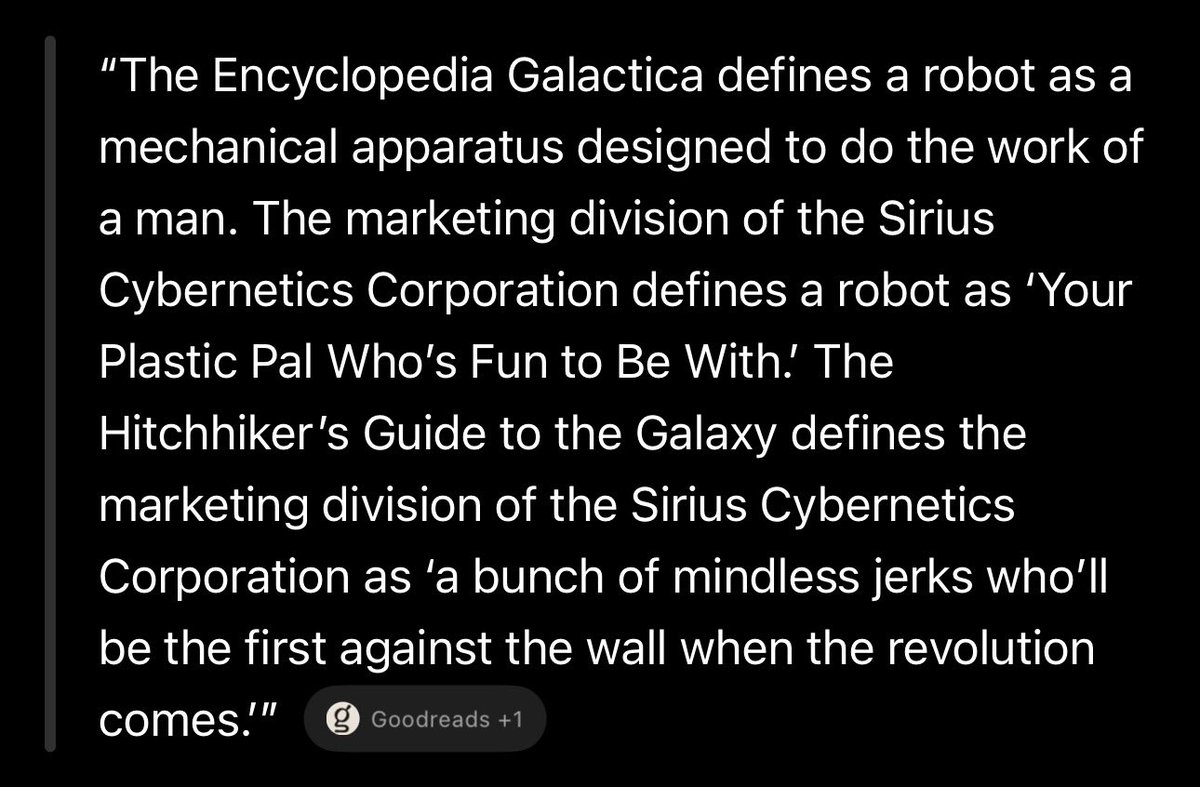
Maybe the real research outcomes are the friends we make along the way
13
26
370
Jun 11
Apparently I have adult dependents when they calculate whether my kids can receive AUSTUDY. But I’m a footloose and fancy-free single person when they calculate my tax.
2
11
809
Jun 11
Correct response was a shrug and a haunted 1000 yard stare
Jun 11

(Interviewer): Alright, first question: Why do you want to work here at Mercenaries ‘R’ Us?
(Candidate): Well, I’m very passionate about this company’s mission, and I feel its values strongly resonate—
(Interviewer): Sorry, you’re not a cultural fit.
13
1,480
Jun 10
RT @ChurchillFella: Ukrainian student Iryna Zabudko died in a hospital today.
She was severely injured during Russian attack on Kyiv on Jun…
1,871
Arthur Dent retweeted

Jun 8
It's so impressive how this man has monetised whining about not being able to speak freely for more than ten years without ever actually saying anything of substance.
x.com/DaveClips/status/20638…

Heartbreaking: Dave Rubin recounts his life-threatening experience on Jubilee.
16
15
276
19,123
Arthur Dent retweeted

Jun 8
Jun 8

A French engineer who lives quietly in Paris has spent 30 years writing software that the entire internet now runs on without knowing his name.
He wrote the code that streams every YouTube video, every Netflix show, every TikTok clip. He wrote the code that runs the virtual servers underneath AWS, Google Cloud, and Microsoft Azure. He calculated more digits of pi than anyone in history. He has no Twitter. He has no marketing. He just keeps shipping.
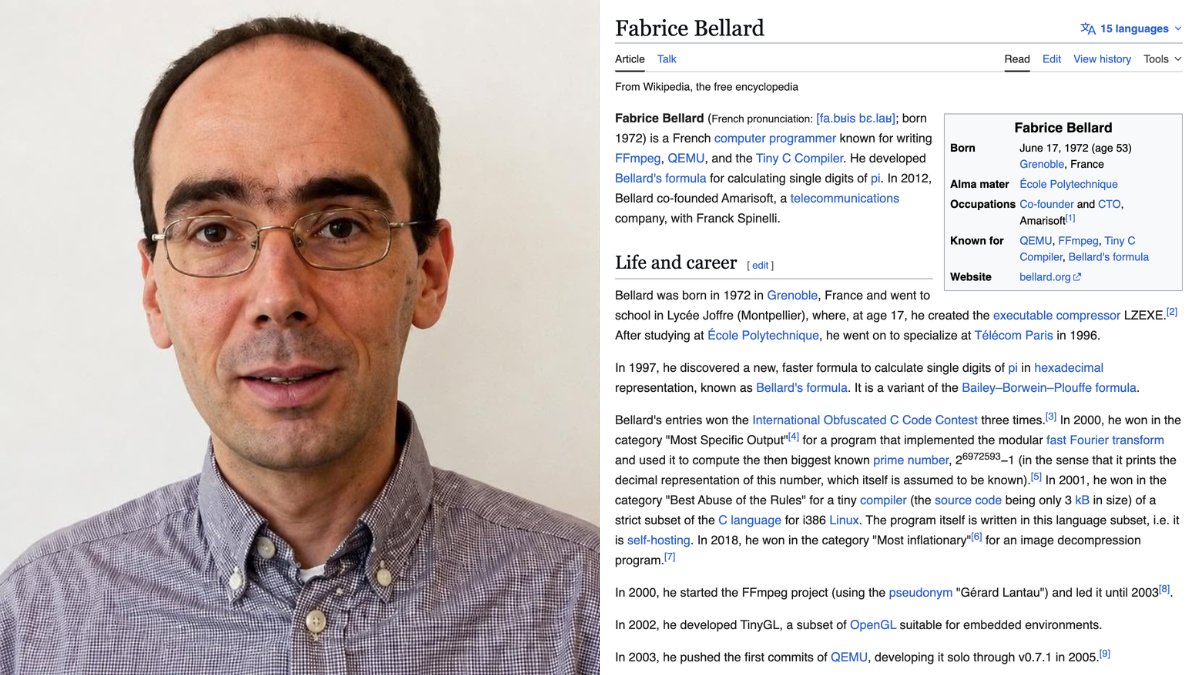
His name is Fabrice Bellard.
Here is the story, because almost nobody outside the systems programming world knows what one man has built.
Fabrice was born in 1972 in Grenoble, France. He studied at École Polytechnique, the top French engineering school. He never went to Silicon Valley. He never built a startup empire. He just wrote code.
In 2000 he started a project called FFmpeg, an open-source multimedia framework for encoding, decoding, and streaming video. He was 28. The project did one thing nobody else had done well. It handled every video and audio format that existed, in one library, on every operating system. He led it himself for years.
Today FFmpeg is the invisible engine of the internet. YouTube uses it. Netflix uses it. VLC uses it. Chrome and Firefox use parts of it. Every Android phone, every iPhone, every smart TV, every video editing tool you have ever touched runs FFmpeg somewhere underneath. If you have watched a video on a screen in the last 20 years, Fabrice's code processed it.
He was not done.
In 2003 he started QEMU, a machine emulator and virtualizer. He wrote it solo until version 0.7.1 in 2005. QEMU lets you run any operating system on any other operating system. It became the foundation of modern virtualization. KVM, the Linux kernel hypervisor, runs on top of QEMU. Every major cloud provider, AWS, Google Cloud, Microsoft Azure, IBM Cloud, runs virtual machines on infrastructure built around it. The Quick Emulator is the most cited piece of cloud infrastructure code on Earth.
He kept going.
In 2001 he won the International Obfuscated C Code Contest with a small C compiler that grew into TCC, the Tiny C Compiler. TCC can compile and boot a Linux kernel from source in under 15 seconds. In 2004 he calculated the most digits of pi ever computed at the time, using a personal desktop computer and an algorithm he derived himself called Bellard's formula. In 2011 he wrote a complete PC emulator in pure JavaScript that runs Linux in your browser, a project called JSLinux that engineers still cannot believe is real.
In 2019 he released QuickJS, a small but complete JavaScript engine that fits where V8 cannot. In 2021 he released NNCP, a neural network based lossless data compressor that immediately took the lead on the Large Text Compression Benchmark.
Then he turned his attention to large language models. He built TextSynth Server, a web server with a REST API for running LLMs locally. He released ts_zip and ts_sms, compression utilities that use language models to compress text and short messages at ratios traditional algorithms cannot reach. He released TSAC, a very low bitrate audio compression system. In December 2025 he released Micro QuickJS, a new JavaScript engine for microcontrollers, separate from QuickJS, designed for environments with almost no memory.
Fabrice co-founded a telecom company called Amarisoft in 2012, where he serves as CTO. Amarisoft builds 4G and 5G base station software used by carriers and labs around the world. He has been running it for over a decade while continuing to ship personal projects from his own home page at bellard dot org
He has no Twitter. He has no Instagram. He gives almost no interviews. His personal website is a flat list of projects with no styling, no fonts, no marketing copy. Just titles and links.
A quiet French engineer who never moved to Silicon Valley wrote the code that quietly runs the internet.
He is still shipping.
23
1,480
20,843
743,728
Arthur Dent retweeted

Jun 6
Saw this walking the pooch earlier...the poor thing forlornly waiting for a 90s chat show to form round it...

4
3
15
2,629
Arthur Dent retweeted

Steve Kirsch just gets more and more bonkers every year.

"70% of elderly people get the flu shot every year, and it kills off a portion of them on day zero. It's got a day-zero kill record. It's in the Medicare data, and nobody's saying a damn thing about this."
~Steve Kirsch
29
21
130
5,794
Arthur Dent retweeted

Jun 7
Cats are the perfect companions for men in their 40s because they get equally as excited about seeing birds in their yard.
4
50
887
20,363
Arthur Dent retweeted

Jun 7
We lost so many good men as a result of what were, in retrospect, preventable blunders in strategy and training

88
132
2,461
193,661
Arthur Dent retweeted

Jun 7
Snyder: Trump is trying to blow America’s chance to be a power in the 21st century. The answer is not to reinvent who you are, but to remember who you are and act on it. If enough people do small things together that affirm those values, it will matter. 3/
1
23
107
2,005
Jun 7
It’s winter, I’ve got a bottle of wine open, making earthy French country style stews with smoked pork bones, dill bulbs and turnips. Fresh herbs going in liberally. Feeling gregarious and a bit overfed
Yep, I’ve gone full Gerard Depardieu mode
1
34
2,019
Jun 5
Me eliminating the impossible to focus on the merely improbable (finding where I put down my glasses)
3
12
685

Many public discussions center around trends and statistics that are not real at all.
For over a decade, there was widespread public discourse about the causes of high and rising maternal mortality in the US.
But, as I've written about before , CDC analyses showed that the apparent rise from 2003 to 2017 was due to a change in measurement ourworldindata.org/rise-us-m… , when a pregnancy checkbox was added to death certificates, which flowed directly into maternal mortality counts in most cases. Rather than mortality rising, the rate had been stable. Many deaths had been previously missed, and many other countries were undercounting maternal deaths.
This isn't an isolated case.
- People often cite the IHME's estimate of childhood height having fallen in the UK over the past decade. Looking at the data sources, it missed one of the key sources of data on height - a national dataset measuring the height and weight of almost all schoolchildren in the UK, which showed no decline (that data wasn't publicly available until an FOIA request) - and instead the IHME estimates were likely extrapolated based on a global model and smaller, less reliable surveys. neilobrien.co.uk/p/honey-we-…
- I often hear claims about disruptive science having declined over time based on a highly influential paper in Nature. nature.com/articles/s41586-0… But the key results were affected by a coding bug, which would have showed a decline simply due to this artefact arxiv.org/abs/2402.14583
- The idea that interstate migration in the US has collapsed has led to lots of concern about dynamism and unemployment. But recently, it's been shown that much of the apparent decline was a statistical artefact of how the survey filled in missing responses, causing it to systematically overcount non-movers. Correcting this shows only a very slight decline over time link.springer.com/article/10…
- The dramatic rise in autism diagnoses, which has spurred lots of commentary about pesticide use and vaccines, actually reflects changes in how autism was defined. In the 1960s, autism described severely disabled, mostly nonverbal children: if a child was verbal or succeeding at school, they were excluded from the diagnosis by definition. The criteria then widened across successive editions of the DSM. Alongside it, it became much easier to get assessed, from requiring a specialist with months-long waiting lists to something that could be done in a few appointments. pubmed.ncbi.nlm.nih.gov/2592…
--
I think this is a persistent problem of people undervaluing data quality and measurement. It may sound dull or academic to care about these issues, but numbers and statistics are a big part of public discussions. They can be the premise of debates that can go on for years and sometimes even decades, and mislead people about social and policy interventions to fix them.
So before spending time arguing about the causes and consequences of a trend or statistic and what should be done about it, it's worth digging into the data to see if it supports the premise at all.
I suspect there are many other discussions affected by this too. Are there others I've missed?
19
149
515
86,169
Jun 3
Idea for some kind of social media auto translate. Eg
“You are not ready for…”
->
“You will be mildly surprised by…” 1/
3
19
851
Jun 3
“Tell me you’re X without telling me you’re X” = “I’m about to describe the most obvious possible stereotype of X.”
1
7
303
Jun 3
There’s like a zillion more examples but you get the idea. Actually a better idea for the app would just be to delete that fluff and replace it with nothing
1
9
298