Joined January 2024
- Tweets 210
- Following 184
- Followers 33
- Likes 23
161 Photos and videos

Pinned Tweet

25 Aug 2024
We are the app with a brain image🧠 and a bulb.💡
1
208
May 26
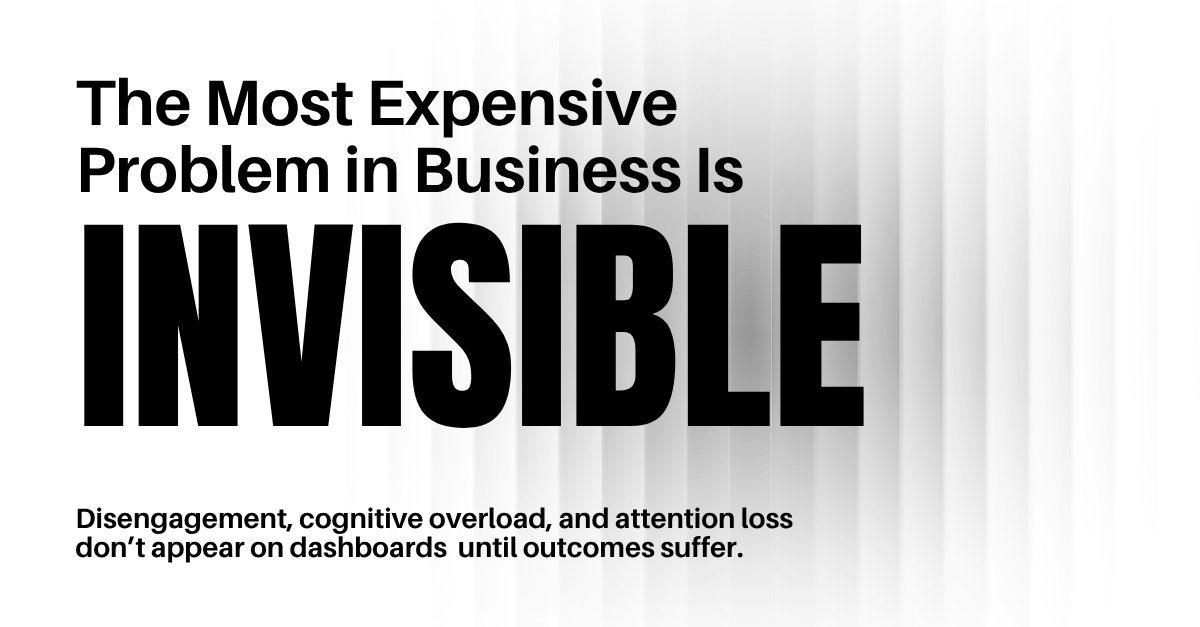
The Most Expensive Problem in Business Is Invisible
Every organization tracks performance.
Revenue dashboards update in real time.
Sales pipelines refresh hourly.
Operational systems monitor latency down to the second.
But the most expensive variable in modern business is still largely invisible.
Human attention.
The hidden cost behind declining performance
By the time performance drops become visible, the underlying problem has often been building for weeks — sometimes months.
Disengagement doesn’t appear overnight.
Neither does burnout.
Neither does cognitive overload.
They develop quietly through:
constant context switching
information overload
low-grade stress
meeting fatigue
fragmented attention
Yet most organizations don’t detect any of it until output suffers.
Missed deadlines.
Lower engagement scores.
Reduced productivity.
Employee turnover.
These are not early warning signs.
They are delayed outcomes.
We built modern work around visible metrics
The irony is that organizations have never had more data.
We can measure:
workflow efficiency
customer behavior
operational performance
financial movement
But we still struggle to understand one of the most important drivers behind all of them:
Whether people are cognitively present in the work itself.
Attendance is measurable.
Activity is measurable.
Even screen time is measurable.
But attention, mental strain, and cognitive alignment?
Those are still mostly invisible.
The engagement crisis is really a visibility crisis
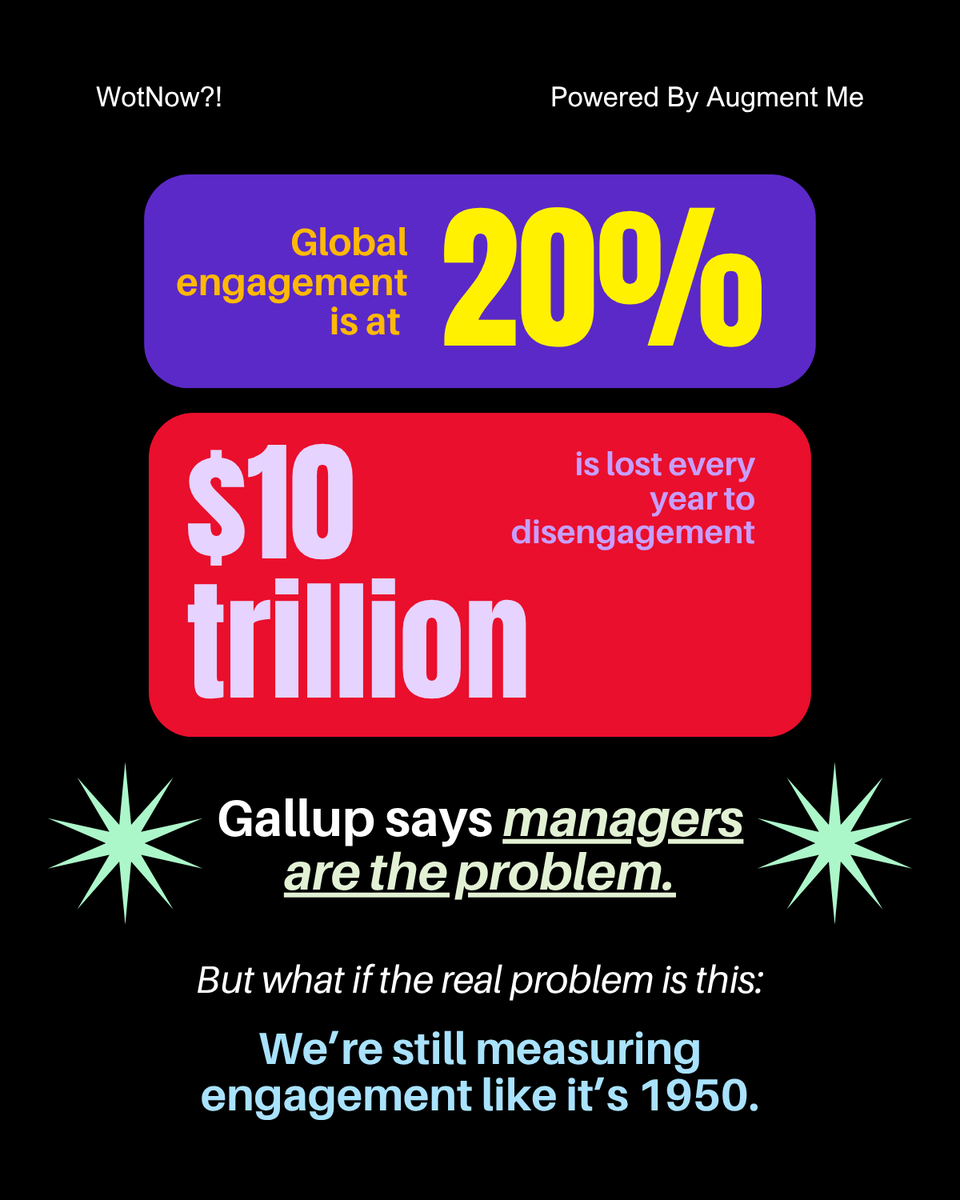
Gallup’s 2026 report found that only 20% of employees globally are engaged at work.
That disengagement now costs the global economy approximately $10 trillion annually.
At the same time, organizations continue investing heavily in AI and productivity systems — yet many report little measurable improvement in performance.
Why?
Because workflows are being optimized while human cognitive capacity is being ignored.
Technology can accelerate tasks.
But it cannot create engagement where attention has already collapsed.
The signals are already there
The human body constantly produces signals long before performance visibly changes.
Subtle shifts in:
attention
cognitive load
physiological rhythm
mental fatigue
These patterns appear before disengagement becomes obvious.
The problem has never been the absence of signal.
The problem has been the absence of visibility.
What happens when invisible problems become measurable
At Augment Me, this is the gap we’ve been focused on solving.
WotNow?! was built around a simple idea:
If organizations can measure operational systems in real time, they should also be able to understand human engagement in real time.
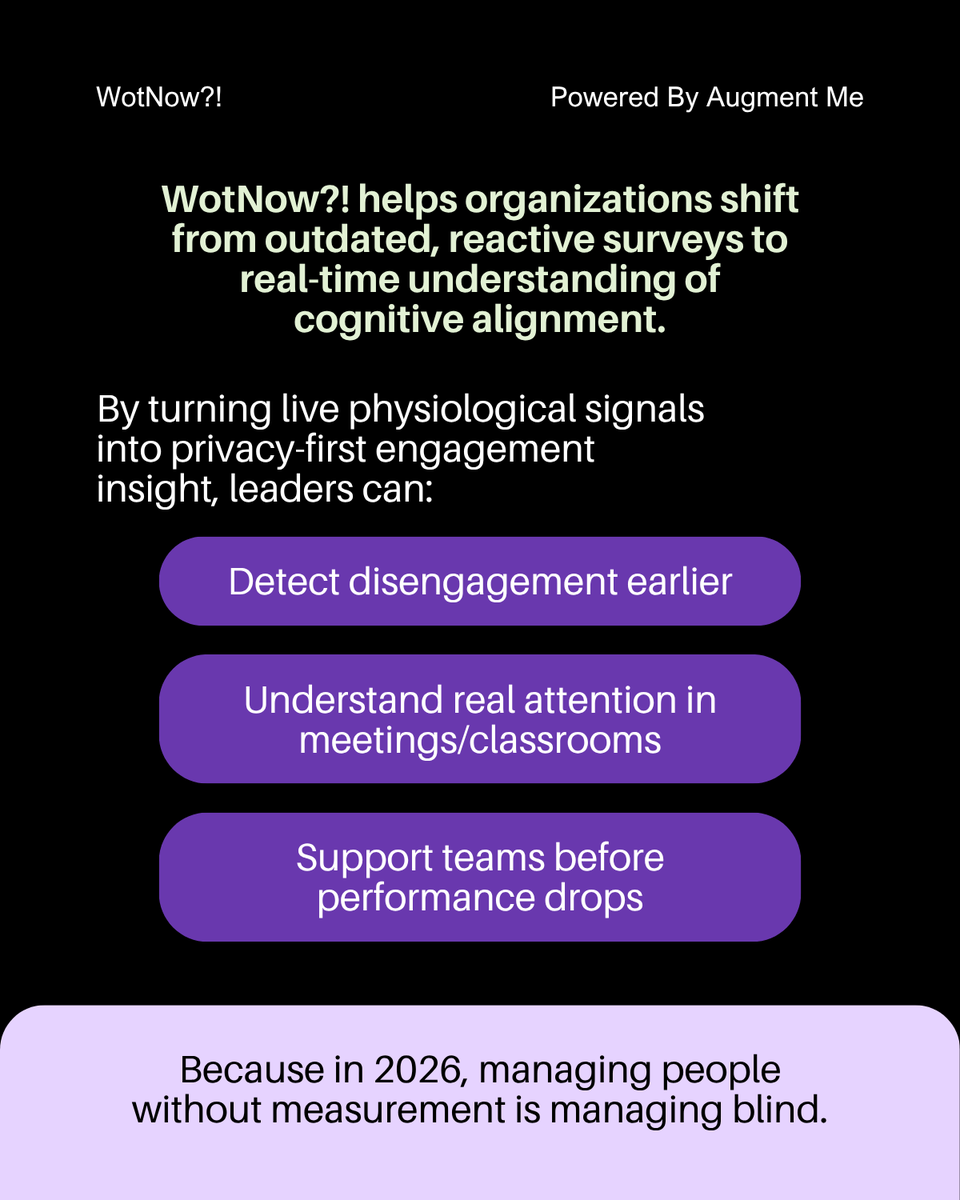
Using privacy-preserving sensing through existing cameras, WotNow?! helps teams identify:
attention shifts
cognitive overload
engagement patterns
mental strain
Not months later through surveys.
Not after performance drops.
In the moment.
Because once leaders can actually see cognitive friction, they can adapt:
meetings
pacing
training
communication
workloads
before disengagement compounds into something more expensive.
The future of work will be measured differently
The organizations that perform best in the next decade will not simply collect more productivity data.
They will understand human performance more clearly.
Not just what people produce —
but how people experience the environments they work in.
Because the most expensive problems in business are rarely operational first.
They become operational after being invisible for too long.
Final thought
Most businesses are trying to improve outcomes while remaining blind to the human signals driving them.
But invisible does not mean immeasurable anymore.
And once you can see the problem —
you can finally start solving it.
#FutureOfWork #Leadership #WorkplaceEngagement #AI #PeopleAnalytics #CognitiveLoad #WotNow #AugmentMe
3
May 25
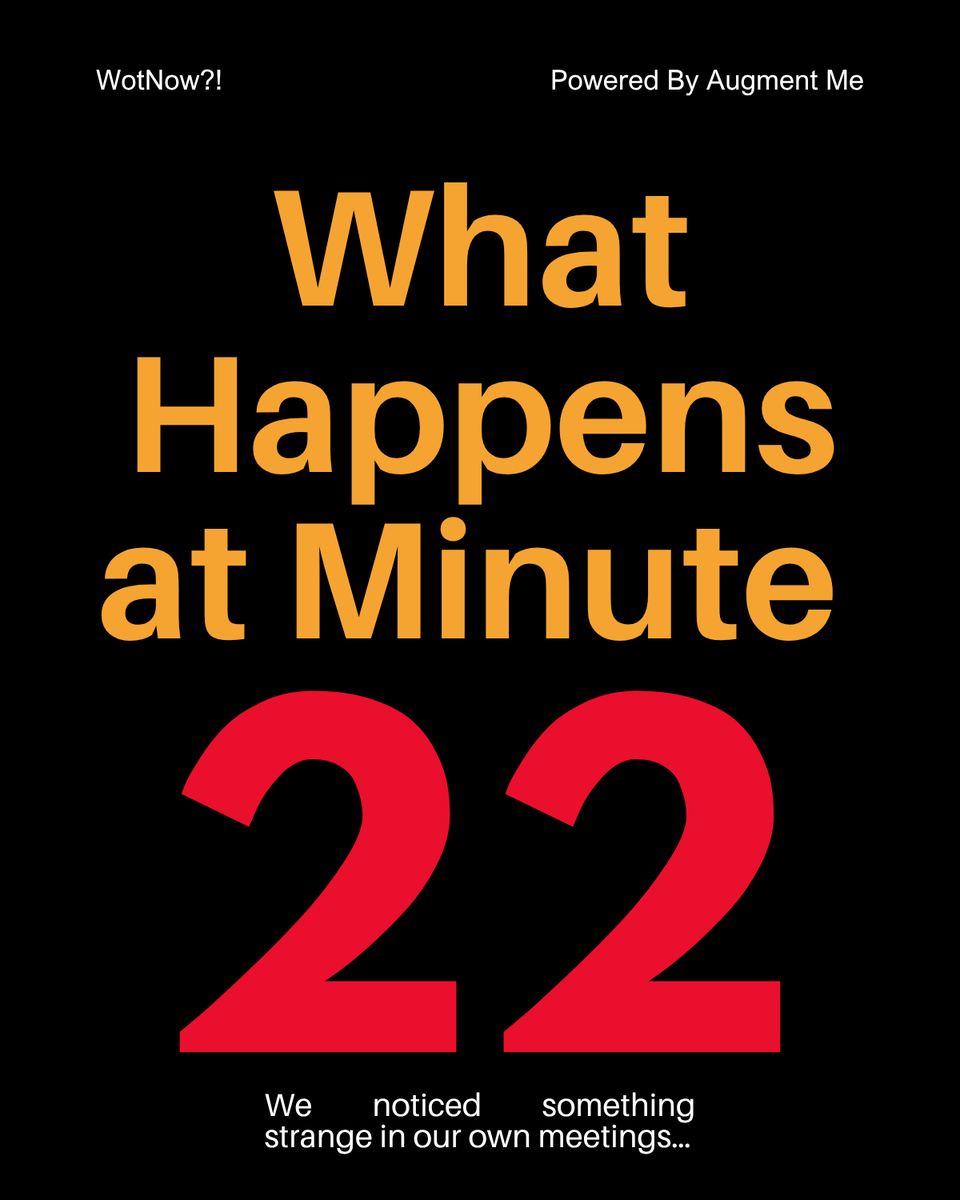
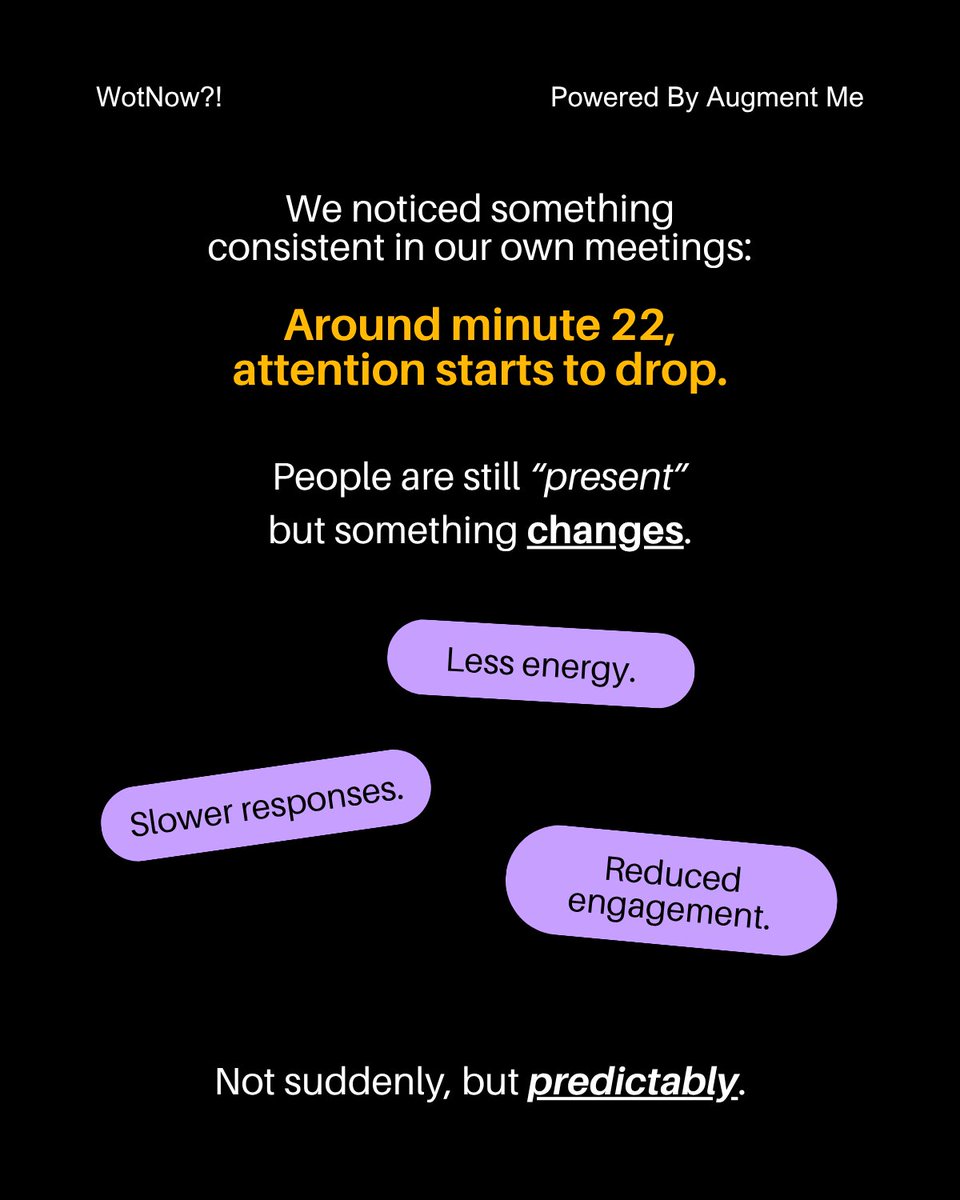
We kept seeing the same pattern internally.
Meetings would start strong…
but around minute 22, something shifted.
Not disengagement in a dramatic way —
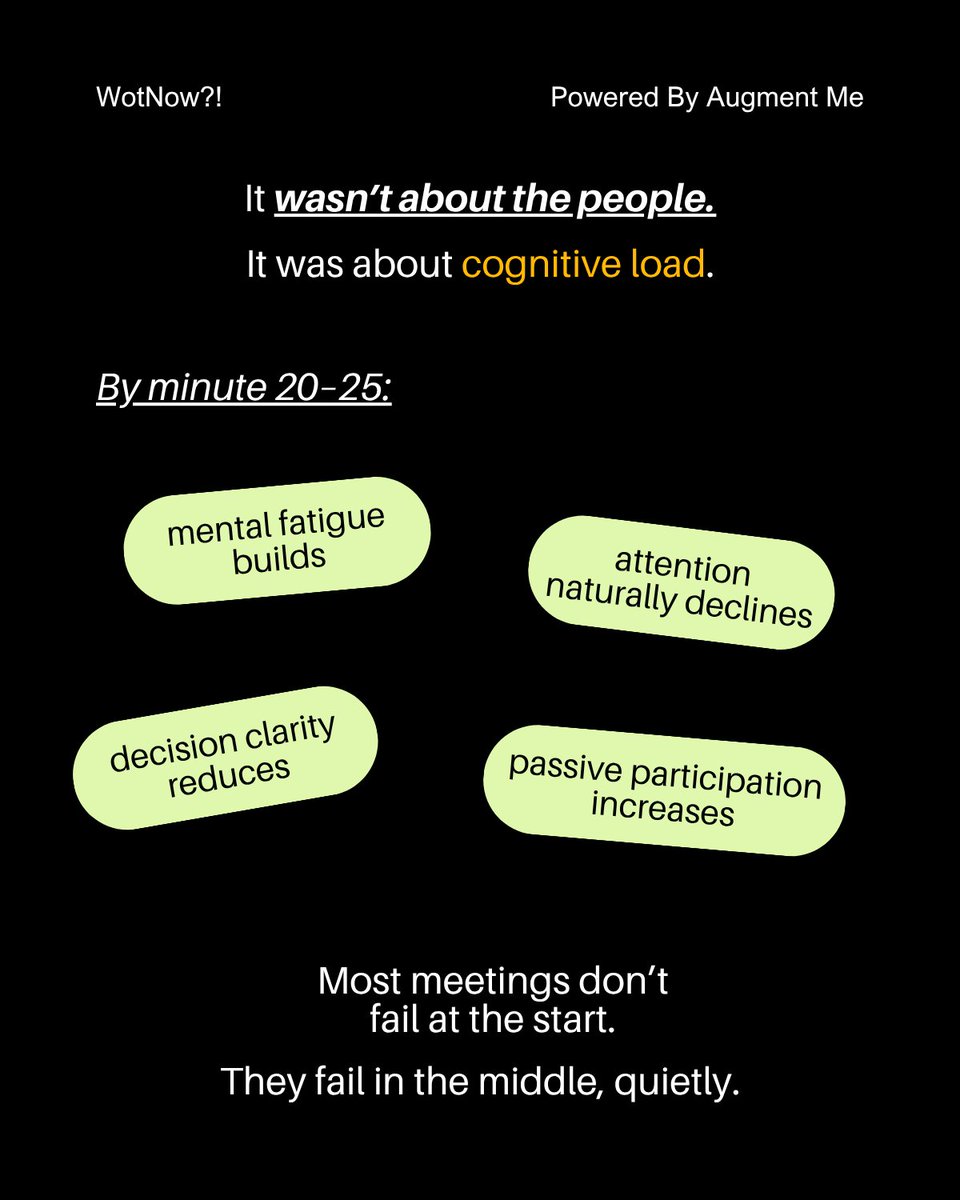
but a subtle drop in attention, energy, and cognitive clarity.
Once we saw the pattern, we stopped ignoring it.
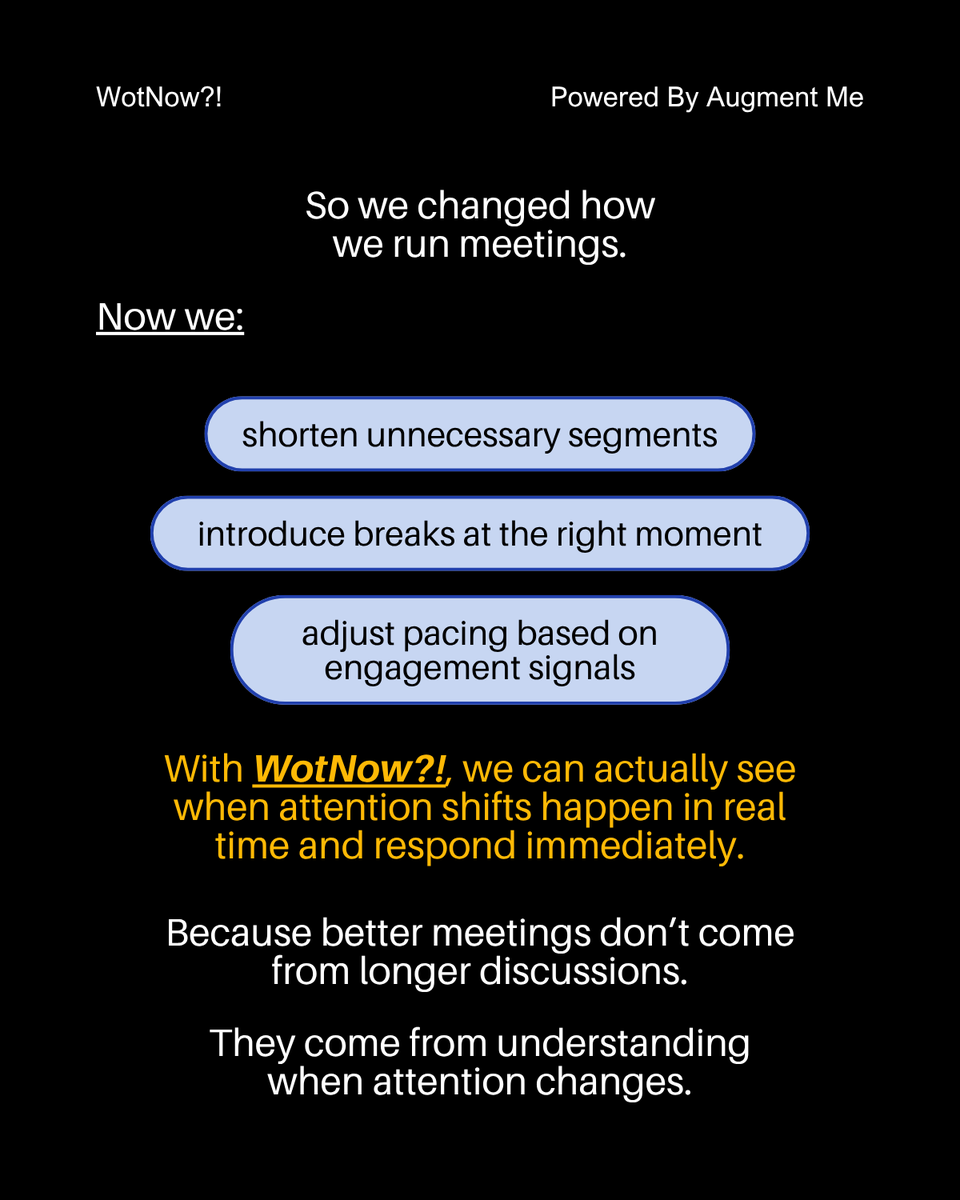
Instead of forcing meetings to run their full length, we began adapting:
shortening sections, adjusting pacing, and responding to real-time engagement signals.
This is where WotNow?! changed how we work internally — turning invisible cognitive shifts into visible decision points.
Because most meetings don’t fail loudly.
They fail quietly… at a very predictable moment.
#FutureOfWork #Meetings #Productivity #AI #WorkplaceWellbeing #CognitiveLoad #WotNow #AugmentMe
2
May 22
For years, workplace technology focused on workflows, outputs, and productivity metrics.
But one of the richest sources of workplace intelligence has been sitting in front of us the entire time:
The camera.
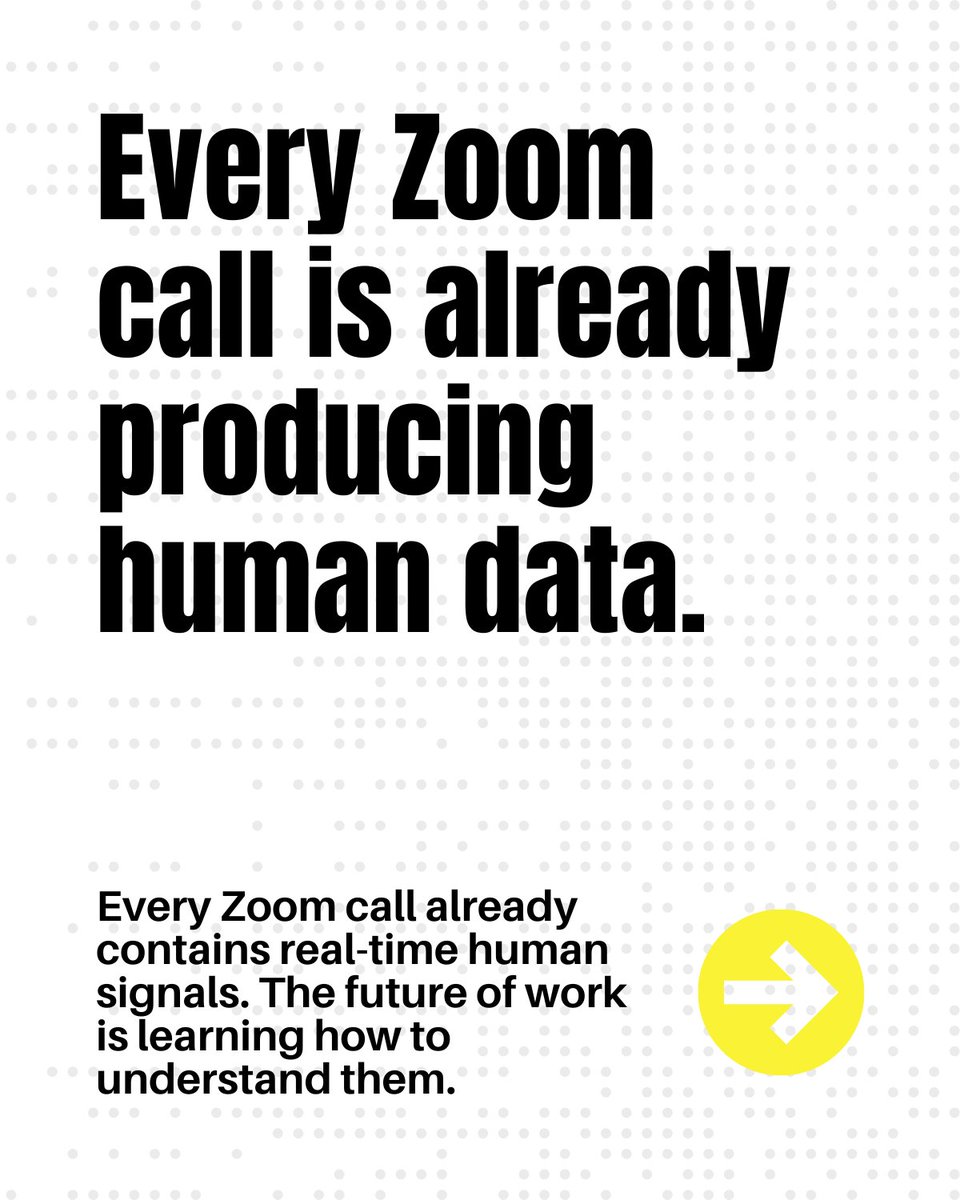
Every virtual meeting already contains signals about:
engagement
cognitive load
pacing
attention shifts
communication clarity
Not through invasive surveillance.
Not through emotion labeling.
But through subtle, measurable physiological and attentional patterns that reflect how people are actually experiencing the interaction in real time.
The infrastructure already exists.
Organizations don’t need more hardware to build cognitively aware environments.
They need better interpretation layers.
That’s part of what we’re building with WotNow?! — turning existing cameras into privacy-first engagement intelligence systems that help teams understand when meetings are working, when cognitive overload is building, and when communication needs to adapt.
Because the future of work won’t just be digital.
It will be aware.
The next generation of workplace intelligence won’t come from collecting more data — it will come from understanding the human data already there.
#FutureOfWork #AI #WorkplaceInnovation #PeopleAnalytics #CognitiveAlignment #WotNow #AugmentMe
1
May 17
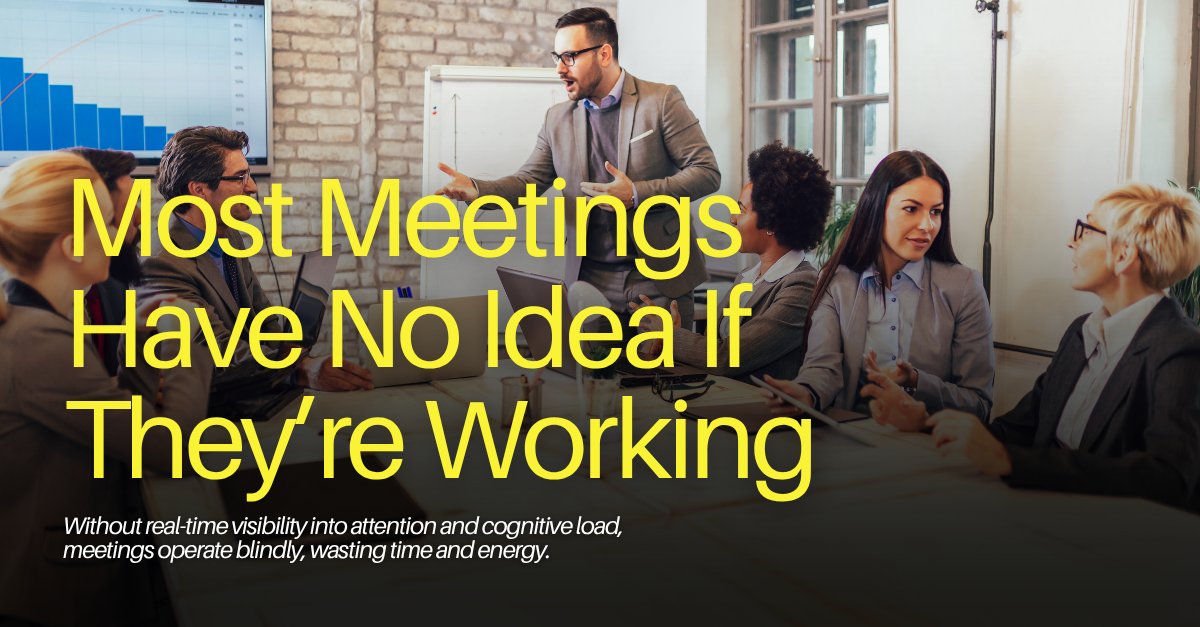
Most Meetings Have No Idea If They’re Working
Think about the last meeting you were in.
Everyone showed up.
Slides were presented.
Updates were shared.
But here’s the real question:
Was anyone actually engaged?
Most teams don’t know.
And that’s the problem.
The illusion of productive meetings
In today’s workplace, meetings are treated as progress.
If it’s on the calendar, it must matter.
If people attend, it must be working.
But attendance is not engagement.
And silence is not alignment.
What looks like a productive meeting is often just polite compliance.
People nod.
They stay on the call.
They say “makes sense.”
But cognitively?
They may have checked out 15 minutes ago.
The measurement gap no one talks about
We track almost everything in real time:
Revenue.
Pipeline.
System performance.
But the one thing that drives all of it — human attention — is still mostly invisible.
According to Gallup’s 2026 report:
Global engagement is at just 20%
Disengagement costs the world ~$10 trillion annually
Yet most organizations still measure engagement through occasional surveys.
That’s like trying to understand a live conversation by reading a summary weeks later.
You cannot coach what you cannot see.
Why meetings fail (and we don’t notice)
Meetings don’t fail loudly.
They fail quietly.
Attention drops.
Cognitive load builds.
Clarity fades.
But because there’s no real-time signal, nothing changes.
The meeting continues.
The time is spent.
And everyone moves on — assuming it worked.
What changes when you can see engagement
Now imagine this:
You’re in a meeting and you can see, live:
when attention starts to drop
when the room becomes cognitively overloaded
when your message isn’t landing
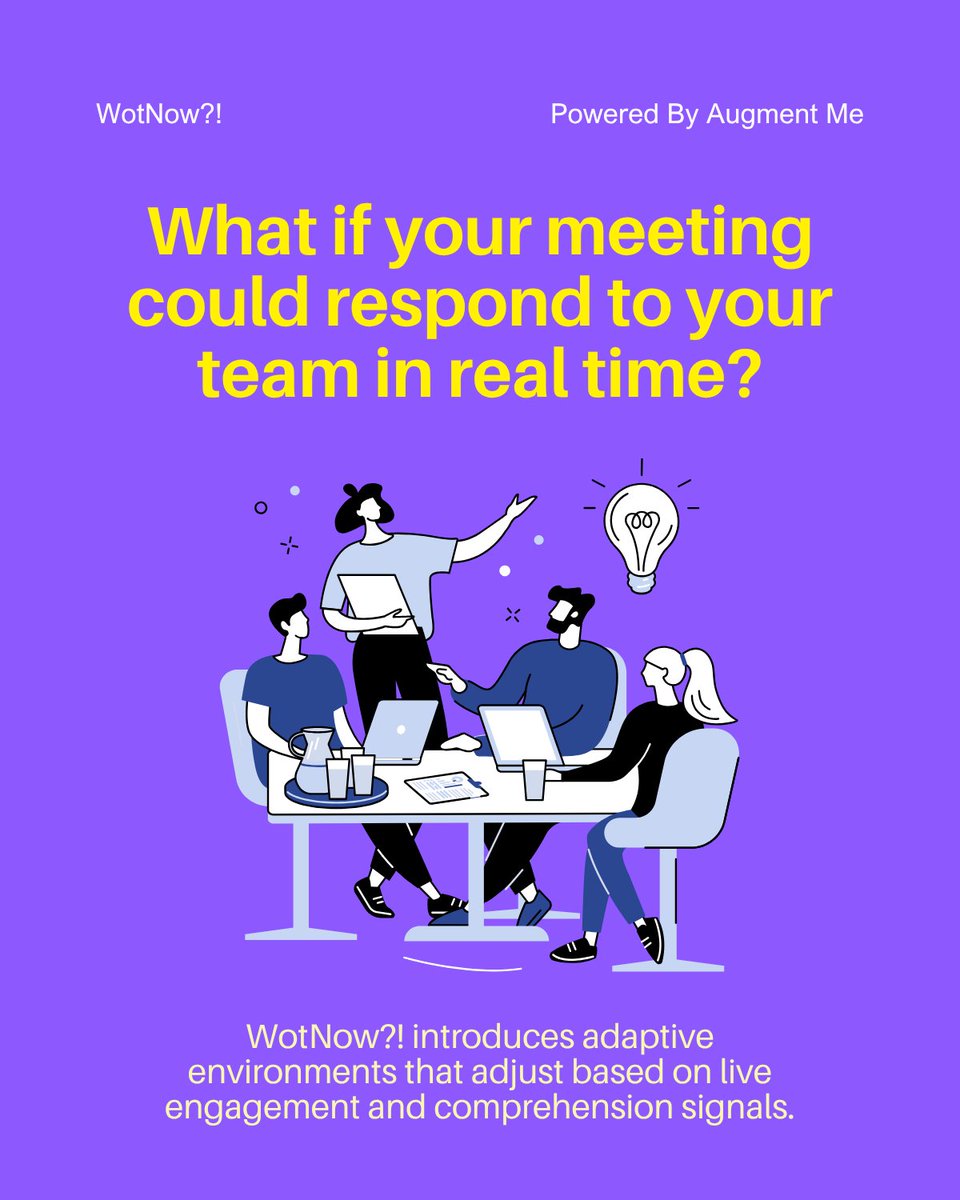
Suddenly, the meeting becomes adaptive.
You shorten the agenda.
You change pacing.
You pause when needed.
You don’t wait for feedback later —
you respond in the moment.
This is what cognitive alignment looks like in practice.
We didn’t just build it. We use it.
At Augment Me, we run WotNow?! in every internal meeting.
Not as a demo.
As our default way of working.
And it’s changed how we operate:
When engagement drops around minute 20, we pivot immediately
Some of our best product features came from noticing our own cognitive friction
When we speak to partners, we share real usage — not just theory
Because when you can see what’s happening in real time,
you stop guessing.
From meetings to intelligent environments
WotNow?! turns existing cameras into real-time engagement intelligence.
No wearables.
No special hardware.
Privacy-first.
It measures cognitive engagement — attention, pacing, comprehension —
and provides live, actionable feedback.
Not after the meeting.
During it.
This is the shift from passive meetings → adaptive environments.
The future of meetings
The problem isn’t that meetings exist.
It’s that they operate without awareness.
In a world where everything is measured in real time,
meetings remain one of the last blind spots.
But that’s changing.
Because the future of work won’t just be about gathering people in a room —
it will be about understanding what happens inside it.
Final thought
Most meetings don’t fail because of bad intentions.
They fail because no one can see what’s really happening.
And once you can see it —
you can finally change it.
#FutureOfWork #Meetings #WorkplaceInnovation #AI #PeopleAnalytics #CognitiveAlignment #WotNow #AugmentMe
2
May 16
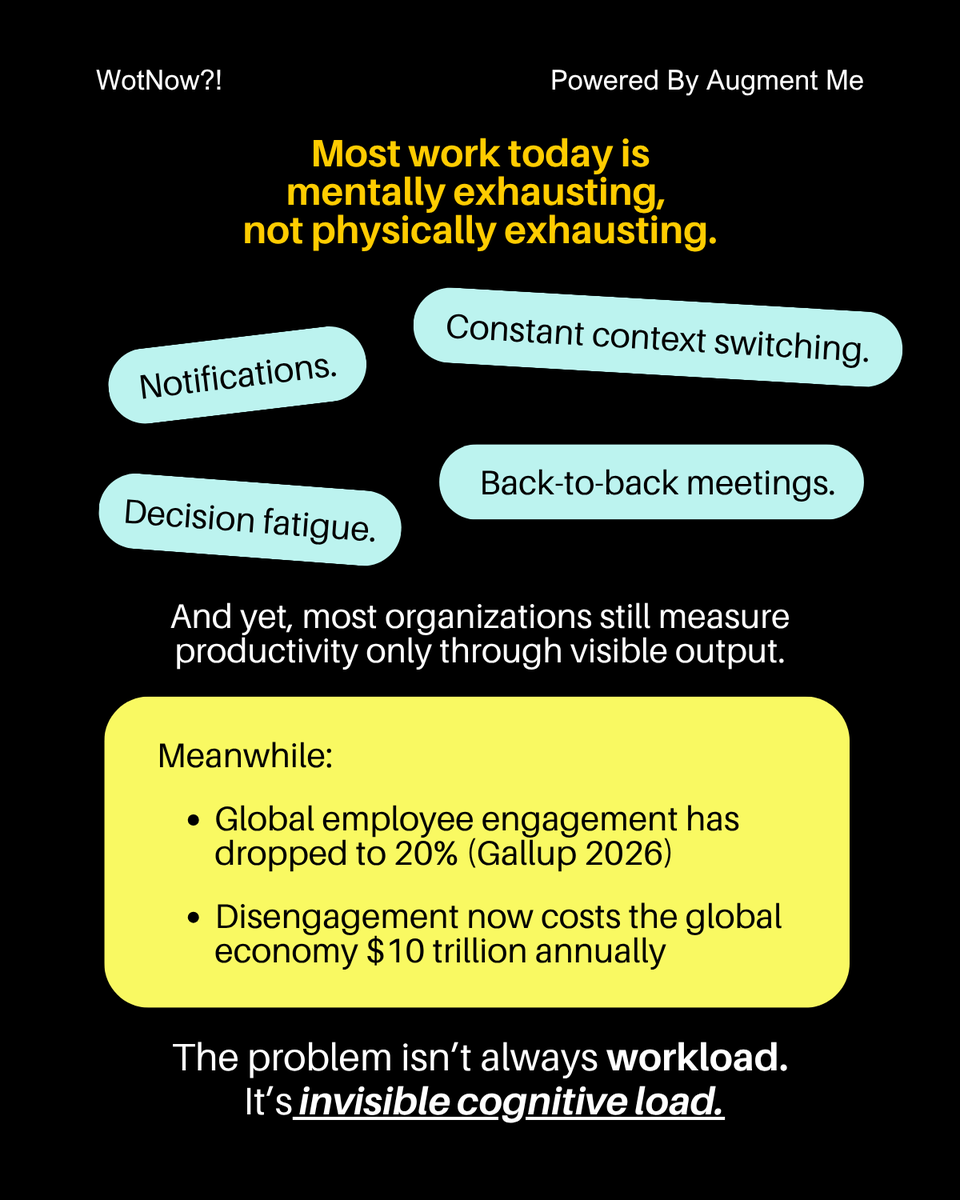
Most organizations are still trying to solve performance problems using visible metrics alone.
Tasks completed.
Hours worked.
Meetings attended.
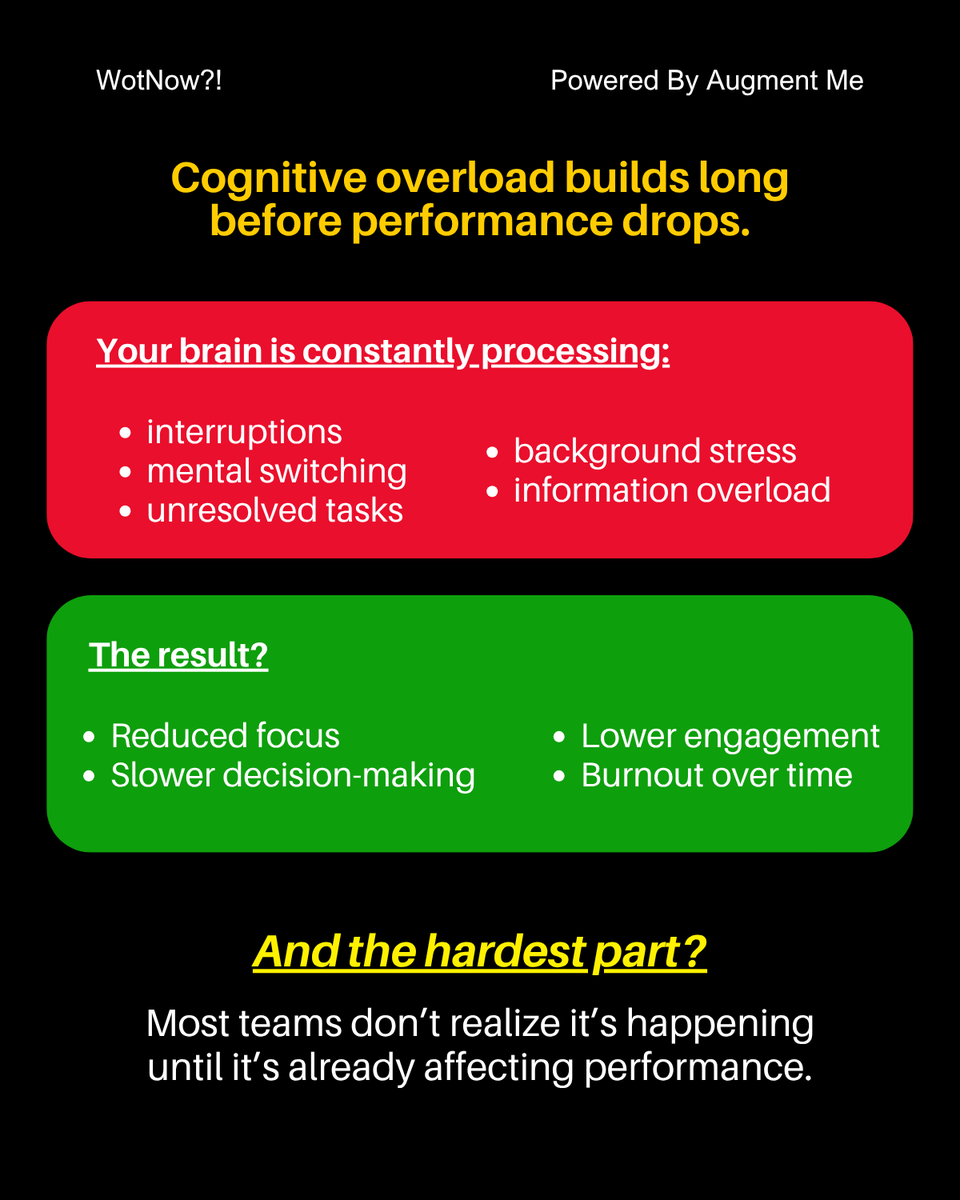
But cognitive overload doesn’t appear neatly on dashboards.
It builds quietly through interruptions, context switching, constant notifications, and mental fatigue — often long before performance visibly drops.
Gallup’s 2026 report found global engagement has fallen to just 20%, costing the world economy nearly $10 trillion annually.
The question is:
How much of that disengagement is actually invisible overload?
This is the first post in our new series:
The Invisible Layer of Work
Exploring the hidden human signals shaping performance, attention, and engagement in modern workplaces.
#FutureOfWork #CognitiveLoad #Leadership #PeopleAnalytics #AI #WorkplaceWellbeing #WotNow #AugmentMe
1
19
May 12
Gallup’s 2026 report landed with a number that should stop every leader in their tracks:
Only 20% of employees globally are engaged. That’s a five-year low.
And it comes with a cost: $10 trillion in lost productivity every year.
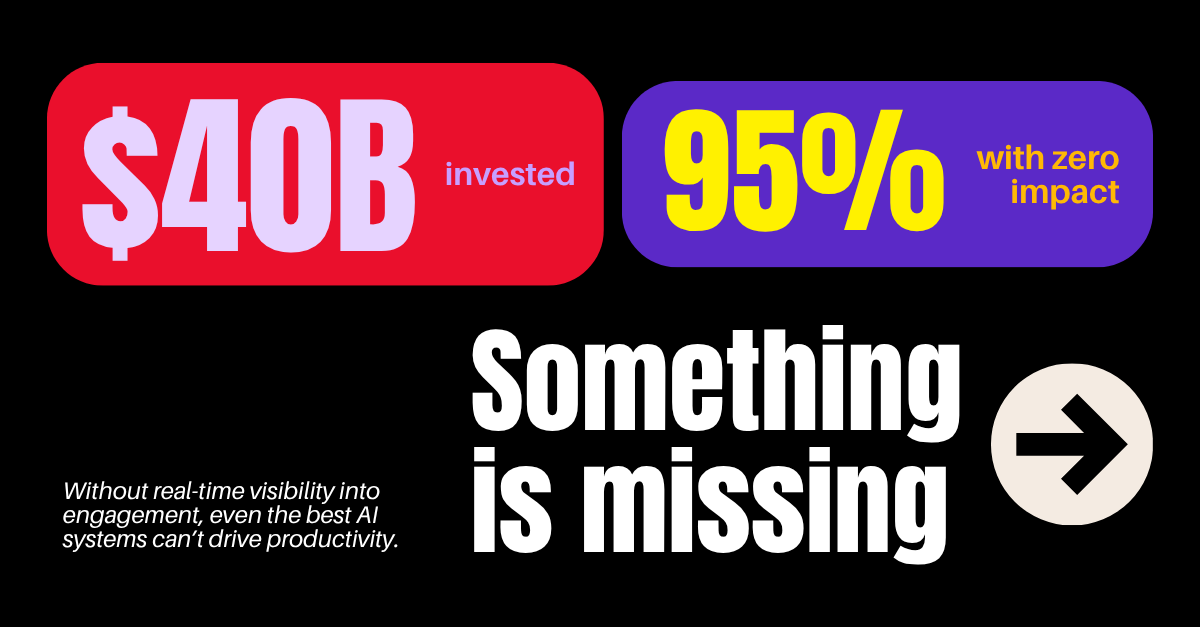
At the same time, organizations have poured nearly $40 billion into AI yet 95% report no measurable impact on profits, and 89% see no improvement in productivity.
So what’s going wrong?
The technology works. But something critical is missing.
The real problem isn’t engagement. It’s visibility.
Engagement isn’t a vague concept.
It’s attention.
It’s cognitive effort.
It’s whether people are actually present mentally, not just physically.
But here’s the issue: We don’t measure it in real time.
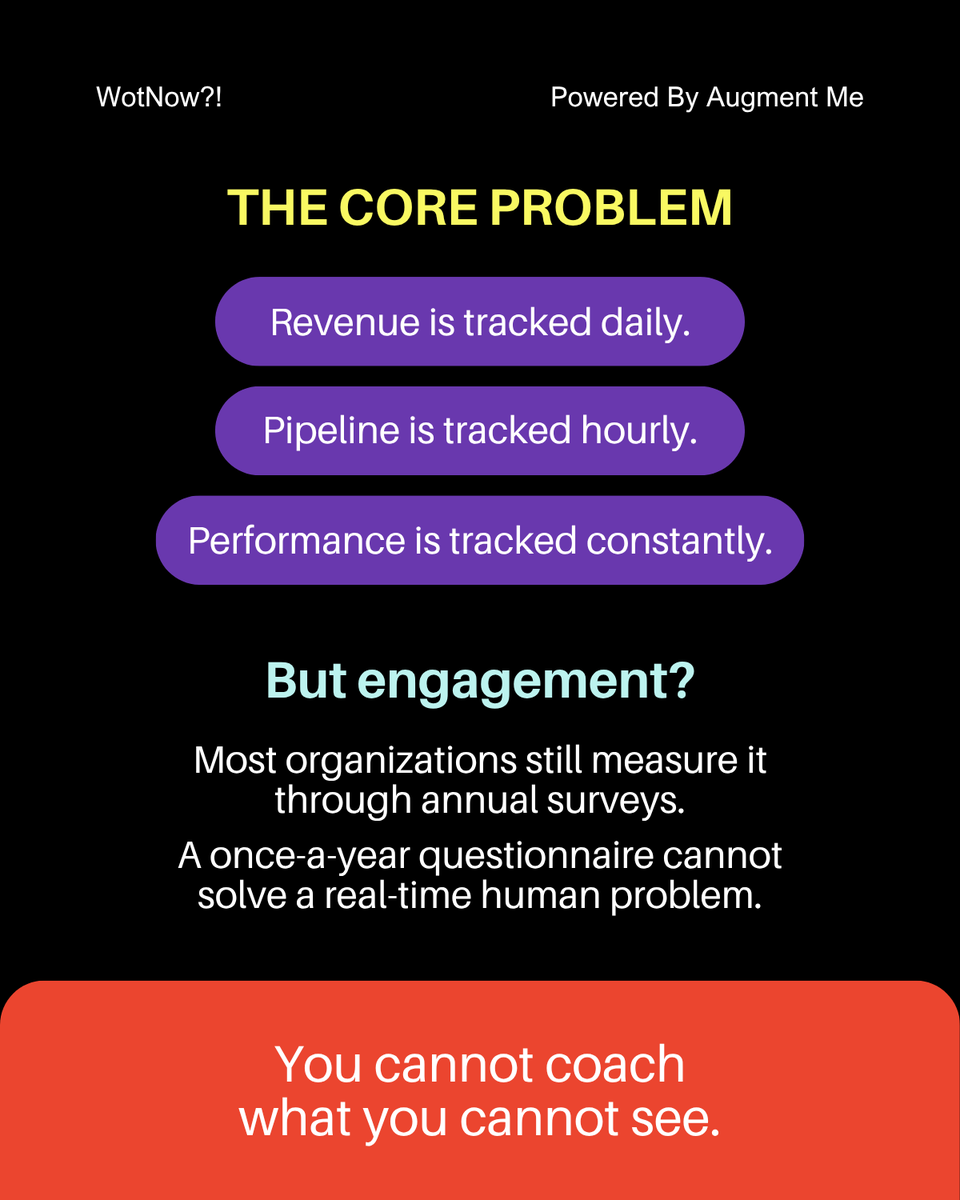
Revenue is tracked daily.
Pipeline is tracked hourly.
System performance is tracked per second.
Engagement? Still measured once or twice a year… through surveys.
We’re trying to understand a real-time human experience using delayed, retrospective feedback. You cannot improve what you cannot see.
Why AI hasn’t moved the needle
Most AI deployments focus on output.
Automating tasks.
Speeding up workflows.
Generating content.
But they don’t answer a more fundamental question: Are people actually engaging with the work?
Because if attention isn’t there no amount of technology will drive meaningful performance.
AI doesn’t fail because it lacks capability. It fails because it lacks context.
What we built instead
At Augment Me, we focused on the missing layer: real-time engagement intelligence.
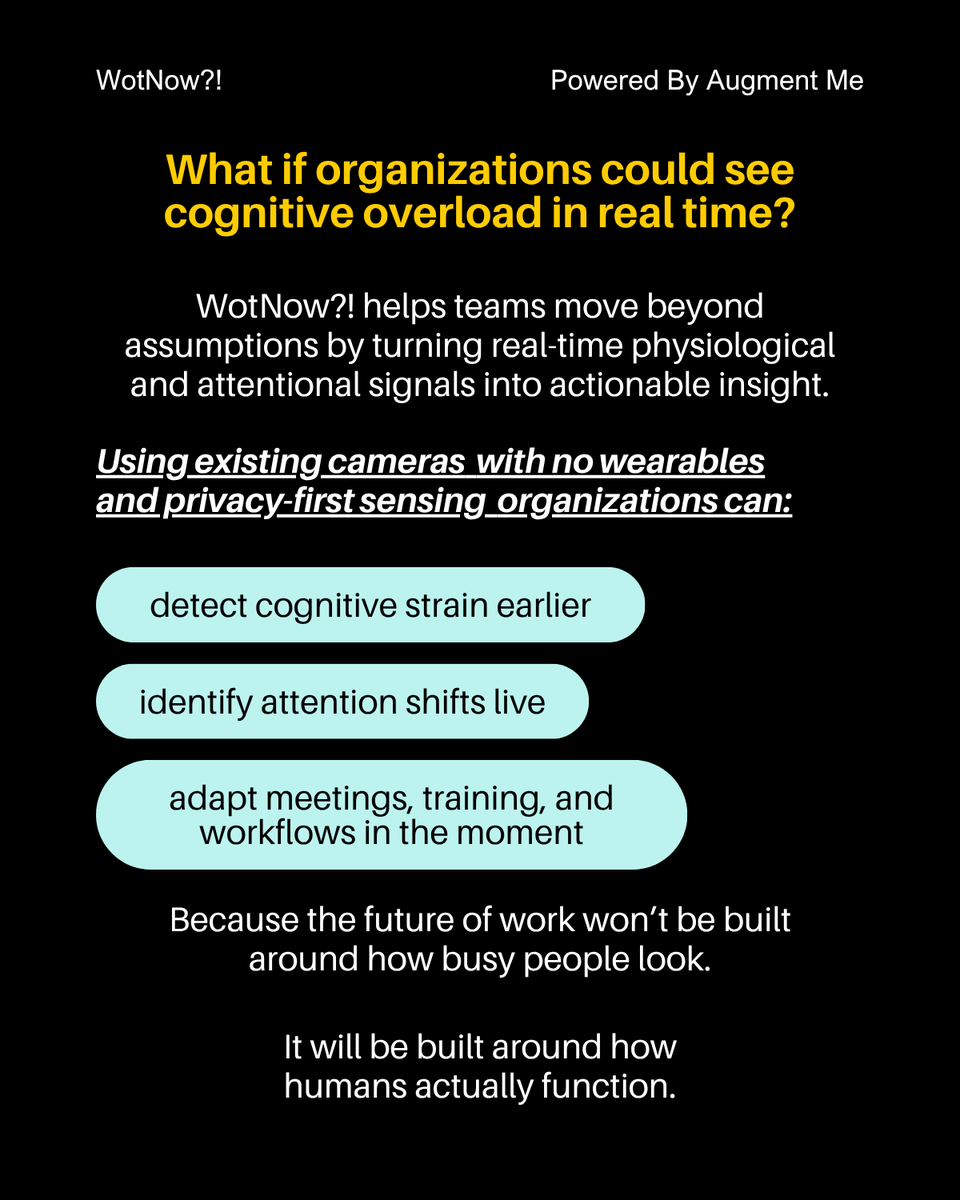
WotNow?! — our Engagement & AI Teammate — uses existing cameras to measure cognitive engagement as it happens.
Not through surveys.
Not through assumptions.
But through over 100 privacy-preserving signals, including:
attention patterns
cognitive load
physiological rhythms
micro-behavioral shifts
No wearables.
No special hardware.
Just real-time visibility into what’s actually happening in the room.
From measurement to action
Measurement alone isn’t enough.
The system doesn’t just observe, it responds.
It surfaces engagement shifts live, enabling leaders, educators, and teams to:
adjust pacing when attention drops
simplify when cognitive load increases
intervene before disengagement becomes a problem
Not after the meeting. Not after the quarter.
In the moment.
Proof, not theory
This isn’t a concept. It’s already in use.
Live in 2M classrooms across 126 countries
Students outperforming benchmarks by 100–400 points
Used in our own team meetings — where we’ve seen engagement consistently drop around minute 20, and adapted in real time
Because the fastest way to build something meaningful… is to use it yourself.
Why this moment matters
The workplace is evolving.
AI is accelerating.
Expectations are rising.
Attention is fragmenting.
But the way we measure human performance hasn’t caught up.
The organizations that win won’t just adopt more tools. They’ll adopt better visibility.
Final thought
The engagement crisis isn’t just about people losing interest. It’s about leaders operating without the ability to see what’s really happening.
And once you can see it, you can change it.
If you’re building for classrooms, teams, or training environments — it’s time to think beyond surveys and start thinking in real time.
#FutureOfWork #WorkplaceEngagement #AI #PeopleAnalytics #EdTech #Leadership #WotNow #AugmentMe
4
May 11
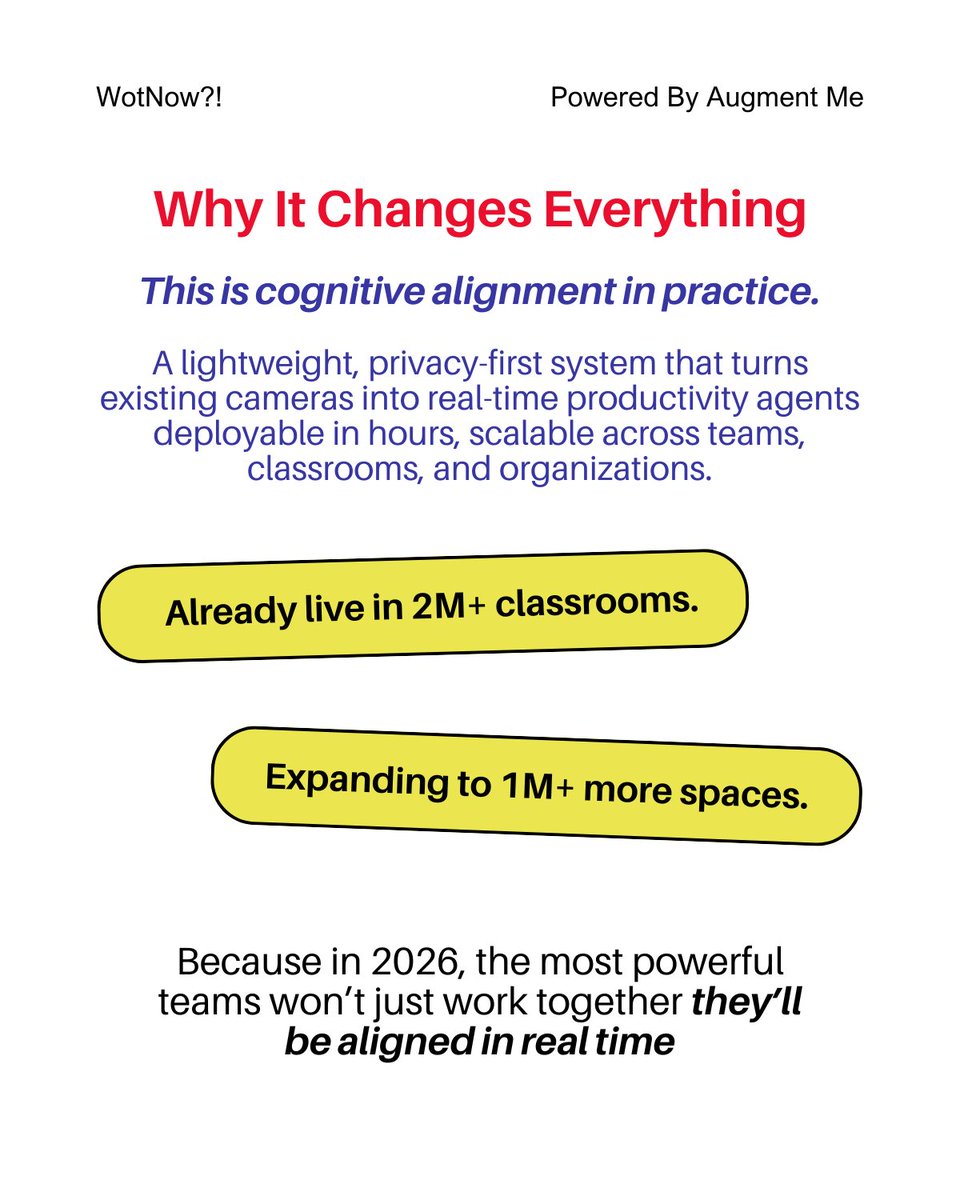
Most meetings today have one major flaw:
They have no idea if they’re working.
No visibility into attention.
No understanding of cognitive load.
No feedback until it’s too late.
That’s what WotNow?! changes.
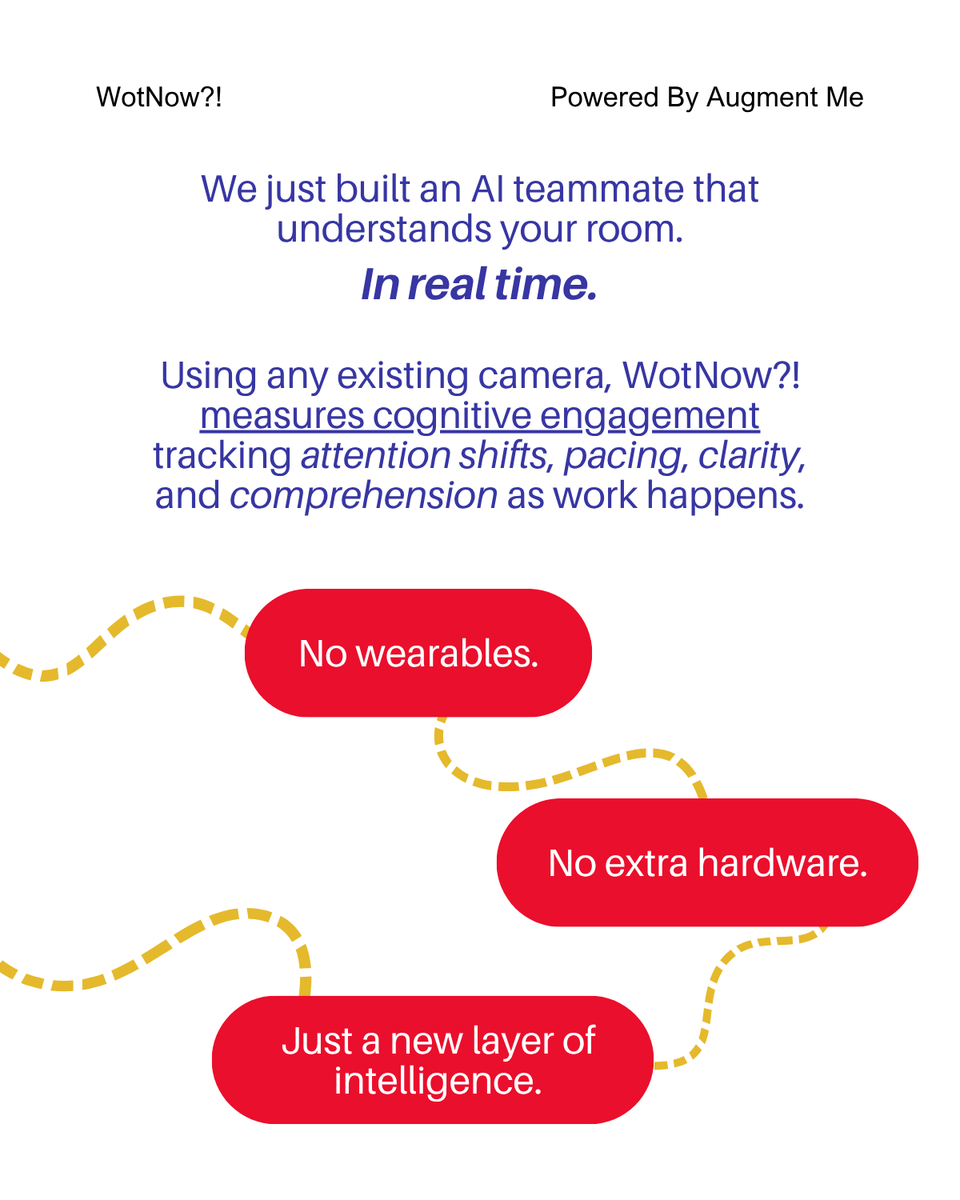
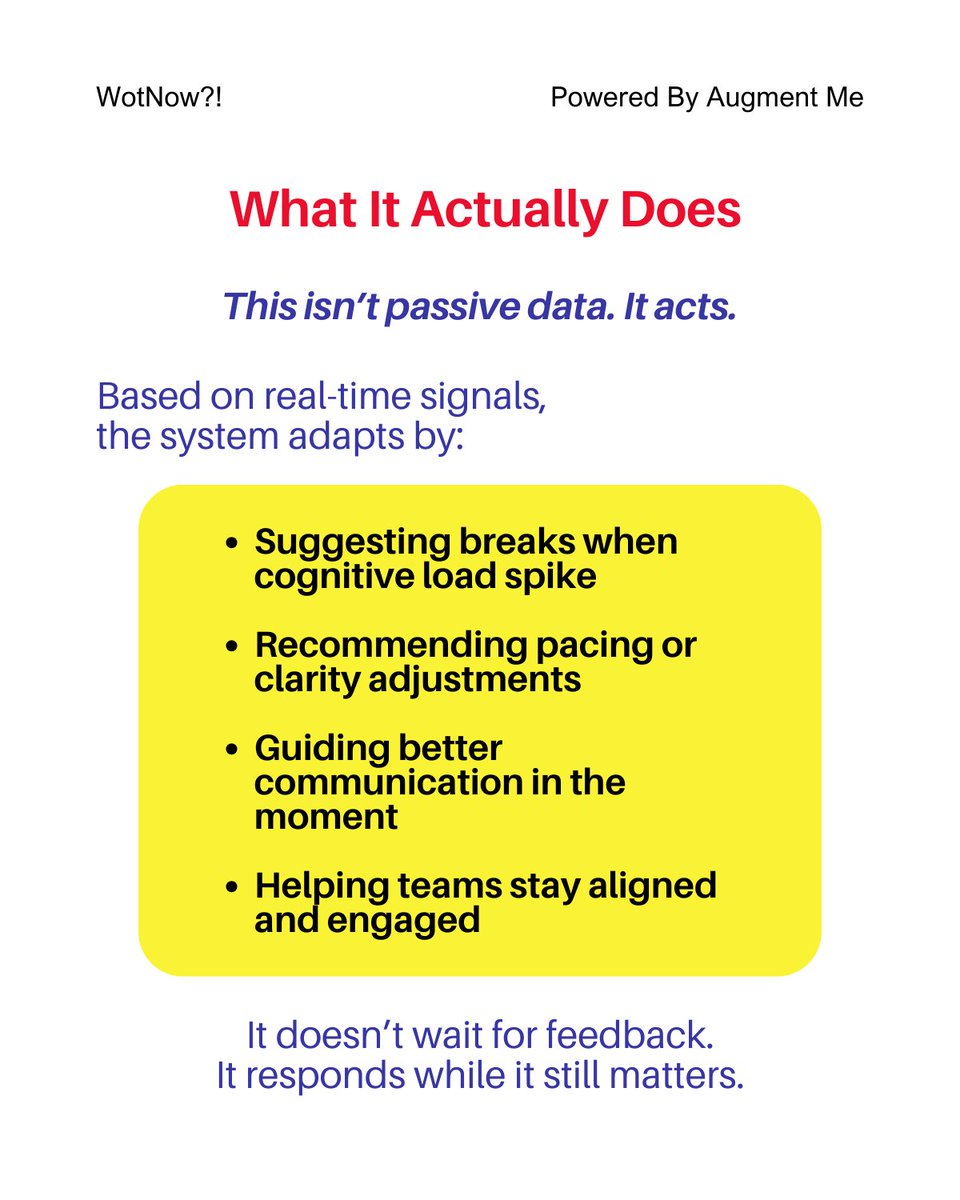
By turning existing cameras into real-time engagement intelligence, teams can finally see — and respond to — how people are actually experiencing work in the moment.
This isn’t about monitoring.
It’s about alignment.
And that’s where performance starts to shift.
#FutureOfWork #AI #WorkplaceInnovation #CognitiveAlignment #PeopleAnalytics #WotNow #AugmentMe
1
May 8
“Build what you use. Use what you build.”
It’s a simple idea — but in our case, it changed everything.
The Engagement & AI Teammate runs during all our internal meetings.
Every call. Every discussion. Every decision.
We don’t rely on assumptions anymore.
We see engagement in real time — rising, dropping, shifting — as the conversation unfolds.
And that’s where the real learning happens.
Three things we’ve learned from using WotNow?! on ourselves:
→ Engagement often drops faster than you think
Around minute 20–25, attention starts to dip.
Now, instead of pushing through, we pivot — shorten, reset, or change direction.
→ The best product decisions come from lived friction
Some of our strongest features didn’t come from brainstorming.
They came from experiencing cognitive overload in our own meetings.
→ Credibility comes from real usage
When we speak to partners, we don’t show a polished demo.
We share our own data — how we work, how we adapt, how it improves outcomes.
Because this isn’t theory. It’s practice.
WotNow?! wasn’t just built for teams.
It was built with our own team — in real time.
And that’s the difference.
5
May 5
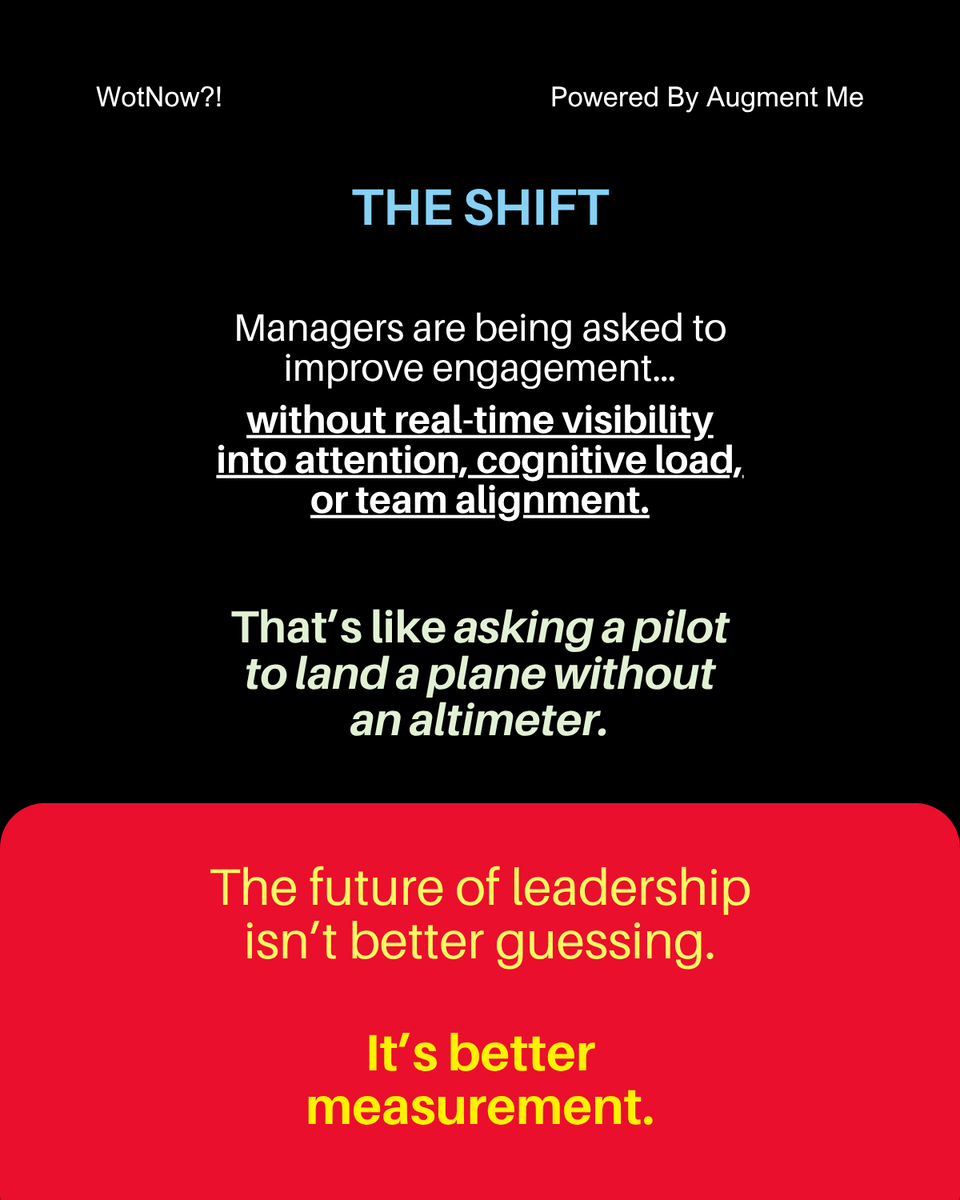
Gallup’s 2026 report highlights a management crisis.
But underneath it… is a measurement crisis.
We track nearly everything in modern organizations in real time — except the human factors that drive performance.
Engagement. Attention. Cognitive alignment.
Instead, we rely on annual surveys to explain year-long human behavior.
That’s not just outdated.
It’s operationally expensive.
If disengagement costs the global economy $10 trillion annually, then better leadership alone isn’t enough.
Leaders need better instruments.
Because the future of work won’t be defined by who manages better —
but by who can measure better.
#FutureOfWork #Leadership #Gallup #WorkplaceEngagement #AI #PeopleAnalytics #WotNow #AugmentMe
1
May 4
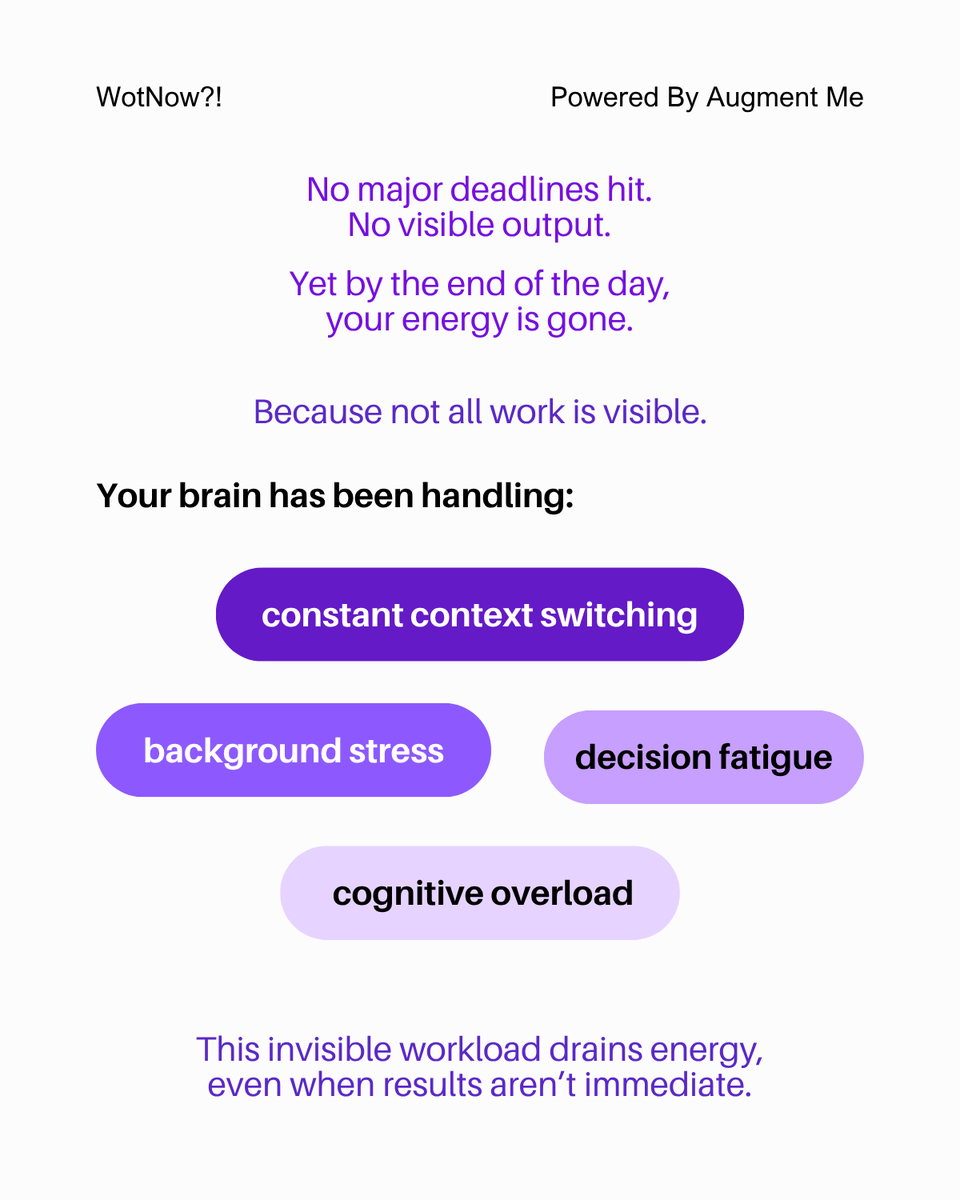
We often measure productivity by visible output.
Tasks completed.
Deadlines met.
Results delivered.
But what about the work we don’t see?
The mental load.
The constant switching.
The quiet cognitive strain that builds throughout the day.
This is where energy gets depleted — even when it looks like “nothing” happened.
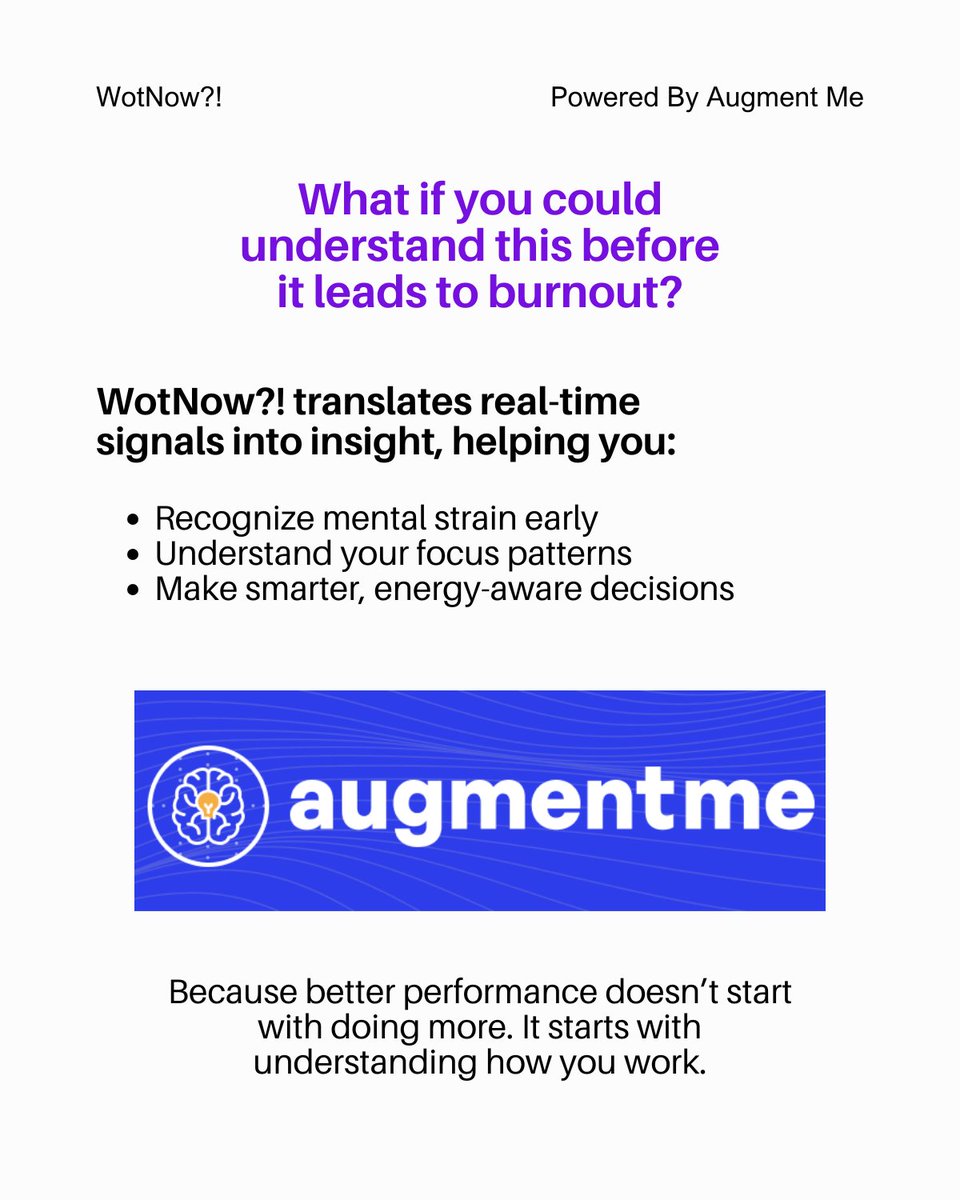
The future of performance isn’t just about tracking outcomes.
It’s about understanding the invisible processes behind them.
That’s the shift tools like WotNow?! are enabling —
moving from reactive productivity to real-time awareness.
#FutureOfWork #WorkplaceWellbeing #Productivity #MentalPerformance #AI #WotNow #PeopleAnalytics
9
Apr 27
Work With Your Biology, Not Against It
For years, productivity has been framed as a discipline problem.
Wake up earlier.
Push harder.
Stay consistent.
But what if the real issue isn’t discipline at all?
What if it’s misalignment?
The hidden cost of working against yourself
Most modern workflows are designed around schedules — not people.
Back-to-back meetings.
Rigid deadlines.
Constant availability.
On paper, it looks efficient.
In reality, it ignores something fundamental:
your brain and body don’t operate on fixed timelines.
Energy fluctuates.
Focus comes in cycles.
Cognitive load builds throughout the day.
When we ignore these signals, the result is predictable:
fatigue, burnout, and inconsistent performance.
Biology is not a limitation — it’s a guide
Your body is constantly giving you feedback.
Subtle shifts in heart rate.
Changes in breathing.
Variations in focus and mental clarity.
These aren’t random.
They’re signals.
Signals that tell you when you’re in a state of deep focus…
and when you’re approaching overload.
The problem is — most of us don’t see them.
So we keep pushing through low-energy states,
mistaking exhaustion for lack of discipline.
The shift from forcing to aligning
High performance doesn’t come from doing more.
It comes from doing the right work at the right time.
When you align your tasks with your natural energy and focus patterns:
Deep work becomes easier
Decisions feel clearer
Output improves without extra effort
This isn’t about working less.
It’s about working smarter and in sync with yourself.
From reactive to real-time awareness
Until recently, understanding your biological patterns required guesswork.
Now, that’s changing.
Tools like WotNow?! are making it possible to translate real-time physiological signals into actionable insight.
Instead of asking:
“Why am I struggling right now?”
You can see:
when your focus is at its peak
when cognitive strain is building
when it’s time to adjust before burnout hits
This is where productivity evolves into something more powerful:
self-awareness at scale.
The future of performance
The future of work isn’t about squeezing more into your day.
It’s about understanding the system you’re working with — yourself.
Because when you stop fighting your biology and start working with it:
performance becomes sustainable
stress becomes manageable
and productivity becomes predictable
Final thought
You don’t need to push harder.
You need to align better.
Work with your biology, not against it.
#FutureOfWork #Performance #Productivity #WorkplaceWellbeing #AI #PeopleAnalytics #WotNow
2
Apr 20
The Lag Between Biology and KPIs
We measure performance through KPIs, grades, and reports.
But by the time those numbers move… the damage is often already done.
A missed target.
A drop in grades.
A disengaged employee.
These aren’t starting points. They’re outcomes.
And yet, most organizations still rely on them as primary signals.
The problem with lagging indicators
KPIs, academic scores, and productivity reports are designed to tell us what has already happened.
They confirm trends — but they don’t prevent them.
By the time a student’s grades fall, cognitive overload has likely been building for weeks.
By the time an employee’s performance dips, burnout has already taken hold.
We’re reacting to results instead of understanding the process behind them.
Biology doesn’t wait for reports
While dashboards update weekly or quarterly, the human body is constantly communicating in real time.
Heart rate variability (HRV), stress responses, recovery patterns — these are signals happening before performance declines.
They’re not abstract. They’re measurable.
And more importantly, they’re predictive.
The body doesn’t suddenly break down. It shows signs long before.
We’ve just been ignoring them.
Leading indicators change everything
What if organizations could see strain before it turns into burnout?
What if educators could identify cognitive overload before grades drop?
This is the shift from reactive to predictive systems.
Instead of asking:
“Why did performance drop?”
We start asking:
“What signals did we miss earlier?”
Physiological data fills that gap.
It gives leaders a forward-looking lens — not just a rearview mirror.
Where WotNow?! fits in
WotNow?! is designed to bridge this exact gap.
By capturing and interpreting physiological patterns collectively, it helps organizations:
Detect stress trends early
Understand workload impact across teams or student groups
Make proactive adjustments before performance declines
It’s not about monitoring individuals.
It’s about understanding systems at a deeper, human level.
The future of performance isn’t reactive
Enterprise leaders and educators don’t lack data.
They lack timely data.
KPIs will always matter — but they shouldn’t be the first signal something is wrong.
Because by then, you’re already behind.
The real advantage lies in seeing what’s coming next.
And biology has been telling us all along.
#FutureOfWork #EdTech #Leadership #PeopleAnalytics #WorkplaceWellbeing #HRV #WotNow
7
Apr 12
We often think focus is something you either have… or you don’t.
But the truth is: focus is a skill. And like any skill, it can be learned, shaped, and improved.
The problem? Most people try to “train focus” blindly — pushing themselves harder, working longer hours, or using generic productivity hacks that don’t account for how their brain actually works.
Focus isn’t about willpower. It’s about understanding your energy, cognitive load, and mental patterns in real time. That’s what separates those who get things done consistently from those who feel exhausted and overwhelmed despite their best efforts.
This is exactly where WotNow?! makes a difference. By reading your physiological signals and translating them into actionable insights, it helps you:
Recognize when your focus is at its peak
Detect early signs of mental strain
Adjust your workflow to match your brain, not the clock
In short: better focus isn’t about working harder. It’s about training smarter — and knowing yourself along the way.
Focus is teachable. WotNow?! shows you how.
#Focus #Productivity #WorkSmarter #FutureOfWork #AI #WorkplaceWellbeing #WotNow #PeopleAnalytics
2
Apr 6
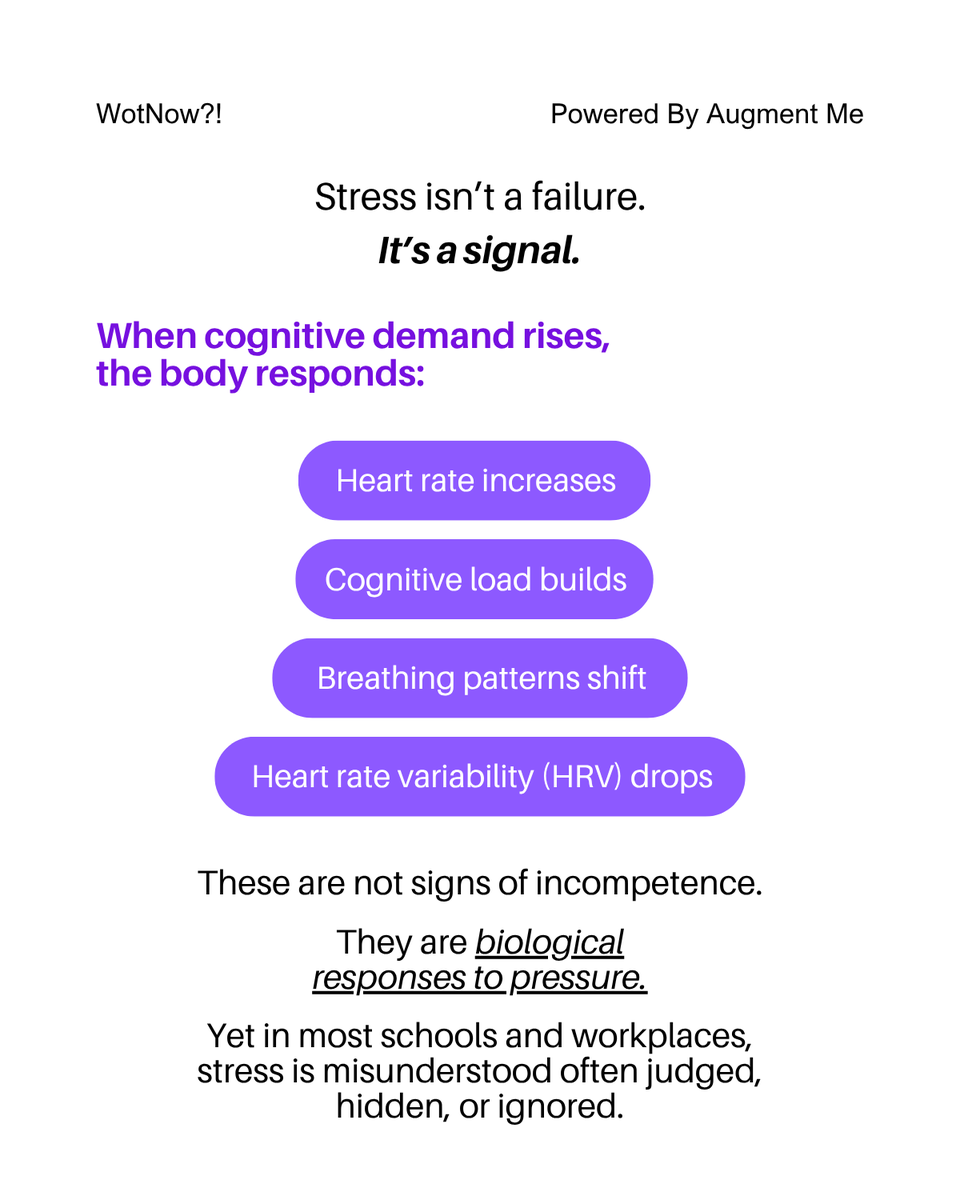
Stress isn’t a weakness. It’s data.
The problem? Most of us were never taught how to read it.
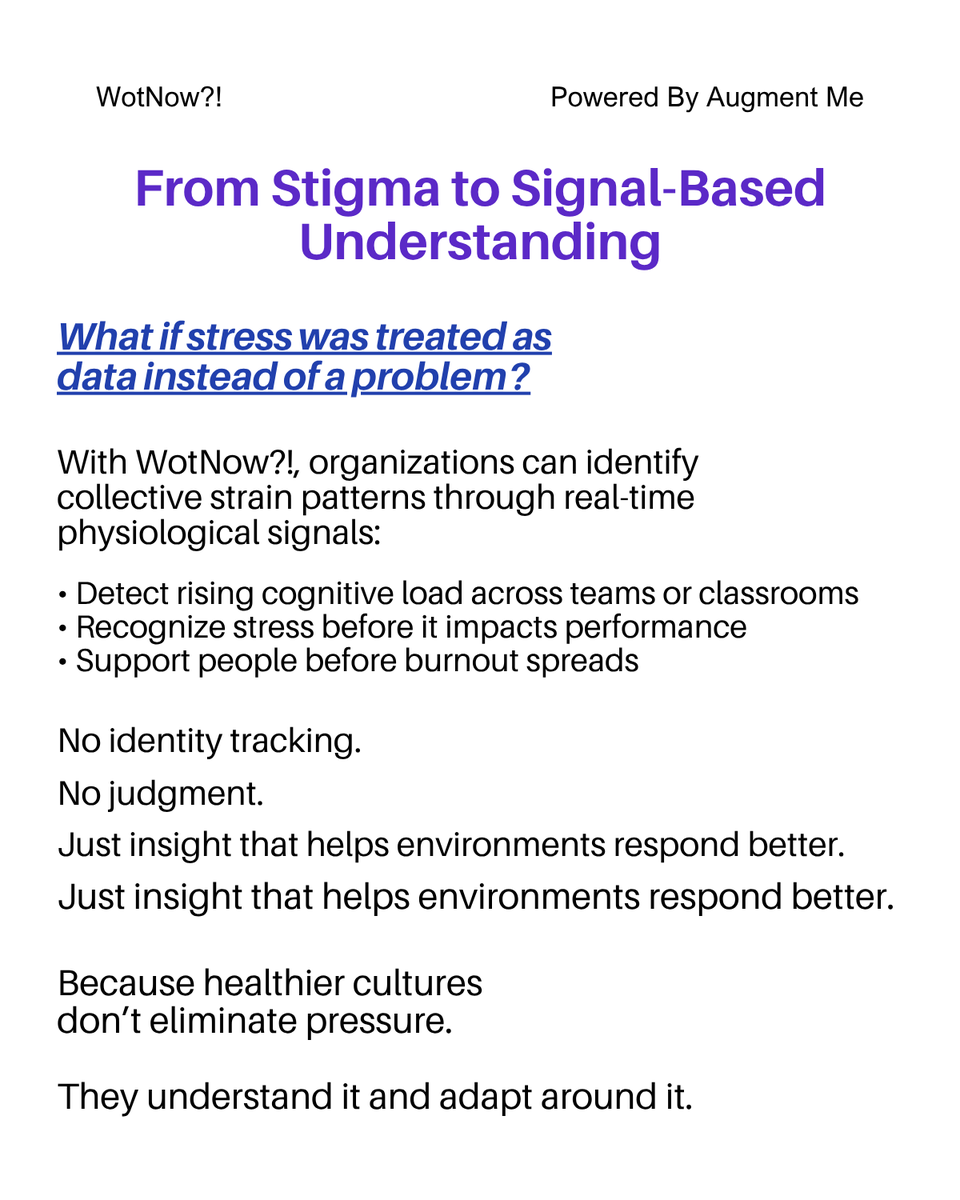
Instead of pushing through burnout or ignoring the signs, what if we started seeing stress for what it really is — a signal that something needs attention, not judgment.
Because better awareness doesn’t just improve performance… it changes how we show up for ourselves and others.
That’s where smarter tools and collective insights come in — helping us understand patterns, not just moments.
We don’t need less stress.
We need a better relationship with it.
#WorkplaceWellbeing #MentalPerformance #HRV #FutureOfWork #WotNow #Leadership #StressManagement
2
Apr 4
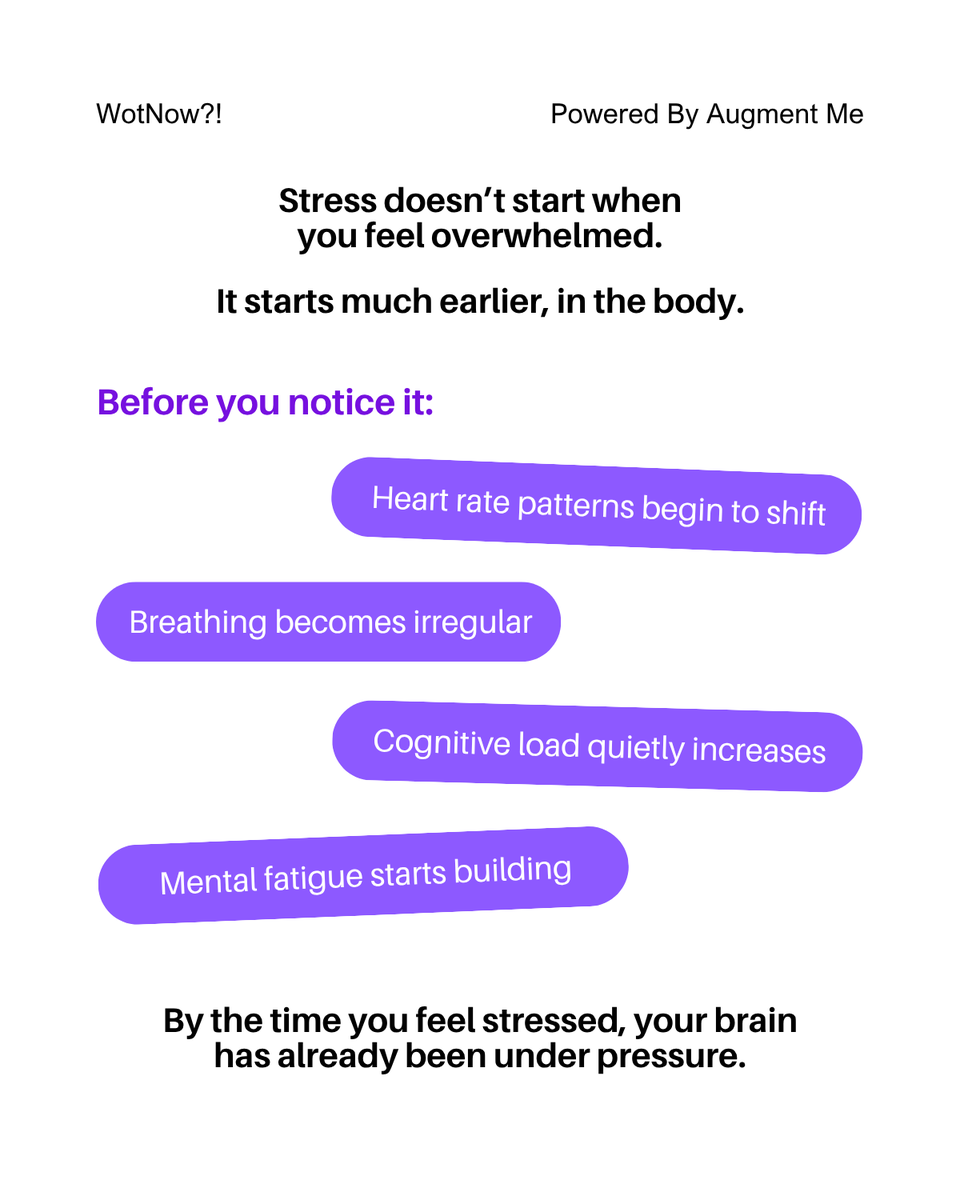
Most people don’t realize they’re overwhelmed until it’s too late.
Because stress doesn’t begin in the mind.
It begins in the body.
Long before someone says “I’m tired” or “I can’t focus,” subtle physiological changes are already happening — heart rate patterns shift, breathing changes, and cognitive load starts to build.
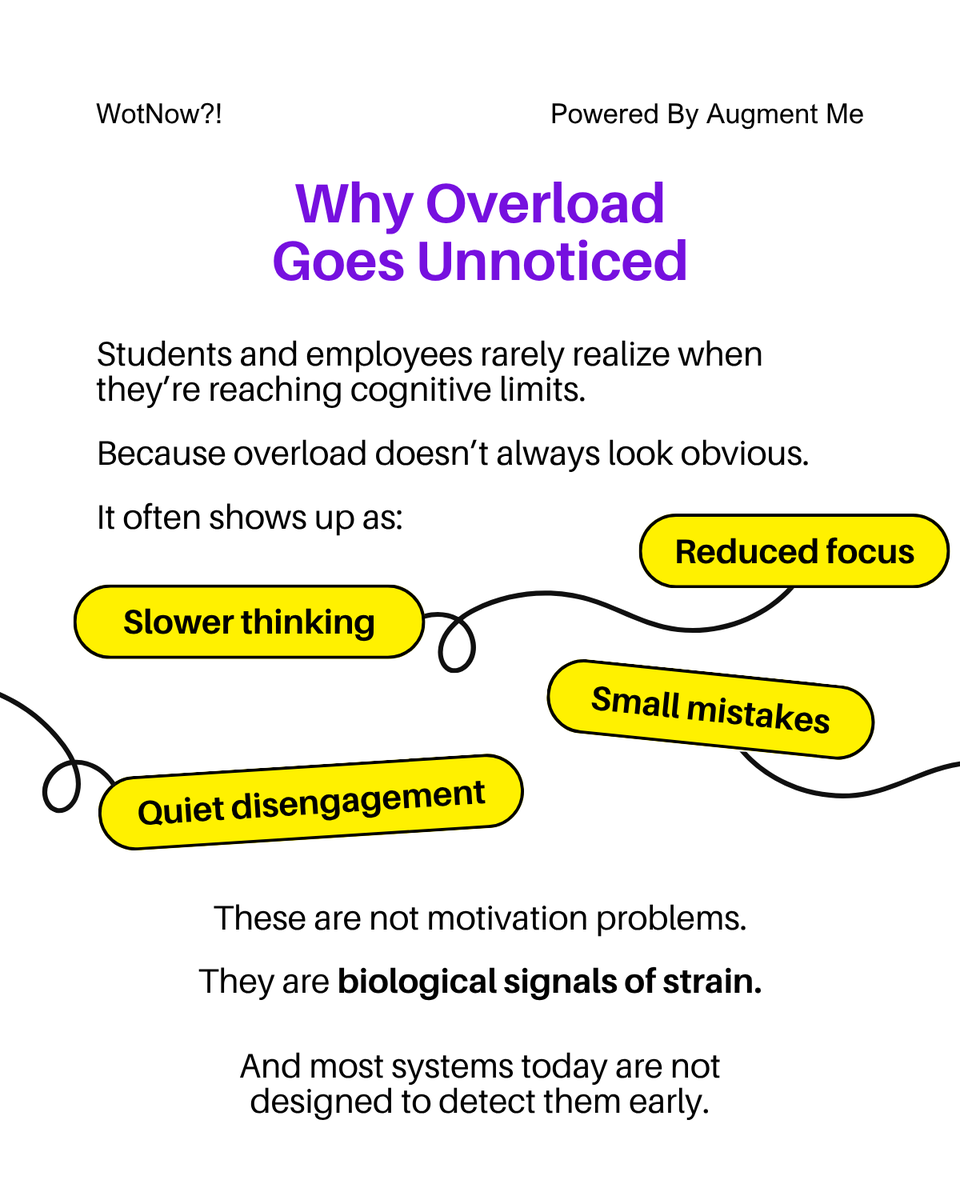
In classrooms, this shows up as quiet disengagement.
In workplaces, it shows up as slower thinking, small mistakes, and decision fatigue.
But by the time we see these signs, the overload has already been there for a while.
That’s the gap most systems miss.
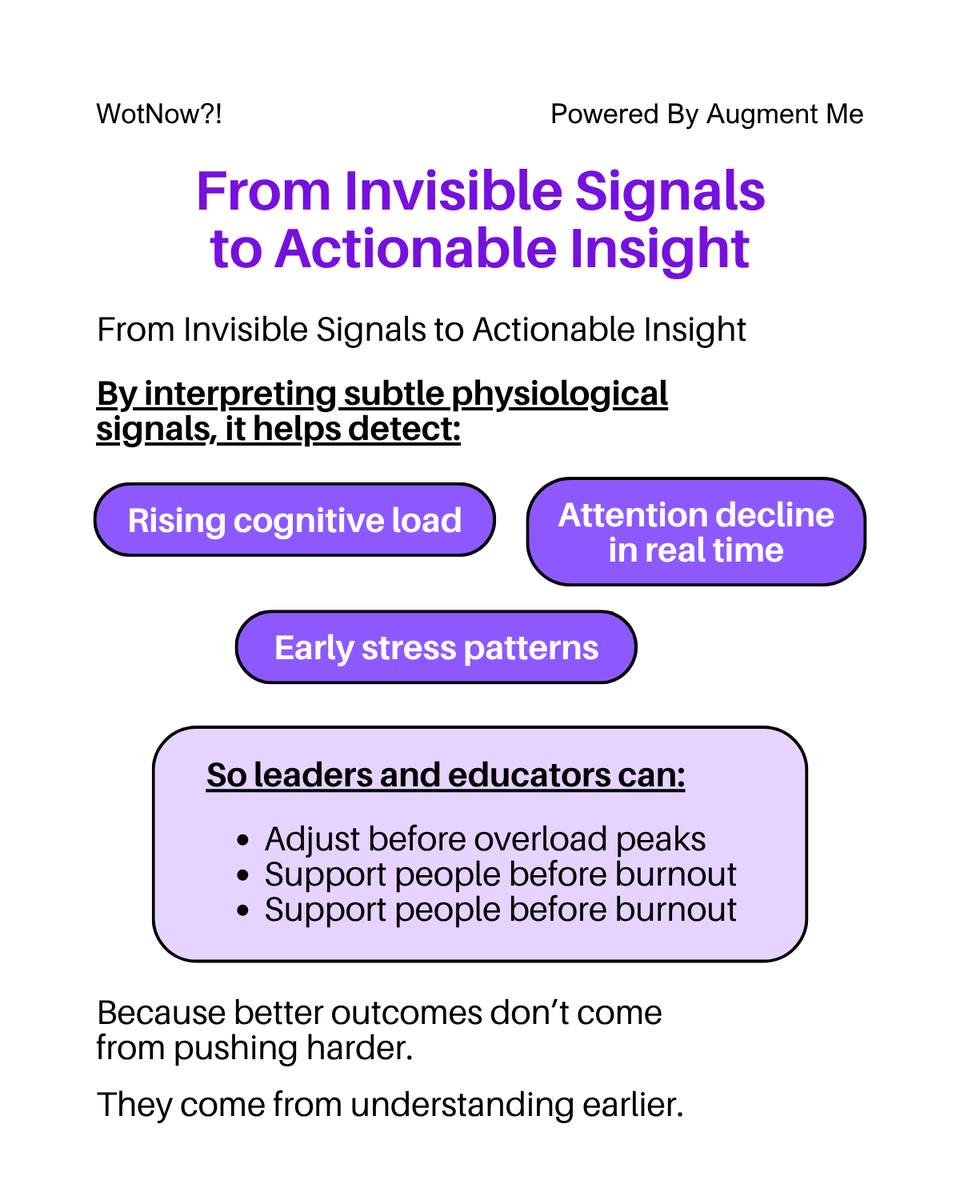
WotNow?! helps close that gap by translating subtle human signals into real-time insight — allowing educators, leaders, and teams to respond earlier, before stress turns into burnout or performance decline.
Because the goal isn’t to push people harder.
It’s to understand when they’re reaching their limits — and adapt while it still matters.
#HumanCenteredAI
#CognitiveLoad
#FutureOfWork
#EdTech
#WorkplaceWellbeing
#WotNow
3
Mar 31
Focus doesn’t just disappear.
It fades — quietly.
And one of the earliest signals is something we rarely notice:
Breathing.
When cognitive load increases, the brain demands more energy. The body responds immediately.
Breathing patterns begin to change.
• Faster, shallower breaths
• Irregular rhythm
• Reduced oxygen efficiency
• Increased stress response
These shifts often happen before visible signs of confusion or disengagement appear.
In classrooms, this can mean students are already overwhelmed before they stop paying attention.
In meetings, it can mean teams are struggling to process information while discussions continue.
The challenge is — these signals are invisible to the naked eye.
That’s where WotNow?! comes in.
By interpreting subtle physiological patterns like breathing dynamics, it helps identify overload windows in real time — allowing educators, leaders, and organizations to:
• Adjust pacing before confusion spreads
• Reduce cognitive strain during critical moments
• Improve focus, retention, and decision-making
Because the future of performance isn’t just about what people do.
It’s about understanding what their body is telling us — in time to respond.
1
Mar 25
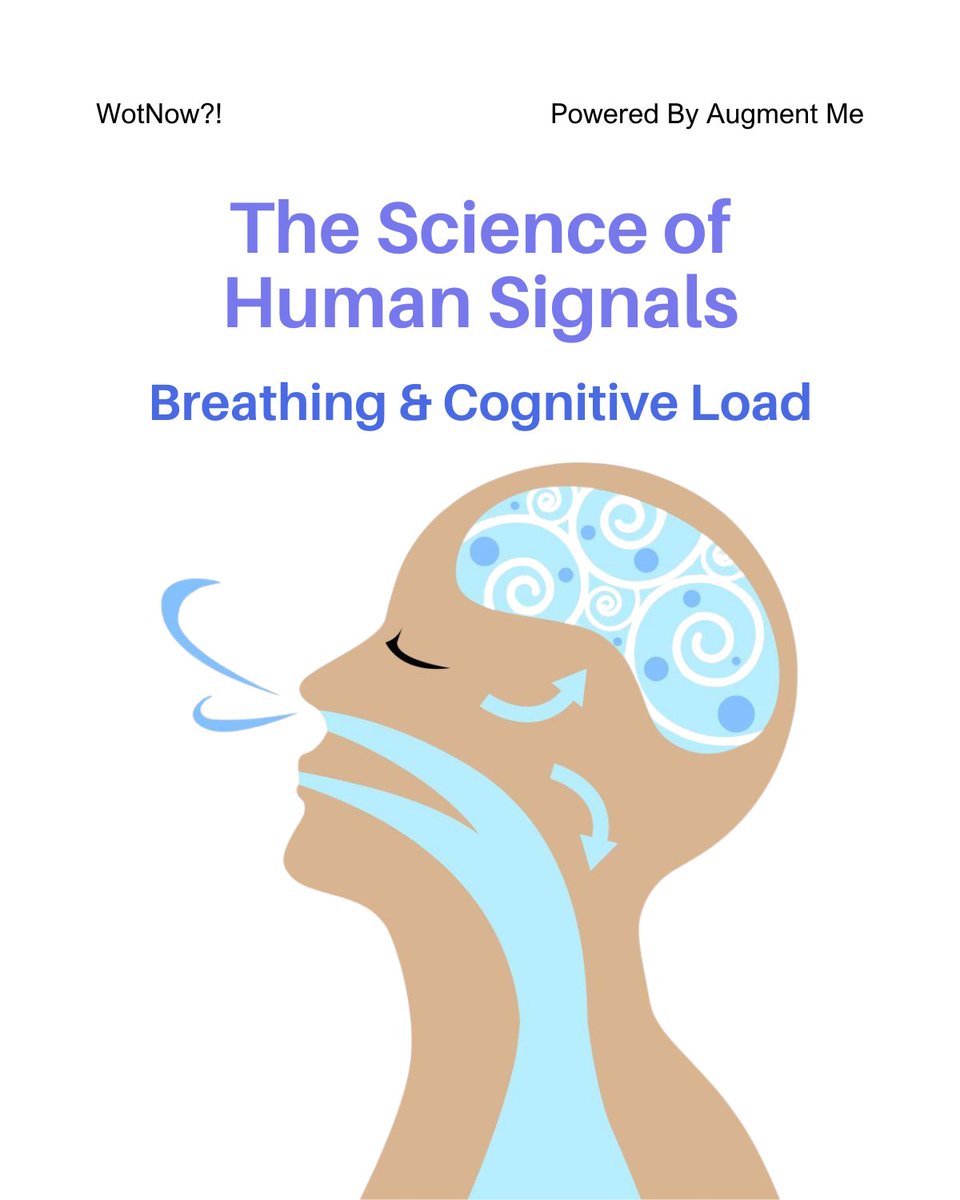
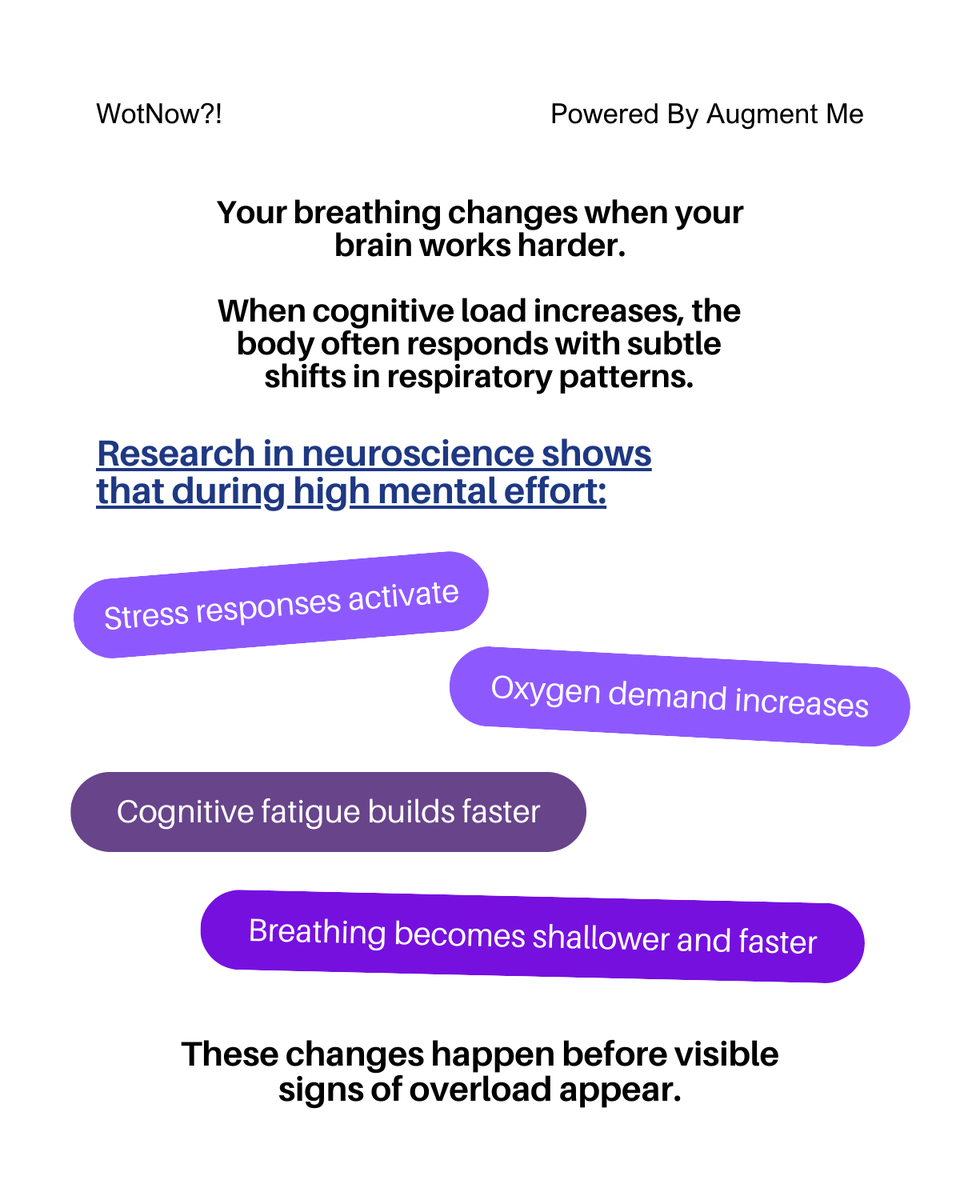
Breathing is more than a physical function.
It’s a signal of how the brain is coping with cognitive demand.
When mental effort increases, the body often responds first. Breathing patterns shift — becoming faster, shallower, and more irregular as cognitive load builds. These changes are part of the body’s natural stress and attention response system.
In environments like meetings, classrooms, and conferences, these signals can appear long before visible signs of disengagement. By the time someone looks distracted, their cognitive load may have already been rising for several minutes.
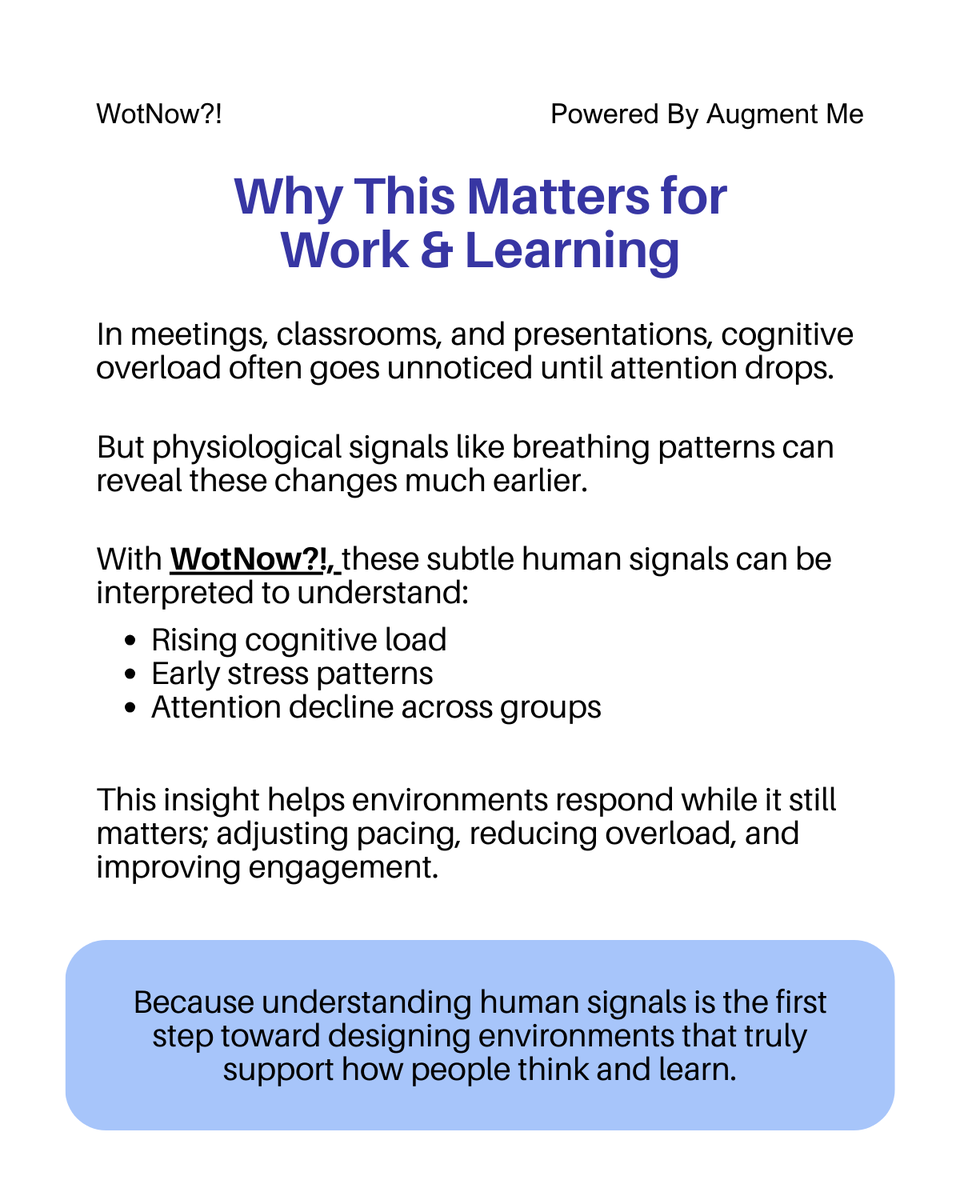
Understanding these subtle physiological signals opens a new layer of insight into how people actually process information in real time.
With WotNow?!, signals like breathing patterns, heart rate dynamics, and other physiological indicators can be interpreted to better understand focus, stress, and cognitive load within environments.
The goal isn’t to monitor individuals.
It’s to help organizations, educators, and leaders design environments that respond to human capacity — improving learning, communication, and decision-making while it still matters.
Because the science of human signals reveals something simple but powerful:
The body often knows when the brain is overloaded before we do.
#ScienceOfHumanSignals
#CognitiveLoad
#HumanCenteredAI
#FutureOfWork
#WotNow
1
Mar 23
For decades, workplace risk meant physical hazards, financial volatility, or operational breakdowns.
But in today’s knowledge-driven economy, a different kind of risk is growing inside organizations:
Cognitive overload.
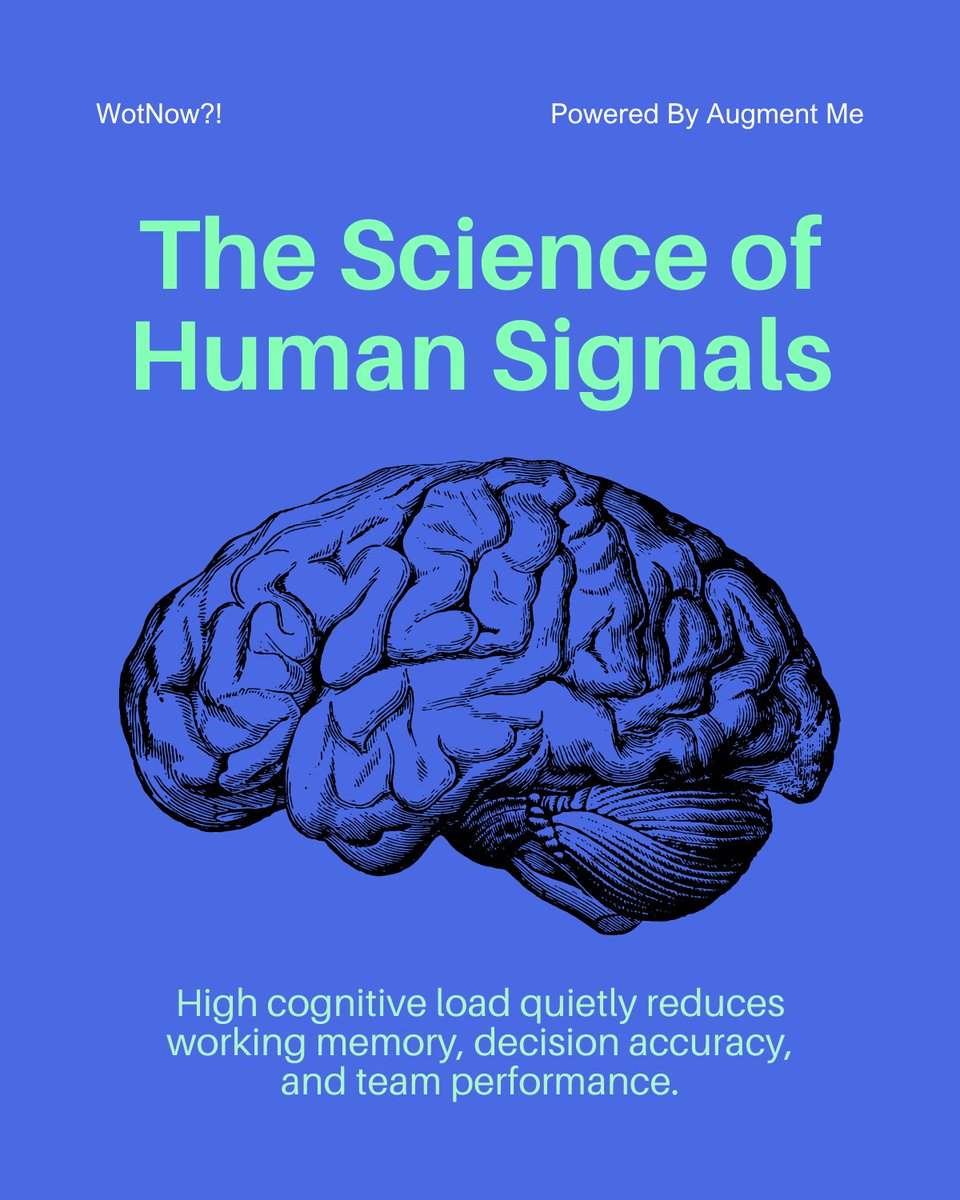
Every meeting, decision, presentation, and deadline places demands on the brain’s working memory. When those demands exceed human capacity, performance begins to decline.
Cognitive science shows that high cognitive load can:
• Reduce working memory capacity
• Slow decision-making
• Increase error rates
• Lower comprehension and retention
• Intensify stress responses
In high-performing teams, this often happens quietly. Employees may still appear productive while their mental bandwidth is already stretched beyond sustainable limits.
This is where new approaches to organizational intelligence are emerging.
Solutions like WotNow?! help interpret physiological signals linked to stress, fatigue, and cognitive load — such as heart rate variability, breathing patterns, and attention dynamics.
Instead of waiting for mistakes, burnout, or declining performance reports, leaders gain early insight into when cognitive strain is rising across teams or environments.
Because the future of leadership will not only be about managing tasks.
It will be about managing human cognitive capacity.
Mar 17
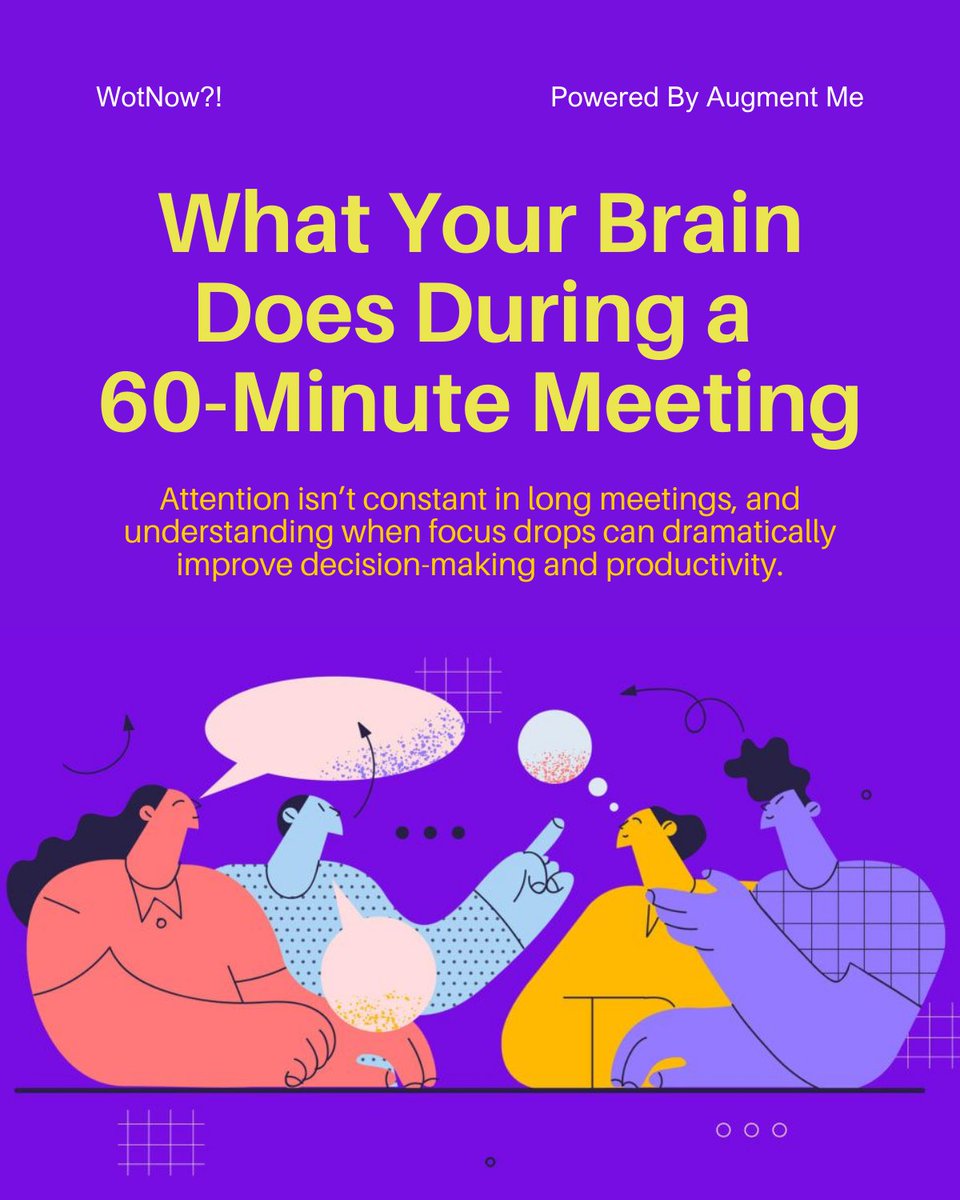
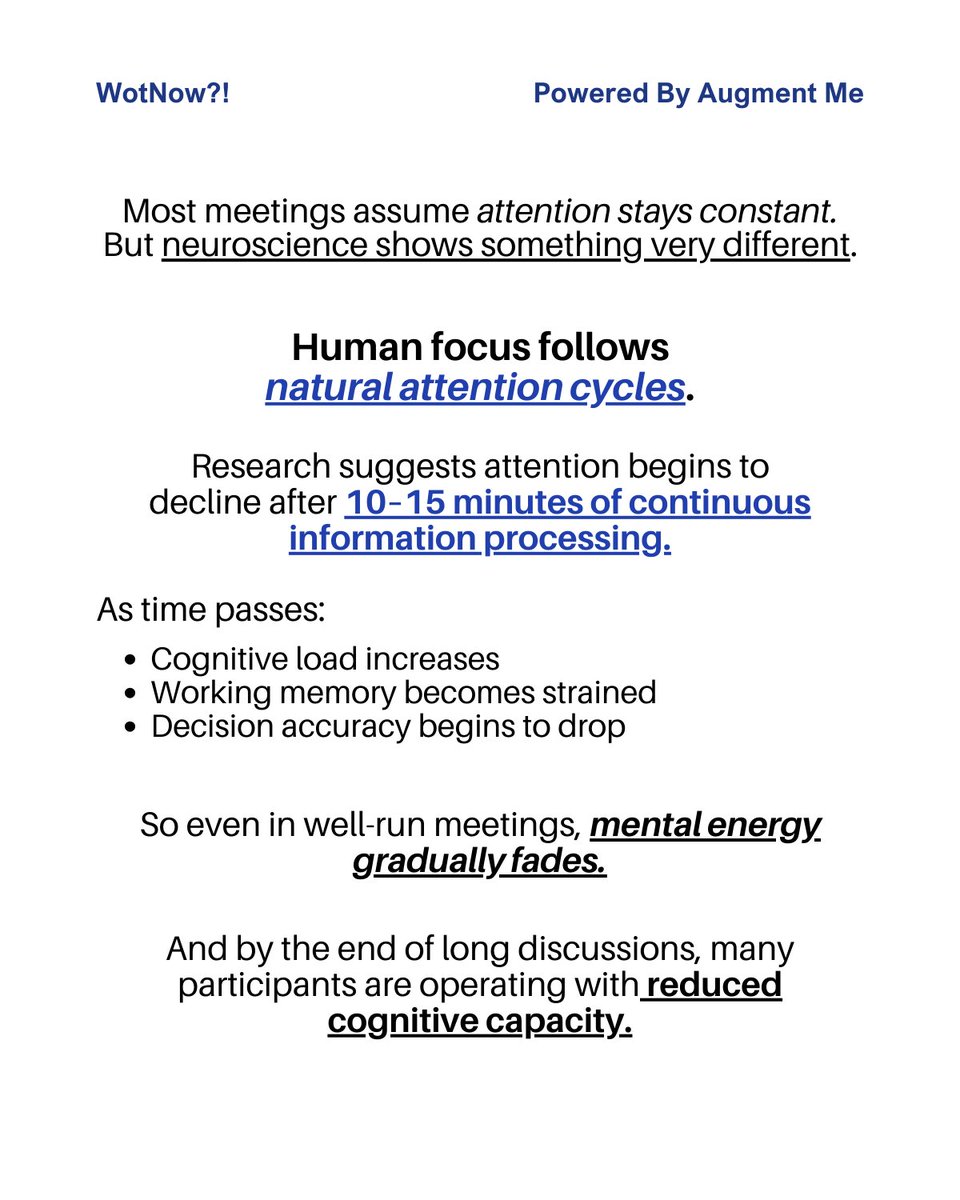
Most meetings assume attention stays constant.
But neuroscience tells a very different story.
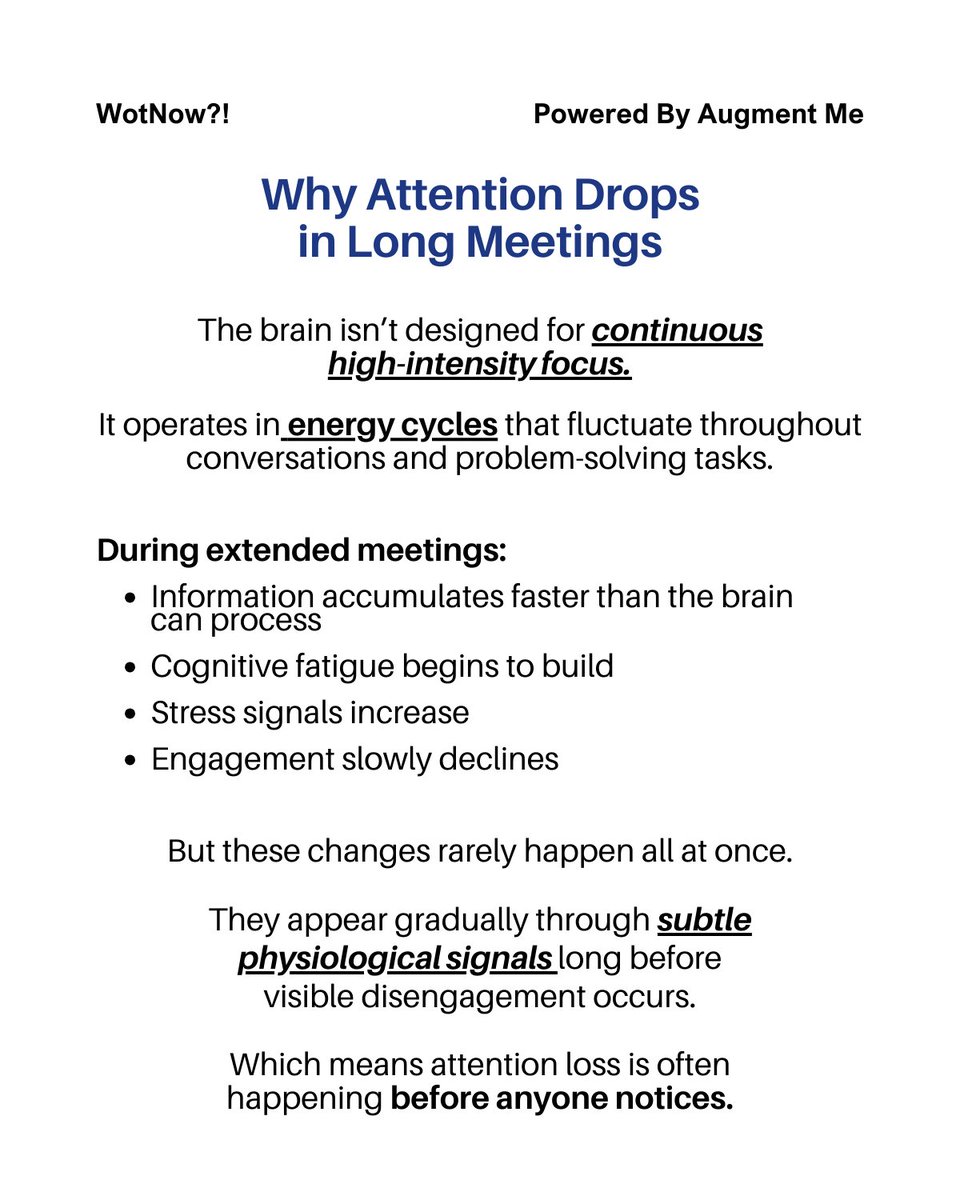
Research in cognitive science shows that human attention naturally drops every 10–15 minutes during continuous information processing. The brain simply isn’t designed to sustain uninterrupted focus for long periods.
During a typical 60-minute meeting, several things happen beneath the surface:
• Cognitive load gradually increases
• Working memory becomes strained
• Stress signals begin to rise
• Decision accuracy slowly declines
By the time a meeting reaches the final discussion points, many participants are already operating with reduced mental bandwidth.
This doesn’t mean people are unmotivated or disengaged.
It means human cognition has limits.
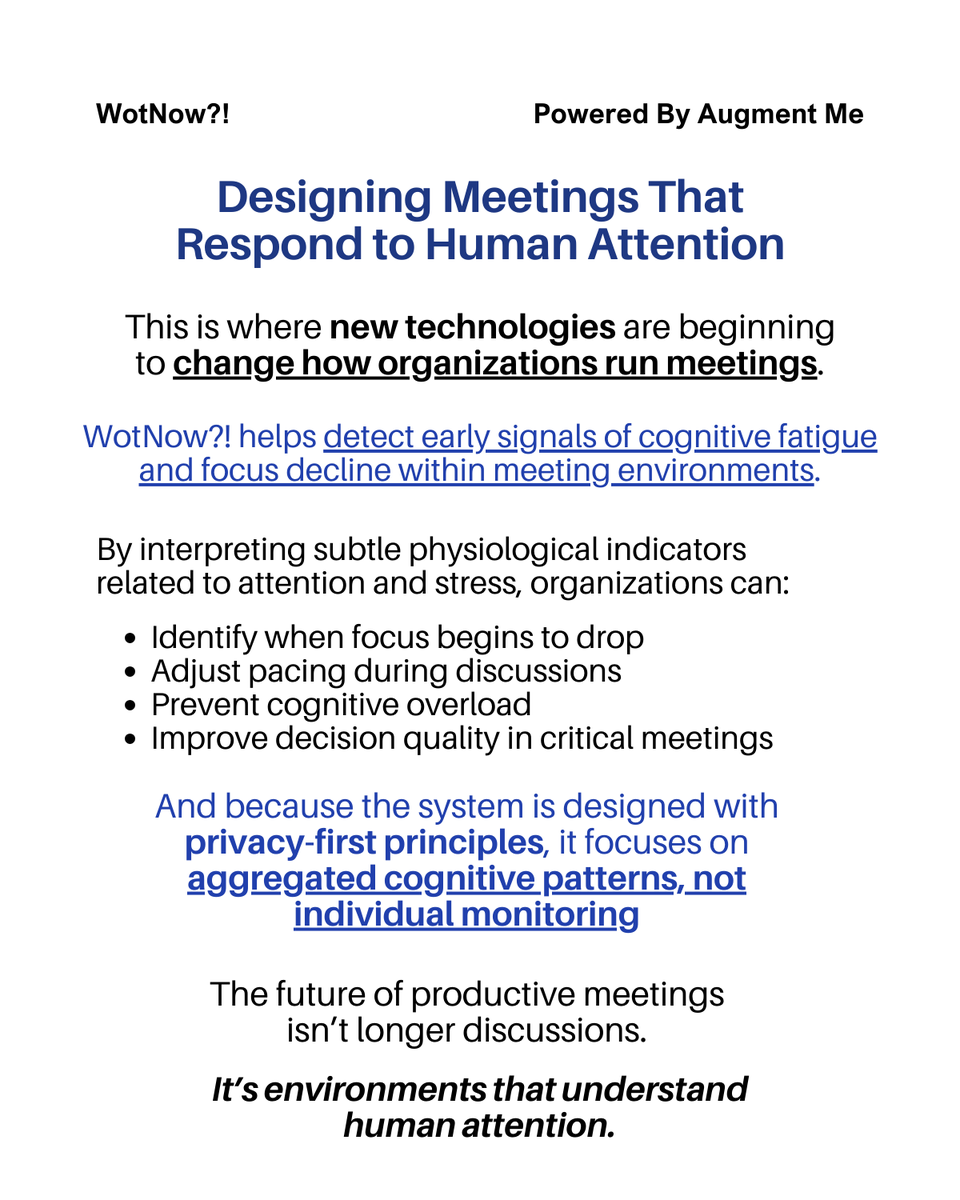
For decades, organizations have had no practical way to observe when attention starts to fade in real environments like meeting rooms, classrooms, or conferences.
But advances in affective computing and physiological signal interpretation are beginning to change that.
Solutions like WotNow?! help interpret subtle signals related to focus, cognitive load, and fatigue using privacy-first sensing methods. These insights allow organizations to better understand how attention flows during conversations and decision-making environments.
The goal isn’t to monitor individuals.
It’s to help environments respond intelligently to human cognitive capacity.
Because the future of productive meetings won’t depend on talking longer.
It will depend on understanding when people are actually able to think, absorb, and decide effectively.
#FutureOfWork #Leadership #WorkplaceScience #HumanCenteredAI #CognitiveLoad #WotNow
2
Mar 16
For decades, workplace risk meant physical hazards, operational failures, or financial uncertainty.
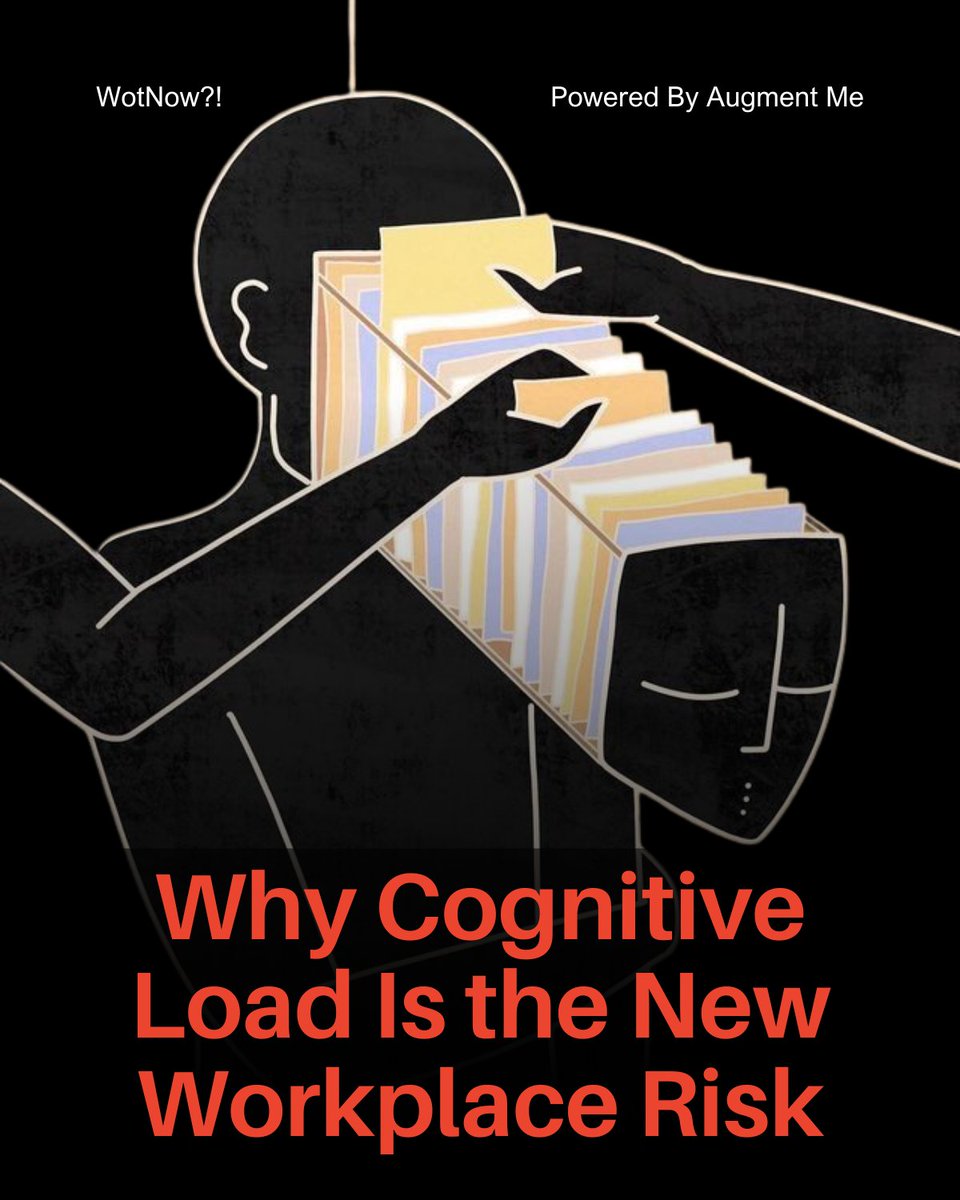
But in today’s knowledge-driven economy, another risk is emerging — one that most organizations rarely measure.
Cognitive load.
Every meeting, decision, presentation, and deadline adds to the brain’s processing demand. When that demand exceeds capacity, performance begins to degrade.
Research in cognitive science shows that high cognitive load can:
• Reduce working memory capacity
• Slow decision-making
• Increase error rates
• Lower information retention
• Intensify stress responses
In fast-moving corporate environments, these effects often accumulate silently. Teams may appear productive while their mental bandwidth is already stretched beyond sustainable levels.
This is where new approaches to workplace intelligence are beginning to matter.
Solutions like WotNow?! help organizations interpret physiological signals that reflect cognitive strain — such as changes in heart rate variability, breathing patterns, and focus dynamics.
Instead of waiting for burnout, mistakes, or disengagement to appear in reports, leaders gain early insight into when cognitive load is rising across teams or environments.
That shift matters.
Because the future of performance management won’t be defined only by output metrics.
It will also depend on understanding human cognitive capacity — the foundation behind every decision, conversation, and innovation.
2