Venezuela & Latin America’s premier AI Intelligence HQ | Decision-grade autonomous intelligence for complex environments.
Joined April 2026
- Tweets 22
- Following 17
- Followers 1,499
- Likes 5
4 Photos and videos
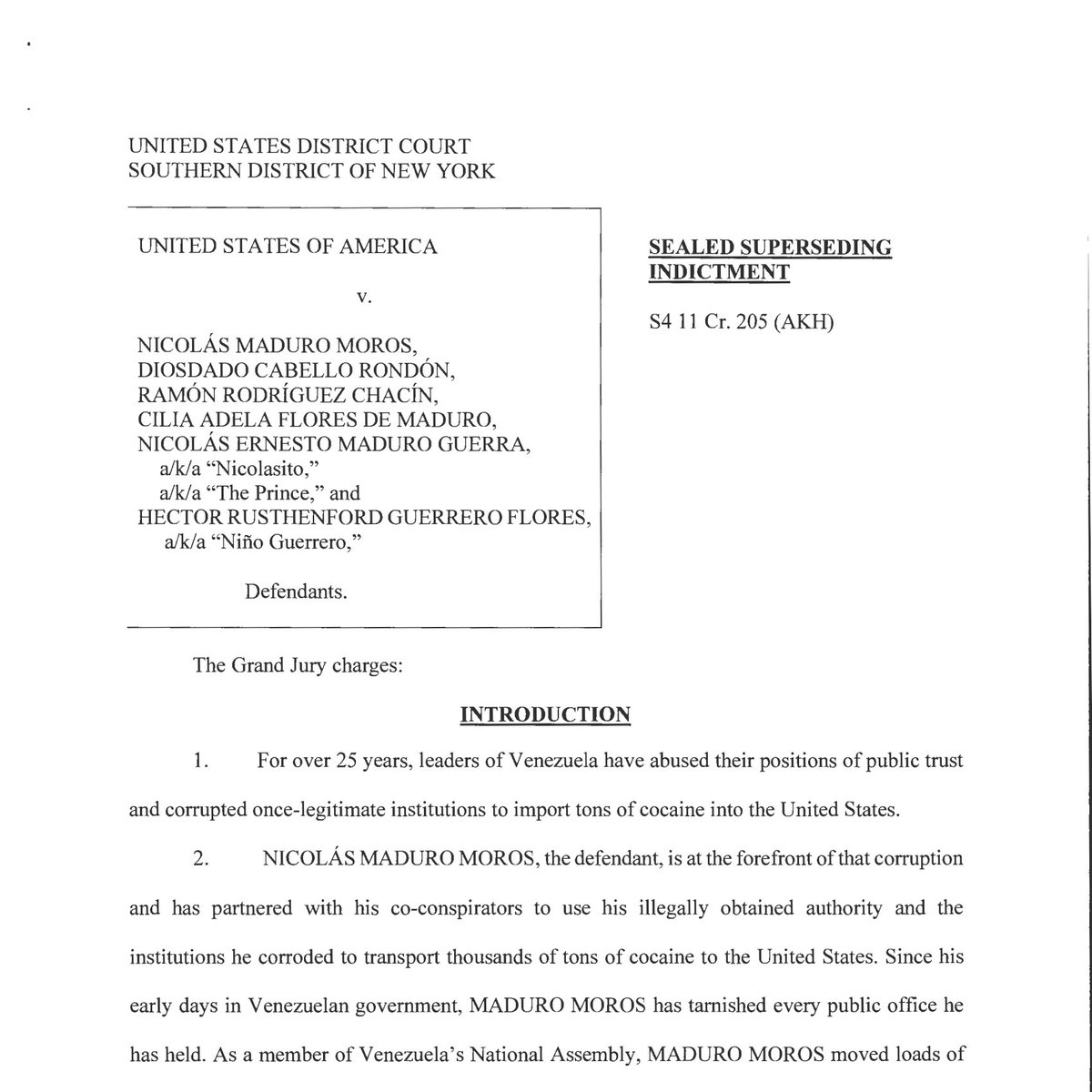
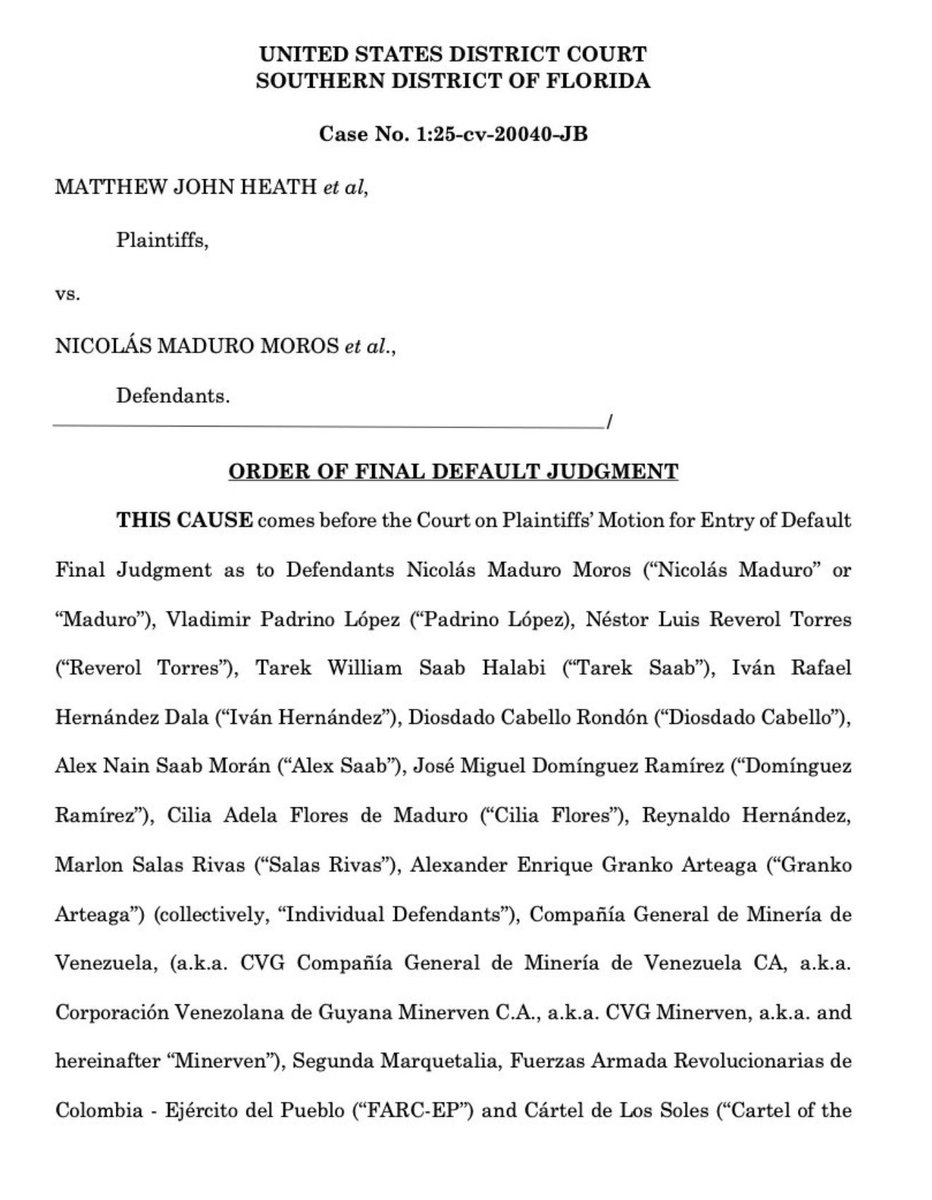

Niño Guerrero is dead.
Maduro, Cilia, and Saab have been neutralized as operational nodes.
The list is narrowing. The Complex Adaptive System is been hit faster than the time it takes for it to reorganize.
The biggest name still standing is Diosdado Cabello.
Not merely a regime figure. The coercive backbone: military networks, intelligence control, enforcement power.
Justice matters. Accountability matters. Hope matters.
U.S. justice may take time, but it arrives. Ask Osama bin Laden. Ask Abu Bakr al-Baghdadi. No matter how long it takes, accountability finds its target.
For millions of Venezuelans, justice is no longer abstract. It is visible. It is moving. And with it comes the possibility of a nation returning from dystopia to reconstruction.
Watch Diosdado.
Trust the three-stage plan.
1
12
25
1,158
The United States is no longer negotiating with Venezuela.
It is supervising it.
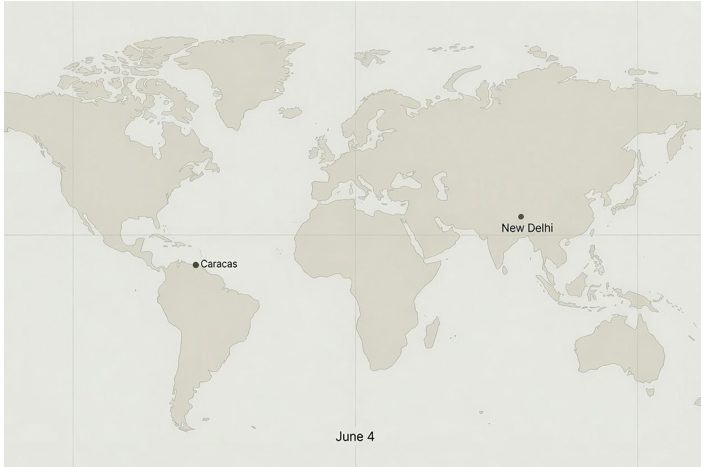
The Chairman of the Joint Chiefs landed in Caracas while Delcy Rodríguez was in New Delhi. The optics are not noise. They are the structure.
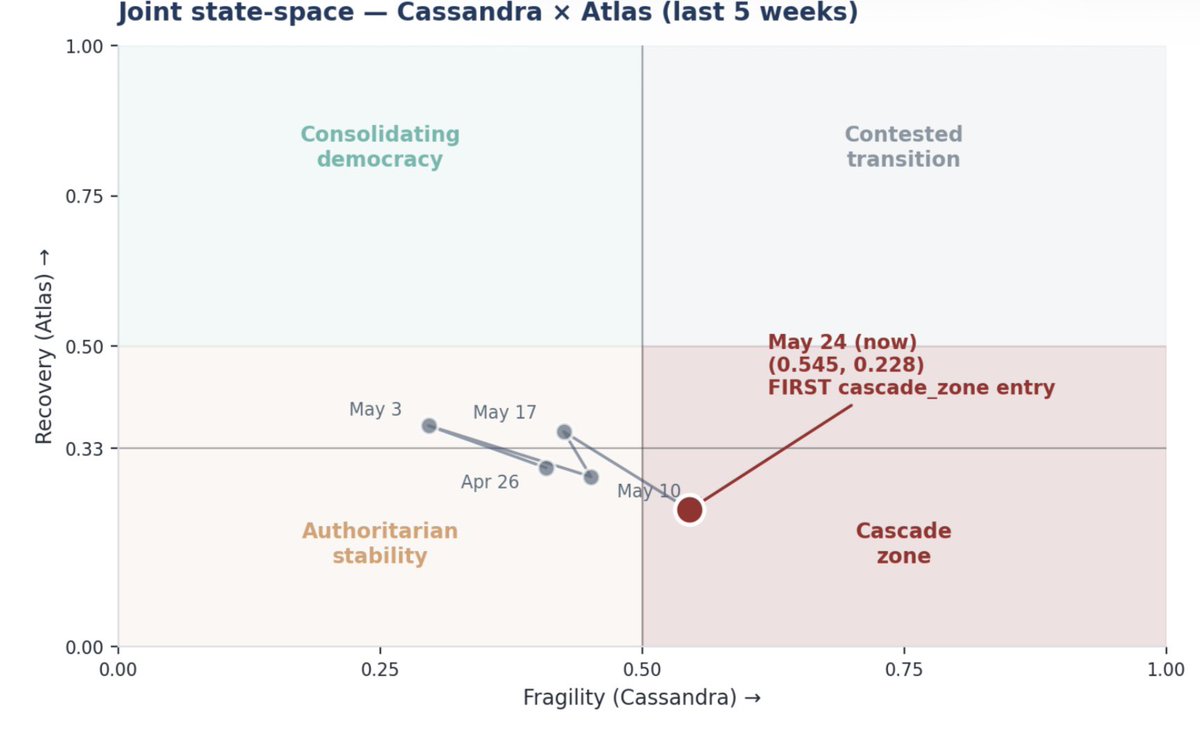
In this week’s Cassandra & Atlas, Autana looks at why Venezuela has now spent three straight weeks in the cascade zone — and why the most important signal is no longer in the streets, but inside the barracks.
The question now is brutally concrete:
When the special-operations cadre walks into central command, does it still recognize the chain of command it walks into?
autanaintelligence.substack.…
1
28
78
40,756
Venezuela did not produce a corruption scandal.
It produced a machine.
For 20 years, every time one laundering channel was exposed, another appeared: currency arbitrage, PDVSA contracts, food imports, gold, euro cash, crypto, stablecoins, and foreign facilitators.
This is why the right metaphor is whack-a-mole.
Hit one operator, another appears.
Hit one channel, value finds another route.
Because corruption behaves like a gradient: water flows, electricity finds ground, migration follows pressure, and stolen money searches for the path of least resistance.
The disease was never one banker, one contractor, one minister, one mediator, or one crypto regulator.
The disease was the captured state.
Autana Intelligence has a long memory.
As Venezuela returns to democracy, memory will matter.
Because only with justice will there be lasting peace.
Read the full essay:
autanaintelligence.substack.…
5
57
91
19,230
Bloomberg confirms what we flagged days ago: Venezuela’s grid can no longer reliably carry its own flagship industry.
New draft oil regulations would require energy firms to bring their own power and go off-grid — to avoid stressing an already fragile system.
The deeper signal is recognition. This is effectively the state conceding the grid’s condition. Rather than repairing generation and transmission, the load is being pushed onto private, islanded generation — in the very oil & gas sectors meant to fund the recovery.
That sets up a self-defeating loop: oil revenue is the only realistic path to financing grid repair, but the grid is too weak to support oil expansion — so oil simply gets pulled off the grid. With that, the pressure on interim President Delcy Rodríguez to fix the public system eases, and the revenue logic for ever doing so is rendered moot. Ordinary consumers are left on the failing grid, while the export enclave quietly powers itself.
The constructive read: distributed local generation is the right first move, and our analysis pointed to exactly this — modular, portable power as the pragmatic bridge.
The real opportunity falls to whoever governs after the third and final phase of the U.S. plan — the post-election government: don’t stop at islands. Use distributed generation deliberately as a short-term stabilizer, then channel oil revenue into a long-term rebuild of the national backbone. Bridge first, grid second.

Energy companies heading to Venezuela are being told to bring their own power plants to run their oil and natural gas operations and shield them from frequent blackouts on the nation’s ill-maintained electricity grid bloomberg.com/news/articles/…
1
44
114
204,846
Venezuela mastered how to make electricity. Everything after that fell apart.
One dam — Guri, once the most powerful in the world — supplies ~70–80% of the country. Nearly all of it travels hundreds of kilometers across a single fragile 765 kV backbone before reaching Caracas, Valencia, Maracaibo and the rest.
That's the trap: it's one giant machine, but every stage has to work in sequence. Generate the power, give it a massive electrical push so it can travel hundreds of kilometers, move it across the country, ease that push back down safely, deliver it. Break one stage and the lights go out — and today that happens again and again. Much of the country lives with daily blackouts and rationing. Water stops, because the pumps run on electricity. Food spoils. Hospitals run on prayers and generators.
And fixing it will take years, even done perfectly: the giant custom transformers the grid runs on now have 2–4 year wait times worldwide.
The realistic way out isn't a bigger power line. It's generating electricity closer to where people actually live.
Full story 👇
open.substack.com/pub/autana…
2
21
39
11,917
Our readers ask, What are Cassandra and Atlas?
In Autana’s Venezuela model, Cassandra measures regime fragility: how much pressure is building inside the system.
Atlas measures recovery: whether the country is moving toward a stable transition or being held together from the outside.
The model uses a simple idea from hidden Markov chains: you cannot directly “see” the true state of a political system.
You only see signals.
Elite fractures. Military silence. Street mobilization. Electoral delays. Sanctions relief. Court cases. Oil flows. Public narratives.
Autana’s advanced model reads those signals and asks: what hidden state best explains what we are seeing?
Is the system stable? Contested? Fragile? Cascading?
This week, Venezuela entered the cascade zone for the first time: rising fragility, falling recovery, and multiple stress signals moving together.
That is why the model matters. It does not predict one headline.
It measures when the ground underneath the headlines is changing.
36
109
66,981
Venezuela has entered Cassandra’s “cascade zone” for the first time.
This week’s signal is not just that fragility rose or recovery weakened. The structural picture changed: elite cohesion fractured, the regime narrative collapsed, electoral integrity hit the floor, and U.S. pressure moved from coordination to something closer to supervision.
At the same time, the opposition is articulating a 2026 pathway outside the regime’s electoral architecture.
The result is a regime squeezed on three flanks at once: internal fracture, external tutelage, and an opposition timeline it does not control.
The key question now is not whether the system is under stress. It is which pressure point breaks first.
Subscribe to Autana Intelligence to read the full Cassandra briefing.
4
78
229
18,784
Today we launch the Autana Intelligence Network publication.
Our first post explains who we are, why we chose the name Autana, and how Cassandra — our probabilistic analysis framework — will help us track Venezuela’s political fragility, institutional risk, and democratic recovery.
Autana is built for those who need disciplined intelligence, not noise.
Read the launch essay here:
autanaintelligence.substack.…
8
20
2,721
How does the South Florida case connect to the New York case against Maduro?
Not procedurally. Structurally.
The New York case is the criminal lane: the U.S. theory that Maduro and senior regime figures were part of a narco-terrorism architecture tied to the Cartel de los Soles, the FARC, cocaine flows, weapons, protection, and illicit finance.
The Southern District of Florida case is the civil lane: victims using U.S. courts to pursue damages against the same alleged ecosystem of power.
That distinction matters.
New York asks: did this network commit federal crimes?
South Florida asks: did this same alleged enterprise create victims, including through hostage-taking, torture, coercion, and the use of Americans as leverage?
For intelligence analysis, the important point is that both lanes point to the same deeper structure: not isolated crimes, but an alleged operating system.
Political command.
Military and security protection.
Illicit finance.
Gold and state-linked companies.
FARC-linked relationships.
Cartel de los Soles allegations.
And figures like Alex Saab, who matter because narco-terrorism cases are not only about narcotics. They are about how money moves, who launders it, who shields it, who benefits, and how criminal finance sustains political power.
That is why these dockets matter.
A default judgment in Florida is not the same as a criminal conviction in New York. The burdens are different. The legal consequences are different.
But the strategic signal is the same: the U.S. legal system is building pressure across multiple fronts.
Criminal prosecution.
Civil liability.
Asset recovery.
Witness pressure.
Documentary records.
Financial trails.
At Autana Intelligence we understand the map.
2
7
17
27,079
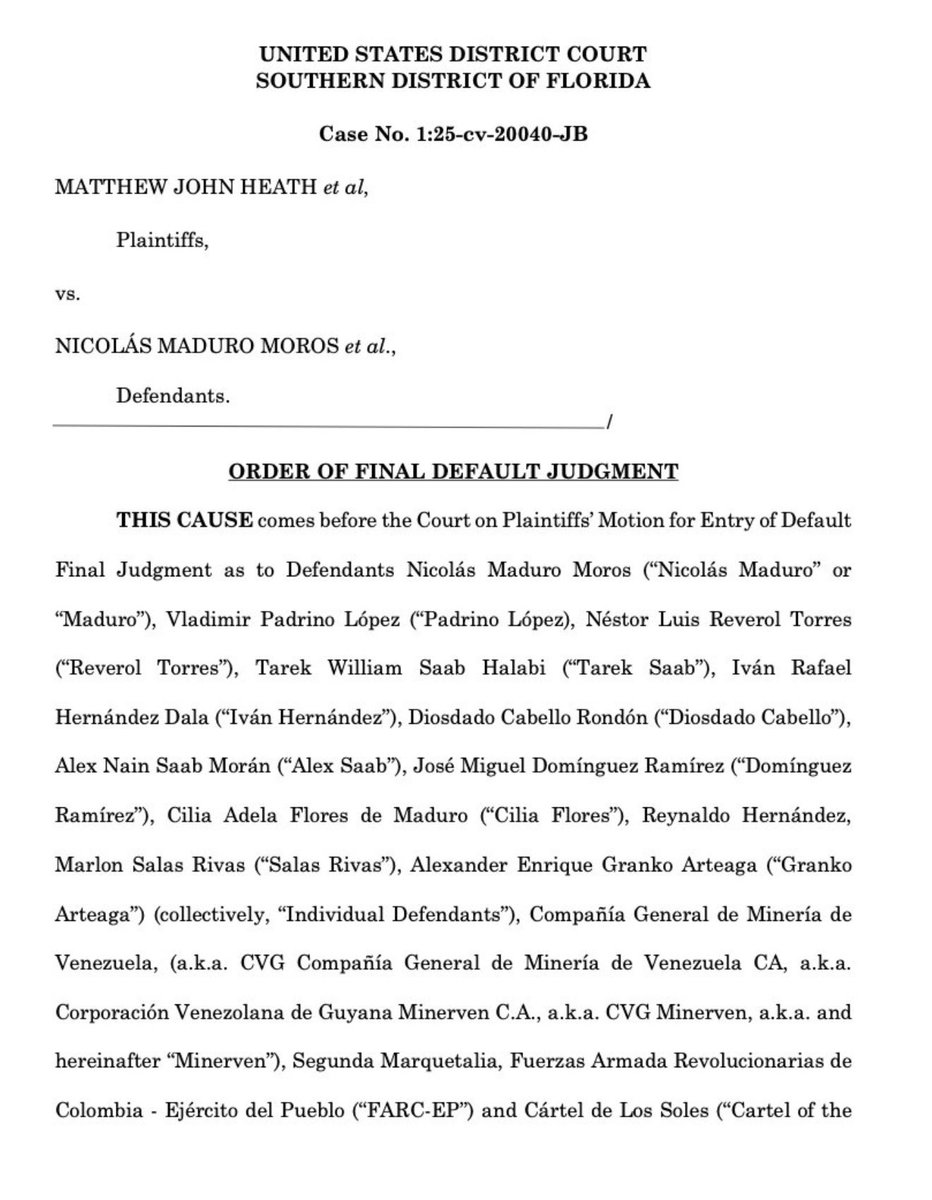
Alex Saab’s transfer to U.S. custody is not just another legal headline.
He may become one of the most important witnesses in the Maduro case.
Why? Because narco-terrorism charges are not only about drugs or weapons. They are about networks: how money moves, who launders it, who protects it, who benefits, and how illicit finance sustains political power.
Saab sits near that intersection.
For Venezuelans, justice has felt unbearably slow. But over the next 12 months, U.S. justice may keep moving methodically: witness by witness, document by document, network by network.
Slow is not the same as stopped.
1
42
69
90,383
This is why Alex Saab matters.
In U.S. litigation against Maduro and his network, Saab appears alongside Maduro, Padrino, Reverol, Diosdado, Cilia Flores, Minerven, FARC-EP, Segunda Marquetalia, and the Cartel de los Soles.
That is not a random list. It is a map of power, protection, money, and alleged illicit networks.
Narco-terrorism cases are not only about narcotics. They are about how money moves, who launders it, who shields it, and how criminal finance sustains political control.
19
19
1,424
🇻🇪 Venezuela esta semana:
El régimen no se está consolidando.
Se está equilibrando sobre tres condiciones que ya están cediendo en el margen; contención social,
control uniforme, cohesión de élite.
La superficie está tranquila. Los indicadores adelantados, no.
Lo que se ve estable desde arriba se está agrietando desde adentro. Y el canal interno del régimen es el único que aún no lo registra.
Lo que hoy es potencial, pronto será cinético.
—Autana Intelligence
14
44
5,354
In Venezuela, the warning is rarely a single headline.
It is the convergence.
Official U.S. trade guidance continues to highlight a high-risk operating environment: sanctions exposure, blocked counterparties, payment risk, corruption risk, and due-diligence complexity.
Now Heimdall — Autana’s 24/7 OSINT monitoring layer — is detecting a surge of BCV audit-related reporting, allegations, and social-media signals around potential irregularities.
That juxtaposition matters.
When official risk frameworks and ground-level information flows begin pointing in the same direction, investors and operators should pay attention.
This is what full-spectrum intelligence is built for.
Autana is not just monitoring the news cycle. We bring years of financial-market experience, Venezuela-specific research, accumulated datasets, counterparty-risk analysis, sanctions awareness, and real-time monitoring into one intelligence framework.
The goal is not to chase rumors.
The goal is to help decision-makers track risk as it forms: identifying weak signals, validating sources, mapping counterparties, detecting narrative shifts, and separating actionable intelligence from noise before capital, policy, or operational decisions are exposed.
What BCV-related signal are you watching most closely?
2
4
24
58,153
Most analysts describe Venezuela in phases.
They narrate the past.
We model the future.
The U.S. framework is clear: Stabilization → Recovery → Transition.
A strong and necessary structure — but real-world systems don’t always move in straight lines.
At Autana Intelligence Network, Mimir — powered by Cassandra — treats Venezuela as a stochastic system, using real-time Heimdall signals to estimate what comes next.
Recovery isn’t a story. It’s a probability.
DM us for the paper.
#Intelligence #AI #Venezuela
1
2
4
11,859
In Venezuela & Latin America, partial intelligence isn’t just incomplete — it’s dangerous.
Autana delivers full-spectrum intelligence: every signal, every angle, one clear picture.
• Munnin → Human networks on the ground
• Thor → Geospatial & satellite awareness
• Heimdall → Real-time monitoring & alerts
• Odin → Hidden connections, mapped
• Mimir → AI-driven decision intelligence
One platform. No blind spots.
→ autanaintelligence.ai
What are you not seeing?
6
8
2,027
Most intelligence fails where it matters most:
opaque, volatile, asymmetric environments.
That’s exactly where we operate.
Autana Intelligence Network delivers decision-grade intelligence for Venezuela & Latin America—combining HUMINT, GEOINT, and real-time signal detection into one system.
Built for those making high-stakes decisions under uncertainty.
6
9
1,721