
AI-Driven Software Quality & Automation Consultant | • Helping Organizations • AI-Enabled Automation • Quality Leadership | Consulting, Workshops & Advisory
Joined June 2022
- Tweets 578
- Following 2,277
- Followers 175
- Likes 42
133 Photos and videos

Pinned Tweet

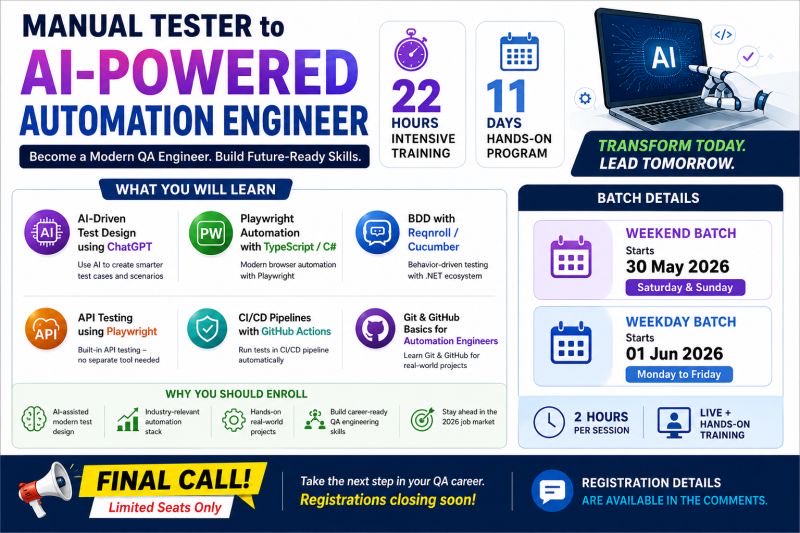
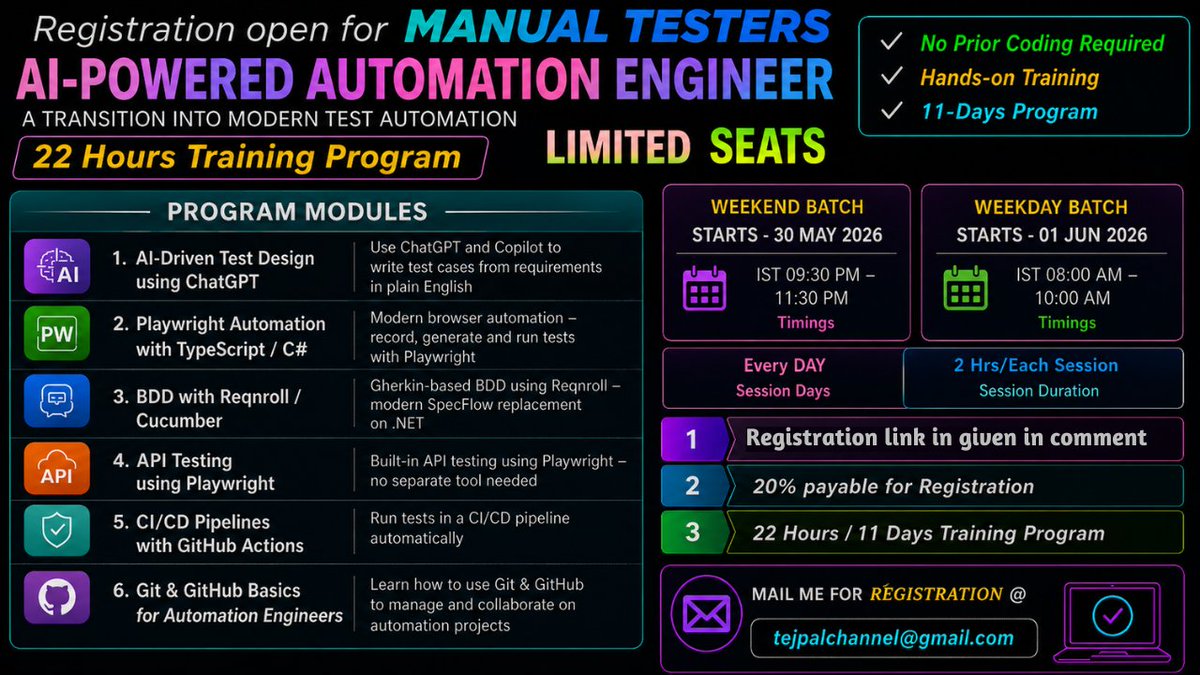
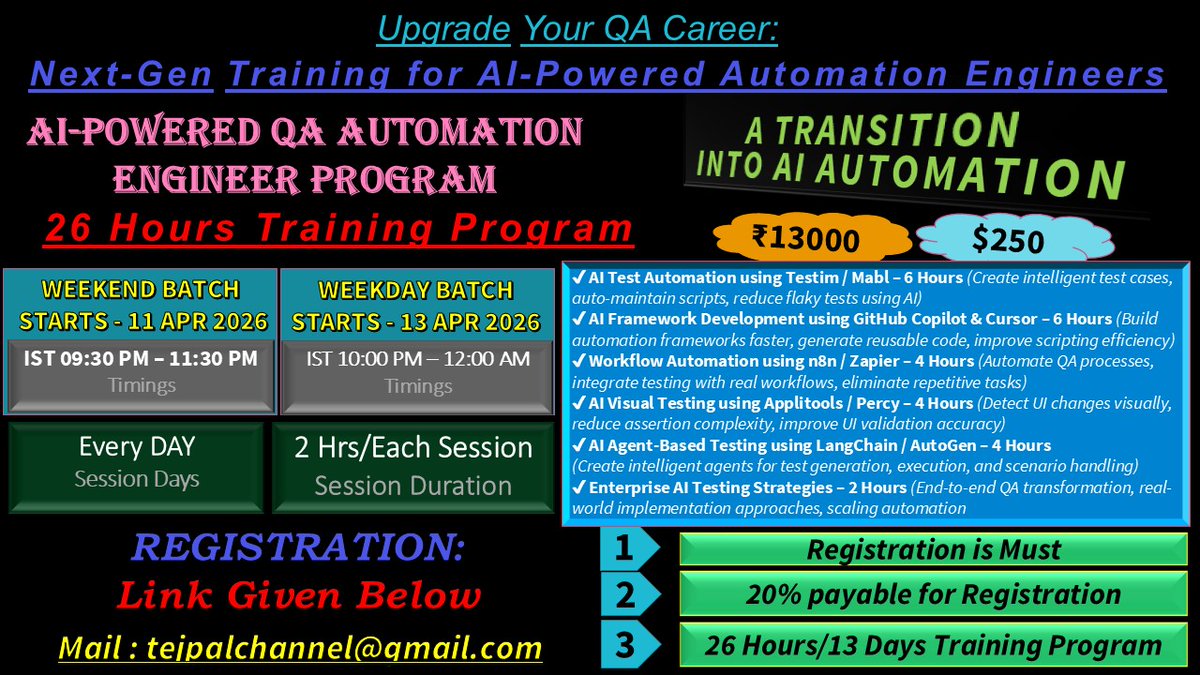
Interested in joining the “Manual Tester to AI-Powered Automation Engineer” program?
Please complete the registration form using the link below to reserve your seat.
🔗 Registration Link: forms.gle/Fg3ChuMbedgR1EaV8
Limited seats available for hands-on learning
2
245
I just published Two versions of your QA career →
Version 1 → Still three years behind. medium.com/p/two-versions-of…
9
Two versions of your QA career →
Version 1 → Still three years behind.
Version 2 → Take different direction to grow next.Two versions of a QA career exist in most organisations right now.
Version 1 - maintaining what someone else built, running regression nobody fully trusts,
1
16
applying for roles that now ask for skills you were never trained in.
Version 2 - owning the architecture, making data-driven release calls, explaining quality in business numbers that leadership actually acts on.
The gap between them is not years of experience.
1
12
It is one deliberate decision and the right path to follow it.
Which version are you building toward right now?
Where is your career currently heading?
#QualityAssurance #QAAutomation #SoftwareTesting #TestAutomation #SDET #Playwright #SeleniumWebDriver #CareerGrowth #TechCareers
12
Most teams don't have a testing problem
They have an Anxiety Gap
The distance between the quality they need and the quality they can confidently deliver
Everyone knows it's there
QA knows
Developers know
Product knows
Leadership knows
Nobody names it
So everyone ships and hopes.
1
11
The Anxiety Gap isn't a resourcing problem.
It's an architecture problem.
What does your team's Anxiety Gap look like?
#TestAutomation #QA #EngineeringLeadership #SoftwareQuality #AutomationTesting #AnxietyGap
8
Tools like ChatGPT, Claude, Gemini, and many others can generate millions of articles, posts, comments, and answers. Much of this content is based on patterns learned from existing content rather than new firsthand knowledge.
As a result, many people feel that:
1
25
Experience
Experiments
Observation
Discovery
Investigation
AI mostly reorganizes and recombines existing knowledge.
So if synthetic content grows faster than original content, finding authentic sources becomes harder.
1
16
The concern many people have is that the web could become increasingly filled with synthetic layers sitting on top of a smaller amount of original human-created knowledge. That's probably closer to the point you were making.
12
Suddenly it hit me.
Remember when everyone said:
DeepSeek will change everything
Sora will replace video production
Copilot will replace programmers
Llama will beat OpenAI
Cursor is the future
Perplexity will kill Google
What happened?
Nothing.
And that's the point.
In AI, fame?
1
26
Most lead magnets fail because they're designed to impress, not help
Nobody wants:
• A 50-page ebook
• A 3-hour course
• A 125-step framework
People want a result. Fast
That's why prompts, templates, workflows, checklists, & AI skills are outperforming traditional lead magnets
1
16
The goal isn't more value
The goal is faster value
Reduce the Time-To-Value (TTV)
If someone can use ur lead magnet in 60 sec & get a win, they'll trust you more than if they download a guide they'll never read
Stop creating content people save
Start creating assets people use
12
Vibe coding lets you build the wrong startup 10x faster.
Ask me how I know?
mass-produced dead projects before one worked.
The issue wasn't execution, it’s things nobody asked for.
Everyone ships in a weekend & calls it a startup.
It’s not product
You have a demo pretending to be
1
1
33
The biggest AI coding myth:
Winning isn’t about coding faster.
It’s about leverage.
The top 1% use:
• Multi-agent systems
• Reusable prompt frameworks
• Automated debugging
• AI code review pipelines
The future belongs to engineers who build systems—not just software.
33
Why was this book written?
To fill a gap
• Real stories from software professionals who faced burnout, pressure, self-doubt, and career exhaustion and rebuilt themselves without leaving tech.
• Practical tools that fit the realities of software work: sprints, production issues,
1
22
still works during stressful periods and setbacks.
• Understanding for the quiet loneliness many technical professionals experience while appearing successful on the outside.
This book was written to answer these challenges and provide a practical path forward for software
1
18
professionals navigating modern tech careers.
Rewire to Rise
The Software Professional's Peak Performance Playbook: Beat Burnout, Sharpen Focus, and Build a Career That Lasts in the AI Era
amazon.com/dp/B0GYX4DH19
#Amazon
#SoftwareEngineering #TechCareers #Burnout #Developers
27