Business Architecture Practitioner Methodology, Solutions, Training & Certifications | Business Architecture Center Of Excellence (BACOE). Est. 1972
Joined January 2017
- Tweets 424
- Following 3
- Followers 76
- Likes 725
319 Photos and videos


Where do you get your information, and what is the credibility of the individual providing this information? That is the purpose of providing you with this broadcast. The purpose of Architecture is to provide a baseline for addressing and managing change. If your Architecture does not do this, what is its purpose? Have a listen to remove the confusion.
The Purpose of Business or Enterprise Architecture? The Baseline for Change
Watch on YouTube: youtu.be/WwUhAeYW1Hs
Watch or listen on the ArchitecturesCOE website: architecturescoe.org/resourc…
Listen on Apple Podcasts: podcasts.apple.com/us/podcas…
Listen on Spotify: open.spotify.com/episode/7pf…
#RealTalkWithSamHolcman #TipsFromSam #EACOE #BACOE #EnterpriseArchitecture #BusinessArchitecture
Business Capability - what is it? This broadcast will define the concept of a Business Capability, a definition of a Business Capability, what is "contained" in a Business Capability, and an example. For a more comprehensive definition and example, please see our website BACOE.org
Watch or listen on the ArchitecturesCOE website: architecturescoe.org/resourc…
Watch on Youtube: youtu.be/kBkJVUOTTYw
Listen on Apple Podcasts: apple.co/3BsPXMc
Listen on Spotify: open.spotify.com/episode/4ex…
#RealTalkWithSamHolcman #TipsFromSam #EACOE #BACOE #EnterpriseArchitecture #BusinessArchitecture
2
As Business Architects or Enterprise Architects, or their Stakeholders, we often speak about Capabilities. Words have meaning, of course. Are we actually representing Capabilities or Abilities to our Stakeholders? They are different and would lead to different actions based on these terms. What are you actually developing and asking? We hope this broadcast helps.
Watch on YouTube: youtu.be/5qMG4kdthhY
Watch or listen on the ArchitecturesCOE website: architecturescoe.org/resourc…
Listen on Apple Podcasts: podcasts.apple.com/us/podcas…
Listen on Spotify: open.spotify.com/episode/2en…
#RealTalkWithSamHolcman #TipsFromSam #EACOE #BACOE #EnterpriseArchitecture #BusinessArchitecture
3
Enterprise Architecture and Business Architecture – Comparing and Contrasting.
Enterprise Architecture and Business Architecture. What are they? What are the similarities? What are the differences? In this broadcast, we will begin with a consistent definition of the word Architecture. From that common definition, we will then add the adjective Enterprise or Business to fully define an Enterprise Architecture or Business Architecture.
Watch on Youtube: youtube.com/watch?v=h_-JGnl5…
Watch or listen on the ArchitecturesCOE website: architecturescoe.org/resourc…
Listen on Apple Podcasts: podcasts.apple.com/us/podcas…
Listen on Spotify: open.spotify.com/episode/6MS…
#RealTalkWithSamHolcman #TipsFromSam #EACOE #BACOE #EnterpriseArchitecture #BusinessArchitecture
This topic is one that should sound familiar to anyone who has been around enterprise architecture, transformation, or banking, as one example, for more than a few years: everything old is new again. The latest version of the old story is being told through “purchased models,” “off-the-shelf ontologies,” and what some are now calling the semantic operating system for banking, as one example.
Buying somebody else’s model of your industry is not a new idea. It is a very old idea in very new packaging. Twenty-five years ago, it was sold as reference architectures, industry models, enterprise blueprints, and packaged best practices. Accenture sold it. IBM sold it.
But if you take that message into the C‑suite or the boardroom, and you lead with “data debt” and “process standardization,” you will lose the audience that matters most.
The Big Four sold it. Entire consulting practices were built around the claim that if you adopted a prebuilt model of your enterprise, you could move faster, reduce risk, and leapfrog the painful work of figuring out your own organization. But here is the Real Talk.
"Purchased Models, Off-the-Shelf Ontologies, and Why Everything Old Is New Again"
Watch on YouTube: youtu.be/mC9p8IVF-2w
Watch or listen on the ArchitecturesCOE website: architecturescoe.org/resourc…
Watch or listen on Spotify: open.spotify.com/episode/6bt…
Listen on Apple Podcasts: podcasts.apple.com/us/podcas…
#RealTalkWithSamHolcman
1
14
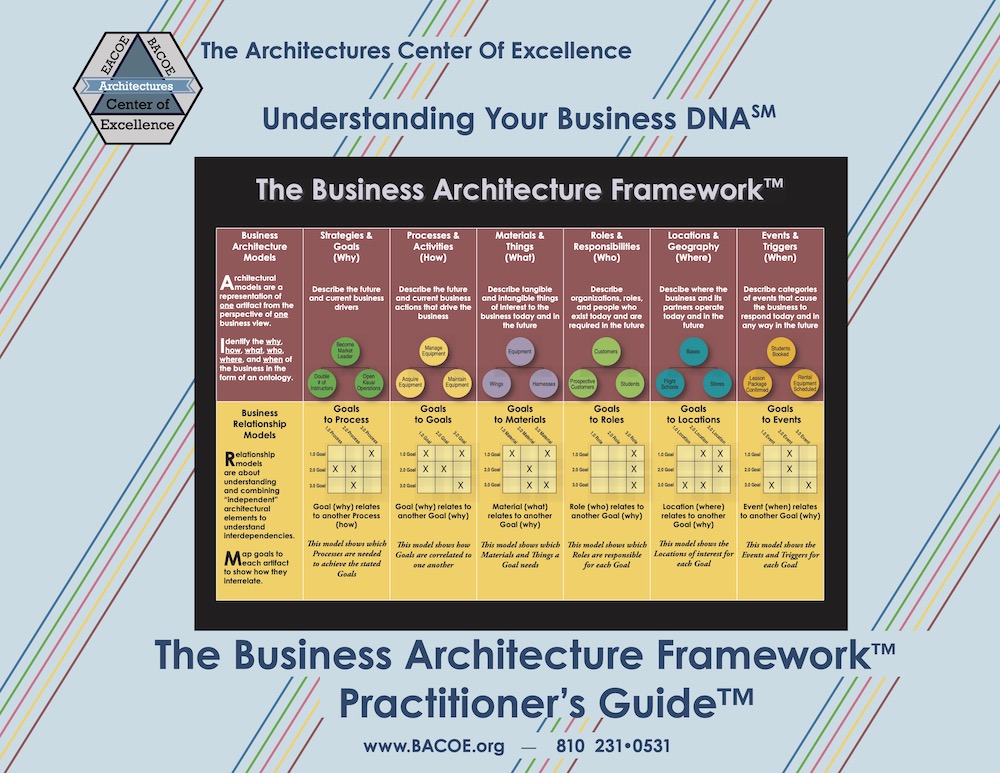
The Business Architecture Framework™ is the tool we use to move Business Architecture from theory to action and implementation. It is supported by detailed elaborations and models, an integrated and multi-decades practiced methodology, education, training, tools, certification, and consulting. It is understandable and usable by both business and technologists. Let's get started...
Whether you have experience or you are new to Business Architecture, The Business Architecture Center Of Excellence’s best-in-class Training and Certification Workshops provide individuals and teams with all the enhanced knowledge, easy-to-use tools, and practitioner-based skills for developing, implementing, and managing the highest returning and most cost-effective Business Architecture - engineered for maximum value. Review the full Workshop brochure bacoe.org/s/BACOEWorkshopBro…
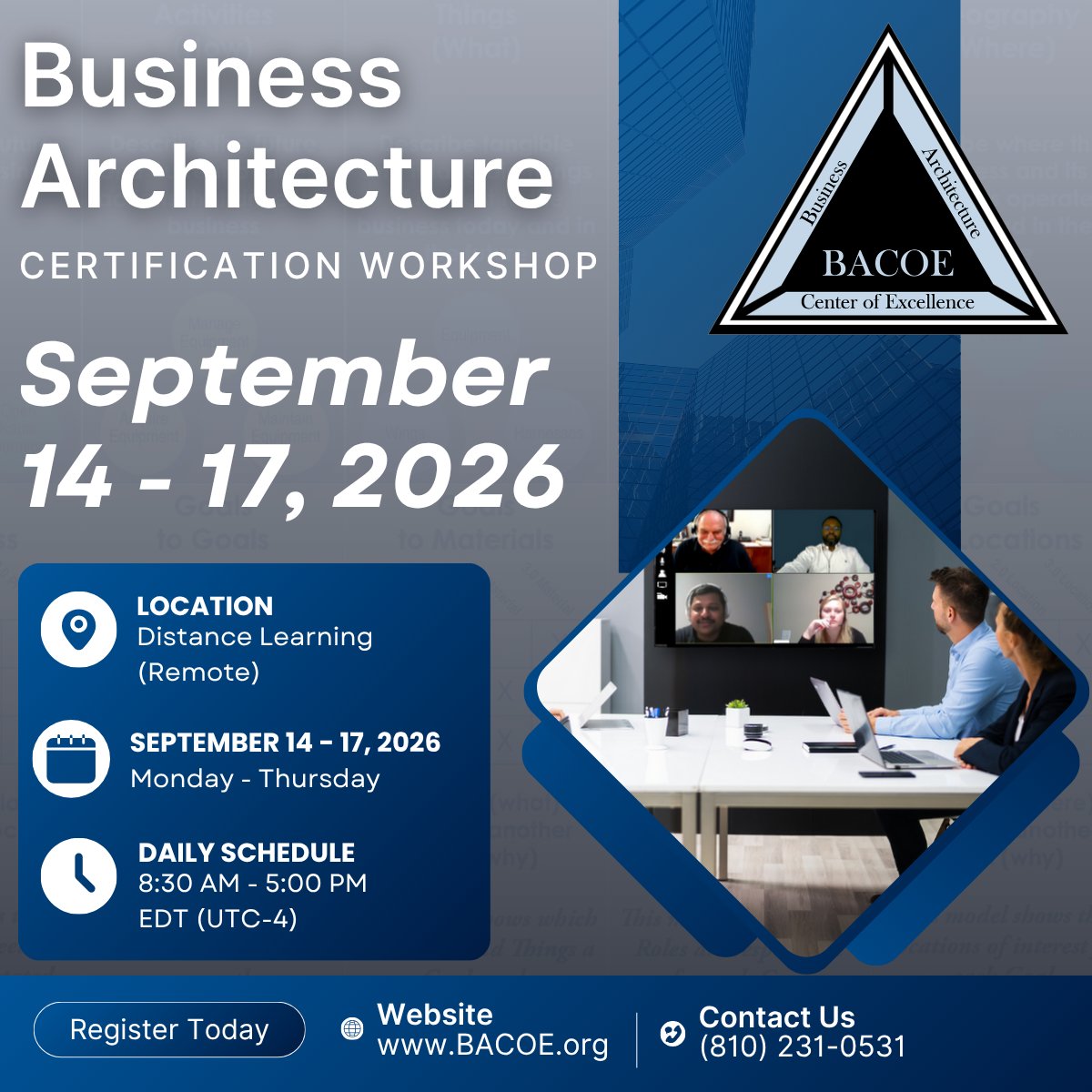
Advance your Architecture skills and become the Business Architect of choice by attending the July 13 - 16 or September 14 - 17, 2025, Distance Learning BACOE Business Architecture Practitioner Training and Certification Workshop. Confirm your Workshop participation by registering using this link - bacoe.org
Coming out of the world-class practitioner-based Workshops are Business Architecture Practitioners certified with the skills, knowledge, and tools to effectively manage change and complexity and enable business mission strategies and goals.
You and your team gain and practice the most cost-effective Business Architecture approach with the only vendor-neutral, fully integrated environment focused on successful Business outcome-driven results and frictionless development / implementation / management efforts.
#BusinessArchitect #BusinessArchitecture #BACOE
6
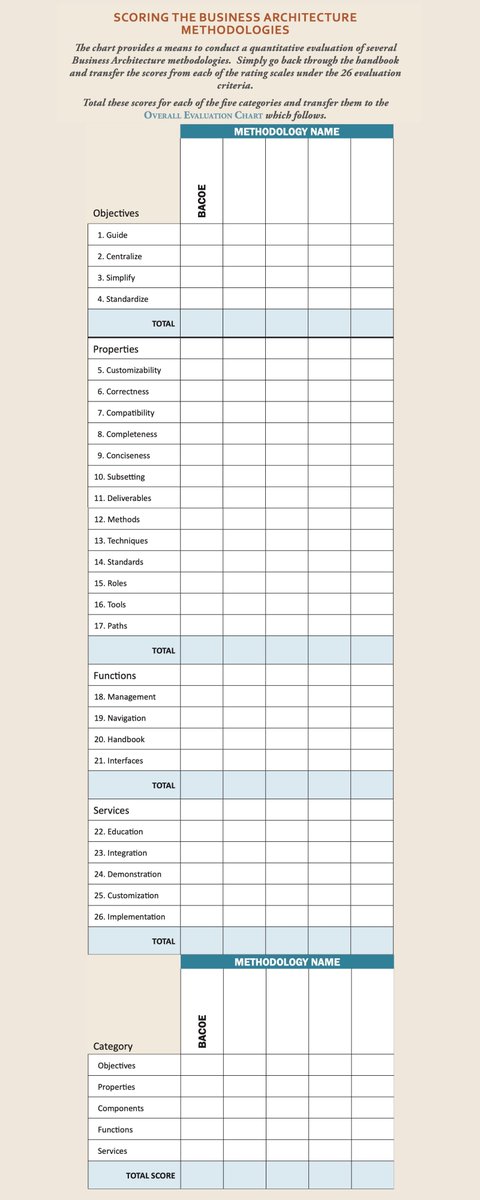
This handbook is designed to help you evaluate a Business Architecture methodology on a quantitative basis. Twenty-six distinct criteria are divided into five categories: objectives, properties, components, functions, and services. Each criterion is presented in the form of a question, followed by a discussion to guide you in evaluating the methodology under review.
Selecting a Business Architecture Methodology: A Ratings and Evaluation Handbook.
This is only a summary. Download the Full handbook using this link: architecturescoe.org/resourc…
The handbook begins with a perspective-setting discussion on methodologies. It then introduces five categories you should consider when selecting a methodology. Each category contains specific criteria stated in question form. Each question is followed by a brief discussion that helps you rate the methodology. The handbook concludes with charts you can use for making quantitative evaluations and for comparing methodologies.
Download the Full handbook using this link: architecturescoe.org/resourc…
#BACOE #BusinessArchitecture #BusinessArchitect
16
If you are a CIO, CTO, or Architecture Manager, you are already paying an “architecture tax” you never approved.
It shows up as overlapping platforms, programs that cannot finish, and “strategic” projects that quietly die after burning millions. The surprising culprit: ten everyday EA/BA words that your organization thinks it understands - but does not.
When these words are fuzzy, your architecture is fuzzy. And fuzzy architecture is expensive.
"The Ten Most Misunderstood Words in EA/BA"
Watch on YouTube: youtu.be/USgPxRL1yxM
Watch or listen on the ArchitecturesCOE website: architecturescoe.org/resourc…
Watch or listen on Spotify: open.spotify.com/episode/1xL…
Listen on Apple Podcasts: podcasts.apple.com/us/podcas…
#BACOE #EnterpriseArchitecture #BusinessArchitecture
6
There is a phrase making the rounds lately: “AI for data and data for AI.”
It sounds balanced.
It isn’t.
🚨 Data drives AI. Not the other way around.
AI is only as strong as the data it learns from - and no amount of sophisticated modeling changes that fundamental truth.
Yet most organizations are sprinting to deploy AI before answering three simple questions:
- Is our data clean, consistent, and trustworthy?
- Do our governance policies start from stewardship - or get patched on afterward?
- Are our data pipelines designed for what we’re asking AI to do?
If any of those answers are unclear, you’re not building intelligent architecture.
You’re building a faster amplifier of existing problems.
Look at the organizations that get this right:
🛍️ In retail - segmentation and clean consumer data enable personalization. AI comes after.
🏦 In financial services - structured transaction data powers anti–money-laundering systems. AI comes after.
⚙️ In manufacturing - reliable sensor data drives predictive maintenance. AI comes after.
The pattern never changes: Data first. AI second.
Still, the narrative keeps flipping that order.
Yes, AI can help manage data - smart ingestion, metadata tagging, anomaly detection. But its effectiveness in those tasks depends entirely on the integrity of the foundation beneath it.
AI can only flag inconsistencies as well as its historical baseline allows. It catalogs only what was well-collected in the first place.
And most conversations about AI architecture skip a critical dimension altogether - data semantics.
Syntax is fixable. Semantics - what data means across systems and decisions - is where most enterprises are dangerously unprepared.
That is the gap where AI produces its most confident and costly mistakes.
🌍 The organizations defining the next generation of enterprise intelligence will not be those chasing AI hype.
They will be the ones disciplined enough to put data first - and let AI serve data’s agenda, not replace it.
📘 Read the full article: architecturescoe.org/resourc…
🎧 Listen to the podcast: architecturescoe.org/resourc…
🎓 Register for the AI Data Modeling Masterclass at EACOE.org and BACOE.org.
#EnterpriseArchitecture #BusinessArchitecture #EACOE #BACOE #AI #RealTalkWithSamHolcman
1
3
On this episode of Real Talk with Sam Holcman, we bring clarity to Integration, Interfacing, Certification through Exam, Certification through Practice, Knowledge Bases – Bodies of Knowledge, and Methodology.
Watch on Youtube: youtu.be/d7czPz1aiVE
For those new to Real Talk, episodes are based on real-world practice-based enterprise architecture, business architecture, and the soft skills required for enterprise and business architects' experiences.
#EnterpriseArchitecture #EnterpriseArchitect #BusinessArchitecture #BusinessArchitect #RealTalkWithSamHolcman
2
Most organizations are chasing "business agility" by doing one thing: trying to make programmers go faster.
They rename it every few years - agile, iterative, sprints, low code, COTS tweaks - but the bet is always the same: if IT ships faster, the business becomes agile. It does not. It just burns out engineers while the real constraint stays untouched.
The problem is simple and brutal: this is one dimensional change.
No matter how clever the technique - agile, incremental development, COTS customization, use cases - if the answer is always "hand craft another solution," IT will never keep up with the volume and pace of business change.
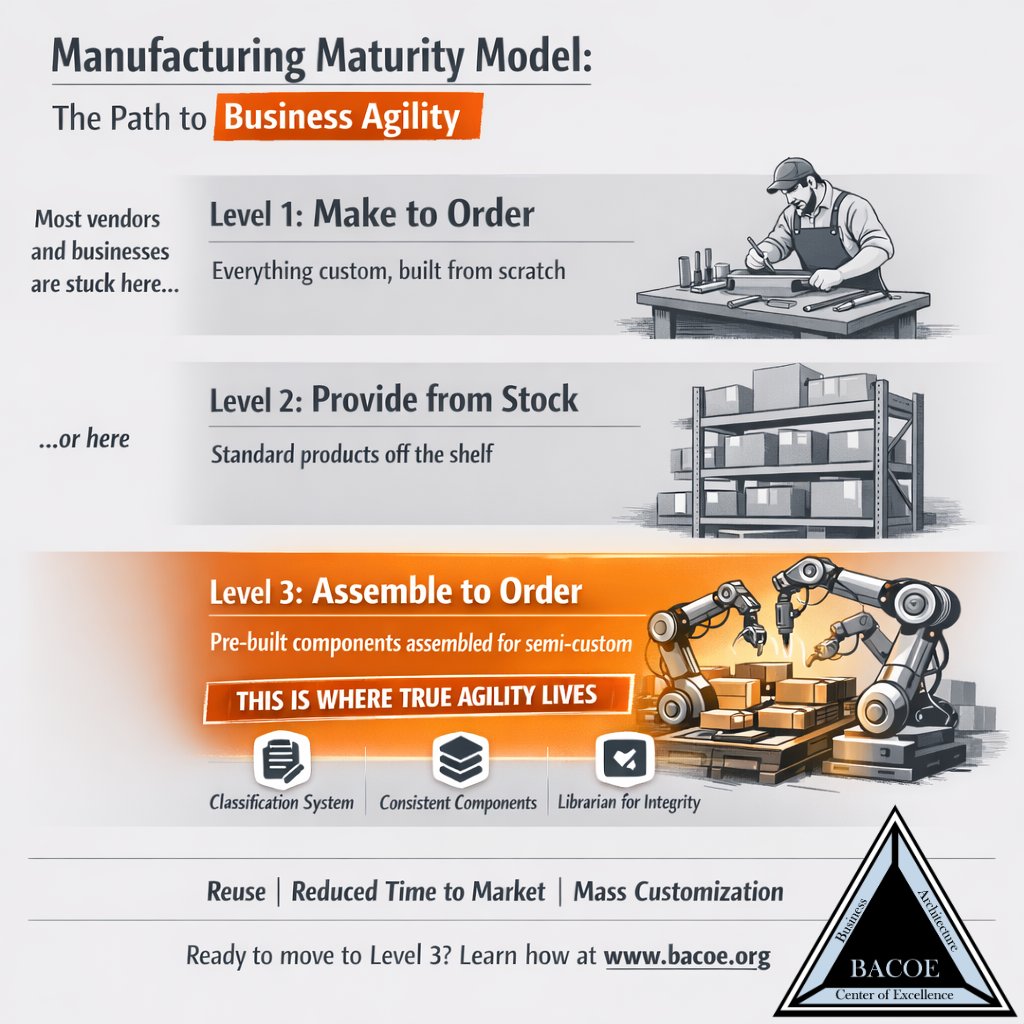
If you want a better model for business agility, look at the physical world: the Manufacturing Maturity Model.
Manufacturing has three maturity levels:
1. Make to Order – Everything custom, built from scratch.
2. Provide from Stock – Standard products, off the shelf.
3. Assemble to Order – Pre built components assembled into solutions.
Most businesses and vendors are stuck at Level 1 or, at best, Level 2.
Level 3 - Assemble to Order - is where real agility lives.
Think about ordering a PC from Dell.
If you accept 250 GB, you get your machine in days. If you insist on 187 GB exactly, you wait longer and pay more, because now someone is effectively building from scratch. At Assemble to Order, the trade off between speed and cost is explicit and sits in the customer's hands.
To bring that kind of agility into the business, you need three things:
1. A classification system so everyone knows what components exist.
2. Stable components that do not randomly change out from under you.
3. A "librarian" function to govern, curate, and protect the integrity of those components.
The payoff: massive reuse, shorter time-to-market, and decisions framed around choice, not chaos.
Right now, most organizations do not have true Assemble to Order options because IT thinking is still stuck in "code faster" mode. But the principles can be applied today - starting with how you design processes, capabilities, services, and data - so that future change is mostly assembly, not reinvention.
Business agility will not come from pushing developers harder.
It will come from changing the architecture of how you build: from Make to Order to Assemble to Order, with business and technology designed for reuse from the start.
For a deeper breakdown of how to move toward Assemble to Order and real business agility, including practical steps and examples, see the full guide to “Achieving Business Agility” architecturescoe.org/resourc…
#BusinessArchitect #BusinessArchitecture
4
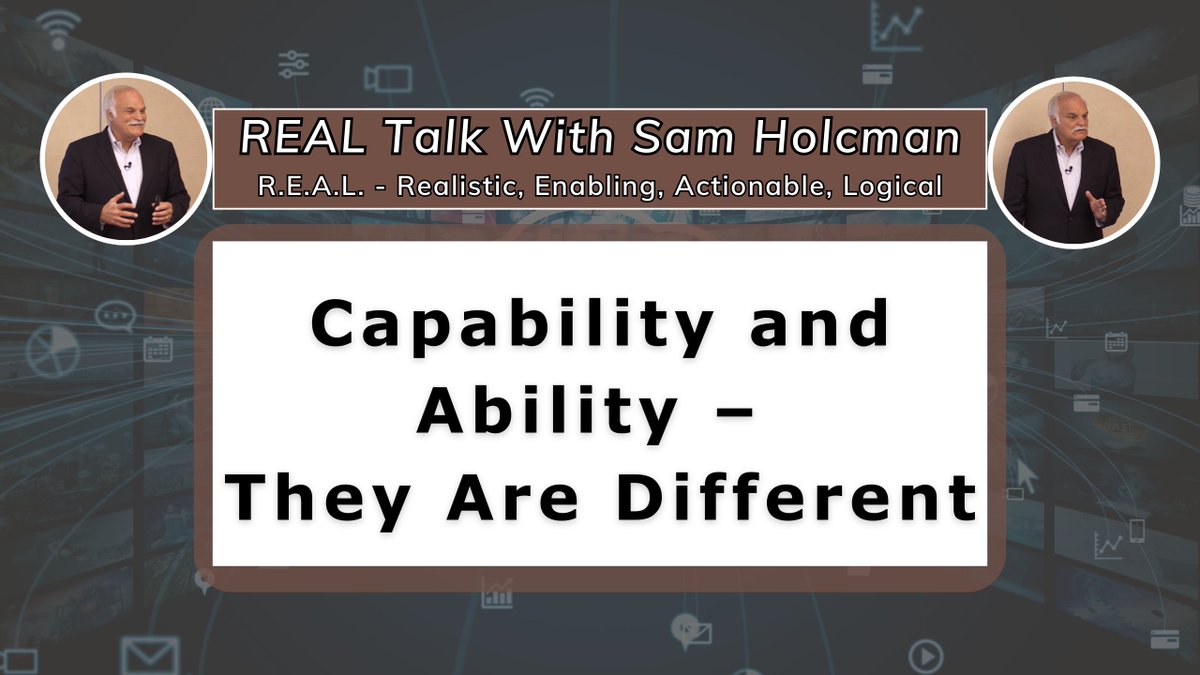
As Business Architects or Enterprise Architects, or their Stakeholders, we often speak about Capabilities. Words have meaning, of course. Are we actually representing Capabilities or Abilities to our Stakeholders? They are different and would lead to different actions based on these terms. What are you actually developing and asking? We hope this broadcast helps.
Watch on Youtube: youtu.be/0cx5A9FhonM
Watch or listen on the ArchitecturesCOE website: architecturescoe.org/resourc…
Listen on Apple Podcasts: podcasts.apple.com/us/podcas…
Listen on Spotify: open.spotify.com/episode/7gl…
#RealTalkWithSamHolcman #TipsFromSam #EACOE #BACOE #EnterpriseArchitecture #BusinessArchitecture
2
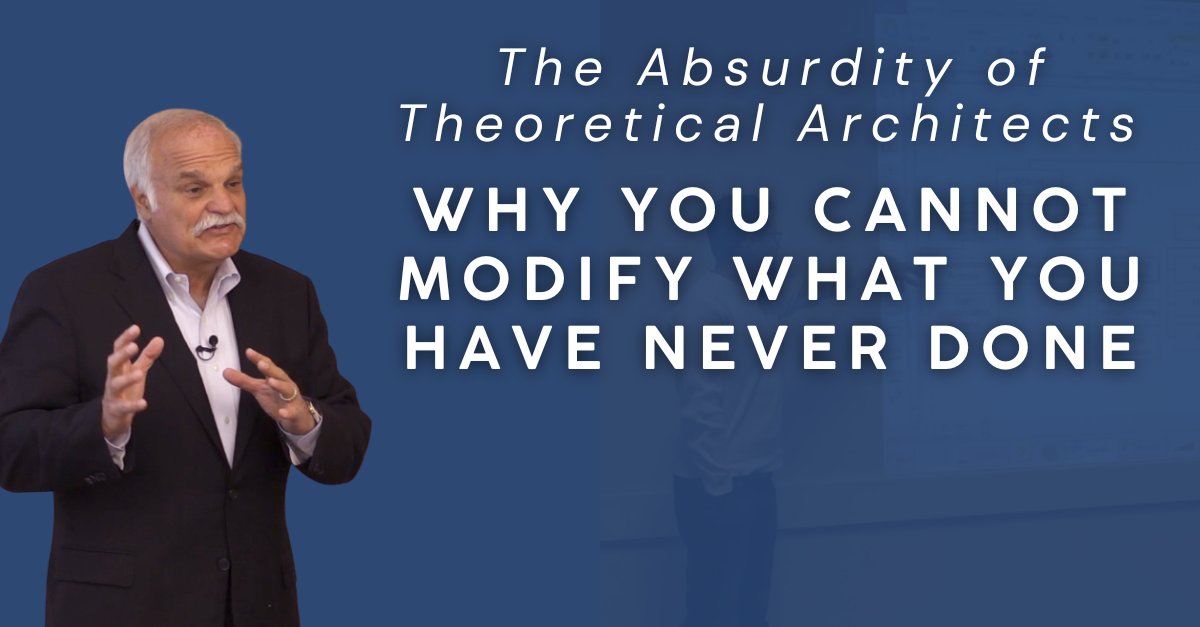
Someone passed a multiple-choice exam last week. Never touched a real architecture project.
And was handed a 1,600-page framework manual with the instruction: “Now modify it for your organization.”
Modify it? Based on what, exactly?
You passed the written driving test.
You have never touched the steering wheel.
And someone hands you a wrench and says:
“Congratulations. Now redesign the transmission.”
That is not mastery. That is madness.
And yet this is exactly what is happening in enterprise architecture and business architecture today.
The industry is flooded with “certified” professionals tinkering with frameworks they have never actually built or executed.
The more uncomfortable question is this: who is doing the certifying?
Have they ever done architecture in a live organization - with real strategies, messy systems, conflicting stakeholders, and political constraints?
Because a multiple-choice exam does not measure architecture. It measures memory and regurgitation.
Thousands of pages do not equal proficiency. Results do.
At Enterprise Architecture Center Of Excellence™ (EACOE™) and Business Architecture Center Of Excellence™ (BACOE™) you do not start by memorizing a giant manual.
You start by doing the work.
A field proven methodology, tested and refined through decades of real-world architecture practice - guided by practitioners, not theorists, right in the workshop itself.
And you leave ready to use it Monday morning.
Not after 1,600 pages of theory.
Monday. Real work. Actual results.
Once you have done enterprise architecture or business architecture, you have earned the ability and right to refine it.
That is how methodologies evolve intelligently - from the hands of practitioners, not from the margins of a textbook.
So, the next time someone says they are “certified” and are “modifying” a framework straight from the book, ask one simple question:
👉 Have you ever actually done this architecture work?
If not - how do you know any modification is even necessary?
Mastery does not come from reading.
It comes from doing.
Review the full article:
architecturescoe.org/resourc…
Or listen to the podcast:
architecturescoe.org/resourc…
#EnterpriseArchitecture #BusinessArchitecture #EnterpriseArchitect #BusinessArchitect #RealTalkWithSamHolcman #EACOE #BACOE
7
There’s a huge opportunity right now for Business Architects who want to elevate their impact.
Many teams have done the hard work: capability maps, value streams, certifications, framework knowledge, and detailed documentation. Those are real achievements, and they show commitment to the craft.
The next step is turning all of that into visible business results.
Leaders care deeply about faster decisions, reduced risk, better customer experiences, and smarter investments. When architecture directly supports those outcomes, it stops being “overhead” and starts being seen as a strategic advantage.
That is why we are so passionate about approaches like the Quick Start BACOE™ Business Architecture Methodology:
- They start from real-world practice, not just theory.
- They focus on decision-ready views, not just thick binders.
- They help connect models and methods directly to measurable business goals.
If you are ever felt that your architecture work is not getting the traction it deserves, you are not alone - and it is absolutely possible to change that. With the right methodology and a focus on outcomes, architecture becomes the backbone for how your organization plans, changes, and grows.
The opportunity is simple: move from “we have great models” to “we drive better results.” And that’s a shift every motivated architect and leader can make.
📘 Read the full article: architecturescoe.org/resourc…
🎧 Listen to the podcast: architecturescoe.org/resourc…
If you are tired of models that never show up in results, reach out at: BACOE.org — we are ready to take your Business Architecture practice to the next level.
#BusinessArchitecture #BusinessArchitect #RealTalkWithSamHolcman #BACOE
4
Business Architecture is supposed to turn strategy into reality.
So why do so many efforts stall out on page one?
Because too many organizations start in the wrong place: with business capability maps. They look sophisticated, but in practice, they often fail to drive real alignment, action, or understanding.
The limitations are painfully familiar:
- Data challenges that make the map inaccurate almost as soon as it is finished.
- Weak stakeholder alignment because no one sees their day-to-day reality in the boxes.
- Abstraction so high it floats above operations.
- Little visible connection to customer value or real outcomes.
That is why capability maps should rarely if ever be the primary instrument for designing or driving business change. They have a role - but not as the starting move.
Impactful organizations do something different. They use a hybrid, grounded approach built around:
- Business Architecture as the foundation and language of intent.
- Process models rooted in how work actually gets done.
- Business capability development as an outcome of Business Architecture, not a standalone mapping exercise.
- Customer interactions and journeys actively shaping design.
- New capabilities emerging from a clear desired state Business Architecture, not from a generic template.
That blend delivers what capability maps alone almost never do: actionable insight that engages stakeholders and closes the gap between vision and execution.
The difference comes down to grounding. When Business Architecture is anchored in clear objectives, compelling storytelling, and real operational reality, the models do not just inform – they energize transformation and growth.
Business capabilities still matter. They are just the result of good Business Architecture, not the place to begin.
For the full eight page guide on drawbacks, alternatives, and best practices beyond capability maps, check out:
👉“Beyond Business Capability Maps: Drawbacks, Alternatives, and Best Practices in Business Architecture”
architecturescoe.org/resourc…
#BusinessCapabilities #CapabilityMaps #BusinessArchitecture #BusinessArchitect #BACOE #RealTalkWithSamHolcman
7
What is Strategy? An Understanding For Business Architects and Enterprise Architects.
Watch the full broadcast: architecturescoe.org/resourc…
Go beyond buzzwords. Discover how strategy is the deliberate creation of a unique series of activities that set you apart from the competition. Learn why true differentiation comes from the distinctive activities you and your organization undertakes - not from generic “published practices” or off-the-shelf models.
#EnterpriseArchitecture #BusinessArchitecture #Strategy
6
Most organizations launch Business Architecture and Enterprise Architecture in exactly the wrong way.
They start by building capability maps, process models, and operating models “in the abstract.” The result? Impressive diagrams, underwhelming impact. Executives see delay, overhead, and extra red tape - because nothing in those artifacts helps with the decision sitting on their desk today.
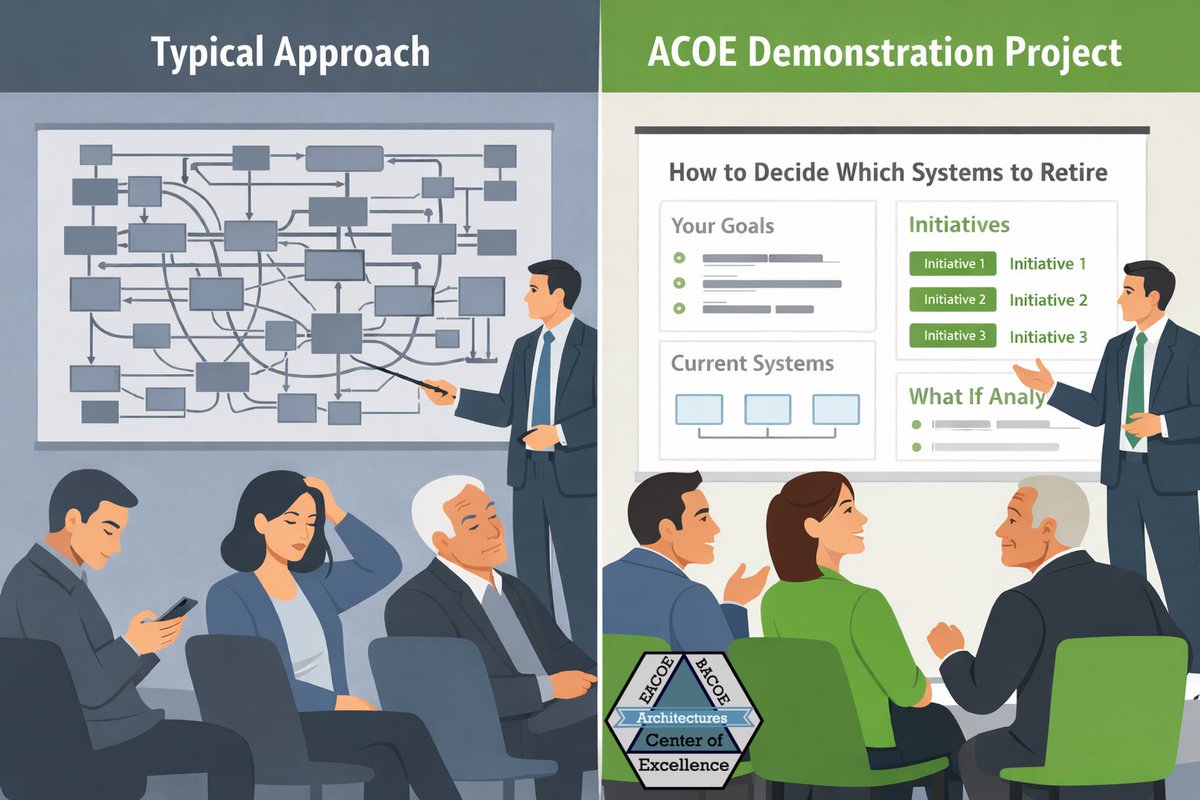
There is a better way: start with a Demonstration Project, not with maps and models.
A Demonstration Project is a tightly scoped, concrete initiative that:
- Starts from an explicit stakeholder ask: “Reduce onboarding time by 30%,” “De-risk this acquisition,” “Decide which systems to retire.”
- Uses EACOE or BACOE architectural thinking and artifacts only to the extent needed to answer that request credibly and measurably - ideally within two weeks.
Its purpose is not to “implement the full architecture.” Its purpose is to create one undeniable proof point: when architecture is applied to a real issue, better decisions are made, faster, and at lower risk. Architecture becomes an analytical engine, not a documentation factory.
The first thing the stakeholder sees is not a capability map, flow, model, or value stream. The first thing they see is a clear answer to their question, in their language, with options, trade offs, and consequences. Architecture views appear only in service of explaining why those recommendations are sound - not as the main event.
That sequence - answer first, architecture second - quietly rewires how leaders think:
- From “architecture is documentation”
- To “architecture is how we make better strategic and investment decisions.”
The Demonstration Project is not a side experiment. It is the seed of a serious Business Architecture or Enterprise Architecture practice, grown from real outcomes, not from slideware. Read more: architecturescoe.org/resourc…
If you are tired of models that look good and change nothing, start with one high impact Demonstration Project and build from there, not with another round of maps, flows, and streams.
#BusinessArchitect #BusinessArchitecture
2
The Four Pillars of Holistic Business Architecture.
This is a clip from the Real Talk with Sam Holcman broadcast: "Practitioner Tips from Practitioner to Practitioners: Mastering Holistic Business Architecture."
Watch the full broadcast: architecturescoe.org/resourc…
#BusinessArchitecture
3
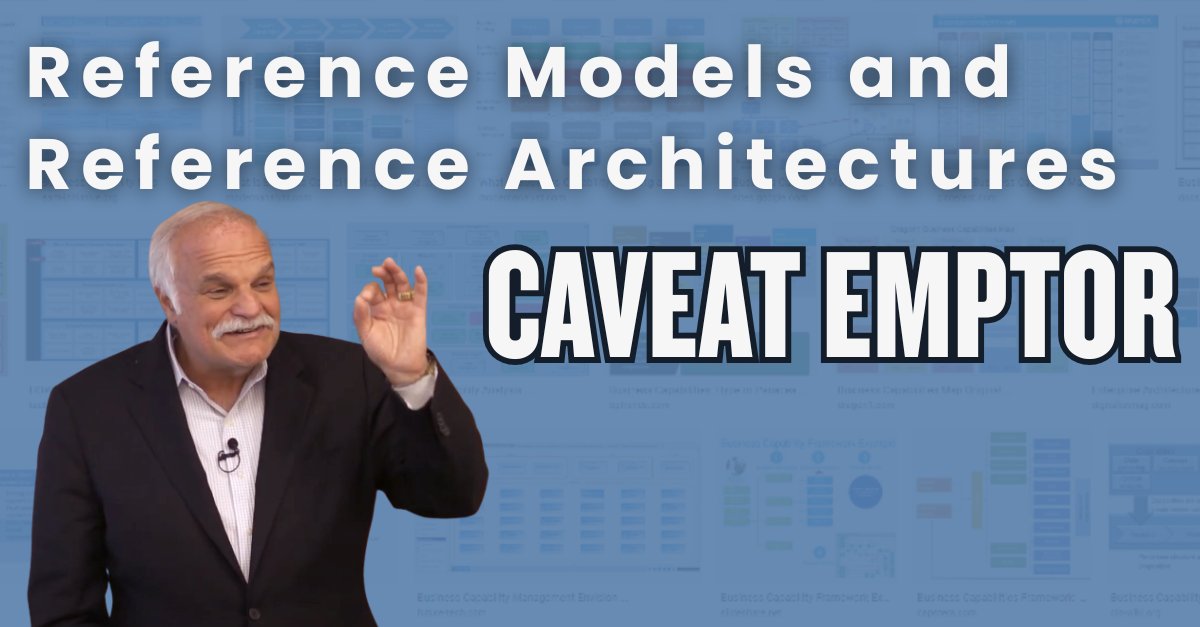
Accenture sold it. IBM sold it. The Big 4 sold it.
Then they quietly walked away.
Reference architectures and enterprise models were sold as the blueprint for digital transformation — standardization, best practices, faster delivery, lower risk.
Instead, they became very expensive shelfware.
Here’s what actually happened inside most organizations:
- Months spent filling out meta-models and templates.
- Teams mapping current state, target state, and every layer in between.
- Governance boards obsessing over conformity to the reference architecture.
And the result?
Projects stalled. Business leaders saw zero ROI. Architecture became something people learned to “navigate around” instead of a partner they pulled into the work.
The market noticed before most architects did. Gartner pivoted to advisory and playbooks. Accenture shifted hard to “outcomes” language. IBM quietly walked away from their reference enterprise models because clients weren’t getting value.
Why did all of this fail so badly?
- Too rigid: Couldn’t keep up with cloud, real-time data, modern security, or product delivery.
- Too generic: Looked impressive, but left the hard implementation decisions to overloaded teams.
- Too slow: Development teams needed architectural answers in a few weeks, not in quarterly governance cycles.
- Too theoretical: Optimized for documentation, not decisions, learning, or value.
But here’s the uncomfortable part almost nobody talks about: The internet didn’t save us either.
Most “best practices” online are really just “published practices.” What worked beautifully at Netflix or Amazon can fail spectacularly in your world because:
- Your scale, regulatory environment, and risk appetite are different.
- Your culture and legacy stack aren’t starting from a blank slate.
- Your organization can’t absorb change at FAANG speed, no matter how pretty the diagram.
So, teams copy patterns from blogs and whitepapers. The slideware looks modern. The architecture isn’t. It’s misaligned with real constraints, politics, talent, and budgets.
The solution is not “better” reference models.
The solution is living, outcome-driven frameworks and methodologies that:
- Treat every pattern as a hypothesis to be tested, not a belief to defend.
- Focus on testable architectural decisions, not exhaustive meta-models.
- Work side by side with product and business teams, in their cadence.
- Evolve based on evidence and feedback, not on fixed templates and annual reviews.
Architecture isn’t about perfect documents. It’s about better decisions, made faster, with clearer consequences.
The full story, the big consulting firms won’t tell you about reference models, is here:
“Reference Models and Reference Architectures – Caveat Emptor” 👉 architecturescoe.org/resourc…
What’s your experience? Drop your story in the comments:
#EnterpriseArchitecture #BusinessArchitecture #BusinessArchitect #EnterpriseArchitect
28
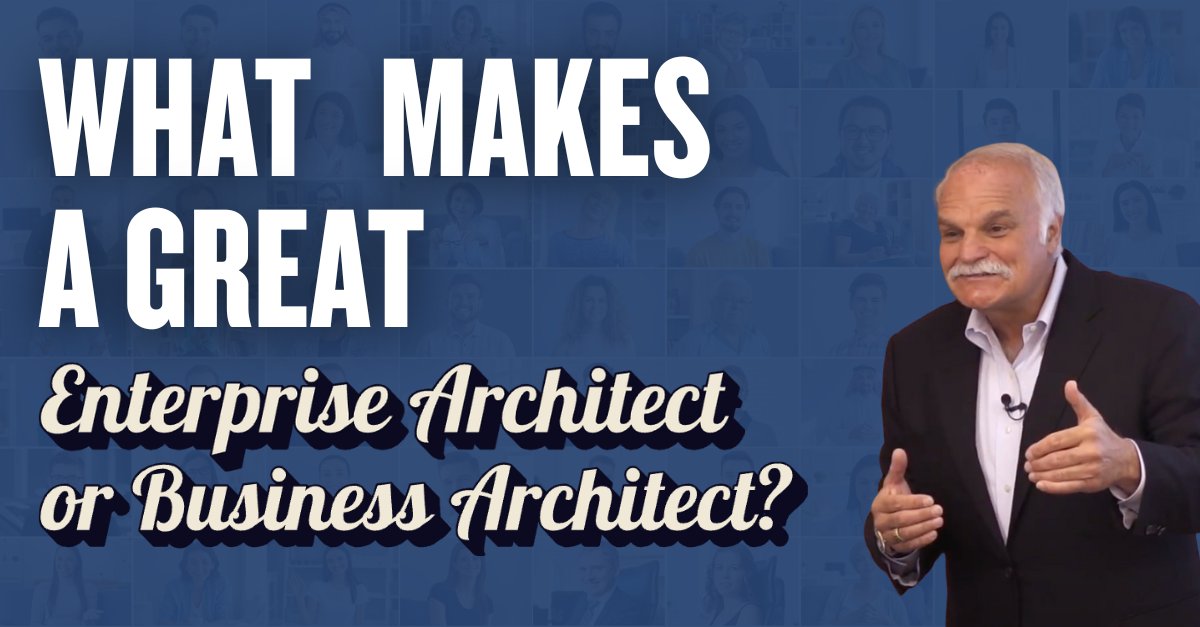
Unpopular opinion: Your certification logo isn’t what makes you a great Enterprise Architect or Business Architect.
There, it’s said.
We just hit publish on a no-BS deep dive into what actually separates "paper architects" from the people executives fight to get into the room.
Spoiler: Passing a multiple-choice exam isn’t it.
After more than five decades in this field, we’ve lost count of how many “certified” architects we’ve seen crank out gorgeous reference models, colorful maps, and eye-watering diagrams… that nobody uses.
The business moves on. The slides stay in PowerPoint.
The architects who matter?
- They’re in the room before the decision is made.
- Leaders treat them like trusted advisors, not documentation machines.
- Their work shows up in outcomes, not just in binders and modeling tools.
Here’s the uncomfortable truth about what really matters:
- Turning complexity into clear, simple choices executives can act on.
- Earning trust by delivering quick wins and showing your work, not hiding behind jargon.
- Thinking strategically across business goals, data, process, organization, location and events – and connecting the dots.
- Influencing without authority, aligning stakeholders who want different things, and navigating politics without drama.
- Operating with stakeholders, for stakeholders — not worshiping a framework as if it’s a religion.
And the problem with most certification exams?
- They test recall, not judgment. Memory, not mindset.
- They reward people who can recite terminology, not those who can broker trade-offs in a tense steering committee.
- They quietly encourage “model freaks” who love governance theater more than business value.
In the new article, we lay out the full picture: the behaviors that build real stakeholder trust, the red flags that scream “paper architect,” and the soft skills that separate theory from tangible enterprise impact.
👉 Read: “What Makes a Great Enterprise Architect or Business Architect.”
architecturescoe.org/resourc…
Your turn:
► What do you think makes a great Enterprise or Business Architect?
► Have you ever seen a “highly certified” architect completely miss the point?
Drop your experience in the comments — the next generation of architects is reading.
#EnterpriseArchitecture #BusinessArchitecture #EnterpriseArchitect #BusinessArchitect #RealTalkWithSamHolcman
16