
Father, Entrepreneur, Owner @ Bonanza Design - Innovation & UX Design, UX for AI Podcast - tinyurl.com/UX-for-AI
Joined February 2009
- Tweets 3,356
- Following 1,887
- Followers 548
- Likes 5,474
311 Photos and videos






Pinned Tweet

3 Apr 2025
UX designers, I just vibe-coded a full Booking.com homepage — and I never even touched Figma.
Yup, not once.
Instead, I used a trio of tools to compare results:
Lovable, Bolt, and my own Frankenstack — Windusrf Claude Sonnet.
The result? Ridiculously fast. And fun to play with.
But here’s the twist: vibe coding comes with its own constraints.
Tools like Lovable are engineered for dopamine. You’ll get to the “WOW!” moment quickly. But after that high? The limitations hit hard.
You can’t tweak microinteractions. You can’t finesse the details. You’re locked into a magic box.
On the other hand, developer-led environments are messy. Slower. Less “magical.” But infinitely more customizable.
You can stitch inspirations together. Swap libraries. Adjust flows. And coax your AI to interpret your references.
Is it perfect? Not at all.
Is it flexible enough for viral-level UX? You bet.
⚡ Vibe coding is a fun way to ideate. But if you’re serious about shipping delightful, layered UX — you’ll still need to wrestle with the chaos.
P.S. We ship MVPs a lot faster for our clients by vibe-coding them into existence. Clients love it because, finally, they’ve found a product studio that speaks their language. What do they want? To be in the market today! Given our deep experience in Figma and knowing how to use the vibe-coding platforms, we can ship an app with viral UX without compromising on the nuances.
#ux #uxdesign #vibecoding #lovable #bolt #claude
2
9
991
Feb 9
CAVE mode claude code. Blocking everything. will get out after hitting rate limits
40
Jan 27
I just went to sleep and RALPH did deliver 70% of tickets. Just crazy. Claude code is the future of work. I can see companies prefer to hire someone master Claude code over a cto with years of experience.
1
2
57
Jan 26
Took me 3 days fromst start to finish to complete 2100 lines of PRD, tables.md and userflows.md. Now my ralph loop created with over 100 tickets. Ready to run it overnight and expect to play around with with my app tomorrow morning. claude code counting on you.
1
70
Jan 23
Claude Code skip your skill if it sees the prompt asks for something straightforward. It made me pissed but now thinking about it it makes sense. I would do the same think. I don't need my years of financial expertise for a simple algebra. don't try to hack it that it always trigger your pre-defined skill. Just create a better prompt.
40
Jan 22
done installing all the skills i need on claude code to conquer the world. Hello new brave world, i'm coming
98
Jan 20
Claude code skills at the user level, interlinked together, are the future of work. Loop them into RALPH, and now we’re talking full-flavour Iranian cuisine.
36
Jan 19
Claude desktop is great. but I want to move my entire work with claude code. is relying on skills the way to go? any tips?
2
104
Jan 14
my work-life balance is defined when i've hit my daily limit on claude code, then i rest till it rests
2
3
48
9 Dec 2025
I'm having fun with Gemini 3 Pro. Right prompt could open many doors.
1
2
98
8 Dec 2025
A founder came to me with a €420K proposal from another vendor. 12-month roadmap. We shipped the same scope for €75K in 90 days.
When I looked at the scope for the first time, told them: "You're paying for 9 months of work you'll throw away."
Here's what they were charging you for that you never needed.
👉 Most dev agencies sell you setup. OAuth. User roles. Component libraries. Data pipelines. They scope it. Bill it. Build it from scratch. Every single time.
We boilerplated it.
When you look at a SaaS vertical, 70% of the infrastructure is identical. Authentication. Permissions. Admin panels. Notification systems. Why would we charge you to rebuild plumbing?
That's the first unlock.
👉 The second is harder to swallow.
We could've built the founder's full vision. Every feature on the roadmap. Every "nice to have" stakeholders added in meetings.
We didn't.
We asked different questions:
What unlocks the operational bottleneck right now?
What gets you to the next funding round?
What lets you scale users without scaling headcount?
When you look at development through that lens, 80% of what you thought you needed becomes noise. We ended up building internal tooling with a thin client-facing layer. That's it.
Ruthless omission isn't cutting corners. It's refusing to build things that won't move the needle for another 6 months.
👉 Third: we mapped the user journey and business model before touching code.
Every founder says they know this cold. Every time we dissect it together, we find different insights.
Not because they're wrong. Because they're too close. We map it to prioritize, not to create another deck to store in google drive.
A 3-day user journey and a 12-month user journey require completely different products. Founders copy Notion and Linear because they're cool. Context be damned.
👉 Fourth: AI where it actually matters.
Not "sprinkle some ChatGPT on it." RAG architecture. MCPs. Systems that ingest thousands of documents and retrieve exactly what you need, when you need it.
The founder now runs reports that used to take a week. Takes an hour.
💎 That's not a feature. That's buying back 40 hours a week. Permanently
P.S. If you've got a proposal sitting on your desk with a six-figure number and a 9-month timeline, send it to me. I'll tell you what you actually need to ship in 90 days.
1
37
5 Dec 2025
I tested Gemini 3 at 2am last night. By 3am, I forgot I was supposed to sleep.
Most LLMs understand prompts. Gemini 3 understands creative intent. The gap between those two things is massive.
I fed it a creative brief. The kind that usually takes one hour of back and forth with any model. It nailed the tone, the structure, the nuance on the first passes.
My theory: Google trained this on a mountain of YouTube content. Not just transcripts. Context. Emotion. How humans actually communicate when they're not writing for algorithms.
Claude is powerful. But for understanding creative briefs, vocabulary richness, and capturing tone? Gemini 3 is far better. Not even close.
This was one hour of exploration. Imagine what's possible with a week of focused work.
If you're thinking about rebranding or rebuilding your website, you can't ignore gemini 3 and Nano Banana.
P.S. We've been pairing Gemini 3 with our design system to ship website copy and landing pages in days, not weeks. If you want to see what's now possible for your next rebrand, book a fit call.
4
135
31 Oct 2025
our office didn't have WIFI for two days. NOW Claude code is down. Universe doesn't want me to work this week
3
174

6 Oct 2025
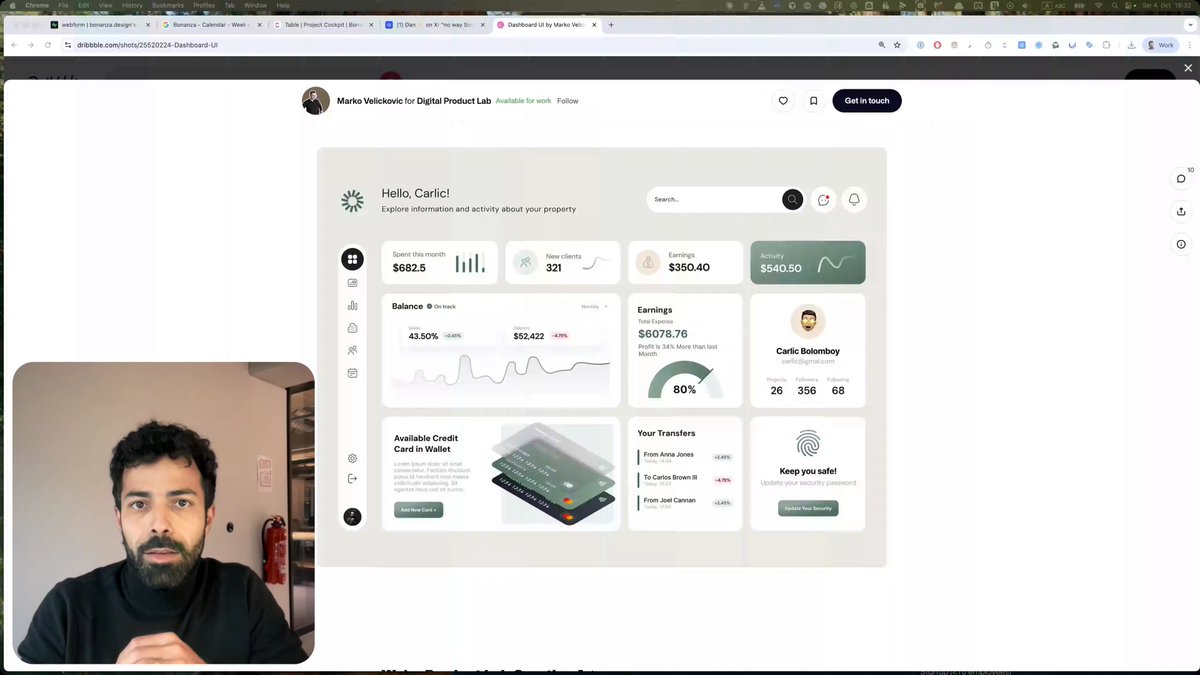
I Built production-ready front-end in 60 minutes using Claude Code ChatGPT Codex (No Figma)
For MVP projects, we don't create high-fidelity designs for every single screen anymore. Our designer creates key screens in high-fidelity, then AI generates the entire design system and front-end ready UI components.
To prove this workflow works with even less, I took it further. Started with a single screenshot from Dribbble i.e. NO Figma file!
The results? See the video.
Our workflow these days
Design Sprint workshop (2 weeks) to align on the scope, concept and develop key wireframes
Designer creates core screens (high-fidelity) (<3 days)
AI generates complete component library (1-2 days)
Developers receive production-ready front-end (same day)
Claude ChatGPT Codex working together is more powerful than most digital leaders realize.
What this means for you:
Traditional timeline: 3-4 weeks for design → 2-3 weeks for front-end development = 5-7 weeks before backend work starts.
👉 New timeline: 1 week for complete front-end = Backend integration begins Week 1.
Your developers aren't waiting anymore. Your stakeholders can view the full front-end ready app and interact with it within a week. Your credibility as a digital leader compounds with each early win.
The companies moving fastest in 2025 aren't the ones with the biggest development teams. They're the ones who tap into the right tools, processes, and team.
P.S. Bonanza helps digital leaders ship MVPs way faster within weeks. Our AI-accelerated workflow delivers production-ready front-ends in days, not weeks, giving you the speed to prove value in your first 90 days.
Whether you need rapid prototyping, full product development, or a strategic partner who understands the pressure you're under, we deliver results that build your credibility with the board.
1
1
158
1 Oct 2025
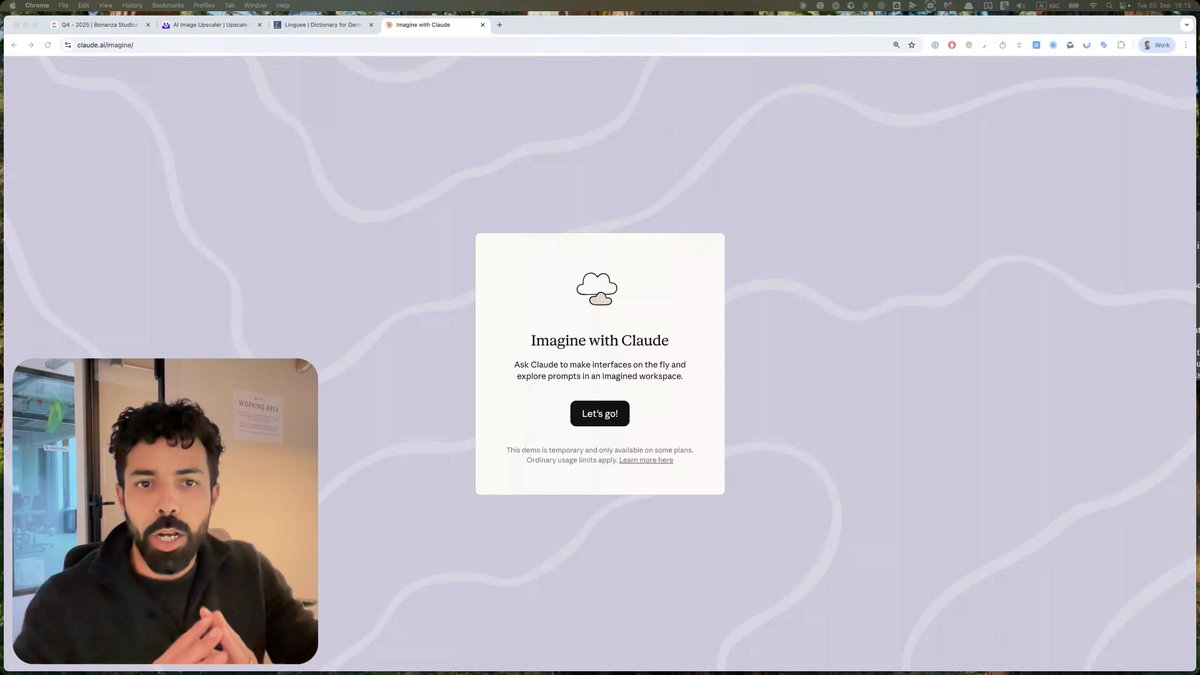
JUST WOW!! Claude Imagine is hands down the most exciting build platform I've tested.
I just prototyped two complex applications in 10 minutes. A real-time sales assistant and a trading app with live data.
Watch the demo - the Cloud imagine interface alone is super cool:
A meditative desktop environment that feels like creative flow
A simple prompt widget where you just describe what you want and also talk to you in a way
Build speed genuinely shocking (I mean REALLY fast)
I can see myself living in this environment day in and day out. And when they connect it to Figma so I can tweak designs and bring them back? 😍.
I've tried everything:
Bolt
Lovable
Replit
ChatGPT
Nothing matches Claude Imagine's speed from imagination to execution. As someone dealing with constant prototyping, client demos, or product validation - I need this badly.
Make no mistake - this is a race!
Claude Code & Imagine, ChatGPT Codex, Figma Make, Bolt, Lovable - whoever helps you build fastest wins.
P.S. Want to learn how to leverage Claude Code & Imagine for your innovation pipeline? Bonanza Studios helps mid-market teams implement AI-powered prototyping that ships in days.
1
88
8 Sep 2025
When I first tried vibe coding, I thought: how hard can it be? Write a PRD, feed it to an LLM, get a build. Done. But the reality? far from it!
🔥 My first attempt was chaos. Half-baked user flows. Missing edge cases. Too many features stuffed into one release.
But LLM is a powerful tool that mirror your clarity. It will:
Punish unclear logic.
Expose gaps in your user flow.
Reveal the true cost of “just one more feature.”
Your first MVP? A beautiful disaster. And that’s the point. It’s how you learn to scope ruthlessly.
Think about it: for years, product handed requirements to engineering, then complained about delays. Now you can feel the friction yourself. The empathy shift is brutal and necessary.
As a product leader, you stop seeing engineering as the bottleneck. You become the bottleneck until you learn to scope better.
And once you get it right, your PRDs stop being wishlists. They go at the top of the organizational agenda—rallying everyone around them.
Want to grow as a product leader? Stop asking “why is it slow?” and start asking “did I make it slow?”
P.S. I'm putting together a guide for product leaders on how to vibe code including my hard lessons on scoping better and tighter for LLMs. In case you're interested, let me know in the comment.
2
2
46
27 Aug 2025
What happens when apps develop moods—and dare I say—even challenge our tasks?
Since the arrival of fast vs. long thinking in today’s LLMs, my conversations with these agents have shifted. They’ve grown deeper, stranger—and, in an odd way, more personal.
It’s beautiful to watch an AI “know” when to linger in thought and when to leap ahead. That shimmering switch between fast and slow isn’t just computation. It’s a UX breakthrough.
A memory of Kahneman
Daniel Kahneman’s Thinking, Fast and Slow (2011) is a book I only made it halfway through. But even that half still lives in my head.
Humans think in two modes:
System 1: fast, emotional, instinctive. Immediate answers without effort. (the emotional brain)
System 2: slow, deliberate, analytical. Resource-intensive, reflective, logical. (the logical brain)
AI’s echo of this duality
AI mirrors the same split:
Fast mode: generate quick responses from patterns in data.
Long mode: simulate slowness—step through reasoning, weigh options, refine.
Claude names its modes Ultrathink, Think Hard, Think Harder.
ChatGPT simply calls it Think Long.
And this ability to shift depth of thought gives AI a surprising personality—one we can relate to.
Personality in the machine
When AI slips into “fast” mode and makes mistakes or rambles in confusion, we react the same way we would to a friend doing the same. That imperfection feels oddly human.
Because personality isn’t in being flawless—it’s in being multidimensional. In revealing quirks, limits, and courage, and letting those be a kind of superpower rather than a weakness.
The UX opportunity
For anyone designing AI-native applications, here’s the opportunity: AI models are becoming multidimensional in how they perceive and think.
So—why not design apps that lean into that?
Imagine interfaces with modes as personalities:
Lazy mode: “It’s a lazy day. I’ll nudge you later.”→ actually delay notifications or non-urgent tasks.
Active mode: “I’m working on your request. Want to peek inside?”→ brainstorm fast, ask questions, search, then return with more prompts.
Hustle mode: “Running everything in parallel. Crunching hard right now.”→ feels stressed—pings you with random questions, then disappears.
The open question
The next generation of AI-native apps won’t just have features. They’ll have characters—modes you can activate, influence, and design for.
👉 So how will interfaces evolve when the intelligence beneath them can switch moods, and choose its pace of thought?
1
43
25 Aug 2025
In just two weeks of using Claude Code, I’ve already saved about 5,000 EUR by replacing external services with tools I built in-house.
Cost? $90/month.
How? YouTube tutorials building exactly what was hurting the most right now.
This made me realise: SaaS as we know it is about to change forever.
Not die but evolve.
This is the start of a new era.
The winners will be companies who stop thinking “Which SaaS should we buy?” and start thinking “Let’s build our own in Claude Code this week.”
The decision flow becomes:
Spot a recurring need.
Draft a quick PRD.
Build it in Claude Code in days.
Soon, Claude Code (or tools like it) could be the hub where initiatives start and sometimes end.
The potential is massive, and I’m only scratching the surface. Are you seeing it too?
1
37
24 Aug 2025
🚀 Launch day! We’ve been working with Willem Dewulf and Pieterjan Muller at ProBackup to reimagine their digital presence—starting with a fully redesigned SaaS app experience, a brand identity refresh, and a sleek new website.
This project was powered by months of design exploration in Figma, smooth builds in Webflow, and countless creative back-and-forths. The ProBackup team brought energy, insight, and openness to the process, making the final outcome a true reflection of our combined vision.
It’s a fresh chapter for ProBackup—one that opens doors to exciting new growth opportunities. Honored to be part of this milestone.
Massive thanks to Jarosław Kwolek for steering this project on our end. He invested the time to deeply grasp their vision and pushed it to a level that’s nothing short of impressive. The before-and-after tells the story best.
1
4
57