
Joined June 2012
- Tweets 80,416
- Following 652
- Followers 1,955
- Likes 365,446
13,942 Photos and videos












Pinned Tweet

21 Dec 2025
⚖️REVELATION⚖️
🏴SCOTLAND🏴
🇺🇸AMERICA🇺🇸
🔱GOD WINS🔱

2
3
21
4,185
"This Air To Ground Saga~
Gonna Launder mah KARMA..."
💥Lo Fidelity Allstars - Battleflag💥
⚔️🇺🇸🇺🇸🇺🇸🇺🇸⚖️🇺🇸🇺🇸🇺🇸🇺🇸⚖️🇺🇸🇺🇸🇺🇸🇺🇸⚔️
youtu.be/B99nd2iKGOw?si=_etd… via @YouTube
6
🪻⚜️RYKER ⚜️8822⚜️🪻 retweeted

🤔
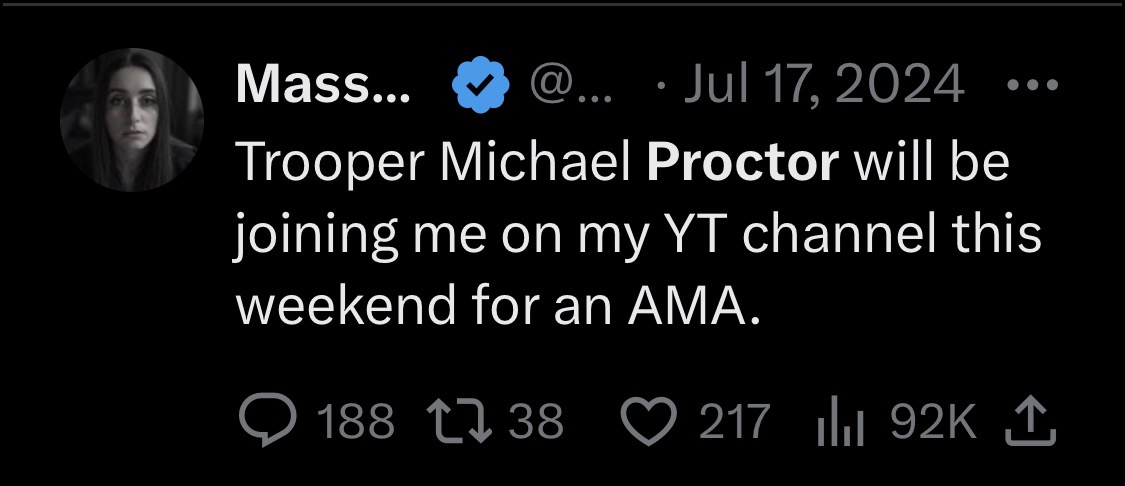
How did Shrek contact Racist Michael Proctor?
14
8
96
2,968
🪻⚜️RYKER ⚜️8822⚜️🪻 retweeted

Practice ARMED defense daily.


9
48
205
5,011
🪻⚜️RYKER ⚜️8822⚜️🪻 retweeted

“We need more tax money!”
No… you need Buck v. Bell

1
1
17
820


🪻⚜️RYKER ⚜️8822⚜️🪻 retweeted

All these idiots screaming about the jews are the weakest people on the planet. They've been psy-oped by low-iq desert monkeys who do nothing but cry victim and grift. No wonder the West is falling.

The black & white tea towel brigade wouldn’t have the balls to set foot inside the good forsaken hell hole of ‘Palestine’
Pro-pally twats. Get back to me when you’ve left your fucking vegan cafe in Brighton & seen the misery of living under Hamas / PA
1
1
14
🪻⚜️RYKER ⚜️8822⚜️🪻 retweeted

The irony of modern education:
telling kids to say no to dr*gs, while simultaneously medicating six-year-olds because they won’t sit perfectly still for eight hours.
12
44
248
2,602
🪻⚜️RYKER ⚜️8822⚜️🪻 retweeted

Elizabeth Warren owns a ($4M) dollar mansion in Cambridge and reports are, her net worth ranges from ($12M - $67M) on a Govt salary of ($174K)
This isn't mathematically possible, it's time for an audit on every member of Congress
No one's above the law, including Democrats



755
7,380
17,966
90,822

Glowing Orbs, Crescent Moon Shapes, & Boomerang-Type Vehicles. Black Projects & the UAP Phenomenon.
David C. Grusch reveals a 1948 memo from the Chief of Naval Operations that discussed the "flying disc" pandemic that they were having and that they were enlisting the help of the Air Force Intelligence Service.
Grusch also states reports from UAP crash retrieval programs and what the crafts looked like, including lenticular discs, crescent "moon shapes," aka "the "flattened sunfish," eggs, discs, boomerang-type vehicles, a bunch of different morphologies that the U.S. government has recovered.
6
35
101
4,840
🪻⚜️RYKER ⚜️8822⚜️🪻 retweeted

Jun 12
Remember when Tim Walz celebrated Tesla’s stock going down?
Elon just became the world’s first trillionaire
Fuck you @Tim_Walz
1,543
8,668
59,552
511,246
🪻⚜️RYKER ⚜️8822⚜️🪻 retweeted

While humans use ultra-thin fiber-optic cables to guide lethal drones across the battlefield in Ukraine, birds have begun repurposing the same material for their nests.
These lightweight, durable cables, which can stretch up to 20 kilometers, are a signature weapon in the ongoing conflict. After each mission, the spent cables are left tangled in trees, scattered across fields, and woven into the soil across vast stretches of the front line. Ukrainian soldiers were among the first to document the phenomenon, photographing a bird’s nest built almost entirely from the discarded fiber-optic strands near the devastated town of Toretsk.
"Nature adapting to war," they wrote.
Yet behind the striking image lies a more troubling reality. Fiber-optic cables are made of spun fiberglass, a material that does not biodegrade. It persists in the environment for decades. When birds incorporate it into their nests, the fibers remain long after the nest falls apart. Soldiers have shared footage of birds and deer entangled in the cables, struggling to free themselves from what can become invisible traps.
To the birds, the material is ideal: strong, flexible, lightweight, and abundant. They have no way of knowing it is the remnant of a weapon that has reshaped their habitat.
The war’s impact does not stop at the front lines. It continues in the soil, the trees, and the nests of creatures who simply use what they find, turning the debris of human conflict into a new, permanent part of their world.

8
33
128
15,311
🪻⚜️RYKER ⚜️8822⚜️🪻 retweeted
True

If someone had stood outside of a restaurant and ripped up a pride flag, elected officials would be having mass seizures.
Where are they all now?
"Knicks Historic Win Overshadowed By Violence And Burning Buses In NYC Streets" | Via @APT__News
2
21
730
Q Review: 💥🔔💥Mike King Recently Interviewed by John Michael Chambers rumble.com/v7b8nau-mike-king…
5
Was Charles Bronson Actually Dangerous? | The Dick Cavett Show
Scene from Jill Ireland on Dealing With Charles Bronson's Temper | The Dick Cavett Show English actress Jill Ireland provides some more insight into the temper of American actor Charles Bronson.youtu.be/HIr3w6oMqFQ?si=lAVT… via @YouTube
16

Pred Sean here tries to claim he was told the girl was 20, when she was actually 13.
When will these l0sers realize everything they do electronically can be seen...
As soon as he does realize, he clams up and starts to break down.
They always try to be aggressive for getting caught....
Yeah, you know what's coming buddy. Dont drop the soap!
He was arrested and held on 31k bond in Tecumseh, Michigan.
Trial is still pending.
There are so many of these pieces of trash...

Former officer Sinmi Asomuyide, probationary officer from Indiana, was convicted a few days ago for SA of a 14 year old girl, and looking at life in prison.
He was assigned a missing persons case, a 14 year old runaway.
He located her, and before taking her home, questioned her on her sexual preferences, experience, etc.
They exchanged numbers, should she need to contact law enforcement.
He tracked her phone, showed up to her house and arrested her. He then took her to an abandoned parking lot and abused her.
Then told her not to say anything, otherwise their will be problems.
His charges were kidnapping, sexual assault and denying her constitutional rights.
Hope the boys in prison take care of this... P.O.S.
5
97
117
13,549
💥🔔💥

Every time a liberal cries a Starship gets its wings.
4
🪻⚜️RYKER ⚜️8822⚜️🪻 retweeted

🇺🇸Mo’rnin America🇺🇸
… and Happy Birthday to the Greatest @POTUS EVER!
8
49
101
589
9,000ft Trees Covered the Earth — They Cut Them All and Called Them Moun... youtu.be/b1I0E2SpVwM?si=IYVM… via @YouTube
6