Professor @ncstateece | ex-{@TechnionLive, @RiceUniversity, @ECEILLINOIS} | research in information theory, quantum computing, & signal processing.
Joined October 2013
- Tweets 3,016
- Following 385
- Followers 411
- Likes 1,503
34 Photos and videos


Jun 3
Bojko Bakalov sites.google.com/a/ncsu.edu/… and I have founded Aqceleration
aqceleration.com/, a startup company whose mission is to accelerate the quantum stack. 1/3
2
3
138
Jun 3
At this time, Aqceleration develops post-processing methods that recover accurate results from noisy quantum measurements. In the future, we will
also work on accelerating and improving other algorithms within the quantum stack. 2/3
1
65
Jun 3
If you want to hear more, want to collaborate with us, join our team, or Aqcelerate yourself, please contact us! 3/3
#quantum
61
18 Nov 2025
In recent work, my colleagues and I examined quantum state tomography (QST) using approximate message passing (AMP): lnkd.in/e7yuiNpR (1/N)
1
74
18 Nov 2025
AMP is a sparse recovery framework that under some technical conditions can provide optimal estimation performance (e.g., achieve the minimum mean squared error among all sparse recovery techniques) for large problem sizes. (3/N)
1
54
18 Nov 2025
Although QST doesn't really satisfy the technical conditions required by AMP, we've gotten it to work quite well. Our numerical results compare favorably with the QST prior art. We'll be glad to receive comments and suggestions from both research communities. (4/4)
41
28 Nov 2024
A professor I know died following various investigations. I know the people mentioned here, and call for a transparent and independent investigation.
technicianonline.com/news/po… via @ncsutechnician
2
2
9
417
7 Nov 2024
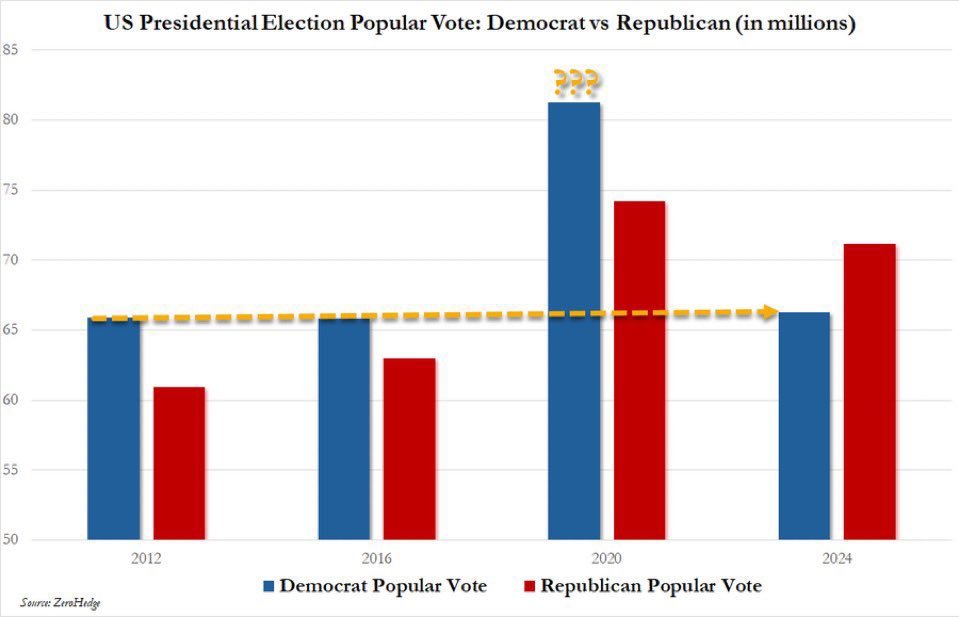
TLDR: some 15m votes remain to be counted. Turnout in 2024 is likely somewhat lower than 2020, hence similar total # voters despite some population growth. And there was some shift from Biden in 2020 to Trump in 2024.
7 Nov 2024

Where are the "missing" votes?
They're coming, and I'll show you.
Perhaps you've seen this chart circulating. Let me show you why it's wrong, and demonstrate to you that this year's totals will slightly exceed 2020's. 1/
1
268
Dror Baron retweeted

18 Jul 2024
👀
17 Jul 2024

Professors in 2024 deciding which memes from 2004 to include in their slides

1
3
60
4,687
13 Apr 2024
Beautiful timeless comments by von Neumann. Steve, thanks for sharing!
12 Apr 2024

There is an excellent quote by von Neumann that I've used to proselytize to people who think that quantum computers will "only" offer quantitative speedups over conventional computers: 1/4
2
365
20 Feb 2024
QMV has downsides, of course. For example, if some qubits are very noisy and measured close to 50-50, then S will need to be (very) large in order for QMV's majority vote to be reliable. 10/11
1
103
20 Feb 2024
An important direction in our ongoing work is to expand from a single correct quantum bitstring output to multiple possible outputs. While our paper considers a simple case along these lines, much remains to be done. 11/11 @ncstateece
80
20 Feb 2024
My first paper in quantum computing came out: arxiv.org/abs/2402.11830
My colleagues and I looked into quantum error mitigation. A quantum computing algorithm is run numerous times on noisy quantum hardware, and our goal is to estimate the output from multiple measurements. 1/11
2
1
9
394
20 Feb 2024
Qubit-wise majority vote (QMV) is a trivial algorithm, the correct bitstring need not *ever* appear among the S shots, and QMV only requires S to grow logarithmically in n, not exponentially. 9/11
1
71
20 Feb 2024
We've shown that for symmetric quantum noise (the probability of a 0 being measured as 1 or vice versa are the same), a simple qubit-wise majority vote (QMV) can determine the correct bitstring. 8/11
1
63
20 Feb 2024
Unfortunately, the correct output may not happen the most times. Instead, the M3 algorithm arxiv.org/pdf/2108.12518.pdf only needs the correct outuput to be measured once. Nonetheless, M3 requires S to be exponential in n. 7/11
1
47
20 Feb 2024
For many types of quantum noise, we expect the correct bitstring to appear the most times among the S that were measured. This probabilistic observation motivates the mode algorithm, which outputs the bitstring that happened the most times. 6/11
1
51
20 Feb 2024
We run the quantum machine multiple times, each run is called a shot, and we have S shots. We're collecting S versions of a length-n bitstring, and we know that these S strings are all noisy versions of one correct length-n bitstring. How can we identify the true output? 5/11
1
43
20 Feb 2024
The assumption that there's a single correct output may seem stringent to some quantum researchers. Nonethtless, some quantum algorithms such as Bernstein-Vazirani and Grover search may indeed have a single correct output. 4/11
1
41