
Joined May 2023
- Tweets 15,771
- Following 391
- Followers 383
- Likes 10,939
659 Photos and videos











Pinned Tweet

24 Jul 2025
Dear Christian friends,
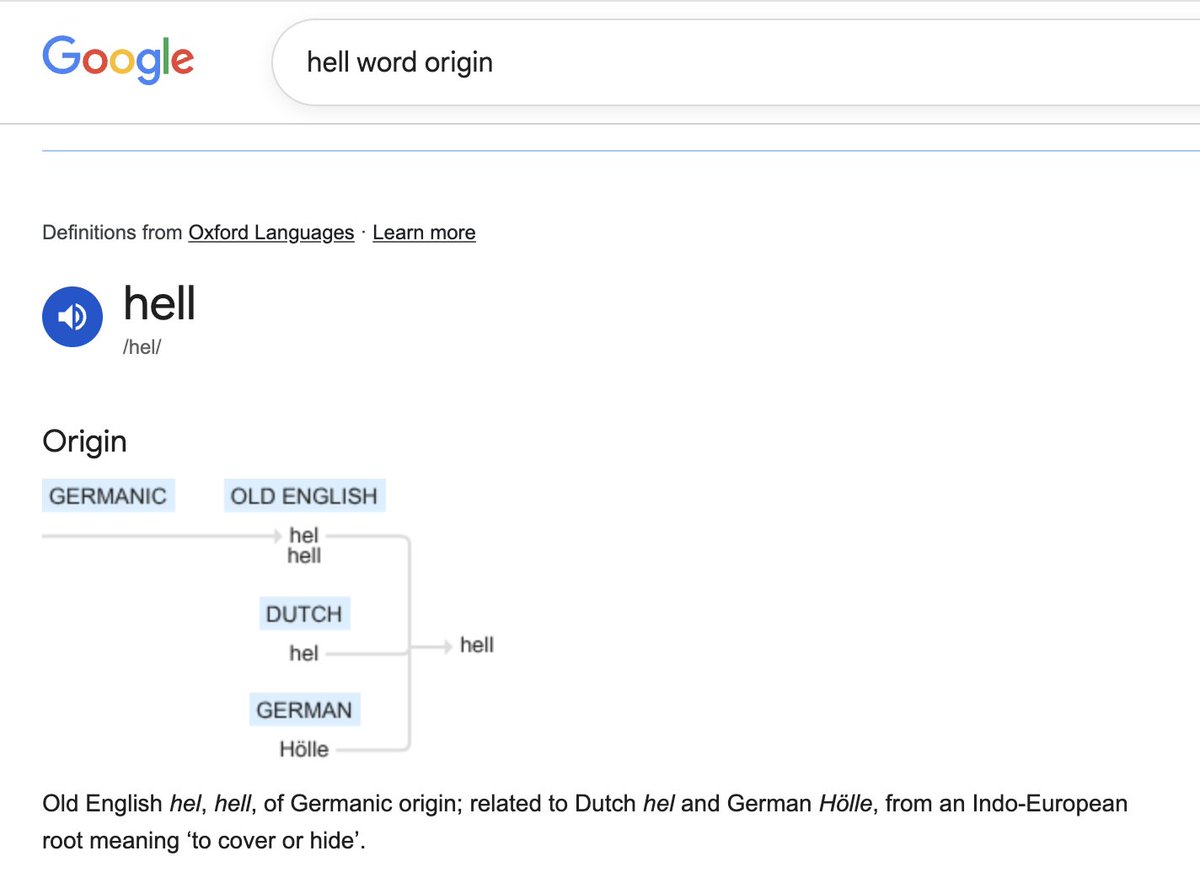
Do a word study on ‘hell’ and try to determine why Sheol / hades / Gehenna / Lake of fire have all become synonyms for “hell”
🔥🌱
5
1
33
2,707
KevinIsPlantingSeeds 🌱 retweeted

And you will never get one.
Atheism can object to this or that argument for God, but it still has to explain why anything exists at all, why reality is intelligible, why reason is trustworthy, why moral obligation is real, and why consciousness exists. It doesn’t explain those things. It borrows them, then pretends God is unnecessary. Atheism isn’t a hardheaded view of reality. It’s the oldest lie dressed up as sophistication.
8
1
5
273
KevinIsPlantingSeeds 🌱 retweeted

Jun 11
A mystery is just something we don’t correctly understand and we posit mysteries to explain things all the time. That’s what dark matter and dark energy are. Countless scientific theories had to posit a mystery because current understanding was inadequate to explain the phenomenon.
So the question isn’t “how mysterious is God,” the question is, can naturalism explain the phenomenon we see in the world? And the answer to that question is: absolutely not.
11
4
85
1,502
KevinIsPlantingSeeds 🌱 retweeted
When we say "the atheist worldview" we know that atheists widely disagree on pretty much every question... except one. That one question will necessarily lead to only ONE string of entailments, not multiple. In other words, atheists are constructing their worldview without God, and without God either morality will be objective, or it will be subjective. Either determinism will be true, or libertarian free will. Either materialism or not materialism will be true, etc.
The string of correct answers to what atheism entails is what's relevant, not that atheists disagree. This string of correct answers is THE atheist worldview.
47
5
56
3,826

KevinIsPlantingSeeds 🌱 retweeted

May 28
If people did an honest deep dive into learning about the human body eg. Organs, muscles, ligaments, cells, DNA.....
They would abandon the idea of evolution completely and at least start asking questions like is there actually a God/Devine creator!
111
11
160
9,788
Testing.
This world is temporary to figure out a bunch of crap.
Testing.
25
KevinIsPlantingSeeds 🌱 retweeted
May 23
Any time atheists use the word “natural” it’s time to start pressing. They can’t justify it, they just assert it and it’s total question begging. There’s absolutely no way to know or demonstrate that whether or not something is caused naturally.
May 23

Cell regeneration is a natural biological process
70
7
138
7,610
I wonder if atheists would be atheists if they realized God is going to save everyone 🤔
1
39
The question of “if god exist why bad thing happen” doesn’t make sense.
This world exists so we can learn and experience joy, peace, and suffering. We are here to gain the knowledge of good and evil.
1
47
KevinIsPlantingSeeds 🌱 retweeted
Consider a Creator who created humans.
In addition to creating the humans, He also creates obstacles for them.
Why? Why is he putting all these obstacles, some of them even causing great suffering and pain? Why is there even pain in the first place? Is the Creator evil? A child may think like this.
But let’s consider the case more closely. Perhaps there is a purpose. By creating obstacles for us to overcome - we become stronger and LEARN virtues like patience; we are learning how to help and take care of each other. We are also gaining appreciation and understanding for the sacredness of life.
Now also consider this world is very temporary. While it may seem to be a very permanent world to us - what with all the cancer, disease, abuse, war and other sufferings; ultimately dying after a short or long life - when we leave this place none of those sufferings will matter. What will matter is the experience and understanding we have gained.
3
1
1
66
KevinIsPlantingSeeds 🌱 retweeted

May 14
"Evolution is not 'by chance', dumbass."
This is the standard dodge. You hear it every time someone is cornered on the actual mechanism.
Yes, natural selection is not random. It is a filter. It removes the unfit. Nobody serious disputes that.
The problem is not whether selection is random. The problem is that selection cannot create the information it is supposed to be selecting for.
You keep saying "variation comes from mutations and sexual reproduction — RANDOM — then filter it with natural selection — NOT RANDOM."
Fine. Let's follow that logic all the way to the end.
Mutations are overwhelmingly deleterious or neutral. The beneficial ones that actually do something useful are extremely rare. Even when they occur, most of them are small tweaks to existing functions, not the creation of new coordinated systems.
The real question is: where does the new functional information come from in the first place?
Selection cannot write code. It can only sort existing code. If the code was never there, selection has nothing to work with. This is why every attempt to simulate macroevolution in real genetic systems fails when you use actual mutation rates and actual population sizes instead of cartoon versions.
We now have the data. Humans accumulate 60–150 new mutations per generation. The vast majority are slightly harmful. Genetic load is increasing across populations. Fertility is collapsing in the developed world. This is measurable genetic entropy, not "progress."
Haldane’s dilemma still applies: the cost of substituting even one beneficial mutation through a population is enormous. When you scale that up to the thousands of coordinated changes required for anything resembling macroevolution, the time required exceeds the age of the universe.
You cannot hand-wave this away by saying "selection is not random." That is exactly the point. Selection is a destroyer and a filter on net once you account for the real mutation spectrum. It does not generate novelty at the scale required.
The only thing that has ever been observed to produce new specified complexity is intelligence. Every single time. In every domain we can actually test.
So when you smugly say "Evolution is not by chance, dumbass," you are admitting the first part of the problem while pretending the second part solves it. It does not. Selection explains why some things survive. It does not explain how the functional information got there to begin with.
The data is not on your side. The math is not on your side. The empirical record is not on your side.
You are left with an unfalsifiable just-so story that requires blind processes to do what intelligence alone has ever been observed to do.
Call it whatever you want. The mechanism is still missing.
6
1
1
1,221
Twitter is a wild place.
May 14

I'd like to propose an experiment you can easily do at home.
I want you to record yourself performing the experiment and then posting the video.
35
KevinIsPlantingSeeds 🌱 retweeted

May 13
consciousness is not emergent, it's foundational
97
40
298
12,239
Evolution proponents look at adaptation and say “see we can observe evolution duh!!!”
Adaptation is not evolution. Take for example the case of black and white winged moths. The moth population adapted based on what camouflage increased survival in its environment. The moth already has the genetic coding for black or white coloring; the variation could appear due to dominant or recessive genes being matched.
We can breed dogs to “create” all sorts of variants. This is akin to natural selection, but is really a forced selection. Humans are selecting the dog traits by breeding certain dogs with those specific traits. But this will always result in another dog.
Get back to me when you bred a dog into something that is not a dog…
🐕
40
For all those asking why do certain “gratuitous” sufferings happen if God is good; surely “god not real bro because bad thing happen”… read my quoted post.
Does God not exist because you stubbed your toe?

You spent most of yesterday asking this question; but your premise is a fallacy - a false dilemma or catch 22.
Your claim is there is some suffering/evil that is too great (ie child cancer). Granted child cancer and many other things in this world are awful.
But let’s examine the idea. Suppose God made a world without child cancer. Now what… is there simply something else that you would call too “gratuitous” of suffering? Perhaps other terrible things, child birth defects, parents dying of cancer, heart disease etc.
Ok then suppose God made the world without those - what about children dying because they wandered off into traffic or into the woods? People dying because they walked off a cliff or drowned in the undertow? Surely that is now too “gratuitous”?
So now God should make a world not only without natural disasters and wild animals; He should also make it so we can’t physically die from falling off a cliff, otherwise it is too gratuitous!!
Do you see the problem here? If you follow this to its natural conclusion, we end up with a world where stubbing your toe is gratuitous violence, and even that should be disqualified.
So now we are all in a safe world where nothing can happen, yet boredom seems like suffering to us. Why can’t we breathe underwater and fly into space and walk through walls? Surely to not have these abilities is to suffer, no?
This is the problem with your argument. Ultimately no amount of suffering is tolerable. In fact what you are asking is “why didn’t God make ME god?”
It ignores some fundamental ideas of the purpose of suffering and coming to understand good and evil.
This is the answer to your question.
1
75
That’s a wrap

The moment we found DNA contained information, that was a wrap for atheism.
155
Another atheist blocks me who can’t engage in a simple discussion? Very bizarre
You realize the earth has abundant resources to feed everyone multiple times over, right?
Yet it is humans who are greedy who want to limit and control those resources…
125
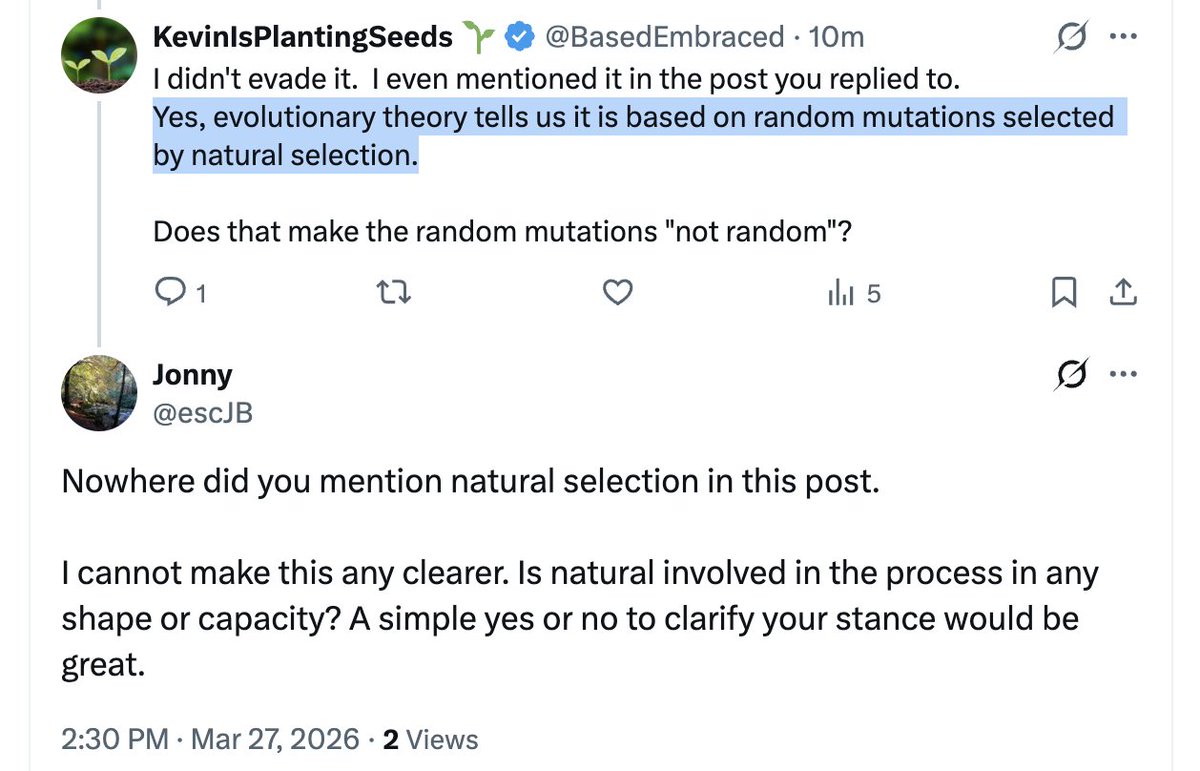
Evolution is random. To claim otherwise is obfuscation and gaslighting
I’ll summarize.
If you select a thing that is randomly created, the thing is still randomly created.
So when natural selection selects incremental improvements that came about randomly, the incremental improvements were still random
So evolution is telling us that all life on earth came about by random improvements.
92