
Media query hub connecting journalists, experts, and PR pros
Joined February 2025
- Tweets 1,863
- Following 338
- Followers 138
- Likes 377
34 Photos and videos

👩🦰 Journalists are looking for women’s voices & expert opinions in Women’s Stories & Health:
🙏 Religious women under 27 (Harper’s Bazaar, UK) – deadline 1d
betatale.com/queries/68cabf0…
👩👧 Childcare costs & menopause at work (AllBright, UK) – 5d
betatale.com/queries/68c88c8…
🏃♀️ Quitting sport over body image (The Times, UK) – 12h
betatale.com/queries/68c2abe…
👙 Maternity bras for testing (Women’s Health, UK) – 2d
betatale.com/queries/68c2abe…
🩺 Surgeons on labiaplasty (Daily Mail, UK) – 7d
betatale.com/queries/68ca78c…
✨ More calls on women’s health & lifestyle at @Betatale [betatale.com/]. Sign up to reply directly.
2
866
💼 Want to get quoted in business media? Here are 5 open journo requests in Finance & Careers:
🎓 Student finances (BBC, UK) – deadline 7d
betatale.com/queries/68cc2cd…
🚗 Car schemes as employee perks (SET’s InTuition, UK) – 8d
betatale.com/queries/68cc2cd…
🎓 Grads struggling to find jobs (City AM, UK) – 5d
betatale.com/queries/68cacd3…
💰 Pension vs. pay rise (The Telegraph, UK) – 10d
betatale.com/queries/68cbca4…
📊 SME accountants on Small Biz Plan (Financial Accountant, UK) – 3d
betatale.com/queries/68c443b…
👉 Hundreds more live requests on @Betatale [ betatale.com/ ]. Register and pitch journalists directly.
1
589
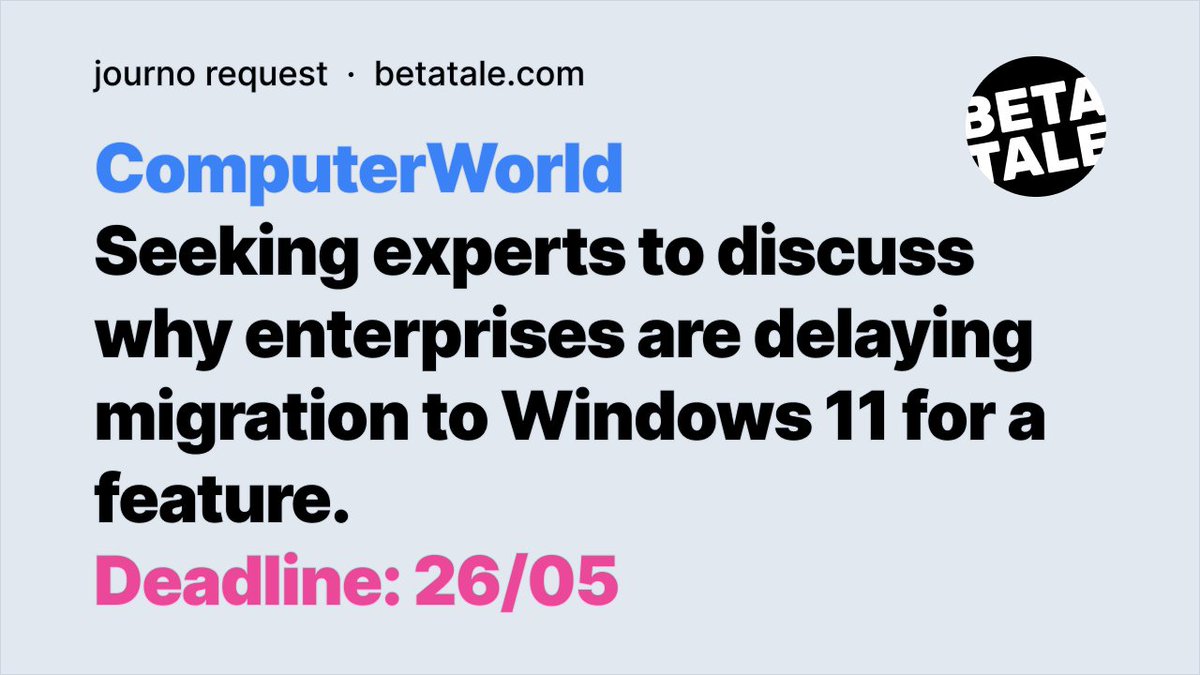
If your company fits the bill please head to the link below to share your experience with the journalist!
betatale.com/queries/6851319…
@windows10builds @Windows @windowsdev @LinusTech @Microsoft
1
1
2
613
Betatale retweeted

3 Jun 2025
Hello, fellow immigrants! For something I'm writing, I'm seeking out tips from people who moved to London from other countries on how they decided where to live in this fine city. If anyone fits the bill and has thoughts to share, please get in touch. #journorequest
6
4
8
2,675
Betatale retweeted

5 Jun 2025
I'm looking to hear people's thoughts on BookTok, excessive TBRs, book hauls and special editions for an article on whether BookTok is promoting overconsumption. 📚 #journorequest #books #booktok #booktwt
2
4
900
Betatale retweeted

5 Jun 2025
Nutritionists! I'm looking for independent health professionals and BANT registered nutritionists to comment on a piece for Women's Health about healthy summer eating habits - please email louella.berryman@hearst.co.uk #journorequest #prrequest
4
2
14
1,279
Betatale retweeted

5 Jun 2025
I'm looking to speak to a man who has tried Botox or facial fillers or dental veneers for an article I am writing.
If that is you or anyone you know, please get in touch!
Thanks.
#journorequest #journorequest
1
1
11
1,321
Betatale retweeted

5 Jun 2025
Seeking *accredited* expert on theme of child psychology - specifically the importance of embracing boredom….
#journorequest
3
2
5
1,555
Betatale retweeted

23 May 2025
Why Human Stories Matter in the Age of AI Pitches?
Today on @BetaTale, an expert posted a pitch that our system flagged as “highly likely to be AI-generated.” That immediately sparked an interesting discussion: what should we do with such pitches?
Strategically, I believe that the value of our platform — and of expert platforms in general — lies in offering the opinions of real human beings.
Yes, in many ways humans lose to machines. AI is faster, better structured, more analytical, with broader access to data — it can essentially represent all the documented expertise in the world.
Humans are subjective, inconsistent, know less, make mistakes, and filter their output through their cognitive biases.
And that’s exactly what makes them valuable.
I once read a column by Wired editor @StevenLevy. He described attending a 2024 writers’ conference, where people were worried about “the prospect of a marketplace flooded by books authored by prompting neural nets.”
Then, Levy says, he had a revelation.
“I put it to the audience something like this: Let’s say you read a novel that you really loved, something that inspired you. And only after you were done were you told that the author had not been a human being, but an artificial intelligence system … a robot. How many of you would feel cheated?Almost every hand went up.”
Why?
“The reason for that feeling,” he continued, “is that when we read — when we take in any piece of art, actually, in any medium — we’re looking for something more than great content. We are seeking a human connection. ...
This remains true even if the author is long dead. If someone still reads Chaucer (has he been cancelled yet?), somehow, across centuries, we can still vibe with the mind of a guy from the 14th century — someone who’d probably be great to chat with over a beer or a goblet of mead."
I agree with Levy. I’d call it “the story.”
For me, the value of many things in this world is created through the story of the person behind them.
Sure, AI could paint a technically better picture than most existing or past artists. But what does “better” even mean?
When I visit the Tate Britain and see a painting that looks average to me, I read the little card beside it — then maybe look up more on Wikipedia. Suddenly, a vast world of history and context unfolds: the artist, their world, their circumstances.
Honestly, I feel like I’ve learned more about history by exploring the context of artworks and their creators than I ever did in school.
How could AI replace that? A bodiless demon with no fate or backstory, unconnected to the world?
To put it simply: the most important thing about a work created by a living person isn’t originality, creativity, or even a unique opinion (AI is getting scarily good at mimicking those). It’s the fact that it’s an expression of a real human being.
I believe we’ll eventually see creative works come with a kind of “human-made certificate” — and those works will be worth a lot.
There’s little value in auto-generating “expert blurbs” for every topic. What has always been most valuable is what’s rare, hard to find, fragile, imperfect. That’s what makes it unique. What’s easy to generate in abundance? That tends to be cheap — or worthless.
Take AI-generated music. It’s been around for years. It’s often just as good — maybe even better — than what human artists can do. And it can be created in endless amounts per second, tailored to any purpose. But this hasn’t destroyed musicians. If anything, it’s made human performers more precious. Why do we follow our favorite artists on Instagram, read news about them, build a personal relationship with them over time?
Because what we care about — first and foremost — is the person.
That’s why many artists and musicians remain popular even as they age. They may no longer be as sexy, energetic, or fashionable. But we value their story. And we’d rather see an aging icon than a no-name beauty — because the icon has a story. And that story is partly ours, too.
That’s what Steven Levy called “the connection.”
In the future, we’ll be surrounded not only by virtual AI, but also by billions of physical robots from Tesla, Amazon, Google. There will be endless AI-generated text, music, films, AI actors, and more.
Against that backdrop, human actions — a text, a poem, a song, or a personal opinion — will become even more precious.
Like the value of a natural diamond in a world where synthetic ones can be mass-produced so cheaply they’re used in construction tools.
So, here’s what we decided to do.
1) We’re introducing an AI checker for users. It will assess how likely a given expert pitch is to be human-written versus AI-generated.
These tools are imperfect, I know — so I’d love your suggestions on how to improve it.
2) We’ll scan all pitches and show journalists a notice indicating how likely the pitch was generated by AI. The journalist can then decide what to do with that information.
3) We’ll also update our terms of service with a policy on AI use. We value AI as a helpful tool — for brainstorming, research, etc. But journalists need to hear the real voice of an expert. If you know of other platforms with similar rules, we’d love to learn from them.
4) Journalists will also be able to rate experts and leave public feedback. Experts should know that a bad review could damage their reputation on the platform — to the point that other journalists might avoid their pitches entirely.
What do you think?
#AI #PR #Journalism #Wired #StevenLevy #Betatale #HumanConnection #MadeByHuman #MediaEthics #FutureOfWork #ExpertVoices #AuthenticityMatters
2
2
172
Betatale retweeted
22 May 2025
A new batch of media requests from @BetaTale on IT and HR topics — great opportunities for those looking to get featured in the press. 📰✨
Deadline: Monday, May 26, 6:00 PM
💡 Challenges in AI and analytics upskilling
betatale.com/queries/682b742…
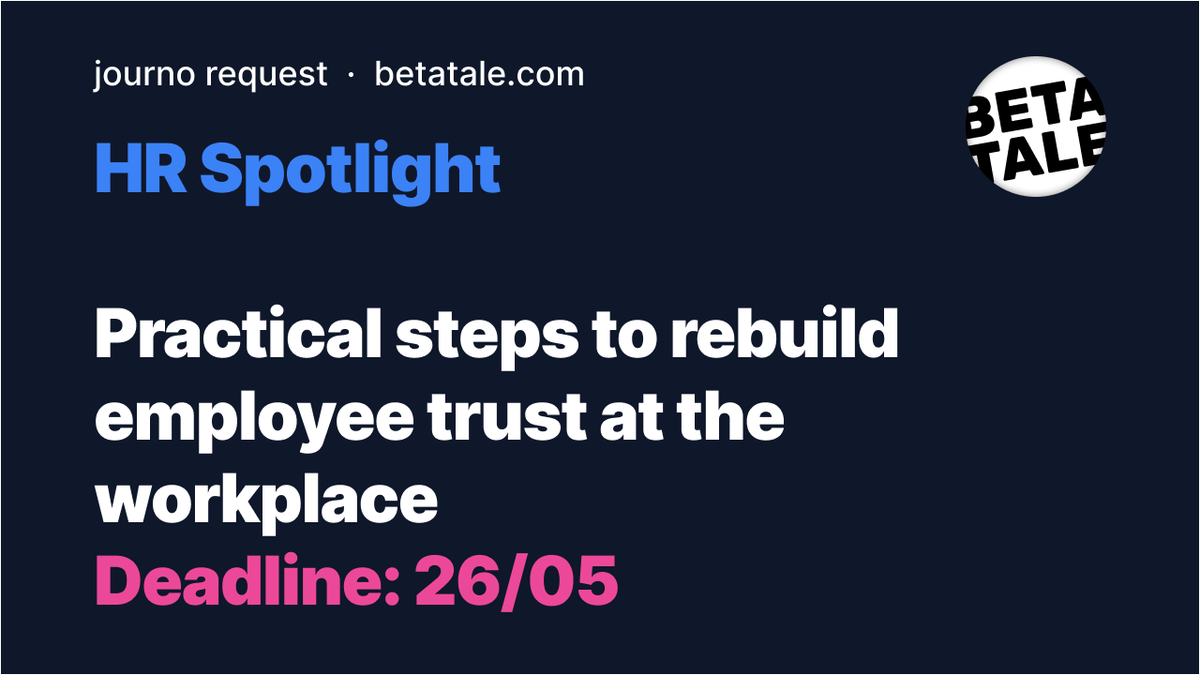
🤝 Practical steps to rebuild employee trust at the workplace
betatale.com/queries/682b740…
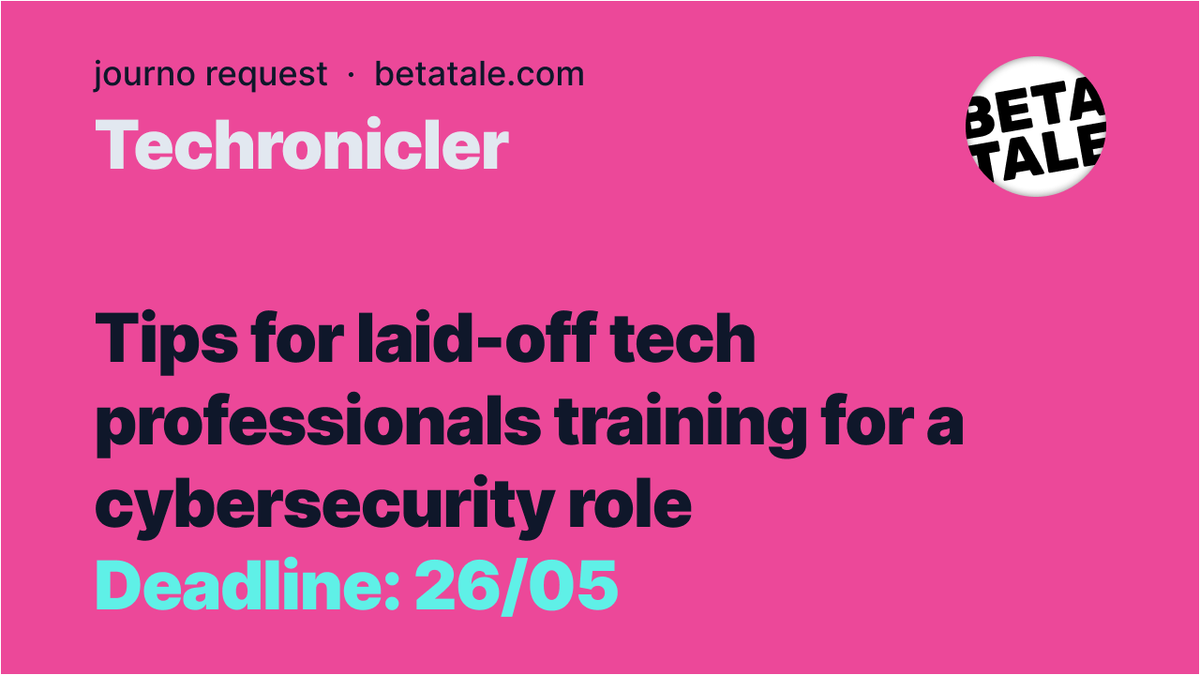
🛡️ Tips for laid-off tech professionals training for a cybersecurity role
betatale.com/queries/682b73c…
🚀 A solution to improve XR scalability in your industry
betatale.com/queries/682b739…
For those unfamiliar: I'm the founder of @BetaTale — a platform where journalists post requests like these for upcoming stories. It helps them save time and find solid input when sourcing the usual way is tough.
Experts track relevant queries and respond to the ones they can contribute to — resulting in free media mentions. 🧠📝
New queries come in regularly, each with its own deadline (ranging from a few days to a couple of weeks). It’s worth checking in from time to time and browsing the latest ones. 👀
Topics vary widely — from consumer trends to niche professional issues. 🌐
Wishing you all lots of press coverage! 🎉📢
#MediaRequests #PRopportunities #FreePressCoverage #ExpertQuotes #Betatale #JournalistRequests #ITmedia #HRinsights #CybersecurityCareers #AIUpskilling #XRtechnology #EmployeeTrust #StartupMarketing #ThoughtLeadership #GetFeatured


1
2
2
111
The first 100 users, the first 10 pitches, the first media publication — and a lot of behind-the-scenes work on the product. It’s all in our April Product Progress, straight from the lab.
medium.com/betatale/april-at…
#StartupJourney #BuildingInPublic #StartupLife #First100Users #SaaS
#BehindTheScenes #PRTech
1
2
2
114
🚀 A glimpse into the future of marketing — powered by media coverage, not ad budgets.
Here’s how @BetaTale works in real life — and why we believe it’s the next big thing.
#Betatale #pr #startup #MarketingTools #StartupMarketing #MediaCoverage #GrowthHacking
#EarnedMedia #NoAdBudget #PRTech #FutureOfMarketing #MediaOutreach #StorytellingMarketing
7 May 2025

🔥 Yesterday I shared the first-ever publication powered by @BetaTale .
If you missed it, this is exactly how it works:
a journalist posts a request → an expert replies → the author picks it up → and voilà — a publication is born.
It’s just the beginning, but I’m already dreaming of something bigger.
That one day, Betatale helps you discover a brilliant, underrated marketing tool — ✨ promotion through media coverage ✨
We don’t even have a proper name for it yet (suggestions welcome — drop your ideas in the comments!). But I’d love to describe how this works and why I believe it’s the future.
Why is media coverage such a powerful way to promote your business?
🟢 It’s free
🟢 It doesn’t disappear when the money runs out
🟢 It drives awareness and sales.
🟢 Publications work across the entire funnel — from brand visibility at the top to engagement and conversion at the bottom.
🟢 It boosts your SEO
🟢 It improves the performance of your other marketing tools. The better you're known, the cheaper your clicks.
🟢 And most importantly: it builds trust. Storytelling and native content are incredibly persuasive.
But wait — haven’t we known this for ages?
That’s why PR exists. That’s why every founder dreams of getting into the media.
So what makes Betatale different from traditional PR?
Everything.
✅ It’s free
✅ No gatekeepers
✅ No special knowledge required
✅ No waiting for someone to “get you in”
You just open the platform and start.
The best comparison? SMM. A marketing tool you can handle yourself — easily, and for free.
Made a Canva design?
Posted a new reel?
Replied to a journalist on Betatale?
That’s what the future might look like.
And every new type of marketing needs the right tool — one that’s reliable, scalable, and ideally, free.
We believe Betatale is that tool.
We believe Betatale’s mission is to turn promotion through media coverage into a standard — alongside paid ads, PPC, content marketing, and SMM.
So again — what should we call it?
Direct media marketing?
Media outreach marketing?
Exposure marketing?
We’re still deciding — help us out in the comments!
1
2
116
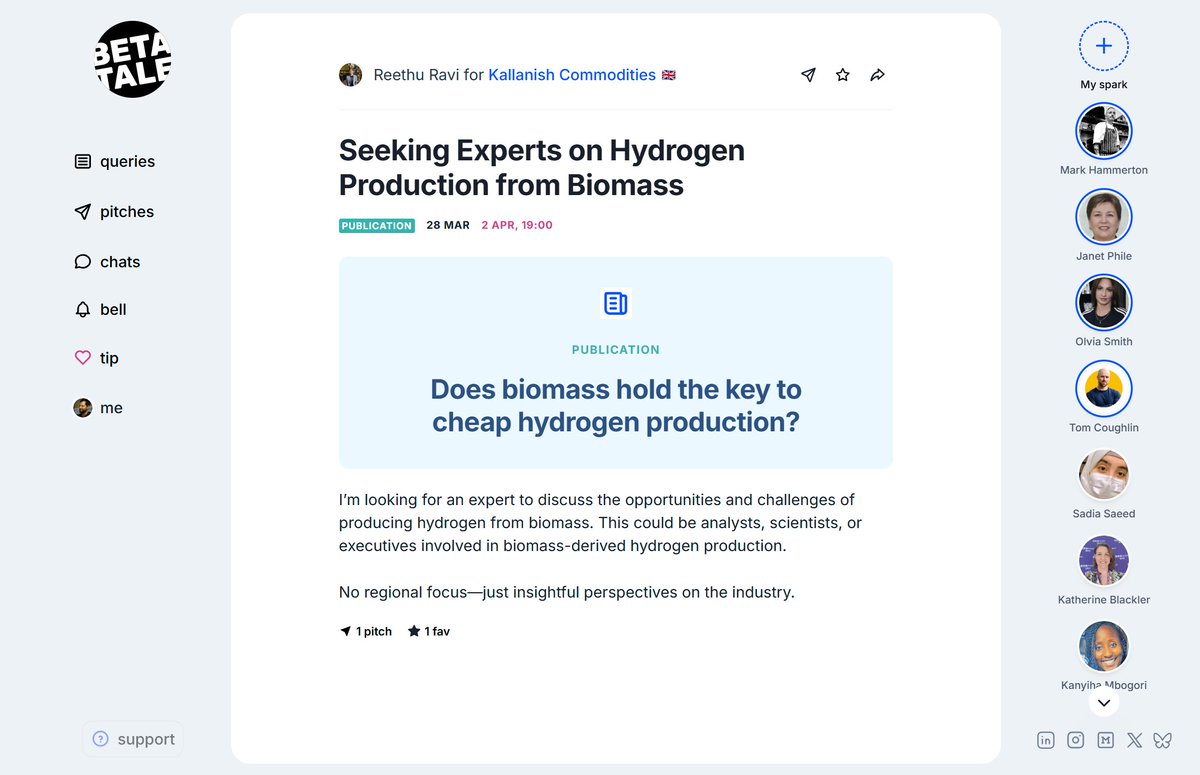
Big milestone for @BetaTale 🧩
Our very first publication created through the platform is now live in @kallanish — an industry media outlet covering steel and power materials.
The topic: Hydrogen Production from Biomass ⚗️🌱
Here’s how it happened 👇
Betatale is a platform where journalists post requests for expert insights, and professionals respond.
📩 Journalist publishes a query
💬 Expert replies
📝 Journalist includes it in the article
📢 A media publication is born
That’s exactly what happened with @reethuravi , who wrote this smart, insightful, and well-researched piece.
It’s detailed, technically rich, and really well-written. Hats off to you, Reethu! 🙌
A big shoutout as well to @ChrisHeadrick, Founder and Chairman of Victory Clean Energy.
His pitch was sharp, compelling, and made it into the final article. 💥
This is exactly how small, innovative companies can share their ideas, products, and vision — through earned media, without spending a penny.
That’s what we believe Betatale was built for. 💡
At Betatale, we believe that *promotion through media coverage* will soon become a standard part of every startup’s marketing toolkit.
And here’s the kicker — both stages are free:
🚫 No cost to use Betatale
🚫 No cost for editorial coverage
We're so grateful to Reethu and Christopher for making this happen.
We’d love to hear your thoughts on the experience of using Betatale — feel free to share! 💬
(And yes, more stories coming soon 🔜)
#EarnedMedia #StartupMarketing #SustainableTech #GreenEnergy #HydrogenEconomy #ClimateTech #CleanTech #MediaCoverage #PRTech #ContentMarketing #MarketingForStartups #JournalismTools #ExpertInsights #BiomassEnergy #TechForGood #BuiltWithBetatale #BetataleStories #PoweredByBetatale
2
1
2
122
🚨URGENT! If you can contribute please head to BetaTale to pitch the journalist. DEADLINE TOMORROW!
betatale.com/queries/68123bd…
#NailArtist #Nails #NailSalon #Manicurist #NailTech
@Alicia_torello @BritneyTOKYO
1
2
3
647
🚨Head to the link below to pitch the journalist before the deadline ends!
betatale.com/queries/6812082…
#WoodFlooring #Flooring #FloorInstallation #HomeExpert
@Woodfloors4u @jgflooringltd @luxflooringmcr @salisbury_wood @jfjwoodflooring
1
2
2
46
🚨Deadline approaching FAST! Head to BetaTale to pitch the journalists before its too late.
betatale.com/queries/6810c42…
@se7enbitesChefT @4RSmokehouse @alonsbakery @SweetHutBakery @k_donatellicake @AmeliesBakery
1
37
🚨Deadline approaching fast! Head to BetaTale to pitch the journalist.
betatale.com/queries/6810b5b…
@BarKumiko @TrickDogBar @mrlyan @CafeTrova @ravpig @IcePlantBar @ThompsonsFTW @brixandrye
2
2
2
35
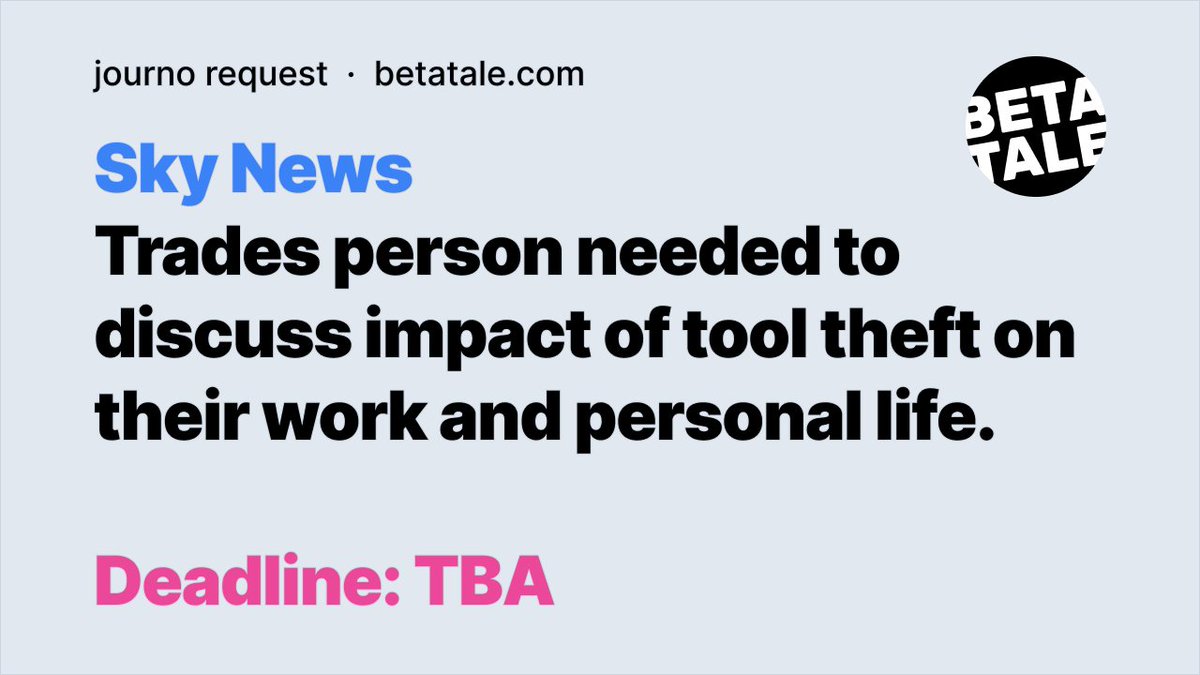
🚨Head to the link below to share your story with Sky News!
betatale.com/queries/6810942…
#Carpentry #Electrician #Plumber #Welder #Roofer #HVACR #MillWright #Mechanic #BrickLayer #Tradesman
2
2
3
517
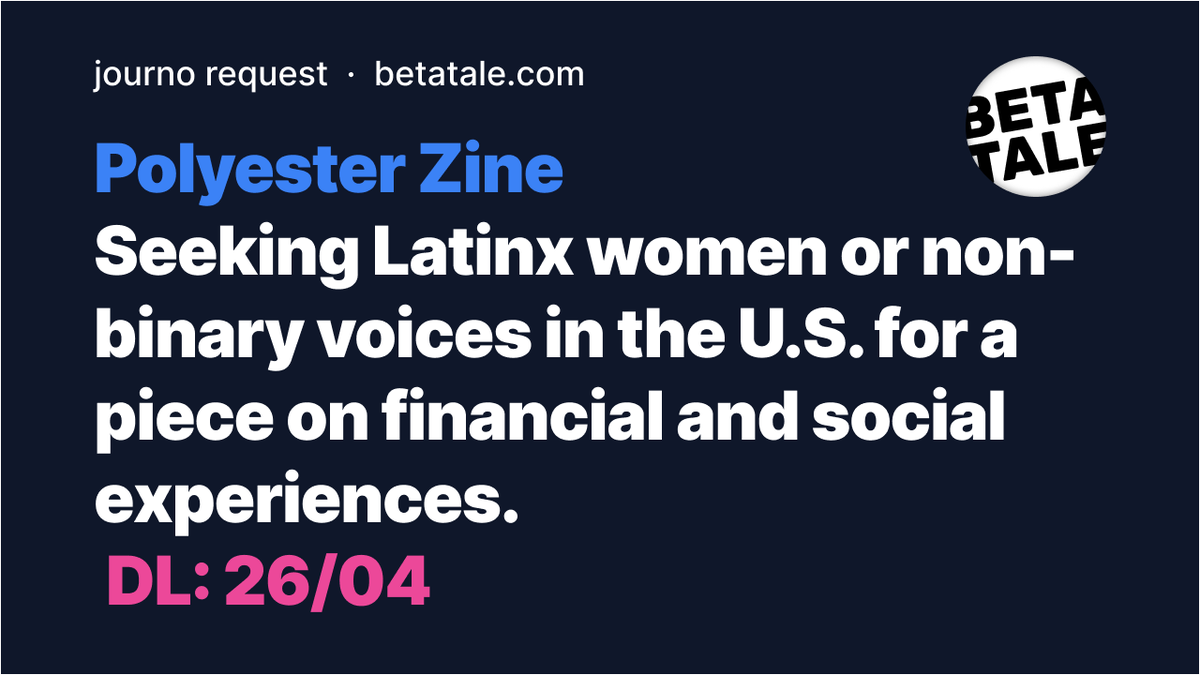
🚨URGENT: Voices needed! Please head to the link below to share your voice with the journalist!
betatale.com/queries/6808f7e…
#LatinX #NonBinary #Tarrif #ReproductiveRights #Xenophobia #LATAM #Miami #LittleHavana #Kissimmee #Asheville
3
2
3
87
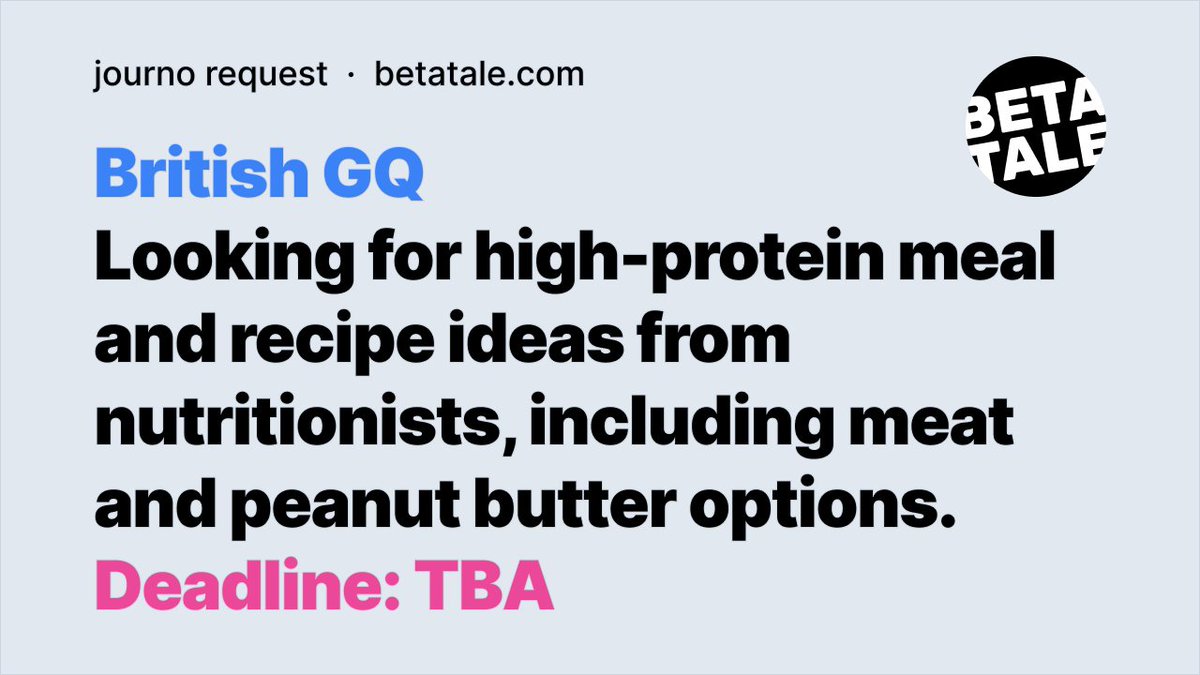
🚨 If you can speak on this subject please head to the link below to pitch the query before the deadline ends!
betatale.com/queries/6808e75…
#Nutrition #Nutritionist #Health #Healthy #Protein #HighProtein
1
25