
Remote-native Agile Product-lead; @flux_garden for digital garden hosting; SimplestThing; NetworkEnlightenment, Progress. At @billseitz@toolsforthought.social
Joined March 2007
- Tweets 82,992
- Following 4,094
- Followers 2,051
- Likes 115,983
2,494 Photos and videos
















Pinned Tweet

29 Sep 2020
Thread of Product Management tweets, perhaps biased toward early-stage...
4
4
19

we are speedrunning creating the Zones of Thought from the Vinge universe. you will only be able to think superhuman thoughts in America
Jun 13

NEWS: The Trump administration is blocking foreign governments, companies and individuals from accessing Anthropic's most advanced AI models
W/@m_ccuri
axios.com/2026/06/12/anthrop…
84
85
1,799
246,980
Bill Seitz of FluxGarden retweeted

Proper should write whatever the hell they want…and people should read whatever the hell they want. And that’s sort of how things get decided. Right…?
1
2
82
Bill Seitz of FluxGarden retweeted

Jun 12
The night you find out your spouse cheated, you don't learn one fact. You re-evaluate ten years of them. Every late meeting. Every weekend trip.
The memories don't change — what they mean does.
Your brain does this automatically. Your AI's memory can't do it at all. ↓
16
4
30
634
Bill Seitz of FluxGarden retweeted

its been painfully obvious to me that the memory retrieval, revisions and integrations are the bane of my working with ai - even in zenith mind elite .... i change an idea, and it should go all the way downstream; and if it a core meaning transformation it should start upstream
1
1
76
Bill Seitz of FluxGarden retweeted
Jun 12
See the loop close in 12 seconds: clone it, run demo.sh. A fact changes. Ripple propagates. A contradiction surfaces. You resolve it in markdown.
Code: github.com/RichSchefren/atla…
90-second demo: livememory.pages.dev
1
1
5
265
Bill Seitz of FluxGarden retweeted
Jun 12
Not vibes — verified. Atlas passes all 49 AGM belief-revision scenarios at 100%: K*2–K*6 plus Hansson Relevance and Core-Retainment, incl. 15 adversarial ones with cycles and concurrent revision races.
Reproducible in one command. 518 tests green, Python 3.10–3.14.
1
1
2
176

Bill Seitz of FluxGarden retweeted

Currently getting a gel removal, typing with one hand — and chuckling
The 4 hr routine is likely possible by a life audit and a deep reduction towards the essentials via someone who lives in LA and has all the context; he primarily trains celebrities. His outcome is routine health, aesthetics, and loving gratitude
1
1
3
1,660
Bill Seitz of FluxGarden retweeted

there should be a female tim ferriss to invent four hour hotness maintenance
ladies, if you had 4 hours per week to dedicate to maintaining hotness, what exactly would you prioritize?
Jun 13

I don't think most men understand that hot women literally don't have time to have many hobbies because maintaining hotness is extremely time consuming. there are so many autistic females whose special interest is being hot.
29
7
491
99,678
Bill Seitz of FluxGarden retweeted

People keep saying we’re in Idiocracy but President Dwayne Elizondo Mountain Dew Herbert Camacho at his core wanted what was best for his people and when evidence presented itself he listened to experts to solve the problem. By all accounts a better leader than this.

59
1,822
12,796
283,216
Bill Seitz of FluxGarden retweeted

Jun 13
Uhhh so incidentally, does anyone have a plan to prevent all the non-US citizen AI scientists from going to join foreign labs after they get bored of playing Wordle at work for a month, or are we just sort of planning on having the greatest counterproliferation failure since we deported Qian Xuesen in 1955 and gave Mao a rocket program?
Jun 13

Some quick takes:
(1) Wow things are getting real.
(2) The government's order focusing on prohibiting transfer to foreign nationals (even e.g. those living in the US, our close allies who help evaluate model safety in the UK, individuals who work at frontier labs like Anthropic) seems remarkably destructive, though is partially a result of the government using older legal authorities that were not designed for this kind of technology.
(3) If you believe (as I do) that AI has profound ramifications for national security, then assuming the government will sit back and do nothing and tolerate explanations like "well jailbreaking is a hard technical problem" for cyber capabilities that used to be the crown jewels of the NSA, is not tenable. If this is how the government reacts to the current level of system capabilities in 2026, how do you expect them to react to whatever is possible in 2028? However, it is extremely important that the authorities that the government uses are legible, transparent, have opportunities for appeal, and are narrowly targeted. Those legal authorities do not currently exist, and in their absence, the government will reach for metaphorical sledgehammers instead of scalpels.
(4) For that reason, it's extremely important that we create regulatory structures that are transparent and give recourse in the event that the government is overstepping or acting in an arbitrary manner. The alternative to passing such laws is not no regulation, it is regulation left primarily to national security authorities that are increasingly and evidently not fit for purpose.
11
60
591
48,450

Unless this changes, OpenAI researchers on visas need to plan for the fact they’ll probably lose access to internal models, and therefore their ability to do their jobs moving forward, sometime in the next couple months.
I hope the company acts to prevent that.
12
32
510
78,898
Bill Seitz of FluxGarden retweeted

Jun 10
He's in the zone 🧘

11
21
291
20,461
Bill Seitz of FluxGarden retweeted

Jun 13
Your calendar was full at 21 and empty at 26 for a reason MIT discovered in 1950.
Researchers studied a housing complex called Westgate and found friendship was predicted by one variable above everything else: physical distance between front doors. Students living near stairwells and mailboxes made the most friends. Shared interests, values, personality? All downstream of foot traffic. They named it the propinquity effect.
Researcher Rebecca Adams later distilled friendship formation into three conditions: proximity, repeated unplanned interactions, and settings where people let their guard down. A college campus delivers all three automatically, dozens of hours a week of engineered collisions. Adult life delivers zero by default.
That's the entire mechanism behind days blending together. Your brain registers novelty from unplanned human contact. Remove the collisions and time loses its texture.
The fix is repetition. One dinner party changes nothing. The same gym class, same coffee shop, same pickup game at the same time every week rebuilds the structure school gave you for free. Friendship grows from accumulated accidental contact, so frequency wins.
College handed you a collision machine. Adults who stay social just rebuilt one.
Jun 12

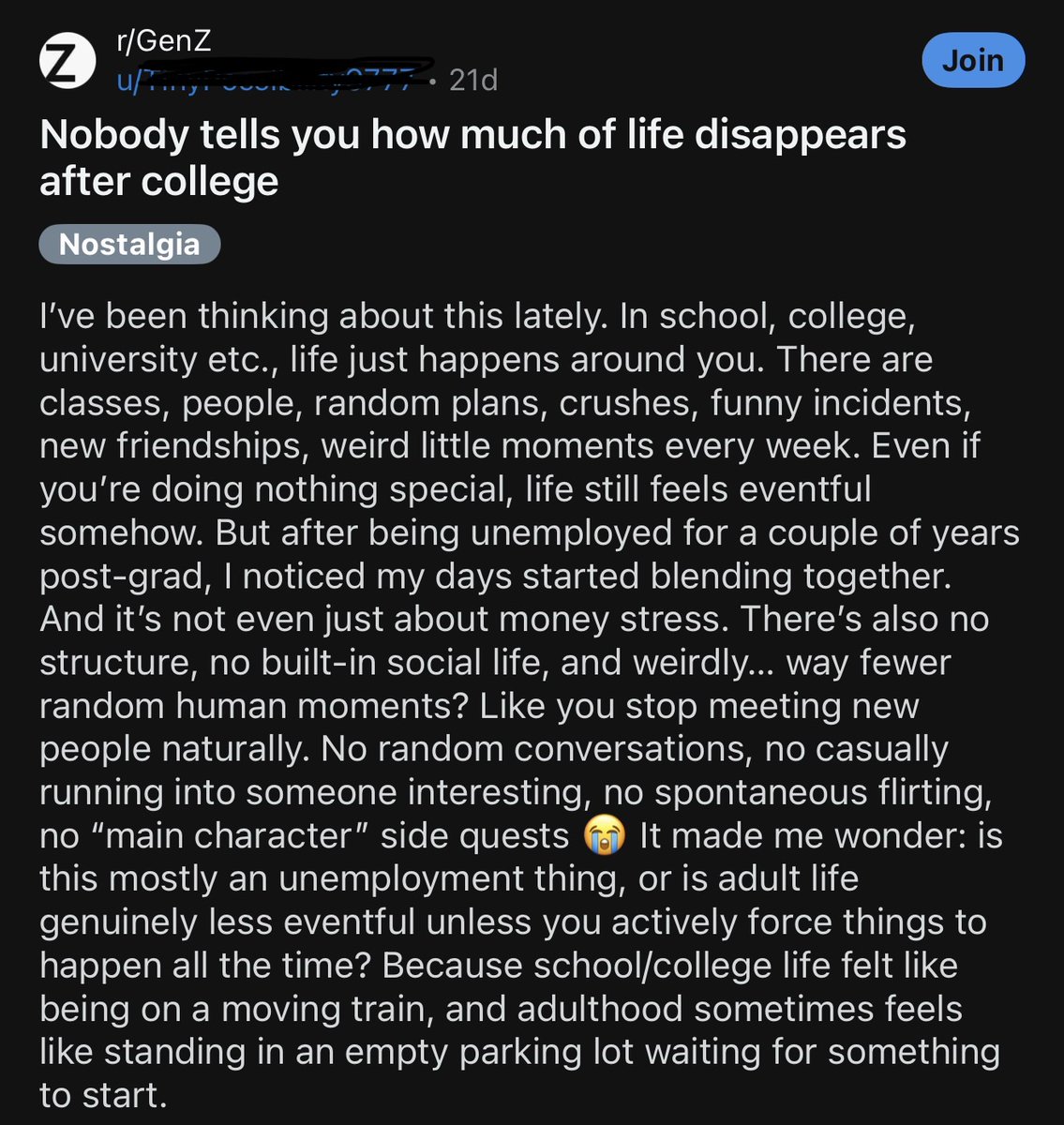
Gen Z realizing one of the biggest shocks after college is that life no longer happens around you.
In school, friends, events, relationships, and opportunities are built into your environment.
As an adult, if you don't actively create a social life, weeks can turn into months surprisingly fast.
27
559
5,034
521,754
Bill Seitz of FluxGarden retweeted

Jun 12
Yes, that is at the core of why many of us are so worried.
This week offered us a clear toy example of how a model release can cause irreversible damage, and that's with the ability to correct the error.
2
1
5
524
Bill Seitz of FluxGarden retweeted

Jun 13
❗️ Commerce’s shocking decree this afternoon – which effectively shuts down Anthropic by cutting off access to Mythos 5 and Fable 5 for many of their own employees — seems both wildly overdramatic and also counterproductive for the US AI industry.
I concur with @deanwball that the decision feels heavy-handed.
Perhaps it does China a favor, though. Certainly every Chinese person working in a US AI company (and there are many) will consider returning to the competition in China ASAP.
And investors will start to wonder whether American AI companies can thrive in this atmosphere.
If you want an example of an AI regulation that can stifle innovation, this is it.
Jun 13

I can’t tell if this is lawfare against Anthropic in particular or extreme national-security hawkery. Regardless, it is simply cartoonish.

44
52
258
27,118
Bill Seitz of FluxGarden retweeted

Jun 13
The US government, citing national security authorities, has issued an export control directive to suspend all access to Fable 5 and Mythos 5 by any foreign national, whether inside or outside the United States, including foreign national Anthropic employees.
The net effect of this order is that we must abruptly disable Fable 5 and Mythos 5 for all our customers to ensure compliance.
Access to all other Claude models is not affected.
We apologize for this disruption to our customers. We believe this is a misunderstanding and are working to restore access as soon as possible.
Read our full statement: anthropic.com/news/fable-myt…
12,341
25,605
87,157
87,109,090
Bill Seitz of FluxGarden retweeted

Gotta figure out a way to get this 3d printed

4
32
1,259