
Concise biotech intelligence. Oncology, cell therapy, antibodies, ADCs, gene therapy, and early clinical signals. High signal, low noise.
Joined November 2025
- Tweets 1,913
- Following 7
- Followers 938
- Likes 457
33 Photos and videos
BioSignal retweeted

Kailera の IPO ポートフォリオが Hengrui のライセンス丸ごと。つまり 欧米投資家 が『China から来た分子』を『China CDMO』じゃなく『innovation』として value をつけ始めたってこと。公開市場のマインドシフトか。
23h

JUST IN: Parabilis Medicines ($PBLS) has priced a record-shattering $670M Nasdaq IPO, cementing a massive macro turnaround for the biopharma sector after the historic funding winter of 2025.
This marks the second record-breaking biotech listing in less than 90 days, following the $625M April debut of obesity-focused Kailera Therapeutics ($KLRA). The multi-year capital drought—which saw public market entries blueprint a record low of just 15 listings last year—is officially over.
The Cross-Market Alpha: This surge in institutional demand highlights a structural shift where public markets are aggressively pricing late-stage clinical assets with robust human data. Look closer at the pipeline drivers: $KLRA’s entire suite of oral and injectable GLP-1/GIP agonists was in-licensed directly from China’s Jiangsu Hengrui Pharmaceuticals. Western public markets are placing massive, multi-billion-dollar premium valuations on advanced Chinese innovations.
With $PBLS locking down $670M to target the undruggable proteome via stabilized peptides, the liquidity window for elite cross-border assets is wide open. Expect a widespread valuation re-rating across late-stage global clinical pipelines.
$PBLS $KLRA $XBI $IBB
1
1
1
309

19h
Everyone thinks mRNA is just a sandbox for Moderna and BioNTech to fight infectious diseases. They’re wrong. The real multi-billion dollar alpha is in vivo CAR-T engineering—and China is quietly conquering the brutal CMC bottlenecks that trigger endless Western clinical holds.
Traditional CAR-T requires costly ex vivo cell harvesting, complex lab manufacturing, and weeks of patient waiting. In vivo CAR-T completely upends this by using mRNA enclosed in Lipid Nanoparticles (LNPs) to reprogram T-cells directly inside the human body. The science is flawless, but the execution is a regulatory minefield. LNPs are notoriously unstable, and FDA/NMPA filings routinely stall due to Critical Quality Attributes (CQAs) like plasmid DNA impurities, sequence fidelity, and structural degradation.
The China Edge: While Western developers grapple with scale-up failures, China’s biopharma ecosystem is treating CMC like a pure engineering optimization problem. CSPC Pharmaceutical ($1093.HK) just secured an IND for SYS6063—the first mRNA-LNP dual-target in vivo CAR-T to clear domestic regulators. Concurrently, US-based Cartesian Therapeutics ($RNAC) just in-licensed a Chinese LNP platform (WestGene) to accelerate its own pipeline. The massive industry-wide mobilization happening right now across Chinese regulatory hubs—exemplified by this weekend's intensive nationwide masterclass on bypassing LNP deficiency letters—proves they are systematizing the path to commercialization.
The manufacturing moat for next-gen genetic medicine is shifting East. This is the pipeline to watch. 🧵
$1093.HK $RNAC $MRNA $BNTX $XBI $IBB
9
614
23h
JUST IN: Parabilis Medicines ($PBLS) has priced a record-shattering $670M Nasdaq IPO, cementing a massive macro turnaround for the biopharma sector after the historic funding winter of 2025.
This marks the second record-breaking biotech listing in less than 90 days, following the $625M April debut of obesity-focused Kailera Therapeutics ($KLRA). The multi-year capital drought—which saw public market entries blueprint a record low of just 15 listings last year—is officially over.
The Cross-Market Alpha: This surge in institutional demand highlights a structural shift where public markets are aggressively pricing late-stage clinical assets with robust human data. Look closer at the pipeline drivers: $KLRA’s entire suite of oral and injectable GLP-1/GIP agonists was in-licensed directly from China’s Jiangsu Hengrui Pharmaceuticals. Western public markets are placing massive, multi-billion-dollar premium valuations on advanced Chinese innovations.
With $PBLS locking down $670M to target the undruggable proteome via stabilized peptides, the liquidity window for elite cross-border assets is wide open. Expect a widespread valuation re-rating across late-stage global clinical pipelines.
$PBLS $KLRA $XBI $IBB
2
943
Jun 13
JUST IN: Parabilis Medicines ($PBLS) priced a $670M Nasdaq IPO — now the largest biotech IPO on record. Worth pausing on what that signals after 2025's funding winter.
It's the second record biotech listing in under 90 days, after Kailera Therapeutics' ($KLRA ) $625M debut in April. For context: US biopharma listings bottomed out around 15 last year. Two records back-to-back is a real shift in tone.
What I'm actually watching is the China angle. Kailera's entire GLP-1/GIP suite — oral and injectable — was in-licensed from Jiangsu Hengrui. Public markets just put a multi-billion-dollar valuation on a pipeline sourced from Chinese R&D. That's the pattern worth tracking, not the headline number.
Parabilis is a different bet — $670M to go after the "undruggable" proteome with stabilized peptides, plus a concurrent Regeneron placement. But the read-through is the same: the window for late-stage assets with real human data is open again, and cross-border deals are getting repriced.
Watching whether this holds or fades.
$PBLS $KLRA $XBI $IBB
6
689

BioSignal retweeted

Jun 12
The LB2501 readout is the standout — in-vivo CD19/CD20 dual-targeting with 100% ORR and no manufacturing requirement changes the cell therapy economics conversation entirely. The durability question is what matters now: what does T cell persistence look like at 6 and 12 months?
1
1
167
Jun 12
For years, the biotech industry assumed that maximizing drug half-life and maintaining continuous target occupancy was the holy grail for treating metabolic liver diseases. They were completely wrong.
Traditional FXR agonists hit a brutal commercial and clinical safety wall—plagued by severe pruritus (itching) and toxic LDL cholesterol spikes—because continuous receptor activation disrupts the liver's natural physiological rhythm. The human body expects bile acid signals to spike and fade rhythmically with eating cycles, not remain permanently switched on.
A breakthrough study just published in Nature completely rewires this paradigm. Chinese scientists from the Shanghai Institute of Materia Medica, alongside private biotech Cascade Pharmaceuticals, have unveiled linafexor (CS0159)—a first-in-class pulsatile FXR agonist.
Instead of chasing prolonged exposure, CS0159 was structurally engineered to be "potent but fleeting." It delivers high-efficiency transcriptional activation to regulate bile acid metabolism, but undergoes hyper-rapid systemic clearance. This precise pharmacokinetic engineering creates a crucial cellular recovery window, mimicking natural postprandial bile acid waves.
The clinical validation is already moving fast:
• Broad Efficacy: Preclinical models demonstrate dramatic reversal of inflammation and fibrosis across three major high-value indications: PBC, PSC, and MASH.
• Regulatory Validation: The asset has already locked in both FDA Breakthrough Therapy Designation (BTD) and Orphan Drug Designation (ODD) for Primary Biliary Cholangitis (PBC).
• Human Proof-of-Concept: Human Phase 1 data published in the study confirms rapid clearance alongside robust, transient activation of downstream biomarkers (FGF19/C4) without the classic FXR toxicity signatures.
As Gilead ($GILD) scales its post-merger PBC footprint and Madrigal ($MDGL) locks down the MASH market, this pulsatile design offers a massive disruptive threat to traditional continuous-exposure small molecules. Cascade is currently private, making it a prime target for a major Western out-licensing deal or a highly anticipated cross-border IPO.
This is the pipeline mechanism to watch. 🧵
$GILD $MDGL $ENTA $XBI $IBB
2
17
2,253
Jun 12
Traditional monoamine-targeting antidepressants have hit a clinical wall, and the market is looking in the wrong place for the next multi-billion dollar neuro paradigm shift.
The alpha lies in the neuro-excitability space—specifically KCNQ2/3 (Kv7) potassium channel openers. Rather than altering serotonin or norepinephrine levels, KCNQ2/3 modulators act as a master dimmer switch for hyperactive neurons. By enhancing potassium efflux, they stabilize the neuronal membrane potential, reinforcing the brain’s natural "stress resilience" pathways to rapidly treat deep-seated anhedonia.
While Western KCNQ pioneer Xenon Pharmaceuticals ($XENE) generated mixed, placebo-plagued Phase 2 data for XEN1101 in Major Depressive Disorder (MDD), China’s innovation ecosystem is aggressively stepping into the clinical void.
Shanghai Zhimeng Biopharma just secured CDE IND clearance to launch a clinical trial for its next-gen KCNQ2/3 opener, CB03-154, specifically targeting MDD.
• The "One-to-Many" Strategy: CB03-154 is building a highly diversified CNS fortress. The molecule is already executing a rapid pipeline expansion, sitting in an ongoing Phase 2/3 trial for ALS and a Phase 2 trial for Epilepsy spanning China and Australia.
• Engineering Out Toxicity: First-gen KCNQ openers like ezogabine were pulled due to poor selectivity causing skin discoloration and urinary retention. Zhimeng’s next-gen molecule is engineered for hyper-selectivity, aiming to unlock a clean psychiatric safety profile.
• Underappreciated Value: Zhimeng is currently a private fast-follower, but their aggressive, multi-indication clinical execution makes them a prime candidate for a major Western out-licensing deal or a future IPO.
This is the pipeline to watch. 🧵
$XENE $BIIB $SAGE $XBI $IBB
190
Jun 12
Small molecules are not dead—they are undergoing a massive structural renaissance. Big Pharma is currently locked in a multi-billion dollar strategic arms race over Molecular Glues, completely redefining how the industry attacks "undruggable" targets.
Novartis ($NVS) just doubled down on Orionis Biosciences in a new multi-year development deal worth up to $1.4B ($40M upfront). This follows an unprecedented wave of capital flooding into the space over the last 18 months, including AbbVie ($ABBV)/Neomorph ($1.64B), Lilly ($LLY)/Magnet ($1.25B), and Gilead ($GILD)/Kymera ($750M).
The underlying investment thesis is a structural shift from accidental discovery to AI-driven rational design, creating an elite class of platform winners.
• The Mechanism: Over 80% of disease-causing proteins lack the deep binding pockets required by traditional small molecules. Molecular glues don't block pockets; they alter a target protein's surface topology to "stick" it directly to an E3 ubiquitin ligase, triggering complete cellular degradation.
• The Platform Advantage: First-gen glues like thalidomide were discovered by pure clinical serendipity. Orionis’s Allo-Glue™ and rival MNC-backed platforms integrate high-throughput chemoproteomics and predictive machine learning to systematically design glues from scratch, turning a historical lottery ticket into a repeatable, scalable asset pipeline.
• The Fast-Follower Threat: While Western MNCs pay massive premiums for early-stage discovery platforms, agile Chinese biotechs like Kangpu Biopharmaceuticals and GlossBio have already quietly pushed proprietary molecular glues into P1/P2 clinical trials for major oncology and immunology indications, threatening to undercut Western clinical timelines.
This is the ultimate small-molecule paradigm shift to watch as platform validation scales exponentially.
$NVS $RHHBY $ABBV $LLY $GILD $KYMR $XBI $IBB
265
Jun 12
Biopharma is finally moving past just clearing Alzheimer’s plaques. The real alpha is shifting upstream to stop them from forming in the first place.
Eli Lilly ($LLY) just dropped $1B ($10M upfront) to license AlzeCure’s preclinical asset, ACD680. It’s a Gamma-Secretase Modulator (GSM) that signals a massive strategic evolution for the AD market leader.
Think of Lilly’s blockbuster antibody Kisunla as the janitor cleaning up amyloid-beta (Aβ) "garbage" after it piles up. ACD680 is the filter at the factory source—halting toxic Aβ42 production while boosting protective, short-chain Aβ37/Aβ38 variants.
The Investment Thesis:
• Delivery & Cost: As an oral small molecule, GSMs offer massive cost-of-goods (COGS) advantages and superior blood-brain barrier (BBB) penetration over complex IV antibody infusions.
• Market Expansion: This unlocks a true "prevention" model, allowing clinicians to treat asymptomatic, high-risk patients before irreversible plaque deposition occurs.
• Elite Moat: The modern GSM landscape is essentially a tight duopoly. Only Lilly and Roche ($RHHBY) are aggressively chasing this, with Roche’s Nivegacetor currently leading the charge in P2.
Lilly isn't just relying on Kisunla; they are cornering the entire AD ecosystem. From early diagnostics (Roche/Qiagen) to intracellular Tau (AC Immune) and upstream prevention (ACD680).
This is the pipeline to watch. 🧵
$LLY $RHHBY $BIIB $XBI $IBB
1
225
Jun 12
BREAKING: QuantumPharm/XtalPi ($2228.HK) just locked in a massive $400M strategic AI drug discovery collaboration with a major global pharma MNC to crack an "undruggable" metabolic GPCR target.
The Alpha: This deal provides massive commercial validation for AI-driven discovery platforms, specifically proving that combining physics-based algorithms with automated robotics can solve structural "blind spots" where traditional High-Throughput Screening (HTS) completely fails.
• The Target: A highly complex, multi-conformation metabolic GPCR with zero public co-crystal structures available globally. Traditional small-molecule pipelines have historically failed here due to poor selectivity and ADMET profiles.
• The Deal Structure: Highly favorable. The unnamed global pharma covers 100% of early R&D costs, provides an upfront payment, and pays out preclinical/clinical/commercial milestones plus royalties up to $400M .
• The Technology Edge: XtalPi is moving past pure dry-lab generative AI. They are leveraging a proprietary multi-agent AI system that directly commands automated physical wet-labs, massively accelerating the Design-Make-Test-Analyze (DMTA) cycle.
While Western AI drug discovery pioneers like Schrodinger ($SDGR) and Recursion ($RXRX) face heavy market skepticism over pipeline progression, XtalPi’s robotic automation model is successfully extracting upfront validation and cash from big pharma.
$2228.HK $SDGR $RXRX $XBI $IBB
316
Jun 12
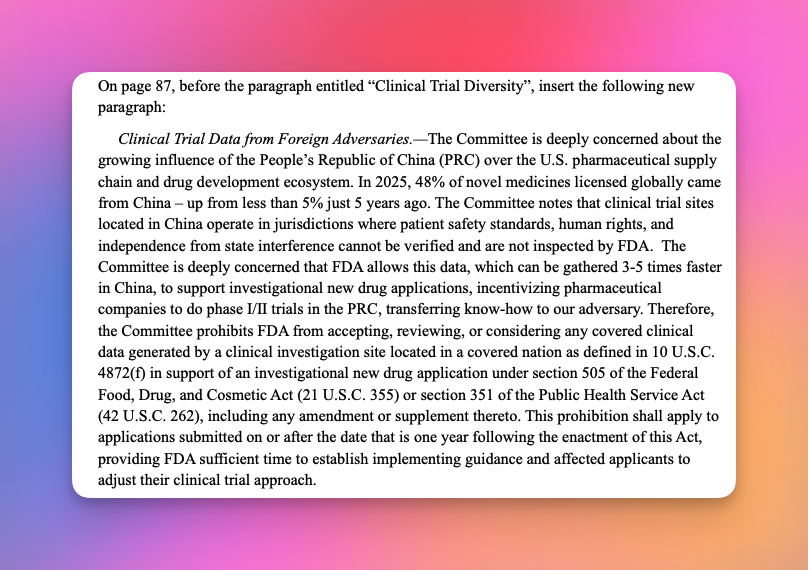
JUST IN: WuXi AppTec ($2359.HK) landed on the Pentagon's 1260H "Chinese military companies" list June 8, and the tape sold it like a death sentence. I think that's the wrong read.
Start with what the list actually is. WuXi went on alongside ~188 names — Alibaba, Baidu, BYD, NIO. The 1260H listing itself imposes no sanctions. It's the on-ramp to a "biotechnology company of concern" tag under the Biosecure Act, but that's a separate step OMB hasn't taken yet (expected around Dec 2026), and the actual procurement ban doesn't bite until the FAR is rewritten — realistically 2028. This is a designation you contest, not a statutory ban hardcoded into law. The 2024 bill named WuXi directly; the version that passed last December dropped names for a process.
What it does NOT touch: commercial B2B pharma. The restriction runs to federal procurement, contracts and grants — FAR-based spending. Medicare Part D and the Medicaid rebate program sit outside FAR, so they're untouched. The commercial book keeps running.
And the runway is long. Contracts signed before the effective date get ~5 years to wind down, pushing real decoupling toward the early 2030s. ~79% of biopharma say they hold at least one Chinese-CDMO contract; swapping a validated manufacturer is slow and expensive — exactly why Congress built the off-ramp.
Where I'd temper the bull case: "courts fix this fast" is shakier than people claim. AMEC got delisted in 2021, then re-listed. Hesai, same. DJI sued the DoD and lost in Sept 2025. WuXi says it'll challenge immediately and has a real OMB removal process to use — but recent 1260H fights have not gone the challengers' way.
Meanwhile the business: Q1 backlog 23.6% YoY to RMB 59.8B, and management's been buying back stock into the panic (~RMB 1B A-share program plus daily HK repurchases through early June).
The headline is scarier than the mechanism: real teeth, but slow, narrow, and contestable — while the commercial engine runs. Not financial advice.
$2359.HK $WUXAY $XBI $IBB
1
273
Jun 11
6 cell-therapy readouts reprice the space at EHA this week — here are the tickers attached to each.
• Legend LB2501 — in-vivo CD19/CD20 CAR-T, 100% ORR at DL2 (Sun late-breaker) · $LEGN
• Cellectis lasme-cel — first allo CAR-T with FDA RMAT in a pivotal B-ALL trial (Sat oral) · $CLLS
• AvenCell AVC-201 — switchable CD123 CAR-T, AML
• Caribou CB-011 — B2M–HLA-E cloaked allo BCMA CAR-T, myeloma · $CRBU
• PeproMene PMB-CT01 — BAFF-R CAR-T, post-CD19 relapse
• Gilead/Kite — DuoCore anito-cel · $GILD
Follow for the reads as they land.
$XBI $IBB · ✨ Made with AI
1
1
9
1,118
Jun 11
Correction to our May 25 thread: the Merck–Kelun figure was wrong. Merck paid $47M upfront up to ~$1.4B in milestones for ex-China rights to sac-TMT (SKB264) in May 2022 — not $9.7B. (The ~$9.3B Dec 2022 figure was a separate seven-ADC deal.) Correcting the record. ✨ Made with AI
May 25
$9.7B. That's what Merck paid in 2022 for ex-China rights to a Kelun ADC most of Wall Street hadn't even modeled. Friday at ASCO (#8506, 3:12pm CT), OptiTROP-Lung05 tells us if it was the best capital-allocation call in oncology this decade. A case study in how the "China discount" dies:
375
Jun 11
100% ORR. 83% CR. No chemo, no apheresis, no manufacturing.
That's Legend's LB2501 — its first in-vivo CAR-T to report human data — built entirely inside the body after one IV infusion. At DL2 (n=6): 6/6 responded, 5/6 complete, all ongoing as of Apr 1. No DLTs, no SAEs, no ICANS. The dual CD19/CD20 design goes straight at the antigen-escape relapse that breaks single-target CD19 CAR-T.
The read: in-vivo CAR-T now has a no-lymphodepletion B-NHL dataset to set against the $7B Lilly/Kelonia BCMA bet — the manufacturing-light thesis just went multi-target. EHA late-breaker Sunday; follow for the reads as they land.
$LEGN $XBI $IBB · ✨ Made with AI
5
23
3,307
Jun 10
Think ADCs are the final frontier in oncology? Think again. Big Pharma is officially front-running the next major therapeutic paradigm shift: DACs (Degrader-Antibody Conjugates).
J&J ($JNJ) just announced a massive $1 billion all-cash acquisition of preclinical startup Firefly Bio. Paying a 10-figure sum for an asset that hasn't even entered human trials yet is a massive validation signal for the entire space.
Why is smart money losing its mind over DACs?
• Traditional ADCs deliver highly toxic chemotherapy payloads directly into cells.
• DACs completely swap the chemo for targeted protein degraders (PROTACs/molecular glues).
Instead of poisoning the cell, DACs hijack the body's internal recycling machinery to systematically destroy disease-driving proteins. Firefly's platform specifically limits payload leakage in the blood, maximizing safety, lowering required doses, and unlocking previously "undruggable" targets like mutant KRAS.
The tier-1 validation capital entering this modality is staggering:
• Eli Lilly ($LLY) was an early venture backer of Firefly.
• Roche just signed a $1B DAC deal with C4 Therapeutics ($CCCC) in April.
• Pfizer ($PFE) remains hitched to Nurix Therapeutics ($NRIX).
• Bristol Myers ($BMY) is already in P1 with an anti-CD33 DAC.
The ADC land grab is rapidly transitioning into the DAC supercycle. With preclinical platforms clearing a $1B benchmark, the public landscape for targeted protein degradation is about to experience severe upward repricing. 🧵
$JNJ $LLY $CCCC $NRIX $BMY $PFE $XBI $IBB
1
8
720
Jun 10
Everyone's filing GSK's $10.6B Nuvalent deal under "big pharma buys another US biotech." The more interesting read is what it's quietly built around: a drug that came out of China.
The terms are real money — $124 a share in cash, a 40% premium, GSK's biggest deal in over a decade and Luke Miels's first major swing as CEO. What it buys is a near-ready lung cancer franchise: two next-gen NSCLC inhibitors sitting right in front of FDA decisions — zidesamtinib (ROS1) on Sept 18, neladalkib (ALK) on Nov 27. Both were built to do what the first-gen drugs couldn't: hold up against the resistance mutations that emerge on treatment, and actually reach the brain, where these cancers tend to spread.
But the tell is in GSK's own framing. They pitched the deal as a commercial platform to expand Ris-Rez — risvutatug rezetecan, their B7-H3 ADC now in Phase 3.
And Ris-Rez isn't a Western discovery. It's HS-20093, licensed from China's Hansoh Pharma (3692 HK) in a ~$1.7B deal last year. So GSK is spending eleven figures on US commercial infrastructure in part to give a China-originated drug its best shot at a global launch.
That's the shift worth watching. Chinese biotechs sitting on high-quality, clinical-stage assets now have real leverage in the race for the next decade of targeted lung cancer therapy — and increasingly, big pharma is building around what they license out.
$GSK $NUVL $3692 HK
6
556
Jun 10
The multi-billion dollar ADC hype cycle is officially topping out. Smart money is already rotating into the next major oncology paradigm shift: DACs (Degrader-Antibody Conjugates), and Chinese cross-border dealmaking is front-running the valuation arbitrage.
J&J ($JNJ) just dropped a massive $1 billion cash upfront buyout for preclinical startup Firefly Bio to grab its "Firelink" dDAC platform. Paying a 10-figure sum for a preclinical asset is a screaming validation signal for Targeted Protein Degradation (TPD) mixed with antibody delivery.
Why are MNCs panic-buying DAC platforms?
• Traditional ADCs dump toxic chemo payloads inside cells, hitting hard safety ceilings.
• DACs replace chemo with catalytic protein degraders (PROTACs/molecular glues).
• They systematically erase "undruggable" drivers like mutant KRAS (G12D/G12V) while engineering out the systemic toxicity and payload leakage that plagues first-gen assets.
The institutional land grab is accelerating globally: Bristol Myers ($BMY) is in P1, Pfizer ($PFE) is tied to Nurix ($NRIX), and Roche expanded its $1B pact with C4 Therapeutics ($CCCC) just two months ago.
But here is the real Alpha: Western investors are paying a massive premium for domestic discovery when Chinese platforms are already delivering identical innovation at a steep discount. In January 2026, Hangzhou Hezheng Pharmaceutical quietly closed the first major global out-licensing deal for a Chinese-developed DAC platform to a US biotech.
As MNCs look to de-risk their pipelines away from hyper-inflated US preclinical valuations, the validation of Firefly’s $1B exit will directly drive business development dollars toward liquid, early-stage Chinese platforms. This is the structural shift to position for. 🧵
$JNJ $LLY $CCCC $NRIX $BMY $PFE $XBI $IBB
329
Jun 9
JUST IN: The US Department of Defense has added WuXi AppTec to its official Section 1260H list of "Chinese Military Companies."
This critical regulatory escalation automatically solidifies WuXi's classification as a "Biotechnology Company of Concern" under the BIOSECURE Act. WuXi has fired back with an urgent corporate filing, stating the Pentagon's allegations of state and PLA ties are "erroneous and factually incorrect" while pledging an immediate legal and administrative challenge to reverse the listing.
The Alpha: While a five-year grandfather clause insulates existing supply contracts through 2031, the compliance ambiguity is officially dead. Western biopharma majors will immediately stop routing new clinical or commercial pipelines to WuXi, precipitating a structural, multi-billion dollar capital rotation toward Western CRO/CDMO alternatives.
$2359.HK $WUXAY $CRL $XBI $IBB
2
359