
Official X account of BitEagle News on #Binance Square | @Binance Creator of the Year ‘23-‘24 | Now on @CoinMarketCap & @BitgetInsights | NFA. DMs open
Joined July 2019
- Tweets 14,421
- Following 648
- Followers 1,396
- Likes 45,754
1,429 Photos and videos









Apr 4
Iranian villagers searching for a US pilot. 😂
What do you think will happen if they find them?
1
160
Mar 24
The majority of individuals concentrate on the crypto assets which people share. The small number of people who study crypto allocation only investigate the rightful recipients.
The problem statement describes the solution which SIGN develops. The project enables credential verification together with token distribution through its global infrastructure which builds on actual user interaction.
The system records your participation in the event. The system proofs your achievement of the established requirements.
The system confirms your entitlement to rewards through verification. The system operates without making any presumptions. The system advances to its next stage of distribution after establishing its data connection.
TokenTable ties airdrops and vesting and incentives to verified users while excluding both bot farms and random wallets. Better allocation results from this approach because it reduces waste which creates stronger ecosystems. The most common reason for project failure occurs at this stage.
Their method involves distributing all content without any restrictions while they wait to see what happens. The infrastructure of SIGN provides accurate measurement which extends through every component.
The system has already reached operational status through its distribution of millions of attestations together with billions of distributed value.
The evidence demonstrates that the situation extends beyond academic research. The majority of people skip this crucial section. The established standards of infrastructure need to become widespread before they can actually matter.
The best systems will remain useless until people begin to adopt them. The story needs additional attention. Watch who starts integrating SIGN. The actual signal exists in that location.
@SignOfficial #signdigitalsovereigninfra $SIGN
72
Mar 23
All people want to obtain airdrops.
People show no interest in learning about the actual decision-making process.
SIGN provides a solution for this problem.
SIGN develops a worldwide system which enables credential verification and token distribution. Projects can establish who should receive rewards through this system which creates authentic on-chain credentials from actual user behavior.
The system records completed tasks for users.
The system records asset ownership as proof of asset ownership. The system confirms asset holders meet all established requirements.
The system delivers pure data without any additional sound elements.
The system provides a direct link to distribution processes.
TokenTable connects verified users to airdrops, vesting, and incentives while blocking access to random wallets and bot farms. The result leads to cleaner distribution processes which prevent loss of funds.
The solution resolves a critical weakness which exists in Web3.
The current methods used for distribution remain highly ineffective. The project loses value to farmers while actual users experience value dilution.
SIGN brings accuracy to its operations.
The system has entered service which processes millions of attestations and distributes more than 2 billion in value. The evidence shows this is not a simple theoretical concept.
You should avoid making quick decisions.
Only if infrastructure receives designation as standard will it obtain value. The limited impact of SIGN continues because projects create separate systems which do not connect with each other.
The actual business opportunity does not involve generating excitement.
The world needs to observe whether SIGN evolves into an essential component which all important protocols silently add into their systems.
You will not experience any sound disturbances because it does not happen.
You will only observe the outcomes which follow.
@SignOfficial #signdigitalsovereigninfra $SIGN
1
44
Mar 22
The majority of people in the world today want to achieve transparency within cryptocurrency systems. Privacy needs to be established as a prerequisite for people to use cryptocurrency systems.
The Bitcoin and Ethereum networks made their entire systems public to establish trust yet this approach fails to protect confidential information which businesses and institutions and individual users require.
Midnight Network has developed a system that enables users to verify financial transactions and smart contract execution without disclosing any protected information.
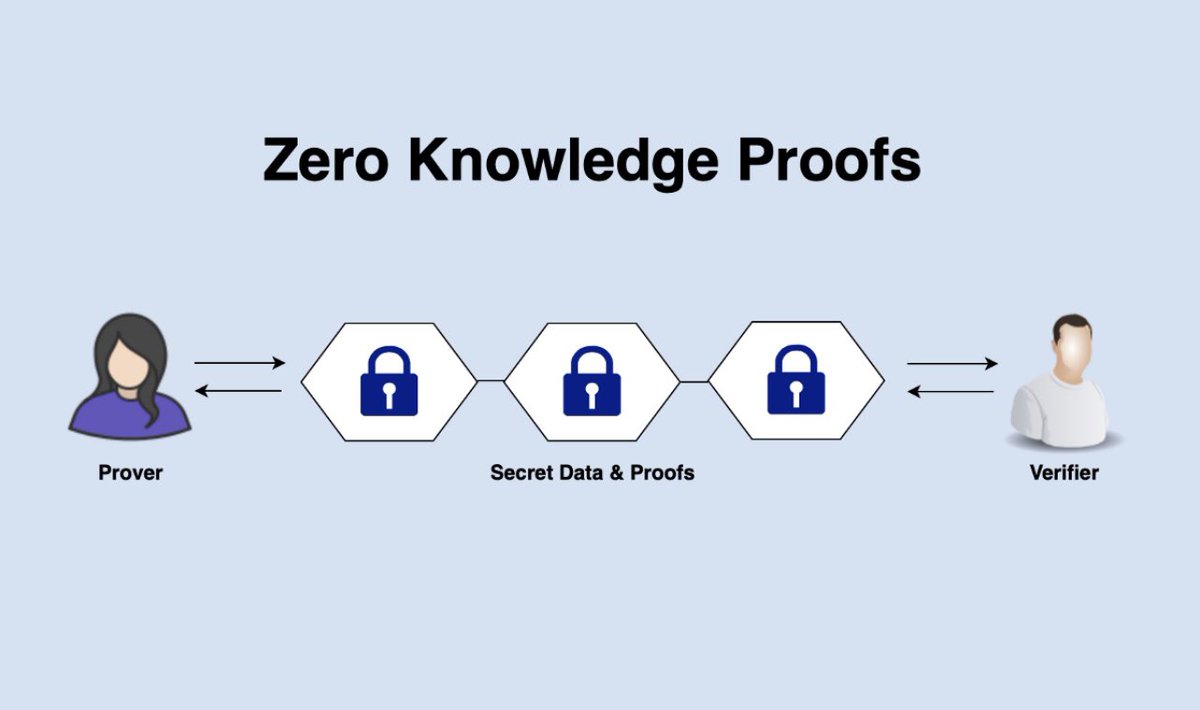
Zero-knowledge proofs enable Midnight users to create privacy protection systems which allow them to demonstrate their claims without sharing their evidence.
The project established by Input Output Global who created Cardano aims to develop a blockchain system which can handle actual business needs.
Crypto systems require complete transparency to operate effectively but their scalability depends on information access control rights.
@Sign #signdigitalsovereigninfra $SIGN
47
Mar 21
Most people still treat identity and distribution in Web3 like side problems.
They are infrastructure that forms the essential foundation of the system. The company has established its operational location in this particular market segment.
The organization develops its worldwide protocol which establishes credential verification and token distribution methods.
The organization develops an all-encompassing network system which enables users and projects and institutions to create on-chain credentials which can be verified.
These credentials which users create represent various aspects of identity and activity and ownership and eligibility and can be applied in multiple digital environments.
The solution provides an effective resolution for a critical operational problem.
@Sign #signdigitalsovereigninfra $SIGN
33
Mar 20
People pursue stories but they fail to recognize the hidden systems which continue to shape cryptocurrency development. The presence of SIGN remains visible to all people who watch. The current situation determines your status as either early or late.
SIGN functions as more than a standard token. The system provides fundamental tools for the operation of infrastructure. The system creates a worldwide network which enables credential verification and token distribution across multiple regions.
The system functions as a verification system which operates across multiple blockchain networks. The system allows governments and companies and dApps to create on-chain credentials which they can use to verify various types of identity and ownership and eligibility.
TokenTable operates as a system which manages airdrop distribution and the process of vesting and incentive distribution at large scale. Trust represents the main element which people fail to recognize.
The Web3 environment exists as multiple separate systems. The system creates standard credentials through SIGN which users can move between different ecosystems while maintaining their ability to verify and protect their credentials against unauthorized access.
#signdigitalsovereigninfra $SIGN @Sign
1
2
45
Feb 11
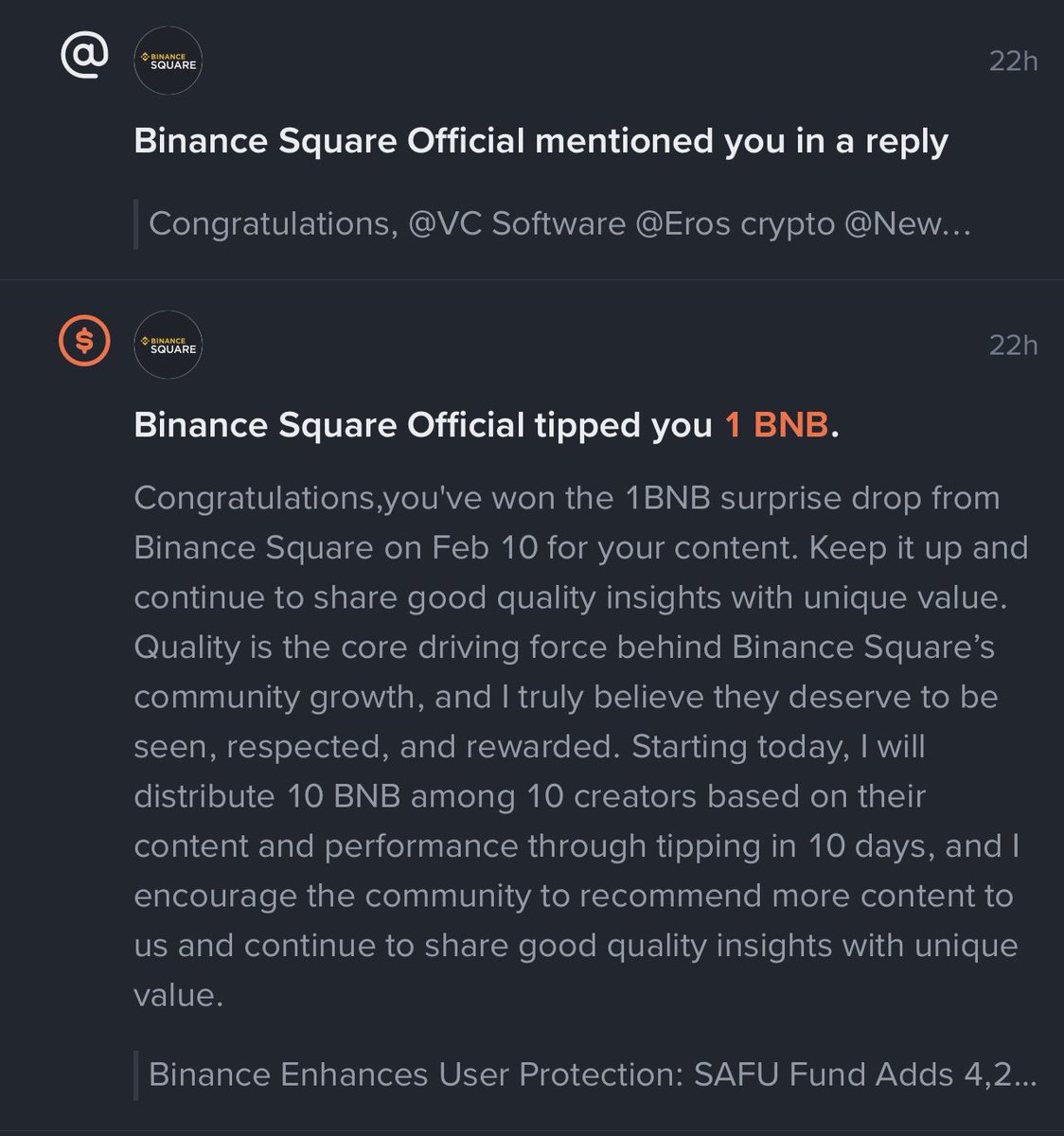
Really grateful for this. Winning 1 BNB for something I genuinely put time and effort into means a lot.
It’s easy to post for engagement, but creating quality content consistently takes work, research, and conviction.
Recognition like this reminds me why I started sharing in the first place.
Appreciate the support from the community and the team for spotlighting creators who focus on value over noise. This one’s special.
@heyibinance , @binance and the Binance square team, thank you for encouraging quality content on the platform. Let’s keep building.
Feb 11

Good ideas grow through thoughtful discussion and steady participation.
Thanks to everyone who continues to share practical insights and different perspectives.
These conversations may seem small on their own, but over time they connect, accumulate, and help move things forward.
Let’s keep learning from each other and improving, one step at a time.
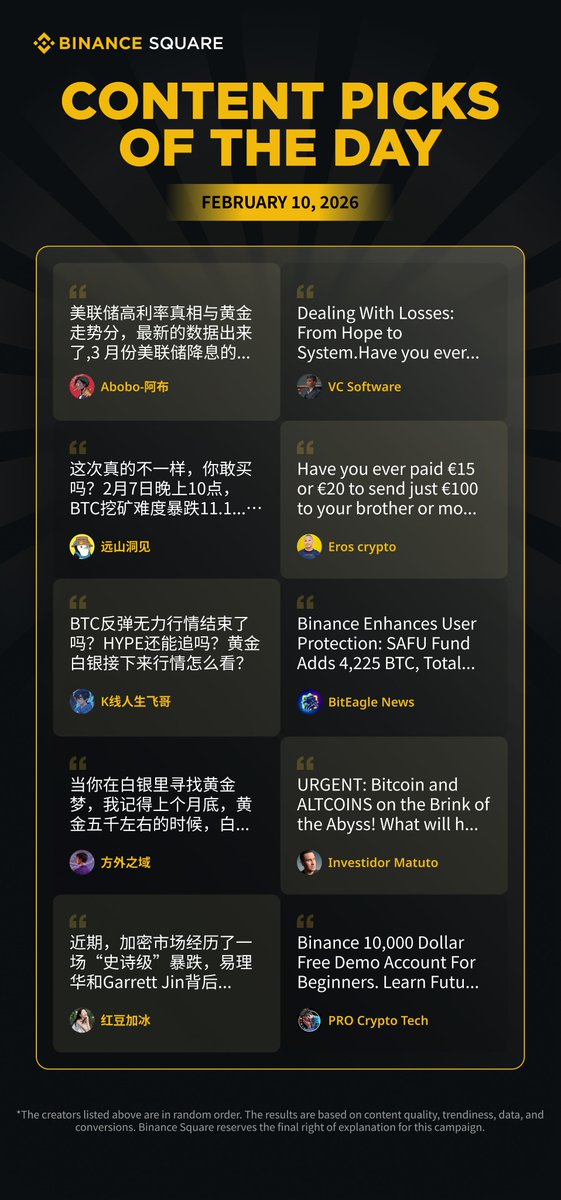
Congrats to Feb 10’s winners 🎉
@VC_Software
@eroscrypto_
@BitEagleNews
@invest_matuto
@ProCryptoTech
1
3
229
BitEagle retweeted

Ad Astra
If there is a common destiny of great men, it is their gaze turned to the stars. From Julius Caesar to Seneca, from Giotto to Thomas Aquinas, from Dante Alighieri to Petrarch, from Michelangelo to Caravaggio, from Amerigo Vespucci to Galileo Galilei, and then so many other men and women who have shaped entire eras. But the stars do not belong only to the greats of history: they also belong to ordinary people. Enrico Fermi recounted that, as a boy, he saw two shepherds stop to gaze at the sky, and that one commented to the other on what, to him, appeared simply as the magnificence of infinity. Today we are facing a change we do not yet fully understand: for the first time in history, we simultaneously possess enabling technologies and industrial capacity that not only permit exploration, but also make it possible for human civilization to extend beyond the atmosphere and, at the same time, structurally improve conditions on Earth. Two closely trajectories are becoming crucial: the first is solar energy, the second is computational capacity dedicated to artificial intelligence. The first concerns not only terrestrial photovoltaics but also the collection and conversion of power in orbit, where irradiance is more stable and (nearly) continuous, potentially offering a higher capacity factor, and where infrastructure can scale without many contraints. The second concerns the growth of computing power (accelerator architectures such as GPUs/TPUs), high-bandwidth, low-latency interconnections, and, of course, the physical constraints that are becoming increasingly dominant: energy and thermal dissipation to support increasingly dense data centers. At first glance, these two stories may seem distant or irrelevant. In reality, they converge at a single strategic point because abundant energy enables computation at scale, and advanced computation accelerates the discovery and optimization of energy technologies, materials, and industrial processes. If humanity is capable of harnessing solar energy in space and maximizing computation in space through dedicated infrastructure, even envisioning orbital data centers, two systemic effects could be generated, with varying propagation times in different regions of the planet: i) a drastic reduction in the marginal cost of energy and an increase in reliable energy access. II) a more universal diffusion of "cognitive" resources in the form of computational services and artificial intelligence models available on a large scale. The first effect could translate into a structural reduction in poverty and sustainable growth less constrained by fuel and geopolitical bottlenecks. The second makes currently unsolved problems in employment, healthcare, and scientific research economically and technically tractable, from diagnostics and drug discovery. The engineering challenges remain enormous: thermal management in a vacuum on an industrial scale, radiation degradation of electronics and materials (total ionizing dose), reliability and redundancy of autonomous systems, high-capacity ground-to-space links, in-orbit maintenance and servicing (Optimus?), orbital sustainability, and debris mitigation. To find potential solutions the main variable is the time needed. I remember once Elon told me that, for him, the most important thing is the value of his time. Generally speaking, the bottleneck is often a mix of technical and bureaucratic time, but the capacity to attract the world's best talent, concentrated in a few companies, is accelerating the process. Once we realize it's both a scientific and industrial problem, and a problem of scale: if the critical infrastructure threshold is exceeded, then energy and computation become multipliers of prosperity, and what today seems like science fiction could transform into the largest technological project of the century.
81
27
191
22,943
BitEagle retweeted

Feb 5
BeeOS Ambassador Program update 🐝
Wanted to contribute to a project as a content creator or KOL?
We’ve rolled out an updated role & progression system for the Ambassador Program.
Clear roles, clear expectations, clear rewards - based on involvement, not reach.
To participate in the ambassador program, you need to obtain the bee larva role.
To do this
> get in discord
> click the bee emoji 🐝 under the announcement message
> make hive quality content
> progress w/ special roles
Be the buzz before the main platform product launch.
82
39
146
11,331
Jan 26
BeeOS is a prediction market platform built with UFC at the core of its brand and user experience. The platform goes deeper than anyone else on UFC markets, while still offering full coverage across sports and crypto to support long term scale.
Alongside the core platform, BeeOS runs a Prediction Hub where anyone can become a caller, publish picks, and build a public reputation through transparent, tracked PnL. Performance is fully visible, allowing skill to stand out over hype.
Top callers earn rewards based on results, while users can follow and copy proven performers directly. Native copy trading is integrated both within the Prediction Hub and on the main platform, making it easy to back the best minds with real capital.
BeeOS combines deep niche focus, transparent performance, and social incentives to create a prediction ecosystem where accuracy is rewarded and trust is earned.
2
75
Jan 17
Once you truly learn how to trade, everything changes.
No connections required.
No office politics.
No permissions needed.
It’s just you, the market, and your ability to manage risk.
That’s the part most people miss. Trading isn’t about predicting the future. It’s about execution, discipline, and surviving long enough for probabilities to work in your favor.
Once that clicks, the skill never leaves you. Markets change, instruments change, narratives rotate, but the core principles stay the same.
And that’s what makes it powerful.
It’s a skill you carry with you for life.
1
65
Jan 14
͏
͏
͏
͏
͏
͏
͏
͏
͏
͏
͏
͏
͏
͏
͏
͏
͏
͏
͏
͏
͏
͏
͏
͏
͏
︎︎
𝗘𝗿𝗿𝗼𝗿 Your account is currently locked due to several reports made on your account for being Posting Bad Memes. For more information please contact X Support.
͏
͏
͏
͏
͏
͏
͏
͏
͏
͏
͏
͏
͏
͏
͏
͏
͏
͏
͏
͏
͏
͏
͏
͏
͏
͏
͏
͏
͏
͏
͏
͏
͏
͏
͏
͏
͏
͏
͏
͏
͏
͏
͏
͏
͏
͏
͏
͏
͏
͏
͏
͏
͏
͏
͏
͏
͏
͏
͏
͏
͏
͏
͏
͏
͏
͏
͏
͏
͏
͏
͏
͏
͏
͏
͏
͏
͏
͏
͏
͏
͏
͏
͏
͏
͏
͏
͏
͏
͏
͏
͏
͏
͏
͏
͏
͏
͏
͏
͏
͏
͏
͏
͏
͏
͏
͏
͏
͏
͏
͏
͏
͏
͏
͏
͏
1
49
Jan 14
Thanks to crypto, i bought this $650k car!
Here’s how i did it 👇
- got my degree
- been active on Binance every day
- bought some crypto
- my dad gifted me $650k
The grind pays off
2
40
18 Dec 2025
A big win doesn’t break accounts.
What comes after does.
Confidence quietly turns into size creep. Rules get bent just once. Stops get wider because “the market owes me”.
That’s how one good trade turns into five bad ones.
The best traders treat wins the same as losses. Same size. Same risk. Same discipline. They lock the profit mentally and reset.
Your edge isn’t the setup.
It’s your ability to stay boring after you’re right.
Trade like you’re protecting capital, not chasing dopamine.
53