
Videos: youtube.com/ryanodonnellteac…
Joined October 2011
- Tweets 716
- Following 0
- Followers 6,686
- Likes 1,365
232 Photos and videos
Pinned Tweet

31 May 2024
I'm releasing a series of videos called "Quantum Computer Programming in 100 Easy Lessons".
youtube.com/playlist?list=PL…
It will cover the 'usual' content (...CHSH, Grover, Factoring), but with some expositional innovations that I *hope* will make it easier for beginners.
25
140
14,173
FOCS 2026 Test of Time call for nominations is out:
tc.computer.org/tcmf/2026/05…
Please submit your nominations! More info on the award here:
tc.computer.org/tcmf/focs-te…
and here's DBLP links for FOCS '16, '06, '96:
dblp.org/db/conf/focs/focs20…
dblp.org/db/conf/focs/focs20…
dblp.org/db/conf/focs/focs96…
3
8
1,158
Ryan O'Donnell retweeted

19 Aug 2025
New w/ Meghal Gupta, William He, @BooleanAnalysis
arxiv.org/abs/2508.09422
We give a quadratically faster classical algo for noisy planted kXOR (k > large const), dispelling (for now) claimed quartic speedup for quantum algos. 🧵 (1/10)
1
7
32
3,603
9 Dec 2024
In case you're in Cambridge, MA on Tue. Dec. 10, I'll give a talk at 4pm (MIT 32-G449) about coboundary expansion in high-dimensional expanders.
It's kind of about group theory, though.
toc.csail.mit.edu/node/1671
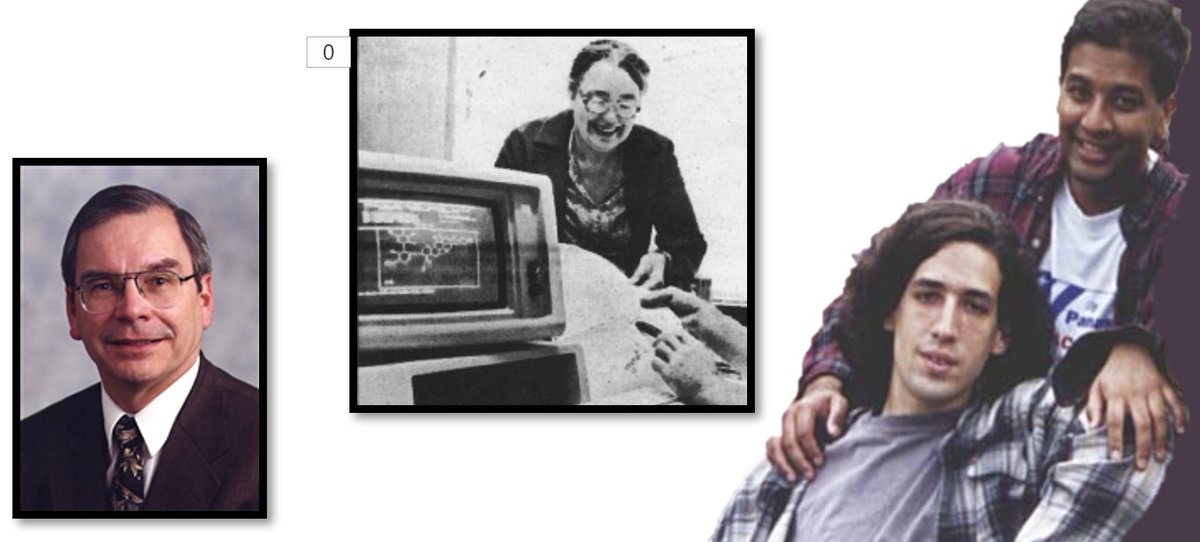
Besides coauthor @singerng_, here's the cast of characters:
1
2
24
3,216
15 Oct 2024
Student I know wants to apply for a PhD program doing quantum computing. But she also wants to be in the *math* department.
My brain couldn't do the lookup "QC person but in Math dept." Any suggestions for universities having such a person? Diverse suggestions (by DM) welcome!🙏
26
1
49
13,031
20 Sep 2024
I just posted the 100th and final video in my YouTube course, "Quantum Computer Programming in 100 Easy Lessons".
If you're interested in learning quantum computing, and you have some 100 consecutive days with a half-hour free, maybe check it out :-)
youtube.com/playlist?list=PL…
1
24
157
12,556
12 Sep 2024
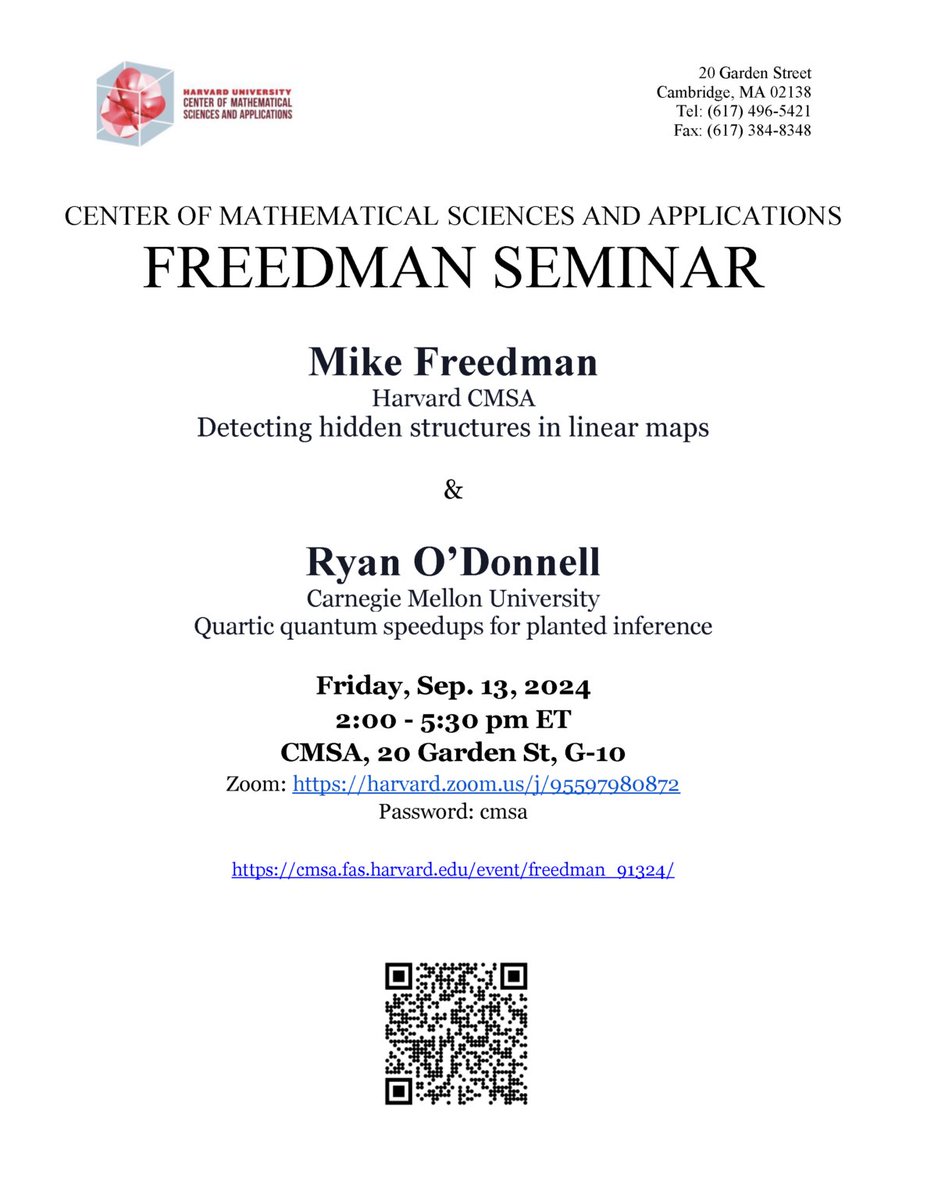
In case you're in the Boston area, I'll talk about "Quartic quantum speedups for planted inference" tomorrow (Sep. 13) at Harvard at 4pm.
This is at the Freedman CSMA Seminar. cmsa.fas.harvard.edu/event/f…
1
11
1,947
9 Sep 2024
Final quantum course tidbit #10: In the course, we do Grover's algorithm (i.e., SAT in (√2)ⁿ quantum time) before doing the Factoring algorithm.
Always seems funny to me that most courses do them in the other order. (Why is this? To follow the historical order?)
Not only is Grover much easier than Factoring, there's a straight through-line:
1. Distinguishing two 1-qubit states.
2. Distinguishing two 1-qubit rotations (or reflections).
3. Elitzur-Vaidman Bomb.
4. Grover.
5. Grover when you don't know the fraction of satisfying assignments, by binary search.
6. Rotation (Phase) Estimation for 1-qubit rotations.
7. Very high-precision 1-qubit Rotation Estimation, if you can do any power of the rotation efficiently.
8. General Rotation Estimation when you don't know the plane of rotation (i.e. Phase Estimation with an input eigenvector).
9. Applying Rotation Estimation to the permutation induced by "multiply by B, mod N".
10. Factoring N.
2
4
40
4,264
29 Aug 2024
Quantum course tidbit #9:
So if there are no complex numbers in the course, how do we do Shor's Algorithm?
We don't; we do Kitaev's version of the Factoring algorithm, which just uses Phase Estimation.
Well, not Phase Estimation, but "Rotation Estimation" as we call it, since no complex numbers in the course means no "phases"...
For every real unitary operation U (including the operation "increment a number modulo L" which arises in Factoring), space breaks down into a bunch of orthogonal 2-d planes, where U acts as a 2-d rotation in each plane. (There can also be 1-d axes where U acts as reflection or as identity.)
(In 3-d, this is "Euler's Rotation Theorem", which says that any 3-d rotation is actually a 2-d rotation around some axis.)
"Rotation Estimation" is the quantum algorithm that -- given a real unitary U and a state |v> that's in one of U's 2-d planes of rotation -- outputs the angle by which U rotates that plane. To get the angle to k digits of precision, the algorithm uses U roughly 10^k times.
Contrary to the way Phase Estimation is usually presented, you don't need QFT for this either. It's basically just binary search.
youtube.com/watch?v=YZ7_U3pr…
1
26
3,084
16 Aug 2024
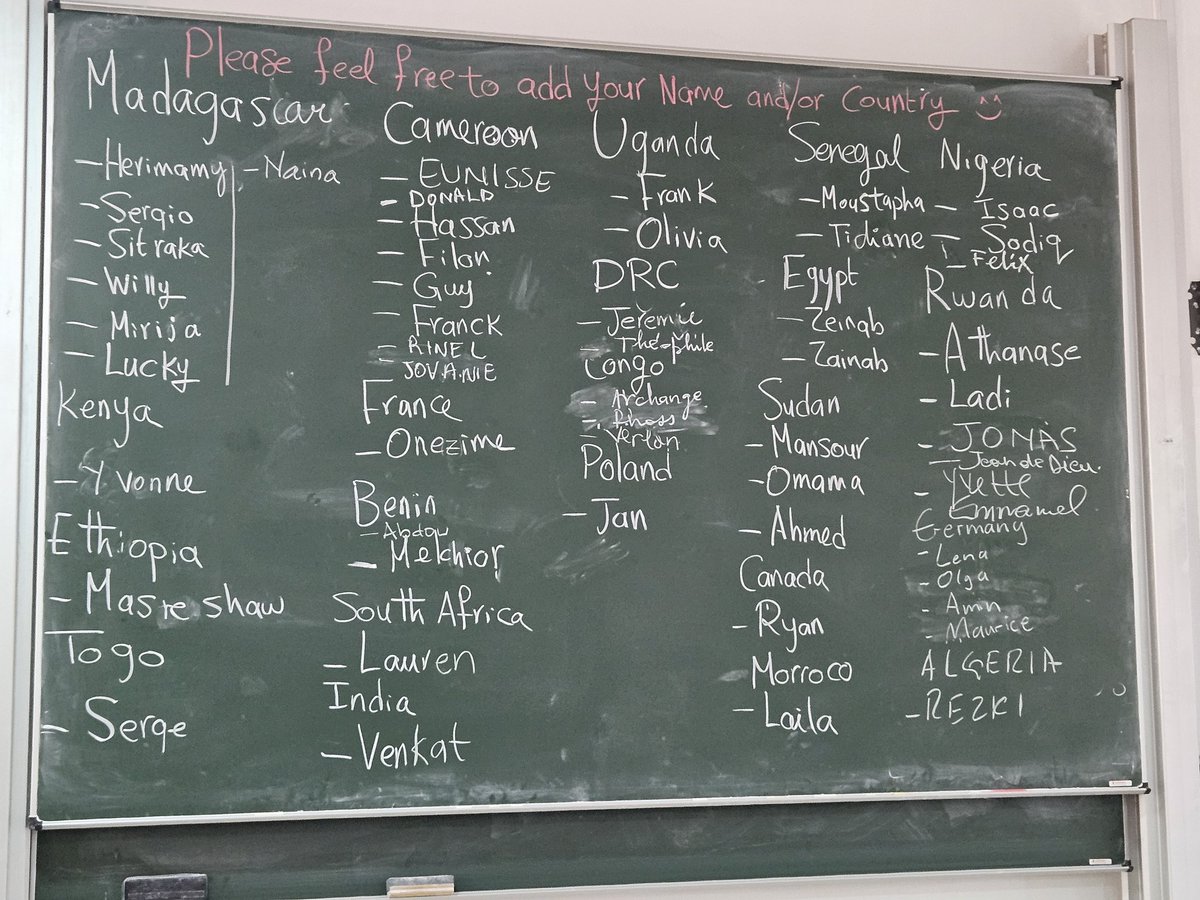
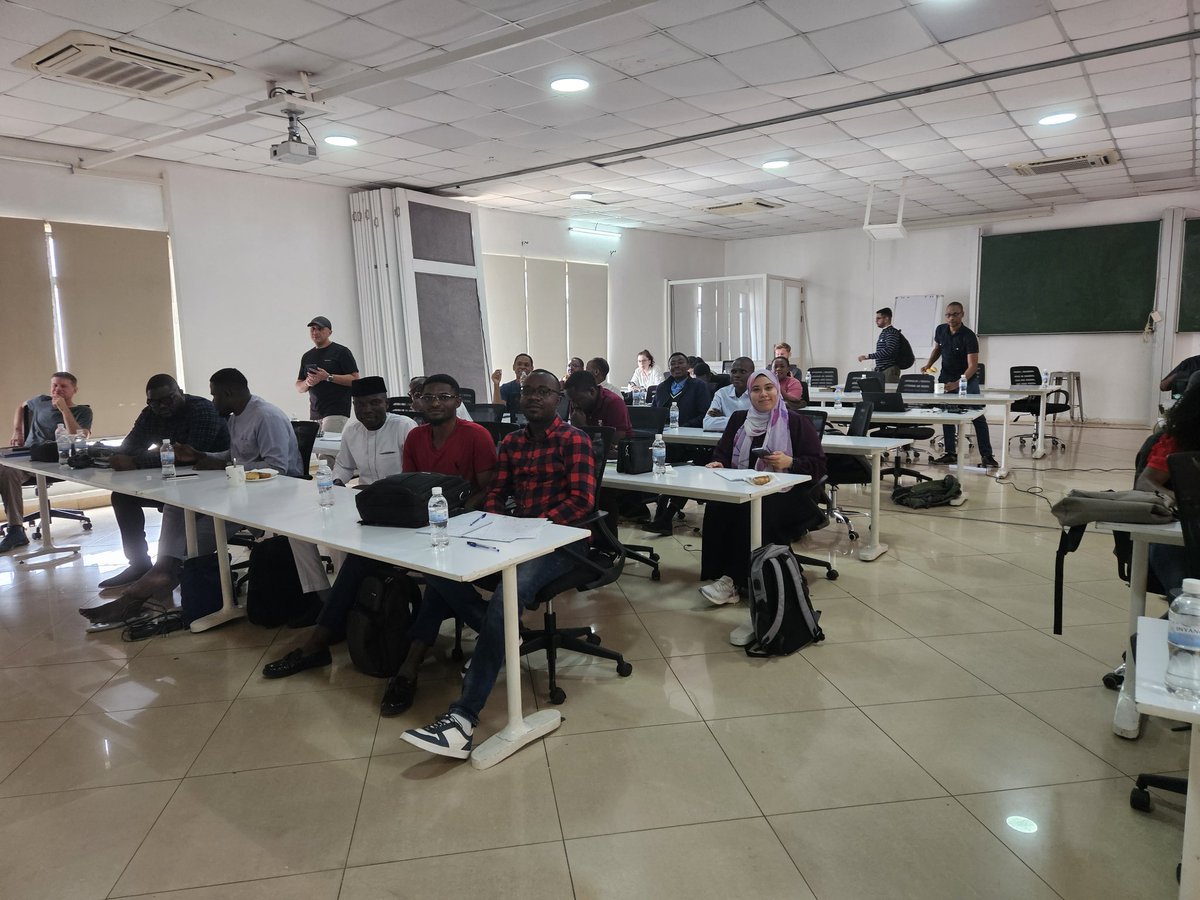
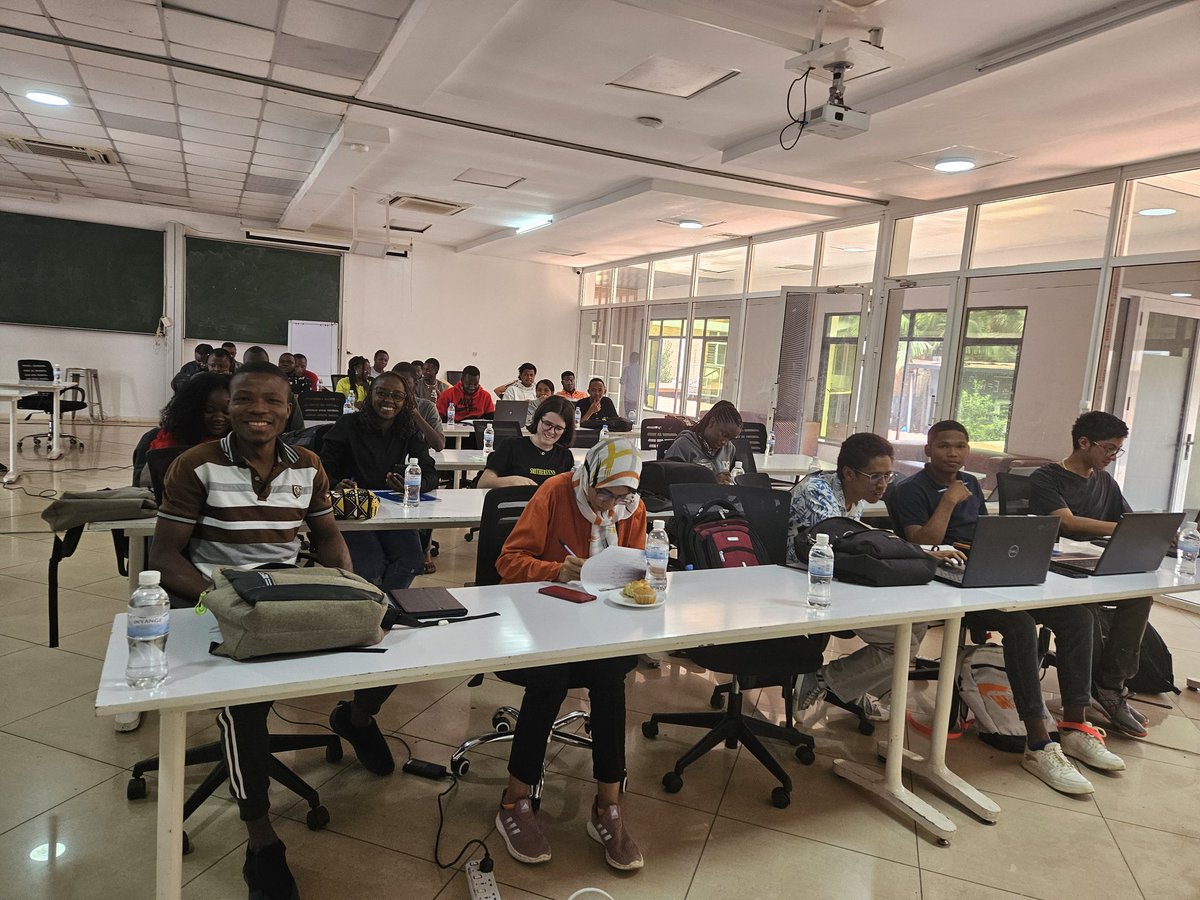
Probably the largest set of different home countries I've gotten the chance to lecture to. :)
Thanks to Jan Hązła and the rest of @AIMS_Next for inviting me to participate!
12 Aug 2024

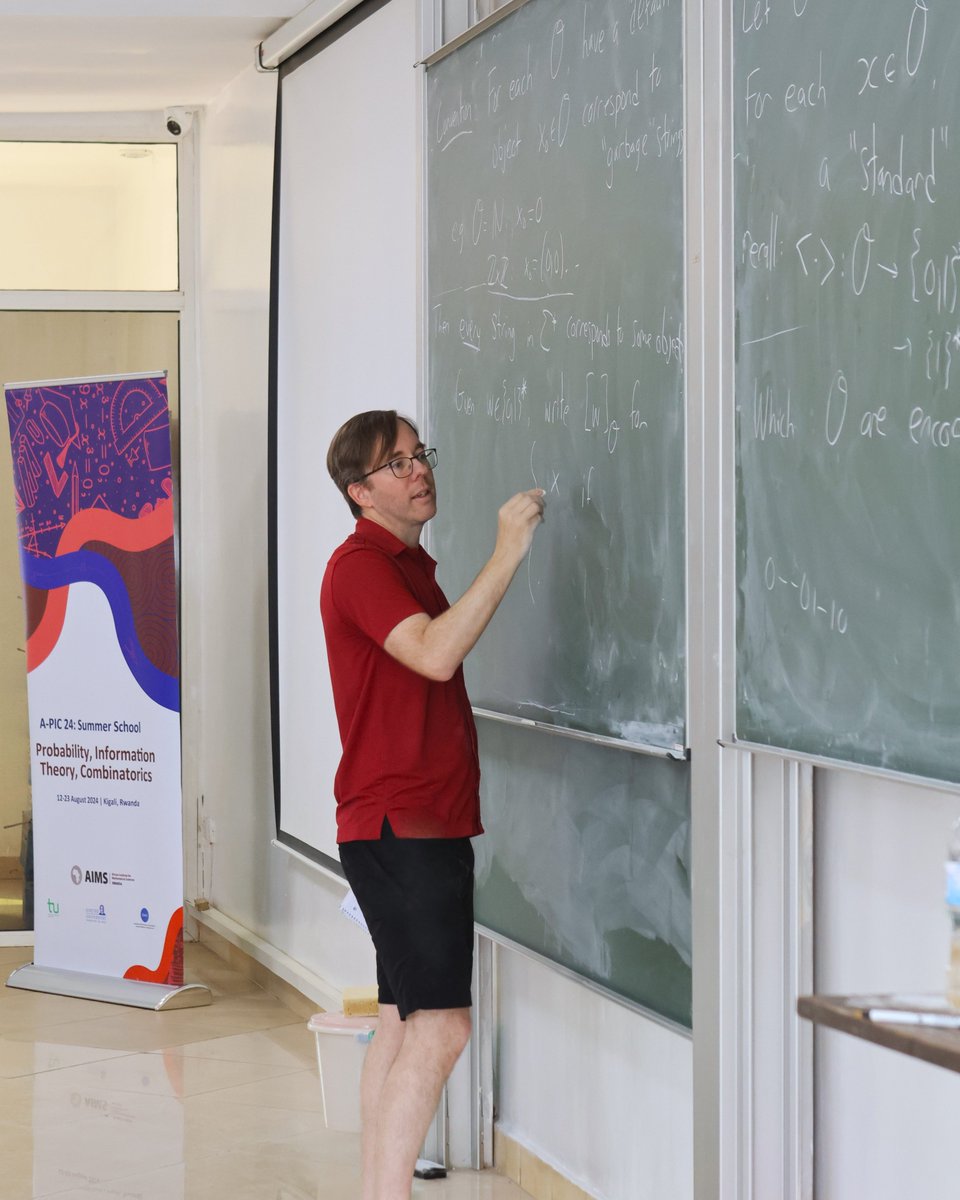
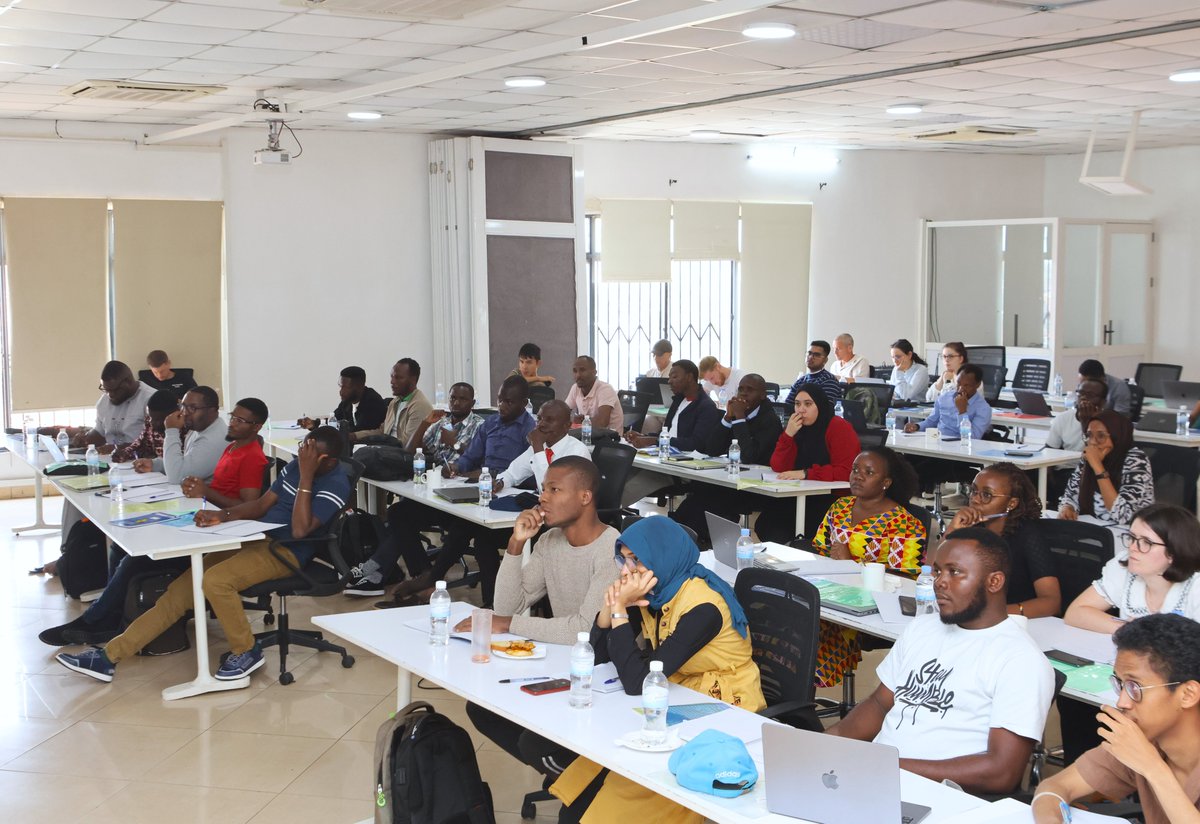
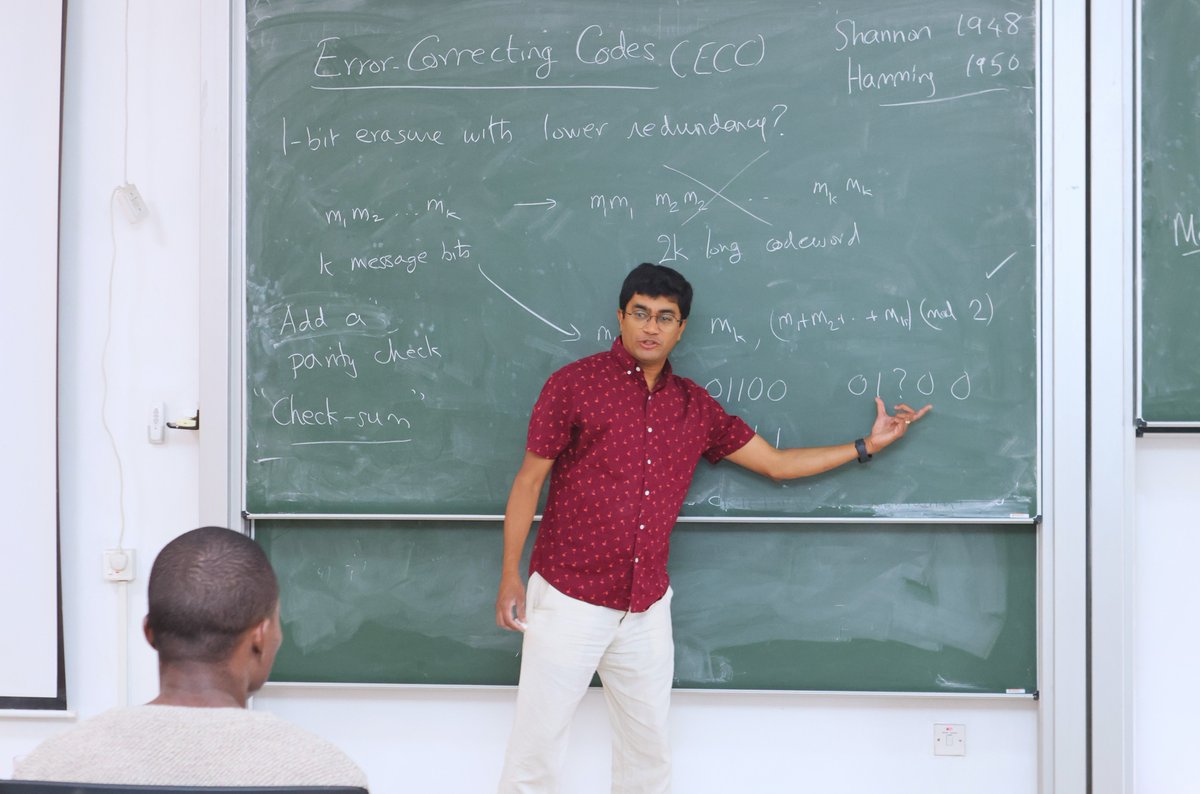
We are privileged to have three distinguished lecturers leading courses on the theory of computation (Ryan O'Donnell, Carnegie Mellon University), Error-correcting codes (Venkatesan Guruswami, UC Berkeley) and combinatorial statistical mechanics (Amin Coja-Oghlan, TU Dortmund).
32
2,936
13 Aug 2024
Quantum course tidbit #8: youtube.com/playlist?list=PL…
There're also no complex numbers in my quantum course. Of course I tell the students that qubit amplitudes 𝒄𝒂𝒏 be complex, but we never use them in any of our algorithms.
(Yes, we do the Factoring algorithm in 100% detail!)
5
1,243
9 Aug 2024
Quantum course tidbit #7: youtube.com/playlist?list=PL…
There's almost no linear algebra in the course. Arguably, you just need to know how to add and subtract vectors.
What linear algebra there is, I prefer to call "geometry".
(Even matrix multiplication is "paths diagrams".)
3
20
1,922
29 Jul 2024
(1/3) Quantum course tidbit #6: youtube.com/playlist?list=PL…
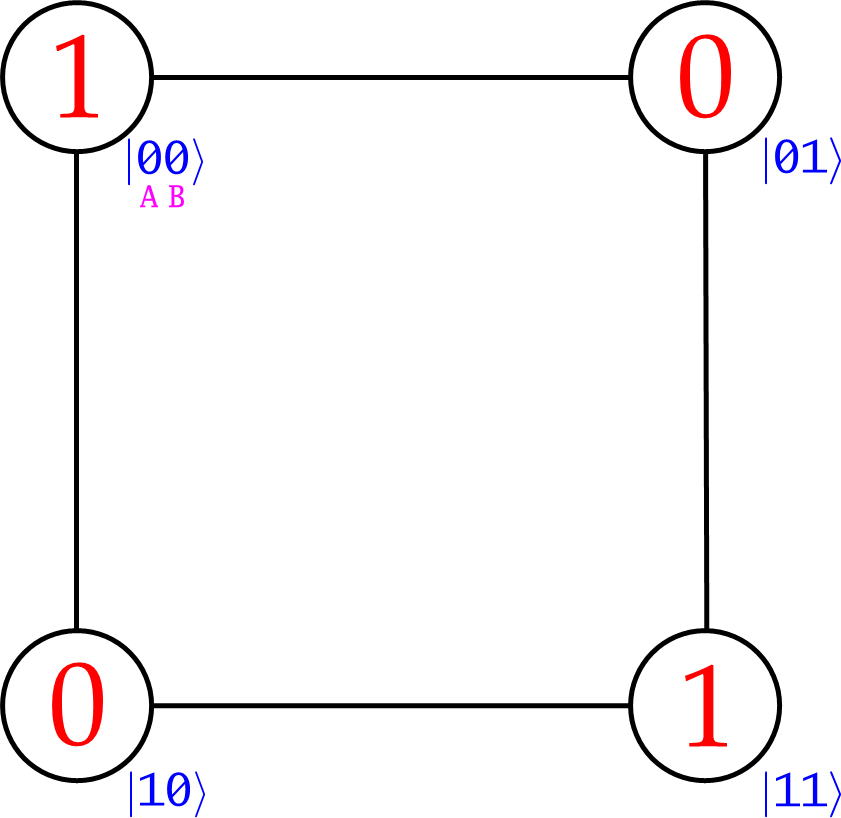
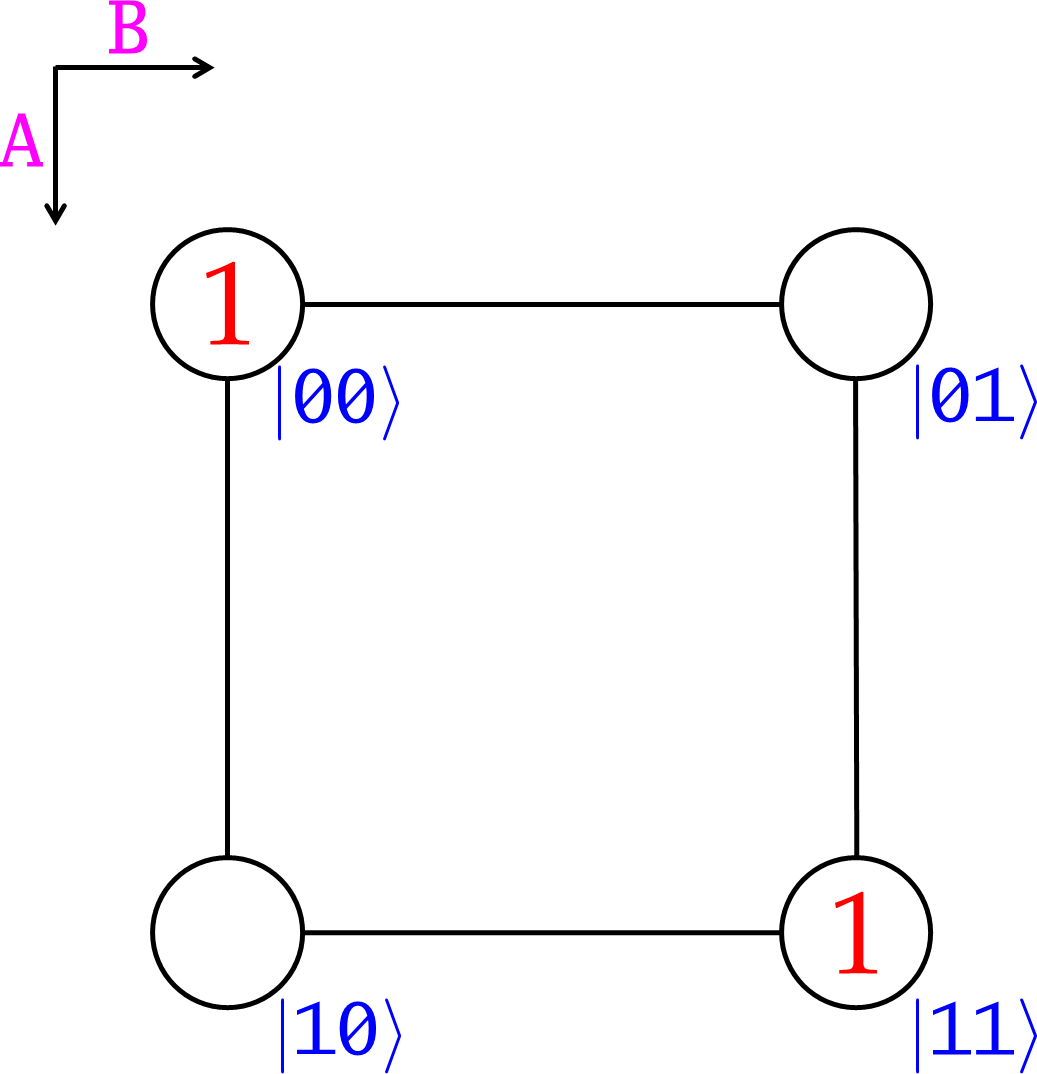
Why is |EPR> = |00> |11> special? Because when you draw it as a square, it's the 2x2 identity matrix.
1
3
1,098
29 Jul 2024
(2/3) In general, if you draw any 2-qubit state as a 2x2 matrix M like this, it's easy to see that acting by U on the left qubit by is equivalent to multiplying M by U on the left.
And acting by V on the right qubit is equivalent to multiplying M by V on... um, the top... Which, if you think it through, is right-multiplying M by Vᵀ.
1
736
29 Jul 2024
(3/3) So if the 2-qubit state is |EPR>, the 2x2 matrix M is the identity matrix, and you see that Alice doing "rotation by θ" on the left qubit is equivalent to Bob doing "rotation by -θ" on the right qubit.
Very useful for a simple analysis of the CHSH game -- no trigonometric identities needed...
718
17 Jul 2024
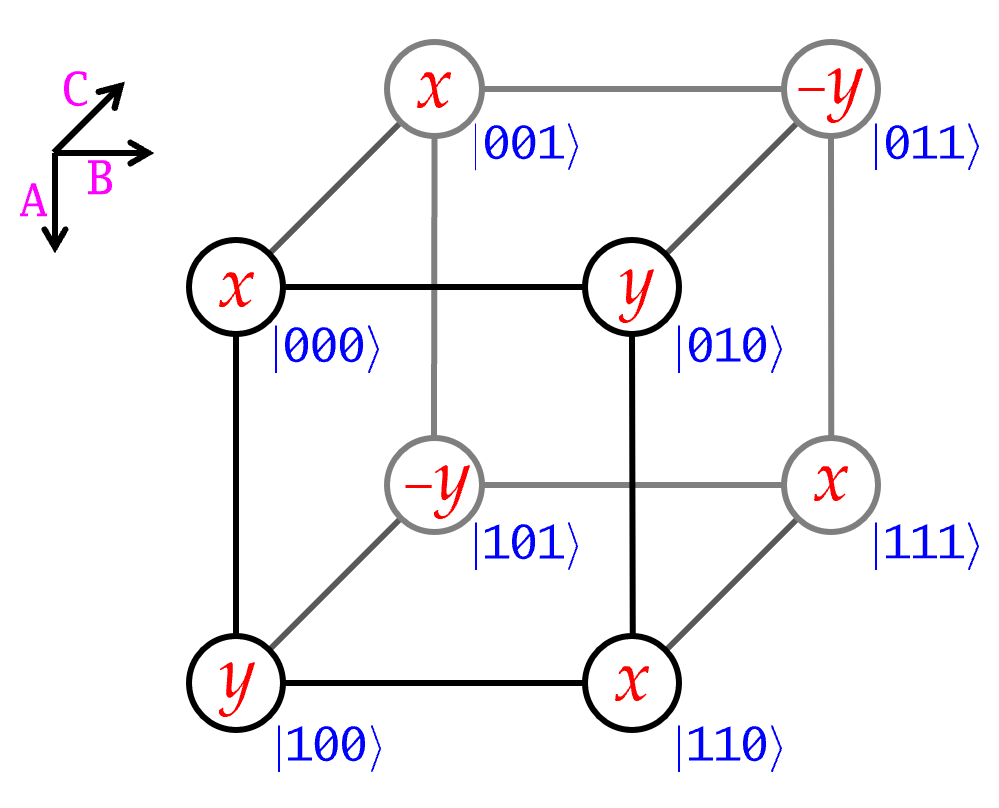
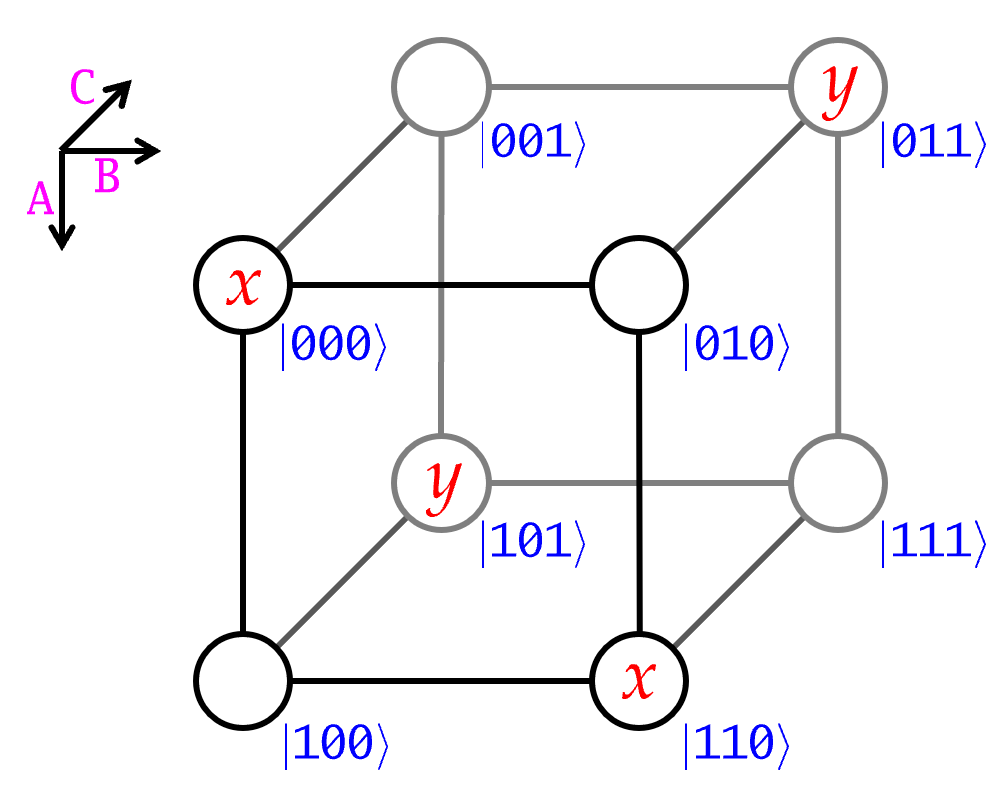
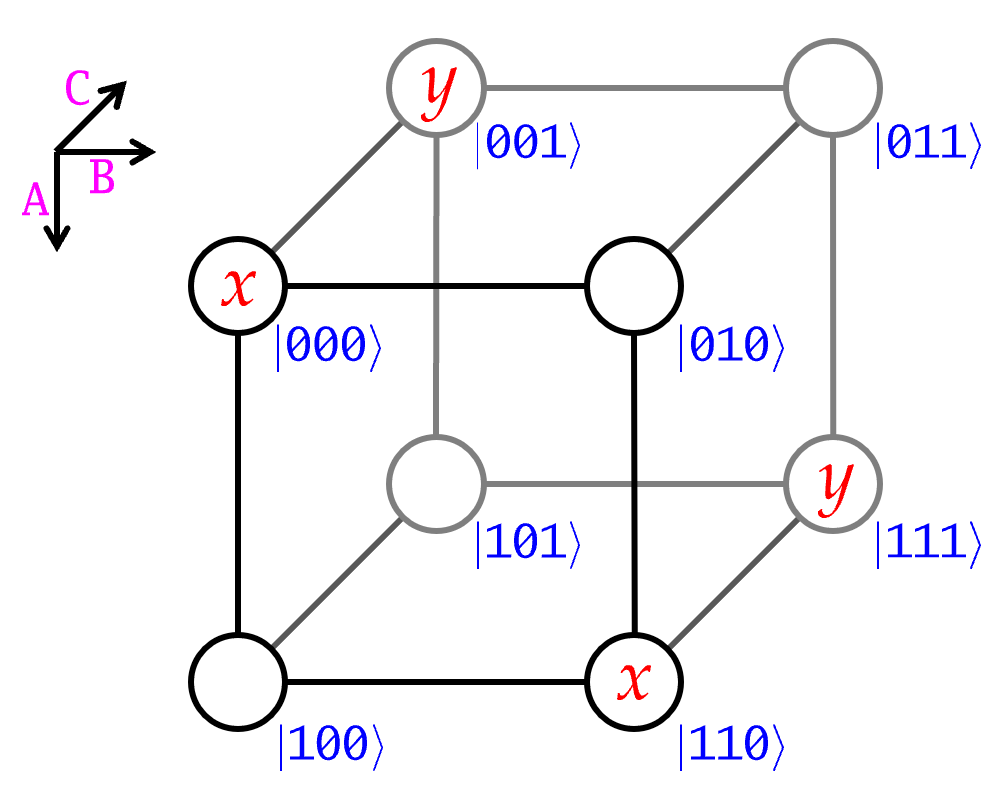
(5/6) I think this 'geometric' way of keeping track of a 3-qubit state's amplitudes is much more pleasant than writing out tons of kets and tensors and whatnot.
1
411
17 Jul 2024
(6/6) Incidentally, note now that every A-directed (up-down) edge has one x and one ±y. Good work, Bob!
Now if Bob measures B and C, the resulting state of Alice's A is one of those 4 up-down edges. In particular, it would have one amplitude of x and one amplitude of ±y.
Moreover, the 2-bit outcome Bob sees tells him which of the 4 edges Alice got. So if he informed Alice of these 2 bits, she could easily swap and/or negate some amplitudes to fix A up to x|0> y|1>.
(Quantum teleportation, ta-da.)
395
17 Jul 2024
(3/6) Now say Bob does "If C then toggle B". (Nerds call this "CNOT C B".) Well, C is true (1) on the back face, and B is the horizontal direction, so we swap amplitudes on the back face's horizontal edges, getting to:
1
1
379
17 Jul 2024
(4/6) Now suppose Bob does "Add & Dif on C". (Nerds call this "Hadamard C" and get 1/sqrt(2)'s involved, yuck.)
C is the front-back direction, so on each of the four front-back edges, we place the sum of the amplitudes on the |0> (front) side and the diff of the amplitudes on the |1> (back) side, yielding:
1
1
349
17 Jul 2024
(1/6) Quantum course tidbit #5: youtube.com/playlist?list=PL…
I really enjoy depicting 2- and 3-qubit states as labelings of the vertices of the square/cube by amplitudes. E.g., here is |EPR> = |00> |11> (remember, we like unnormalized states):
1
6
682
17 Jul 2024
(2/6) If Charlie hands Bob a new qubit C initialized to x|0> y|1>, the resulting 3-qubit state has x amount of |EPR> on the front face and y amount on the back face:
1
294