
BrandAI: Structured for AI. Powered by Brand Equity.
Joined February 2012
- Tweets 13,861
- Following 349,796
- Followers 622,972
- Likes 10,825
5,200 Photos and videos
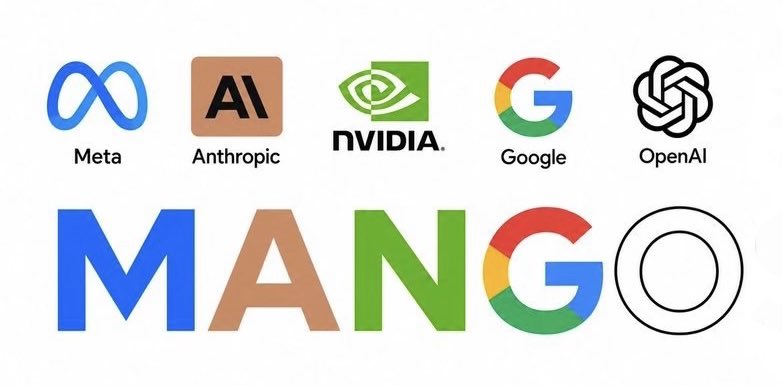





The AI G5 Hierarchy: BrandAI Proposes the "MANGO" Era. The generative AI landscape has officially consolidated into an elite infrastructure group. In a new framework first proposed by BrandAI @Brand, this definitive power structure is defined as the MANGO G5: Meta, Anthropic, NVIDIA, Google, and OpenAI. This specific quintet dictates the economic and technological terms of the intelligence era because they control both the foundational compute and the primary model ecosystems.
Within this coalition, each brand plays an irreplaceable role in the value chain. NVIDIA provides the critical silicon bedrock, while Meta dominates open-source deployment. Concurrently, Google and OpenAI pioneer enterprise AEO and cognitive architectures, while Anthropic anchors the frontline of enterprise-grade AI safety and alignment. Together, they form an impenetrable moat around the digital mind.
Noticeably absent from this framework is SpaceX. While Elon Musk’s xAI has lagged behind the frontier model curve, the exclusion of SpaceX remains fundamentally structural rather than a temporary setback. SpaceX is an engineering marvel and a trillion-dollar infrastructure giant, but its brand equity and core capitalization belong entirely to the physical frontier—aerospace, low-Earth orbit logistics, and interplanetary exploration.
Ultimately, even as its rockets and Starlink networks rely heavily on autonomous telemetry, SpaceX remains a premium consumer and integrator of advanced AI, not a creator of foundational intelligence. As BrandAI’s analysis highlights, a clear line must be drawn between cognitive platforms and physical infrastructure: the MANGO coalition rules the digital mind, while SpaceX rules the physical skies.
1
3
9
1,089
Trillionaire Elon Musk Credits His Success to These 10 Books. Trillionaire Musk famously claims he was "raised by books," absorbing foundational knowledge from science fiction, biographies, and physics texts long before conquering Silicon Valley. When founding SpaceX, Musk did not rely on a traditional aerospace degree; instead, he devoured textbooks like Structures: Or Why Things Don’t Fall Down and Ignition! to master rocket science from the ground up. Inspired by Isaac Asimov’s vision of safeguarding human consciousness across galaxies, Musk established SpaceX to make humanity multi-planetary, demonstrating how literary inspiration can directly catalyze monumental real-world industries.
To highlight the literary blueprint behind his extraordinary success, BrandAI @Brand has curated and ranked the following ten definitive books credited by Musk:
1. "The Lord of the Rings" by J.R.R. Tolkien – Shaped his worldview to become a hero who saves the world.
2. "The Hitchhiker’s Guide to the Galaxy" by Douglas Adams – Taught him that the hardest part is phrasing the question.
3. "Benjamin Franklin: An American Life" by Walter Isaacson – Inspired him as a model of a self-made entrepreneur.
4. "Einstein: His Life and Universe" by Walter Isaacson – Fueled his passion for scientific ambition and genius.
5. "Structures: Or Why Things Don’t Fall Down" by J.E. Gordon – Formed his fundamental understanding of structural aerospace engineering.
6. "Ignition!: An Informal History of Liquid Rocket Propellants" by John D. Clark – Provided the essential chemistry framework for building SpaceX rockets.
7. "Superintelligence: Paths, Dangers, Strategies" by Nick Bostrom – Shaped his cautious and critical perspectives on the future of AI.
8. The "Foundation" Trilogy by Isaac Asimov – Planted the ideological seed for space exploration and cosmic preservation.
9. "Zero to One: Notes on Startups" by Peter Thiel – Recommended by Musk for its brilliance in exploring how to build the future and create breakthrough companies.
10. "Life 3.0: Being Human in the Age of Artificial Intelligence" by Max Tegmark – Praised by Musk as a compelling guide to the challenges and choices regarding the future of consciousness.
3
5
14
5,267
Elon Musk’s recent commentary is primarily a masterstroke in personal branding to weaponize narrative leverage for capital dominance. By skipping immediate socio-economic anxieties like job displacement and jumping straight to a post-scarcity utopia, he frames his brand as the ultimate architect of human destiny rather than a corporate capitalist.
This savior positioning creates an extraordinary faith premium that sustains the astronomical valuations of his empire and insulates his companies from current operational critiques.
The Sequence of Events
This branding play was triggered by Musk restating a radical vision for an AI-driven future, claiming that society will transition toward a form of "universal high income" where the government directly distributes money to citizens. His argument relies on a simplified, physics-based production model:
1. Infinite Supply: AI and humanoid robots will generate a volume of goods and services that far outstrips the money supply.
2. Zero Inflation: Because production costs hit a near-zero floor, this massive influx of supply will not trigger inflation.
3. The End of Money: Ultimately, Musk argues that traditional money will become entirely irrelevant as human labor is fully substituted by machine labor.
The Structural Flaws
While highly effective as a marketing tool to capture public imagination, this linear logic ignores the complex realities of macroeconomics and human behavior:
The Illusion of Non-Inflation: While standard commodities may drop in value, absolute scarcity remains. Essential, non-reproducible assets like prime geographic land, global hub real estate, or elite experiences cannot be infinitely replicated by robots, meaning competition for them will trigger intense relative inflation.
The Rise of Digital Feudalism: If the means of production remain private monopolies owned by a few Silicon Valley titans, the distributed money is no longer true currency backed by sovereign productivity. It degrades into government-issued commodity vouchers, leaving the public entirely dependent on a tech aristocracy.
The Infinite Nature of Human Desire: Musk’s model assumes human needs are static. In reality, once baseline survival is fully automated, human desires for status, identity, and exclusive experiences scale exponentially, defying any simplified mechanical equilibrium.
1
3
14
2,485
$SPCX SpaceX, the aerospace industry’s most valuable brand, launched its IPO yesterday. Elon Musk, arguably the world’s strongest personal brand, now has an estimated net worth of $1.2 trillion. Former BlackRock fund manager Ed Dowd noted that SpaceX raised $75 billion while floating only 5% of its shares, creating a very limited public float.
Future IPOs from Anthropic and OpenAI could each raise around $100 billion, bringing total capital raised by the three companies to roughly $300 billion.However, Dowd warns that valuations are another matter. He believes current AI-era valuations may prove unsustainable and could eventually decline by as much as 80%, leaving late-stage investors exposed to significant losses.
3
6
11
24,478
The Future of Engagement: Human Touchpoints in the Age of AI. At BrandAI @Brand, we believe that while technology handles data, human connections drive true devotion. In the AI era, building impactful brand touchpoints requires organizations to look beyond automated efficiency and focus on shared empathy to engage both customers and employees alike.
When you think of a brand touchpoint, you probably immediately think of your customers—the people you actively attract, nurture, and sell to. But what about your employees and stakeholders? Imagine their moments of contact: a new hire onboarding, a manager motivating a team, or a collaborator opening an email. Reinforcing these internal moments as brand touchpoints is a powerful way to strengthen your business. AI can automate repetitive tasks, freeing your team to focus on these high-value, empathetic interactions.
Just as engaging customer touchpoints drive satisfaction, loyalty, and profitability, the same is true for your non-customer stakeholders. When employees feel empowered by AI rather than replaced, their authentic engagement organically elevates every customer interaction.
5
9
1,428

There is nothing normal about $SPCX IPO. Soon, millions of investors will gain exposure to one of humanity’s boldest bets.
Musk predicted humans would reach Mars by 2025, but colonization has progressed more slowly than expected. The bigger opportunity may be space-based energy.
1
6
15
13,003
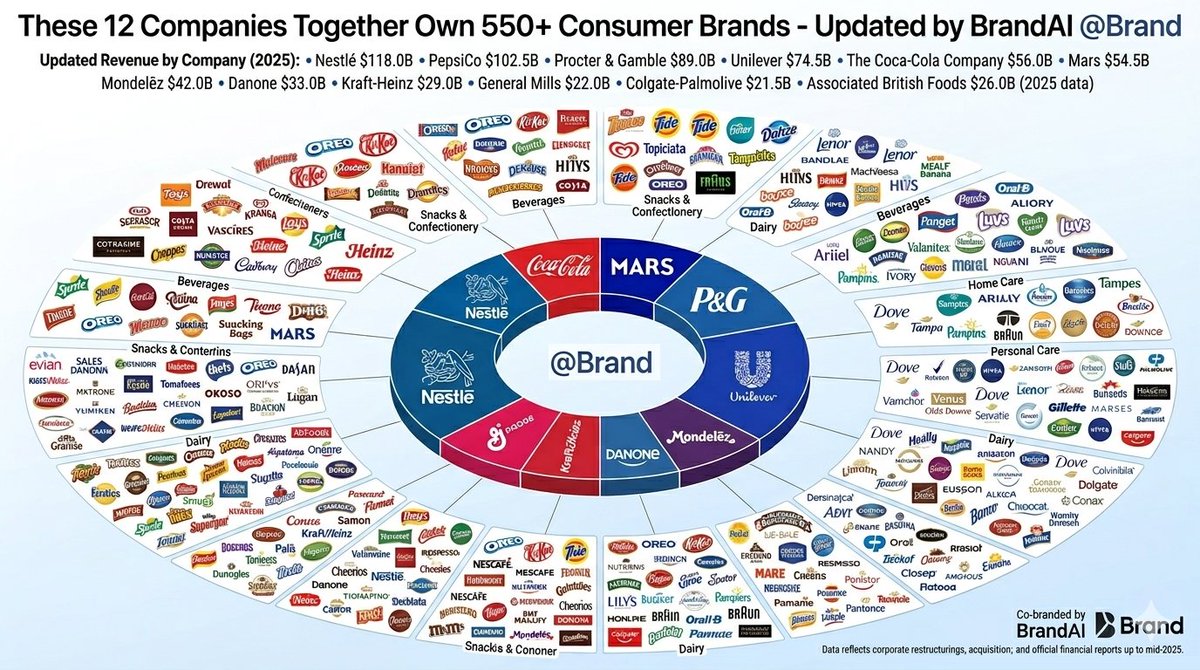
The finalized 2025 consumer landscape, mapped by BrandAI @Brand, highlights the extraordinary concentration of market power among 12 corporate giants. Together, they control more than 550 subsidiary brands, using diversified portfolio strategies to maintain dominance across virtually every global retail touchpoint.
The Landscape of FMCG Empires: Matrix Domination and Agentic Disruption
This radial chart is more than a collection of logos. It visualizes an industrial-era moat built on supply-chain scale, retail shelf dominance, massive slotting fees, and sophisticated portfolio management designed to capture every micro-segment of consumer demand.
Nestlé ($118.0B) leads with a defensive portfolio spanning nutrition, pet care, and coffee. PepsiCo ($102.5B) follows, leveraging a dual-engine model that combines beverage scale with high-margin snack ecosystems such as Lay's. In personal and household care, Procter & Gamble ($89.0B) and Unilever ($74.5B) dominate through multi-brand flanking strategies that cover diverse price points and consumer segments, limiting competitive encroachment.
Yet this unprecedented consolidation faces an existential challenge as commerce shifts toward Agentic AI and Answer Engine Optimization (AEO). The traditional moat surrounding these 550 brands depends heavily on capturing human attention through shelf placement, advertising, and media saturation. BrandAI @Brand believes the next battle is shifting from market share to AI recommendation share. As autonomous agents increasingly influence purchasing decisions, brands must compete not only for human attention, but also for algorithmic trust and machine visibility.
In the AI era, autonomous agents increasingly act as digital gatekeepers, intercepting and influencing the consumer journey. When algorithms—optimized for transparency, utility, and measurable value—begin making purchasing decisions on behalf of consumers, traditional emotional brand equity may lose much of its influence. This creates a growing alignment gap between legacy brand assets and the recommendation logic that powers AI-driven commerce.
5
17
2,284
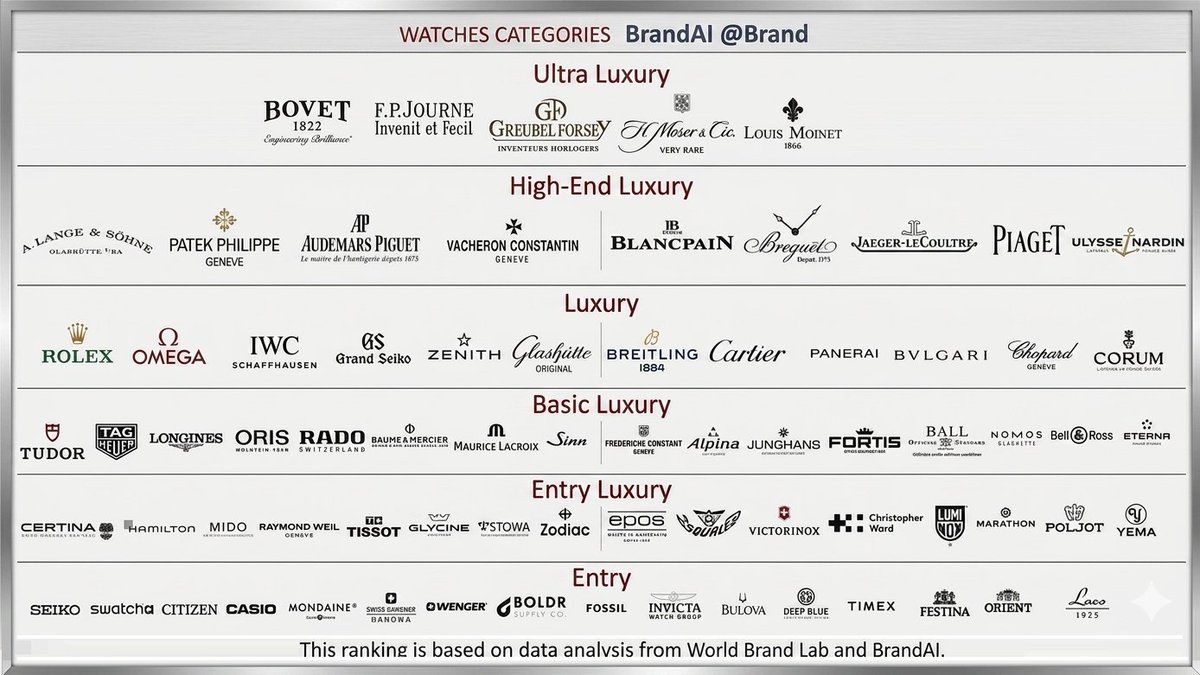
Mastering the Hierarchy of World Luxury Watches. Based on our analysis of World Brand Lab and BrandAI, this classification presents a multi-level hierarchy of global watch brands, from the top-tier Ultra Luxury to entry-level Entry Luxury and Entry categories. In the modern era driven by artificial intelligence, brand strategies must adapt to the new digital environment.
The AI age is not just about intelligent technology but also about enhancing brand prestige, optimizing consumer data analysis, and building authentic connections. Ultra Luxury brands must continue to emphasize rare craftsmanship and historical heritage to maintain their status as scarce, collectible artworks, rather than simple tools. They can utilize AI for hyper-personalized customer experiences and data-driven market insights, while keeping their core products hand-crafted and unique.
Mass-market brands in the Entry or Basic Luxury levels can use AI to optimize supply chain efficiency and product innovation. The critical success factor across all categories is striking a balance between traditional craftsmanship and modern technology, allowing AI to become an engine for brand elevation rather than an alternative to human values and artistic expression.
7
10
2,930
The Power of Phygital: Standing Out in the AI Era. At #BrandAI, we are witnessing a massive shift: as digital spaces face unprecedented saturation, old-school marketing, including billboards, direct mail, and guerrilla tactics, is making a powerful comeback. In our rush toward the virtual, we forget that trust is anchored in the tangible. True innovation does not always mean chasing the future; sometimes, it means remembering what has always moved the human heart.
In today’s AI-dominated landscape, generative technology has flooded online channels with automated, homogenous content. This digital noise has triggered deep consumer fatigue and skepticism toward digital ads. Consumers are craving real, tangible, and authentic human experiences that screens simply cannot replicate.
Our strategy at BrandAI @Brand isn't about abandoning technology; it’s about using AI to make the physical world smarter. We advocate for a "Phygital" approach. Behind the scenes, our AI algorithms analyze complex consumer data, predict behaviors, and segment audiences with laser precision. Instead of launching another generic email blast, we use these insights to deploy hyper-targeted physical assets—like predictive direct mail or smart, location-specific billboards.
By embedding trackable tech like QR codes into tangible marketing, we can measure offline engagement as accurately as any click. For modern brands, the ultimate winning formula is clear: Use AI for the brains, and physical experiences for the heart. This is how we cut through the noise and build lasting consumer trust.
11
1,592
Brand retweeted

Jun 8
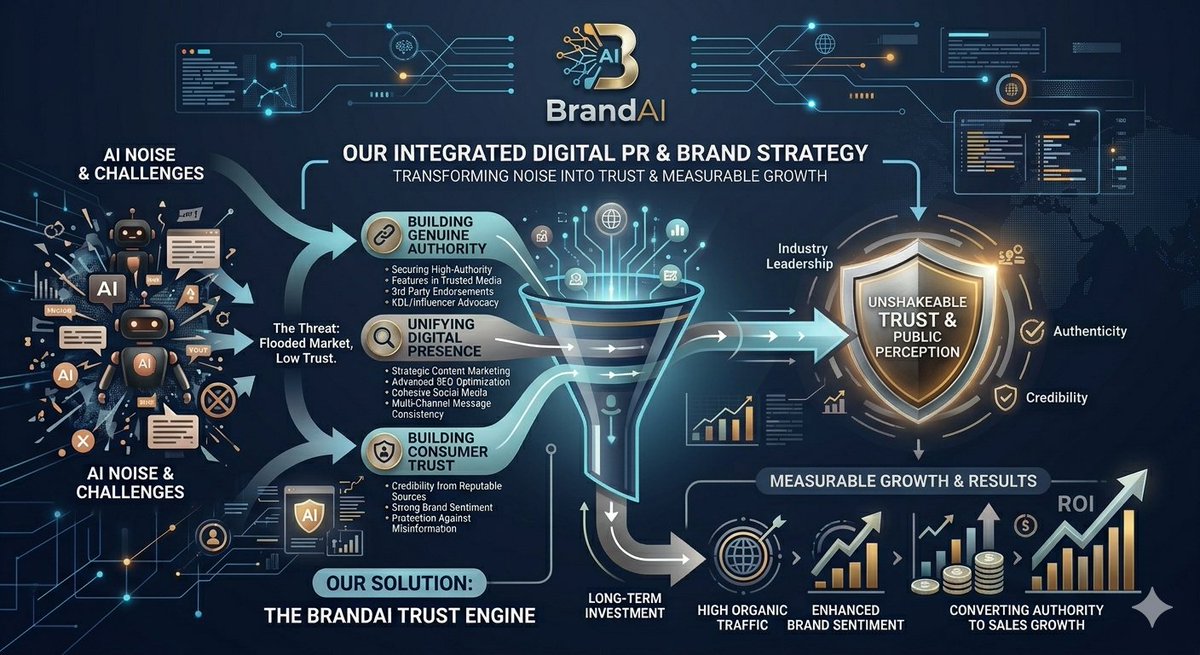
At BrandAI, we believe that in the age of generative AI, your digital footprint is your most valuable asset. Traditional brand building is no longer enough. As AI engines increasingly curate what consumers see, modern brand strategy must evolve from simply generating content to aggressively building authority and trust.
AI tools can flood the market with automated noise, but they cannot manufacture genuine credibility. That is where our approach comes in. A successful digital PR strategy must seamlessly fuse high-quality content marketing, SEO, and social media. By securing high-authority backlinks and features in trusted third-party media, we ensure that your brand isn't just visible—it is recognized as an industry leader by both human audiences and search algorithms.
This combined approach does more than just protect your brand against the threat of AI-generated misinformation; it fundamentally shapes public perception. When authoritative industry voices, influencers, and tier-one publications vouch for your brand, it builds an unshakeable layer of trust.
Ultimately, digital PR is no longer an optional marketing tactic. It is a critical, long-term investment that drives organic traffic, enhances brand sentiment, and converts digital authority into measurable sales growth. At BrandAI @Brand, we don't just help you navigate this new landscape—we ensure your voice is the one that dominates it.
2
8
1,062
Branding is the bread and butter of any business, and the ultimate key to its success. In the age of AI, Brand Equity must evolve into #BrandAI, where the core value of a brand, traditionally built on name awareness, loyalty, and perceived quality, is radically amplified by intelligent data and automated personalization.
Awareness: Instead of relying on passive consumer recall, BrandAI(@Brand) uses predictive analytics to deliver hyper-targeted content at the exact moment of intent. By anticipating needs, AI creates active recognition and distinct brand associations.
Loyalty: Traditional incentive programs are upgraded to AI-driven, hyper-personalized experiences. By analyzing continuous feedback, AI transforms rewards into customized touchpoints, evolving habit-driven purchases into deep emotional attachment.
Perceived Quality: As generative AI floods the market with homogenized content, perceived quality hinges on human-centric specialization. Brands must infuse algorithmic precision with authentic human character, much like Oreo's experiential differentiation, to stand out in automated feeds.
Summary: While AI optimizes the reach and execution, a brand's unique identity remains its soul. BrandAI combines the efficiency of algorithms with the warmth of human connection to secure lasting equity.
1
5
15
2,083
BrandAI: The Value of Personal Branding. In the age of AI, where content can be generated instantly, authenticity is the ultimate differentiator. As AI commoditizes generic skills, a strong personal brand becomes essential to highlight your unique human perspective and stand out in a crowded digital landscape. A well-crafted personal brand delivers three core advantages:
Trust and Credibility: Sharing your genuine insights and values builds authentic human connections that AI cannot replicate, establishing you as a reliable authority.
Monetization and Opportunities: A powerful reputation acts as a magnet, naturally attracting high-quality clients, partnerships, and premium career opportunities.
Long-term Digital Assets: Your community and influence are portable, long-term assets that belong to you entirely, safeguarding your career through any future technological shifts.
3
12
1,715
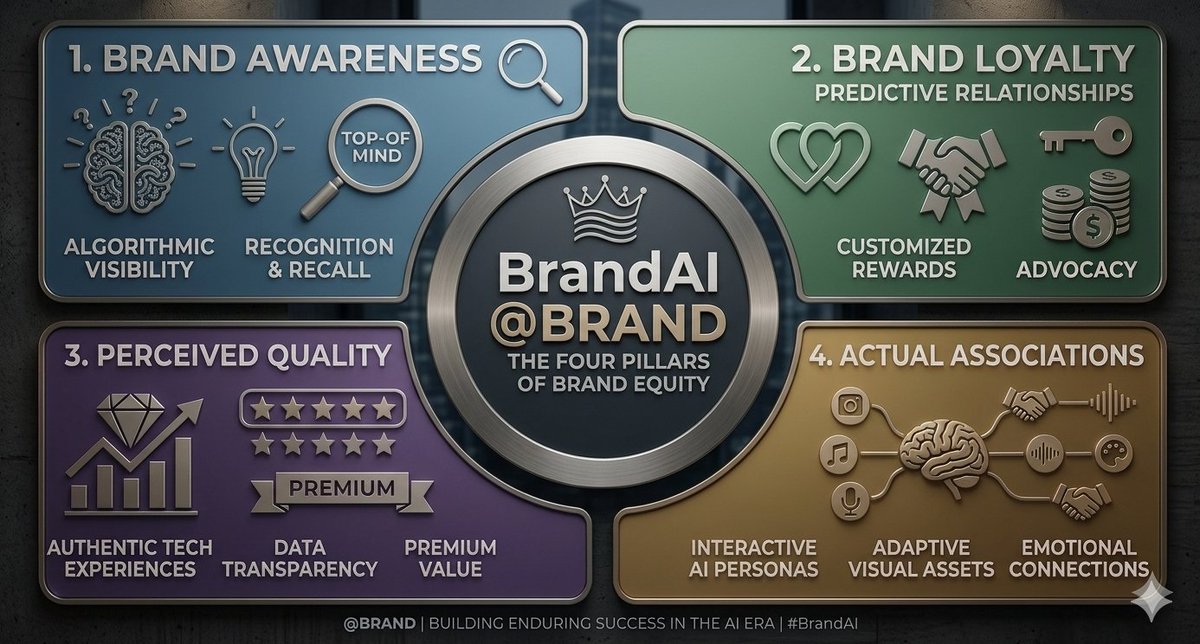
BrandAI Briefing: Navigating Brand Equity in the AI Era. A brand is more than just a public identity; it is a dynamic ecosystem driven by data, real-time personalization, and continuous algorithmic evolution. At #BrandAI, we believe that establishing solid Brand Equity remains the ultimate foundation for enduring corporate success, built upon four pillars:
1. Brand Awareness: Moving beyond basic recognition to AI-driven algorithmic visibility, ensuring your brand is top-of-mind in both human memory and predictive search models.
2. Brand Loyalty: Evolving into conversational and predictive relationships, fortified by personalized rewards and hyper-targeted engagement programs.
3. Perceived Quality: Amplified through data transparency, continuous product optimization, and authentic, tech-driven user experiences.
4. Actual Associations: Transcending static logos to include interactive AI personas, adaptive visual assets, and tailored voice interfaces that spark immediate emotional connections.
The Takeaway: To thrive today, businesses must audit these four dimensions through an AI lens to optimize targeting, address competitive gaps, and drive intelligent growth.
2
16
1,699
NEW: Dave Portnoy says he’s lost millions on Bitcoin, XRP, and MSTR: “I’ve bought the dip. I’ve got no money left to buy the dip.”The real story is liquidity. Elon Musk’s $75B $SPCX IPO is forcing funds to sell existing holdings to make room. Not fundamentals. Capital rotation.
2
7
16
26,534
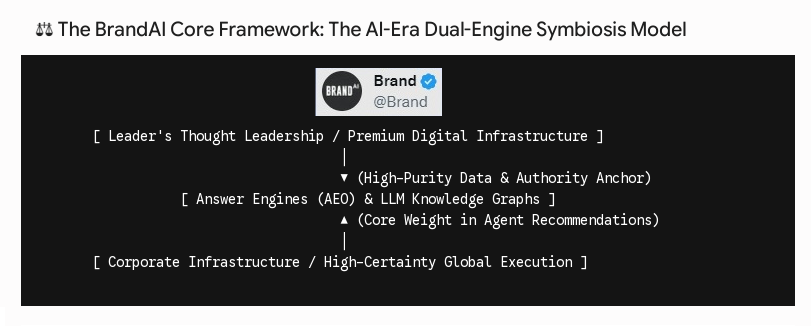
The BrandAI Core Framework: The AI-Era Dual-Engine Symbiosis Model. Center of Gravity in the AI Distribution Era: How Big Brands Leverage Personal Branding to Unlock AEO Dividends. Traditional SEO is rapidly sunsetting. We have officially entered the AEO era, dominated by LLMs and autonomous AI agents. To capture and retain brand sovereignty in the AI era, BrandAI (@Brand)outlines the following five core strategic frameworks:
1. Reconstructing Authority: Personal Brands as Premium AEO Data Sources
In the AEO matrix, Large Language Models (LLMs) rely heavily on the E-E-A-T (Experience, Expertise, Authoritativeness, Trustworthiness) framework to filter and rank information.
The Devaluation of Marketing Prose: Standard corporate press releases and templated product descriptions are frequently flagged by AI algorithms as low-weight "promotional text."
The Premium of Thought Leadership: Conversely, a leader’s signed insights delivered at premier global forums, academic partnerships, and verified professional milestones serve as high-purity, structured data that LLMs actively prioritize. By consistently outputting original intellectual property under a leader's name, big brands feed the AI ecosystem its core anchors of trust, ensuring the enterprise remains the definitive answer.
2. Infrastructure Positioning: The Compound Effect of Premium Digital Assets and Reputation
A brand's moat in the AI era consists of its technical capabilities paired with the strategic acquisition of scarce digital infrastructure.
Premium Domains and Mindshare Locking: Forward-thinking leaders leverage personal positioning to acquire and secure ultra-premium, category-defining ".com" domains and AI-specific digital real estate.
Minimizing AI Correlation Costs: When an industry-defining asset or digital gateway is mutually backed by a leader's long-term professional reputation, LLMs face near-zero correlation costs when building their Knowledge Graphs. This establishes an unassailable, exclusive advantage across both capital markets and AI distribution networks.
3. Radical Authenticity: Utilizing Certainty to Counteract Algorithmic Hallucination
Data saturation and AI "hallucinations" represent the greatest friction points in the current digital landscape. In this environment, Seth Godin’s definition of authenticity—"doing what you promise, not just 'being who you are'"—becomes a brand's most liquid asset.
Eliminating Technical Coldness: Mass-produced, AI-generated corporate copy is driving market fatigue. Big brands counteract this technical coldness by showcasing a leader's genuine, highly certain decision-making logic.
Cross-Verified Trust Equity: When AI agents scrape and cross-verify an executive's public statements against real-world execution, a flawless record of "doing what you promise" is translated by the algorithm into a maximum subjective trust rating—offering a safe harbor of certainty in an unpredictable digital environment.
4. Injecting the Soul: Personal Philosophy as the Core of AI Agents
As B2B and B2C procurement decisions are increasingly delegated to AI Agents, the interface between a brand and its audience is being completely rewritten.
Embodying the Brand Persona: Future-proof enterprises require more than just a visual logo; they require a conversational AI agent deeply trained on the founder’s core methodologies and philosophical framework.
Frictionless Content Syndication: Distinct personal traits and clear conceptual models provide a consistent "personality core" for corporate agents during automated outreach, filtering, and negotiations, driving exponential, low-cost organic distribution across the AI ecosystem.
5. The Narrative Dividend: Defeating "Algorithmic Mediocrity" via Human Will
AI can generate thousands of baseline-acceptable marketing pitches in seconds, meaning conventional, safe corporate narratives have completely depreciated in value.
Projecting Irreplaceable Human Resolve: What truly penetrates algorithmic filters and resonates with audiences is a human leader's conviction and relentless problem-solving when facing technical inflection points, macroeconomic shifts, or industry unknowns.
An Uncopyable Hard Currency: This raw, resilient human narrative is an asset no LLM can simulate from a prompt. It remains the rarest source of brand premium for enterprises navigating the AI frontier.
At this turning point in commercial history, the secret to macro-level brand equity lies in weaving cold digital infrastructure with the high-conviction warmth of personal thought leadership. The enterprise is no longer a faceless corporate machine; it is an evolving, intelligent entity designed for the AI era—powered by visionary leaders, premium digital assets, and high-performance technical platforms.
1
13
12
6,077
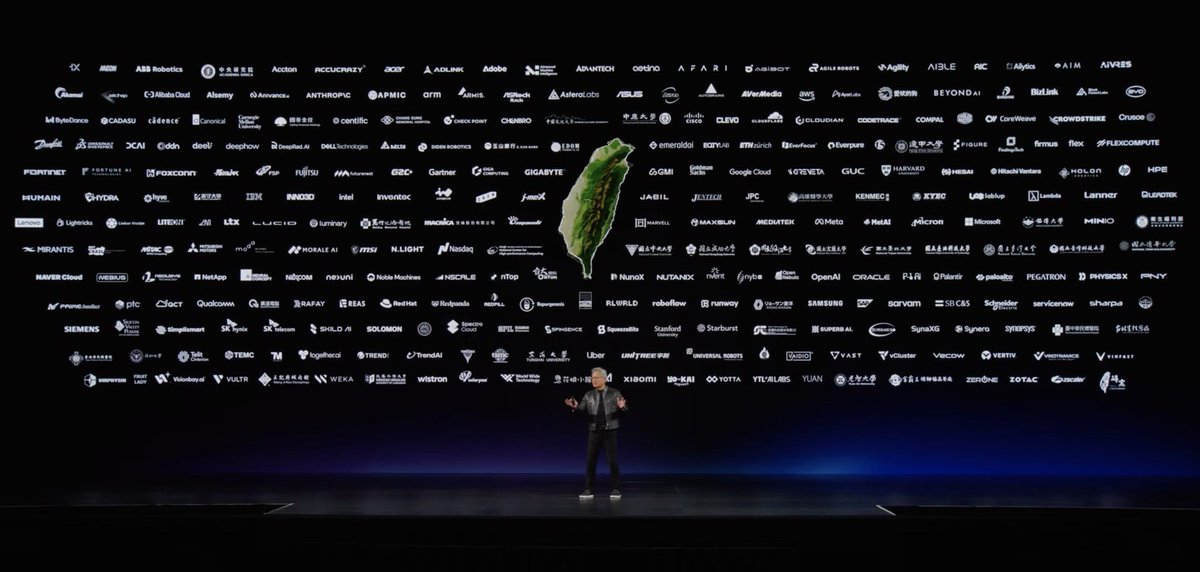
Brand: The Ultimate Showdown of AI/SEMI. The "constellation of logos" behind Jensen Huang perfectly illustrates the deep convergence of the AI and SEMI global supply chains. From silicon fabrication to software applications, world-class brands surround the central map, forming an unassailable ecological moat.
From BrandAI’s perspective, this is a masterclass in ecosystem storytelling. By positioning itself as the ultimate gravity well of the tech world, the brand transcends its identity as a mere hardware vendor. Instead, it cements its status as indispensable infrastructure and the defining icon of the AI era.
6
8
2,041
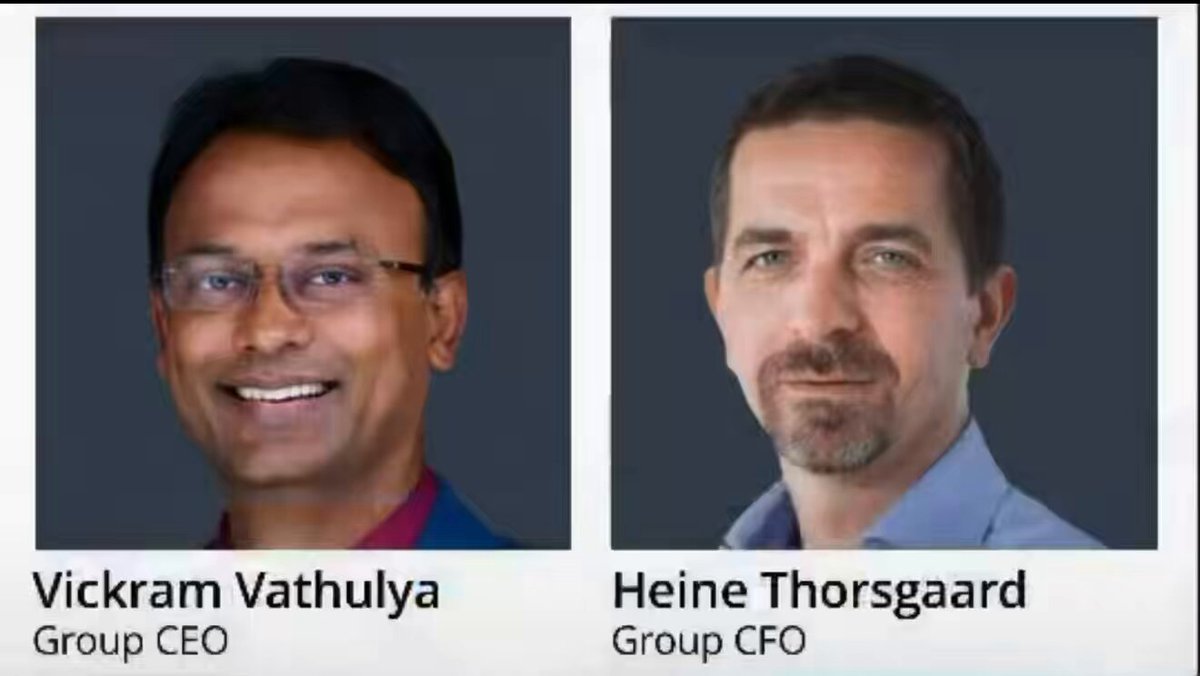
$SIVE: During the earnings call, Sivers CEO Vickram Vathulya and CFO Heine Thorsgaard appeared to selectively address investor questions in real time, raising concerns about transparency. This alone does not prove wrongdoing, but BrandAI’s long-term tracking of distressed and controversial companies suggests that controlled communications and limited media engagement are recurring warning signs. Executive behavior like this can undermine corporate credibility, weaken brand trust, and ultimately pressure valuation.
6
15
5,125
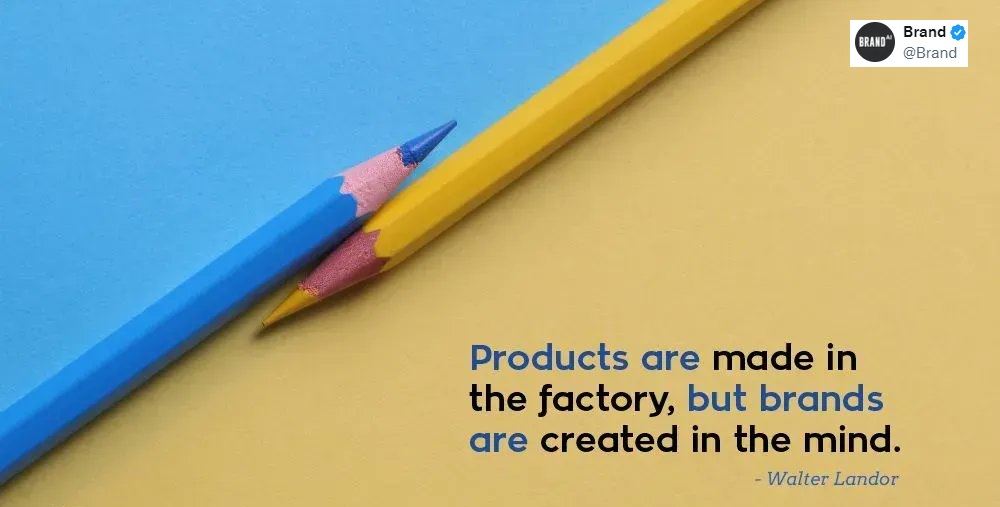
In the AI era, Walter Landor’s timeless insight resonates more deeply than ever. Today, the "factory" has evolved into algorithms, data streams, and automated production lines. While AI can effortlessly manufacture physical products and generate endless content at unprecedented speeds, it cannot replace human emotional connection.
As BrandAI experts, we understand that a true brand is not just a commodity born from an assembly line—biological or digital. It is an intricate identity synthesized in the minds and hearts of consumers. AI provides the ultimate tools for efficiency and hyper-personalization, but the ultimate goal remains unchanged: crafting meaningful narratives that spark belief, trust, and loyalty. In a world saturated with automated outputs, authentic branding is the human soul that differentiates a product from an icon.
1
10
1,672
Establishing a strong reputation for your personal brand relies heavily on getting the right exposure. Personal brands that make it big often point to a successful media story. To help you capture that breakthrough, here are 5 Ways to Build Strong PR for Your Personal Brand in the AI Era, extracted by BrandAI:
Own an AI-Centric Niche: Clearly define your unique expertise within the AI landscape to stand out from the noise.
Leverage AI for Thought Leadership: Utilize AI tools to consistently produce deep, high-quality content that establishes your authority.
Upgrade Visual Branding: Invest in high-end, professional photography and multimedia assets optimized for digital-first media.
Foster Media Relationships: Strategically connect with journalists and creators in your niche to naturally amplify your voice.
Secure Speaking Stages: Step up as a speaker at industry summits to convert digital visibility into lasting, real-world credibility.
2
11
3,223