
Founder & CEO @Architect_Fi | Derivatives exchange group for AI commodities and perpetual futures. Offering the American Innovation Exchange and AX.
Joined May 2021
- Tweets 5,057
- Following 2,934
- Followers 61,904
- Likes 28,896
449 Photos and videos







Pinned Tweet

May 28
Introducing the American Innovation Exchange, the first U.S. derivatives exchange designed for trading the AI economy. Trade futures and options on compute, metals, energy, and other critical instruments in the AI supply chain. Coming soon from Architect.
25
48
341
53,475
Brett Harrison retweeted

Jun 12
Compute futures are the most novel product I've heard of in the past month.
What is a "compute future"?
@BrettHarrison explains exactly how it works in 99 seconds (he and his team at @Architect_Fi pioneered them).

Over a trillion dollars worth of perps are traded every month, yet 99% people have never heard of them.
This @LawofCodeFM episode is a multi-hour deep dive on perps, starting from the history of grain futures in Chicago to Friday's historic @CFTC announcements. It took me months to put this together.
My goal: the internet's most comprehensive explainer on perps.
You'll hear from the world's leading experts on the legal layer of perps; @jchervinsky and @BradBourque of @HyperliquidPC, @BrettHarrison of @Architect_Fi, @kkirkbos, @_Ryne_Miller, @mdf2000 and David Shafer of @coinbase.
By the end of this episode, I promise you'll be in the top percentile for understanding perps, regardless of where you're starting from.
(You just might need to listen twice. There's a lot here.)
Timestamps:
0:00 Intro
4:04 What is a perp @BrettHarrison
7:18 Why futures contracts exist
8:15 Liquidity fragmentation
11:01 History of U.S. futures @_Ryne_Miller
17:08 Richard Nixon, the gold standard and financial futures
21:27 Birth of the CFTC
24:27 Robert Shiller's 1992 paper @kkirkbos
30:09 Price convergence
32:00 The funding rate
43:41 Oracles and manipulation risk
47:39 Are perps swaps or futures?
52:44 A @ChairmanSelig clip on perps
54:02 The DCM framework
59:16 DCMs, DCOs and FCMs explained
1:04:55 History of crypto perps (BitMEX)
1:13:00 How Hyperliquid works
1:25:41 CFTC's historic announcements on May 29, 2026
1:35:00 Fireside with @jchervinsky and @BradBourque of @HyperliquidPC
Nothing in this podcast is legal or investment advice.
1
6
17
2,650
Jun 12
In light of today’s SpaceX IPO, a story from inside Jane Street on the day of the 2012 Facebook IPO:
30
156
3,335
841,595
Jun 12
That assumption failed for the Facebook IPO. Overflow of a single byte caused Jane Street’s US trading operations to halt, which even then accounted for double-digit percentages of US equity/ETF volume. We ended up using a secondary data provider and narrowly averted catastrophe.
2
6
418
76,707
Jun 12
In trading there’s nothing better than meeting an unprecedented market event head-on and learning from it. SPCX traders, I hope there aren’t 2^24-1 orders at the support today.
7
8
745
74,254
Brett Harrison retweeted

Jun 12
Congratulations @SpaceX for making today a reality.
SpaceX perpetuals are live on Architect’s AX Exchange.
2
9
26
3,864

How volatile are GPU rental prices and does that make them tradable?
@BrettHarrison, founder and CEO of Architect:
"By observation, it looks like the vol is somewhere between 20 and 40, based on which GPU you're currently looking at."
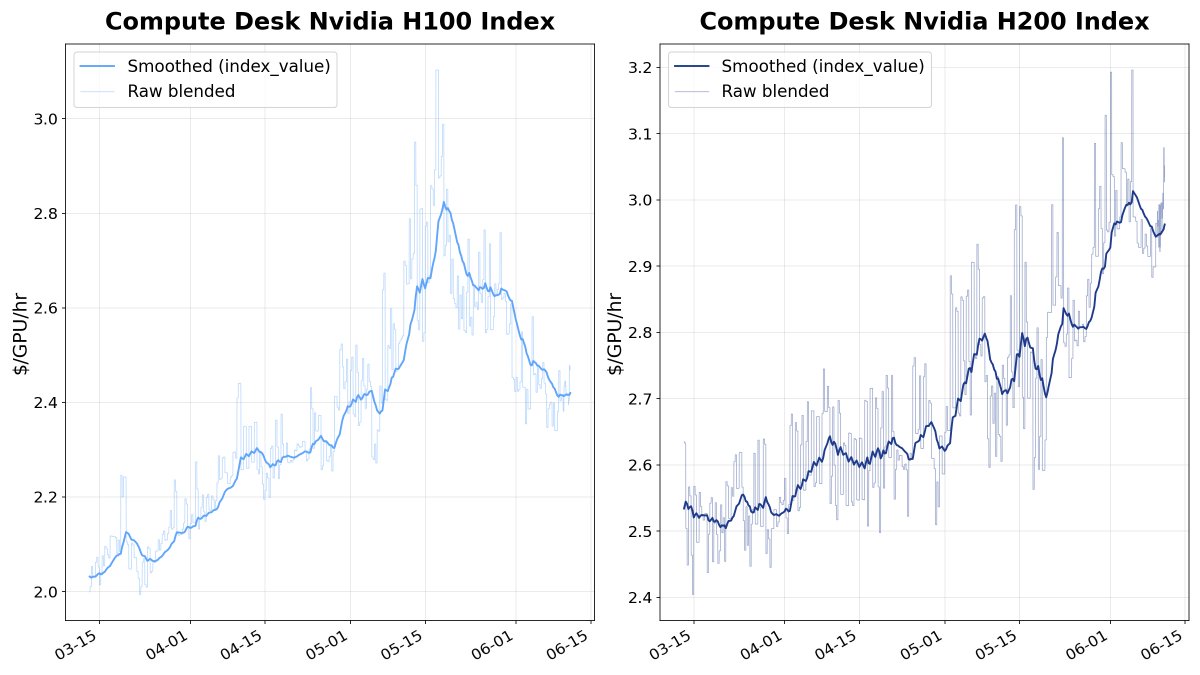
"Within 90 days, the price of H200 GPU rental prices went up around 17% to 19%, a pretty big move in a very short period of time."
"People often predicted that GPU rental prices will strictly go down over time as chips depreciate and new chips come out, but what we've seen is that they've basically only gone up as demand has completely outstripped supply."
"In order for this to be a tradable asset, it has to not be a 200 vol type of future... otherwise people would get blown out every time they put on a position."
Jun 11

GPU depreciation is about resale value, GPU yield is a different story. H100 rental prices are up 19% in 90 days and H200 up 17%. Older silicon may fetch less on the secondary market over time, but the compute the chips produce is renting for more. Not the same trade.
2
5
40
8,764
Why does AI compute need a financial market?
@BrettHarrison, founder and CEO of Architect:
"Just like a wheat farmer who doesn't know what prices will be at harvest, futures let them lock in a price today without being exposed to the volatility between now and three months from now."
"We've spoken to data center operators who are being loaned capital to build out data centers... concern that if they outfit an entire data center with H100 GPUs, 12 months from now the rental price might plummet because everyone wants to switch to H200s."
"If they therefore can't meet their debt service, they can't pay down those debt payments to their lender because they haven't been able to protect against that downside risk."
"What a future or option on compute does... allows them to transfer that risk away, guarantee they're gonna be able to meet that debt service, and therefore go out and build that data center."
"We think the futures and options markets developing will actually help the AI industry grow larger and faster."
Jun 9
AI datacenters are driving unprecedented demand for electricity consumption and current power futures markets no longer offer an effective hedge. Existing power contracts are inadequate for two reasons:
5
10
52
9,464
Jun 11
I’ll be on @MTSlive at 5:30pm ET/2:30pm PT, looking forward to discussing financializing AI industry inputs and starting a new US futures exchange.

DARIO ESSAY | AI POLICY | OPENAI-ANTHROPIC PRICE WAR x.com/i/broadcasts/1rGmqqWbk…
3
9
46
7,704
Jun 11
GPU depreciation is about resale value, GPU yield is a different story. H100 rental prices are up 19% in 90 days and H200 up 17%. Older silicon may fetch less on the secondary market over time, but the compute the chips produce is renting for more. Not the same trade.
2
8
57
12,165
Jun 9
AI datacenters are driving unprecedented demand for electricity consumption and current power futures markets no longer offer an effective hedge. Existing power contracts are inadequate for two reasons:
5
9
44
15,203
Jun 9
1) Futures are priced at generic hubs rather than at the localized node where power is drawn.
2) A growing percentage of datacenter power occurs behind-the-meter, and therefore never shows up in public energy prices.
2
2
14
1,648
Jun 9
There are economically real, costly hedging gaps latent in AI markets, and the timescale to address them matters. Compute futures close only one of those gaps. New patterns of electricity consumption require new derivatives.
1
1
12
1,392
Brett Harrison retweeted

Jun 8
. @Architect_Fi makes it incredibly intuitive to place trades on compute futures. Rates provided by @ComputeDesk indices.
Jun 8

Trade for size on the American Innovation Exchange. Negotiate bilateral block transactions and report as a single print, via voice or desktop or mobile. Multi-leg spread trades supported.
1
2
14
3,741
Brett Harrison retweeted

Goldman Sachs and JPMorgan are weighing compute futures as a hedge against the risks building up in AI infrastructure finance.
Read more: thein.fo/4v7tP43
2
3
30
13,694