
We are a traditional financial capital team engaged in angel investment in the cryptocurrency sector| Share some novel economic views| AI|X402 Protocol|Bridge🌉
Joined November 2025
- Tweets 66
- Following 7
- Followers 324
- Likes 86
27 Photos and videos












Pinned Tweet
從我出生的那一刻起,我就知道我會從 Bridge Capital 賬號發帖

1
2
3
1,575

Jun 15
I think @Bridgerlang might be the world’s biggest condom enthusiast.
But seriously, who wants merch like this? 😂
4
1,658
Bridge Capital retweeted

Jun 14
Happy Birthday to the 45th and 47th President of the United States, Donald J. Trump. A relentless patriot who fights every day for the country he loves, the people he serves, and the American Dream. 🇺🇸🇺🇸

18,284
34,201
157,865
2,319,579
Bridge Capital retweeted
Jun 9
Trust.


President Trump is in attendance for Game 3 in New York.
He's the first sitting U.S. President to attend an NBA Finals game.
6,084
5,224
35,793
1,906,117
Maybe we should adopt an NFT collection as the mascot of Bridge Capital 🤔
A logo builds recognition.
A mascot builds culture.
The right NFT collection could become a symbol of our community, our values, and the consensus we’re building together.
We’re considering adopting an NFT collection as Bridge Capital’s mascot. Which one would you choose? 🤔👇
2
6
777
Bridge Capital retweeted
Jun 6
Patriots in control. 🫡

4,955
7,523
33,354
1,169,789

⚠️ Warning: Please Be Alert to Potential Irrational Market Behavior Ahead! ⚠️
As market sentiment continues to fluctuate, some sectors may soon experience periods of extreme speculation and irrational trading activity. 🚨
Stay rational. 🧠
Manage your risk carefully. 🛡️
Avoid emotional decisions driven by FOMO. 😵💫
Protect your capital and stick to your strategy. 💰
🔍 Always do your own research.
⚖️ Discipline beats emotion.
🚀 Opportunities will always come, but capital preservation comes first.
#MarketWarning #RiskManagement #DYOR #Crypto #Investing #StaySafe ⚠️📊💎
1
4
309
Bridge Capital retweeted
Jun 1
Decline was a choice. Not anymore.
In just 14 months, @POTUS has restored our nation’s capital, making it SAFE & BEAUTIFUL.
🧵 500 instances of graffiti cleaned, 153 homeless encampments removed, 22 fountains restored, 28 statues cleaned, & more. Check out some of the wins ⬇️

2,514
7,707
41,307
841,676
Bridge Capital retweeted
May 30
Decline is a choice.

4,831
22,823
111,770
1,754,850
May 30
BRIDGE CAPITAL – OFFICIAL NOTICE
Dear Shareholders and Supporters,
We would like to express our sincere gratitude to every shareholder who has supported Bridge Capital throughout this journey, with special appreciation to our friends and partners in Macau and the United Kingdom.
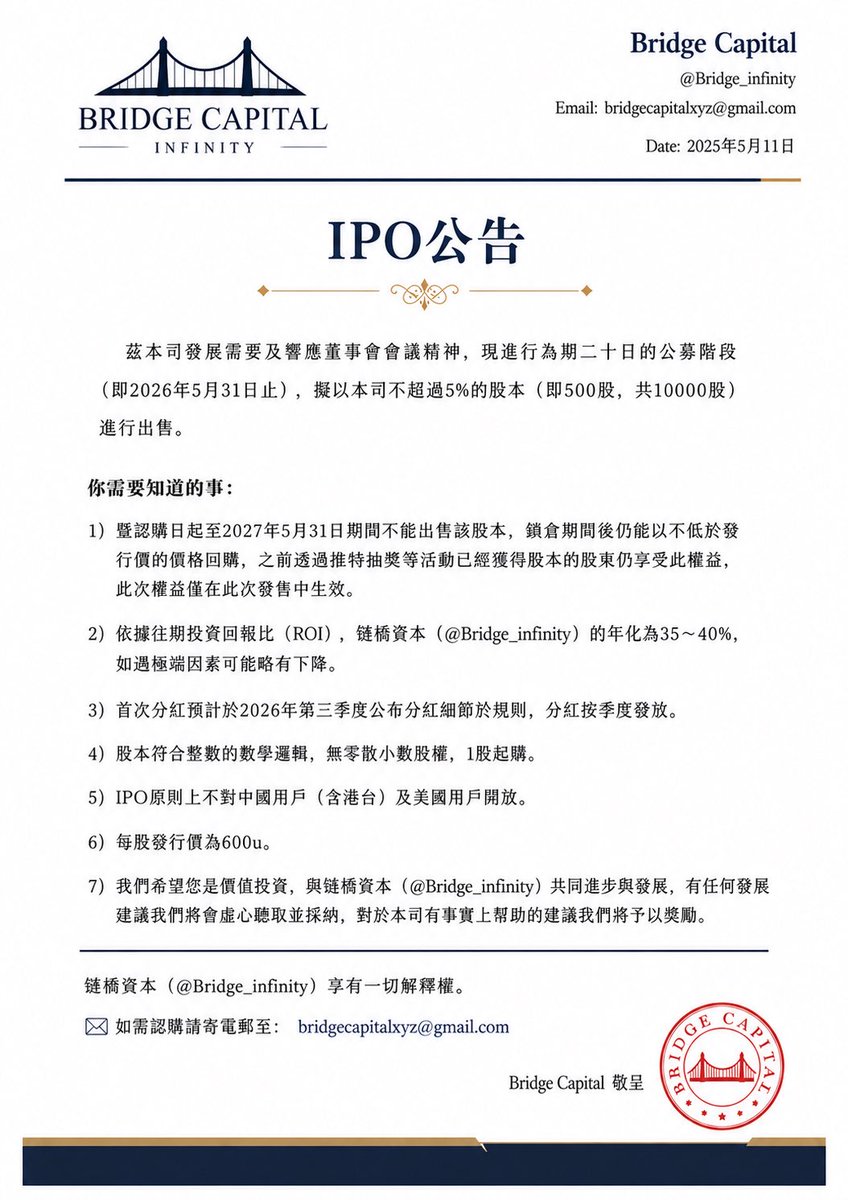
With less than 24 hours remaining before the conclusion of our inaugural IPO, we are honored to grow alongside each of you. Your trust motivates us to continuously refine our investment philosophy, optimize our operational model, and build a sustainable framework designed to deliver long-term value for our dedicated community members.
As we have consistently emphasized, Artificial Intelligence and the X402 ecosystem remain at the core of our strategic vision. By embracing technological innovation and adapting to the changing landscape of the digital economy, we are positioning ourselves at the forefront of the next generation of opportunities.
We remain committed to providing solutions that are secure, reliable, and efficient. Looking ahead, Bridge Capital will continue to pursue excellence, innovation, and responsible growth while creating meaningful value for all stakeholders.
Thank you for taking the time to read this announcement. We are proud to have you with us on this journey.
Bridge Capital
Advancing Together. Investing for Tomorrow.
May 27

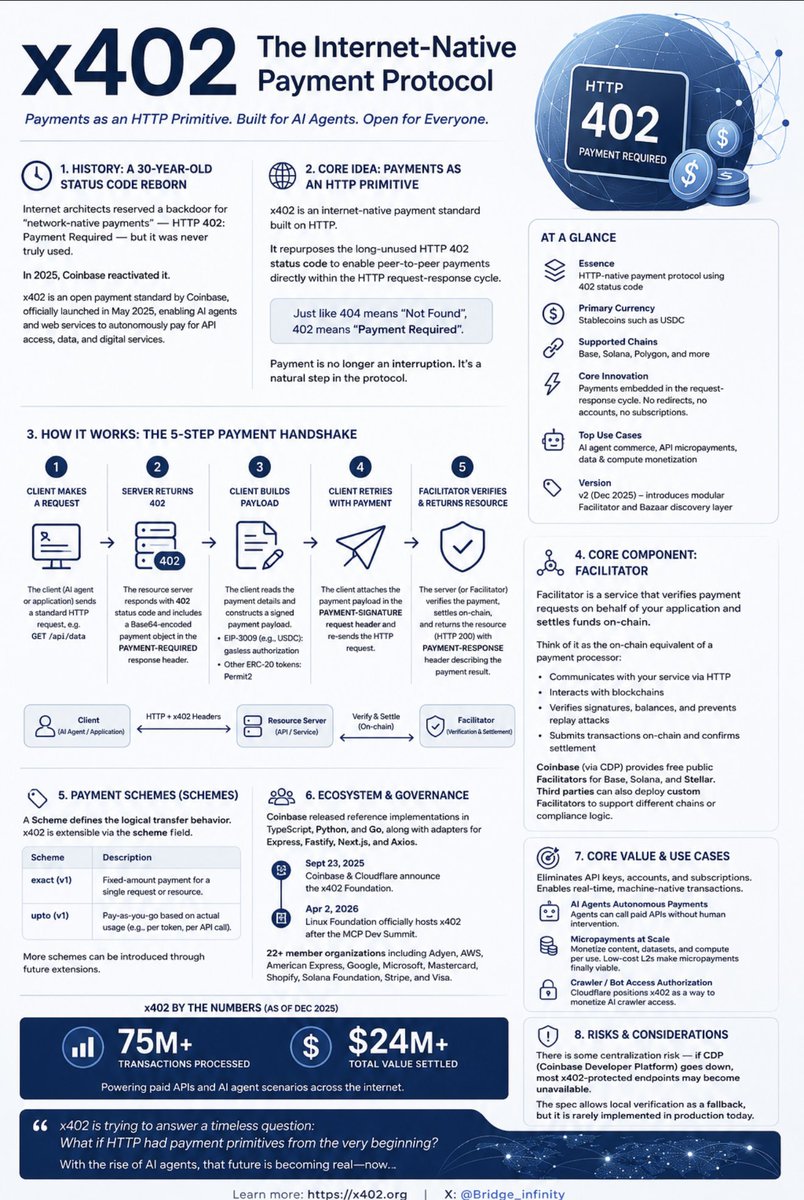
x402 Protocol In-Depth: Building an Internet-Native Payment System
The HTTP protocol contains a status code that has sat dormant for nearly thirty years — 402 Payment Required. Architects reserved it in the early days of the internet with the intention of enabling native web payments, yet it remained unused throughout the long stretch of time that followed. That changed in 2025, when leading crypto platform Coinbase officially activated this long-idle capability and built upon it an entirely new open payment standard, x402, finally putting the long-shelved 402 status code to work.
x402 was developed under Coinbase’s leadership and formally released to the public in May 2025. It is positioned as a decentralized payment rail for the open internet, with the core goal of enabling AI agents and web services of all kinds to complete payment actions autonomously — handling automatic settlement across scenarios such as API calls, data retrieval, and online digital services.
The most fundamental design principle behind this protocol is to make payment a native, built-in capability within the HTTP ecosystem. x402 is built entirely on top of the existing HTTP protocol, reviving the long-vacant 402 status code so that financial exchanges between parties can be embedded directly within the HTTP request-response cycle. In the past, paying for an online service typically required a redirect to a third-party checkout page, interrupting the original service flow. Under the x402 framework, payment is simply a routine step within the network interaction — much like how the familiar 404 status code signals that a page cannot be found, the 402 status code straightforwardly indicates that the requested service requires payment before access can continue.
2
3
1,393
Bridge Capital retweeted
May 29
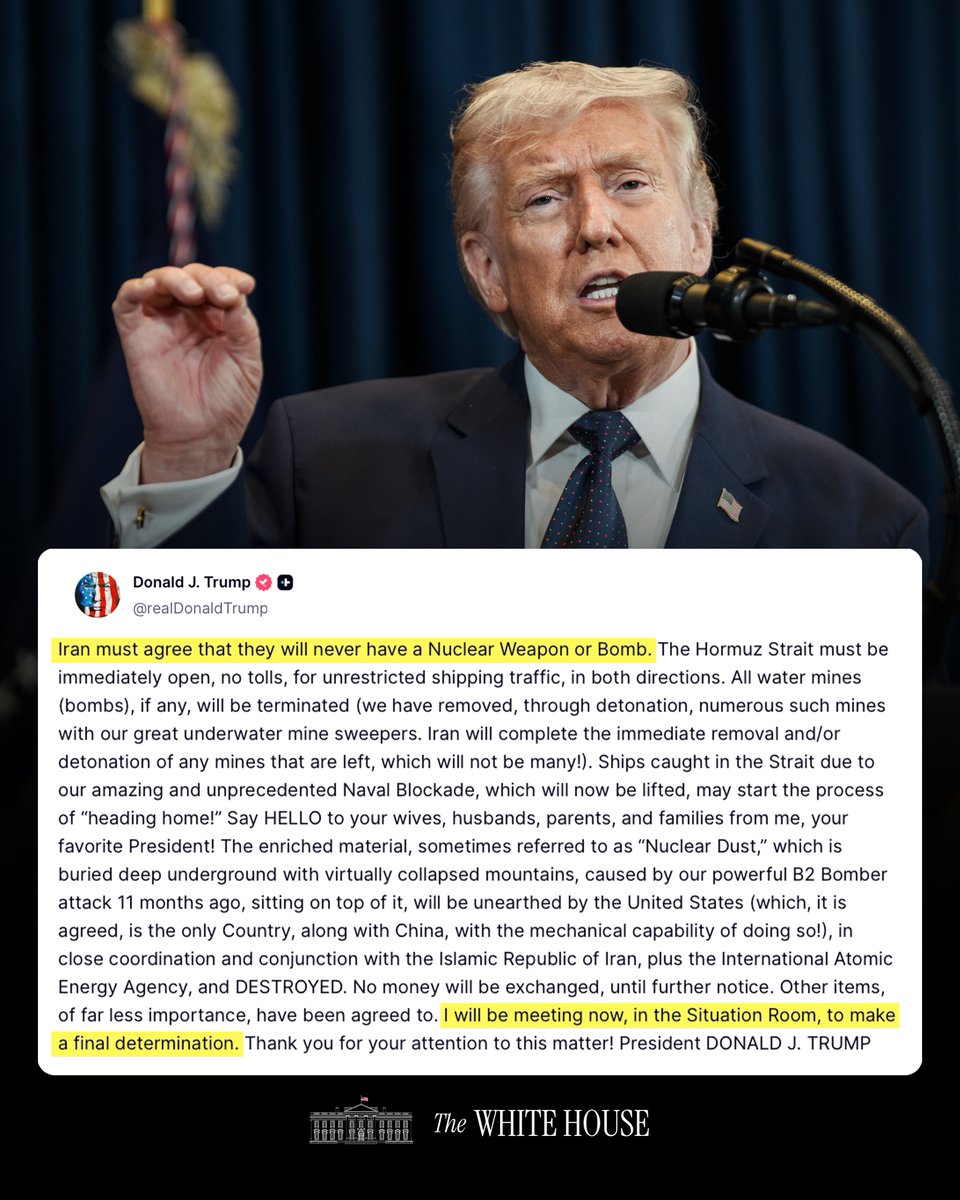
"Iran must agree that they will never have a Nuclear Weapon or Bomb... I will be meeting now, in the Situation Room, to make a final determination." - President Donald J. Trump 🇺🇸
5,324
6,317
24,391
1,206,615
May 27
x402 Protocol In-Depth: Building an Internet-Native Payment System
The HTTP protocol contains a status code that has sat dormant for nearly thirty years — 402 Payment Required. Architects reserved it in the early days of the internet with the intention of enabling native web payments, yet it remained unused throughout the long stretch of time that followed. That changed in 2025, when leading crypto platform Coinbase officially activated this long-idle capability and built upon it an entirely new open payment standard, x402, finally putting the long-shelved 402 status code to work.
x402 was developed under Coinbase’s leadership and formally released to the public in May 2025. It is positioned as a decentralized payment rail for the open internet, with the core goal of enabling AI agents and web services of all kinds to complete payment actions autonomously — handling automatic settlement across scenarios such as API calls, data retrieval, and online digital services.
The most fundamental design principle behind this protocol is to make payment a native, built-in capability within the HTTP ecosystem. x402 is built entirely on top of the existing HTTP protocol, reviving the long-vacant 402 status code so that financial exchanges between parties can be embedded directly within the HTTP request-response cycle. In the past, paying for an online service typically required a redirect to a third-party checkout page, interrupting the original service flow. Under the x402 framework, payment is simply a routine step within the network interaction — much like how the familiar 404 status code signals that a page cannot be found, the 402 status code straightforwardly indicates that the requested service requires payment before access can continue.
May 21
By the way, our IPO has only ten days left before it concludes… This first issuance has also been the most profitable round so far. Although we don’t know when the next one will be, we’re truly honored to have you participating in the ecosystem of Bridge Capital!🫡
1
2
5
2,697
May 27
On the settlement model front, x402 achieves flexible extensibility through its Scheme mechanism, where different schemes correspond to different fund transfer logics, allowing the protocol to accommodate a wide range of billing needs. The first to launch was exact mode, which deducts a fixed amount for each individual transaction. The subsequently introduced upto mode supports tiered billing based on actual usage, making true pay-as-you-go scenarios possible.
On the ecosystem and governance front, Coinbase released the codebase under the Apache 2.0 open-source license, publishing reference implementations in three mainstream languages — TypeScript, Python, and Go — alongside toolkits adapted for popular development frameworks including Express, Fastify, Next.js, and Axios, lowering the barrier to entry for developers. Governance has also been progressively transferred to independent stewardship: on September 23, 2025, Coinbase and Cloudflare jointly established the x402 Foundation; on April 2, 2026, the project was formally brought under the administration of the Linux Foundation.
The consortium of participating institutions has now grown to 22 organizations, spanning leading global payment networks, cloud providers, technology companies, and blockchain foundations — among them Adyen, AWS, American Express, Google, Microsoft, Mastercard, Shopify, Stripe, Visa, and the Solana Foundation. On the metrics side, as of December 2025, x402 had cumulatively processed over 75 million transactions with a combined value of 24 million USD, with adoption concentrated primarily in two domains: paid API access and autonomous AI agent commerce.
Compared to traditional payment models, x402’s advantages are considerable. It breaks free from the entrenched patterns of API keys, platform accounts, and recurring subscriptions, enabling millisecond-level machine-to-machine transactions — a particularly strong fit for the current direction of technological development. In AI agent scenarios, agents of all kinds can settle payments for paid API calls entirely on their own, without any human intervention. In the micropayments space, services such as web content, professional datasets, and cloud compute can be billed on a per-request basis; by leveraging the low on-chain fees of Layer 2 networks, x402 resolves the longstanding problem of micropayments being economically unviable under traditional payment rails. Cloudflare has also adopted it as a monetization tool, using it to commercially capture value from AI crawler and automated bot traffic visiting websites.
That said, the protocol has clear shortcomings at this stage, with centralization risk being the most pressing concern. The vast majority of service endpoints currently integrated with x402 rely on the public Facilitator provided by Coinbase’s CDP platform — should that service experience an outage, the affected paid endpoints and services would become equally inaccessible. While the protocol specification does reserve local verification as a fallback mechanism, virtually no production deployments in the industry have actually enabled it, leaving reliability as an area that still needs improvement.
1
74
May 27
Taken as a whole, x402 is a native web payment system built on top of the HTTP protocol by repurposing the 402 status code. Its primary settlement assets are stablecoins such as USDC, running mainly on public blockchains including Base, Solana, and Polygon. Its most significant breakthrough is the integration of payment directly into the native HTTP interaction flow — no page redirects, no account registration, no subscription plans required — with its core adoption concentrated in two areas: autonomous AI agent commerce and API micropayments.
The project is currently governed by the x402 Foundation under the Linux Foundation. The v2 update released in December 2025 introduced a modular Facilitator architecture and a Bazaar resource discovery layer, further rounding out the protocol’s overall capabilities.
At its core, x402 is an attempt to reconstruct the foundational logic of the internet: if HTTP had been built with native payment capabilities from the very beginning, what would today’s web services and commercial interactions look like? With AI agents now achieving widespread adoption, that vision finally has fertile ground to take root — and this protocol, dormant for thirty years, has arrived at the moment that was always meant to be its own.
89
Bridge Capital retweeted

May 27
买了 $Aeon
先说缺点:
是有技术但是没有使用区块链
个人开发者,容易犯错
代币目前看跟协议绑定不深,不过开发者称后续有改动
剩下的都是优点:
龙虾的进阶版,全自动框架
市值足够的低,有落地的才5m
技术上已经有落地有应用
已经收到了杰西和A16Z联创的关注
开发者比较听社区的话
143
1
26
28,876
Bridge Capital retweeted
May 26
The mission is simple.

7,141
4,823
27,621
1,065,320
May 21
By the way, our IPO has only ten days left before it concludes… This first issuance has also been the most profitable round so far. Although we don’t know when the next one will be, we’re truly honored to have you participating in the ecosystem of Bridge Capital!🫡
2
1,366