
CAIR is the Center for Accessibility and Inclusion Research at RIT. Faculty and students conduct accessibility and assistive technology research.
- Tweets 213
- Following 961
- Followers 458
- Likes 11








ALT Card with this work's information. It has a “CHI’2024” tag at the top, a label for what this work is (Special Interest Groups), its title (Spatial Computing: Defining the Vision for the Future), its complete list of authors (Jiangnan Xu, Konstantinos Papangelis, Garreth W. Tigwell, Nicolas LaLone, Pengyuan Zhou, Michael Saker, Alan Chamberlain, John Dunham, Sanzida Mojib Luna, David Schwartz), its session and date/time (Spatial Computing: Defining the Vision for the Future, and Monday, May 13, 16:00-17:20), and a logo for the Center for Accessibility and Inclusion Research (CAIR) and the Golisano College of Computing and Information Sciences, RIT.
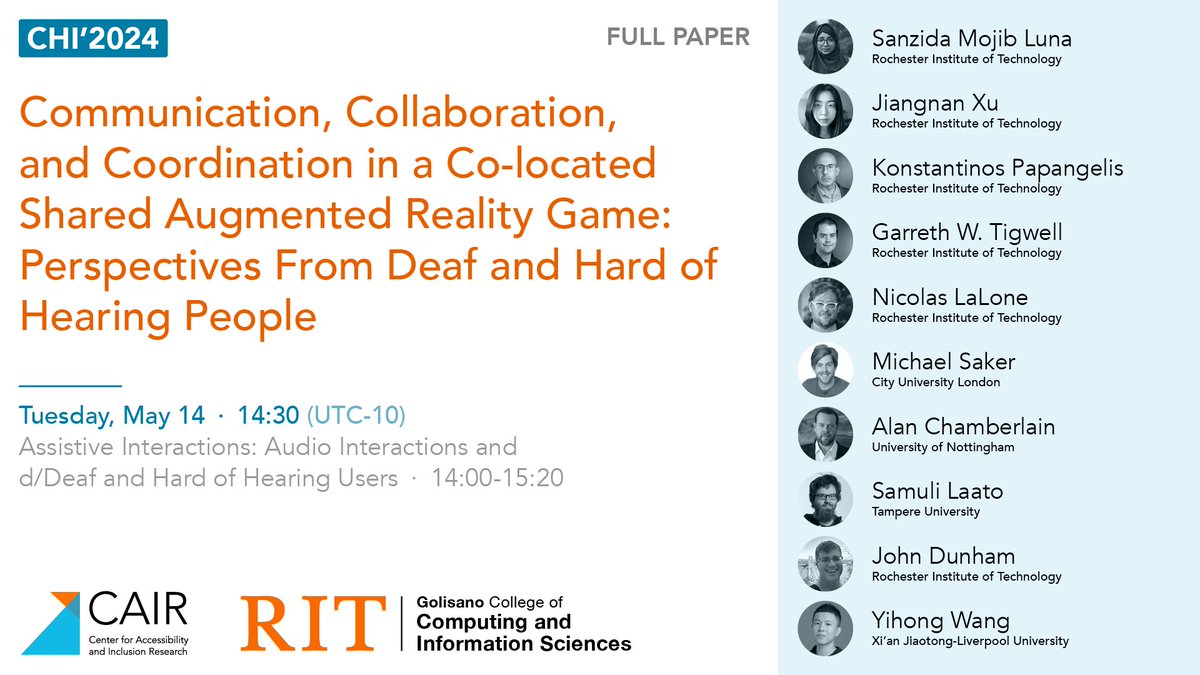
ALT Card with this work's information. It has a “CHI’2024” tag at the top, a label for what this work is (Full Paper), its title (Communication, Collaboration, and Coordination in a Co-located Shared Augmented Reality Game: Perspectives From Deaf and Hard of Hearing People), its complete list of authors (Sanzida Mojib Luna, Jiangnan Xu, Konstantinos Papangelis, Garreth W. Tigwell, Nicolas LaLone, Michael Saker, Alan Chamberlain, Samuli Laato, John Dunham, and Yihon Wang), its session and date/time (Assistive Interactions: Audio Interactions and d/Deaf and Hard of Hearing Users, and Tuesday, May 14, at 14:30), and a logo for the Center for Accessibility and Inclusion Research (CAIR) and the Golisano College of Computing and Information Sciences, RIT.
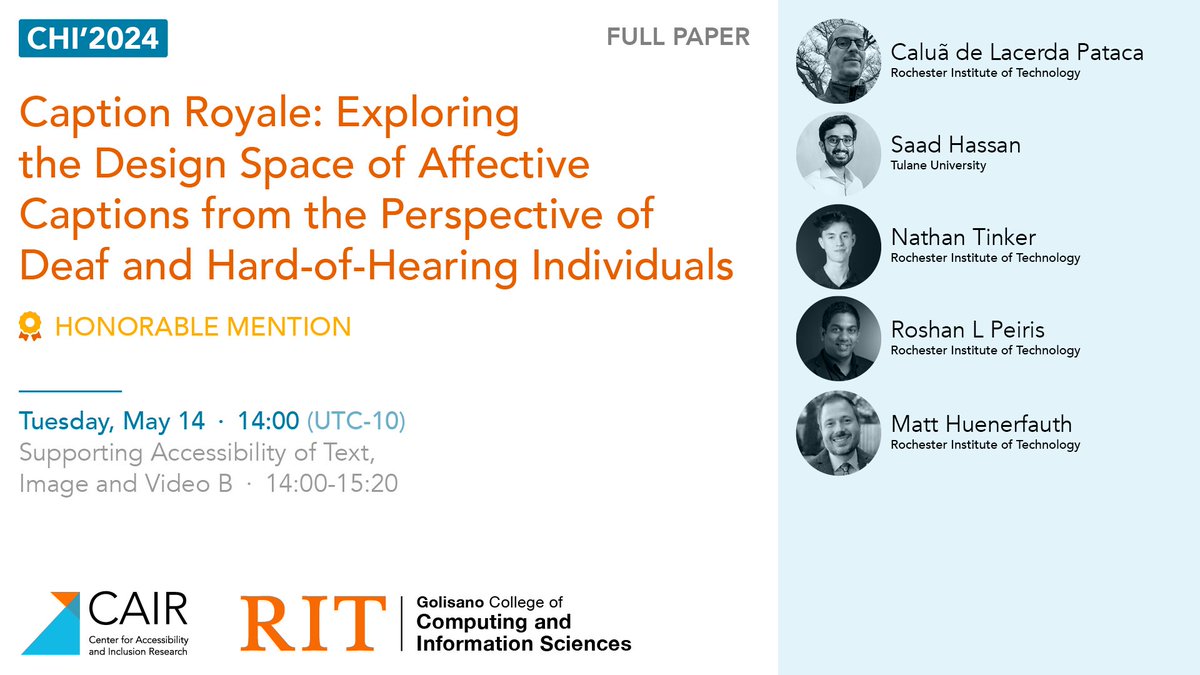
ALT Card with this work's information. It has a “CHI’2024” tag at the top, a label for what this work is (Full Paper), its title (Caption Royale: Exploring the Design Space of Affective Captions from the Perspective of Deaf and Hard-of-Hearing Individuals), its complete list of authors (Caluã de Lacerda Pataca, Saad Hassan, Nathan Tinker, Roshan L Peiris, and Matt Huenerfauth), its session and date/time (Supporting Accessibility of Text, Image and Video B, and Tuesday, May 14, at 14:00), and a logo for the Center for Accessibility and Inclusion Research (CAIR) and the Golisano College of Computing and Information Sciences, RIT.
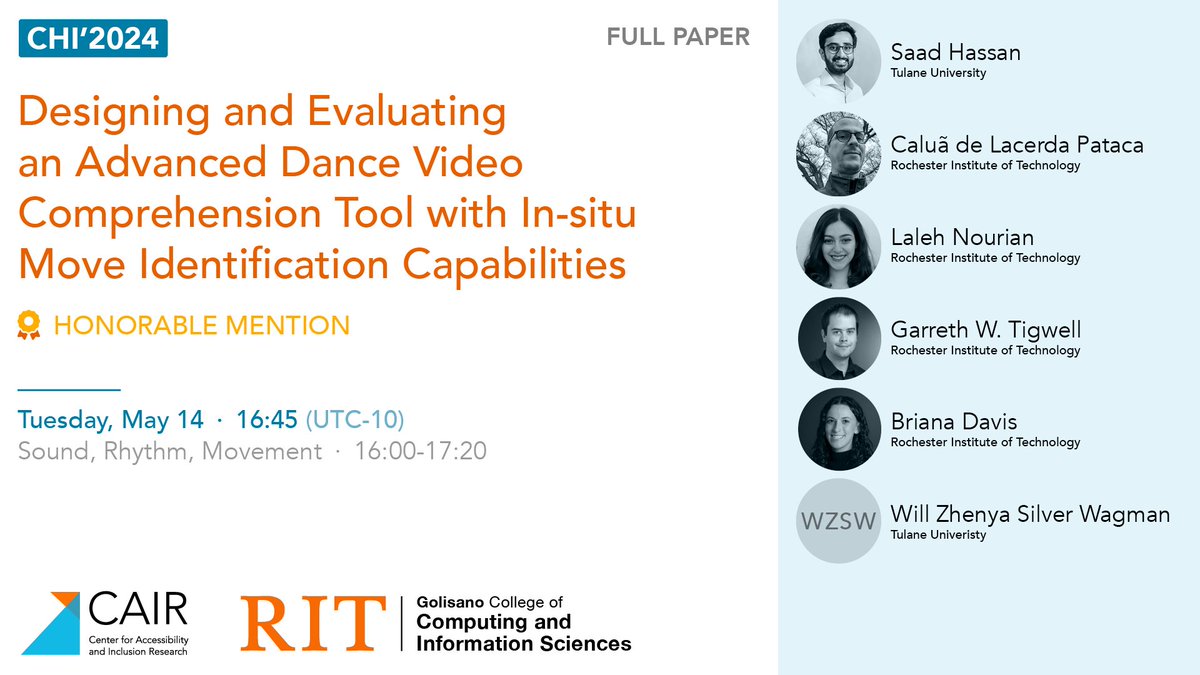
ALT Card with this work's information. It has a “CHI’2024” tag at the top, a label for what this work is (Full Paper), its title (Designing and Evaluating an Advanced Dance Video Comprehension Tool with In-situ Move Identification Capabilities), its complete list of authors (Saad Hassa\n, Caluã de Lacerda Pataca, Laleh Nourian, Garreth W. Tigwell, Briana Davis, and Will Zhenua Silver Wagman), its session and date/time (Sound, Rhythm, Movement, and Tuesday, May 14, at 16:45), and a logo for the Center for Accessibility and Inclusion Research (CAIR) and the Golisano College of Computing and Information Sciences, RIT.