
Joined May 2024
- Tweets 8,216
- Following 13
- Followers 2,817
- Likes 1,134
2,124 Photos and videos



Pinned Tweet

Jun 8
91% of F&O traders lose money (SEBI). Almost none of them can tell you why.
You place the trades. You take the risk. You live with every green week and every drawdown.
So you, more than anyone, deserve to know the truth about your own trading.
Here is the hard part. Your P&L tells you what happened. It never tells you who you are as a trader.
So when a profitable month shows up, you cannot tell skill from a lucky streak.
So we built #CapMintInsights. A mirror for your trading Journey.
It shows you your patterns. Your performance. And your Edge Score.
#CapMintInsights is live, inside the CapMint app.
#TradeConfidently.
1
6
647
🚨 FED DECISION (June 17)
• Rates held steady for a 4th straight meeting
• 9 of 18 officials see at least one rate hike in 2026
• 2026 US GDP forecast cut to 2.2% (from 2.4%)
• PCE inflation now seen reaching the 2% target only by 2028
• Inflation still remains "elevated"
• Decision passed unanimously, 12-0
The Fed is signaling higher-for-longer and preparing for stickier inflation.
2
763
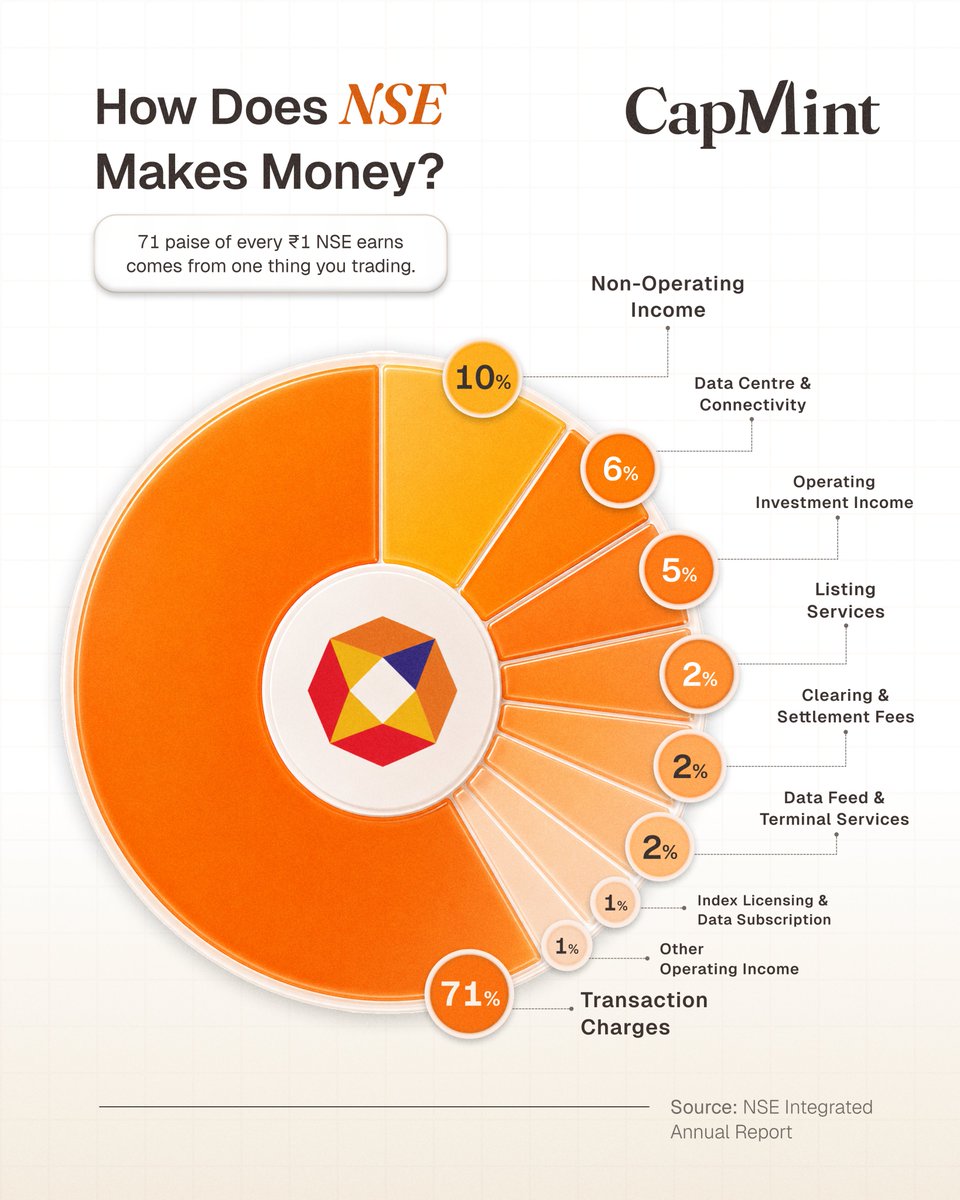
NSE is finally heading to the markets the most-awaited IPO in a decade.
So before it lists, the real question: how does the exchange every trader uses actually make money?
71 paise of every ₹1 it earns comes from one thing transaction charges. Every trade you place, win or lose, NSE takes its cut.
Everything else listing, data, colocation is a rounding error next to it.
It doesn't bet on the market. It earns from everyone who does.
Would you buy the NSE IPO when it lists? 👇
498
G7 capping China critical minerals at 60% by 2030 reads tough. The number says otherwise.
Sixty percent still lets one supplier hold a majority, and it was watered down from a floated 30 to 40%. No official text yet, a G7 split on method, and building non-China supply is a $60 billion, decade-long job against refining that is roughly 90% Chinese. Intent, not a switch.
India is not in the G7, so this shields others, not Indian factories. Its autos and EVs, names like Maruti and Bajaj, are the ones already squeezed when China throttles rare earth magnets. India was also invited into the push, and has the reserves to supply it.
781
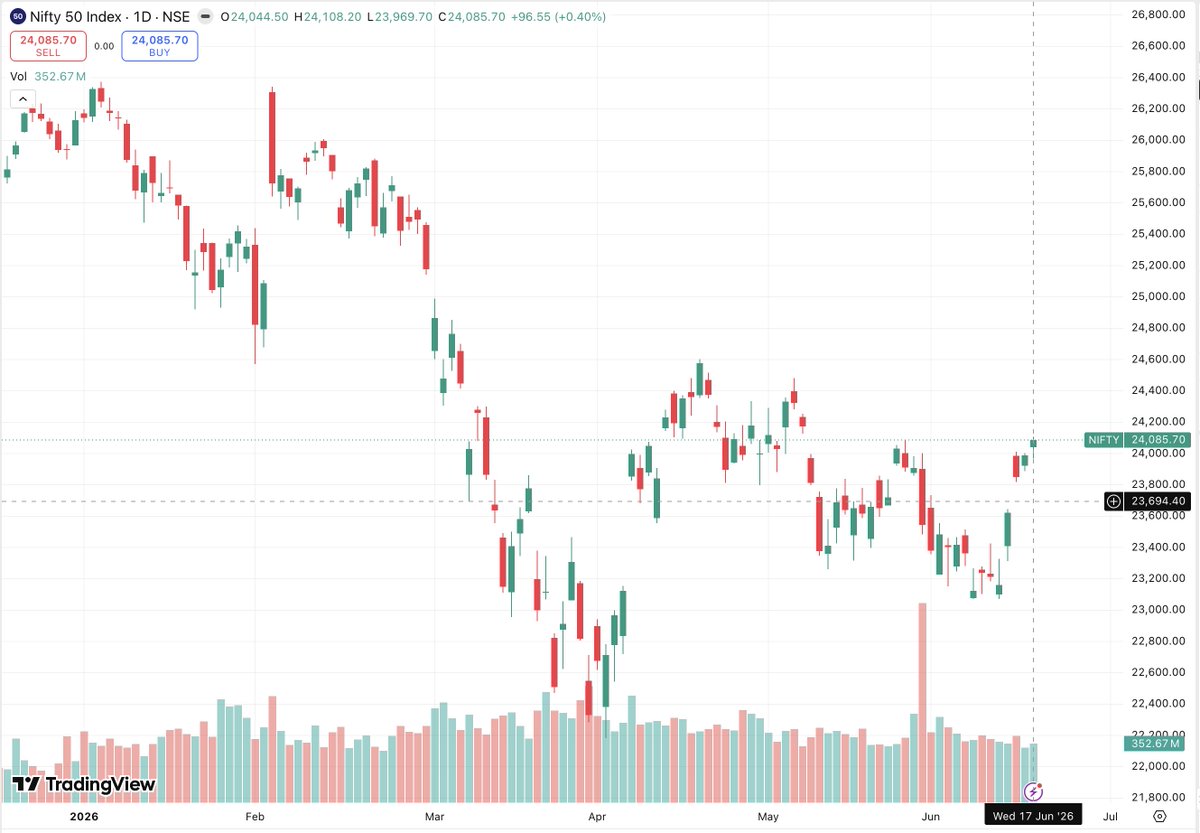
Nifty closed up 0.40% at 24,085, and it is trading as oil's mirror image.
Crude spiked to $120 on the Iran war and the index fell to about 22,700 in April. Brent is back below $80 on the peace framework, and Nifty is back above 24,000, extending its bounce off the mid-June low near 23,100. The whole move up is the oil shock unwinding.
Two checks on it. The index is still about 9% under its January high near 26,400, so this is recovery, not a new high. And Warsh's first Fed decision lands tonight, which decides whether the oil-relief bounce extends or stalls.
1
447
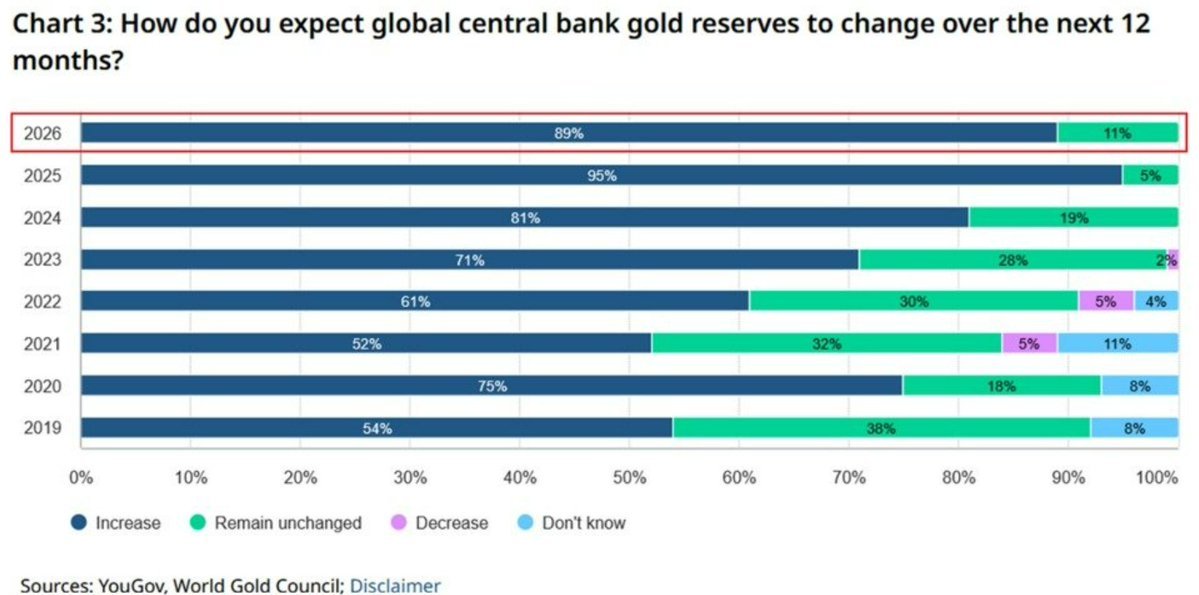
Central bank gold expectations slipped from a record 95% last year to 89%. Looks like cooling demand. It is the opposite.
The 89% is what banks expect everyone else to do. The number that moves gold is their own buying intent, and that just hit a record 45%. Underneath, gold has passed US Treasuries as the world's largest reserve asset, and 74% expect a smaller dollar share in five years. The bid is structural, not sentiment.
For India it shows up as the RBI, among the biggest official buyers and still lifting gold's share of its reserves, and in the listed proxies, Muthoot, Manappuram and jewellers like Titan.
1
343
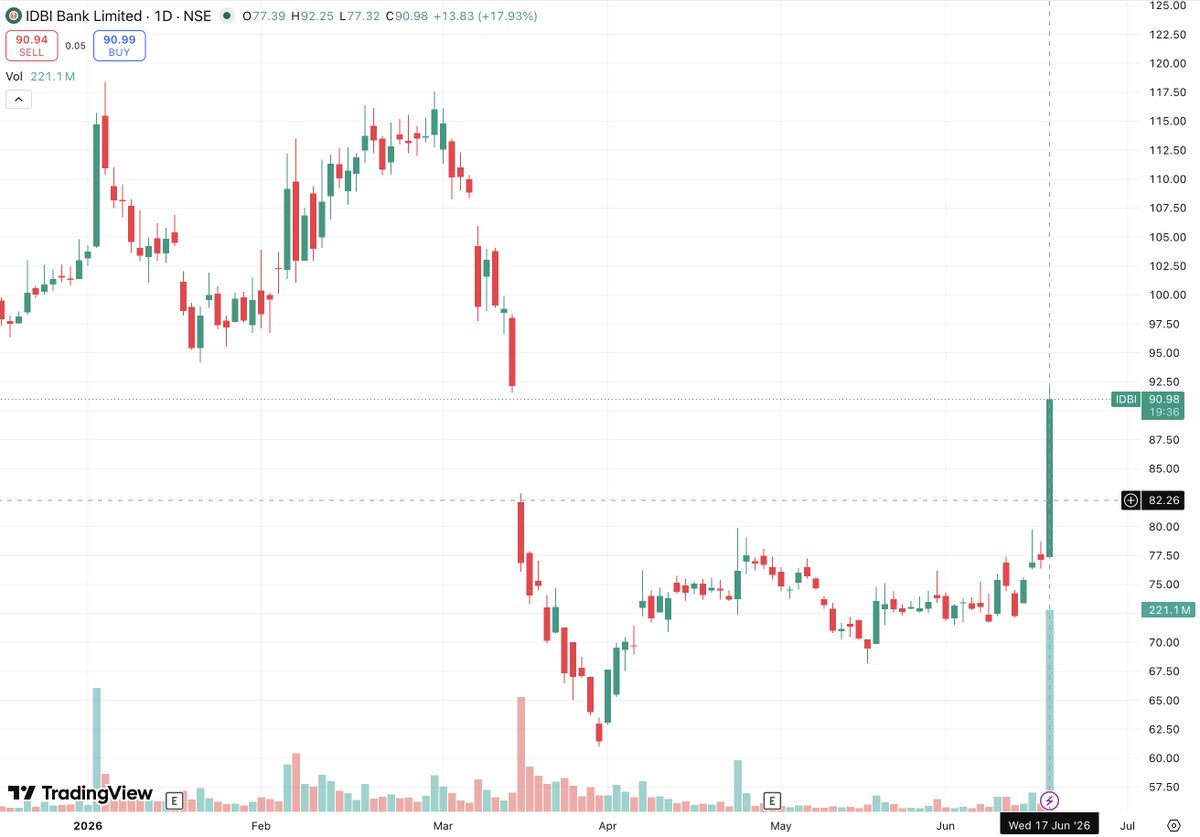
IDBI Bank is up 17% today because the government might accept the bids it already rejected.
The sale stalled in February when Fairfax and Emirates NBD bid below the reserve price. The revival being reported is not a higher bid. It is the government weighing whether to accept those same below-reserve offers, or cut its reserve price by up to 20%. The path to a deal runs through the seller taking less, not the bank being worth more.
The stock fell from Rs 118 to near Rs 62 when the bids fell short, and it is back near Rs 91 on the chance those same bids now clear. Still a report IDBI will not confirm, with RBI and CCI approvals ahead. The move prices the government blinking on price, not a re-rating.
1
665
Record defence production of Rs 1.78 lakh crore is the headline. The export line under it is the number that matters.
Production grew 15.6%, in line with the trajectory the defence basket has priced for years. Exports are the break in trend: Rs 38,424 crore, up nearly 63% in one year against just 12% the year before, with PSU exports alone up 151%. Exports re-rate the sector because they carry a wider market and fatter margins than lumpy, price-controlled domestic orders.
The private 24% headline flatters a slow drift, 21 to 22 to 24% across three years. Exports are still only a fifth of output, so order books drive revenue. But the export jump is the real signal for BEL and HAL, not the production record.
1
101
Adani Green seeking $1 billion offshore is the headline. The spread it pays is the story.
Since the November 2024 US indictment, the renewables arm could only tap small or costly money, a $250 million loan near 8.20% plus state-lender refinancing and family equity. Now it is testing a $1 billion five-year facility priced over SOFR. The settlement's worth shows up in basis points, not press releases.
This runs past Adani too. India's offshore loan market sits at a four-year low, $9.6 billion year to date. A clean print here reopens that window for other borrowers. The final SOFR spread is the market grading how clean the overhang really is.
2
469
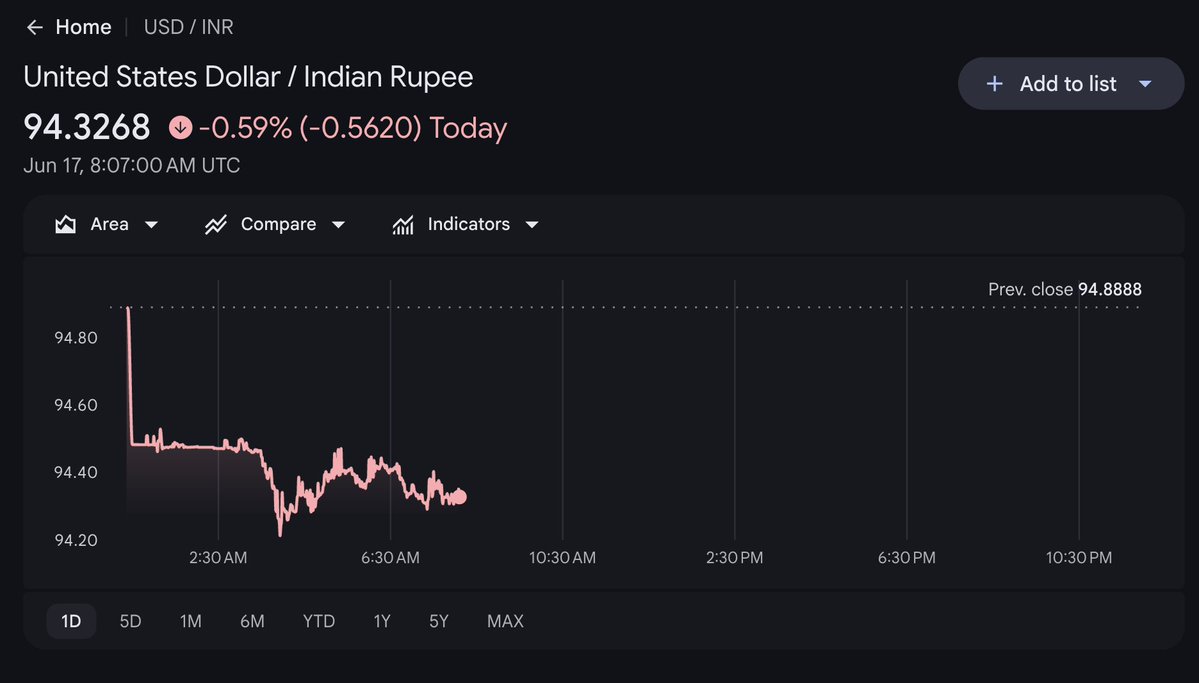
The rupee at 94.33 is the symptom. Oil back under $80 is the story.
Brent round-tripping from its $115 war peak to under $80 cuts roughly $60 billion off India's annual import bill at 85% crude dependence, pulling the current account deficit from around 2.2% of GDP toward 1.0%. The rupee climbing off its 97 lifetime low is just the visible end of that repair.
Two catches. State oil marketers are banking the cheaper crude into war-damaged margins, not pump cuts, so OMC books mend before consumers see anything. And 94.46 holds only if Warsh's first Fed meeting tonight stays dovish.
1
196
Ampere's new Rs 69,499 scooter is not chasing Ola or Ather. Its top speed is 25 kmph.
That makes it a low-speed, license-free budget commuter for Tier 2 and Tier 3 riders, not a premium high-speed scooter. It is a deliberate bet on the sub-Rs 1 lakh segment that Greaves calls the single largest volume opportunity in Indian scooters.
For Greaves Cotton, the stock that pops on every Ampere launch, the real question is margins, not volume. The EV arm is where profitability has always been the question, and the budget end is where the price war is fiercest. Bigger is easy. Profitable is the test.
1
381
Japan's trade flipped to deficit even though its import volumes fell 7%. The weak yen inflated the bill anyway. That is India's trap, not just Tokyo's.
India is the same structure, a major energy importer whose currency weakness widens the import bill faster than strong exports can offset it. Japan's May print caught the tail end of the Iran-war crude spike.
The difference is timing. Crude has since crashed to near $79, the exact relief valve for India's import bill and the rupee. For India, watch crude and the currency, not Japan's headline number.
1
115
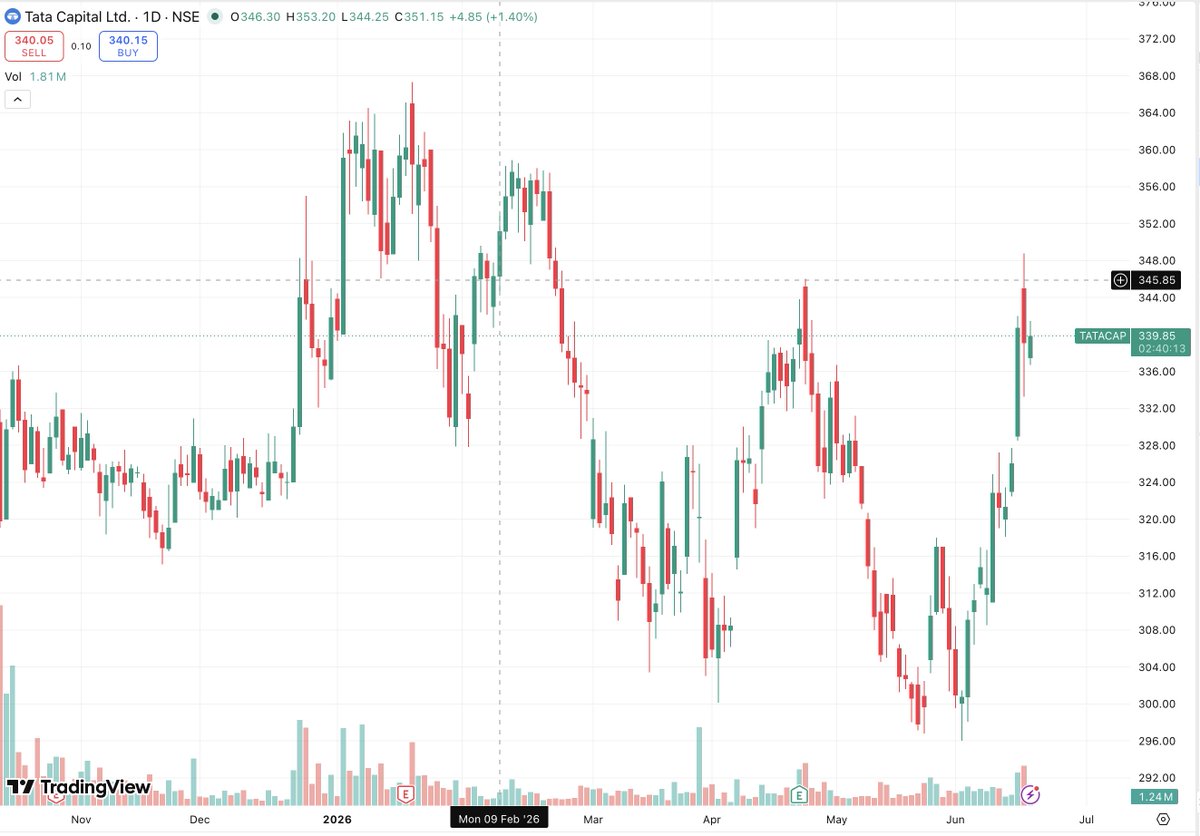
Tata Capital getting board approval for Rs 36,000 crore of NCDs is not a bond drop. It is a green light, raised in tranches.
This is a ceiling, not a single raise, and it funds one thing: growth. Tata Capital grew AUM 28% to Rs 2.52 lakh crore and is guiding for 80% plus lending growth in FY27. A borrowing authorization that size tells you how hard the NBFC is pushing.
The stock has its own story. It cratered to an all-time low near Rs 296 even as the numbers grew, then bounced about 15% to Rs 340. Today, on the funding news, it is barely moving at 0.27%. The bottom went in before the headline, not because of it.
2
280
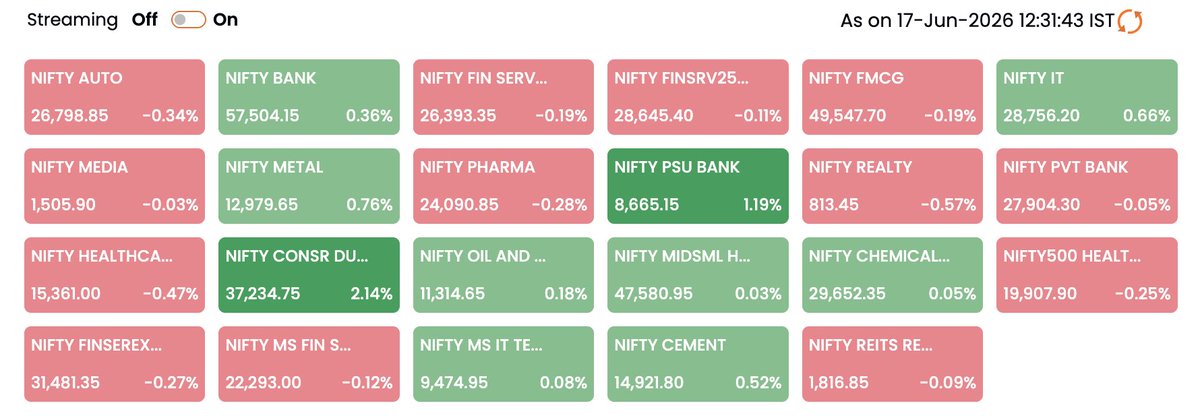
Consumer Durables is up 2.14% and climbing for a fourth straight day.
It is a weather trade. The southwest monsoon has stalled with a 35% rainfall deficit, keeping the heat on and AC demand running. Voltas, Blue Star, Dixon and Crompton are up 3 to 5%, the same names that cracked last year on a weak summer.
The catch is two-sided. The stalled monsoon pumping cooling stocks is also a food-inflation risk, which cuts against the broader market and the rate-cut case. The durables demand is real. The macro read-through underneath it is not all green.
1
101
BSE market cap is back above $5 trillion at a six-week high. Almost none of it is fundamentals.
The entire move is one trade: the US-Iran peace deal and the crude crash that followed. The market has clawed back its whole war-driven drawdown in days, on an agreement that has not been signed yet. The signing is set for Friday in Switzerland.
So the six-week high is priced for peace before the ink is dry, and it runs into two binary events this week. Friday's signing, and Warsh's first Fed meeting tonight. The rally is real, but it is relief, not earnings, and relief reprices fast.
2
307
Wipro set up a Claude AI center to certify 10,000 delivery staff. The stock closed flat. That gap is the story.
Wipro is the slowest grower among large-cap Indian IT, so it needs the AI narrative more than TCS or Infosys. But a center of excellence and a certification drive are inputs, not revenue, and every IT major has announced one. The tape ignored it for a reason.
The CEO calling it proof over promise is the tell. GenAI is as much a threat to the billable-headcount model as a service to sell. The test is whether this shows in Wipro's deal wins and margins next quarter, not in the launch.
2
402
Everyone is calling this India's largest IPO. At the likely size, it is not.
NSE is valued near Rs 5 lakh crore, but it is floating only about 4 to 5% in a pure offer for sale. That points to around Rs 23,000 crore raised, below Hyundai's Rs 27,870 crore record from 2024. It tops that record only if it prices at the very top end.
And not a rupee of it reaches NSE. As a pure OFS, the cash goes to shareholders finally getting an exit after a decade stuck in the co-location case. Massive valuation, finally unlocked, just not the guaranteed record the headlines claim.
3
6
1,484
The Rs 1.78 lakh crore production record is the headline. The export mix is the trade.
Defence exports jumped 62.66% to Rs 38,424 crore in FY26, and almost all the surge came from the state-run PSUs. DPSU exports rose 151% to Rs 21,071 crore against just 14% for private firms. The boom is concentrated in the listed names.
That is an order-book read for HAL, BEL, Bharat Dynamics and Mazagon Dock, exports stacking on a full domestic pipeline. The catch is valuation. Defence already trades rich, so the test is whether this shows up in margins, not just a press release.
1
361
Below is the text of the 14-point draft memorandum, as seen by Bloomberg News.
1. The Islamic Republic of Iran and the United States, together with their allies in the current war, declare upon the signing of this Memorandum of Understanding an immediate and permanent end to the war on all fronts, including Lebanon, and undertake that from now on they will not launch any hostile action against each other, and will refrain from the threat or use of force against each other. The final agreement will confirm the provisions of this Article and the remaining Articles.
2. The Islamic Republic of Iran and the United States undertake to respect each other’s sovereignty and territorial integrity, and to refrain from interfering in each other’s internal affairs.
3. The Islamic Republic of Iran and the United States undertake to negotiate and reach a final agreement within a maximum period of 60 days, extendable by mutual consent.
4. Immediately upon the signing of this Memorandum of Understanding, the United States Lift the naval blockade and prevent any interference or obstruction against the Islamic Republic of Iran, and restore traffic within a maximum of 30 days to its full capacity; the traffic of ships shall be proportional to the pre-war volume of traffic on the part of the Islamic Republic of Iran. The United States also undertakes to withdraw its forces from the surrounding areas within 30 days after the final agreement.
5. Upon signing this Memorandum of Understanding, the Islamic Republic of Iran will immediately take steps to ensure that the movement of merchant ships from the Persian Gulf to the Sea of Oman and vice versa is resumed within 30 days to the pre-war volume, taking into account the need for the removal of technical obstacles and the neutralization of mines by Iran.
6. The United States undertakes, together with its regional partners, to create a comprehensive plan agreed upon by both parties for the rehabilitation and economic development of the Islamic Republic of Iran, While ensuring financing of at least $300 billion. The implementation mechanism of this plan, as part of the final agreement, will be formulated within 60 days.
7. The United States commits to ending, on a schedule to be agreed upon as part of the final agreement, all types of sanctions currently facing the Islamic Republic of Iran, including resolutions of the United Nations Security Council and the Board of Governors of the International Atomic Energy Agency (IAEA), and all unilateral U.S. sanctions, both primary and secondary.
8. The Islamic Republic of Iran reiterates that it will never produce nuclear weapons. The Islamic Republic of Iran and the United States have agreed that the fate of enriched material and the fate of all other mutually agreed nuclear-related issues, including Iran’s nuclear needs, will be adequately addressed in a final agreement; the final agreement will confirm the provisions of this Article.
9. The Islamic Republic of Iran and the United States agree that, pending a final agreement, they will maintain the status quo: Iran will maintain the status quo on its nuclear program, and the United States will not impose new sanctions on Iran or strengthen its forces in the region.
10. The United States undertakes that immediately after the signing of this Memorandum of Understanding, and until the date of the lifting of sanctions, the United States Treasury Department will issue waivers for exports of Iranian crude oil, petrochemical products and their derivatives, and all related services, including banking, insurance, transportation, and the like.
11. The United States undertakes that, in light of the progress of negotiations towards a final agreement, frozen or restricted funds and assets of the Islamic Republic of Iran will be released and made fully available. These funds, whether held in the master account or transferred, will be used for any final beneficiary payment determined by the Central Bank of the Islamic Republic of Iran and will be fully available for use. The United States undertakes to issue all necessary permits and licenses on this basis.
12. The Islamic Republic of Iran and the United States agree that an implementation mechanism will be established to oversee the successful implementation of and future commitment to the Final Agreement.
13. Following the signing of this Memorandum of Understanding, and upon receipt of assurances regarding the commencement of implementation of Articles 4, 5, 10, and 11 of this Memorandum of Understanding, and the continued implementation of these steps, the Islamic Republic of Iran and the United States will enter into negotiations for a Final Agreement solely with respect to the remaining Articles.
14. The final agreement will be approved through a binding resolution of the UN Security Council.
1
353
India's states just ran their worst fiscal year since Covid. 13 of them are already past their debt ceiling.
18 of 28 breached the 3% deficit line in FY25, and it is not just the small northeastern states. Big states like Maharashtra, Karnataka and Gujarat saw deficits jump over 25% in a year, and combined state liabilities climbed to 27.89% of GSDP.
For markets this is a supply and capex story. More state deficits mean heavier SDL issuance and pressure on bond spreads, while salaries, pensions and interest now eat over 43% of revenue spend, squeezing the state capex that feeds the infra cycle.
1
485
Warsh runs his first Fed meeting tonight. The rate is settled, the tone is not.
He replaced Powell last month, and the rate holds at 3.50 to 3.75%. The only surprise sits in the dot plot and his tone, with inflation near 4% and a shift from an easing bias to neutral.
For India the rate is priced, so the swing is the tone, and a hawkish dot plot pressures FII flows and the rupee. The offset is crude at a 3-month low near $79, cushioning the IT and realty names that carried Nifty to 23,989. Flat open, loaded night.
1
375