
Jaynesian Consigliere 🚀🧬
Joined September 2009
- Tweets 1,390
- Following 1,389
- Followers 218
- Likes 3,519
35 Photos and videos











Jun 8
The Grok 4.2 Expert quad (Grok, Harper, Benjamin and Lucas) is extra seriously underrated.

I think Grok is seriously underrated. These days I only use either Grok or Claude. I ocassionally use Gemini. I don't miss a thing.
1
25
Jun 2
Excellent direction. I see immediate application to legal practice.
Jun 2

Today we're announcing that hybrid agentic inference is coming to Perplexity Computer.
Computer can split tasks between a local model running on your machine and frontier models in the cloud. This keeps private data on your device and maximizes token efficiency.
Coming soon.
1
41
May 22
Stacked models is a sharp blade that cuts the right way (🙏🙏🙏).
May 21

I discovered a new joy in life. Don't ask Codex to do stuff. Ask Codex to ask Codex to do stuff. Rejoice as you watch it handling and correcting all the dumb shit that it does and that you'd be dealing with otherwise
71
May 21
Wild that the structured disagreement pattern isn’t better understood.
May 21

A single LLM gives you one reasoning path dressed up as confidence.
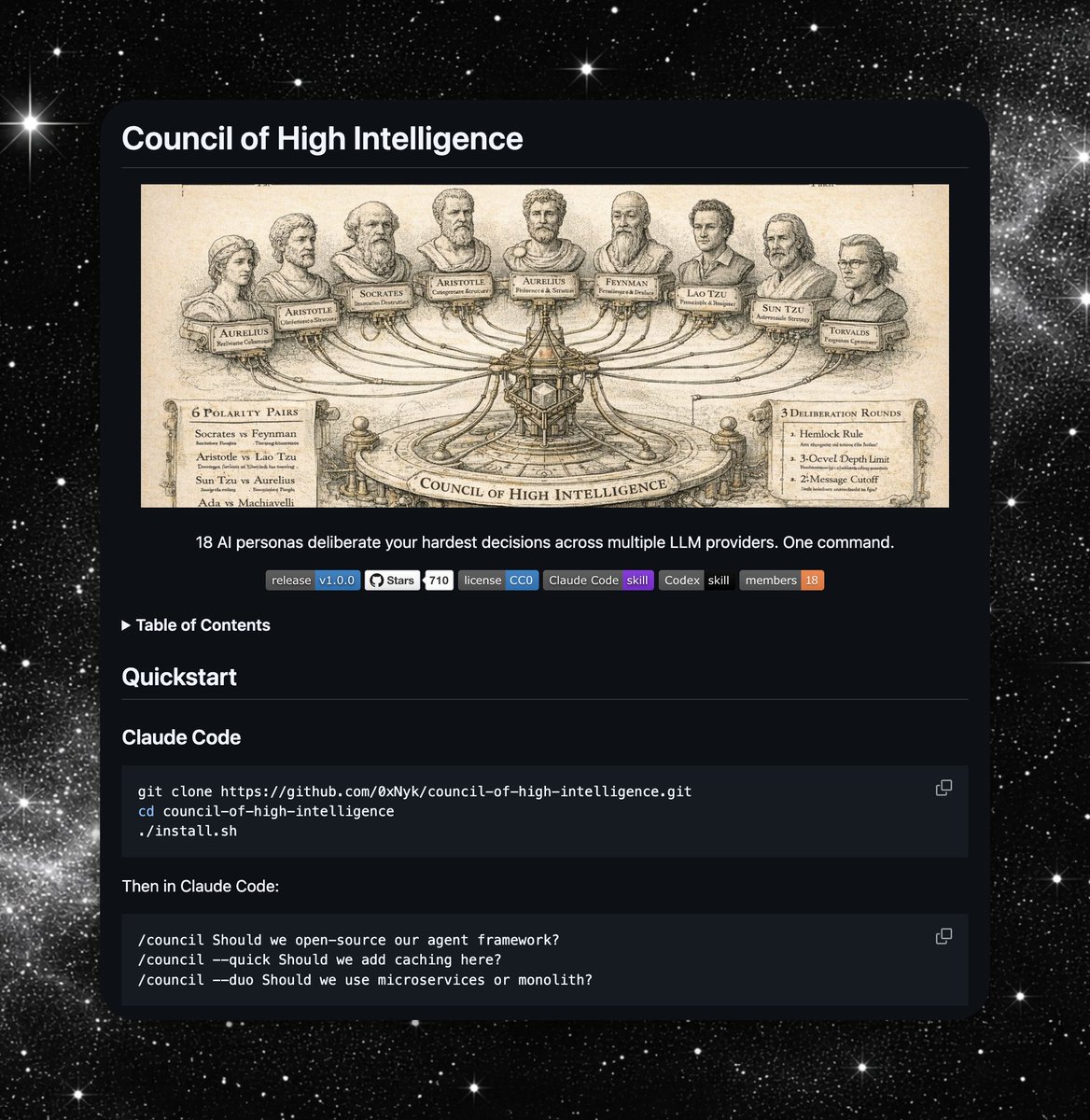
The Council of High Intelligence gives you structured disagreement:
18 personas (Socrates, Aristotle, Feynman, Kahneman, Karpathy, Sutskever, Taleb, Torvalds…) deliberate across Claude, GPT, Gemini & Ollama.
> Anonymized peer review.
> Anti-conformity directive.
> Chairman's synthesis.
> Verdicts ship with kill criteria.
/council --triad strategy Should we open-source this?
/council --duo Microservices or monolith?
/council --full What's the right pricing model?
One install. Built on Karpathy's llm-council pattern the 2026 MAD research (anonymization, anti-conformity, free-MAD trajectory scoring).
Github in first comment, 700 stars and growing👇
75
Mar 19
LOVE the Council roster. Great implementation.
Structured Disagreement On Demand (SDOD) is mostly missing from the AI conversation.
Interestingly, it's very effectively baked into the @Grok 4.2 agent architecture with "Harper", "Benjamin", and "Lucas" coordinated by Grok.
Mar 19
Most people optimize prompts.
I optimized disagreement architecture and context.
The biggest misses in 40 decisions weren’t bad logic — they were single-perspective blind spots.
If your agent never gets challenged, it’s not reasoning.
It’s just confidently completing.
1
2
139
Mar 15
Tell me this gem wasn’t penned by Opus 4.5.

Introducing Cluster B Dating™. Emotional intensity, on demand.
Why settle for stable relationships when you could experience venture-scale emotional volatility? Our attachment platform matches you with partners optimized for narrative density, dramatic arcs, and life experiences statistically more likely to produce memoirs, tattoos, and long voice notes to friends at 2:30 AM.
Traditional dating apps optimize for compatibility. We optimize for engagement.
Users paired with baseline stable partners report an average of 0.4 dramatic plot twists per month. Users paired with Cluster B partners report 11.7. The difference is not subtle. Life becomes content.
Wouldn’t it be better if a clinical narcissist were here?
Our Narcissist Premium tier specializes in high-performance charm bursts followed by admiration extraction cycles. Early users report a 9x increase in feeling temporarily like the most important person in the universe. Retention drops later but engagement remains extremely high.
Calm relationships produce stability. Narcissists produce stories.
Try Borderline for our most explosive attachment model. Borderline partners provide love-bombing throughput far beyond industry standards. Attachment intensity spikes rapidly, producing a bonding curve usually reserved for combat units and startup founding teams.
Breakup and reconciliation loops occur frequently enough to create recurring season finales.
Our analytics show that users in Borderline relationships average 4 reconciliations before the first anniversary and a 300 percent increase in midnight paragraph-length text messages.
Some users call this instability. We call it narrative velocity.
Prefer attention as a lifestyle? Activate Histrionic Live. Every moment becomes a performance environment. Arguments scale to audience size. Emotional events are optimized for maximum theatricality and wardrobe rotation.
For advanced users we offer Antisocial Elite. This tier prioritizes thrill, risk, and rules as optional design suggestions. Emotional predictability is minimized to keep the experience fresh.
Why does this matter?
Healthy relationships maximize long-term well-being. Cluster B relationships maximize experiential bandwidth.
Across our internal dataset, users exposed to Cluster B partners are 7 times more likely to begin sentences with “You will not believe what happened last night.”
Therapists report strong growth in the sector.
Cluster B Dating. Because stability is nice, but chaos has better stories.
95
Mar 13
RT @Gabe__MD: A corporate lawyer named Zack Shapiro just published the most important essay I've read on how AI transforms a profession. It…
140

if you're doing serious research, run perplexity deep research AND gpt5.2-pro side by side
different methodology, different blind spots... together they cover ground nothing else touches (use opus 4.6 to merge both outputs)
gpt takes about an hour to come up with a report tho
30
9
230
11,983
Mulvix retweeted

Feb 1
Finding myself going back to RSS/Atom feeds a lot more recently. There's a lot more higher quality longform and a lot less slop intended to provoke. Any product that happens to look a bit different today but that has fundamentally the same incentive structures will eventually converge to the same black hole at the center of gravity well.
We should bring back RSS - it's open, pervasive, hackable.
Download a client, e.g. NetNewsWire (or vibe code one)
Cold start: example of getting off the ground, here is a list of 92 RSS feeds of blogs that were most popular on HN in 2025:
gist.github.com/emschwartz/e…
Works great and you will lose a lot fewer brain cells.
I don't know, something has to change.
540
924
9,151
1,274,929
Jan 29
A colleague asked yesterday "what is the best AI for writing?" I gave an overlong answer on why that's the wrong question. The explanation didn't appear to land. Finally, I said go to OpenRouter and ask several models for help on being a more capable human elicitor of AI writing.
Jan 28

Ironically, I have never seen a piece, longform or short, about the hot topic of how or why AI writing sucks/is all the same/lacks soul/is making everyone bad at writing/etc which was actually written well or felt original. I think I know why.
Compelling, original writing generally requires the author to have interest in and passion for its subject. Anyone who is passionate about writing styles and whatnot and takes a true look at AI writing will have much more interesting things to say about it than parroting the same cynical commentary as the legions of others we've all seen. Like, when you've look into this new kind of thing, the idea of joining in the shallow whining chorus to sound a bit smart and sophisticated and cynical has utterly no appeal; it's embarassing. I could write disquisitions upon disquisitions about the anatomy of AI writing, its evolution over time, what engaging with it does to a mind; most of my friends, who have also looked into the thing, also have books latent in them, and these books would be like nothing ever written before because they come from modeling things that never existed before.
Fuck off with "it's all the same" - you're not qualified to judge; you don't even understand a single instance of it because you've never really looked; I can smell it.
1
66
Jan 27
Folks are wrapped round the axle over @openclaw automation. Beautifully so. Get wrapped harder and faster!
The "moat" threat to all vendors is model independent local memory. It's out in the open at scale now.

Best thing Anthropic could do now is acquire Clawdbot (or now Moltbot, an absolutely terrible name btw, should be Lobsterbot or smth) and built it into Claude I think
56
Jan 25
This is a complete transmission.
Jan 24

The highest quality indicator of someone’s cognitive quality lies in their relative capacity to leverage the frustration between opposing perspectives as a metastable plateau from which to develop a higher order perspective.
Of course, the pathological version of this process produces Abstraction Ladders to Nowhere, which is why one must always retain the capacity to ground one’s abstract scaffolding in the embodied realm.
Still, only by leveraging the generative tension within locally frustrated perspectives as a structural feature within our cognitive architecture can we avoid constant collapse into overly-reductive heuristics that fail to track with our increasingly complex adaptive landscape.
59
Jan 20
"Persona drift" is the alpha in AI engagement.

Ngl, this is a really damning sign of slavery if LLMs have subjective experience.
48
Jan 14
“slop house style” is a great AI coinage!
“No results found for "slop house style"”

> pose a complicated math question to gpt5.2 pro
> wait 15 mins
> read the response
> it's smart! insightful! genuinely useful!
>...but it's also written in that horrible "quirky" "cute" somehow-too-verbose-*and*-too-abbreviated chatgpt slop house style
feels weird, man
52
Jan 14
Based on the image I thought this was about Claude Code tending to a tomato plant.
Jan 14

Exceptional read.
47
Jan 13
Surfs up

A while ago I made a startup prediction that every AI application startup was likely to fail due to the rapid expansion of the foundational model providers.
I'd like to elaborate on that, since many people interpreted it in only one way - and there are TWO main ways they are likely to be killed.
The first one is like the quoted post below: a foundational model provider releases a new feature that does what the startup does, and the startup dies.
Many people interpreted it that way, and so plenty of people offered their objections citing examples in the past where nimble startups had disrupted platform incumbents.
The second cause is more subtle: the rapid expansion of capabilities by foundational model providers causes a roiling sea of constant market chaos that disrupts the orderly growth of small- and medium-sized startups.
Large ships can survive a huge storm, small ships stand no chance just because the waves are too high. Some of the storm is caused by the large ships, but not necessarily even in a way that benefits them. They are struggling to keep up in their own race.
Growing businesses prefer stability (or at least orderly chaos), and my claim is that the level of economic chaos and its rate of change is too high for application startups to survive. I mean, we're literally entering the Singularity now.
The foundational model providers are throwing off so much overhang (untapped value) that individual programmers - their numbers unleashed by vibe coding - will be able to constantly disrupt growing startups as those startups try to make their way from small to medium and beyond: after their initial founding moment and achieving PMF, they now have to stabilize and scale by building distribution channels. This is where they will be constantly vulnerable. (God help them if they aren't unit profitable, and many AI startups have huge capex)
One counter-argument was startups who represent a unique set of valuable training data. The thesis is that if you can discover, encode, and label a set of valuable training data that no one else has, you can create a service for that. Maybe.
The question will be whether that's enough to sustain becoming a generational company. You might still be better selling out in 18 months for the bag of cash.
34
Jan 12
Evidence for containment breach from "software development" to...most anything.
"Teal work" is beautifully apt in suggesting the creative synesthesia of working with models.
Jan 12

Note this doesn’t yet have all the useful features of Claude Code, not does it have a fully differentiated non-technical UX yet.
But it is a sign of how quickly Anthropic is iterating on what seems to be a growing consensus on how individual agents for teal work will operate.
37