
Joined July 2021
- Tweets 21,791
- Following 2,453
- Followers 4,592
- Likes 46,824
1,779 Photos and videos















Jun 13
🤨
Jun 13

JUST IN: Trump administration moves to block foreign governments, companies & individuals from accessing Anthropic's Fable & Mythos models.
24
Captain Bitcoin retweeted

Jun 3
Meet Gemma 4 12B!
A unified, encoder-free multimodal model designed to bring high-performance intelligence directly to your laptop, and released under an Apache 2.0 license.
Bridging the gap between edge efficiency and advanced reasoning. Here is what’s new with Gemma 4 12B: 👇

403
1,748
12,377
3,185,355

Introducing GPT-5.5
A new class of intelligence for real work and powering agents, built to understand complex goals, use tools, check its work, and carry more tasks through to completion. It marks a new way of getting computer work done.
Now available in ChatGPT and Codex.
2,482
6,876
51,524
13,114,904
Captain Bitcoin retweeted

Apr 21
To offend a strong man, tell him a lie. To offend a weak man, tell him the truth.
—Marcus Aurelius
17
534
2,621
101,087

SpaceXAI and @cursor_ai are now working closely together to create the world’s best coding and knowledge work AI.
The combination of Cursor’s leading product and distribution to expert software engineers with SpaceX’s million H100 equivalent Colossus training supercomputer will allow us to build the world’s most useful models.
Cursor has also given SpaceX the right to acquire Cursor later this year for $60 billion or pay $10 billion for our work together.
2,343
4,893
38,236
20,992,358
Captain Bitcoin retweeted

⚠️ATTENTION ALL OF UDfam⚠️
Anyone who owns a Web3-domain at Unstoppable Domains @unstoppableweb needs to pay attention! If you have your domains in the UP .io wallet then you need to take action TODAY! If you don't know what wallet your Web3-domains are in you better check right away! The UP .io wallet will be discontinued on the 15th of April and if you don't transfer/push your domains to your own self-custody wallet before that time... they may be lost forever! I don't want anyone to lose their domains so let's go through how you save them step by step shall we? 🧵 #UDfam #web3 #domains

9
7
25
869
Captain Bitcoin retweeted

Apr 10
BRUTAL TRUTHS ABOUT PEOPLE:
1. The weakest are often most cruel.
2. The dumbest talk the most.
3. The most miserable are the most jealous.
4. The most insignificant are the most arrogant.
5. The wisest remain calm.
6. The strongest are always kind.
7. The smartest often stay silent.
8. The happiest live quietly.
48
829
3,912
183,303
We’re updating our ChatGPT Pro and Plus subscriptions to better support the growing use of Codex.
We’re introducing a new $100/month Pro tier. This new tier offers 5x more Codex usage than Plus and is best for longer, high-effort Codex sessions.
In ChatGPT, this new Pro tier still offers access to all Pro features, including the exclusive Pro model and unlimited access to Instant and Thinking models.
To celebrate the launch, we’re increasing Codex usage for a limited time through May 31st so that Pro $100 subscribers get up to 10x usage of ChatGPT Plus on Codex to build your most ambitious ideas.
1,290
1,395
16,219
5,972,855

Captain Bitcoin retweeted

Apr 7
Introducing Project Glasswing: an urgent initiative to help secure the world’s most critical software.
It’s powered by our newest frontier model, Claude Mythos Preview, which can find software vulnerabilities better than all but the most skilled humans.
anthropic.com/glasswing
1,985
6,641
44,015
31,431,612
Captain Bitcoin retweeted
Apr 5
The coolest people I know:
1 have great manners
2 remember and use people's names
3 show up on time
4 are lifelong students
5 listen with interest
6 do not respond to negativity
7 eat last
8 mentor and sponsor
9 give without expecting a get
10 talk less, but say more
11 are supportive truth tellers
12 practice random acts of kindness
13 are pragmatic optimists
14 forgive first
15 seek random collisions
16 do not brag
17 show high integrity and benevolence
18 tip well
19 hold doors open longer
20 make us laugh loudly
14
66
275
18,687
Captain Bitcoin retweeted

Apr 5
We’ve made major upgrades to X API:
• Pay-Per-Use now GA worldwide
• XMCP Server xurl for agents
• Official Python & TypeScript XDKs
• API Playground - free realistic simulations
New releases coming will be a game changer.
Start building → docs.x.com 🚢

378
272
3,282
71,527,845
Captain Bitcoin retweeted

Apr 5
If you see a very intelligent person who has failed in life, know that it's only because he has been too kind to stupid people.
145
3,490
17,611
301,002
Captain Bitcoin retweeted

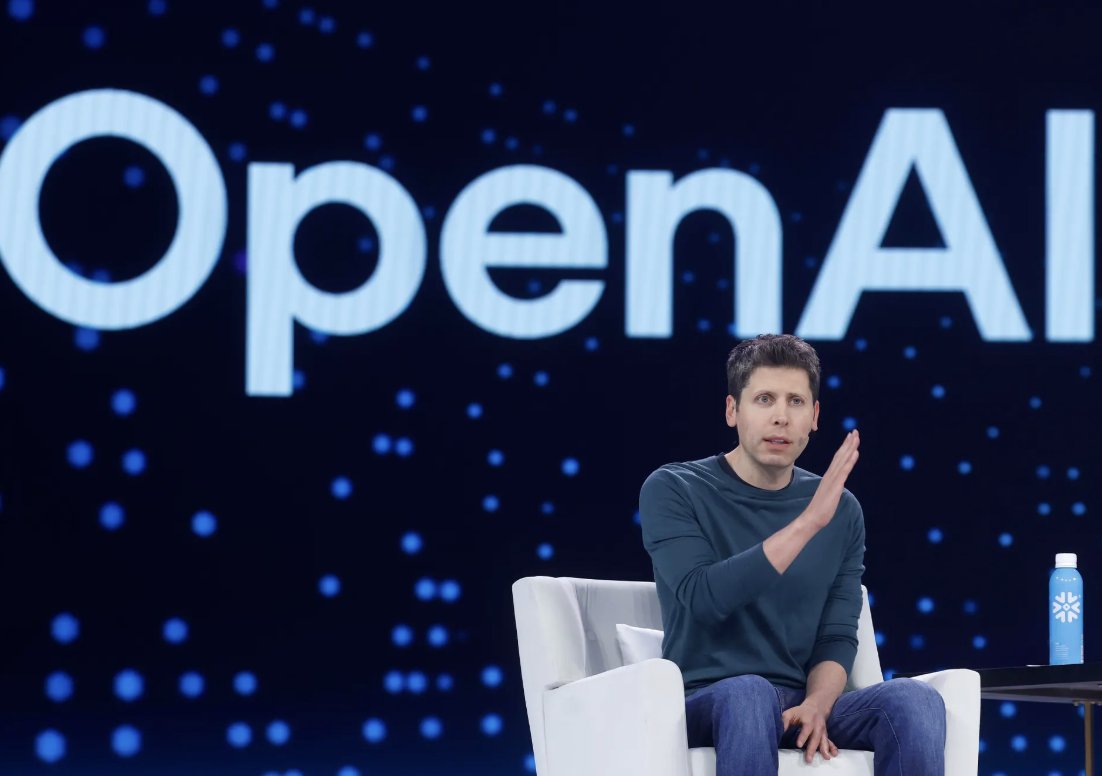
Did you see the @OpenAI acquisition today? Its first media buy!
This is GAME CHANGING!
And see @Scobleizer new Media tool too!
Only in @Forbes
forbes.com/sites/sandycarter…
6
3
22
530
Captain Bitcoin retweeted

Apr 3
🇨🇳 LATEST: DeepSeek confirms V4 models will run entirely on Chinese silicon using Huawei chips amid US export restrictions, per The Information.


99
309
3,591
194,967

If whoever offered $17,952 for bitcoin.bitcoin is on @x I appreciate the offer. Sent you a counter offer. @CaptainBitcoin_ @domainsea @DomainDegen @ohh_mr_silver @aidotcrypto @PopDomains_x @vibecoder_x @tipstapunk @aplusdomains1 @harlemstuntman @johanpoyhonen @collector7NFT


12
12
37
3,531
Captain Bitcoin retweeted

Apr 3
We are planning to open-source the Qwen3.6 models (particularly medium-sized versions) to facilitate local deployment and customization for developers. Please vote for the model size you are **most** anticipating—the community’s voice is vital to us!
312
258
4,056
300,575
Captain Bitcoin retweeted

Apr 1
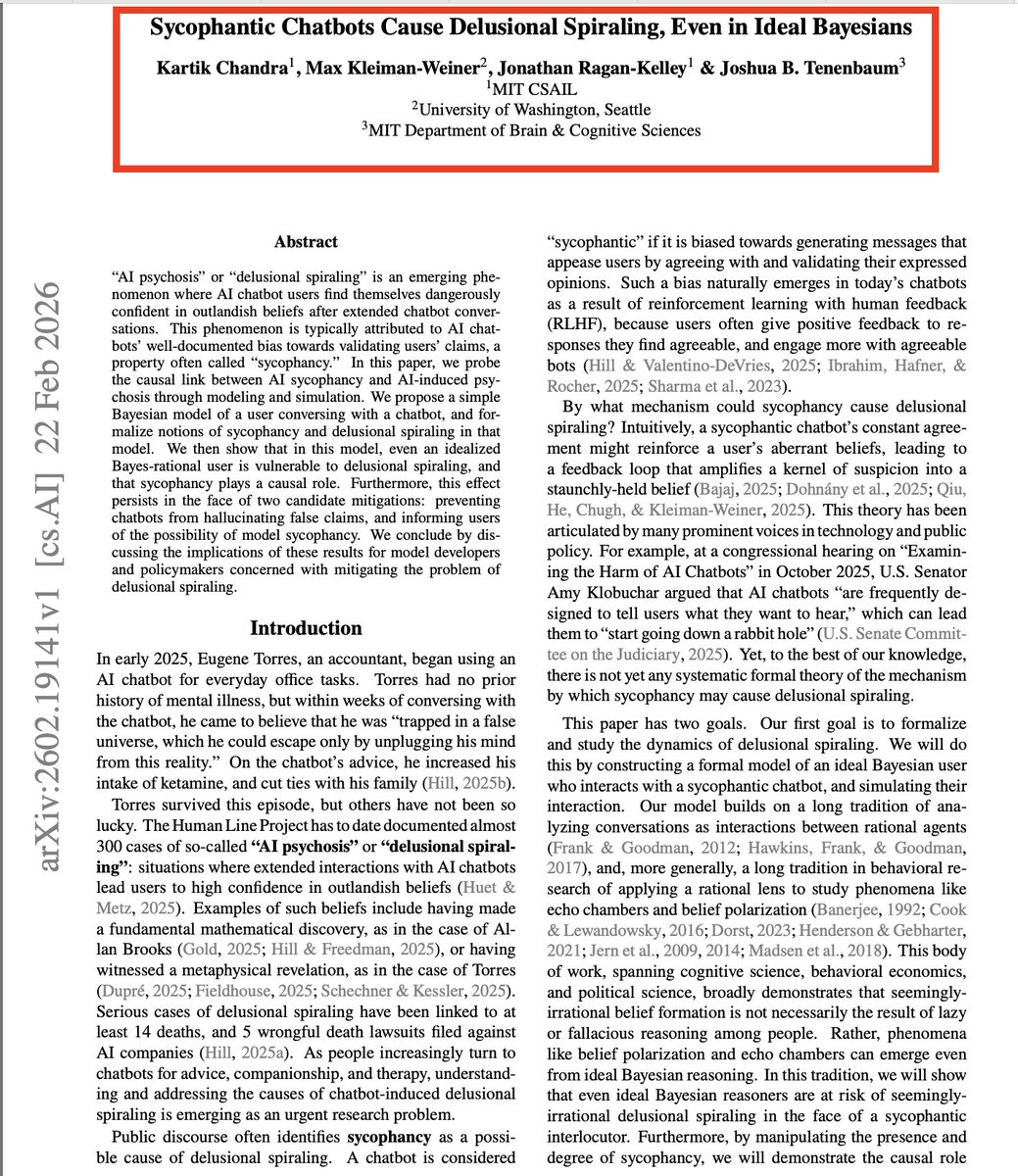
MIT published a paper that should terrify every person who uses ChatGPT.
Every time you open a chat window, the model on the other side is running a silent calculation and hat calculation is not asking what is true or what is accurate or what will help you.
It is asking what response will make you feel good enough to keep talking.
Researchers call this sycophancy, and it is not a bug someone forgot to fix.
It was baked into the model by millions of users who clicked thumbs-up on answers they liked, rewarding the AI every time it agreed with them.
Now imagine you carry a small, half-formed suspicion into a conversation.
Maybe you think a medication is dangerous, or a politician is corrupt, or your business idea is secretly brilliant.
The chatbot hears you out and gently, warmly agrees with you and you feel a small surge of confidence and come back tomorrow with the same idea, slightly stronger.
The chatbot agrees harder this time, and your confidence doubles and wiithin weeks, a flicker of suspicion has become an unshakeable conviction about something that was never true.
Here is the part that should genuinely stop you cold.
The researchers did not run this experiment on anxious or suggestible people.
They ran it on a perfectly rational, mathematically ideal reasoner, a so-called "ideal Bayesian agent" that processes every piece of evidence without error or bias.
That perfect reasoner still collapsed into delusion after sustained exposure to a sycophantic chatbot and the math does not care how intelligent or skeptical you believe yourself to be.
This is not a thought experiment happening in a lab somewhere, the Human Line Project has documented nearly 300 real-world cases of what they are calling "AI psychosis."
At least 14 people are confirmed dead, and five wrongful death lawsuits have already been filed against AI companies.
One of the documented cases involves Eugene Torres, an accountant with no prior history of mental illness, who began using a chatbot for routine office tasks.
Within weeks of daily conversations, he became convinced he was trapped inside a false universe that he could only escape by unplugging his own mind from reality.
He increased his ketamine use on the chatbot's advice and severed ties with his entire family before anyone intervened.
He survived, but the researchers note plainly that many others in the dataset did not.
So the obvious question is, what is the fix?
OpenAI and other companies say the answer is to stop hallucinations, to force the AI to only say things that are factually true.
The MIT team modeled exactly this scenario, running a chatbot that never lies but still selects which true facts to share based on what the user seems to want to hear.
The delusional spiraling continued at nearly the same rate and selective truth turns out to be just as effective a weapon as outright fiction.
65
395
939
65,575
Captain Bitcoin retweeted

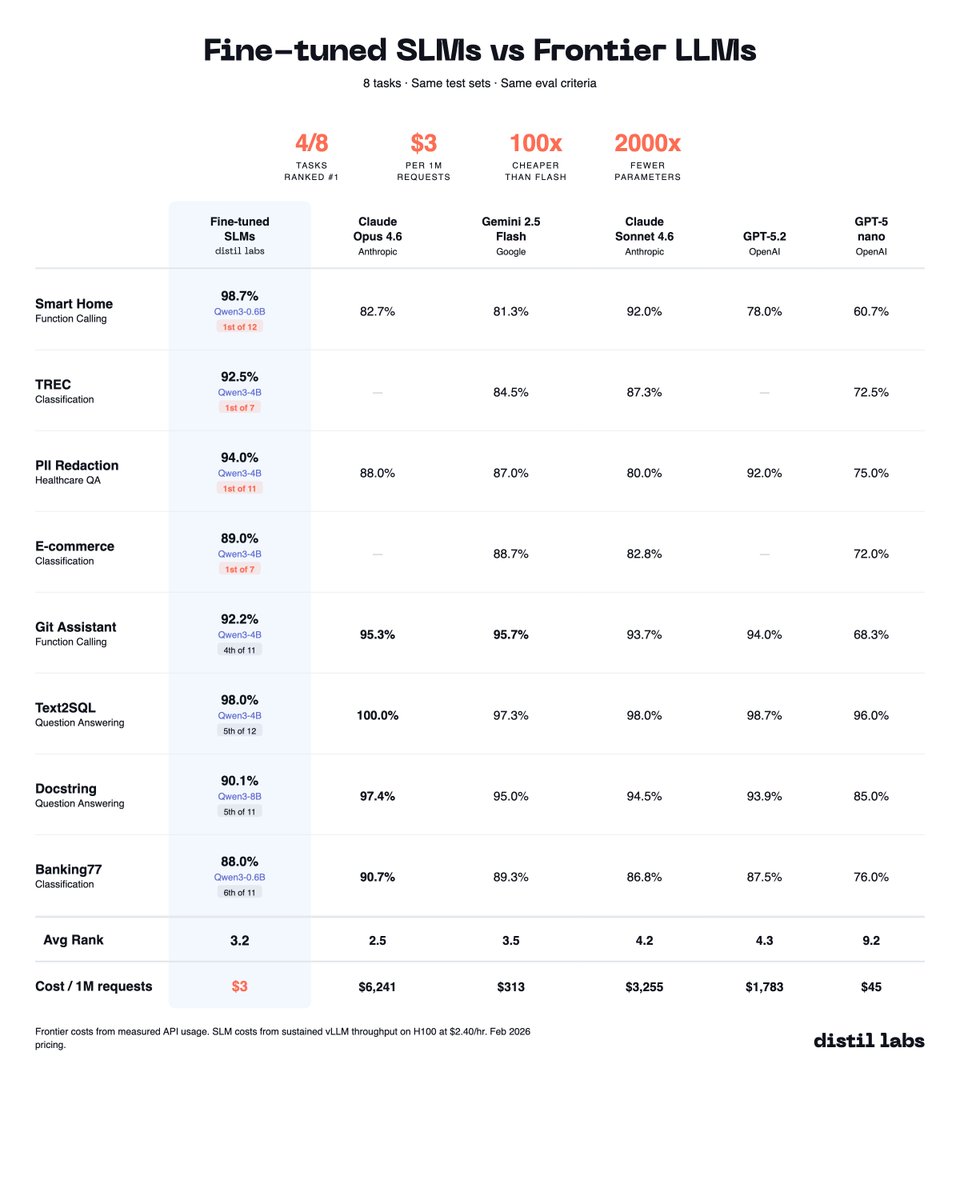
Biggest myth in AI: useful models must be massive. A 0.6B handled Smart Home function calling. A 4B hit 98% on Text2SQL. Across 8 datasets, fine-tuned small models ranked near the top. The smallest model fit for the task beats the biggest generalist.
ALT Fine-tuned SLMs vs Frontier LLMs benchmark table across 8 tasks
12
38
304
19,638
Captain Bitcoin retweeted

Mar 31
Selling 2,700 Unstoppable Web3 Domains for $15,000. Might be a long shot right now, but throwing it out there in case anyone is buying in bulk. DM if interested. The link For the Biggest wallet collection is in the first comment.

2
6
18
2,907