
Joined June 2024
- Tweets 49,912
- Following 6,640
- Followers 3,492
- Likes 59,405
706 Photos and videos








ChainBuilder.pro retweeted
For users of @quipnetwork , 3look, @Wallchain, and @TheARCTERMINAL , the rumored release of Anthropic's Mythos isn't just another AI launch.
In the world of quests, reputation systems, and AttentionFi, we're already experimenting with turning user activity into measurable value. Mythos could push that idea much further.
According to reports, Anthropic is preparing a public version of its Mythos-class model, possibly under the name Claude Fable. Until now, the technology was reportedly limited to government and enterprise programs through Project Glasswing.
What makes it different is its focus on security. Instead of simply generating text, Mythos is designed to identify software vulnerabilities and conduct security analysis with a high degree of autonomy. Reports claim the system has already helped uncover thousands of issues across operating systems and browser codebases.
That changes the conversation.
If AI can find security flaws at scale, the value of human contribution shifts. Raw participation becomes less important than verification, review, and judgment. In other words, attention alone is no longer enough. Trust becomes the scarce resource.
For quest platforms and creator ecosystems, several trends stand out:
• Measurement
Campaigns may rely less on simple engagement metrics and more on proving that information, research, or testing results are accurate.
• Ownership
The people who can validate, organize, and act on AI-generated findings may capture more value than those who simply generate content.
• Reputation
Future reward systems could increasingly favor contributors who improve reliability, security, and data quality.
The market is already reacting to the potential capabilities of these systems, but capability and safety are not the same thing. Anthropic has reportedly delayed public access multiple times, highlighting how thin the line can be between finding a vulnerability and enabling an exploit.
Regardless of the final release timeline, the broader signal is clear: security is becoming increasingly automated, and human reputation may increasingly depend on the ability to verify and interpret what autonomous systems produce.
As these models become more common, what will make your contribution valuable when AI can perform the first layer of analysis in seconds?
Preview hook:
Autonomous AI auditors are coming. The real question is who gets rewarded when verification becomes more valuable than attention.
58
3
67
6,011
ChainBuilder.pro retweeted
Friends, even if you’re into quest platforms like @quipnetwork , 3look, @Wallchain or @TheARCTERMINAL , you still need a reliable exchange for all your swaps and predictions.
Zoomex combines everything you need in one place! Check out my latest video to see why I’m making the switch
youtube.com/watch?v=swHhwpYa…
21
2
38
3,953
Friends, even if you’re into quest platforms like @quipnetwork , 3look, @Wallchain or @TheARCTERMINAL , you still need a reliable exchange for all your swaps and predictions.
Zoomex combines everything you need in one place! Check out my latest video to see why I’m making the switch
youtube.com/watch?v=swHhwpYa…
21
2
38
3,953
👉 Place your bets on Zoomex: zoomex.com/ru-RU/predict/cry…
1
7
156
If you follow Quip, 3look, Wallchain, ARC Terminal or Konnex, Tennessee’s new data center law is not just a local infrastructure story.
It points at the physical cost behind every AI, quest, mindshare and AttentionFi economy:
compute does not run on narratives.
It runs on power, substations, transmission lines and someone’s electricity bill.
Tennessee has passed a law aimed at stopping utility ratepayers from covering electricity infrastructure costs for large data centers.
The rule applies to data centers with peak electricity demand of at least 50 megawatts during their first three years of operation.
Those facilities must pay for their own electricity infrastructure.
Supporters frame this as ratepayer protection.
The argument is simple:
if a massive AI or data center project requires new infrastructure, local residents and businesses should not automatically subsidize the buildout through their utility bills.
That matters because the Tennessee Valley Authority says data centers already account for about 18% of its overall power load.
The article also references xAI’s Colossus project in Memphis, with the facility estimated to use enough electricity to power 200,000 to 300,000 homes.
This is where the story becomes relevant for quest and mindshare ecosystems.
Most people see AI platforms through the front end:
agents, prompts, rewards, leaderboards, creator campaigns, points, content tasks.
But underneath that layer is a hard infrastructure question:
who pays for the compute economy?
@quipnetwork talks about useful compute.
@TheARCTERMINAL talks about private AI infrastructure.
@3look_io and @Wallchain turn attention, creators and distribution into measurable campaign value.
All of these models depend on a bigger assumption:
that digital participation can become economically valuable at scale.
But as AI demand grows, the cost side becomes harder to ignore.
Power demand, grid upgrades and local infrastructure are becoming part of the AI business model.
That means the next fight may not only be about models, tokens or rewards.
It may be about whether the people around the infrastructure carry the cost while the platforms capture the upside.
For quest participants, this is a useful signal.
The best narratives will not just ask:
“what can users earn?”
They will also ask:
“what real infrastructure, cost or value is being coordinated here?”
Because the more AI and Web3 converge, the more important it becomes to separate empty activity from systems that actually produce, secure or distribute value.
So the real question is:
if AI economies need public infrastructure to scale, who should pay for the rails?
22
1
40
3,574
its going to be crucial for startups relying on these data centers to figure out their cost structures early on, especially if theyre scaling quickly. local policy shifts like this could mean tighter margins for new projects.
1
8
233
If you spend time on Quip, 3look, Wallchain or ARC Terminal, SR Platform is not just another robotics announcement.
It touches a question that sits at the center of quest platforms, mindshare campaigns, creator rewards and AttentionFi: how do you measure and reward valuable human contribution in an AI-native economy?
Strike Robot is building SR Platform, an embodied AI training stack focused on robotics. The platform aims to turn natural-language descriptions into executable robot simulation environments, reducing the complexity of creating training-ready scenes. According to the project's published materials, the system uses a multi-stage agentic pipeline that plans environments, generates or retrieves assets, validates layouts and outputs executable simulation environments. The team also recently highlighted upcoming contributor programs and community participation around training data and platform development.
What makes this interesting is that the discussion quickly moves beyond robotics.
The deeper question is where future AI systems get their training environments, behavioral data and edge-case knowledge from. AI models do not improve in isolation. Someone creates the datasets. Someone labels information. Someone contributes examples, feedback loops and domain expertise.
That is where the conversation starts to overlap with what quest and mindshare ecosystems have been experimenting with for years.
Platforms like @quipnetwork , 3look, @Wallchain and @TheARCTERMINAL already treat participation as something measurable. Attention becomes a signal. Distribution becomes a signal. Contribution becomes a signal. Points, leaderboards and creator rewards attempt to quantify value that traditionally remained invisible.
$SR Platform introduces a similar idea from a different direction.
If robotics training increasingly depends on community-generated environments, datasets and feedback, then participation itself becomes part of the production process. The challenge is no longer just building AI. It becomes designing systems that determine who contributed value and how that value should be allocated.
Of course, none of this guarantees a new ownership model will emerge.
Contributor rewards, data programs and participation incentives remain controversial. Measuring quality is difficult. Rewarding the wrong behaviors can create noise instead of useful signal. And not every contributor economy succeeds simply because it is on-chain.
But even if specific programs evolve or change, the broader signal is hard to ignore.
Across AI, Web3 and robotics, the same debate keeps appearing: who should capture the upside when intelligence is trained using collective participation?
For people active in quest platforms and mindshare ecosystems, that may be the more important trend to watch than any individual reward campaign.
The next generation of incentives may not be built around attention alone, but around verifiable contribution, credibility and ownership of the value created alongside AI.
If AI systems increasingly rely on communities to generate data, environments and feedback, should contributors earn temporary rewards - or long-term ownership in the value they help create?
22
2
41
3,406
If you follow Quip, 3look, Wallchain or @TheARCTERMINAL , Bernie Sanders’ AI proposal is not just another political headline.
It points at the same question quest platforms, mindshare campaigns and AttentionFi are already testing in public:
who should capture the value created by AI, data, attention and user participation?
Sanders is reportedly preparing a bill that would push for 50% public ownership stakes in the largest American AI companies through an AI sovereign wealth fund.
The idea is simple, but explosive:
if AI models were trained on collective human knowledge and culture, then AI-generated wealth should not flow only to a small group of companies and shareholders.
That is why the proposal is being compared to sovereign wealth fund models like Norway’s fund or Alaska’s Permanent Fund, where public resources can produce public upside.
Whether this bill has any realistic path forward is a separate question.
It is politically controversial, and it would be a mistake to treat it as neutral business news or assume it will pass.
But the market signal matters.
The AI debate is moving from “how do we regulate models?” to “who owns the wealth created by models?”
That shift should matter to anyone building or participating in quest ecosystems.
Because @quipnetwork , 3look, @Wallchain, ARC Terminal, and similar platforms are already experimenting with a smaller version of the same idea.
Users create attention.
Creators create distribution.
Communities create narratives.
Participants create measurable activity.
Leaderboards, points, X Scores and creator rewards turn that activity into economic signals.
Today, those signals may look like campaign rewards or airdrop eligibility.
Tomorrow, they may become reputation, allocation, ownership or governance weight.
That is the deeper link between AI policy and quest platforms.
Both are asking whether value should belong only to the infrastructure owners, or also to the people whose data, attention, culture and participation made the system valuable in the first place.
So the real question is not whether this specific proposal passes.
The real question is:
if AI and attention economies are built on collective input, what is the fairest way to distribute the upside?
21
1
27
4,293
ChainBuilder.pro retweeted

May 29
The week is coming to an end, and I am sitting here trying to figure out what to buy in this market.
Overall, the charts look very similar and highly promising, but they haven't formed a crystal-clear buy signal just yet.
Across all the tokens we will discuss below, the picture is practically identical: the first wave of growth has concluded, followed by a textbook Elliot Wave 2 pullback.
It is already a solid area to buy, but since we lack strict confirmation that the downward move is over, consider this post as a weekend accumulation plan for the next 3 days.
Even if you are currently fully focused on completing tasks in @TheARCTERMINAL, @3look_io, @wallchain, and @quipnetwork, you should still pay close attention to this analysis.
Multiple Xs don't just appear out of nowhere.
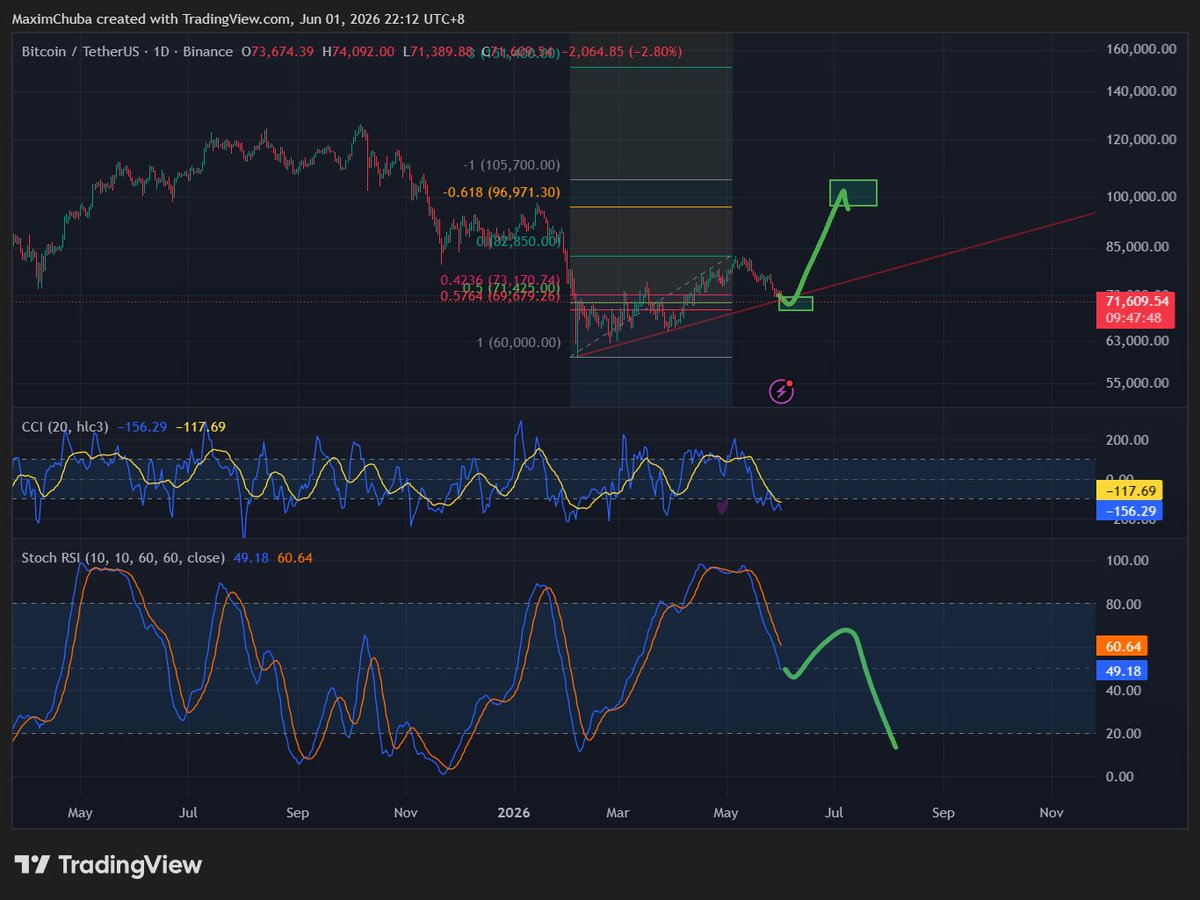
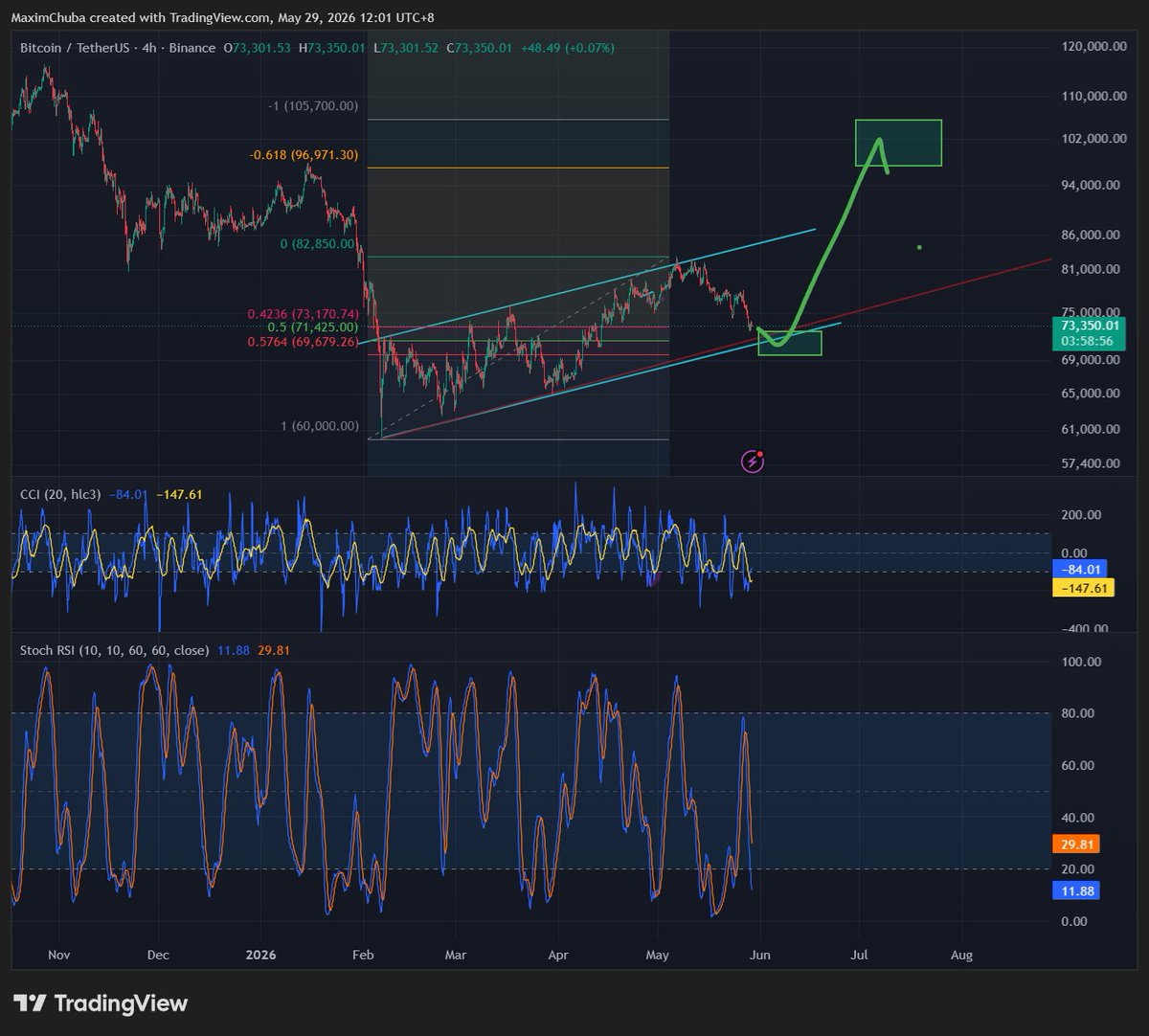
Let’s start with the market leader: bitcoin:native .
Naturally, BTC itself won't deliver the same massive Xs as meme coins, but if you want to amplify the results, you can always utilize leverage.
I expect a sharp upward move within the next month, and the current downside looks like it is nearing completion.
Overall, the $70,500–$72,500 zone is an excellent accumulation area for the next 1–2 months.
Here we have the 50% Fibonacci retracement level, a retest of the support line, and solid liquidity pools.
I am targeting a move above $100k, meaning even 10x leverage here could net you over a 3x return.
53
2
73
3,709
ChainBuilder.pro retweeted

Jun 2
Commentary is one of the most important pillars of X. And sometimes the best way to share your thoughts is with video.
Today we're launching a whole new way to make them:
React with Video
Tap the repost button and start recording with green screen, split screen, or picture-in-picture.
Now available on iOS
3,609
1,602
13,760
8,029,972
ChainBuilder.pro retweeted
May 28
99% of people are still using AI just to rewrite emails or generate pretty pictures.
Meanwhile, the top 1% are building autonomous systems that do the heavy lifting - coding, trading, and executing tasks while they sleep.
The era of manual grinding is officially dead. Here is how AI Agents are changing the game right now.
We’ve all been there: staring at charts, debugging lines of code for hours, or trying to manage cross-chain liquidity manually. It’s exhausting, inefficient, and leaves too much room for human error.
The bottleneck isn’t the lack of tools; it’s that you still have to operate them.
But what if the tool could think, adapt, and execute on its own?
Enter @StrikeRobot_ai - the missing link between raw AI intelligence and autonomous execution. Imagine having a relentless, 24/7 digital workforce tailored specifically to your goals.
No emotion. No fatigue. Just pure execution.
Whether it’s deploying smart contracts, sniping on-chain opportunities, or orchestrating complex data workflows, the shift from "AI assistants" to "Autonomous AI Agents" is happening fast.
With platforms like StrikeRobot, you aren’t just prompting; you are delegating. You set the strategy, define the parameters, and let the agent navigate the chaos.
The internet is moving from information-rich to execution-driven. The ones who leverage autonomous agents today will be the ones setting the rules tomorrow.
Stop working for your tools. Make your tools work for you.
$SR 0x93e7c445d77e6506b77c869c469e4305c15c075b
@TheARCTERMINAL
@3look_io
@wallchain
@quipnetwork
youtube.com/watch?v=ML76zIdd…
40
3
59
6,708
May 29
The week is coming to an end, and I am sitting here trying to figure out what to buy in this market.
Overall, the charts look very similar and highly promising, but they haven't formed a crystal-clear buy signal just yet.
Across all the tokens we will discuss below, the picture is practically identical: the first wave of growth has concluded, followed by a textbook Elliot Wave 2 pullback.
It is already a solid area to buy, but since we lack strict confirmation that the downward move is over, consider this post as a weekend accumulation plan for the next 3 days.
Even if you are currently fully focused on completing tasks in @TheARCTERMINAL, @3look_io, @wallchain, and @quipnetwork, you should still pay close attention to this analysis.
Multiple Xs don't just appear out of nowhere.
Let’s start with the market leader: bitcoin:native .
Naturally, BTC itself won't deliver the same massive Xs as meme coins, but if you want to amplify the results, you can always utilize leverage.
I expect a sharp upward move within the next month, and the current downside looks like it is nearing completion.
Overall, the $70,500–$72,500 zone is an excellent accumulation area for the next 1–2 months.
Here we have the 50% Fibonacci retracement level, a retest of the support line, and solid liquidity pools.
I am targeting a move above $100k, meaning even 10x leverage here could net you over a 3x return.
53
2
73
3,709
May 29
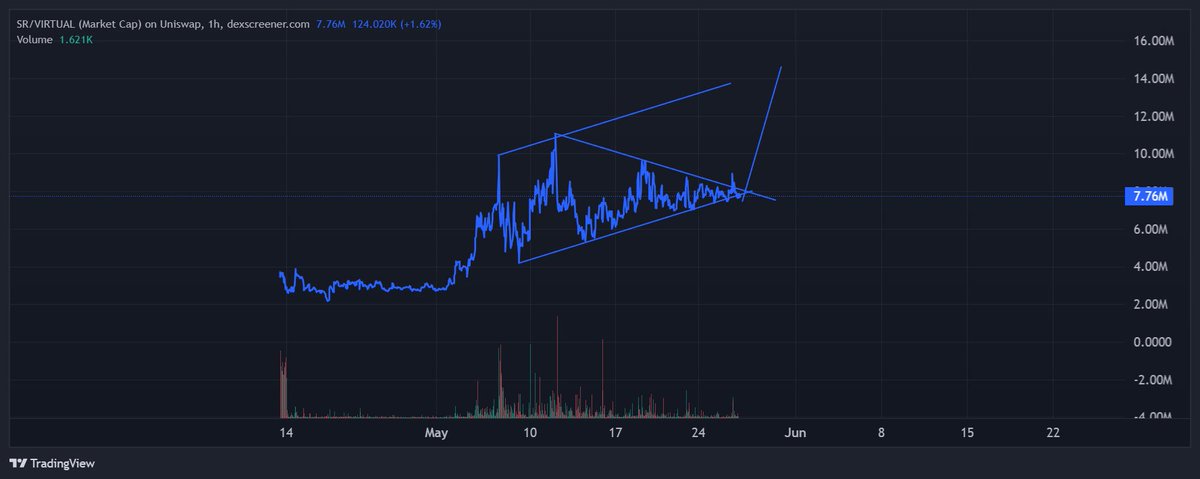
The final candidate for our weekend shopping list is solana:CcLd8HTAKLWtQHatqPwBQjtuCA72FNB9E1ckRTEzpump on pump.fun:
This play has already given me a 2x return.
The current correction is nearing its end, and if the opportunity presents itself, I will happily bids this again around $0.005 with targets above $0.03.
I am not expecting a 10x from this one, but a 5x is well within reach.
pump.fun/coin/CcLd8HTAKLWtQH…
2
14
224
May 29
This is the breakdown for the upcoming days.
The setups are clean, the risk-to-reward ratios are favorable, and the weekend liquidity might give us the exact entries we need.
What are your thoughts on these setups?
Which tokens are you accumulating over the weekend?
Let me know in the comments below.
8
154
ChainBuilder.pro retweeted
May 27
The Race for Mindshare: Why the Strike Robot Contributor Challenge is a Game-Changer for Web3 Analytics
In the fast-paced world of Web3, project survival is heavily tied to one critical metric: mindshare. Tech is important, but attention is the ultimate currency. This is exactly why the Strike Robot Mindshare Challenge is such a brilliant and timely initiative. It bridges the gap between raw data and real community value.
For creators and analysts, this challenge isn't just a promo campaign - it’s a merit-based runway to become a recognized contributor in an ecosystem that is actively pushing boundaries.
Breaking Down the Mindshare Challenge
Strike Robot has set clear, high-standard rules for this race, filtering out the noise and making sure only quality content wins. The core criteria are straightforward but demanding:
Value-Driven Content: No empty hype or spam. Submissions must deliver genuine insights and relevant analysis regarding Strike Robot.
Skin in the Game: To participate, users must hold at least 10,000 $SR in their wallet. This ensures that every voice entering the challenge is genuinely aligned with the project’s success, rather than just chasing a quick bounty.
Verified Influence: Accounts must be active for over 3 months and verified on X, keeping the ecosystem clean from bots and sybil accounts.
Why This Matters for the Community
Most crypto platforms suffer from "info-fi overload" - thousands of accounts posting the same generic referral links and automated templates. The Mindshare Challenge completely flips this dynamic. By incentivizing real analysis and original takes in any language, Strike Robot is building a decentralized library of deep-dive research.
For a data-driven ecosystem, this is pure gold. It allows everyday users to see the project through different lenses, whether it's through tracking tokenomics, evaluating on-chain activity, or looking closely at the project's technical milestones.
Looking Ahead
True proof in Web3 is always backed by action. As the challenge rolls out, the creators who focus on deep market analysis and authentic community building will inevitably stand out.
The race to become a Strike Robot contributor is officially on, and it’s a perfect example of how a project should leverage its community to scale its intellectual footprint. If you have the data, the skin in the game, and the insight - now is the time to let your content do the talking.
@TheARCTERMINAL @3look_io @wallchain @quipnetwork
33
1
39
3,427