
Official Twitter account of NASA’s Chandra X-ray Observatory. Operated for NASA by Smithsonian (SAO). Verification: nasa.gov/socialmedia Legal: s.si.edu/legal
- Tweets 78,093
- Following 198
- Followers 418,351
- Likes 13,299
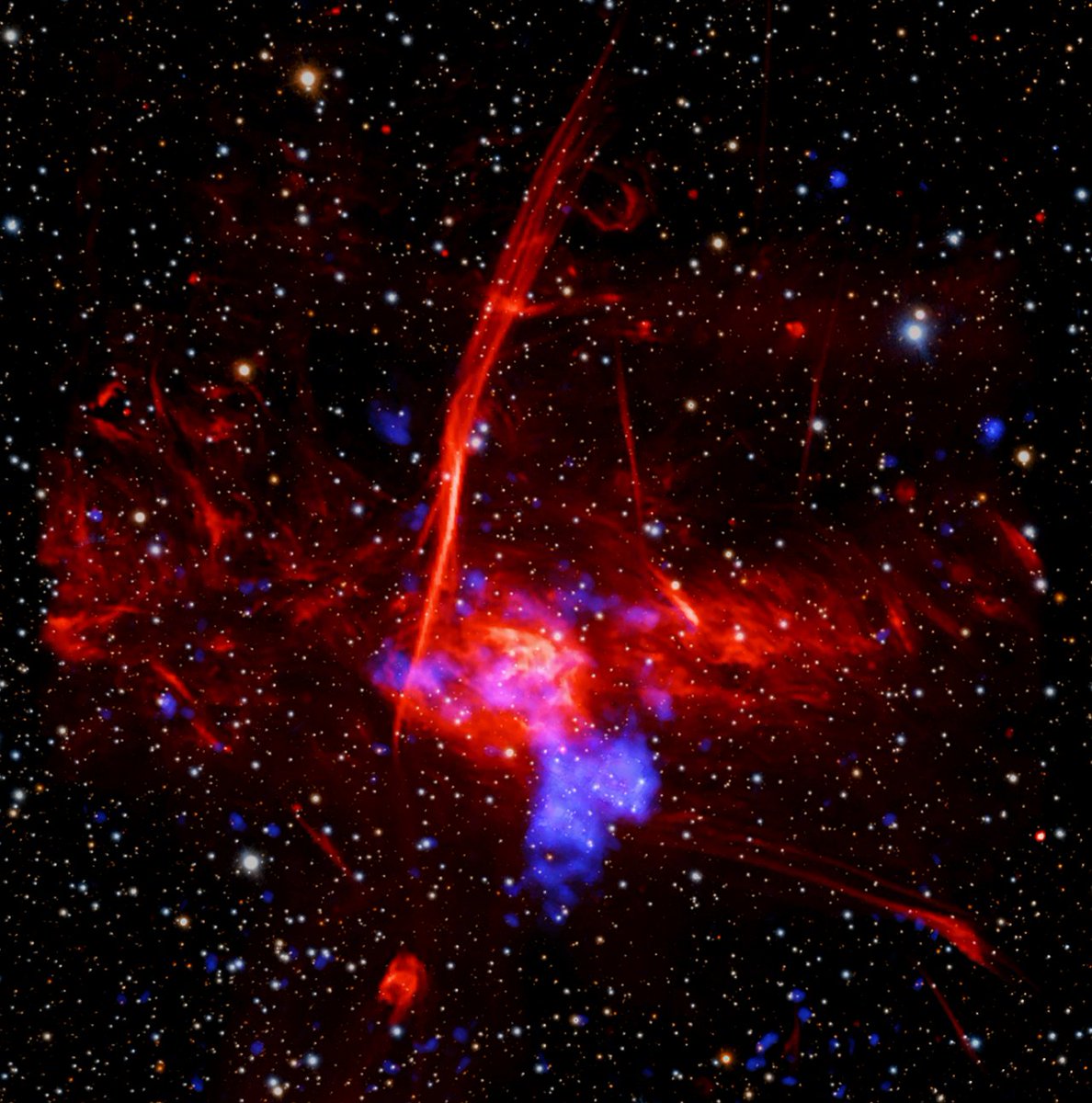


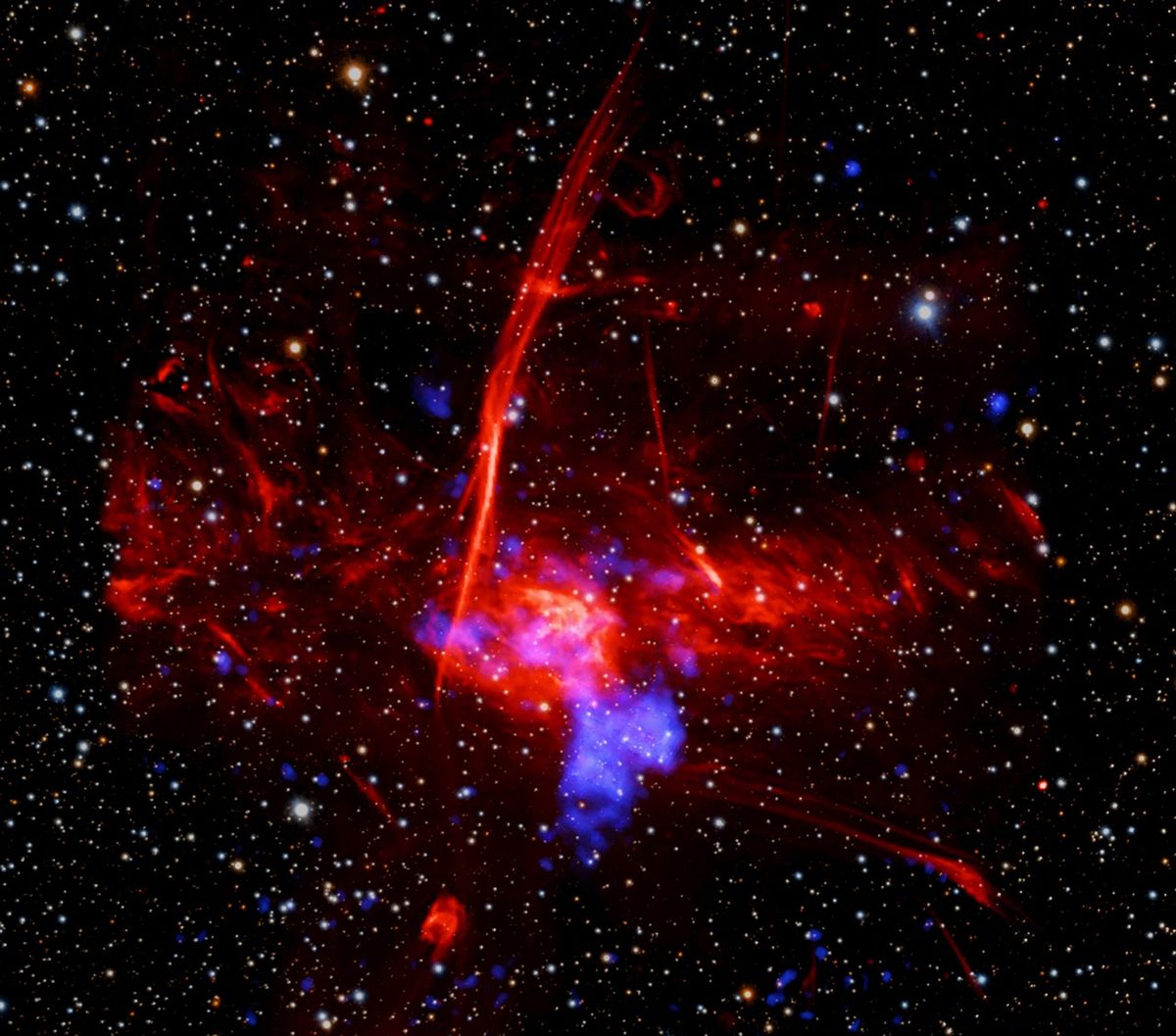
ALT This release features a composite image of colorful, overlapping clouds, which suggests to astronomers that a supernova remnant may be buried in gas near the center of our Milky Way galaxy. Set against a backdrop packed with distant stars and other specks of light are two distinct, overlapping clouds. The larger, visually dominant cloud, is red and multifaceted. It has an irregular shape, and features patches of different textures, including pockets that resemble wispy smoke, tangles of faint red veins, and clear streaking lines. This large cloud of expanding gas represents radio data from the MeerKAT telescope in South Africa. Overlapping with that red cloud is a cloudy blue blob representing X-ray data from NASA's Chandra X-ray Observatory and ESA's XMM-Newton. Astronomers suggest that this blue blob of X-ray emissions is the remains of a massive star destroyed by a supernova.

ALT This composite image of colorful, overlapping clouds, suggests to astronomers that a supernova remnant may be buried in gas near the center of our Milky Way galaxy. Set against a backdrop packed with distant stars and other specks of light are two distinct, overlapping clouds. The larger, visually dominant cloud, is red and multifaceted. It has an irregular shape, and features patches of different textures, including pockets that resemble wispy smoke, tangles of faint red veins, and clear streaking lines. This large cloud of expanding gas represents radio data from the MeerKAT telescope in South Africa. Overlapping with that red cloud is a cloudy blue blob representing X-ray data from NASA's Chandra X-ray Observatory and ESA's XMM-Newton. Astronomers suggest that this blue blob of X-ray emissions is the remains of a massive star destroyed by a supernova.
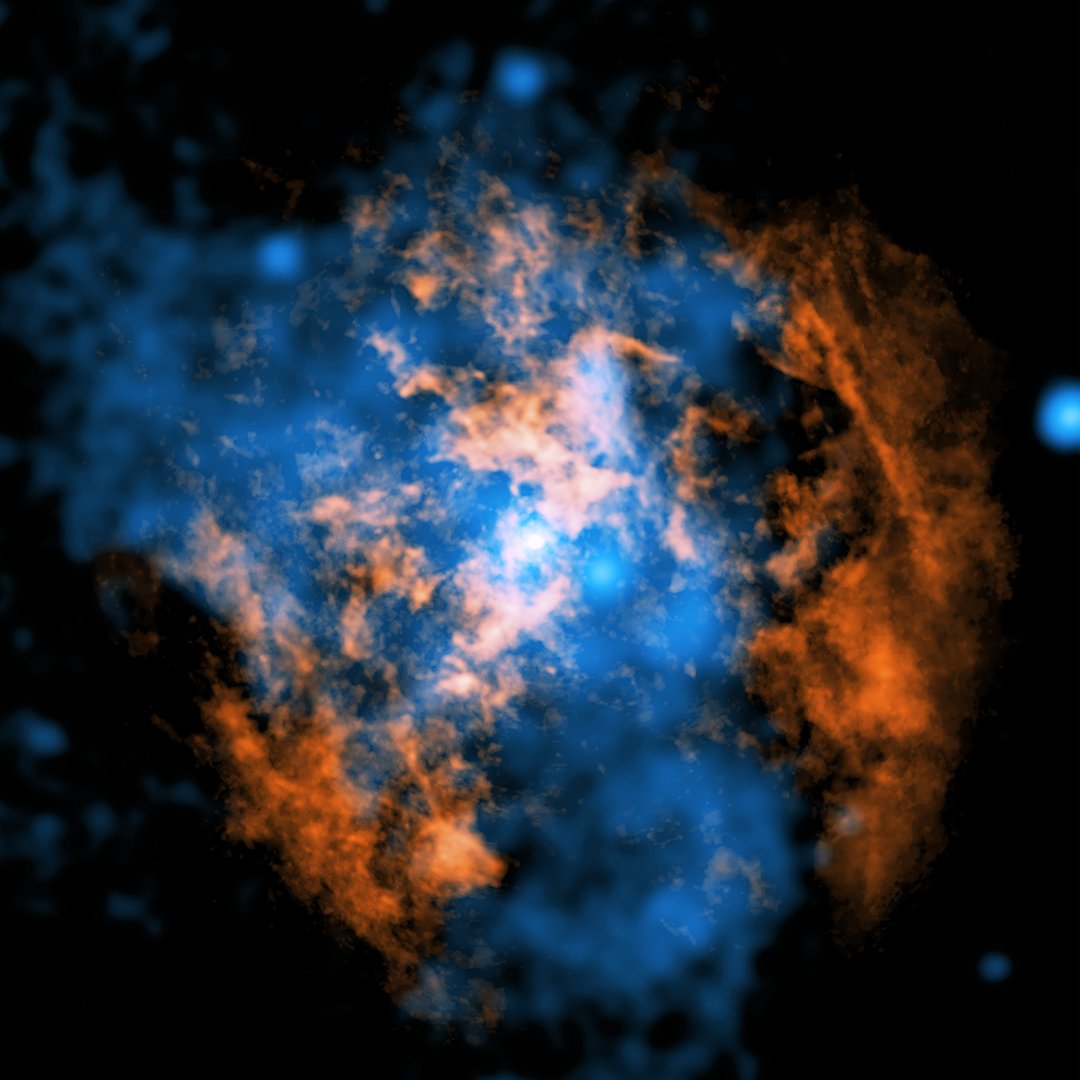
ALT This image centers on a bright, pinpoint white glow marking Sagittarius A* (Sgr A*), the supermassive black hole at the heart of the Milky Way, surrounded by a turbulent, cloud-like environment. Radiating outward from the center is a luminous swirl of blue X-ray emission from NASA's Chandra X-ray Observatory, forming a soft, irregular halo that is brightest near the core and fades into darker shades toward the edges. Interwoven with this blue glow are thick, patchy structures in orange, tracing colder gas mapped by radio observations from ALMA. These orange regions form a partial ring and clumpy arcs around the center, but notably break open to reveal a wide, cone-shaped cavity where little to no orange emission appears. This hollowed-out region is instead filled with the blue X-ray glow, emphasizing the contrast between hot and cold material. The scene feels dynamic and layered, with the interplay of blue and orange just a few light-years from the galaxy’s core.
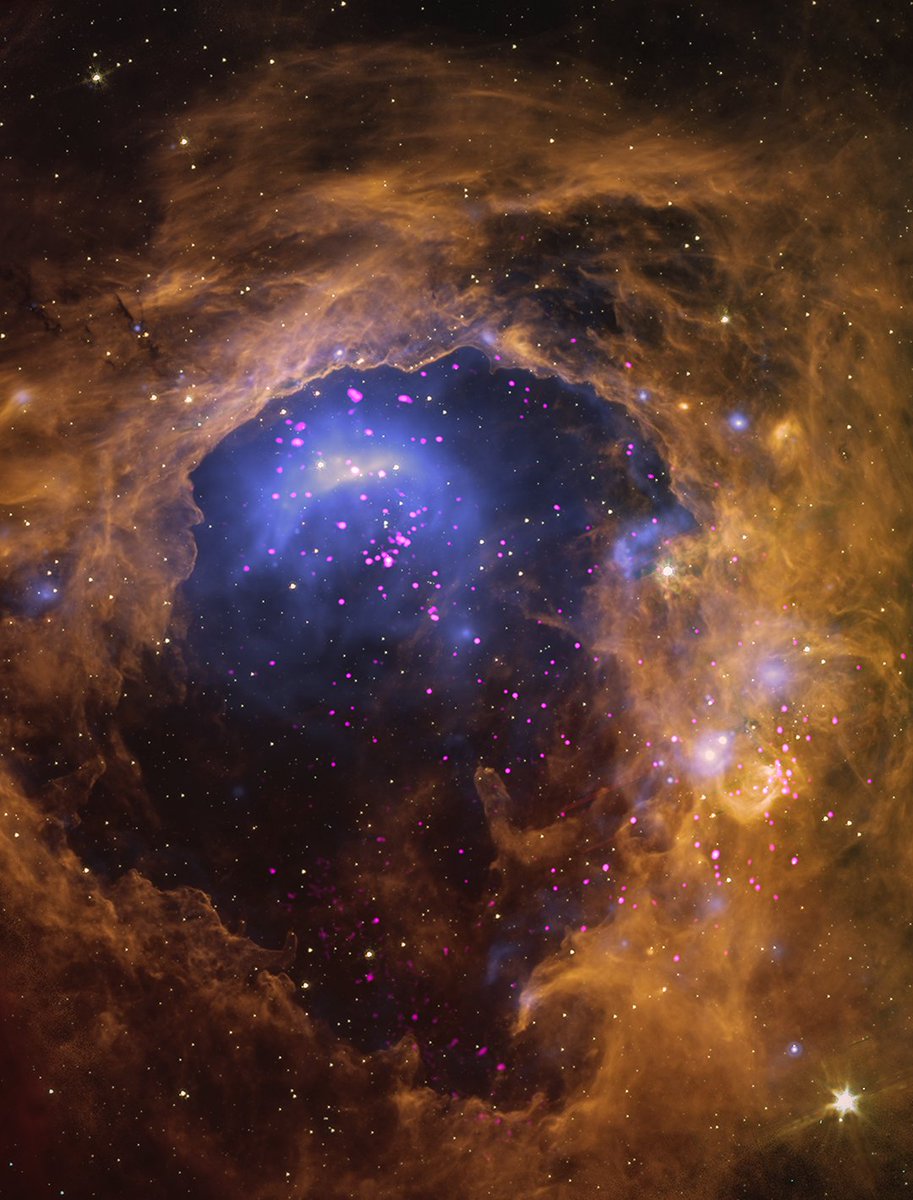
ALT This composite image features two star clusters, viewed through a churning tunnel of golden cloud. The cloud creates a border around the entire image, like a thick swirling smoke ring. Beyond it, in the open center, is a vast field of neon purple specks. These specks are young stars observed by Chandra. Within the central field, two cluster groupings are suggested by separate swirls of faint, steel blue mist. One sits near our upper left. The other is near the bottom right, partially obscured by the golden yellow ring cloud.
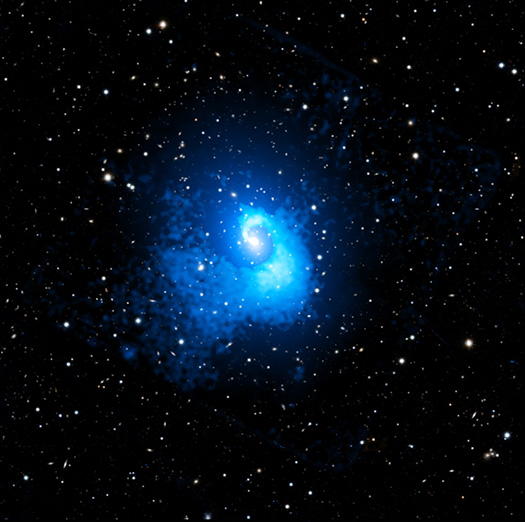
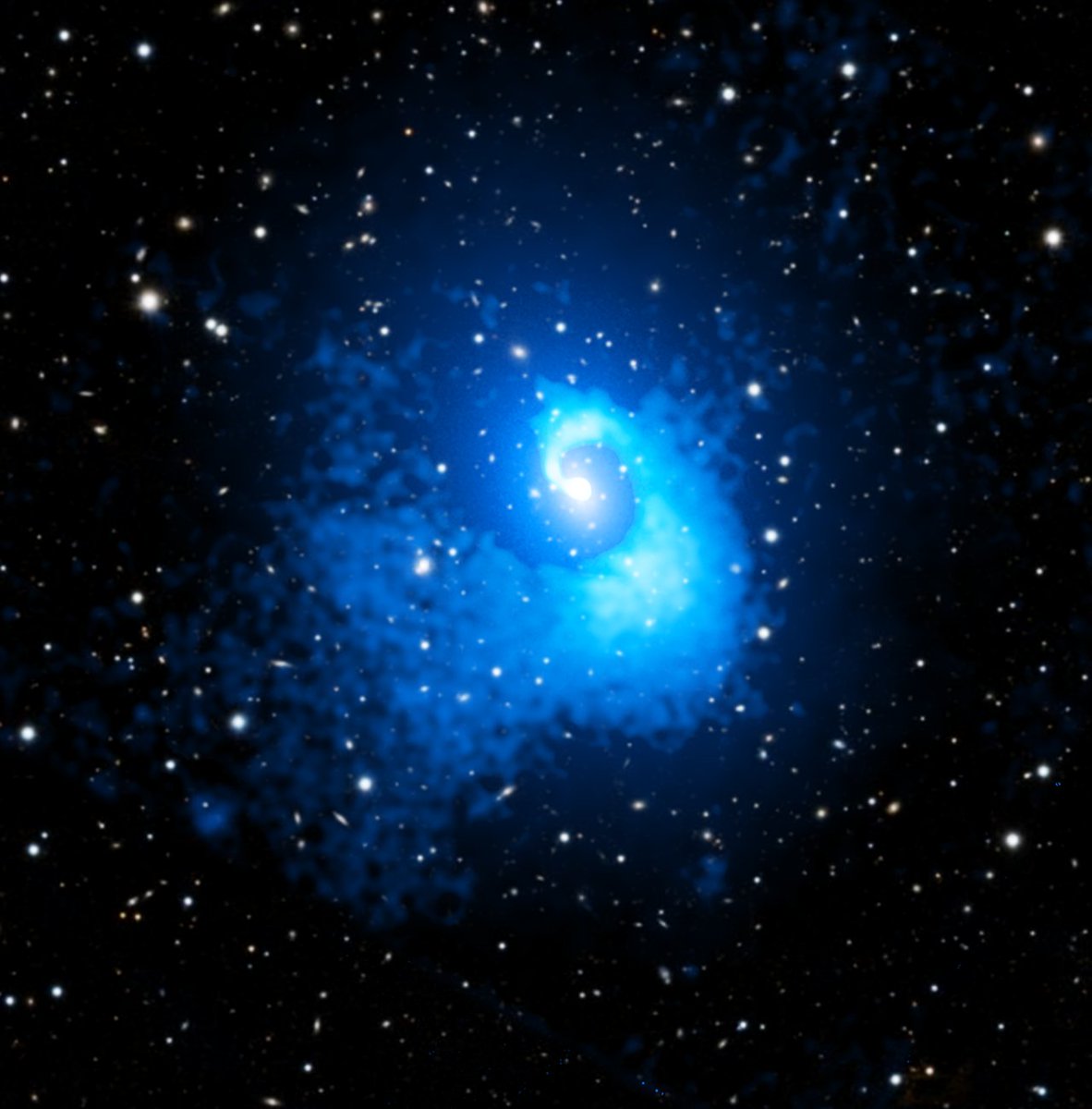
ALT This release features a composite image of a galaxy cluster with a unique spiral shape, giving it the appearance of a giant galactic seashell floating in the star-speckled blackness of space. In this composite image, the surrounding stars and individual galaxies appear white, captured in optical light from Pan-STARRS, a telescope in Hawaii. But much of the spiraling cluster is rendered in neon blues, representing X-ray gas observed by Chandra. This super-heated gas fills the space between galaxies, giving the cluster its spiral shape when observed by scientists using an X-ray telescope. Here, the blue spiral begins as a pale blue dot at the center of the cluster. The spiral stream of light and dark neon blue gas then widens as it moves away from the center of the cluster, gently corkscrewing one full rotation as it extends two-million lightyears into the distance. Credit: X-ray: NASA/CXC/CfA/C. Watson et al.; Optical: PanSTARRS; Image Processing: NASA/CXC/SAO/N. Wolk and P. Edmonds
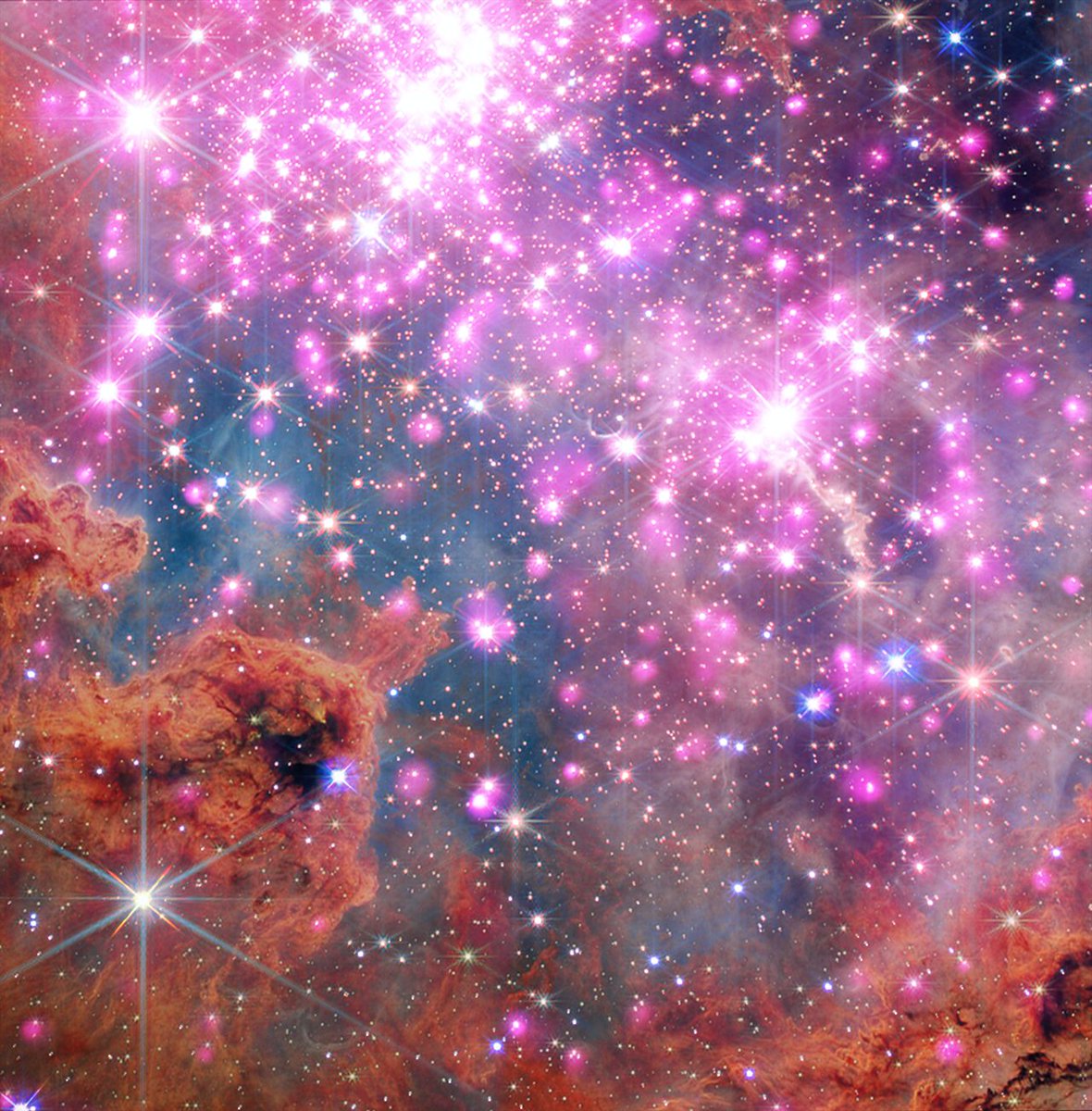
ALT This is a composite image of the young star cluster known as Westerlund 2. Here, scores of gleaming white specks ringed in neon pink are scattered across the image in a band that stretches from our lower right to our upper left, and beyond. Clouds of brick-orange dust enter the image from our lower left, and spread along the bottom edge of the frame, showing off the raw materials of this active stellar nursery.
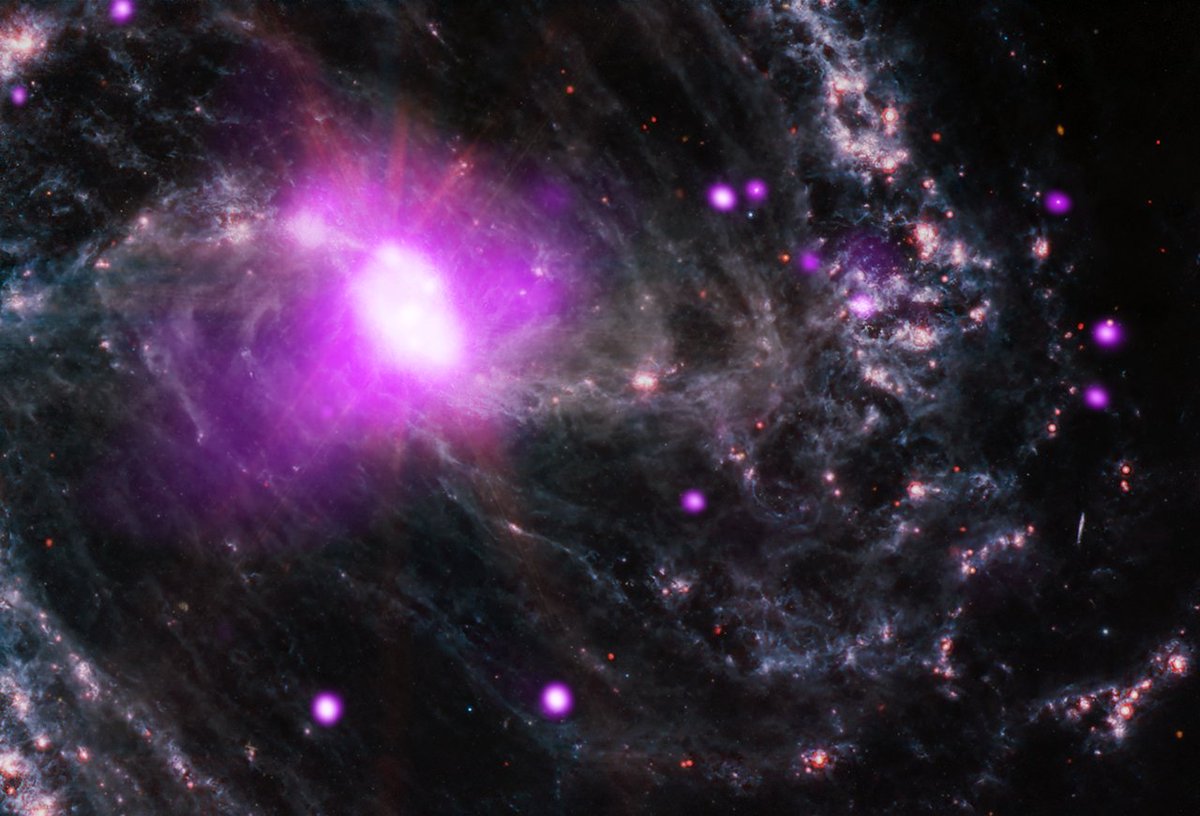
ALT A close up image of spiral galaxy NGC 1365 and the supermassive black hole at its center. Here, the galaxy is shown at a dramatic angle, as if the bright pink core is gazing past our right shoulder. Swirls of pale, grey-blue material, resembling waves in a dark ocean, spiral toward the radiant pink core, which hangs at our upper left. Glowing pink circles, and flecks of red, dot the churning spiral galaxy.
ALT This is a composite image of galaxy cluster Abell 2029, a galaxy cluster with a unique spiral shape, giving it the appearance of a giant galactic seashell floating in the star-speckled blackness of space. The surrounding stars and individual galaxies appear white, captured in optical light from Pan-STARRS, a telescope in Hawaii. But much of the spiraling cluster is rendered in neon blues, representing X-ray gas observed by Chandra. This super-heated gas fills the space between galaxies, giving the cluster its spiral shape when observed by scientists using an X-ray telescope. Here, the blue spiral begins as a pale blue dot at the center of the cluster. The spiral stream of light and dark neon blue gas then widens as it moves away from the center of the cluster, gently corkscrewing one full rotation as it extends two-million lightyears into the distance.

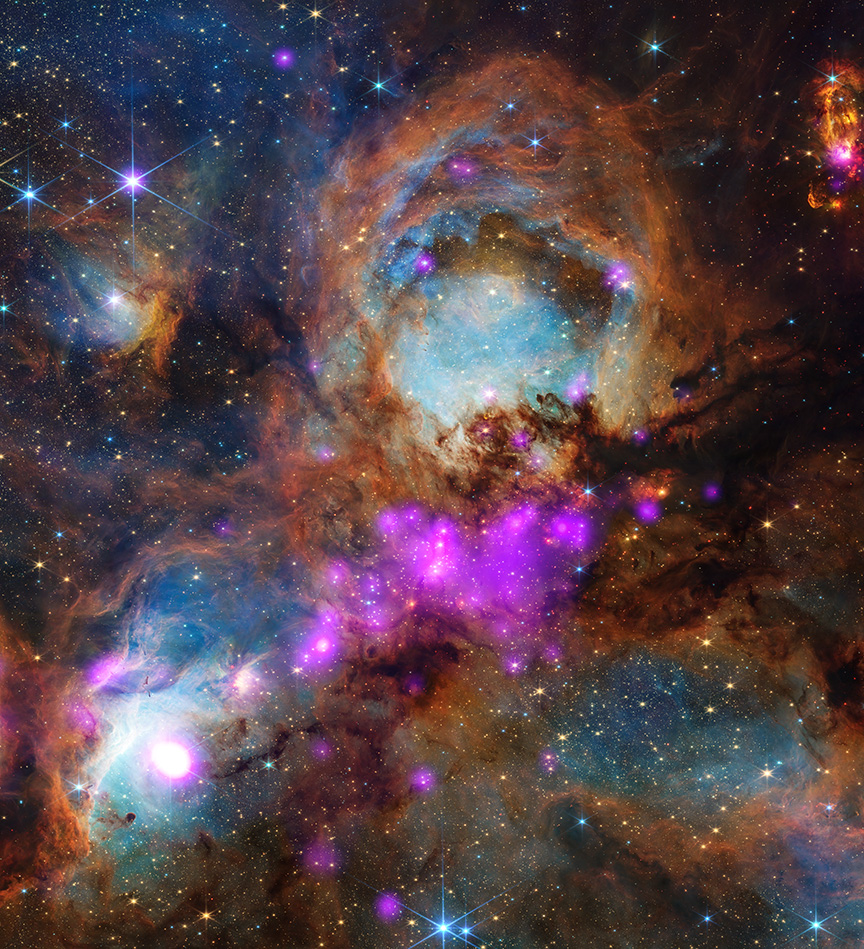
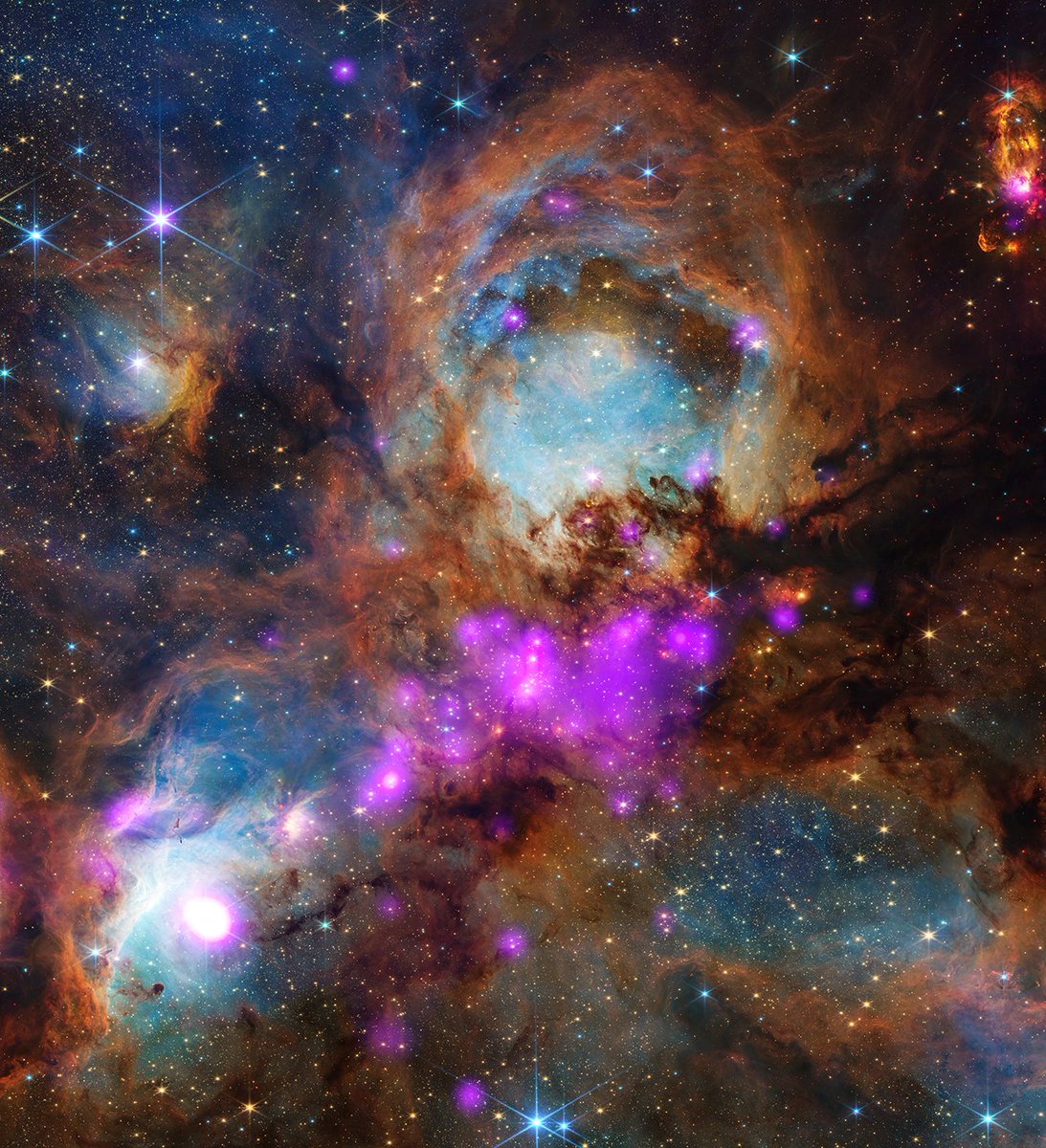
ALT A colorful section of the Cat\u2019s Paw Nebula. Four circular areas are shown in the center of the image, each glowing blue. Rusty wisps of dust are interspersed amongst them. Luminous blotches of purple decorate the dust, as well as diffuse yellow and blue stars. Credit: X-ray: NASA/SAO/CXC; Infrared: NASA/ESA/CSA/STScI; Image Processing: NASA/CXC/SAO/J. Major

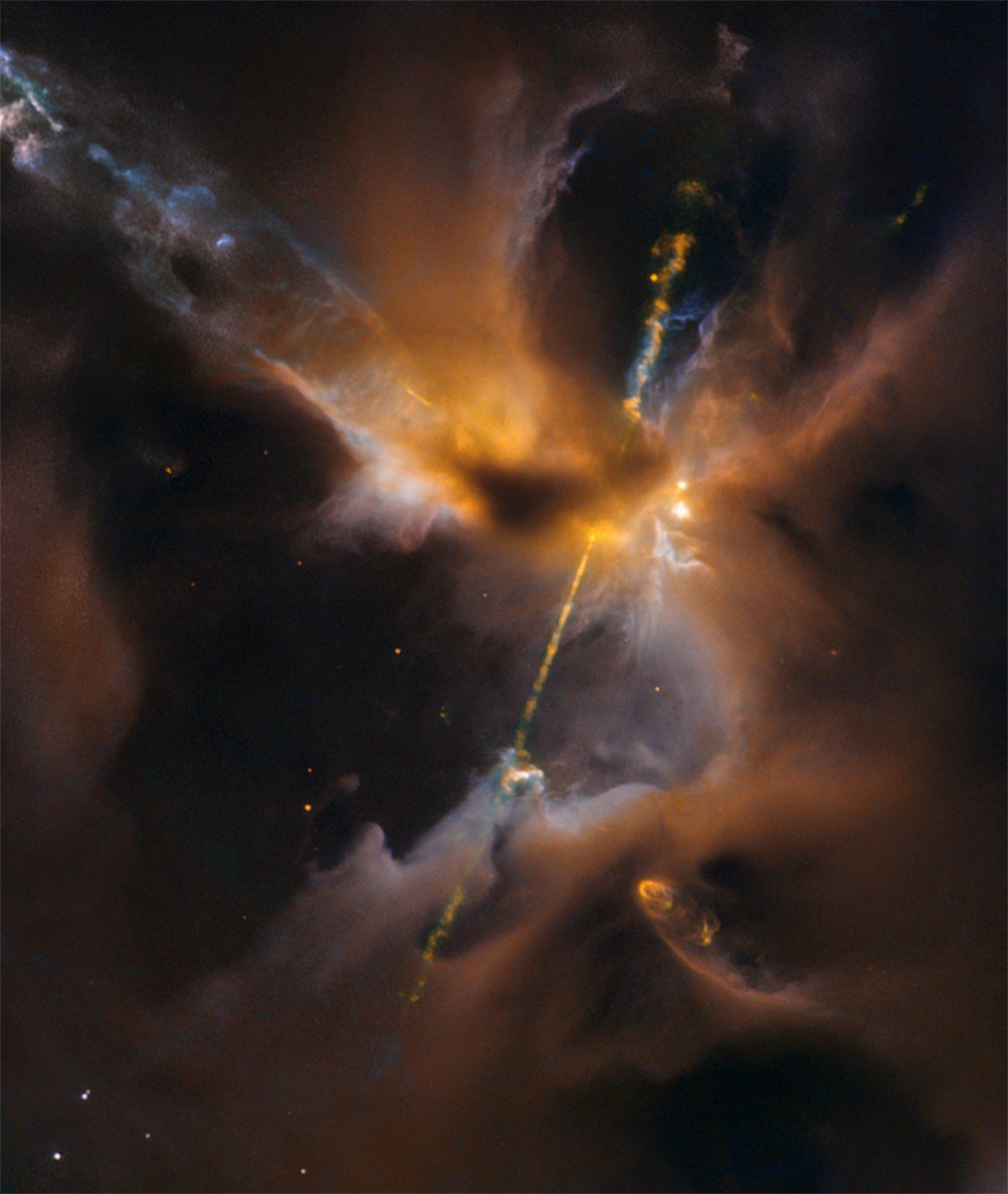
ALT A cloudy region of space glows orange with the light of a jet arcing diagonally through the image.
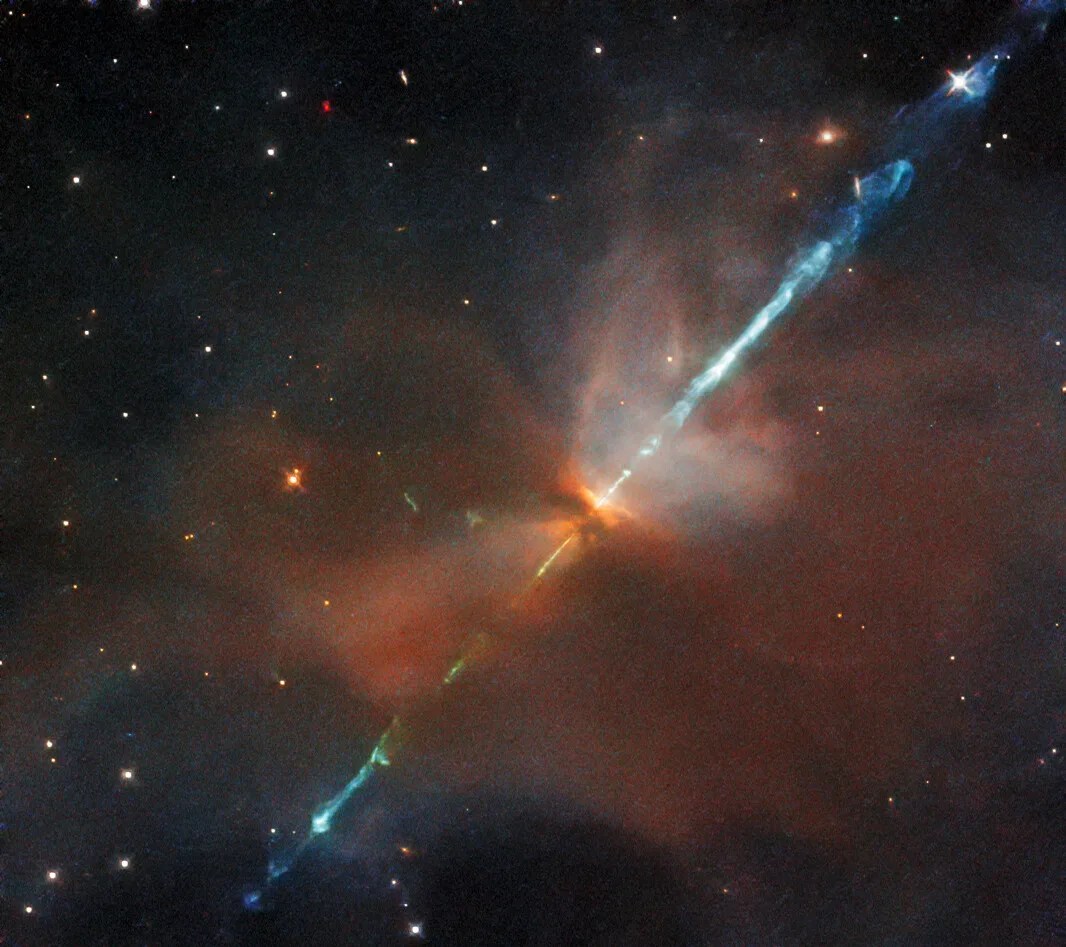
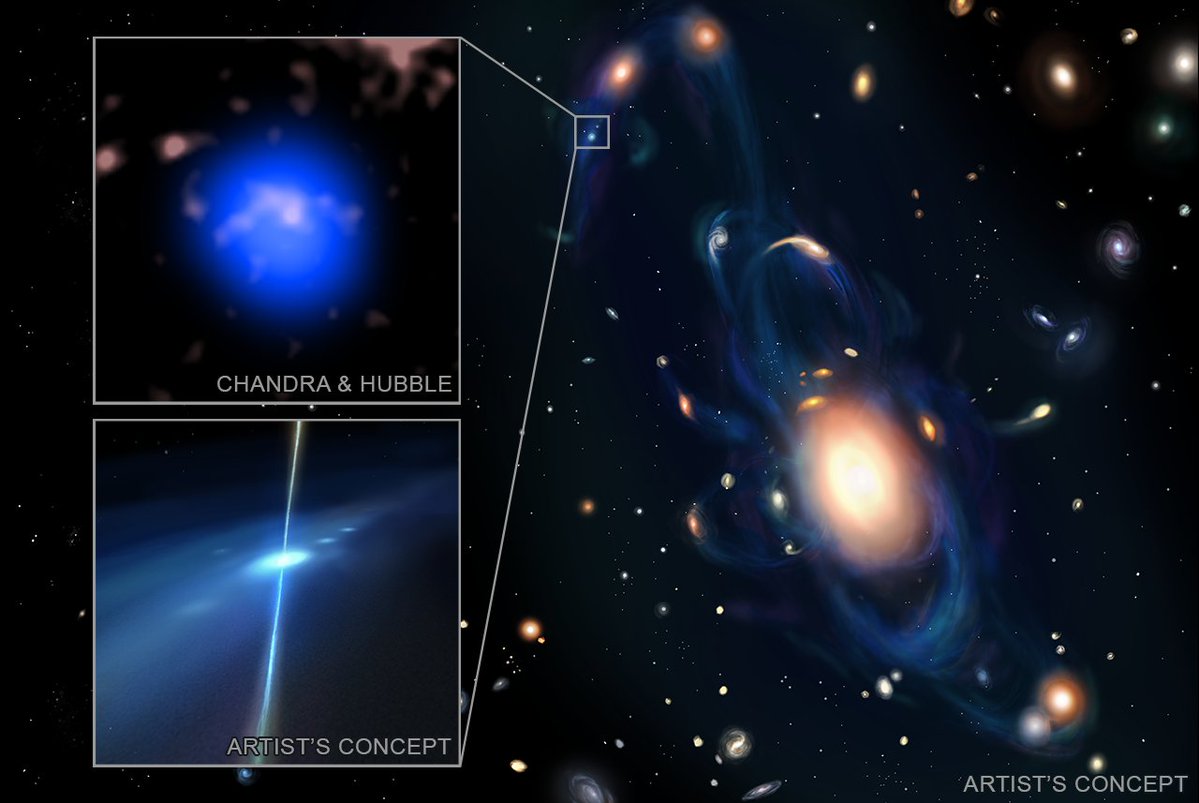
ALT A reddish haze of gas and dust is pierced by a diagonal blue filament, against the black backdrop of space.

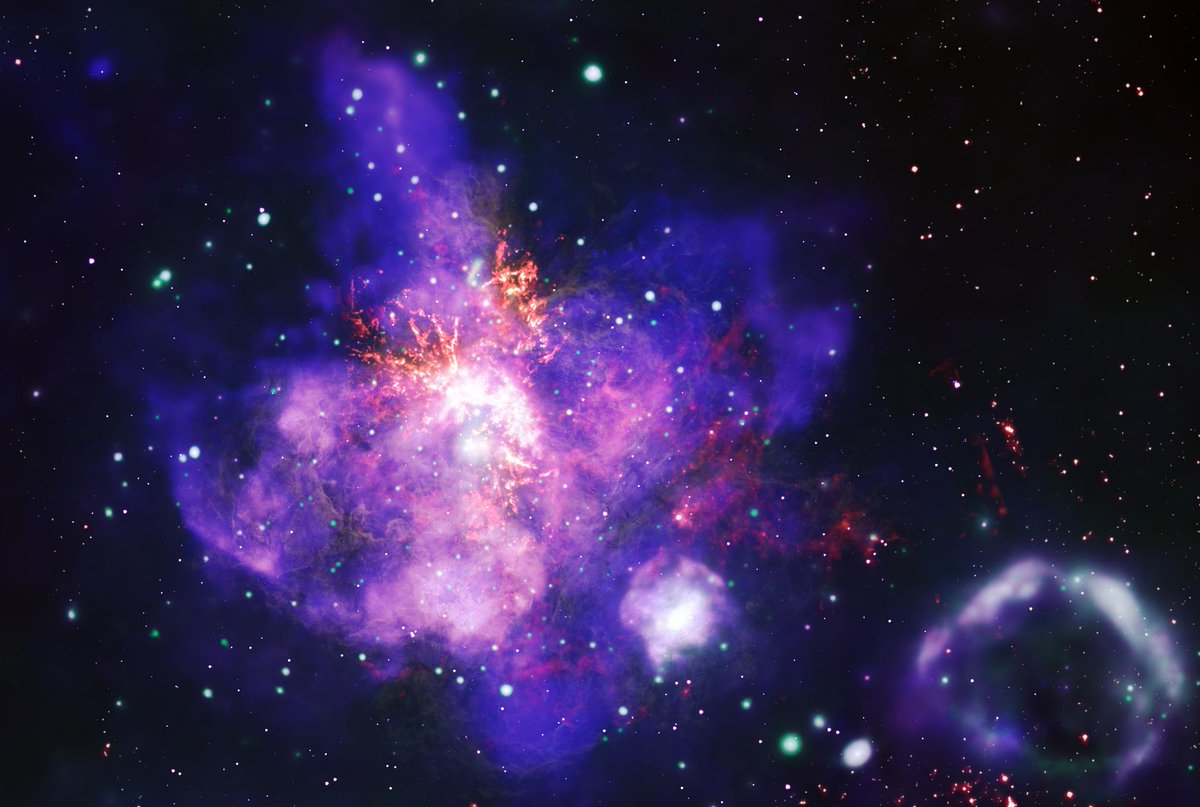
ALT This composite image contains the deepest X-ray image ever made of the spectacular star forming region called 30 Doradus. By combining X-ray data from NASA’s Chandra X-ray Observatory (blue and green) with optical data from NASA’s Hubble Space Telescope (yellow) and radio data from the Atacama Large Millimeter/submillimeter Array (orange), this stellar arrangement comes alive. Credit: X-ray: NASA/CXC/Penn State Univ./L. Townsley et al.; Infrared: NASA/JPL-CalTech/SST; Optical: NASA/STScI/HST; Radio: ESO/NAOJ/NRAO/ALMA; Image Processing: NASA/CXC/SAO/J. Schmidt, N. Wolk, K. Arcand
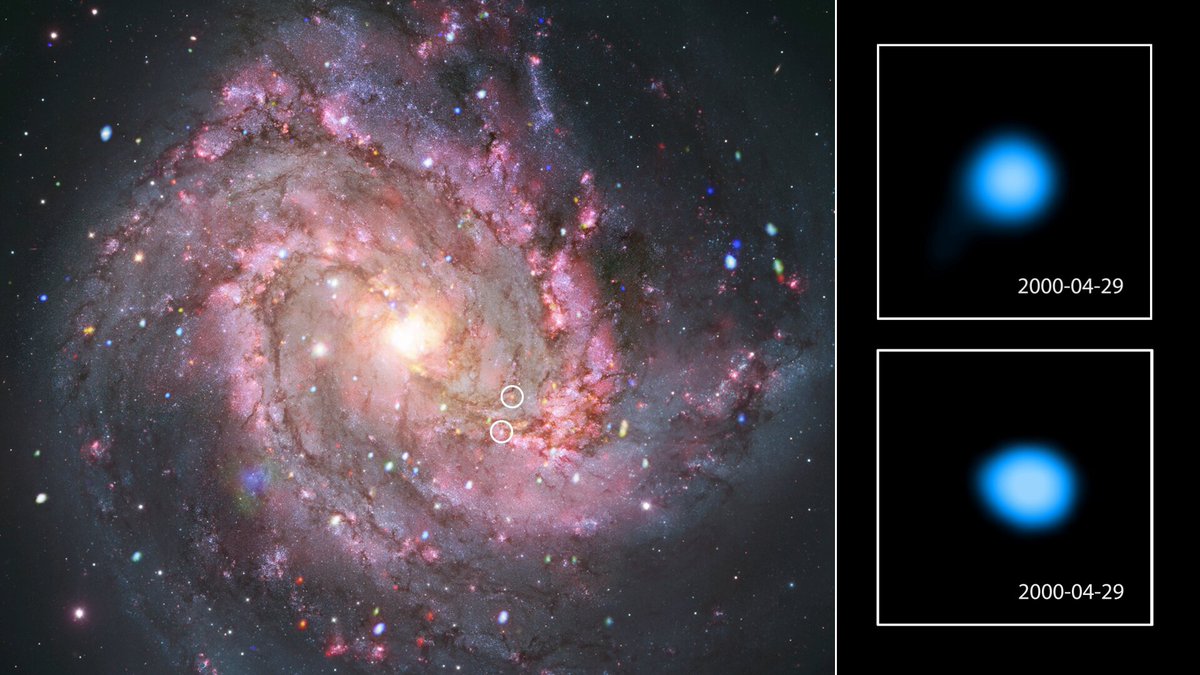
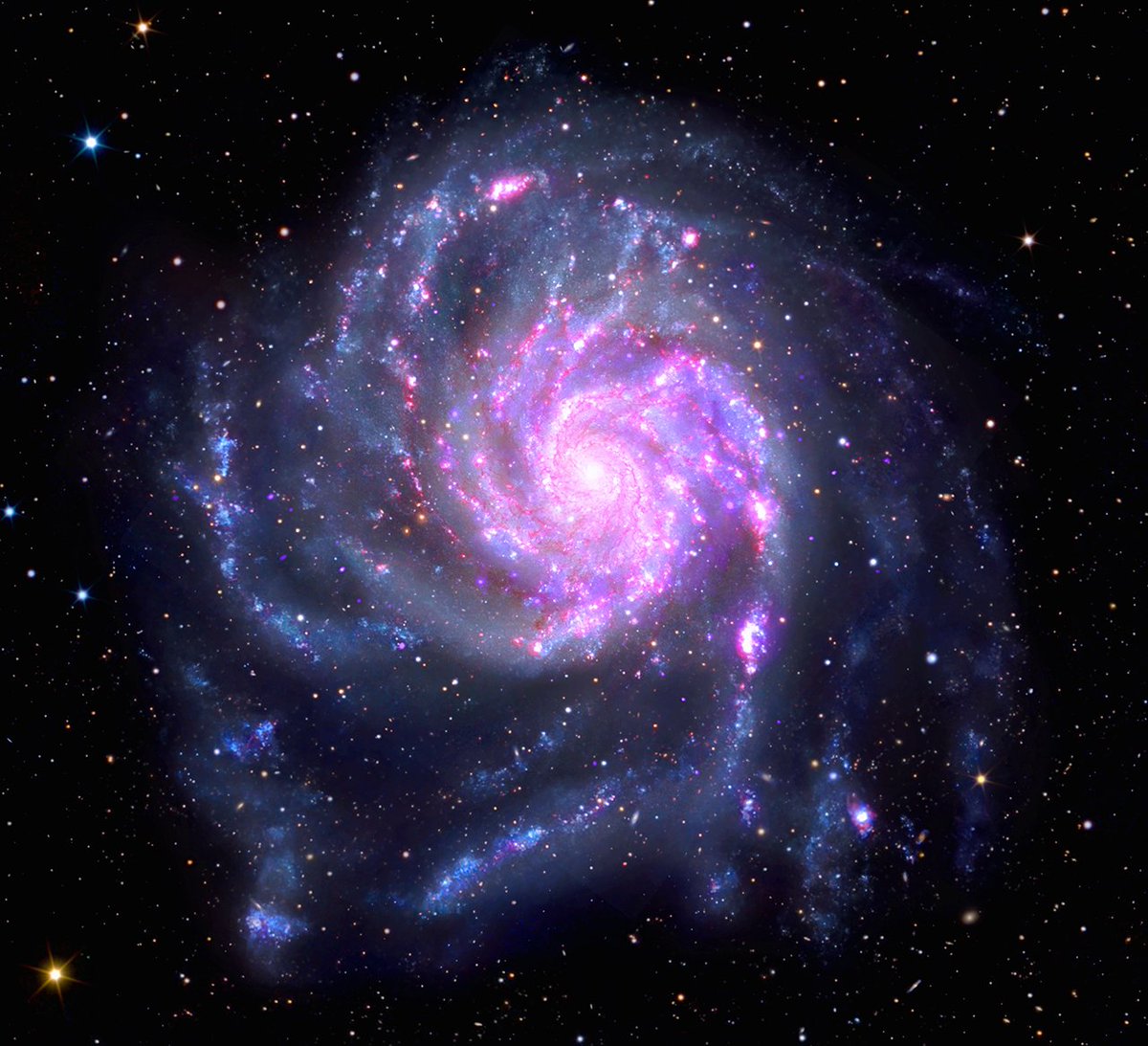
ALT The image shows a luminous, face-on spiral shaped like a softly glowing cosmic pinwheel against a dark, star-speckled background. A compact white central core anchors the scene, from which broad spiral arms sweep outward in graceful arcs, filling much of the frame. These arms look textured and mottled rather than smooth, dotted with bright knots and layered colors with blue highlights, red sprinkles and purple confetti. Together, the overlapping colors give the galaxy a speckled, dynamic appearance, emphasizing both its immense scale and the active environments distributed throughout its wide, extended disk.
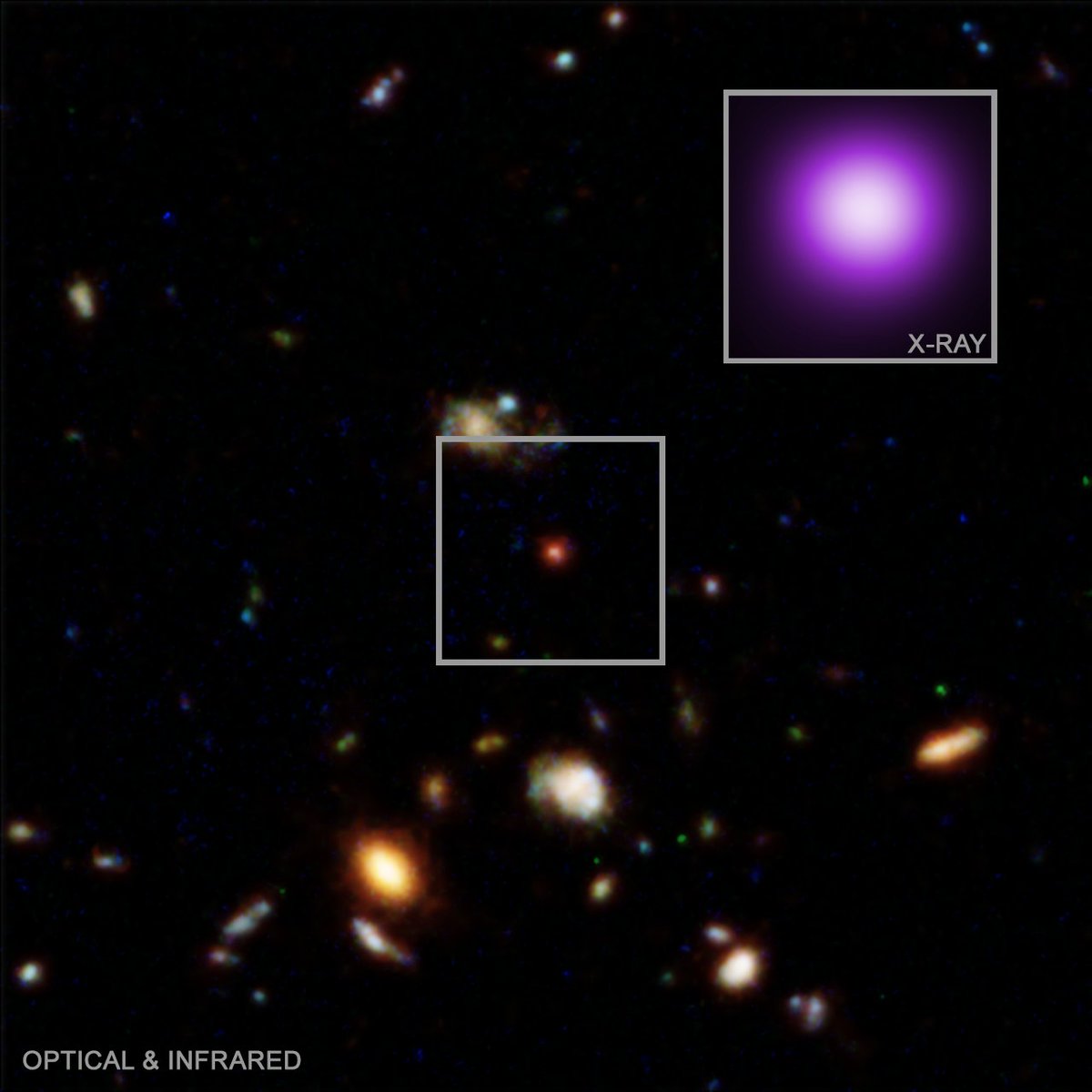
ALT A composite image with an X-ray image inset at our top right. Shortly after NASA's Webb Space Telescope started its observations, reports of a new class of curious objects emerged. Astronomers discovered small red specks over 12 billion light-years from Earth. These objects were given the name "little red dots," or LRDs. One such dot sits at the heart of this image. The composite optical and infrared image features a smattering of distant galaxies and other cosmic objects and phenomena in a variety of colors, set against the blackness of space. At the center of the square image is a small, somewhat pixelated, little red dot, outlined in a white box for clarity. This curious, but inconspicuous, little dot is enlarged in an X-ray insert at our upper right, because it does something no other LRD has been found to do; it emits X-rays! The inset dot appears as a much larger white sphere in the Chandra image, ringed with a neon purple glow.
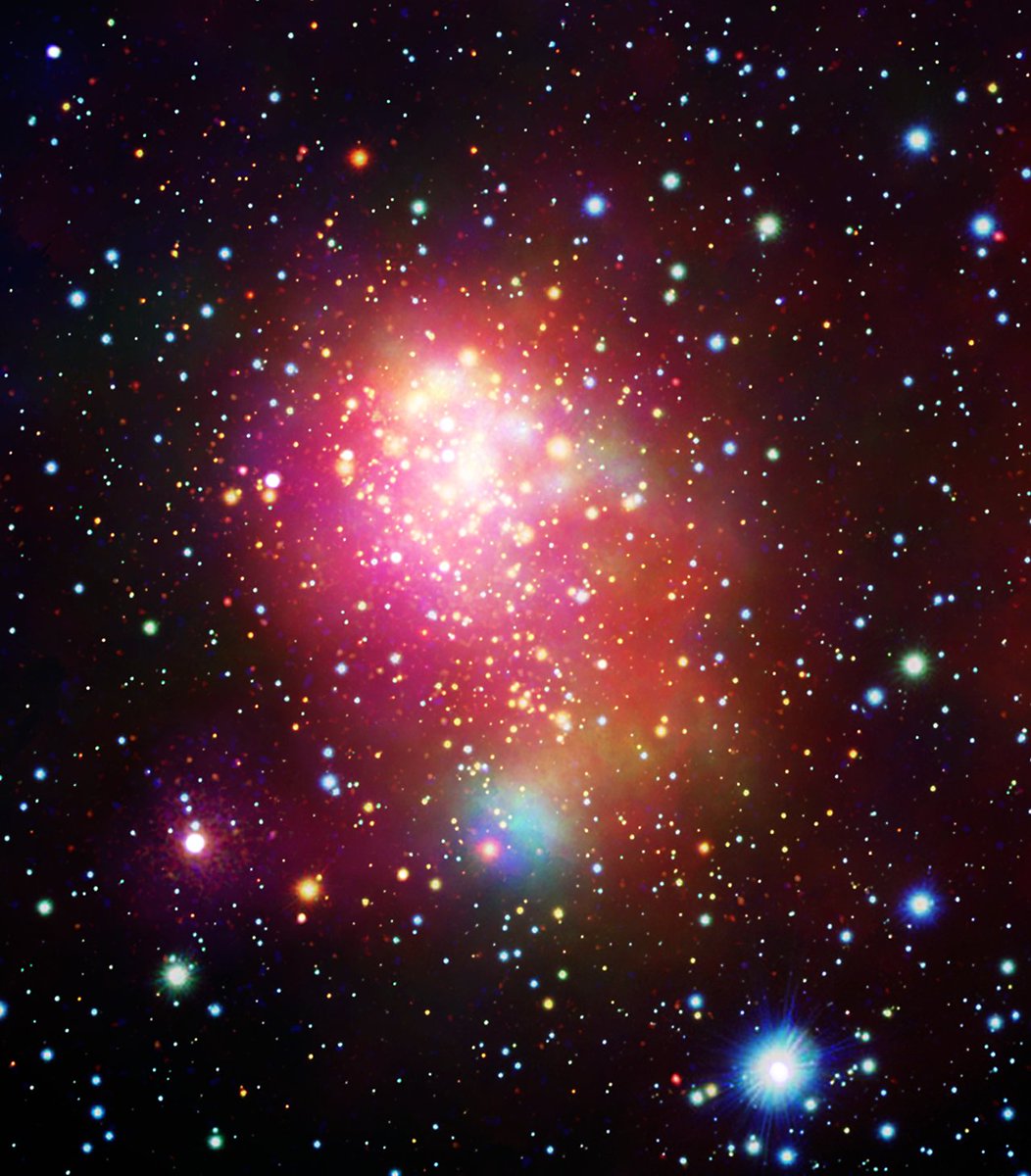
ALT This is a multiwavelength image of the Westerlund 1 star cluster and the surrounding region in X-ray and optical light. The black canvas of space is peppered with colored dots of light of various sizes, mostly in shades of red, green, blue, and white. At the center of the image is a hazy cloud of red and yellow gas encircling a grouping of tightly packed gold stars. The arrangement and distribution of stars in the cluster call to mind effervescent soda bubbles dancing above the ice cubes of a recently poured beverage.
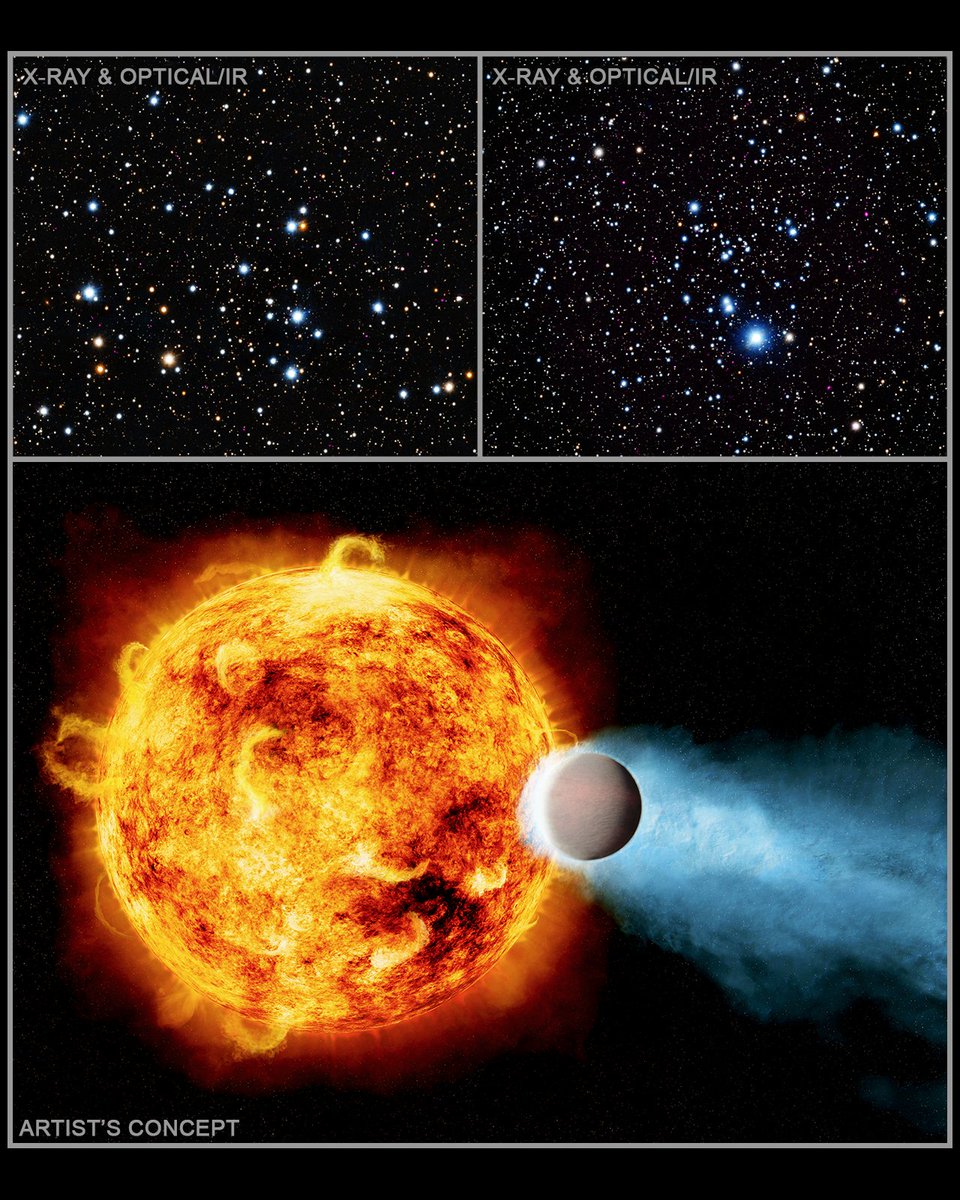
ALT This image features two composite images and an artist's illustration. Each composite image shows a different star cluster packed with countless glowing specks of light. The illustration depicts the effects of a young Sun-like star's high energy radiation on the atmosphere of an orbiting planet. Composite images: the blackness of space is blanketed in white, blue, orange, purple, and golden yellow dots. Some of the dots are in the foreground, while others are background stars. Many in the middle-ground are clustered Sun-like stars being observed in the Chandra study. Some of the stars in the foreground appear as gleaming dots with glowing halos and occasional diffraction spikes, while the background stars are smaller and fainter. Illustration: a massive ball of churning fire, a young Sun-like star, occupies the left half of the photorealistic graphic. At its right is an orbiting planet, a relatively small, pale sphere, shedding its atmosphere, shown as a wake of faint blue mist.
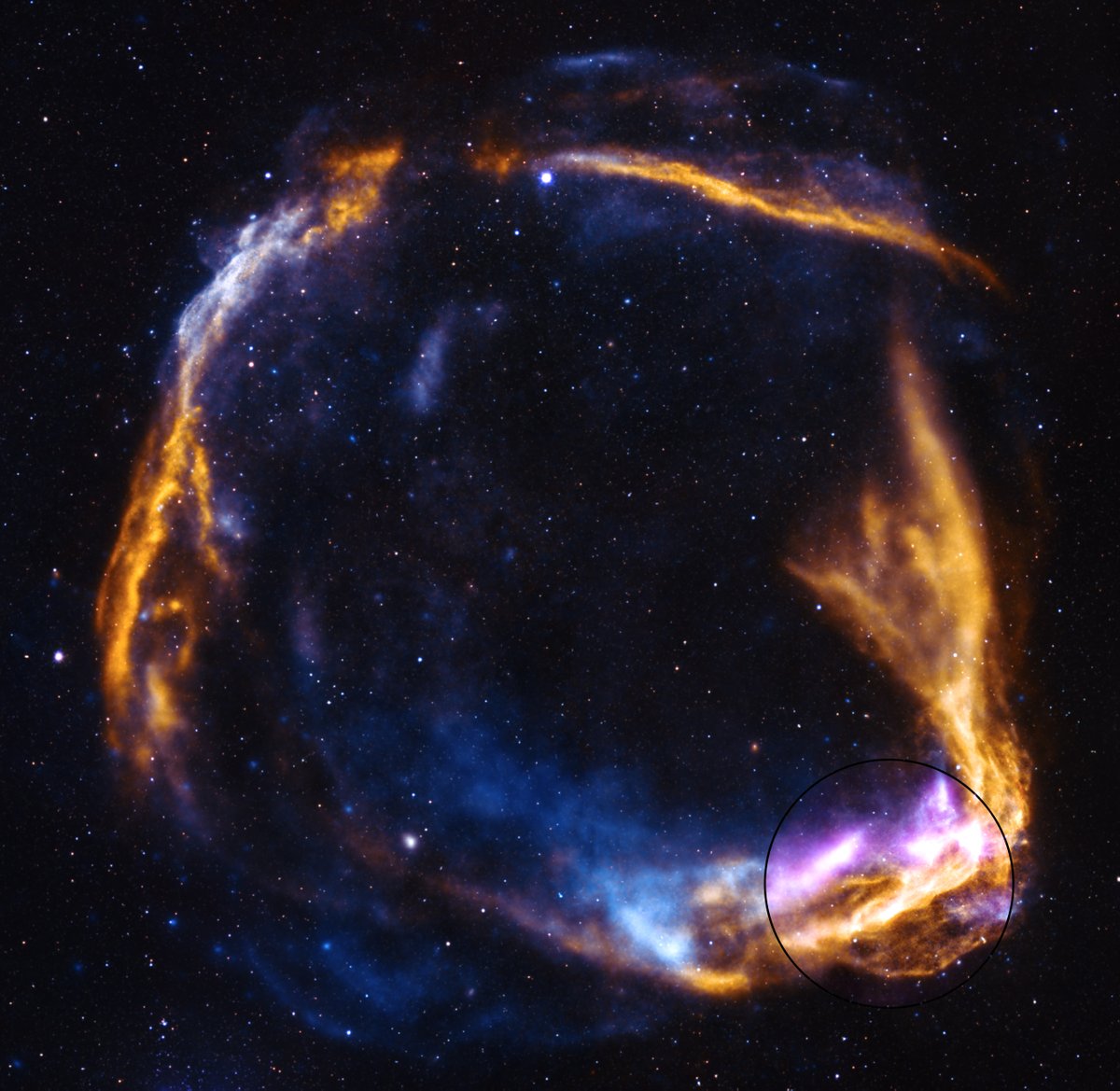
ALT In this image of RCW 86, the data appears like a golden ring in the sky with hints of blues and purples in some areas. NASA\u2019s IXPE data is showcased in a circled region in the bottom right side of the ring. The full image also includes legacy observations from two other X-ray telescopes: NASA\u2019s Chandra and the ESA (European Space Agency) XMM-Newton telescope. Yellow represents low-energy X-rays, while blue shows high-energy X-rays detected by Chandra and XMM-Newton. The starfield in the image comes from the National Science Foundation\u2019s National Optical-Infrared Astronomy Research Laboratory (NOIRLab).
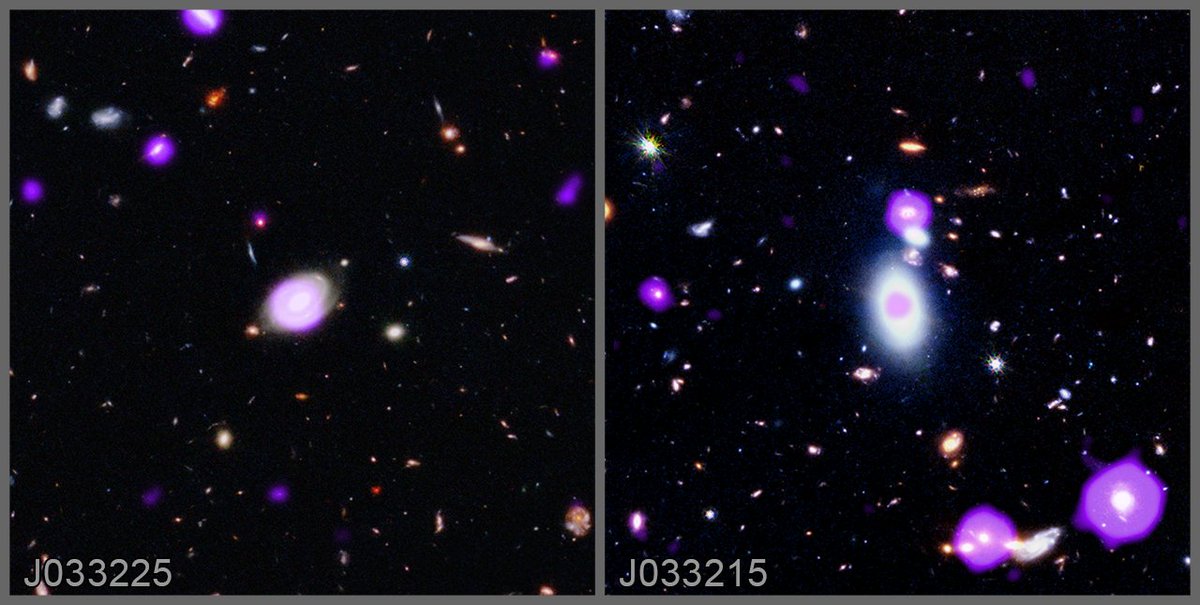
ALT Two composite images, presented side-by-side with a single galaxy positioned at the center of each frame. The two images appear visually similar. Both feature dozens of galaxies; glowing specks and elliptical shapes in purples, golden oranges, blues, and whites, scattered across the blackness of space. The focal points are the galaxies at the center of each frame. Both galaxies glow in pinks and whites, and both have supermassive black holes at their core. But the featured galaxy on our left is far more distant than the featured galaxy on our right. On our left is a spiral galaxy some 5.6 billion light-years from Earth. It resembles a large dot with a hazy, neon pink outer ring, and a white core. On our right is an elliptical galaxy at a distance of about 3 billion light-years. This galaxy resembles an egg with an oval-shaped white outer ring, and a round pink circle at its core. This galaxy’s supermassive black hole is a much fainter source of X-rays than the source on the left.