
ChangeWA is a non-partisan 501(c)(4) organization focused on advancing common sense policies around smart growth, public safety, and government accountability.
Joined December 2019
- Tweets 3,591
- Following 684
- Followers 5,459
- Likes 5,003
183 Photos and videos





Pinned Tweet

Jun 7
Washington taxpayers are paying billions for a ghost train.
In 2016, voters approved Sound Transit 3 with the promise of reduced congestion and responsible growth. A decade later, the system is fundamentally broken, and the numbers are an insult to every hardworking resident who trusted the agency.
Here is the reality of the 2026 revised plan:
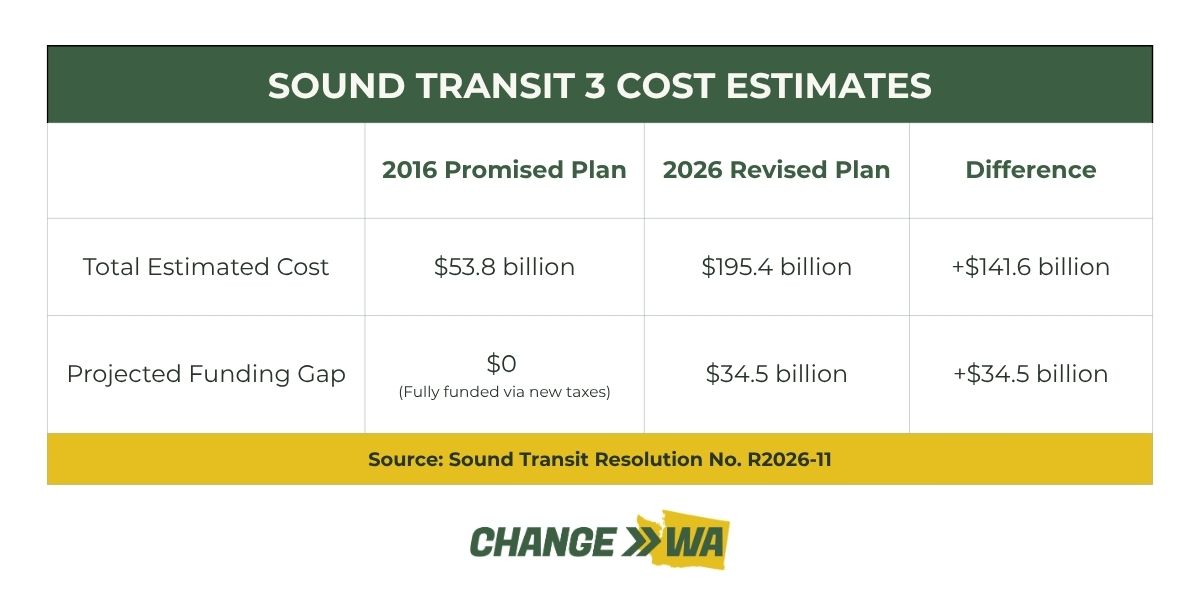
>The original 2016 promised cost was $53.8 billion.
>The current 2026 estimated cost is $195.4 billion.
>The revised plan carries a massive $34.5 billion funding gap.
>The South Kirkland-to-Issaquah project is delayed until 2050.
>Ballard residents lost their final rail stretch entirely, stopping miles short at Seattle Center.
Who is responsible? An unelected board. In a glaring display of cronyism, the board just selected former King County Executive Dow Constantine as CEO, a decision made by several members he originally appointed.
Taxpayers are footing higher sales and property taxes for stations that have simply disappeared from the map. It is time for directly elected board members and true accountability.
30
75
191
5,158
A Seattle business owner whose family's been here over a century is paying out of his own pocket to fight the sex trafficking outside his store on Aurora: banners aimed at the buyers and ads running in hotel rooms during the World Cup.
The city's finally escalating too.
But it took a private citizen to force the issue. Credit to Mike Dunn for not waiting for permission.

Dunn said employees at the store routinely witness sex trafficking activity, including what appear to be underage girls being exploited in plain sight.
komonews.com/news/local/dunn…
1
15
81
3,414
Change Washington retweeted

EXCLUSIVE: Seattle Mayor Katie is accused of ignoring pleas for help from business owners victimized by crime in Chinatown-ID.
Late Sunday evening, we stumbled upon a car prowler outside Henry's Taiwan Kitchen.
Owner Henry Ku intervened and nearly got into a fight. He says homeless drug addicts have robbed him multiple times this year.
His son says, "Whatever the City Hall is doing, it's f*cked up."
@MayorofSeattle|@thehoffather
Jun 15

HAPPENING NOW: Less than 24 hours before the first FIFA World Cup match is played in Seattle. But parts of the city look like a zombie apocalypse. Mayor Katie Wilson is accused of pushing homeless drug addicts outside of the downtown tourist corridor so fans do not get upset or inhale second hand fetty smoke. Problem is, the addicts have all been pushed to vulnerable minority communities like Chinatown-ID. And business owners are pissed.
@MayorofSeattle|@weheartseattle
52
586
2,550
107,947
Jun 10
On Saturday night, hundreds of Seattle residents marched down Aurora Ave. carrying signs that read "Stop Sex Trafficking. No More Shootings."
Sit with that for a second.
In 2026, in a major American city, families had to organize a march to ask for the most basic public safety protections.
These weren't radical activists, vandals, and political provocateurs. They were parents, neighbors, small business owners, and concerned community members. People who've spent years reporting open-air prostitution, trafficking, and gunfire on their street, and who recently saw a bullet enter a home where an infant was sleeping.
Before marching, residents tried going to community meetings and raising concerns through any official government channel.
Even worse: After a string of shootings this spring, some neighbors even installed makeshift barriers on side streets being used as getaway routes. The city's response? It removed the barriers and installed chicanes. Government moved faster to take down the residents' solution than it ever moved to provide its own.
And here's the part that should bother everyone, regardless of politics:
Seattle already has tools. Stay Out of Areas of Prostitution (SOAP) orders, which are court orders barring repeat buyers and traffickers from known hot spots, literally exist right now.
But as @seattletimes reported, City Attorney Erika Evans has declined to request or enforce them.
Residents keep hearing that trafficking cases are difficult, resource-intensive, or complicated. True enough! But these people aren't asking for explanations of why solutions are hard ... they're asking for solutions.
When a neighborhood is living with recurring gun violence and open exploitation, "it's complicated" cannot be their government's final answer.
23
45
184
4,860
Jun 10
Most Seattle voters are compassionate people. They want victims protected and vulnerable people connected to core services, and they want neighborhoods where children can sleep safely.
Those goals are not in conflict, and anyone telling you they are is simply declaring their own failure, both morally and ideologically.
changewashington.org/aurora-…
2
1
11
607
Jun 7
Washington taxpayers are paying billions for a ghost train.
In 2016, voters approved Sound Transit 3 with the promise of reduced congestion and responsible growth. A decade later, the system is fundamentally broken, and the numbers are an insult to every hardworking resident who trusted the agency.
Here is the reality of the 2026 revised plan:
>The original 2016 promised cost was $53.8 billion.
>The current 2026 estimated cost is $195.4 billion.
>The revised plan carries a massive $34.5 billion funding gap.
>The South Kirkland-to-Issaquah project is delayed until 2050.
>Ballard residents lost their final rail stretch entirely, stopping miles short at Seattle Center.
Who is responsible? An unelected board. In a glaring display of cronyism, the board just selected former King County Executive Dow Constantine as CEO, a decision made by several members he originally appointed.
Taxpayers are footing higher sales and property taxes for stations that have simply disappeared from the map. It is time for directly elected board members and true accountability.
30
75
191
5,158
Jun 7
1
11
248
May 30
Seattle Mayor Katie Wilson's first five months in office have not gone smoothly. Multiple media mistakes, policies backfires, conflicts with SPD and councilmembers and her now infamous wave "bye" to job creators and top taxpayers.
Will she become the 7th consecutive Seattle mayor to leave office due to loss of voter confidence.
changewashington.org/seattle…
65
34
174
5,887
May 29
Are you looking for factual information about Washington's growing homelessness crisis? (Risen 68% since declared an emergency in 2015).
Visit ChangeWA website to understand why problem grows and learn what experts say is the best solution.
changewashington.org/
1
2
179
May 29
Mayor Wilson's lead staffer on her expensive homelessness programs has suddenly quit.
Things are not starting out well for the new mayor with key advisors already heading for the exits and multiple staff shake-ups in less than five months on the job.
More on this over the weekend as ChangeWA will explore whether the mayor can turn things around.
thecentersquare.com/washingt…
4
9
35
678
May 28
Evidently @JayInslee is not worried about the climate today.
With large SUV idling by, the politician who imposed a $0.50 /gallon climate tax, hops on private plane.
Chances are this trip was funded by the climate tax.
That should make you feel good when you fill up your tank

27
300
967
16,332
May 26
He is not wrong:
Stats on SEA homeless
80% did not go to high school in King Co - 64% went to HS outside of WA
67% do not have family in King Co
50% experienced homelessness elsewhere first.
75% self-admit they have addiction issues
fixhomelessness.org/wp-conte…
May 25

NEW: Spencer Pratt fires back at reporter after he was asked about his plan for the homeless, says they will all end up in Seattle.
Reporter: "What are your plans for the over 40,000 homeless in Los Angeles?"
Pratt: "Well, they're not homeless, they're drug addicts... These people have been bused in by scam rehabs, scam NGOs, scam homeless nonprofits."
"These people, when I unplug them ... they're all going to Seattle, where the mayor will welcome them."
13
93
308
9,263
May 26
Journalism choices - which do you choose?
#1: @choeshow & @BrandiKruse shows the public the decay occurring in Progressive Seattle.
#2: @seattletimes who copy/paste stories written the wealthy who financially benefit from current policies.

3
3
17
731
May 25
Why do our tax $$ go towards enabling drug addicts to continue their self-destructive actions yet no $$ is spent leading them towards recovery & productive lives?
It is the same reason that tiny home villages have units for drug use and not one for addiction treatment/recovery.
May 25

Check out how Seattle hands out foil to cook illegal and lethal fentanyl TENT SIDE! 👇🏼 @spencerpratt @MayorofSeattle
5
11
44
621
May 24
While Seattle & King Co. enable addicts to keep destroying their lives w/ "Harm Reduction" policies, Snohomish Co. leaders seek ways to help people find recovery.
Harm Reduction leads to more OD deaths, while recovery leads to hope & independence.
changewashington.org/snohomi…
2
2
22
375
May 23
While King County leaders refuse to admit their "harm reduction" drug policies are enabling addicts, Snohomish County leaders are voting on commonsense policies which help addicts recover to lead productive lives.
True compassion helps addicts recover
changewashington.org/snohomi…
4
7
46
578
May 22
Under Democrat policies WA has even fewer police officers.
During his campaign, Bob Ferguson promised more officers since WA ranked 51st for resident/police officer ratio.
After two legislative sessions, the state is worse now than before.
fox13seattle.com/news/gov-fe…
11
16
47
767
May 22
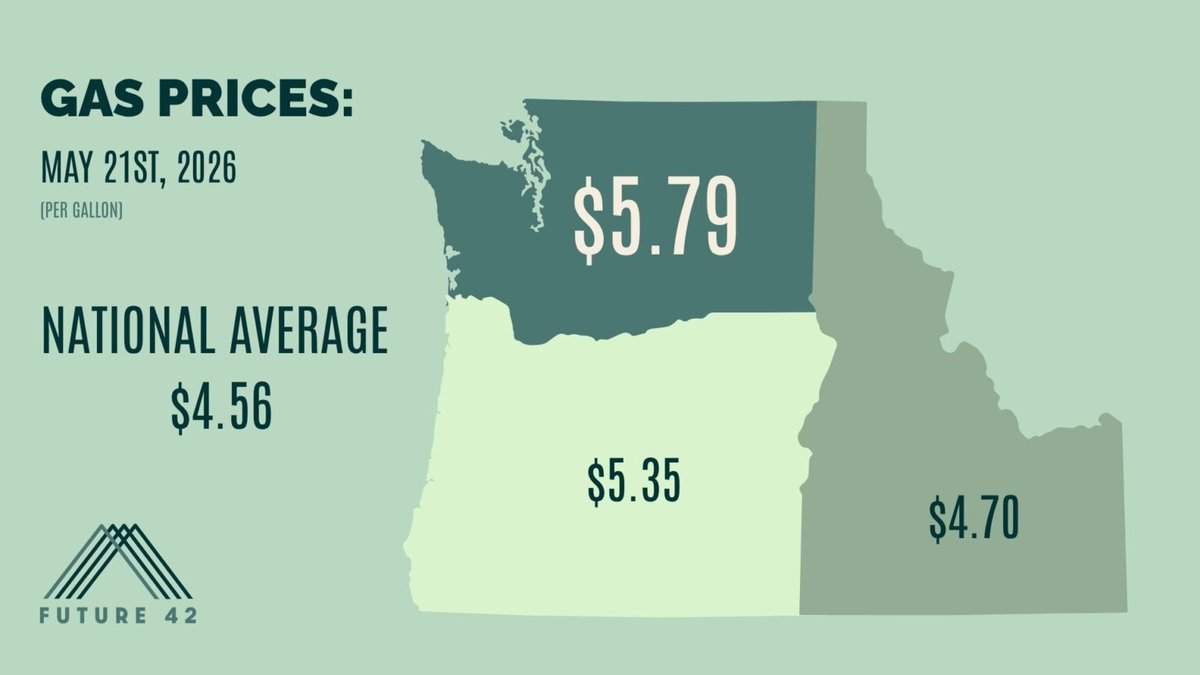
WA residents paying $1.20 more per gallon than national average. This is due to a tax that sends $ to wealthy Democrat contributors and has yet to show benefit to climate.
Lower-income workers are hit the hardest by this tax.
11
59
144
2,114
May 21
Ouch!
More Seattle Councilmembers are critical of the reckless actions of @MayorofSeattle Katie Wilson as high-paying jobs flee.
Previously supportive CM Rob Saka now says he is "Gravely concerned."
Is Wilson already a lame-duck mayor less than six months in office?

WATCH: Seattle councilman wants new approach to dealing with Starbucks job losses thecentersquare.com/washingt…
6
5
46
2,965
May 21
FINALLY!
Law enforcement is brought in to investigate fraud at King Co's Dept of Community & Human Services that took place under Dow Constantine
Those on the Left claim bigger gov't solves problems, yet many became rich while homelessness increased.
Government failure.

NEW INFORMATION: Law enforcement to review 'fraud, forgery, and attempted theft' of King County grant money
Our @JeremyHarrisTV explains why at least one county councilmember believes more county contracts should be investigated.
2
33
98
1,377
May 20
MORE POSSIBLE FRAUD UNCOVERED IN DOW CONSTANTINE"S KING COUNTY.
Constantine is now very wealthy while investigators keep finding fraud within homeless bureaucracy he created.
Politicians get rich while the homeless suffer
komonews.com/news/local/dchs…
45
214
561
4,977