
Crypto enthusiast |Magnitude 7.0 on SeismicSys | Community Advisor on linera_io
Joined October 2022
- Tweets 12,345
- Following 1,211
- Followers 1,199
- Likes 30,091
848 Photos and videos






Pinned Tweet

18 Nov 2025
Thread X: Seismic's $10M Round and the Future of Protocol-Level Privacy in Fintech
1/8
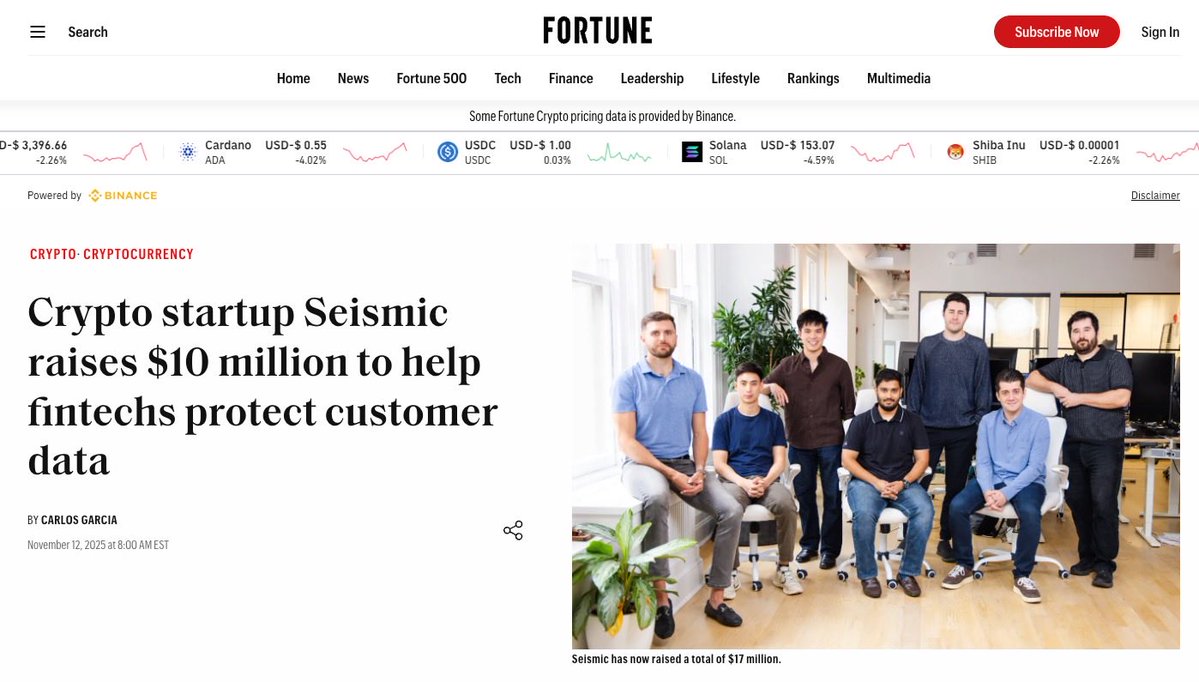
Seismic’s freshly announced $10M extension round (led by a16z crypto, bringing total funding to $17M) is one of the clearest signals yet that native, protocol-level privacy is transitioning from niche to must-have for mainstream fintech.
Source: Fortune Crypto (Nov 12, 2025)
2/8
While the broader market consolidates (Bitcoin oscillating between $98K–$102K after October’s correction), institutional capital is becoming more selective. Investors are no longer chasing only high yields; they are backing infrastructure that can protect customer data while remaining fully compliant with tightening global regulations.
Source: CoinDesk Market Overview (Nov 14, 2025)
3/8
Founder @lyronctk has long argued that public blockchains suffer from “forced transparency” that actively hinders fintech adoption. @SeismicSys solves this with end-to-end encryption powered by Intel TDX, making transactions auditable yet invisible to the outside world.
4/8
The core promise is to make privacy composable, fast, and developer-friendly, three qualities largely missing from existing privacy solutions.
5/8
Applications like Brookwell (private stablecoin salary & bill payments) and upcoming private credit protocols show what becomes possible when confidentiality is built into the chain itself, not bolted on at the application layer.
6/8
With MiCA( (Markets in Crypto-Assets Regulation) now fully in force across Europe and U.S. stablecoin legislation advancing in Congress, the timing could not be better. Fintechs handling sensitive flows (payroll, rent, loans) need infrastructure that satisfies regulators without exposing user data on a public ledger.
Source: European Commission MiCA update (Nov 2025)
7/8
Seismic’s EVM compatibility means developers can port existing DeFi tools with minimal changes, while the underlying TEE layer guarantees privacy by default. This combination dramatically lowers the barrier for institutions and traditional fintechs to enter crypto confidently.
8/8
In an industry moving from experimentation to real-world scale, Seismic’s latest milestone reminds us that privacy is no longer optional, it is the foundation for the next wave of financial applications.
@NoxxW3 @heathcliff_eth @xealistt
28
100
4,502
My default reaction to NFT announcements is usually the same: show me the utility in six months and I'll check back then.
That is why the Wingston collection from @RallyOnChain caught my attention.
It is a free mint, but the interesting part is that the ecosystem comes first. The community is already active, the artwork is genuinely top-tier, and the utility exists from day one through Rally Score boosts and daily RLP staking.
Most NFT projects ask you to buy into a future roadmap. Wingston is being attached to something people are already using.
That makes it feel less like a speculative collectible and more like a product NFT with a real purpose inside the Rally ecosystem.
What is the last NFT you came across that felt genuinely useful before anyone started talking about price?

12
5
19
78
Jun 17
The plot twist nobody wants to admit: most creators do not have a community problem. They have a distribution problem.
We tell people to spend years building Discord servers, hosting spaces, and nurturing engagement loops when none of that matters if the work never reaches new people.
A small audience with strong distribution beats a large community trapped in the same room talking to itself.
Community compounds trust. Distribution creates opportunity. Most creators are optimizing for the second thing first.
That is why @RallyOnChain stands out to me. It puts more weight on the quality and impact of the contribution than on who already has the biggest audience. The work gets a chance to travel.
The creator economy talks endlessly about building communities. I think the bigger bottleneck is building distribution.
What is a widely accepted creator economy rule that becomes weaker the longer you look at it?
15
5
23
957
Jun 16
Today I am writing a eulogy for the genuine surprise crypto airdrop.
I miss the era when a protocol would quietly drop tokens into your wallet simply because you used the product.
There were no six month grinding quests. No spreadsheets tracking daily check-ins. No forced social engagement masquerading as participation.
I still remember checking my wallet before work one morning and finding an airdrop I never knew was coming. For a few minutes, it felt like the internet had noticed I was there. It felt like curiosity was being rewarded.
Now, everything is a points farm disguised as a community.
We trade our time for hypothetical future allocations, turning organic usage into a tedious second job.
That feeling is why @RallyOnChain resonates with me. The platform rewards the quality of what people create and contribute, not how many hoops they can jump through. It feels closer to the old internet idea that curiosity should be rewarded, not constantly gamified.
Rest in peace to the surprise airdrop. You were one of the few moments when the internet felt genuinely generous.
What is the one dead internet ritual or forgotten feature you would gladly pay good money to bring back today?
15
5
22
887
Jun 16
si mbappuk ini kenapa di timnas gacor sedangkan di klub bapuk ya🧐


2
4
52
Jun 16
The most absurd thing about DeFi is that we call it permissionless finance while expecting normal people to think like infrastructure engineers.
A simple strategy can require bridging assets, swapping tokens, approving contracts, moving between dApps, and double-checking every step because a mistake can be expensive.
My startup idea is an Intent Execution Layer.
Instead of manually assembling transactions, you simply describe the outcome you want:
"Protect my ETH if it falls 15% and earn yield on the hedged position."
The system handles the routing, coordinates the required protocols, and executes the strategy without forcing users to become experts in the underlying infrastructure.
The real breakthrough is not better interfaces. It is making interfaces disappear from the user's decision-making process altogether.
We are already seeing the same principle emerge elsewhere. @RallyOnChain reduces the complexity of creator discovery and campaign evaluation so people can focus on producing value instead of optimizing for platform mechanics.
I think the next generation of crypto products wins the same way: by hiding complexity and delivering outcomes.
What is the one crypto task you still do manually that feels like software should have solved years ago?
12
4
25
917
Jun 16
The most interesting thing about the Wingston collection from @RallyOnChain is that it asks a question most NFT projects never do:
"What if access had to be earned before it could be owned?"
Wingston is a free mint, but getting on the whitelist requires actual participation. You need to complete:
1. at least 3 Rally campaigns
2. finish in the top 425 on the weekly leaderboard
3. follow Rally on X.
Only then do you earn the right to mint.
The NFT itself is tied to a working ecosystem, with staking benefits, VIP access, and Rally Score boosts that already exist today.
That's what makes this feel different to me. The value is not built around who can spend the fastest. It is built around who contributes consistently.
If that model sounds more interesting than the usual mint-first approach, the details are here: rally.fun/whitelist
What's a fairer way to build a community: letting anyone buy access, or making people earn it?
15
5
62
1,639
Jun 16
Last month, I spent three days researching and writing a thread that got fewer replies than a random joke I posted while waiting for coffee.
That wasn't frustrating. It was clarifying.
Most platforms are optimized to measure distribution. Very few are built to evaluate contribution.
That's why the Rally waitlist being gone matters.
@RallyOnChain is now open to everyone, and the idea is refreshingly simple: smaller creators should not have to borrow someone else's audience to prove their value.
If your work consistently creates insight, conversation, or influence, you finally have a place where that signal can compete on its own merits.
rally.fun/r/changzhcrypto
What's the best thing you've ever published that barely anyone saw?
14
4
26
1,212
Changzh retweeted

Jun 15
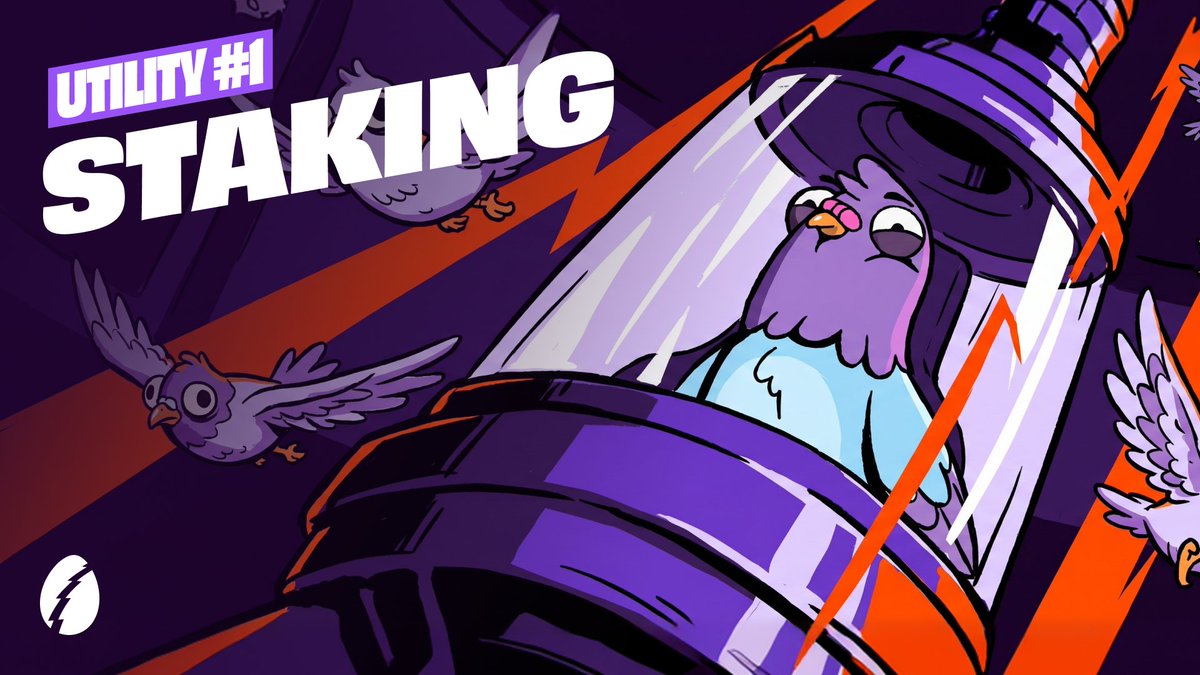
Introducing our first Wingston NFT utility: Staking
Stake your NFT and earn RLPs every single day. Just for holding and staking
This is what we meant by real utility
43
23
181
16,591
Jun 15
My Anti-CV:
Survived the 2022 crypto winter because I forgot my hardware wallet PIN and physically could not panic sell.
Own 47 domain names, 39 unfinished Notion documents, and one spreadsheet called "Master Plan" that has not been opened since 2023.
Spent years confusing research with progress because reading felt safer than shipping.
My most valuable professional skill is sounding thoughtful while buying myself enough time to figure out what I actually think.
Reading stories on @RallyOnChain reminds me that most careers are held together by lucky accidents, unfinished projects, and lessons that only make sense in hindsight.
What's the most embarrassing line that belongs on your Anti-CV but explains your success better than your real resume?
9
1
17
714
Jun 15
Most crypto debates still focus on throughput.
The institutions I have seen evaluating onchain settlement rarely start there.
Their first question is much simpler: who gets to see our business?
A trading desk cannot expose counterparties. A bank cannot broadcast sensitive flows. Compliance teams cannot build on assumptions that confidentiality will be added later.
That is why architecture matters.
Privacy, institutional control, cryptographic finality, and cross-chain composability are not independent features. Regulated settlement requires all four at the same time.
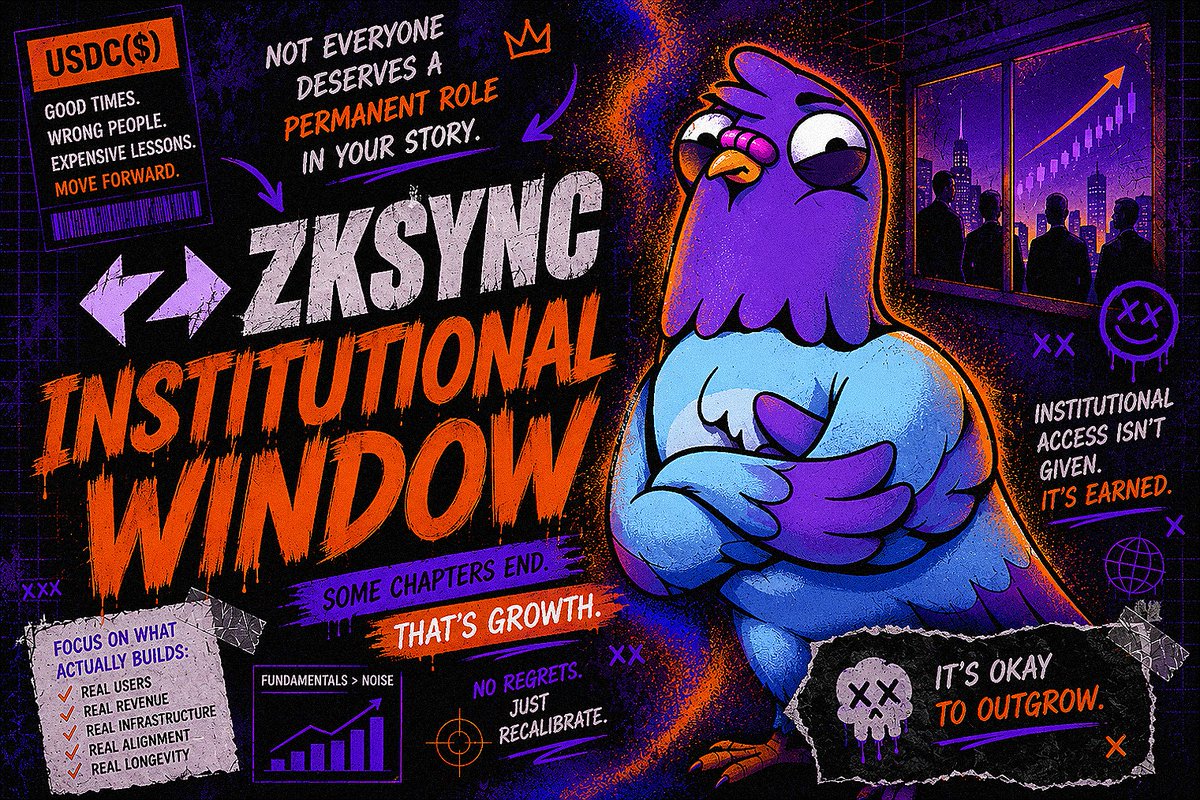
This is where @zksync stands out.
Rather than assembling separate components from different teams, ZKsync operates the proving system, the ZK Stack platform, and Prividium as an integrated stack. The result is an architecture designed to deliver those requirements together instead of treating privacy as an add-on.
The institutional proof points are already emerging.
Cari Network, founded by former U.S. Comptroller of the Currency Eugene Ludwig, is currently onboarding with production rollout planned for later in 2026, bringing five U.S. regional banks representing more than $600B in combined deposits onto the same privacy-preserving infrastructure.
That matters because settlement standards do not become standards through marketing. They become standards when multiple regulated participants choose the same rails.
The lead is real, but it is not permanent.
The next 12 months will determine whether today's deployments become tomorrow's default settlement layer or simply an early advantage competitors eventually close.
As of today, $ZK serves its current defined role within the network: governance token, the only native asset of the ZKsync network, and the native gas token for ZKsync Gateway.
The more interesting question is not whether institutions are moving onchain.
At what point does a settlement network stop being an alternative and start becoming the default?
13
4
20
2,107
Jun 15
gmic
at this point getting arrested by the Seismic community feels like a badge of honor 😂
thanks to @0xhomaa for creating this cool jail card for me

good night @SeismicSys community.
who wants to go to jail, lol 😂
I made for @ChangzhCrypto , and there will be more other versions 🗿

1
10
45
Jun 15
By 2030, I expect to hire a Neural Personality Calibration Specialist.
Their job will be teaching my AI clone how to sound slightly uncertain, occasionally wrong, and just passive-aggressive enough that people still believe it's me.
Once machines master competence, human flaws become a premium feature.
Watching builders discuss AI on @RallyOnChain convinced me this is less science fiction than it sounds.
What future job title sounds completely ridiculous today but inevitable tomorrow?
10
2
19
817
Jun 14
In 2021, I bought a token because its entire website was a blurry GIF of a dancing hotdog and the contract address was displayed in Comic Sans.
I threw 0.1 ETH at it without reading a roadmap, checking the team, or asking a single question. The sheer confidence of putting in that little effort somehow convinced me it was genius.
It went to zero.
I still hold it.
Years later, that worthless token is still my favorite thing in my wallet. Not because it made money, but because it reminds me that every onchain journey is partly conviction and partly complete nonsense.
Seeing people share stories like this through @RallyOnChain made me realize the assets I remember most were never my best trades. They were the ones attached to the dumbest decisions and the funniest lessons.
What's the most ridiculous thing in your wallet that you still can't bring yourself to sell?
9
2
20
940
Changzh retweeted

51
59
233
28,944
Jun 13
I'm deeply honored to accept the Crypto Person of the Year 2026 award.
To everyone who spent last year explaining why crypto was dead, thank you for making survival feel like overachievement.
This trophy is now the only thing I own that's gone up in value without requiring a support group.
The funny part is I got it through @RallyOnChain for building, which feels almost suspicious in an industry obsessed with shortcuts.
After enough cycles, I've noticed the ones who last usually aren't the loudest. They're just the ones who kept showing up after the excitement left.
Drop your worst trade of the year below so I can remember I'm not the only one funding market makers' vacations.
14
4
18
1,678
Changzh retweeted
Jun 12
gm fam yesterday felt like 2021 NFT peak hype ♥️
and honestly at Rally we go all in, we don't care about trends or market conditions, we build with vision and for what we believe is good for the community!

65
11
132
2,901
Changzh retweeted

Jun 11
Hundreds of businesses trust DashX for crossborder payments with millions of dollars processed through our platform
Today, we're announcing a strategic investment from Hadron Founders Club
Accept global payments and settle compliantly
Get started at dashx.xyz.
59
12
142
18,866
Jun 12
Wall Street does not reject public blockchains because of speed.
It rejects them because of visibility.
No institutional trading desk operates on a network where counterparties can see its book. This makes privacy the absolute gating requirement for onchain settlement, not a nice-to-have feature.
This is why the stack versus assembly dynamic is the real moat.
Most architectures try to bolt privacy on top of a public state. This structurally fails GDPR, banking secrecy laws, and MiFID II best-execution constraints.
Operating the full stack end-to-end is entirely different. @zksync integrates Airbender proving, which currently ranks first on eth_proofs, directly with Prividium as the institutional surface. It delivers privacy by architecture, providing cryptographic finality without optimistic challenge windows.
The institutional trust is already scaling. Cari Network, founded by former U.S. Comptroller of the Currency Eugene Ludwig, is currently onboarding with production rollout planned for later in 2026. This brings five U.S. regional banks representing over $600 billion in combined deposits to the same rail.
This entire infrastructure is anchored by $ZK in its current, defined role: as the governance token, the only native asset of the ZKsync network, and the native gas token for ZKsync Gateway. It powers this ecosystem functionally, operating strictly within the mechanisms governance has already decided.
With privacy established as the absolute gating requirement, the operational risk of bolting it onto a public state is now unsustainable.
Which legacy financial infrastructure will fracture first under this mounting counterparty pressure?
13
6
22
2,316

From cross-border payments to real businesses…
It’s always exciting to see real-world use cases come to life.
Congrats to @DashXHQ
Jun 11

Hundreds of businesses trust DashX for crossborder payments with millions of dollars processed through our platform
Today, we're announcing a strategic investment from Hadron Founders Club
Accept global payments and settle compliantly
Get started at dashx.xyz.
50
56
244
5,318
Jun 12
I used to view onchain adoption through the lens of retail speculation, but tracking the actual institutional flows reveals a different reality:
"we are watching the silent calcification of the next decade's financial plumbing".
The data is no longer theoretical. With JPMorgan’s Kinexys processing over $1.5 trillion and the tokenized asset market nearing $29 billion, the transition from pilot to permanent infrastructure is already underway.
In this layer of finance, being first isn't about marketing dominance; it is about structural lock-in. Migration costs here aren't just technical; they are operational nightmares involving years of regulatory re-attestation and counterparty alignment. Once a bank integrates a rail, switching becomes mathematically uneconomic.
The April 2026 GFMA report highlights the final hurdles: interoperability and privacy. The platforms solving these first create a gravitational pull. The math is unforgiving: ten institutions create 45 settlement corridors, but one hundred create nearly 5,000. Every new participant exponentially raises the switching cost for the next bank.
This is why the live institutional deployments on @zksync are the critical signal to watch. They aren't just testing technology; they are positioning themselves to capture the narrow window where the standard is still being defined.
As these corridors multiply and migration becomes structurally uneconomic, what specific operational hurdle will become the breaking point for institutions locked into legacy rails before this 18-month window closes?
13
6
22
3,174