
Empowering humans to do what humans do best. We're hiring: chefrobotics.ai/careers
Joined May 2018
- Tweets 289
- Following 1
- Followers 1,104
- Likes 123
130 Photos and videos



Jun 12
Recently, our robots completed 100 million production servings 🚀
The Chef team celebrated this milestone with a scavenger hunt (pictured below), table tennis, and a karaoke afterparty, videos of which shall remain safely under wraps.
Meanwhile, our robots quietly made another 17 million servings at customer sites.
Next stop: 1 billion 🤖
1
61
Jun 11
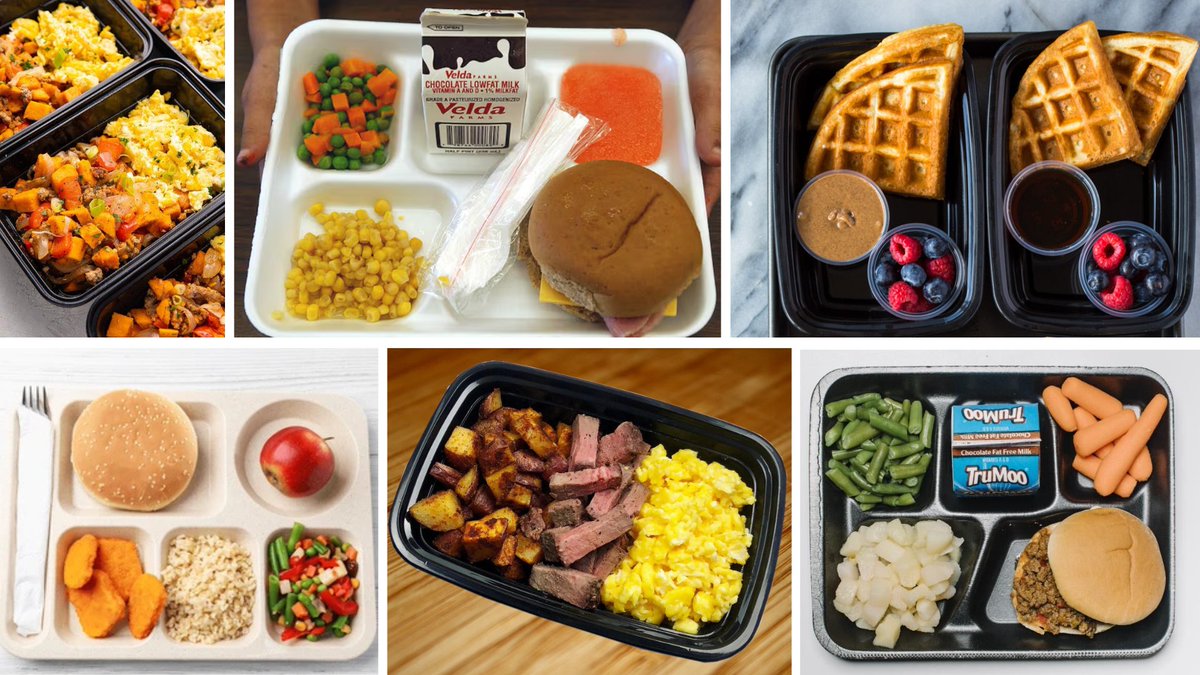
Breakfast tray assembly is one of the most manual steps in institutional food production and one of the most difficult to automate.
Chef robots handle the full breakfast tray assembly: scooping oatmeal and grits by weight, piece-picking sausage patties and hash browns, and dropping in sauce packets—all in a single pass at production speed.
From K-12 school nutrition programs and hospital food service to airline catering and correctional facilities, breakfast lines run with quick changeover windows, early shift start times, multiple SKUs, and tight compliance requirements, making manual assembly difficult to sustain at scale.
Chef's physical AI models are built for exactly this environment.
Read more on our blog: chefrobotics.ai/post/how-che…
#foodmanufacturing #foodautomation #breakfastproduction #institutionalfoodservice
1
1
78
Jun 10
We hosted @foxglove CEO @adrianmacneil at our office last week to discuss food as a market for robotics companies, why food manipulation is such a complex engineering problem, and how we've built the largest dataset of in-production deformable material training data.
Also, check out our preview of what the Chef R&D team is working on so that our robots can soon expand beyond the food manufacturing floor and serve other use cases across the food service industry, ghost kitchens, and fast-casual restaurants.
#robotics #physicalai #trainingdata

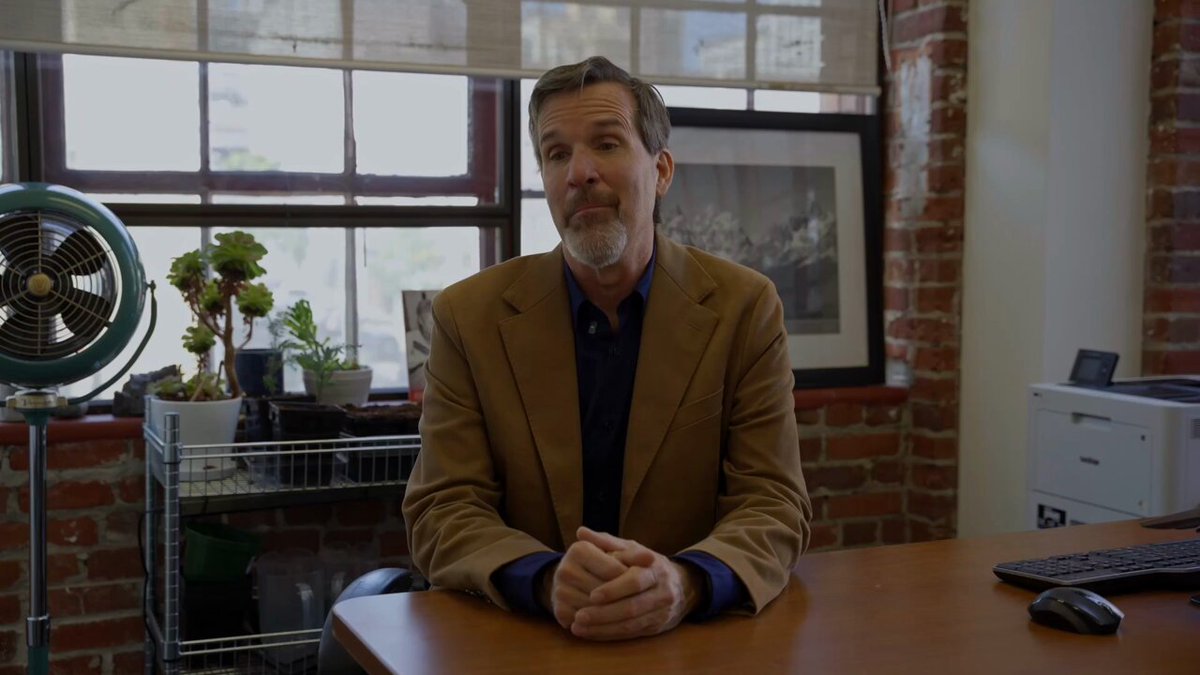
"It's not just for beans, you have to do this for trillions of ingredients, zero-shot. It's a way harder problem than meets the eye."
My interview with @RajatBhageria, founder and CEO of @ChefRobotics is live! Chef is tackling one of the hardest categories in robotics: food production.
It’s messy, variable, physical, operationally intense, and full of edge cases. Exactly the kind of environment where the best robotics teams build the data flywheel that makes robot data actionable to improve autonomy and scale.
I really enjoyed this discussion - thinking about starting a series of in-person founder interviews like this. Let me know in the comments if you enjoyed it, and who should I speak to next?
2
193
Visit us at IDDBA 2026 today and tomorrow!
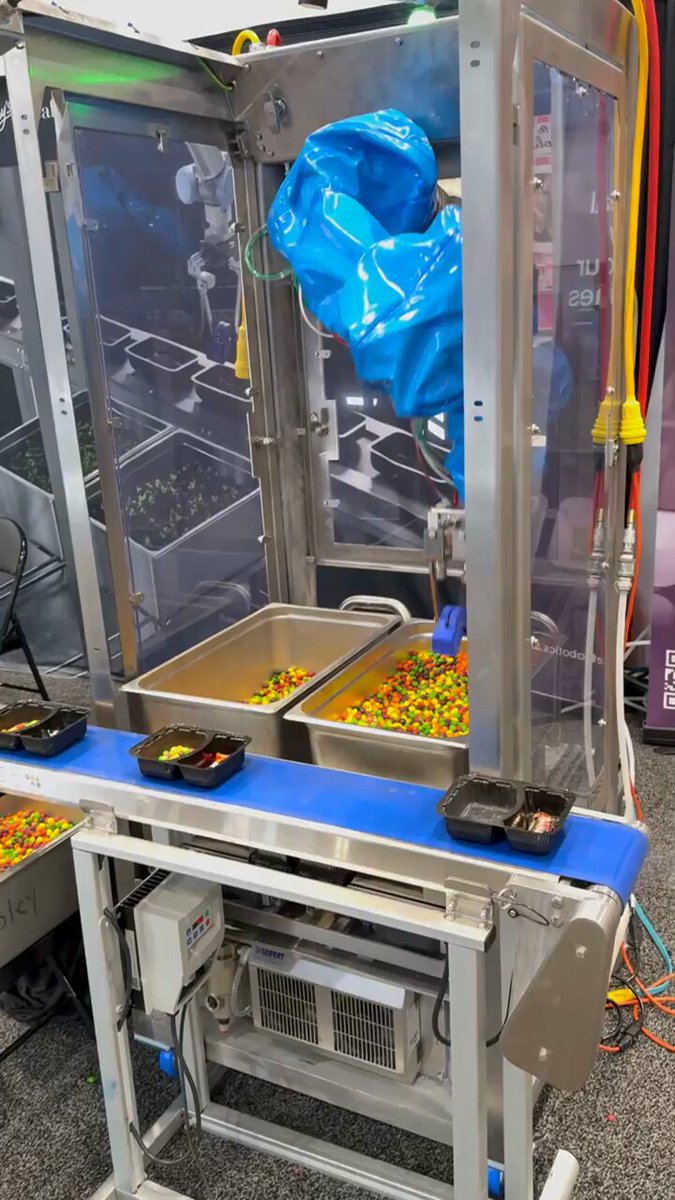
Our live robot demo showcases how physical AI automates food assembly for over a dozen manufacturers across North America. The Skittles are just an example 🍬
Meet Nicolas De Keijser, Nick Yang, Aditi Jain, and Shaolin Kataria at booth 4961.
#iddba #foodautomation #foodmanufacturing
160
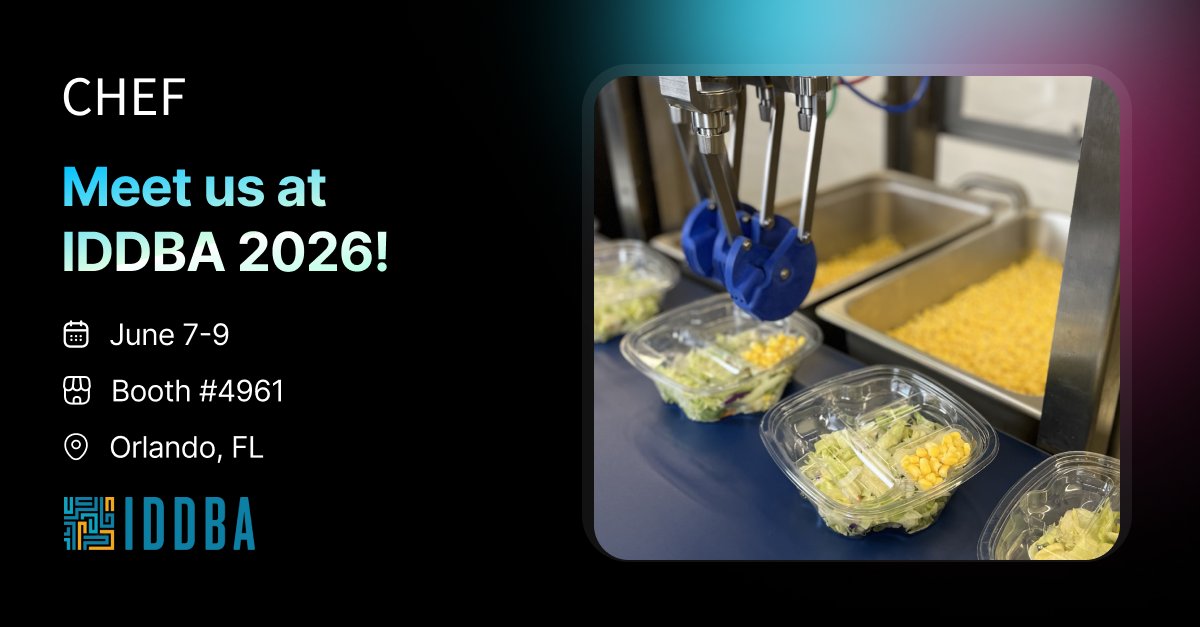
We're heading to IDDBA 2026 in Orlando next week! 🎉
Food manufacturing is changing fast, and we'd love to show you what's possible with physical AI on the production line.
Stop by booth 4961 between June 7–9. Whether you want to see a live Chef robot demo, talk automation, or just say hi—we'll be there.
See you in Orlando! 👋
#iddba #foodautomation #foodmanufacturing
1
94
Will physical AI be general-purpose or specialized?
We think it's both.
There's a major debate in robotics right now about whether generalist models and humanoids will outperform verticalized solutions. Our view is that the industry is converging toward a different outcome:
🧠 Intelligence will become increasingly shared
🤖 Embodiments will remain highly specialized
Why? Because industrial customers don't buy versatility. They buy ROI.
A food manufacturer doesn't need a robot that can fold laundry. They need a robot that can portion food accurately, operate in 32°F cold rooms, survive daily washdowns with caustic chemicals, and run reliably at production scale.
The same logic applies across construction, logistics, agriculture, manufacturing, and healthcare. Different industries have different environments, economics, and performance requirements. One embodiment won't fit them all.
In our latest blog, we make the case that the future of physical AI will consist of shared intelligence layers combined with verticalized embodiments, proprietary data, and domain expertise.
Or put differently: the future may look a lot more like 𝘞𝘈𝘓𝘓-𝘌 than 𝘐, 𝘙𝘰𝘣𝘰𝘵.
Read the full post: chefrobotics.ai/post/the-cas…
#PhysicalAI #Robotics #AI
1
3
109
We’re excited to welcome Steve Van Der Hoeven to Chef as a Senior Staff Software Engineer!
Steve brings over two decades of software engineering experience from companies like Google and Optimizely. He most recently worked at Zeromatter, where he built a CI/CD and validation platform for robotics stacks. At Chef, Steve will help our growing team of robotics and software engineers bring robots into real production environments across over a dozen customer sites.
If this sounds interesting to you, see our open roles at chefrobotics.ai/careers!
#robotics #ai #hiring
1
1
512
May 29
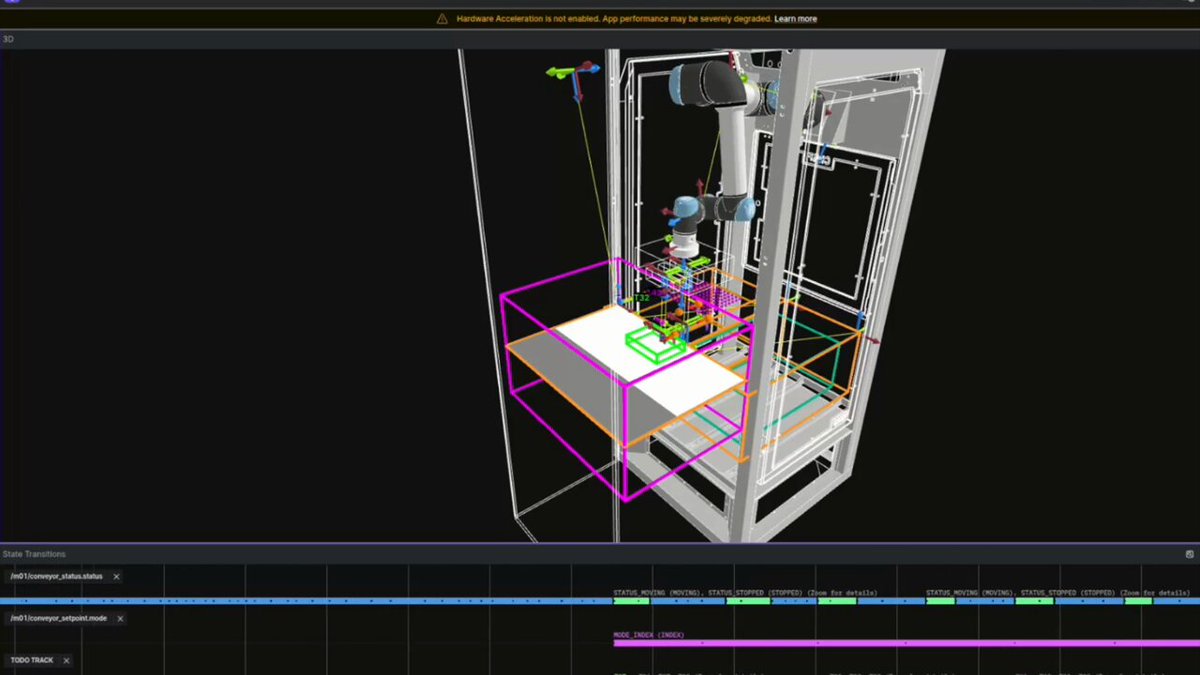
When a robot on a food production line deposits an ingredient into a tray, it doesn't act alone. The conveyor has to stop, every robot on the line has to finish its deposit, and only then does the line move again. That coordination happens dozens of times a minute, every shift.
Chef has a device that manages this entire sequence. And until recently, the only way to test whether that logic was working correctly was to run it on a live production line with physical hardware present.
We had two ways to test a stop-and-go conveyor without hardware. Neither covered the full loop.
So we built a hardware abstraction layer within the runner and an in-process PLC model to simulate the customer controller. The complete indexing stack now runs on a developer laptop with zero hardware in the loop.
Read more on our engineering blog: chefrobotics.ai/post/testing…
#physicalai #robotics #foodrobotics
1
2
7
742
May 28
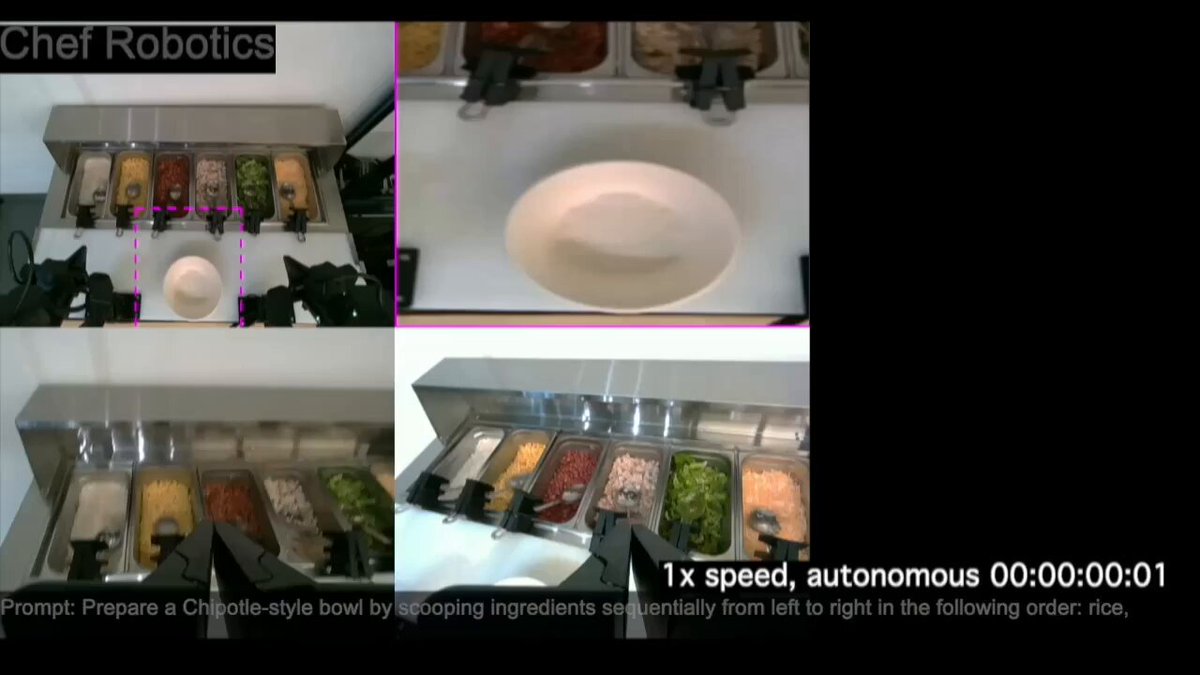
Last week, we were making burgers. This week, we’re scooping burrito bowls!
Our latest engineering blog explores how we taught Chef’s Food Foundation Model (FFM) to manipulate loose, deformable foods like rice, beans, lettuce, cheese, and chicken using the same underlying physical AI architecture.
Scooping sounds simple, but it introduces entirely new robotics challenges:
• Portioning loose ingredients precisely
• Preventing spills and cross-contamination
• Handling food that behaves differently with every scoop
Instead of rebuilding the system for a new meal, we trained the same model on new demonstration data and taught our robot to use ordinary kitchen utensils with a robot-friendly handle.
After about 25 hours of demonstrations, our robot can assemble a burrito bowl in under 2 minutes.
This is what general-purpose physical AI for food looks like.
Read the full blog: chefrobotics.ai/post/buildin…
#physicalai #robotics #food
3
5
36
4,183
May 26
The best stories are often the unexpected ones. Robots preparing medically tailored meals in San Francisco’s Tenderloin is one of them.
We’re proud to collaborate with @ProjectOpenHand to help assemble medically tailored meals for seniors and community members living with chronic illnesses. For over 40 years, the nonprofit has built its mission around the idea that food is medicine, recognizing the critical role nutrition plays in managing chronic illness. But since the COVID-19 pandemic, the organization has faced ongoing volunteer shortages. That’s where our robots come in.
Today, two Chef robots work alongside volunteers in the Project Open Hand kitchen, helping assemble meals and freeing up volunteers to focus on other, less repetitive tasks. This is just one example of how new technologies can support mission-driven organizations and help them operate more efficiently.
Watch the full video and read Project Open Hand’s story: chefrobotics.ai/case-studies…
Big thanks to @BooneAshworth and @WIRED for covering the story: wired.com/story/these-robots…)
#robotics #physicalai #nonprofit
1
227
May 22
We’re excited to welcome Dmitriy Ganapolskiy to our manufacturing team as a Senior Technician!
Dmitriy brings over a decade of engineering technician experience from companies like Tesla and Skydio, where he worked on scaling complex hardware systems. At Chef, he’ll play a key role in optimizing and scaling the production of our food robotics systems deployed across North America and Europe.
We’re thrilled to have him on the team. Welcome, Dmitriy!
6
978
May 21
Ingredient onboarding is one of the hardest problems in physical AI.
Food doesn’t behave like rigid objects; it’s messy, variable, and highly context-dependent. That makes traditional robotics approaches brittle and hard to scale.
Our AI team has developed SAGE, an LLM-powered agent, to solve this.
Instead of relying on simple similarity matching, SAGE combines:
• Structured production data
• Expert heuristics encoded in prompts
• Real-time reasoning over ingredient behavior
The result: a system that can recommend utensils and manipulation parameters for new ingredients faster, more consistently, and with full traceability.
This is what physical AI looks like when it’s designed for real-world environments.
Read more on our engineering blog: chefrobotics.ai/post/using-l…
#physicalai #robotics
2
1
5
299
May 19
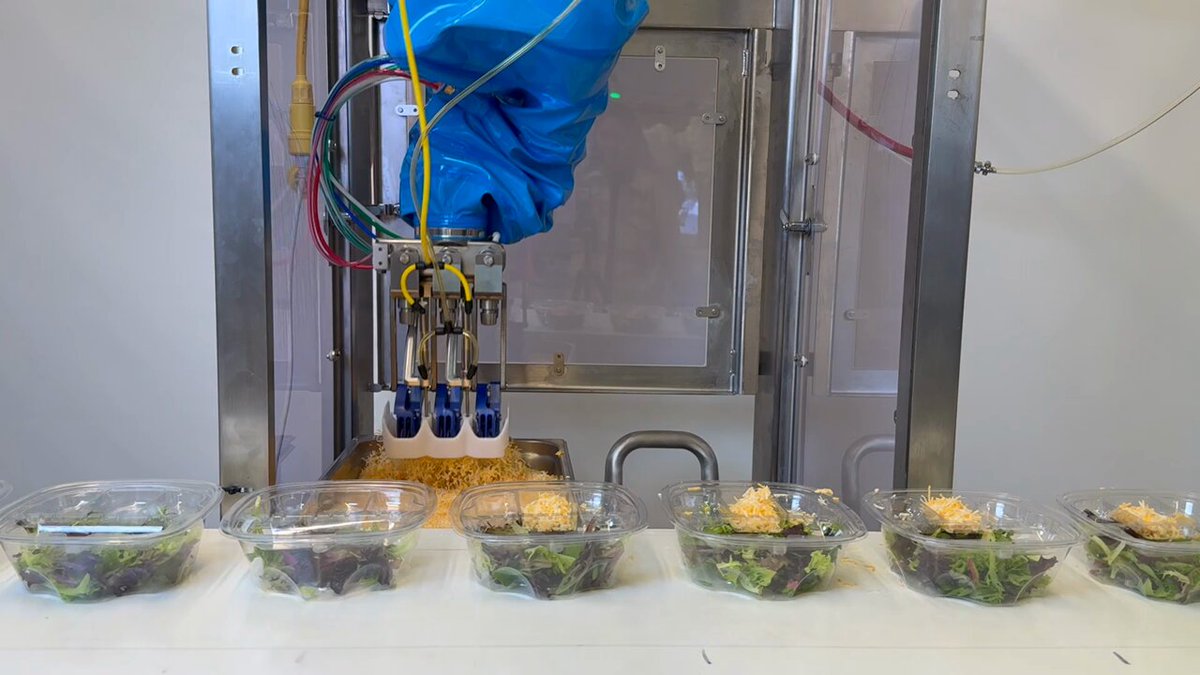
Chef robots can now deposit scoopable ingredients into small compartments and inserts with higher accuracy.
𝗧𝗵𝗲 𝗰𝗵𝗮𝗹𝗹𝗲𝗻𝗴𝗲
For depositing finer, stickier ingredients like shredded cheese, small compartments leave little margin for deposit error. After picking, cheese tends to cling to the outer portion of the utensil and get stuck between utensils, and when the robot moves to the next deposit, the leftover ingredient falls into the wrong compartment.
𝗛𝗼𝘄 𝘁𝗵𝗲 deposit assist 𝘄𝗼𝗿𝗸𝘀
Deposit assist is a hardware attachment that our customers can add directly to Chef's utensils. It introduces two mechanisms:
→ As the deposit assist is a physical funnel, it guides the deposit toward the center of the target compartment as the utensil opens, even when the compartment is small or irregularly shaped. The funnel can be customized to match the compartment size, utensil size, and number of utensils used across different tray formats and SKUs.
→ Before each deposit, the robot shakes the utensil multiple times over the pan, driven by a food-safe, NSF-certified air cylinder actuator, dislodging any leftover ingredient stuck between the utensils before moving to the deposit location.
𝗧𝗵𝗲 𝗿𝗲𝘀𝘂𝗹𝘁
Food manufacturers reduce spillage into adjacent compartments and achieve consistent deposits across a production run without changes to existing production line infrastructure.
Read more on our blog: chefrobotics.ai/post/chef-in…
#foodmanufacturing #foodautomation #mealassembly #foodrobotics
2
2
309
May 18
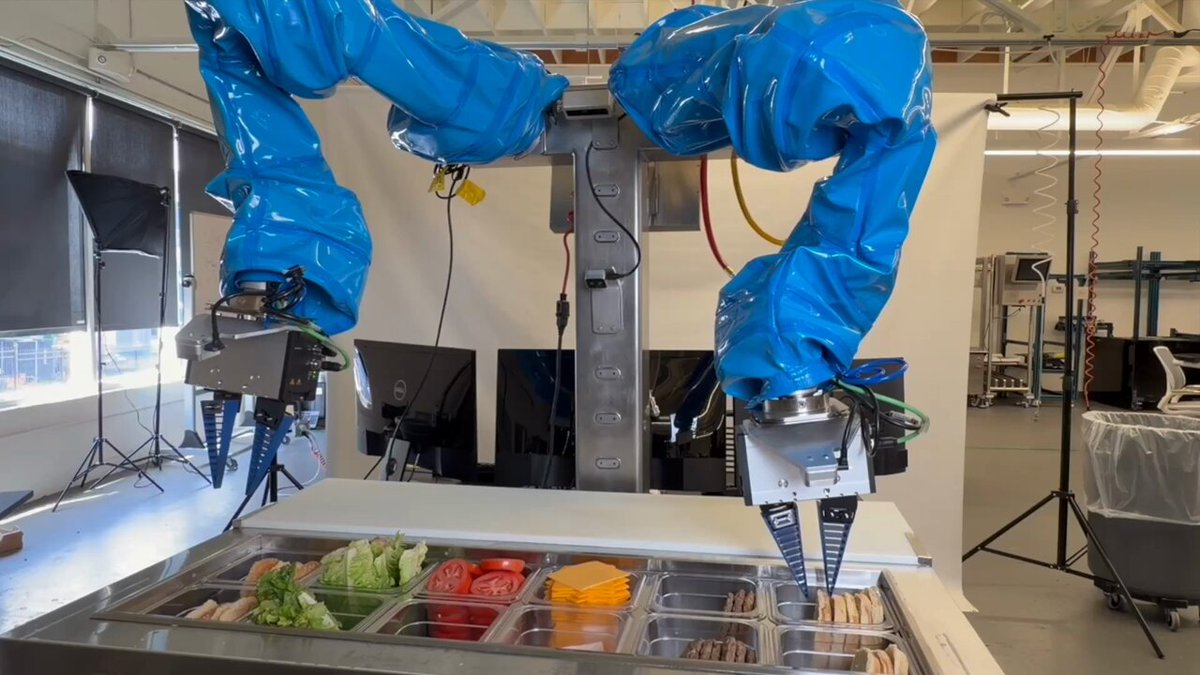
Physical AI is allowing robotics to extend beyond the production line and into the prep table.
Today, Chef robots handle high-volume meal assembly on conveyor systems. Physical AI enables lower-volume, higher-complexity prep table food assembly with a single system assembling an entire meal.
We’re building a bi-manual physical AI system powered by our Food Foundation Model (FFM):
• Two robotic arms for coordinated, dexterous manipulation
• A single foundation model for handling diverse food assembly tasks
• Designed for real-world food environments (messy, variable, and unstructured)
Unlike traditional robotics, the FFM will learn from demonstration and generalize across ingredients, tasks, and hardware.
This is a step toward something bigger: a unified AI layer for food. And it will one day allow Chef to serve the food industry outside of manufacturing use cases, from ghost kitchens to fast-casual restaurants, airline catering, schools, hospitals, military, prisons, stadiums, corporate dining, and hotels.
Read our blog to learn more: chefrobotics.ai/post/buildin…
#robotics #physicalai #foodautomation
2
271
May 13
We're honored to be among the winners of @therobotreport's RBR50 Robotics Innovation Awards for the second year in a row!
The Robot Report has been recognizing top robotics companies for the past 15 years. With the rise of physical AI, innovation has accelerated and expanded to an even wider range of industries, from manufacturing and logistics to autonomous vehicles, aerospace, and medicine. We're proud to be the only company focused on food production, alongside one in agriculture, representing innovation in this space.
Download the full report here: therobotreport.com/rbr50-202…
#rbr50 #robotics #physicalai
1
2
521
May 12
We’re proud to be featured in @SVG_Ventures' THRIVE Top 50 FoodTech Report for the second year in a row.
Food production is one of the most critical but challenging industries to automate. It's exciting to see the growing number of companies bringing robotics and physical AI into this space to help solve real-world problems throughout the food production process.
Grateful to be included alongside such an innovative group that advances innovation in the food industry.
thriveagrifood.com/top-50-fo…
#foodtech #robotics #physicalai
146
May 11
We’re excited to welcome Mohamed Elzaki to Chef as a Senior Mechanical Engineer!
Mohamed brings over half a decade of mechanical engineering experience from Ample and RIOS Intelligent Machines. He’s joining our growing hardware team to help design, build, and deploy physical AI that makes a real impact in one of the most critical industries in the US.
Welcome, Mohamed!
Interested in joining our team? Check out our open roles: chefrobotics.ai/careers
#robotics #physicalai #mechanicalengineeringjobs
3
664
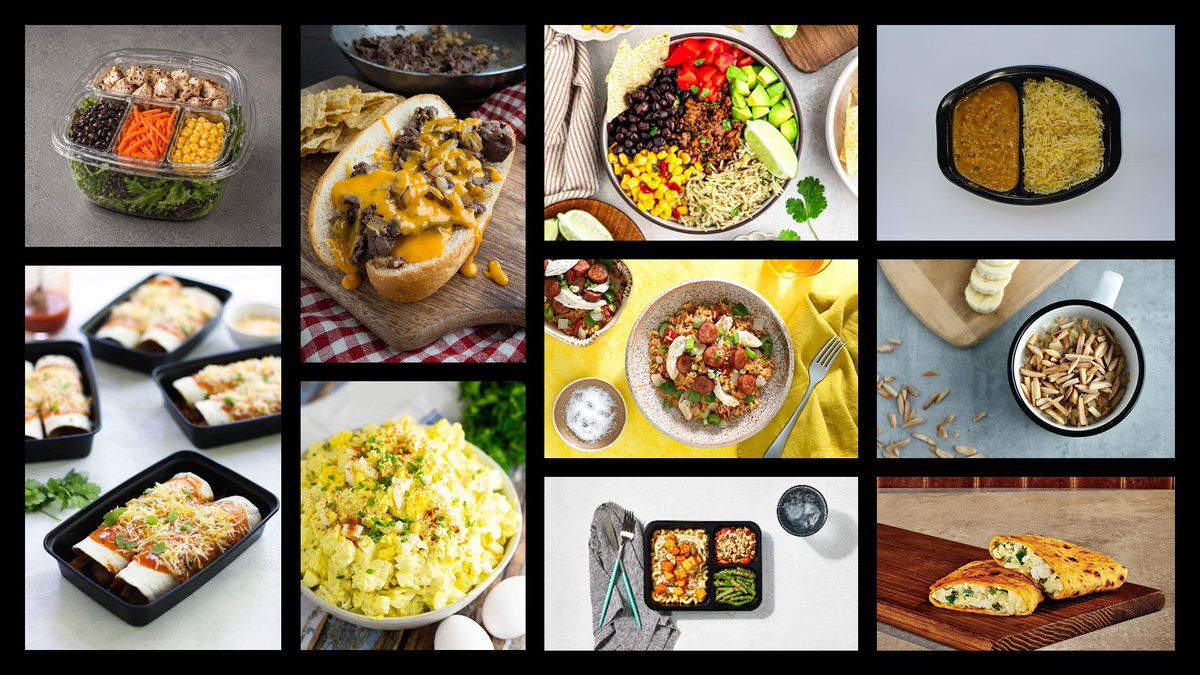
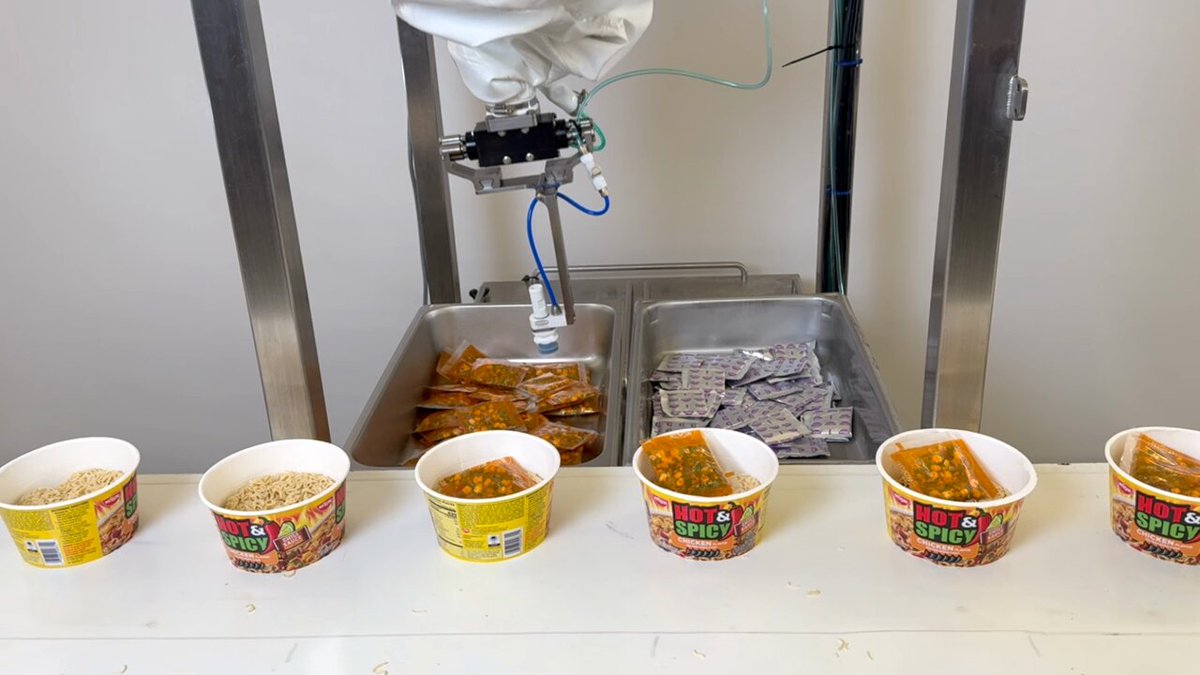
Chef robots can now automate assembly for consumer packaged goods 📦
For instant noodle bowls, after the noodles and dried vegetables have been placed into the bowl, the secondary step is to add the seasoning sachet, sauce pouch, and garnish packet before sealing. At most facilities, this is still done by hand.
Chef robots can now automate it—and not just for noodle bowls.
Sauce sachets. Seasoning packets. Garnish toppers. Dried proteins. Non-food inserts like plastic-wrapped cutlery kits and desiccant packets. Whatever discrete item your line places into a bowl, cup, or tray before sealing, Chef robots can now handle it.
The most common applications for Chef's CPG automation include shelf-stable product assembly like ramen bowls, multi-compartment trays, global meal kits with sauce pouches and bread accompaniments, premium snack cups with toppers, and any product that requires a cutlery drop.
𝗪𝗵𝘆 𝘁𝗵𝗶𝘀 𝘀𝘁𝗲𝗽 𝗶𝘀 𝗱𝗶𝗳𝗳𝗶𝗰𝘂𝗹𝘁 𝘁𝗼 𝗮𝘂𝘁𝗼𝗺𝗮𝘁𝗲
Items in CPG assembly are often flat, lightweight, and deformable. A sauce sachet, a folded utensil pouch, and a dried shrimp packet each behave differently in a bin—they crinkle, shift, and sit at different angles after every pick. That makes it difficult to reliably achieve consistent placement across a full shift.
𝗛𝗼𝘄 𝗖𝗵𝗲𝗳 𝗿𝗼𝗯𝗼𝘁𝘀 𝗵𝗮𝗻𝗱𝗹𝗲 𝗶𝘁
Chef robots handle CPG assembly using our existing piece-picking capability. Our AI-powered computer vision assesses each item's position, shape, and orientation in real time and determines how to pick and place it precisely with no pre-sorting or fixed bin placement required.
This enables our robots to:
→ Detect each item's angle in the bin and reorient it mid-pick to land at the exact orientation required.
→ Place multiple items of the same type (e.g., several seasoning sachets) into the same bowl in a single automated pass.
→ Fill multi-compartment trays by placing each item into its correct section without migration into adjacent areas.
Read more on our blog: chefrobotics.ai/post/chef-ro…
#foodmanufacturing #foodautomation #pickandplace #CPGmanufacturing #secondarypackaging
1
240
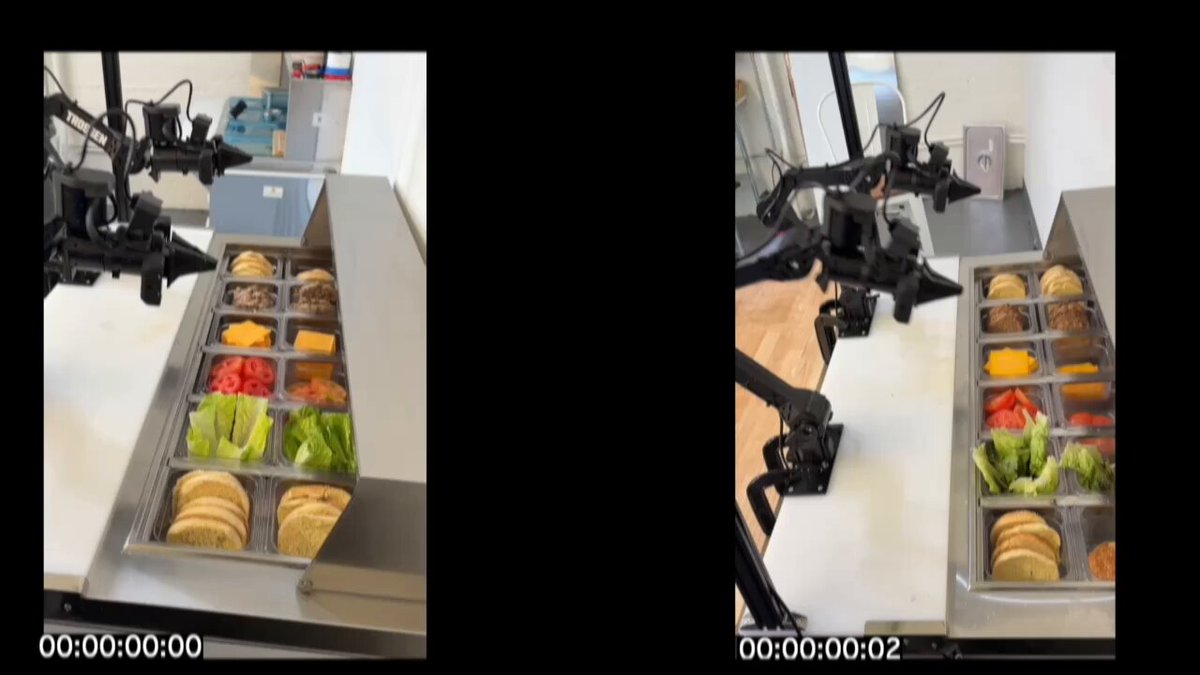
When we built a physical AI system that assembles a burger in under a minute, we ran into an unexpected issue: the robot was shaking.
We traced it back to latency: a lag between our vision-language action model (VLA) predicting action chunks and the robot executing those chunks. By the time our robot had carried out specific actions, our VLA's predictions were already stale.
This delay came from three sources: our VLA's model inference time, a leader–follower lag during teleoperated data collection, and asynchrony between the different cameras our physical AI system was using.
To fix this problem, we measured the total latency and shifted the prediction target forward. Instead of waiting for one action chunk to be carried out before making the next prediction, we adopted asynchronous inference, issuing the next prediction before the current action chunk was completed.
This approach reduced velocity discontinuity by 64.9% and acceleration jerk by 30.8% on our physical AI system with no added inference cost.
Learn more about this problem and how we solved it in our latest tech blog: chefrobotics.ai/post/latency…
#physicalai #robotics #techblog
4
3
366