
Joined December 2020
- Tweets 1,909
- Following 936
- Followers 3,385
- Likes 2,026
1,270 Photos and videos
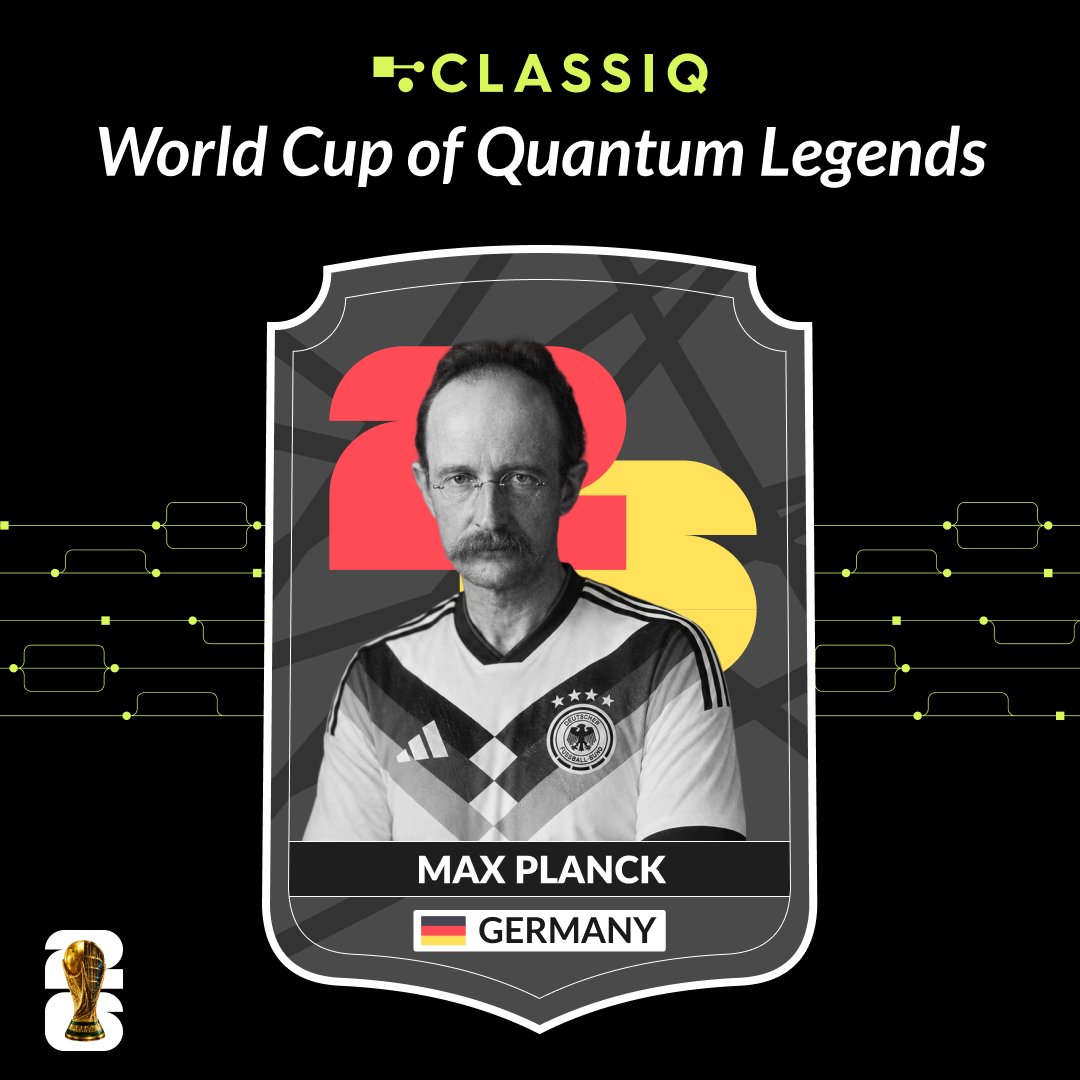

🇩🇪 While Germany takes the pitch at the World Cup, here's a different kind of German legend. A quantum legend:
Max Planck was born in 1858 in Kiel, Germany.
As a young physicist, he was drawn to the study of heat, energy, and thermodynamics. At the time, many physicists believed the foundations of the field were largely complete.
Planck disagreed. He thought there were still important questions to answer.
One of those questions involved blackbody radiation, the light emitted by a hot object. Existing theories could not fully explain the experimental results.
For years, Planck worked on the problem.
In 1900, he proposed a mathematical solution that came with a surprising assumption: energy could only be emitted or absorbed in discrete packets, rather than in a continuous flow.
Planck viewed it as a mathematical trick.
It wasn't.
That idea became the foundation of quantum theory.
The constant that emerged from his work, now known as Planck's constant, appears throughout quantum mechanics. It helps define the scale at which quantum effects become important and remains one of the fundamental constants of nature.
Albert Einstein later used Planck's idea to explain the photoelectric effect. Niels Bohr incorporated it into his model of the atom. Over time, an entire field grew from the assumption Planck had introduced to solve a single problem.
In 1918, he received the Nobel Prize in Physics for his discovery of energy quanta.
Planck spent much of his career studying the limits of classical physics.
In the process, he helped open the door to an entirely new understanding of nature.
That's quite a legacy.
2
44

Jun 12
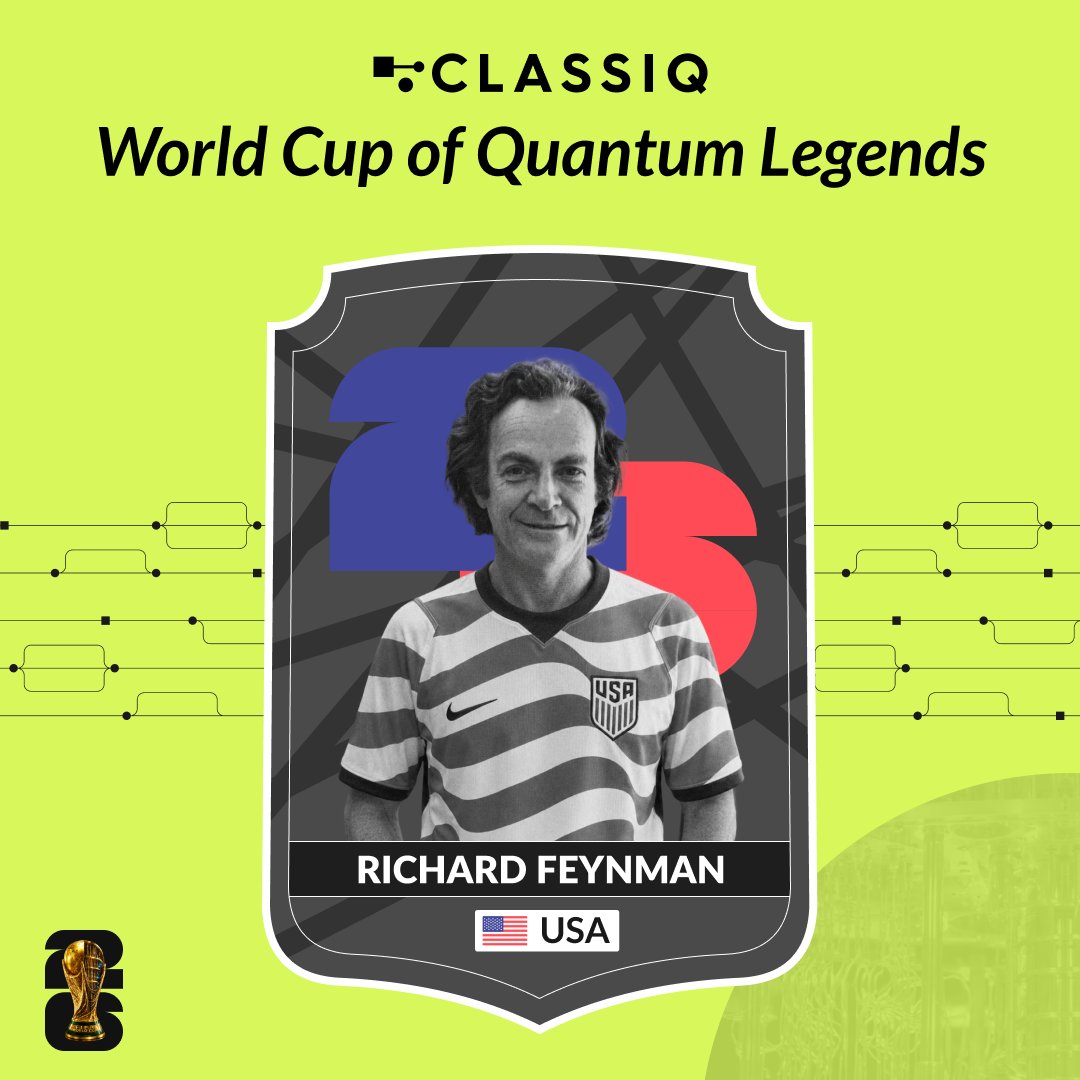
As Team USA takes the field at football's biggest tournament, we're kicking off our World Cup of Quantum Legends series with a scientist whose ideas helped inspire an entirely new way of computing: Richard Feynman.
Richard Feynman was born in 1918 in Queens, New York.
As a teenager, he developed a reputation for fixing radios. He would diagnose problems by reasoning through how the circuits worked, often without schematics or instructions.
That approach stayed with him.
He studied physics at MIT and Princeton, then joined the Manhattan Project at Los Alamos during World War II, where he worked alongside many of the leading physicists of the era.
After the war, Feynman focused on a problem that was frustrating physicists: how to accurately describe the interaction between light and matter.
His work helped build quantum electrodynamics (QED), one of the most successful theories in the history of science. He also introduced Feynman diagrams, a simple visual language that transformed how physicists calculate and think about particle interactions. They remain a standard tool in physics more than 75 years later.
Feynman was also one of the first physicists to clearly articulate a challenge that still drives quantum computing today: simulating nature is hard for classical computers. In a famous 1981 lecture, he argued that a quantum system would be best simulated by another quantum system, an idea that helped inspire the field of quantum computing.
In 1965, he received the Nobel Prize in Physics for this work.
But his influence extended far beyond research.
Through his lectures, books, and teaching, Feynman became one of the most recognizable physicists of the twentieth century. Generations of students learned physics through his explanations, many of which are still used today.
A teenager who liked fixing radios went on to help explain some of the fundamental interactions of the universe.That's quite a career.
6
156
Jun 11
⚽ The World Cup Starts Today!
And it's not only the biggest event of the year is may also be the biggest physics experiment on Earth.
Every match is a showcase of forces, motion, energy, and precision.
Take a free kick.
When a player strikes the ball with spin, the airflow around the ball changes. One side experiences lower pressure than the other, creating a force that bends the ball through the air.
Physicists call this the Magnus effect.
Football fans call it magic.
The beauty of the World Cup is that it makes physics visible. Billions of people watch the same laws of nature play out in real time, whether they realize it or not.
A bending free kick.
A dipping long-range strike.
A goalkeeper launching across the goal.
Different moments. Same physics.
More than a century ago, scientists were trying to understand the forces that govern our world.
Today, that journey continues, from classical physics to quantum physics, helping us understand everything from footballs to the fundamental building blocks of nature.
The next time a ball curls into the top corner, remember: you're not just watching football.
You're watching physics.
1
86
Jun 10
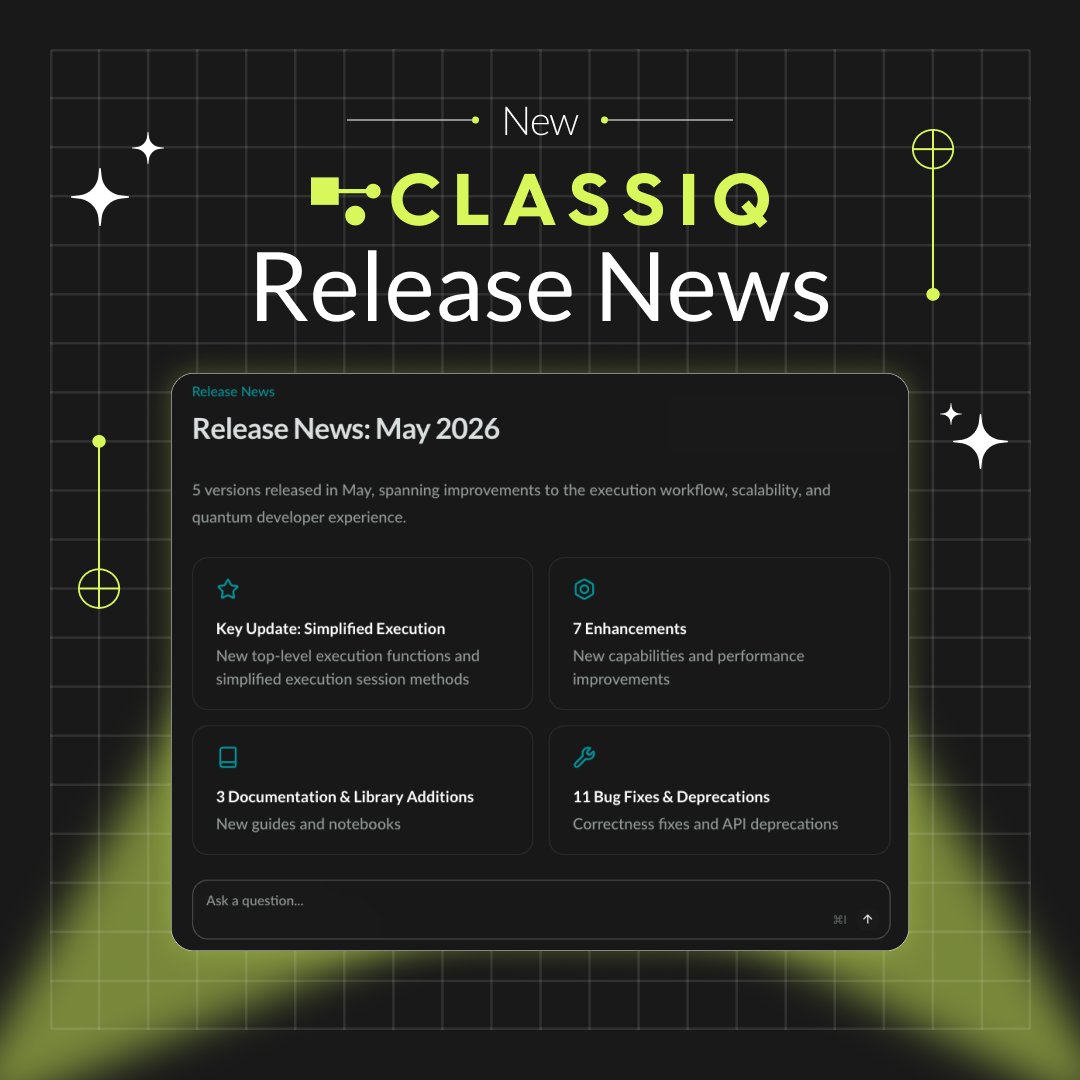
This month marks the launch of our monthly Release News.
Release News highlights the most important updates from the past month, including key enhancements, documentation and library additions, bug fixes, and deprecations.
Beyond a technical changelog, each update is conveyed in a way that intuitively explains what’s new and why it matters.
The main highlight of May’s release is the introduction of a simplified execution workflow, which streamlines the process of running quantum applications and provides a more straightforward execution experience.
Check out the May Release News here:
docs.classiq.io/release-news…
1
4
227
Classiq Quantum Agent - a case that works!
A lot of quantum computing research still lives in the pen-and-paper era.
Not because the ideas aren’t interesting, but because implementing them is often a project in itself: understanding the algorithmic details, translating them into circuits, adapting them to hardware constraints, debugging, optimizing, etc.
But now, with our AI agents, this project is no longer a barrier.
Join Dr. Tom Shindelman, Classiq's Quantum Applications Engineer for a short journey from idea to a working model
The workflow starts from a research paper. The agent identifies the relevant quantum procedure, generates an executable implementation, synthesizes the circuit, and prepares it for execution on quantum hardware. All within a single flow.
We know that AI can't replace the understanding of the algorithm itself, and there’s still a long way to go, but reducing the friction between “reading a paper” and “testing the idea” significantly accelerates quantum research.
Let us know what you think and test it yourself at: platform.classiq.io/
1
2
19
1,378
May 28
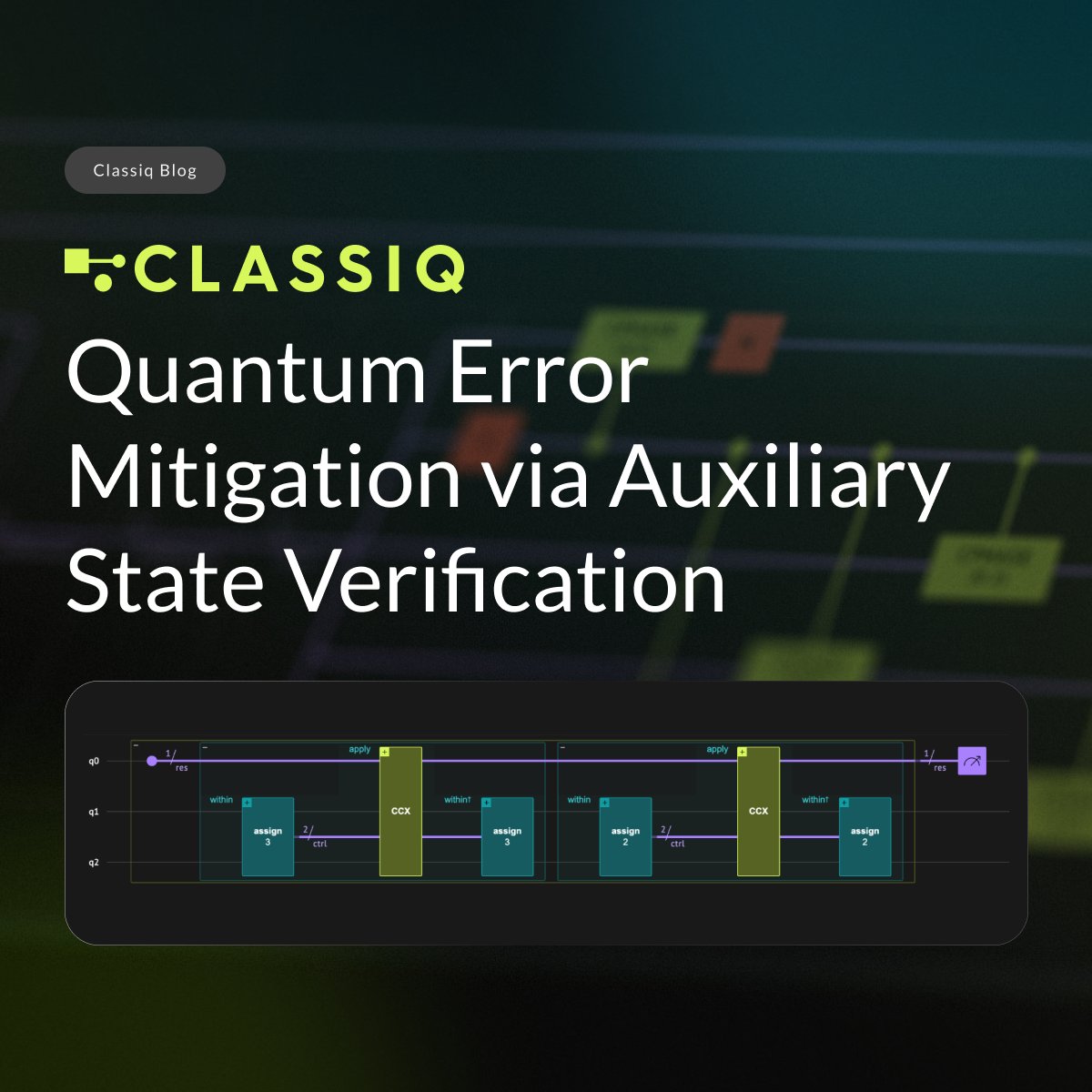
🚨 New paper alert: leveraging Classiq’s qubit “garbage collection” to improve quantum execution fidelity and runtime efficiency.
In Classiq’s synthesis engine, auxiliary qubits are automatically reused once they return to the |0⟩ state through uncomputation and qubit lifecycle management.
In our new paper, we show that these same reset points can also be used to detect corrupted executions.
If an auxiliary qubit is not measured in |0⟩ when expected, it’s a strong indication that noise affected the computation.
This enables:
✨Real-time detection of corrupted shots
✨Improved execution fidelity
✨Early termination of faulty executions and immediate restart of a fresh shot
The exciting part is that this capability naturally emerges from the synthesis flow and compiler-managed qubit reuse — without additional complex logic.
🔗 Read the full paper: arxiv.org/abs/2605.28342
Read the full blog: classiq.io/insights/quantum-…
Great work by Gilad Kishony, Avi Elazari, Ron Cohen and Lior Gazit
#QuantumComputing #QuantumCompiler #QuantumSoftware #classiquedunkerque
2
11
1,099
Classiq Technologies retweeted

Quantum progress starts with the right software layer. Discover the ShortList for Quantum Computing Software Platforms. By @holgermu zurl.co/gxQn4 @1QB_IT @awscloud @ClassiqTech @Evidenlive @Google @IBM @Intel @Microsoft @qctrlHQ @QCWare @QuantinuumQC @rigetti @Strangeworks @XanaduAI
2
3
306
May 24
See the video: Classiq's agentic quantum software workflow in integration with @Oracle #quantumsoftware #quantumcomputing
youtu.be/7zdfA4CNlo4
1
5
684
May 24
Oracle and Classiq Bring Quantum AI Agents to HPC-Scale Quantum Simulation
Quantum software developers need an efficient way to build applications and the computing capacity to test them at scale. In a recent proof of concept, Oracle and Classiq connected those two pieces. Classiq used its quantum expert AI agent as the starting point for generating a quantum portfolio optimization application, and Oracle GPU infrastructure provided the compute capacity for a demanding 36-qubit simulation. See more here:
classiq.io/insights/oracle-a…
6
19
104,428
May 20
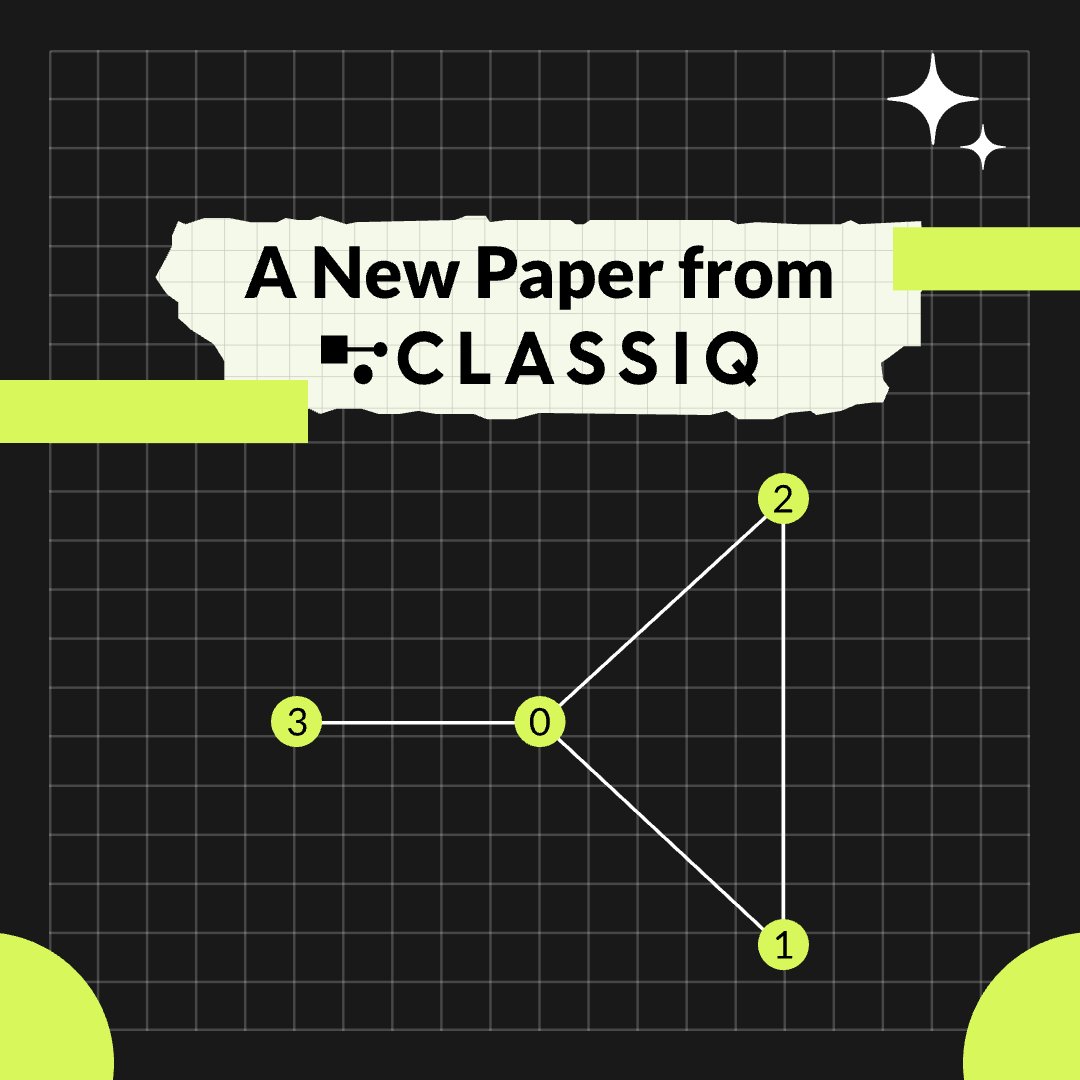
Most quantum walk examples stop at simple lattices.
Real-world networks are…. messier.
Huge congratulations to Dr. Rei Sato! 🥳 His paper on implementing coined quantum walks on complex networks has been officially accepted by Quantum Information Processing!
Using Classiq's Qmod, Synthesis, and Execution capabilities, the study demonstrates an intuitive, end-to-end journey from mathematical modeling to real quantum hardware execution.
The standout feature? Model Reusability. 🔄 Once a model is defined in Qmod, researchers can easily generate circuits for different complex networks just by updating the input graph structure. There is absolutely no need to rebuild quantum circuits from scratch for each dataset, making experimentation faster and more scalable.
Here is the paper:
link.springer.com/article/10…
Enjoy!
7
414
May 18
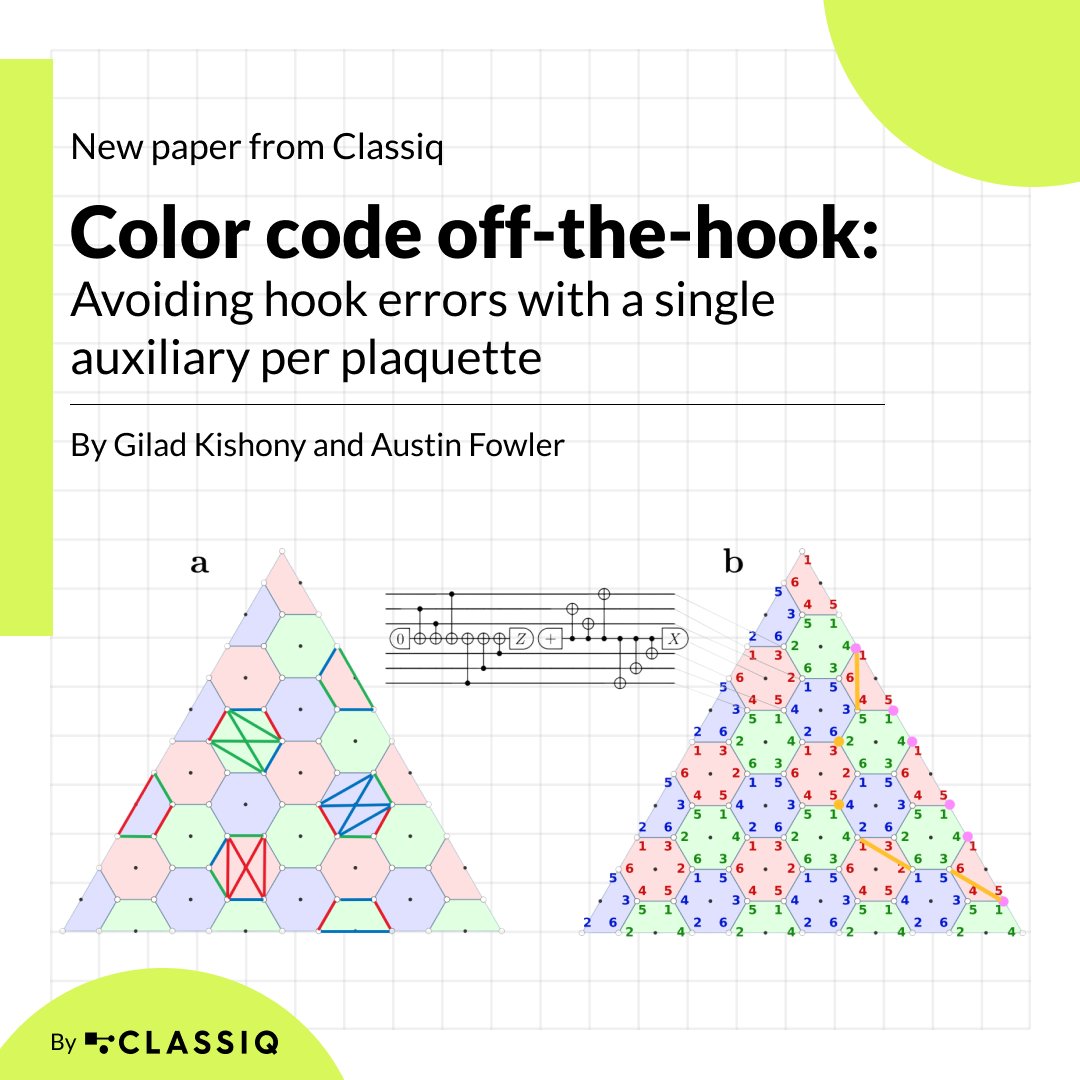
New Breakthrough in Quantum Error Correction and Syndrome Extraction
A recent paper by Classiq's Gilad Kishony and renowned quantum computing researcher Austin Fowler introduces a new approach for improving syndrome extraction in planar color codes, addressing one of the key challenges in maintaining circuit-level error-correction performance while minimizing hardware overhead.
The work demonstrates a single-auxiliary syndrome extraction circuit that preserves full circuit-level distance and outperforms previous state-of-the-art approaches through simulation.
This research highlights the importance of innovation across the full quantum computing stack, from algorithms and software abstraction to the underlying foundations of fault-tolerant architectures.
Congratulations to Gilad and Austin on this important contribution to the field. We are proud to be a part of it.
Read the full paper: arxiv.org/pdf/2603.28852v1
1
6
29
2,222
Simulating the Physics That Powers Next-Gen Materials
We recently added a quantum simulation of the 1D Fermi-Hubbard model, one of the most important toy models in condensed matter physics for understanding superconductivity, magnetism, and strongly correlated electrons.
Inspired by Google AI Quantum's 2020 experiment (arXiv:2010.07965), the notebook walks through:
Initial state preparation: building the ground state of a non-interacting Hamiltonian as a Slater determinant using a network of Givens rotations.
Trotterized time evolution: quenching the system to the interacting Fermi-Hubbard Hamiltonian and propagating it in time using a first-order Trotter decomposition with Jordan-Wigner mapping.
Observing spin-charge separation: a striking 1D phenomenon where charge and spin excitations propagate at different velocities due to interactions, a regime that's hard to reach with classical methods.
Everything is implemented at a high level with the Classiq SDK, making the algorithm readable and the circuits automatically optimized.
Great work by Roie Dann
2
8
340
Classiq is turning 6
Wishing us a Happy Birthday!
6 years of building, breaking, scaling — and not slowing down.
From a bold idea to a platform used by teams around the world: Designing. Optimizing. Running real quantum software.
No hype. No shortcuts.
Just relentless focus on making quantum actually usable.
Along the way:
We've grown a bit (🐣 💪),
Expanded worldwide (🌎 ),
Created a community pushing what’s possible every day (❤️),
And a platform that keeps getting sharper, broader, and more powerful!
Quantum is no longer “someday.”
It’s being built right now.
And we’re just getting started.
Let’s go 🚀
2
4
21
627
Apr 28
Documentation That Thinks With You
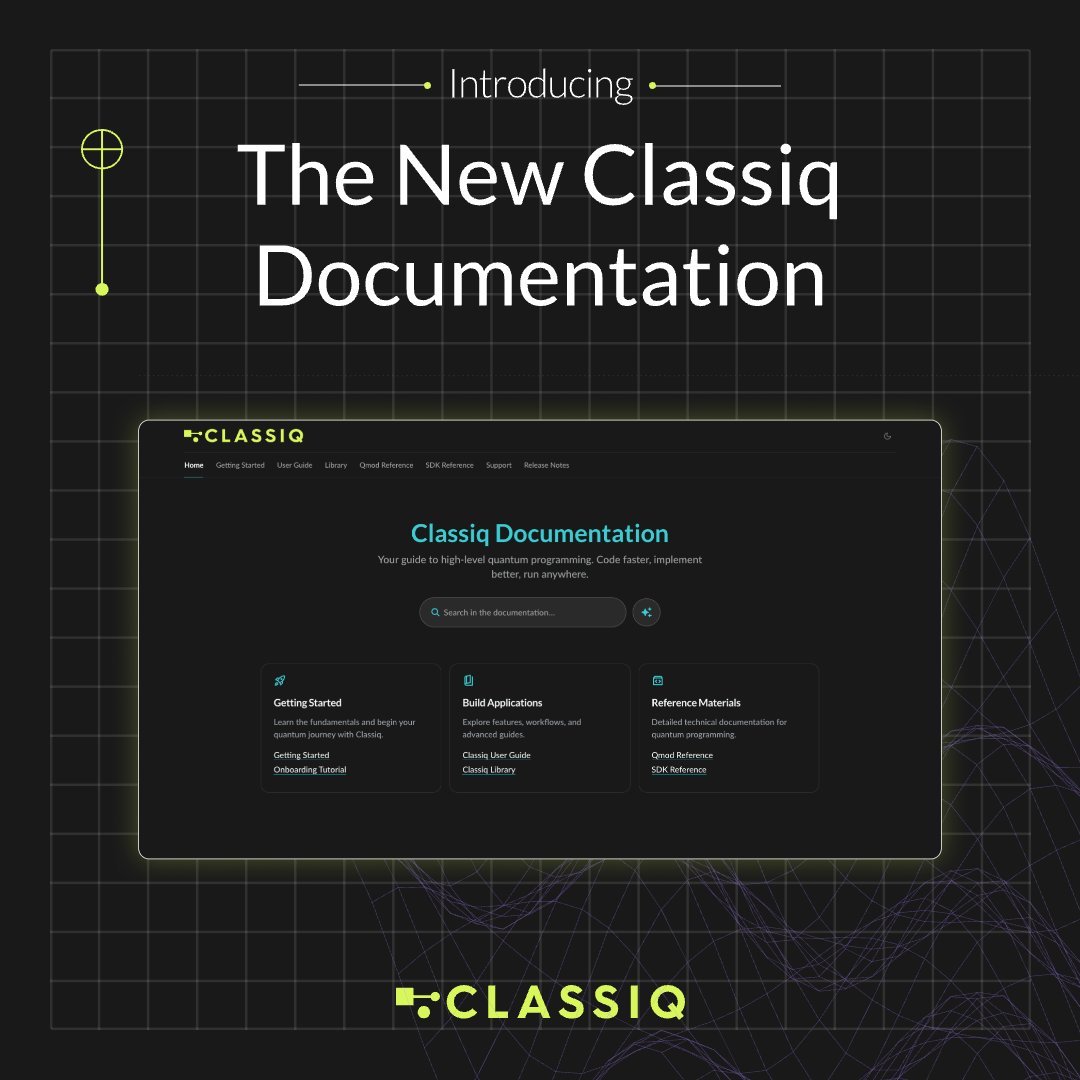
Exciting news!
We’ve launched the new Classiq documentation experience: same trusted content, now with a cleaner design and smoother, more intuitive navigation.
The biggest addition is AI built directly into the docs, allowing users to ask questions, get contextual explanations, and interact with content without leaving the page.
Combined with a cleaner interface and improved flow, this turns the documentation into a more dynamic workspace, helping developers spend less time searching and more time building quantum applications.
Great work by Alexandre Cesar Ricardo and Lior Gazit.
🔗 Go to docs.classiq.io/
2
4
659
Apr 20
Proud moment for Classiq!
Our Quantum Error Correction Researcher Gilad Kishony has published a paper with none other than Austin Fowler—and it’s a standout.
Introducing a novel approach that reshapes how we think about quantum error correction.
Here is all you need to know:
Compiling a logical computation for execution via lattice surgery on the surface code is a layered problem rather than a single translation step.
The computation must first be mapped to a topological picture, and that picture must then be embedded as a consistent layout in three-dimensional space-time.
Only after that can the abstract structure be lowered to the physical-qubit level: determining which stabilizers are measured, on which plaquettes or elongated regions, and how those measurements tile the device.
Even once the layout is fixed, much of the work still remains.
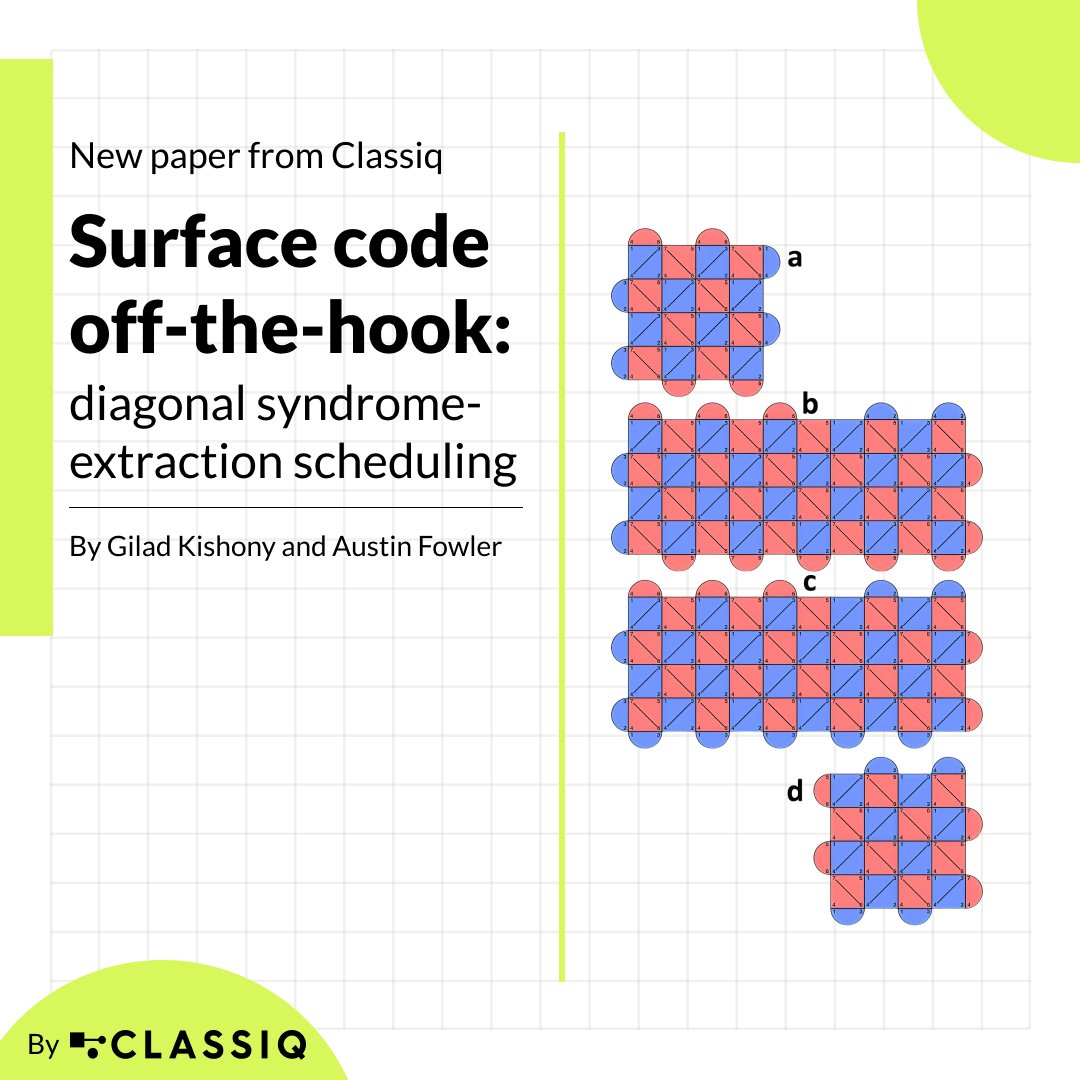
The syndrome-extraction circuits implementing each stabilizer measurement must be specified gate by gate, including the ordering of two-qubit couplings, their timing relative to neighboring operations, and the scheduling of resets and measurements.
These choices determine how faults propagate, for example, through hook errors, and therefore directly affect the achieved circuit-level distance and resource overhead. The objective is to reduce this low-level complexity, requiring fewer geometry-dependent conventions and fewer special scheduling cases, without sacrificing the performance metrics that matter in practice, such as preserving distance and keeping the measurement cycle as compact as the hardware model permits.
The diagonal schedule provides a “same recipe everywhere” approach: one fixed ordering for all X-type stabilizers and another for all Z-type stabilizers. This removes the need to specify circuits on a plaquette-by-plaquette basis while still steering hook errors away from logical-operator directions, thereby preserving full circuit-level distance.
Discover the full approach: arxiv.org/abs/2602.09099
1
6
24
1,570
Apr 14
Happy World Quantum Day!!!
Why April 14th?
The date points to 4.14, reflecting the first digits of Planck’s constant (4.14 × 10⁻¹⁵ eV·s), one of the most fundamental numbers in physics.
Planck’s constant defines the scale at which the classical world gives way to the quantum one. It sets the “quantum of action,” meaning that energy, momentum, and other physical quantities are not continuous, but come in discrete packets. This idea, introduced by Max Planck in 1900, marked the birth of quantum theory and fundamentally changed how we understand nature.
From that single constant emerges everything from quantized energy levels in atoms to the behavior of photons and ultimately, the principles behind quantum computing.
Today, as quantum technologies mature, the significance of Planck’s constant is no longer confined to theory. It underpins the hardware we build and the algorithms we design.
#WorldQuantumDay #QuantumComputing #Classiq #QuantumPhysics
2
15
94
3,096
Apr 14
Classiq is excited to be part of @hannover_messe , the world’s leading trade fair for industrial transformation.
Across industries, quantum computing is moving from theory into practice: addressing real-world challenges in optimization, simulation, and beyond.
@hannover_messe brings together the leaders turning advanced technologies into deployed solutions, where innovation is measured by impact, not potential.
We look forward to engaging with the global ecosystem and sharing how quantum computing is already being applied today.
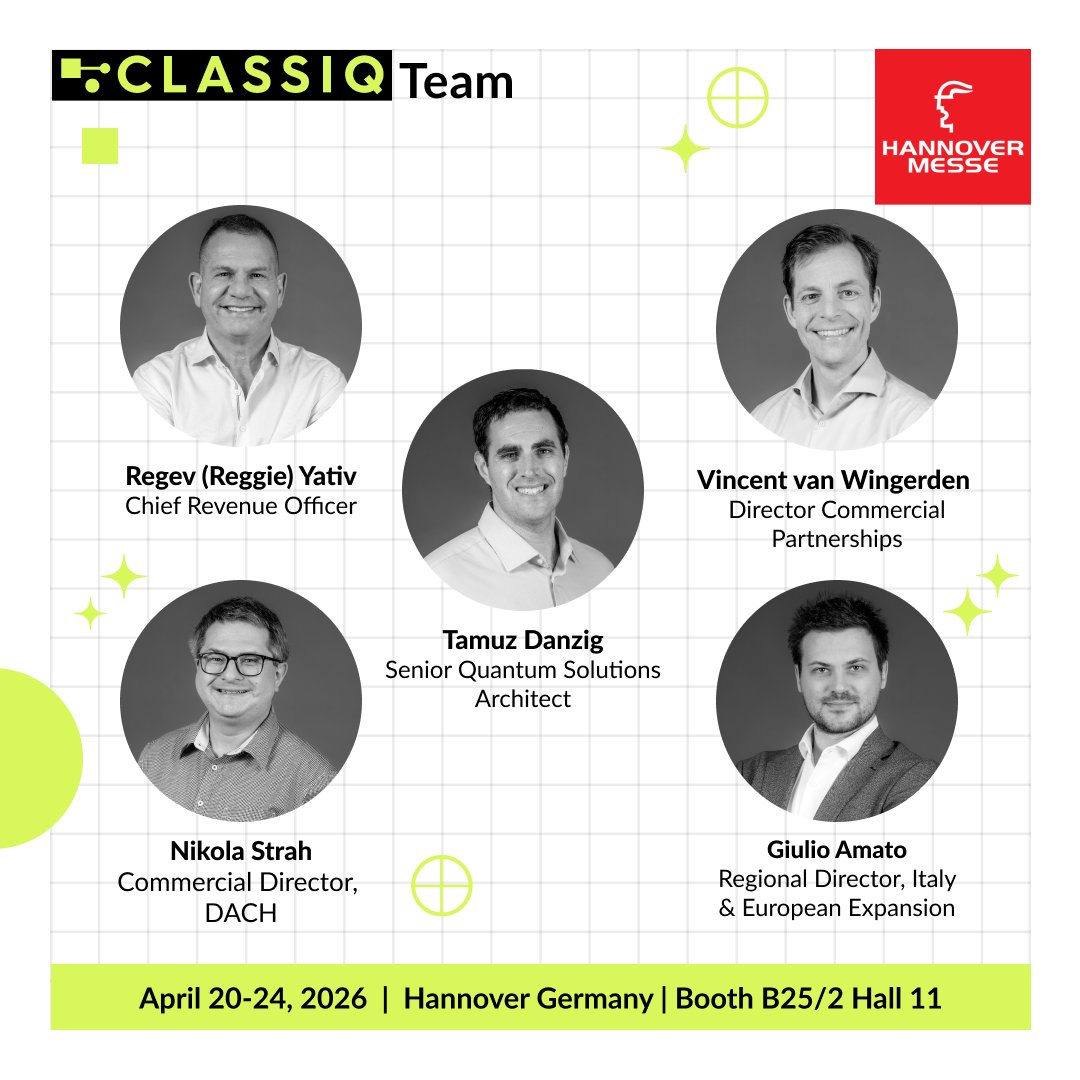
Come and meet our team: Regev Yativ, Nikola Strah, Giulio Amato, Vincent van Wingerden, and Tamuz Danzig
To schedule a meeting, go here- lnkd.in/dAnB9iwk and press HANNOVER MESSE
#HannoverMesse #QuantumComputing #IndustrialInnovation #DeepTech
2
148
Classiq is excited to be part of @hannover_messe the world’s leading trade fair for industrial transformation.
As industries actively adopt advanced technologies, quantum computing is becoming a practical tool for tackling real-world challenges, from optimization to complex simulations.
@hannover_messe brings together the companies and innovators turning these capabilities into deployed solutions, connecting technology with immediate industrial impact.
We’re looking forward to engaging with the global ecosystem and discussing how quantum computing is already being applied across industries today. And how @ClassiqTech is building and scaling quantum teams.
#HannoverMesse #QuantumComputing #IndustrialInnovation #DeepTech
2
782