
Senior scientist @ECMWF working on sub-seasonal (s2s) prediction.
Joined June 2009
- Tweets 650
- Following 319
- Followers 335
- Likes 822
25 Photos and videos






Pinned Tweet

9 Dec 2024
🚨 New preprint 🚨 - "Ensemble reliability and the signal-to-noise paradox in large-ensemble subseasonal forecasts"
arxiv.org/abs/2411.17694
1
1
3
148
19 Apr 2025
Final published version of “Unbiased calculation, evaluation, and calibration of ensemble forecast anomalies” now available online in the Quarterly Journal of the Royal Meteorological Society:
rmets.onlinelibrary.wiley.co…
11 Oct 2024

Do you calculate anomalies from ensemble forecasts?
If yes, then maybe you should be doing it differently!
🚨 New paper!🚨
"Unbiased evaluation and calibration of ensemble forecast anomalies"
arxiv.org/abs/2410.06162
5
125
23 Dec 2024
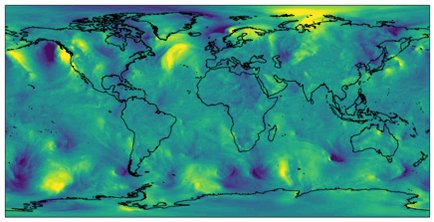
And here is an example 10 day forecast of 850 hPa Meridional Wind from AIFS-CRPS provided by Simon Lang. This animation shows that CRPS-based training does not suffer from smoothing and/or reduced variance for longer rollouts that is inherent to deterministic MSE-based training.
23 Dec 2024
🚨New preprint🚨from @ECMWF introducing AIFS-CRPS, a new data-driven ensemble system for medium-range and subseasonal forecasting. arxiv.org/abs/2412.15832
1
7
258
23 Dec 2024
This is because optimising a fair ensemble score means there is no trade-off between minimising error and maintaining realistic levels of variability, which is unavoidable for deterministic training. fCRPS loss is minimised when the fc is drawn from the same distribution as obs.
1
2
50
23 Dec 2024
More details on fair ensemble scores:
rmets.onlinelibrary.wiley.co…
rmets.onlinelibrary.wiley.co…
47
23 Dec 2024
🚨New preprint🚨from @ECMWF introducing AIFS-CRPS, a new data-driven ensemble system for medium-range and subseasonal forecasting. arxiv.org/abs/2412.15832
1
7
22
6,111
23 Dec 2024
This paper presents a novel approach to obtain a weather forecast model for ensemble forecasting with machine-learning.
2
2
174
23 Dec 2024
Thread continued:
23 Dec 2024
AIFS-CRPS is an ensemble variant of the Artificial Intelligence Forecasting System (AIFS) developed at ECMWF. The training protocol utilises a probabilistic loss function based on the Continuous Ranked Probability Score (CRPS).
1
134
23 Dec 2024
AIFS-CRPS is an ensemble variant of the Artificial Intelligence Forecasting System (AIFS) developed at ECMWF. The training protocol utilises a probabilistic loss function based on the Continuous Ranked Probability Score (CRPS).
1
1
6
399
23 Dec 2024
This work represents a huge team effort from @ECMWF colleagues Simon Lang, Mihai Alexe, Mariana Clare, Rilwan Adewoyin, Zied Ben Bouallègue, Matthew Chantry, Jesper Dramsch…
1
4
96
23 Dec 2024
… Peter Deuben , Sara Hahner, Pedro Maciel, Ana Prieto-Nemesio, Cathal O'Brien, Florian Pinault, Jan Polster, Baudouin Raoult, Steffen Tietsche, Martin Leutbecher!
1
149
Chris Roberts retweeted

17 Dec 2024
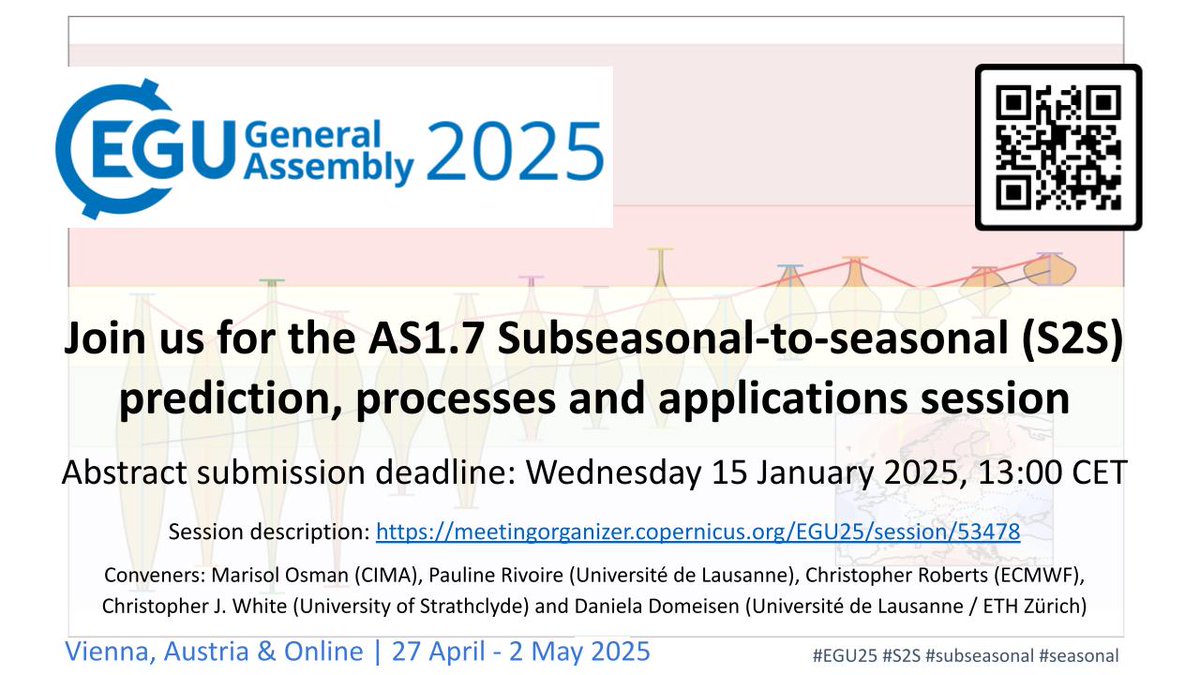
🚨 Don’t miss out! 🚨 Submit your abstract before the Christmas break and join us at #EGU25 to discuss recent progress in #S2S prediction
@Dr_Chris_White @Domeisen_D @ClimatePrimate
25 Oct 2024

The #EGU25 call for abstracts is open! Join our session AS1.7 to discuss recent advances in #S2S prediction, including process understanding and applications. We look forward to your contribution! @Dr_Chris_White @ClimatePrimate @Domeisen_D
1
4
186
9 Dec 2024
🚨 New preprint 🚨 - "Ensemble reliability and the signal-to-noise paradox in large-ensemble subseasonal forecasts"
arxiv.org/abs/2411.17694
1
1
3
148
9 Dec 2024
Crucially, there is no inconsistency between the objectives of eliminating an apparent signal-to-noise paradox and traditional approaches to ensemble forecast development guided by unbiased evaluation of forecast reliability and optimization of fair ensemble scores
1
1
42
9 Dec 2024
And if you made it this far, come follow me on Bluesky! I am not sure how much longer I will be active on Twitter...
bsky.app/profile/cdroberts.b…
34