We care about school air quality, help you understand the effects of school air quality, and what can be done to help monitor and manage school air quality.
Our Teacher Resource Pack is live!
It enables schools without a #SAMHE monitor to access versions of our educational activities, together with teacher guidance and example #AirQuality data and graphs for pupils to work with.
Download it FREE👉 samhe.org.uk/get-involved#ukedchat
ALT Image of the cover of the Teacher activity guide, which is part of the Teacher Resource Pack. The SAMHE robot stands against a sky blue background with the text "SAMHE. Schools Air quality Monitoring for Health and Education. Teacher activity guide."
Thanks for reading and, as I have said before, X is not designed for in-depth scientific debate. I’m always happy to meet people to discuss the details of anything scientific but I might not be able to respond on X.
B) @SAMHEProject is also working directly with teachers, school leaders, and pupils to support their understanding of their school’s air quality and to guide their efforts to improve it.
A) @SAMHEProject is creating a large dataset indicating the state of air quality in UK schools and its effects - using that to report scientific findings (some of which are unpopular on X!) and to work with government and unions to improve guidance and future provision, and ...
4) Finally, I want to emphasise that @SAMHEProject is only about trying to help improve air quality in schools - @SAMHEProject is working with schools to help improve air quality in two main ways: ...
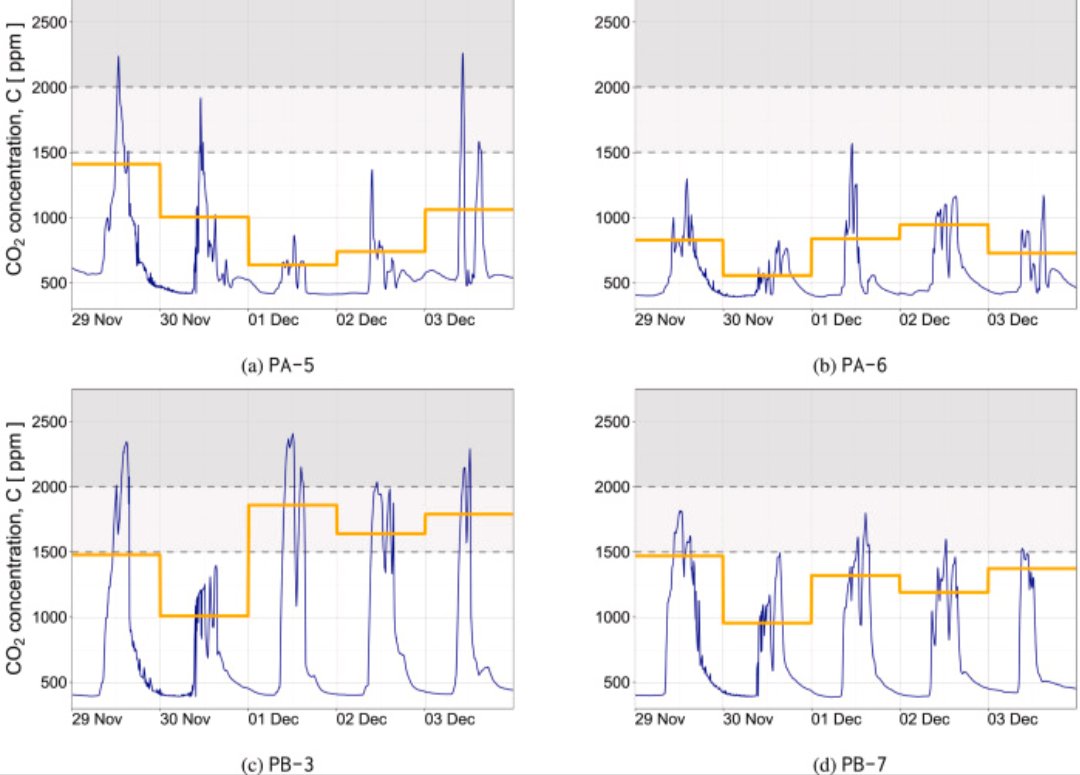
Without knowing occupancy and window opening some suggestions made (e.g removing 11:30-14:00) would result in lowering the daily mean CO2 reported - certainly the much talked about 'lunch hour' makes a non-significant difference on the vast majority of days shown.
Before everyone gets going about our favourite 'lunch hour', zoom into the attached figure (from doi.org/10.1016/j.jobe.2022.…) notionally similar classrooms and occupancy - so ventilation behaviour has a leading order effect ...
ALT Figure 6 from https://doi.org/10.1016/j.jobe.2022.105459
3) The vast majority of data we analyse is from when classrooms are occupied: we know schools are operational on the days analysed and monitors are placed in teaching spaces; these tend to occupied most of the day (schools don't have many empty classrooms kicking around!) And ...
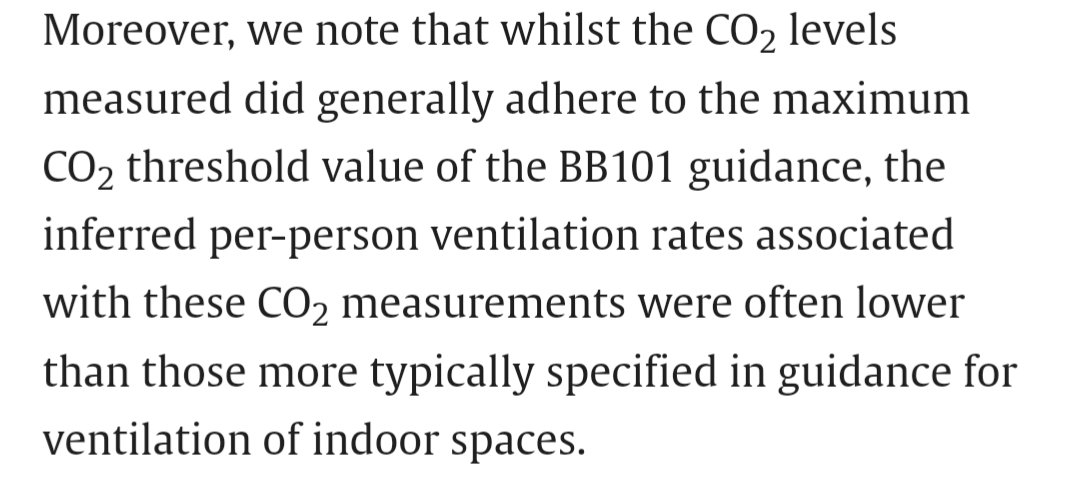
2) Article goes to effort to infer pp vent rates, concluding the below - these rates account for inoccupancy and are far more meaningful than CO2 thresholds. Fact tha t these rates are low & adherence to the guidance is high = best evidence for the need for change.
ALT Quote from https://doi.org/10.1016/j.dibe.2024.100520
Finding most the data shows adherence to guidance can still mean that many do not, see our highlight: "Most classrooms conform to CO2 guidelines but some regularly exceed, often significantly so" - so we can all agree that there is lots of improvement still required.
1) It's a research article, not an opinion piece - only reporting facts allowed, not passing personal opinions on the suitability of guidance. I made it clear on X that the BB101 thresholds are not what we should be aiming for but, for now, they are the guidance for UK schools...
we also use the analysis published here doi.org/10.1016/j.buildenv.2… to demonstrate that the associated per-person ventilation rates are low (relative to almost all available guidance). Thoughts please @CathNoakes @CorsIAQ
My own takeaway is that the @SAMHEProject dataset has already proved it's value just based on one term of looking at just CO2, there is so much more evidence that will follow from this data - thanks to @SarahWest_SEI and all of the amazing @SAMHEProject team...
Loads more findings within - my fav is that CO2 levels are statistically differ within primary and secondary schools but translating to per-person ventilation shows there is no difference as the latter appropriately accounts for differing generation rates of different age groups
Very glad to see this paper out: doi.org/10.1016/j.dibe.2024.…, reporting evidence based on the first term of CO2 data from the @SAMHEProject - headline is that adherence to UK guidance for schools is relatively high most of the time; however, ...
📢The support we can offer #SAMHE schools will reduce from 31 July, when our current funding ends. But don’t worry, you can keep using your #AirQuality monitor and the Web App for many years to come!
If you haven't signed up yet, you have till 31 May!
👉samhe.org.uk/register/school
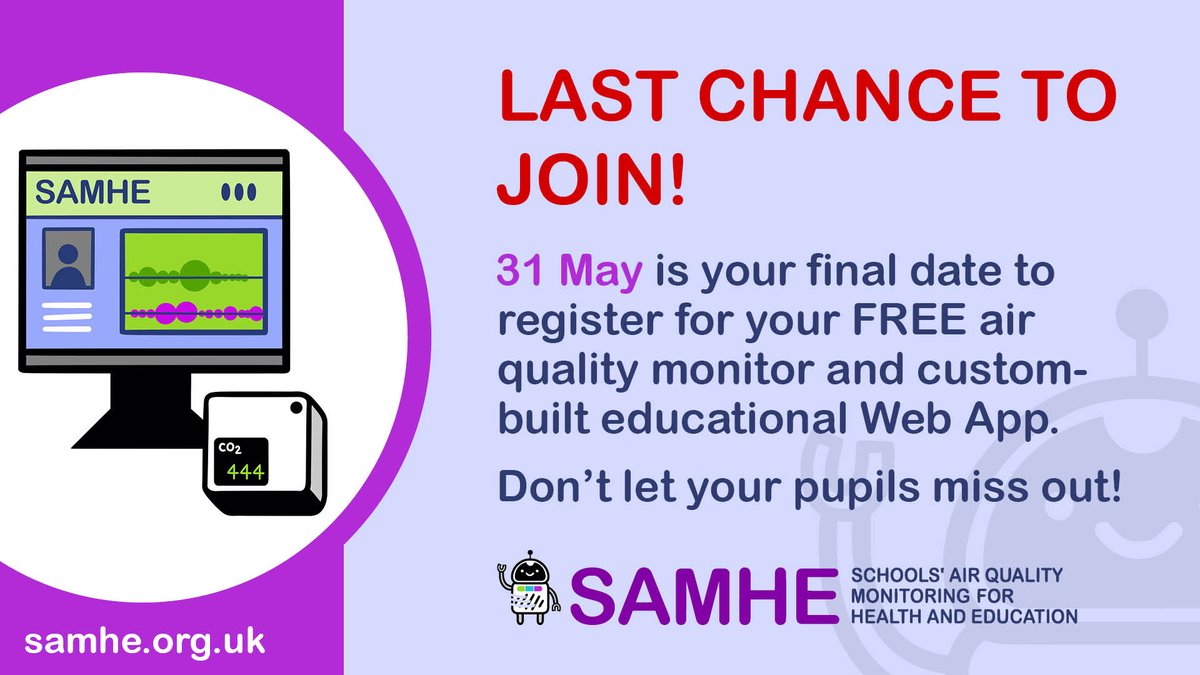
ALT A purple, and lilac card with graphics of the SAMHE air quality monitor and Web App, the SAMHE logo and the text “Last chance to join. 31 May is your final date to register for your FREE air quality monitor and custom-built educational Web App. Don’t let your pupils miss out!”
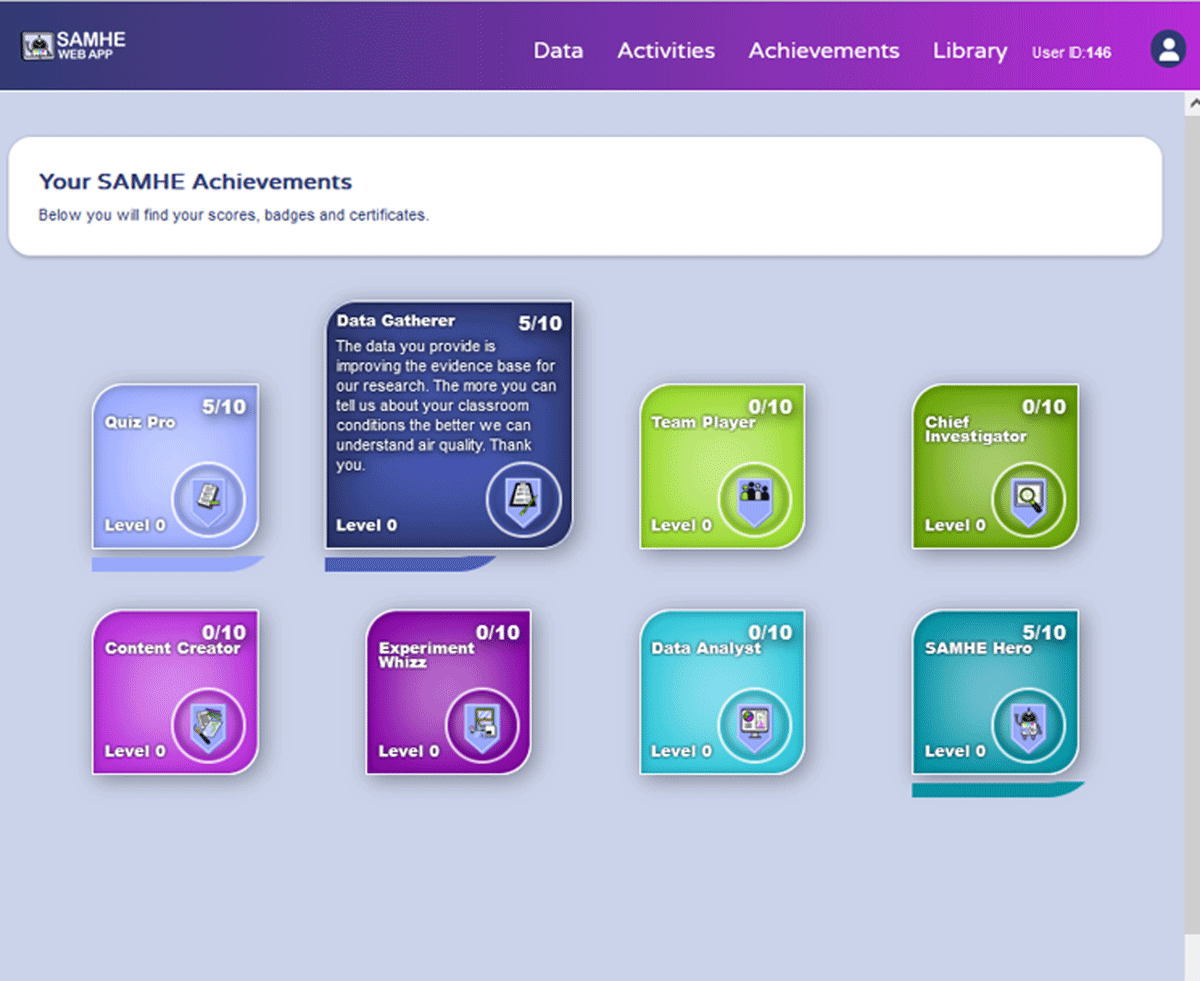
ALT Screenshot of the achievements page of the SAMHE Web App, taken October 2023, showing the different badges, how you obtain them, and progress towards them.
Hear teachers explain why they love #SAMHE!
Thank you Andy Brittain, Alex Burns, Gemma Hortop, Steven West and their schools for wholeheartedly embracing SAMHE project and their willingness to share their stories and enthusiasm!
youtu.be/8fhvbjLUMtg?si=LzHX…#classroomair#edutwitter