
Joined May 2019
- Tweets 13,519
- Following 104
- Followers 8,936
- Likes 8,926
337 Photos and videos




Pinned Tweet

29 Jul 2024
🚨 Python Testing Series 🚨
Employ testing to gamify your coding.
Learn how to test code using pytest.
Build a Cash Dispenser project in Test Driven style.
Ongoing series of posts, see README at:
github.com/CodingComputing/g…
1
20
5,393
Coding Computing Coach retweeted
Answer: 125
Solution: a looks like a number, but it's not!
The quotes around it make it a string - a sequence of characters.
But, int(a) converts it from string to an integer, so b is now the int 123. You can do arithmetic operations on it.
Printing b 2 prints 123 2, ie, 125.
1
4
378
Coding Computing Coach retweeted
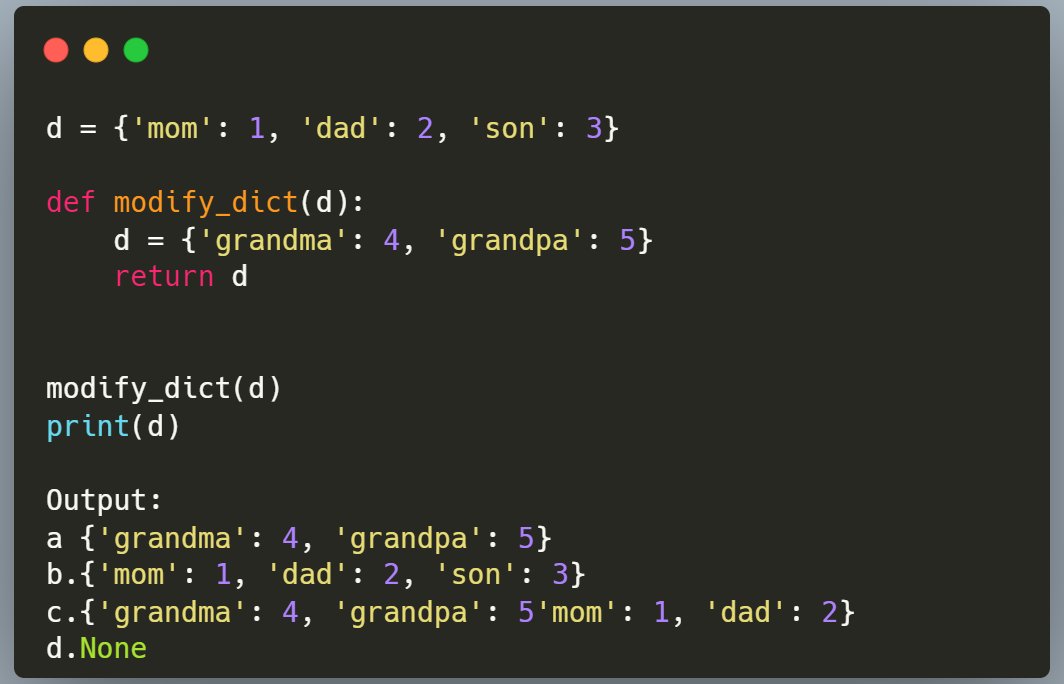
Answer: B
Solution: The function is the tricky part, let's zoom in on that.
The function call passes the argument d to modify_dict.
But modify_dict doesn't "modify" d.
Rather, it gives the name d to something else (dictionary with grandma).
And, that changed d is just a
1
1
1
142
Coding Computing Coach retweeted

Python Question
What is the output of this code and why?
7
7
24
3,777
Coding Computing Coach retweeted
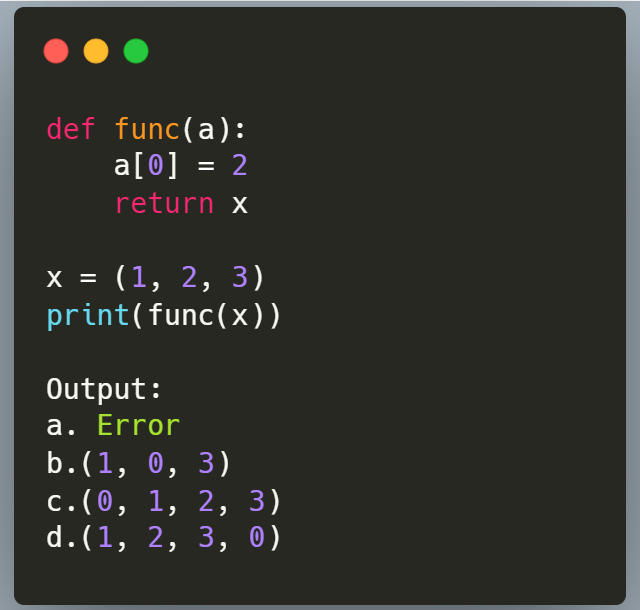
Answer: a. Error
Solution: x is a tuple.
Tuples are immutable, ie, you cannot change it after it is created.
In the function call to func, the argument is the tuple.
However, func tries to modify the index 0 value of this tuple.
This gives error because tuples are immutable.
1
1
116
Coding Computing Coach retweeted
Python Question:
Let's see who can explan this better.
What is the output of this code?
12
5
21
2,019
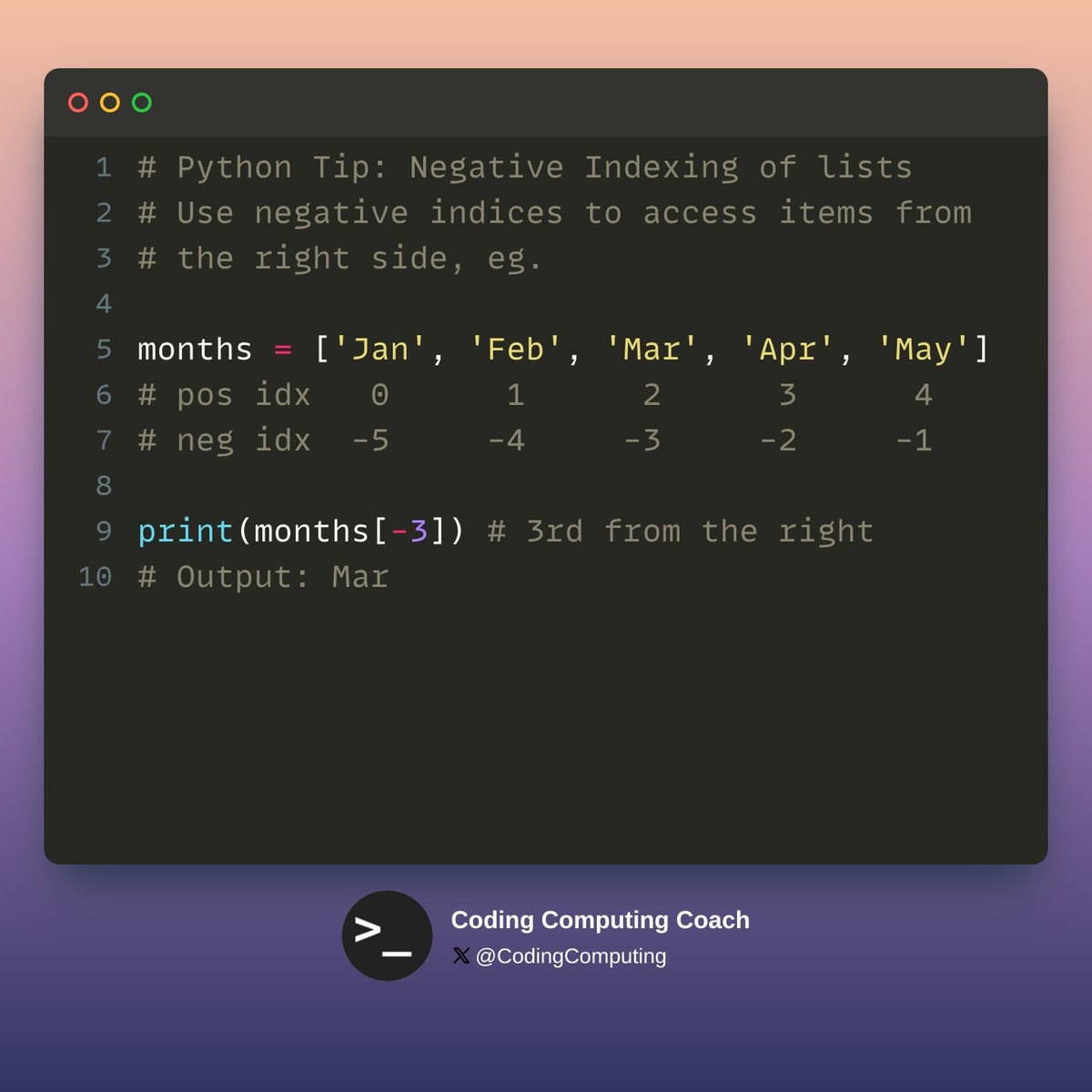
Indexing starts from 0 for the leftmost item.
The more you increase, the rightwards you go.
BUT there is a negative indexing feature.
The negative index starts from -1 from the rightmost item.
The more you decrease, the leftwards you go.
181
In python, * doesn't just multiply...

Answer: C
a is a str & b is an int.
It seems impossible to multiply them using the * operator.
But the * operator does different things for different operand types.
For str and int, the * operator repeats the str, int times.
'5' * 3 repeats the string thrice, ie, "555"
235
Coding Computing Coach retweeted
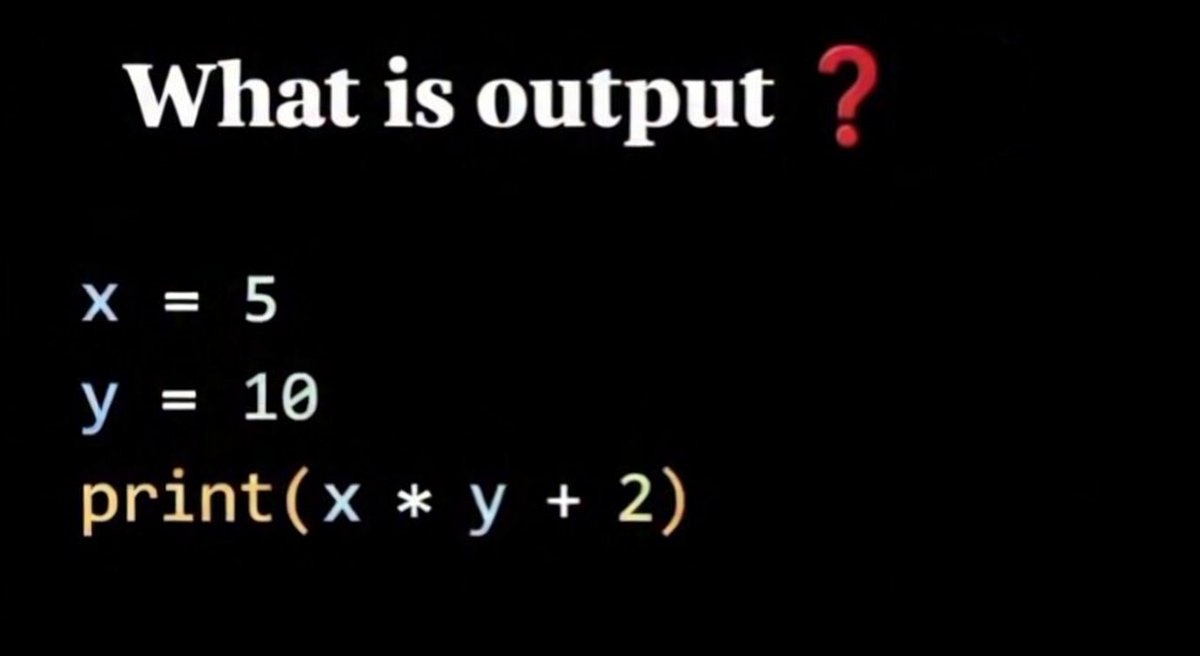
Answer: 52
x is 5, y is 10.
In x*y 2,
the multiplication happens first (PEMDAS rule)
5*10 2
simplifies to
50 2
that is 52, which gets printed.
1
3
471
Coding Computing Coach retweeted

May 4
Python Quiz: What is The Output ?
25
8
86
15,221
Coding Computing Coach retweeted
Answer: 5
Solution: x is a list [1, 2, 3].
Now we run
print(x.pop(1) x[1])
The expression inside print now evaluates as
x.pop(1)
this actually removes the item at index 1 in x (thus modifying x), AND returns it here.
Thus x.pop(1) evaluates to 2, and modifies x to [1, 3]
1
1
5
495
Coding Computing Coach retweeted

May 3
What will be the output of the following Python code?
x = [1,2,3]
print(x.pop(1) x[1])
48%
5
9%
6
28%
Error
14%
None
232 votes • Final results
6
2
36
12,839
Coding Computing Coach retweeted
Answer: a. tuple
Solution: In Python, a comma makes a tuple. The parentheses are actually the optional part.
So, what many people assume is "python magic" like
a, b = b, a
is actually just a tuple assignment.
The comma between the list [1, 2] and the tuple (1,2) makes a tuple
1
1
114
Coding Computing Coach retweeted
return = "I am done. Clean up, take this value and go back."
yield = "I am done for the moment, I can take back a value. But instead of cleaning everything up, let me save my work to take it from that point when I come back to work on the next value."
1
1
6
247
Coding Computing Coach retweeted
Pythonistas, where are you?
Explain the difference between return and yield in Python functions as if I am 10.
5
1
17
5,067
Coding Computing Coach retweeted

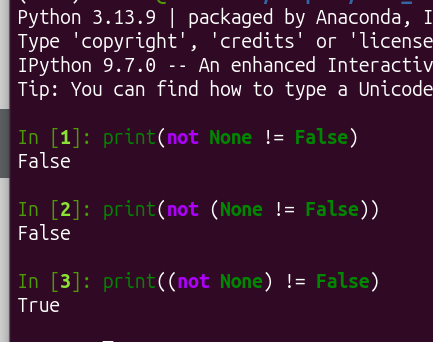
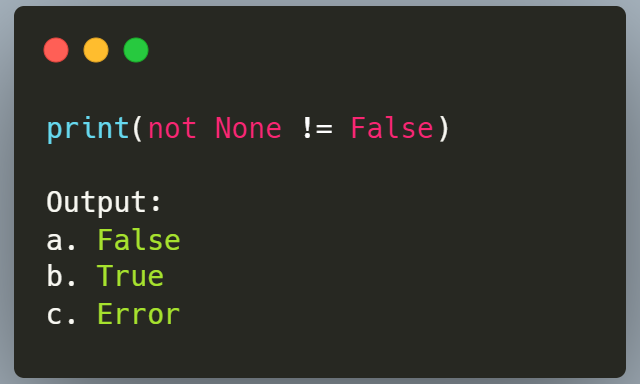
I got it wrong, too.
It turns out that boolean "not" has a lower precedence than comparison operators, so this expression gets evaluated as
not (None != False) => not True => False

2
1
2
169
Coding Computing Coach retweeted
Answer: True
Solution: Python considers None as a "falsy" value.
So, its conversion to bool is False.
Now, `not` reverses the bool value of its operand.
Hence,
not None
produces the opposite of None's bool value, giving True.
So it simplifies to
True != False
that's True.
1
1
3
476
Coding Computing Coach retweeted
Python Question:
What is the output of this code and why?
14
4
25
4,808
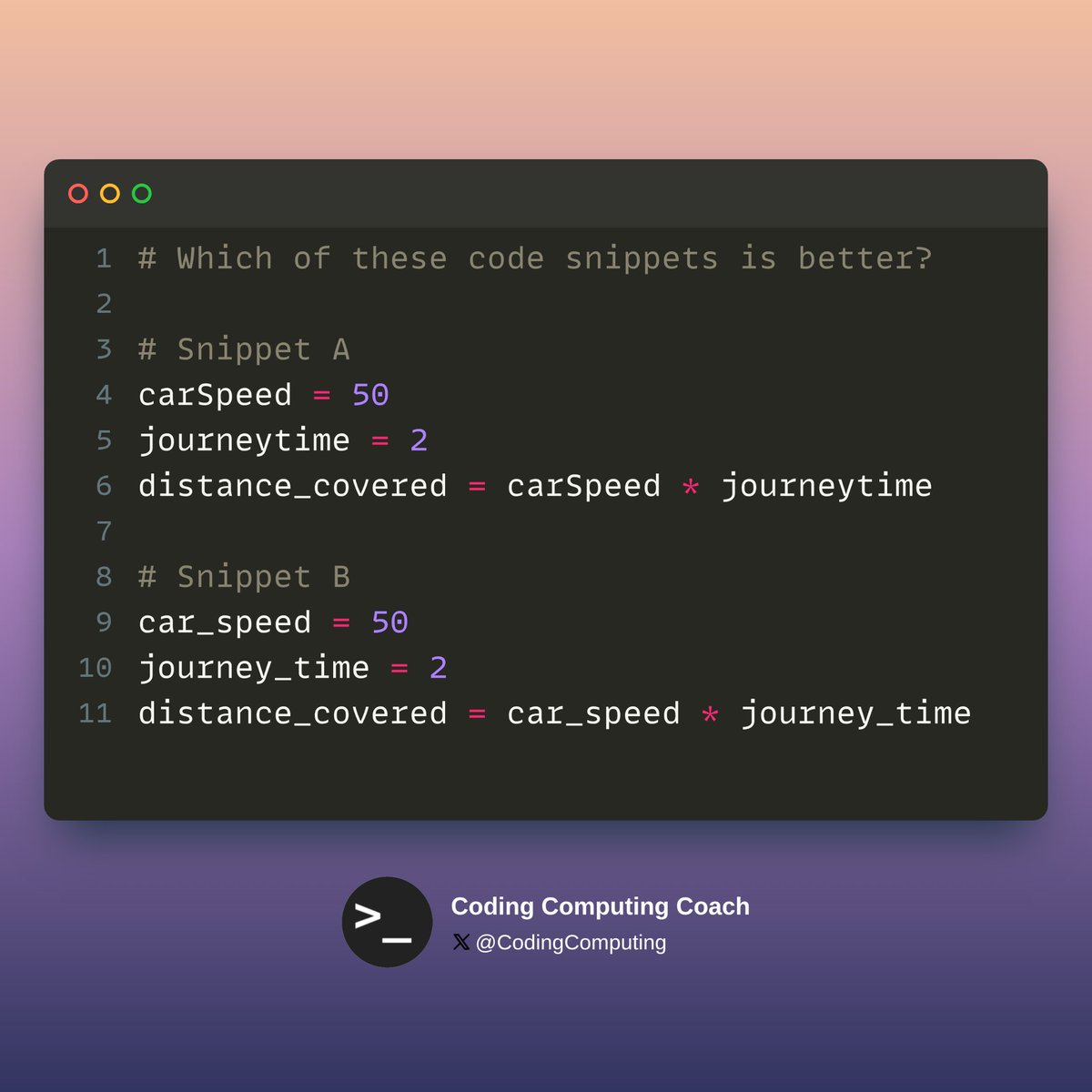
If a programming language allows something,
doesn't automatically mean it's a good idea to do!
1
241
For anyone who needs to know...
Kolourpaint does on Linux what Paint does on Windows
2
250