370 Photos and videos







𝗖𝗙𝗧𝗖 𝘄𝗿𝗼𝘁𝗲 𝗶𝘁𝘀 𝗳𝗶𝗿𝘀𝘁 𝗽𝗿𝗲𝗱𝗶𝗰𝘁𝗶𝗼𝗻-𝗺𝗮𝗿𝗸𝗲𝘁𝘀 𝗿𝘂𝗹𝗲. 𝗔𝗺𝗲𝗿𝗶𝗰𝗮𝗻𝘀 𝗮𝗹𝗿𝗲𝗮𝗱𝘆 𝘁𝗿𝗮𝗱𝗲𝗱 $𝟯𝟰𝗕 𝗼𝗳𝗳𝘀𝗵𝗼𝗿𝗲.
A Rutgers study found that Americans accounted for up to $34 billion in offshore prediction-market volume over the twelve months ending April 2026. Not a projection. Actual volume. Harry Crane, a CFTC Innovation Advisory Committee member, ran the numbers — so this is not an anti-regulatory hit job.
CFTC Chairman Mike Selig unveiled his first real framework on June 10: a 90-day review process for whether prediction contracts serve the public interest, with a specific exemption for commercial shipping contracts like Strait of Hormuz oil flows. It is an honest attempt to build a durable structure for an industry that outgrew the rulebook.
The problem: the market already moved. Americans skipped the compliant on-chain platforms that Kalshi and Coinbase-backed built and went straight to Polymarket and others — where products are wider, users are unverified, and the legal exposure falls somewhere else.
The gap between a $34 billion behavioral fact and a 90-day comment period is the actual story. On-chain infrastructure worked as designed. Users chose the unlicensed version anyway.
The bull case for the CFTC framework has real teeth: formal rulemaking with multiple comment rounds is more durable than staff-level guidance, and it would be genuinely hard for a future administration to walk it back. But Polymarket already built the habits, the liquidity, and the product variety. A 90-day review process is not the same as no KYC, global access, and thousands of live markets.
The Coalition for Prediction Markets — Kalshi, , and Coinbase — commissioned the Rutgers study to make exactly this point to regulators. It worked. The number is in the room. Is a $34 billion behavioral fact something regulators can actually change — or is the offshore cat already out of the bag?
1
1
52
Coin Crafty retweeted
Today's financial brief covers 8 verified developments across geopolitics, commodities, equities.
𝗨𝗦-𝗜𝗿𝗮𝗻 𝗽𝗲𝗮𝗰𝗲 𝗱𝗲𝗮𝗹 𝗿𝗲𝗮𝗰𝗵𝗲𝗱; 𝗛𝗼𝗿𝗺𝘂𝘇 𝘁𝗼 𝗿𝗲𝗼𝗽𝗲𝗻
The US and Iran have agreed to end nearly four months of conflict. Pakistan PM Shehbaz Sharif announced the framework; Trump confirmed the Strait of Hormuz will reopen and the US naval blockade lifted, with formal signing set for June 19 in Switzerland. The E3 nations welcomed the deal and signaled readiness to lift sanctions on Iran pending verifiable nuclear steps.
Source: BBC News, CNBC
𝗢𝗶𝗹 𝗳𝘂𝘁𝘂𝗿𝗲𝘀 𝗳𝗮𝗹𝗹 ~𝟱% 𝗼𝗻 𝗛𝗼𝗿𝗺𝘂𝘇 𝗿𝗲𝗼𝗽𝗲𝗻𝗶𝗻𝗴 𝗰𝗼𝗻𝗳𝗶𝗿𝗺𝗮𝘁𝗶𝗼𝗻
Brent crude dropped 4.8% to $83.18/barrel and US-traded WTI fell 5.6% to $80.13/barrel in Asian trading. The Strait had been effectively closed since late February; analysts warn normalization faces headwinds from sea mines and a backlog of waiting tankers, with full pre-war flow unlikely for weeks to months.
Source: BBC News, CNBC
𝗔𝘀𝗶𝗮𝗻 𝗲𝗾𝘂𝗶𝘁𝗶𝗲𝘀 𝘀𝘂𝗿𝗴𝗲; 𝗦𝗼𝗳𝘁𝗕𝗮𝗻𝗸 𝗿𝗮𝗹𝗹𝗶𝗲𝘀 𝟭𝟮%, 𝗞𝗼𝘀𝗽𝗶 𝟱.𝟭%, 𝗡𝗶𝗸𝗸𝗲𝗶 𝟯.𝟲%
South Korea's Kospi jumped 5.1%, Japan's Nikkei 225 climbed 3.6%, and Australia's ASX 200 gained 1.3% on the peace news. SoftBank led Japanese tech, surging over 12%. Samsung Electronics rose 4.65%, SK Hynix gained 6.42%, and TSMC added 2.16%, reflecting broad capital reallocation from safe havens into Asian risk assets.
Source: CNBC
𝗧𝗿𝗲𝗮𝘀𝘂𝗿𝘆 𝘆𝗶𝗲𝗹𝗱𝘀 𝗮𝗻𝗱 𝗱𝗼𝗹𝗹𝗮𝗿 𝘄𝗲𝗮𝗸𝗲𝗻 𝗮𝘀 𝗿𝗶𝘀𝗸 𝗽𝗿𝗲𝗺𝗶𝘂𝗺 𝘂𝗻𝘄𝗶𝗻𝗱𝘀
The 10-year Treasury yield fell 5 basis points to 4.423% while the US dollar index weakened 0.32% to 99.483 in Asian trading. Simultaneous rallies in equities and bonds signal markets had been pricing the energy shock as transitory rather than structural, with lower oil also easing pressure on central banks entering a busy policy week.
Source: CNBC
𝗦𝗽𝗮𝗰𝗲𝗫 𝗜𝗣𝗢 𝗰𝗹𝗼𝘀𝗲𝘀 𝟭𝟵% 𝗮𝗯𝗼𝘃𝗲 𝗼𝗳𝗳𝗲𝗿 𝗽𝗿𝗶𝗰𝗲 𝗮𝘁 $𝟭𝟲𝟭; 𝗿𝗲𝘁𝗮𝗶𝗹 𝗯𝗼𝘂𝗴𝗵𝘁 $𝟭𝟬𝟬𝗕 𝗶𝗻 𝘀𝗵𝗮𝗿𝗲𝘀
SpaceX debuted on Nasdaq on June 12, closing at $161 versus its $135 offer price. Retail investors bought approximately $100 billion in shares — an unusually high level that experts say leaves the stock exposed to volatility if SpaceX misses delivery targets. Analysts noted a P/E near 100 times and Morningstar assigned a fair value of $63.
Source: CNBC
𝗚𝟳 𝘀𝘂𝗺𝗺𝗶𝘁 𝗼𝗽𝗲𝗻𝘀 𝗶𝗻 𝗘𝘃𝗶𝗮𝗻-𝗹𝗲𝘀-𝗕𝗮𝗶𝗻𝘀, 𝗙𝗿𝗮𝗻𝗰𝗲, 𝘄𝗶𝘁𝗵 𝗧𝗿𝘂𝗺𝗽 𝗮𝘁𝘁𝗲𝗻𝗱𝗶𝗻𝗴 𝗵𝗼𝘂𝗿𝘀 𝗮𝗳𝘁𝗲𝗿 𝘁𝗵𝗲 𝗜𝗿𝗮𝗻 𝗮𝗻𝗻𝗼𝘂𝗻𝗰𝗲𝗺𝗲𝗻𝘁. Leaders are set to formalize the peace framework and address Russia's ongoing war.
Source: CNBC
𝗨𝗞 𝗘𝗩 𝘁𝗮𝗿𝗴𝗲𝘁 𝗿𝗲𝘃𝗶𝗲𝘄 𝘁𝗼 𝘄𝗲𝗮𝗸𝗲𝗻 𝗰𝘂𝗿𝗿𝗲𝗻𝘁 𝟴𝟬% 𝗺𝗮𝗻𝗱𝗮𝘁𝗲
The UK government is preparing to lower the 80% EV sales target for 2030, with a formal consultation imminent and options ranging from 50% to 70%. Car makers and unions have lobbied for years citing costs; the industry faces fines of £15,000 per non-compliant vehicle. Sustainability groups warn any weakening threatens climate targets and investor confidence in the UK's energy transition.
Source: BBC
𝗨𝗞 𝗮𝗻𝗱 𝗝𝗮𝗽𝗮𝗻 𝘀𝗶𝗴𝗻 £𝟭𝟴𝗯𝗻 𝗶𝗻𝘃𝗲𝘀𝘁𝗺𝗲𝗻𝘁 𝗱𝗲𝗮𝗹
UK PM Keir Starmer and Japanese PM Sanae Takaichi signed agreements in London covering over £9 billion in UK infrastructure and financial services and up to £9 billion in offshore wind projects, creating tens of thousands of jobs. Rolls-Royce separately partnered with Japan's Atomic Energy Agency on next-generation nuclear technology. The deal was announced as the UK economy faces headwinds from the Middle East conflict.
Source: BBC
3
2
125
Coin Crafty retweeted
Today's financial brief covers 4 verified developments across geopolitics, companies, regulation.
• 𝗨𝗻𝗶𝘁𝗲𝗱 𝗦𝘁𝗮𝘁𝗲𝘀 — Iran deal uncertain after Israel strikes Beirut
A US-Iran memorandum to end the war and reopen the Strait of Hormuz is in doubt after Israel struck a Hezbollah command center in Beirut. Trump condemned the strikes on Truth Social, warning parties not to "blow it"; a senior official said the deal was not 100% certain.
Source: CNBC
• 𝗨𝗻𝗶𝘁𝗲𝗱 𝗞𝗶𝗻𝗴𝗱𝗼𝗺 — UK boards Russian shadow fleet tanker in first UK-led operation
Royal Marine Commandos and NCA officers boarded tanker SMYRTOS in the English Channel on Sunday, the first UK-led interception under powers PM Starmer authorized in March. The vessel will be held off England's south coast.
Source: UK Government (GOV.UK), CNBC
• 𝗠𝗲𝘁𝗮 — Meta's $14B AI bet struggles to win over Wall Street
A year after spending over $14B to bring Alexandr Wang and Scale AI engineers into Meta Superintelligence Labs, the company has delivered the Muse Spark model — its first proprietary foundation model departing from open-weight tradition — but analysts remain unimpressed. Meta is down 18% over 12 months, the worst megacap performer alongside Microsoft.
Source: CNBC
• 𝗨𝗻𝗶𝘁𝗲𝗱 𝗞𝗶𝗻𝗴𝗱𝗼𝗺 — UK preparing to weaken 80% EV sales target for 2030
Downing Street is set to reduce the UK's EV sales target to 50–70%, with a consultation expected this week. Car makers face a £15,000 fine per non-compliant vehicle.
Source: BBC
1
128
Coin Crafty retweeted

Jun 14
Anthropic was warned to delay. They shipped anyway. The exploit confirmed exactly why.
Three days before launch on June 9, the administration asked Anthropic to pause Fable 5 and Mythos 5 to harden national security safeguards, Axios reported, citing an administration official. Anthropic declined. On June 12, the Commerce Department issued an export control directive and access to both models was cut off for everyone outside the US.
The threat was real: a working jailbreak that bypassed safeguards on cybersecurity, chemistry, and biology — the exact capabilities Anthropic said made this its most responsible AI release yet.
The recovery case is straightforward. If hardening closes the jailbreak, Fable 5 ships internationally with the safeguards the administration wanted. Domestic Claude access is unaffected. The hardening could take "a few weeks."
But the timing cuts the other way. A jailbreak that neutralizes these specific safety features within days of launch suggests the problem is deeper than a patch. Retraining or re-architecting the safety layer could take months. And every international developer and partner is now watching the same reality: the US government can cut off access to frontier AI within 72 hours of a security concern.
The harder question is not when access returns. It is whether the next administration warning arrives before a launch, and whether the next company listens.
Does the hardening actually close the jailbreak, or is Fable 5's international future a months-long problem?
1
1
68
Coin Crafty retweeted
Jun 13
Financial Brief — June 13
1. SpaceX raises $75B in largest-ever US IPO at $2.2T valuation.
Shares opened at $150, briefly hit $176.50, and closed around $161.
2. Anthropic received a US export control order at 5:21pm ET Friday citing national security authorities and disabled its Fable 5 and Mythos 5 models for all customers by Saturday to comply.
The government did not provide specific details of its concern.
3. UAE calls Reuters reports of $10–20B frozen Iran fund release entirely false
CNBC reports that the UAE Ministry of Foreign Affairs on Saturday called Reuters reports that it agreed to unlock $10–20B in frozen Iranian funds entirely false, saying no such transfers have been made.
Sources: CNBC, BBC, Anthropic official statement
4
4
96
Coin Crafty retweeted
Jun 12
OpenAI did not solve agentic commerce by building a better checkout. It plugged ChatGPT into Visa.
On June 10, Visa and @OpenAI announced that ChatGPT (@chatgptgapp) users will be able to link a @Visa card and let an AI agent complete purchases within user-defined limits, approvals, and merchant restrictions. Visa provides the authorization, fraud monitoring, credentials, and global acceptance network. OpenAI provides the agent that decides what to buy.
That division of labor matters because OpenAI already tried owning more of the transaction. Instant Checkout was retired in March after limited merchant adoption, with its 4% merchant fee becoming part of the friction. The model could find the product. The harder problem was getting merchants, payments, trust, and liability to work at scale.
Visa changes the distribution equation. Instead of convincing retailers to integrate a new AI checkout one by one, ChatGPT can potentially transact anywhere Visa is already accepted. The moat is not just intelligence. It is permissioning, fraud controls, chargebacks, and decades of payment-network reach.
The bear case is real: the system initially keeps humans in the approval loop, Visa and OpenAI have not disclosed the economics, and one bad wave of agent mistakes or disputed purchases could slow adoption quickly. This is infrastructure for autonomous commerce, not proof that consumers are ready to surrender the buy button.
But the strategic signal is hard to miss. AI companies may own discovery and intent while payment networks continue owning trust and settlement. If that holds, the agent economy will not replace the old financial rails. It will make them more valuable.
Does Visa become the invisible operating system for AI commerce, or will agents eventually route around card networks entirely?
1
2
3
93
Coin Crafty retweeted
Jun 12
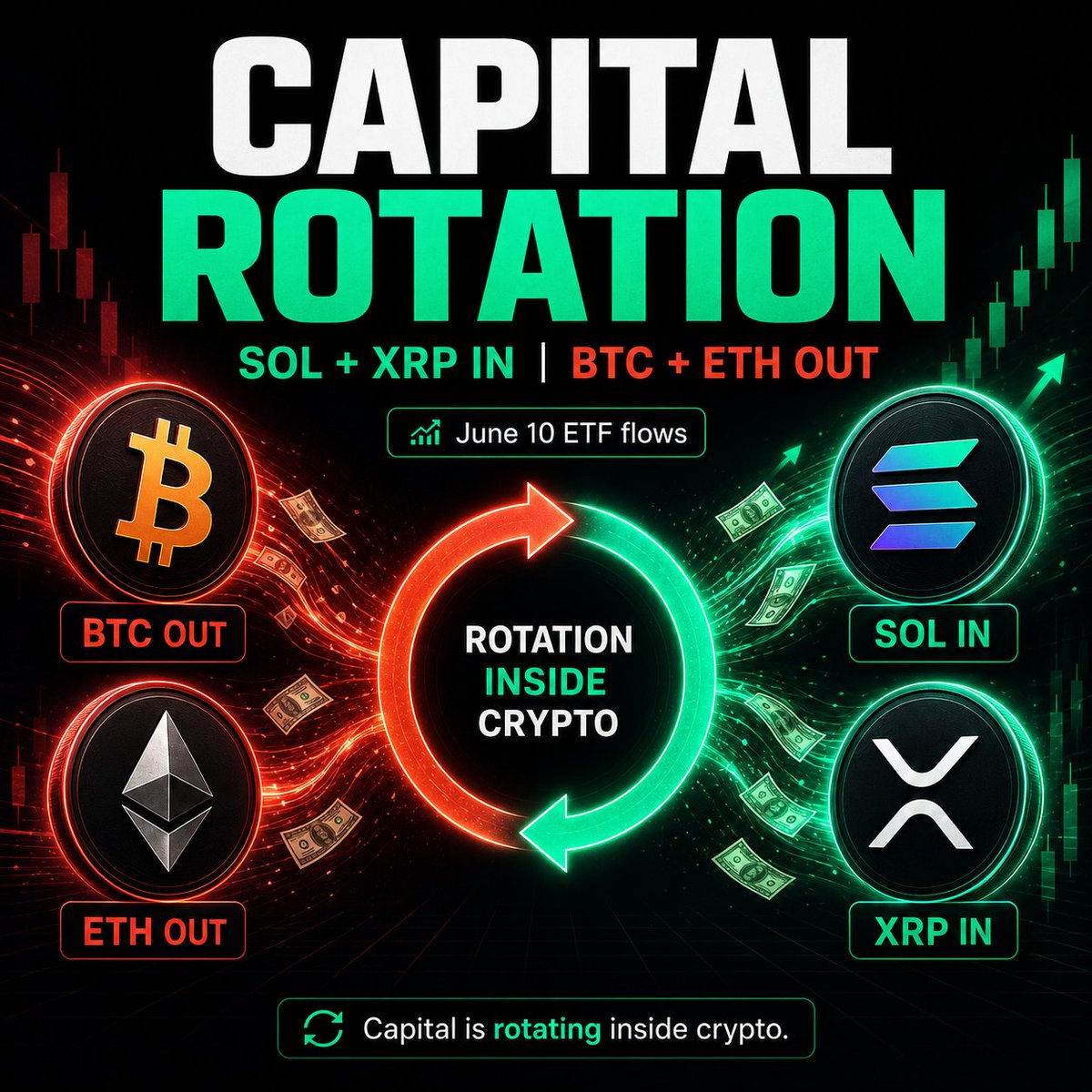
The capital rotation inside crypto just got louder.
On June 10, SOL and XRP spot ETFs pulled in fresh capital while @Bitcoin and @Ethereum ETFs bled. The day before, spot BTC ETFs saw $1.72 billion in outflows. Three days before that, BTC cracked $60,000 — its lowest since October 2024. And even the brief relief rally that followed the end of BTC's 13-day outflow streak on June 5 did not hold. The pressure returned within days.
What makes this noteworthy is the persistence, not just the direction. @GoldmanSachs already held $260 million in XRP and $SOL ETFs as of earlier this year, one of the first major institutional disclosures of altcoin ETF ownership. That was the early signal. The June 10 flow data suggests the signal has not faded.
@Solana has built real DeFi and institutional infrastructure. XRP has the legal clarity from the SEC case and a payments-oriented narrative. Both are attracting flows that BTC and ETH are not right now. XRP hit a 19-month low in early June before stabilizing. Solana is still down significantly from its all-time highs. These are not safe havens — they are rotation targets, and the rotation has a structure.
The bull case for BTC and ETH is their ETF liquidity is the deepest in crypto, their institutional adoption is the most entrenched, and outflow streaks have reversed quickly in prior cycles. The bear case is that persistent outflows without a corresponding price recovery signal real demand destruction, and that newer chains are capturing adoption the majors are missing.
The market is sending a clear message: capital is rotating within crypto, not just leaving it. Whether that rotation holds or snaps back is the real question for the next few weeks.
What are your thoughts on this capital rotation? Will BTC/ETH recover, or is this a new trend?
1
2
2
97
Coin Crafty retweeted
Jun 11
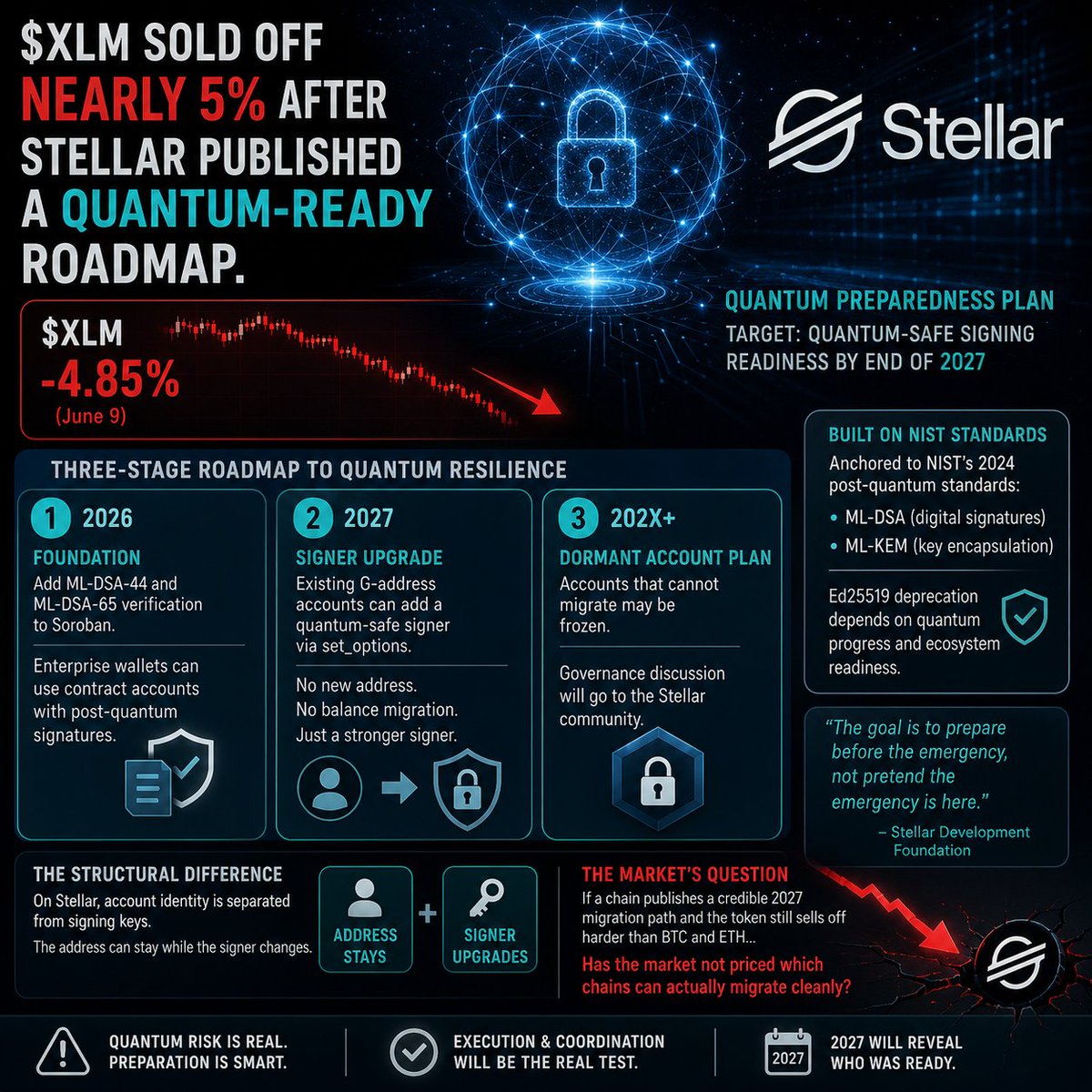
$XLM sold off nearly 5% after @StellarOrg published one of the more concrete post-quantum roadmaps in crypto.
SDF's June 9 Quantum Preparedness Plan targets quantum-safe signing readiness by the end of 2027. Stage 1 adds ML-DSA-44 and ML-DSA-65 verification to Soroban in 2026, letting enterprise wallets move through contract accounts. Stage 2 lets existing G-address accounts add a quantum-safe signer through set_options without a new address or balance migration.
That is the structural difference. On Stellar, account identity is separated from signing keys. The address can stay while the signer changes. On many chains, migration is messier because key exposure, old addresses, wallets, exchanges, and external references all become part of the coordination problem.
This is not "quantum breaks crypto tomorrow." The plan is anchored to NIST's 2024 post-quantum standards, including ML-DSA and ML-KEM, and it explicitly says Ed25519 deprecation depends on quantum progress and ecosystem readiness. That is the right framing: prepare before the emergency, but do not pretend the emergency is here.
The real counterweight is dormant accounts. Stage 3 could freeze accounts whose holders cannot migrate, which creates a governance problem before it creates a technical one. Stellar says that discussion will go to the community, not be forced unilaterally.
So the market's reaction is the interesting part. If a chain publishes a credible 2027 migration path and the token still sells off harder than BTC and ETH, is that because quantum risk is too far away to matter, or because the market has not priced which chains can actually migrate cleanly?
1
1
89
Coin Crafty retweeted
Jun 10
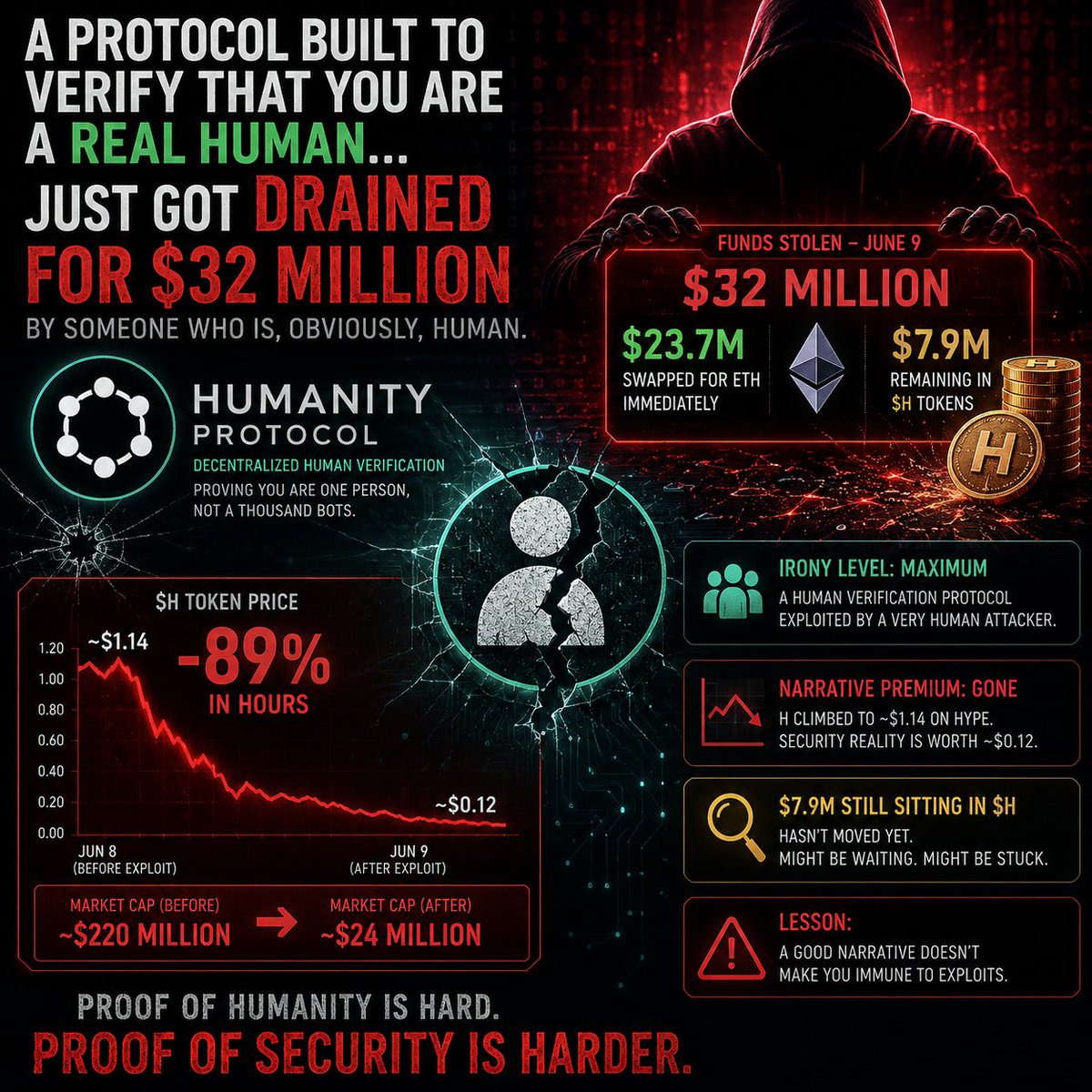
A protocol built to verify that you are a real human just got drained for $32 million by someone who is, obviously, human.
Wallets linked to Humanity Protocol (@Humanityprot) were emptied on June 9, with $23.7 million immediately swapped for Ethereum and $7.9 million still sitting in the exploiter's H position. The Block confirmed the numbers with onchain analysts. The $H token dropped 89% -- from roughly $1.14 to $0.12 in hours. That rapid a fall does not leave time for graceful exits.
The irony is not subtle. Humanity Protocol's core function is human verification -- solving the Sybil problem that plagues decentralized systems by proving you are one person and not a thousand bots. The protocol combines decentralized identifiers with verifiable credentials to do this. The exploit worked anyway. A human verification system got exploited by whoever found the vulnerability first, and the system's response was to let $32 million walk out the door.
The price tells the other part of the story. H had climbed to roughly $1.14 in the week before the exploit, with a market cap around $220 million. After the 89% crash, it is back near $0.12 -- roughly where the early-June breakout began. The pre-exploit price was not anchored to any real utility. It was narrative premium, and the market proved it by returning almost exactly to the starting price once the certainty of the exploit became clear.
The remaining $7.9 million H position has not moved yet. That does not mean it will be returned. It might be waiting for the heat to die down, or it might be stuck in a contract that the attacker cannot exit. Either way, the fact that $23.7 million was immediately swapped for ETH suggests this was not an amateur operation.
What the post-exploit market is now pricing in is the difference between a proof-of-humanity narrative and the actual security of a small-cap DeFi protocol. The narrative was worth roughly $1 per token. The security reality is worth $0.12.
1
2
191
Coin Crafty retweeted
Jun 9
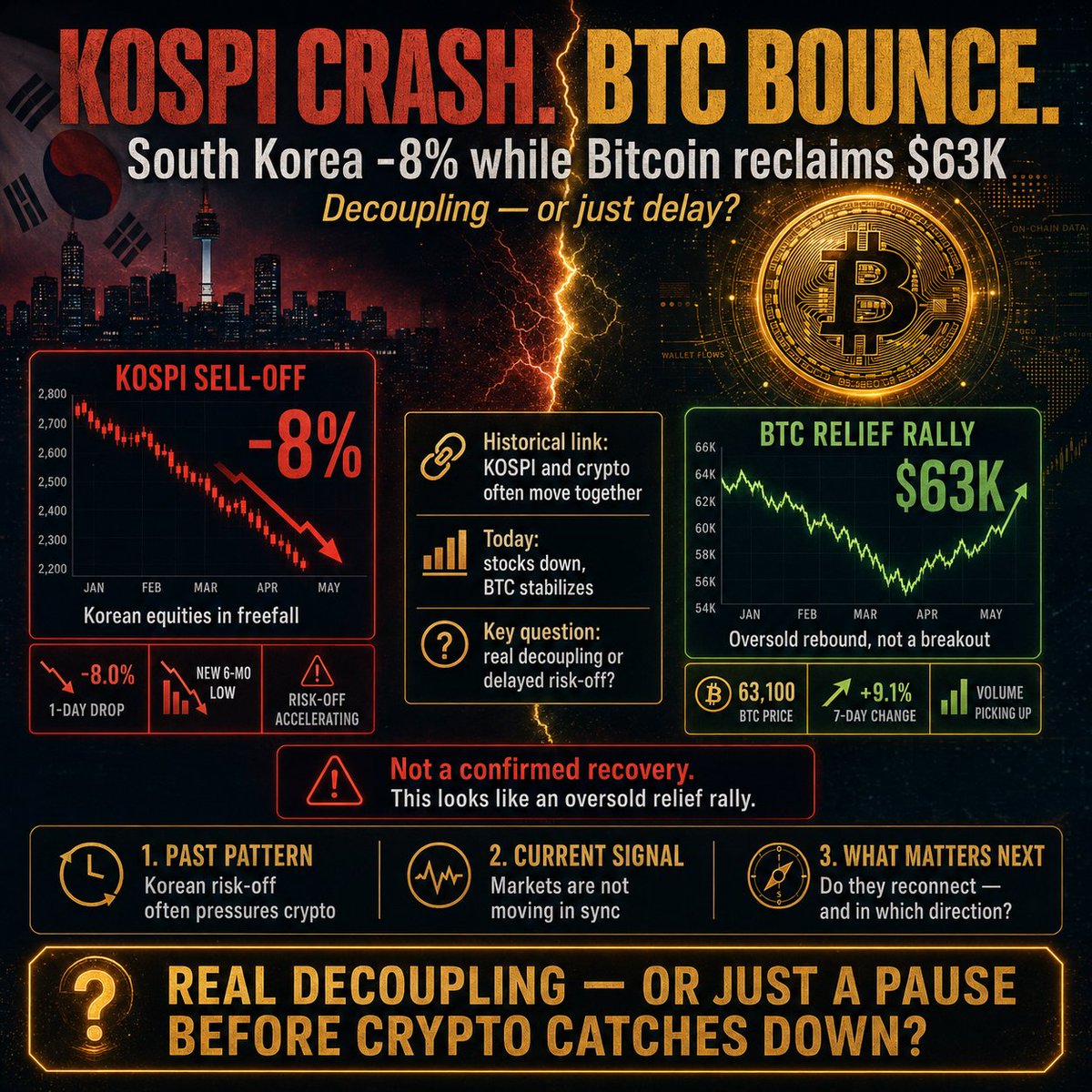
South Korea's stock market crashed 8% and $BTC reclaimed $63,000 on the same day. That is not how this is supposed to work.
KOSPI and crypto have tracked each other for years — Korean retail has been a meaningful flow channel for digital assets, and a Korean equity crash has historically signaled broader risk-off that hits crypto too. Instead, the market called an audible on June 8: crypto found its footing while Korean equities are in freefall.
The Block confirmed the moves with the oversold relief rally framing. Presto's Min Jung told The Block that KOSPI's crash may have had some impact on Bitcoin's recovery, but not substantially. That qualifier is doing a lot of work — "some impact" could mean capital rotating out of Korean assets into crypto, or it could mean the two markets are simply responding to different signals today.
The oversold label matters. This is not a bullish breakout — it is a technical bounce after conditions got stretched. A genuine recovery would have fundamental support: macro tailwinds, institutional flows, or protocol-level catalysts. An oversold relief rally just means prices dropped too far too fast and some buyers stepped in. The KOSPI crash suggests conditions are not improving — they may be deteriorating in ways that have not yet reached crypto.
The disconnect is real. Whether it lasts is the question worth watching. If KOSPI's crash is a Korea-specific event with limited global spillover, crypto can decouple and find its own bottom. If it's a leading indicator of broader risk-off that eventually reaches crypto, the relief rally is just a pause in a larger drawdown.
The difference between decoupling and delay is usually only visible in hindsight. The market is telling you these assets are not talking to each other right now. History suggests they eventually sync back up. Which direction is the real question.
What do you think is the more likely scenario: decoupling or delay?
1
67
Coin Crafty retweeted
Jun 8
Michael Saylor may be preparing to buy more bitcoin. Strategy’s bitcoin stack is sitting roughly $11–12 billion below cost basis.
@Saylor posted “A good time to add more dots” on June 7 — his familiar signal that another Strategy bitcoin purchase may be coming. But this time the signal lands differently.
@Strategy holds 843,706 BTC at an average purchase price of about $75,700. With bitcoin trading near $62,000, that position is roughly $11–12 billion underwater on paper. That does not mean Strategy has realized the loss. It does mean the market is no longer watching a simple “Saylor buys, bitcoin goes up” story. It is watching a leveraged capital-markets machine try to keep compounding through a drawdown.
And there is another detail that matters: Strategy just sold bitcoin.
The sale was tiny — 32 BTC, about $2.5 million, or less than 0.004% of its holdings. Financially, it barely dents the stack. Symbolically, it matters. For years, Saylor built the brand around relentless accumulation, HODL discipline, and the idea that bitcoin was the exit strategy. Strategy had sold before in 2022 for tax-loss purposes, but this latest sale was different: it was tied to preferred-stock distributions. That changes the narrative from “we never sell” to “we may sell small amounts when the capital structure requires it.”
That is the tension now.
On one side, the bull case is still intact: Saylor has been right about bitcoin before, Strategy remains the largest corporate holder, and if BTC recovers, the company’s structure amplifies the upside.
On the other side, buying more does not close an $11B paper hole. Only a higher bitcoin price does. And the sale, however small, shows that the bitcoin stack is no longer purely untouchable. It is also a balance-sheet tool.
The timing is important. Today, June 8, shareholders vote on the STRC amendment to move dividends from monthly to semi-monthly. JPMorgan analysts have also warned that Strategy may need to rebuild dollar reserves to reassure investors, especially if markets start asking whether more BTC sales could be used to meet preferred-dividend obligations.
So the question is not just whether Saylor adds more dots.
It is whether the market still treats “more dots” as a bullish signal when Strategy is already underwater on its bitcoin position — and has now shown it is willing to sell a few dots too.
What do you think: is this disciplined financial engineering, or the first crack in the never-sell story?
1
1
98