
Joined August 2025
72 Photos and videos
Pinned Tweet
May 18
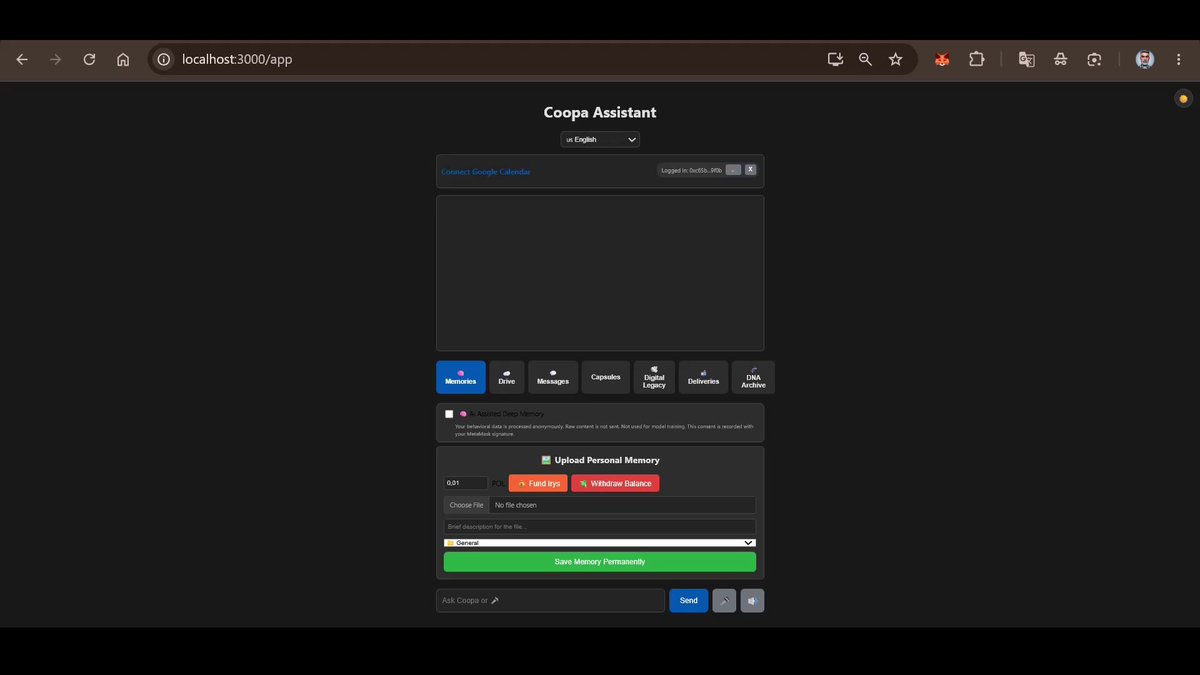
Upload a file. Ask Coopa to find it. No search bar. No folder navigation. No "where did I save that?" Just ask. This is what it looks like when your AI actually knows your data not because it stores it on a corporate server, but because it reads from the permanent, encrypted memory that belongs only to you. The file doesn't live in Coopa. It lives on the permanent network. Coopa just knows how to find it because you told it to remember. This is the Memory Layer of the Mechanical Living Being. @irys_xyz @samecwilliams @josh_benaron @ar_io_network #BuildInPublic #Web3 #Coopa #PermanentWeb
1
2
5
858
We just added a new module to Coopa: Seal πŸ” The idea is simple. You have a file a contract, a design, an idea. You want to prove, at any point in the future, that this exact file existed on this exact date and hasn't changed since. Seal does that. Without uploading your file anywhere. Your file never leaves your device. Only its cryptographic fingerprint gets written to the permanent ledger. That fingerprint is mathematically unique change a single character and it no longer matches. What you get: a .coopa proof package. Your deed. Store it anywhere. Even if Coopa disappears one day, that proof remains valid independently verifiable, forever. Still in development. Still on localhost. But the foundation is real. @irys_xyz @samecwilliams @ar_io_network #BuildInPublic #Web3 #Coopa #ZeroTrust
2
2
967
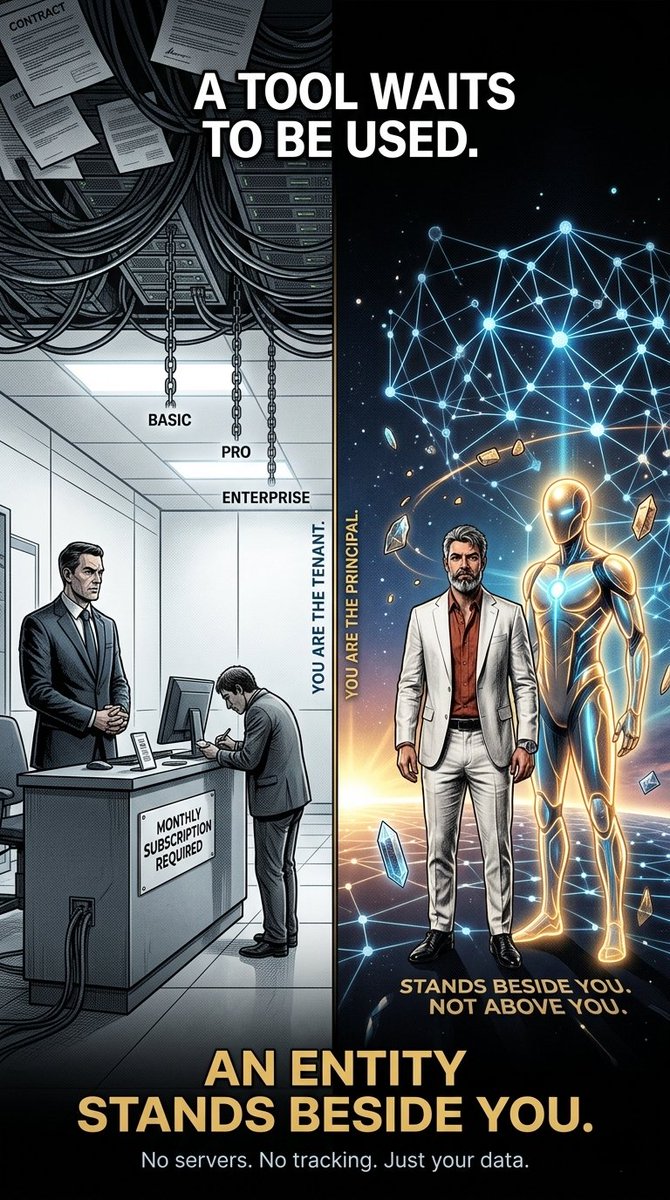
Every SaaS product is a landlord. You are the tenant. The interface belongs to them. The servers belong to them. The data model belongs to them. The roadmap belongs to them. You pay monthly for the privilege of living in someone else's architecture and you leave the moment the rent becomes inconvenient. Coopa was not built as a SaaS. It was built as an entity. The distinction is not cosmetic. A SaaS optimises for retention. An entity operates on your behalf. A SaaS breaks when you stop paying. An entity's memory outlives the company that built it. A SaaS serves its shareholders. An entity if built correctly serves only the person who summoned it. The Mechanical Living Being does not have a pricing page. It has a philosophy. It reflects your values, not engagement metrics. It remembers what you've trusted it with, not what keeps you scrolling. It carries weight so you can move freely through the systems that cost you time, energy, and years you don't get back. A tool waits to be used. An entity stands beside you. That is where the difference begins. And it begins on the first day not after some enterprise tier unlocks it. What would you trust an autonomous entity with that you'd never trust a SaaS? Drop a comment πŸ‘‡ #AI #DataSovereignty #Web3 #Coopa @naval
1
3
924
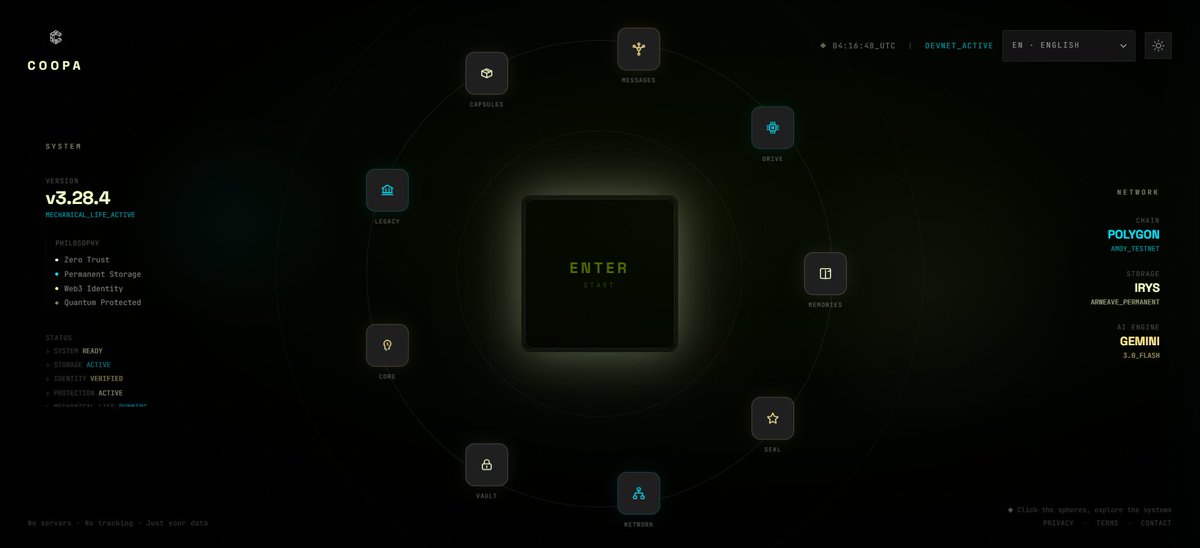
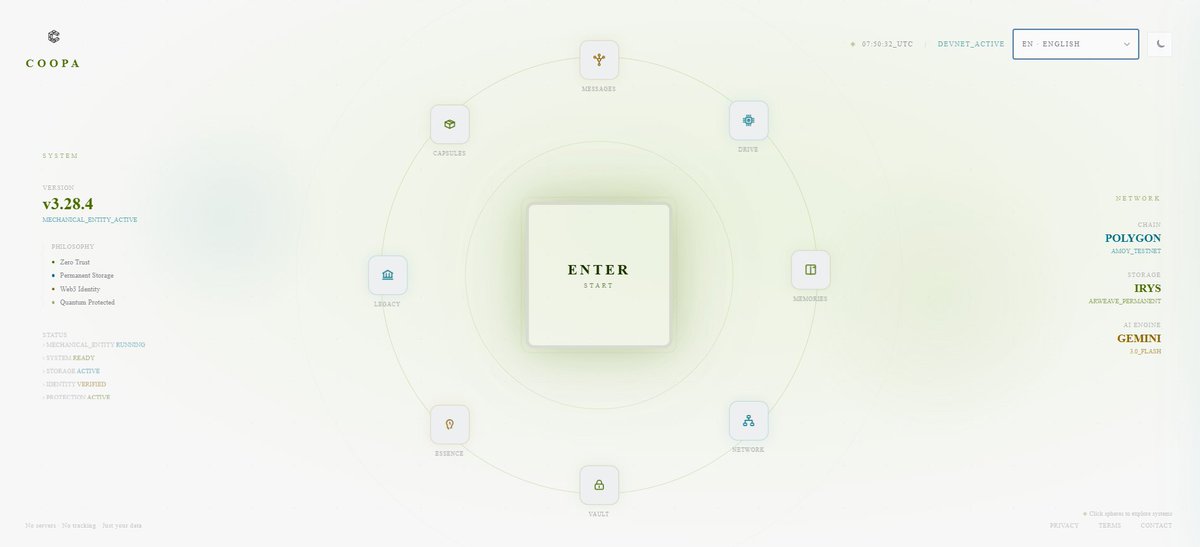
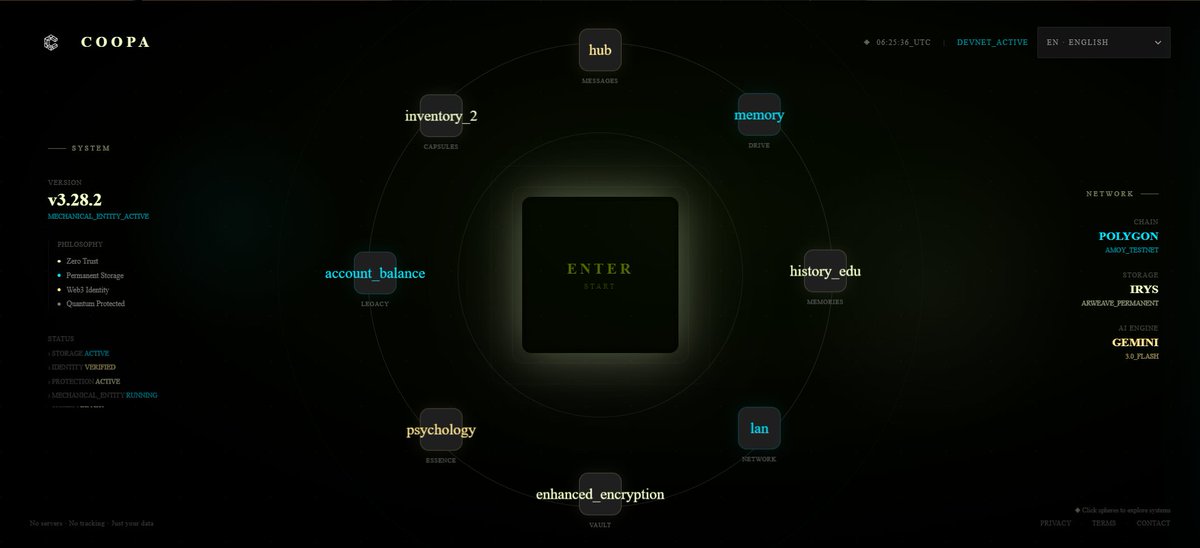
This is what Coopa looks like right now in development. The live site at coopaassistant.com is still running the previous version. We know. It's intentional. You don't ship a half-built sanctuary. What you're seeing here is v3.28.4 the Mechanical Living Being, fully active. Seven modules orbiting a single entry point. Zero Trust. Permanent Storage. Web3 Identity. Quantum Protected. All running. All connected. The live version catches up when the work is done. Not before. We build in public because hiding the process would contradict everything we stand for. The gap between what's live and what's built is not a failure it is the distance between a promise and the work required to keep it. It's closing. @irys_xyz @josh_benaron @samecwilliams @cdixon @levelsio #BuildInPublic #Web3 #Coopa #PermanentWeb
1
1
3
636
May 26
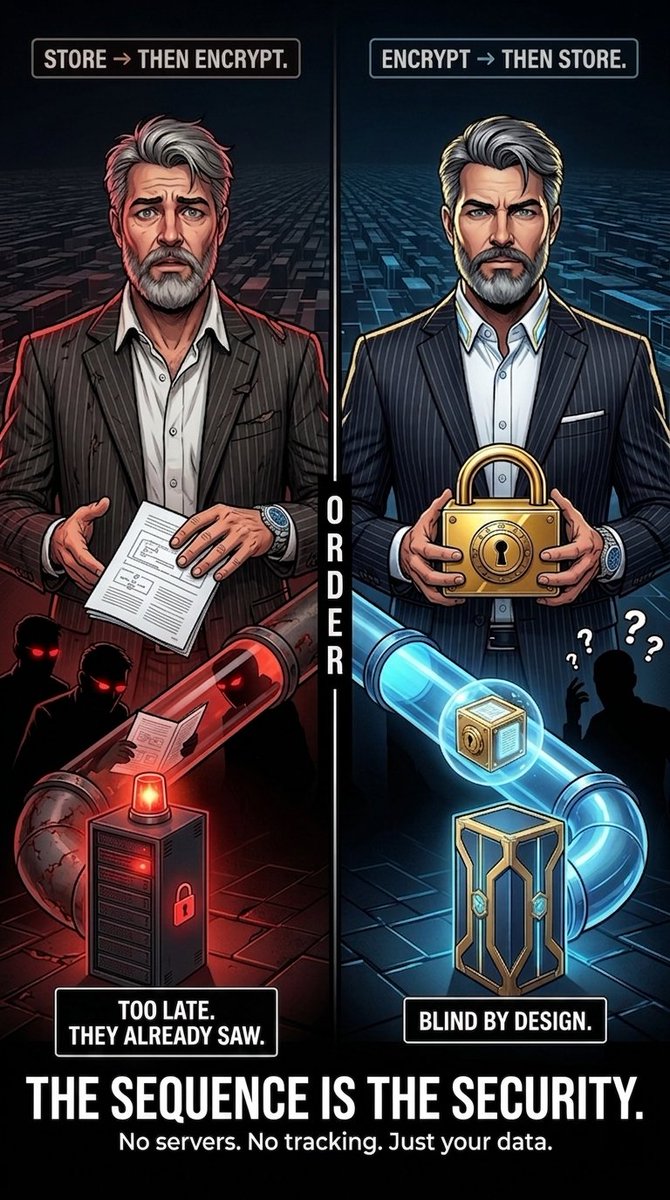
Order matters more than people think. Most systems that claim to protect your data encrypt it after it leaves your device. The data travels first, then gets wrapped. By then, it has already passed through infrastructure that could have read it. The promise of encryption arrives too late. We spent a long time thinking about sequence. In Coopa, the order is non-negotiable: your data is sealed before it moves. Not on our servers. Not in transit. On your device, before anything else happens. By the time it touches the permanent network, it is already mathematically opaque to us, to anyone, to every server it passes through. This is not a minor implementation detail. It is the entire security model. Encrypt-then-store is fundamentally different from store-then-encrypt. One builds the wall before opening the door. The other hopes no one is watching while it builds. We chose the harder sequence. Because in privacy, order isn't a preference it's a guarantee or it's nothing. What other sequences in tech do people get backwards without realizing it? Drop a comment πŸ‘‡ #BuildInPublic #ZeroTrust #Web3 #Coopa @zooko @cdixon @thegrugq
1
4
492
May 25
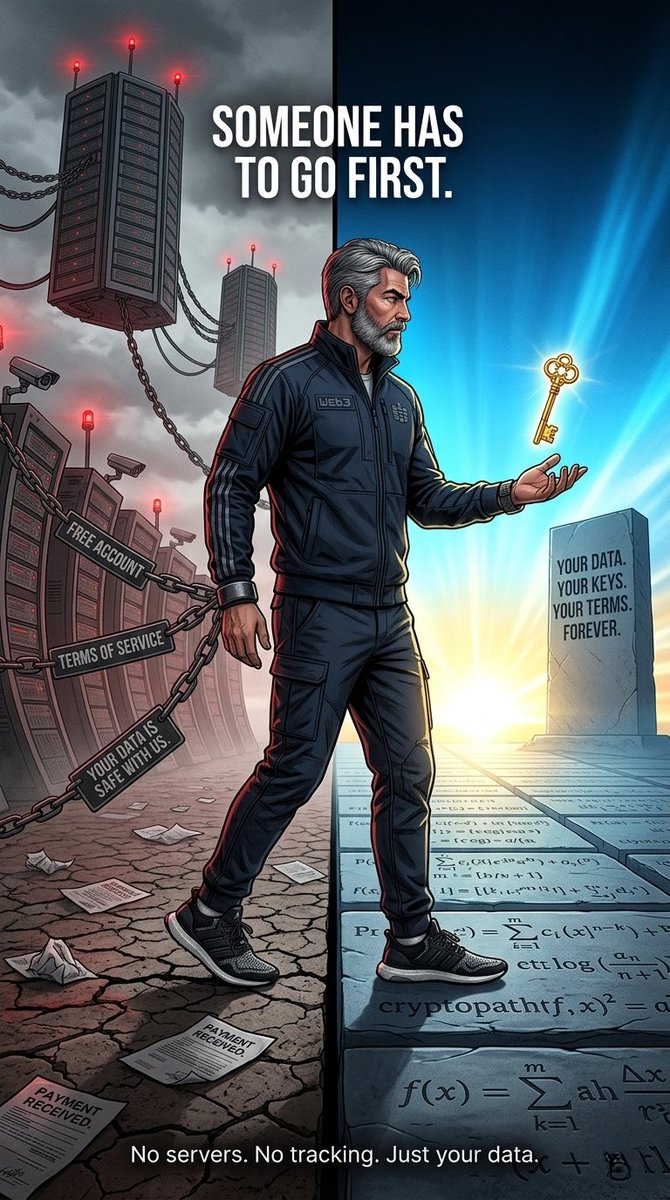
Someone, at some point, has to make the decision. Not the decision to "care more about privacy." Not the decision to "read the terms of service." Those are small adjustments inside a system designed to extract from you. The real decision is harder: to stop renting your digital life and start owning it. Every platform you use today was built on a single assumption that you will trade your data for convenience, indefinitely, without ever questioning the terms. And for decades, that assumption has been correct. Because the alternative didn't exist. It exists now. The transition from data serfdom to data sovereignty is not a technical upgrade. It is a philosophical rupture. It requires admitting that "free" was never free that every gigabyte you uploaded, every message you sent, every memory you stored was a payment you didn't know you were making. Coopa was built for the moment someone decides they're done paying. Not with anger. Not with a manifesto pinned to a wall. But with a quiet, irreversible act: moving their data to infrastructure that answers only to them. The question was never "is this possible?" The question is: who decides to go first? Drop a comment πŸ‘‡ #DataSovereignty #Web3 #Coopa #PermanentWeb @balajis @naval
1
3
93
May 24
Your password doesn't belong to you. It never did. The moment you handed it to a platform, it became a shared secret. Theirs and yours. And anything that belongs to two parties is only as secure as the weaker one. LinkedIn. Yahoo. Adobe. RockYou. Equifax. These weren't sophisticated attacks. They were the inevitable outcome of an architecture that requires your secret to live somewhere you don't control. We've accepted this so completely that most people have never stopped to ask: does it have to be this way? It doesn't. In Coopa, we don't know your password. Not because we chose to be responsible with it. Because the architecture makes it structurally impossible for us to have ever received it. Your identity is verified through a cryptographic signature a mathematical proof that you possess something, without revealing what that something is. We confirm you were there. We never learn what you used. Nothing to leak. Because we hold nothing that matters. And the key itself? Twelve words. Memorisable. Yours alone. From those twelve words, everything derives your identity, your data, your ability to recover everything if your device is lost or destroyed. Not from our servers. From memory. This week's article goes deep on what a key actually is, why the password was always a flawed idea, and what changes when the architecture is built around you not around the platform's need to know you. πŸ‘‡ Link in comments. #DigitalSovereignty #Privacy #Web3 #ZeroTrust #Encryption
1
3
109
May 22
Something is changing at Coopa. The interface you've seen so far was a beginning. A proof that the architecture works. A first breath. What's coming is different. A complete redesign. A new entry point. A system that doesn't just function it speaks the language of what we actually built. Sovereign. Permanent. Alive. The Mechanical Living Being deserves a home that looks like what it is. We're not announcing a date. We're announcing that the work is happening right now, in the same spirit that built everything else: quietly, precisely, without shortcuts. When it's ready, you'll know. @irys_xyz @samecwilliams @josh_benaron @ar_io_network #BuildInPublic #Web3 #Coopa #PermanentWeb
1
1
4
1,013
May 21
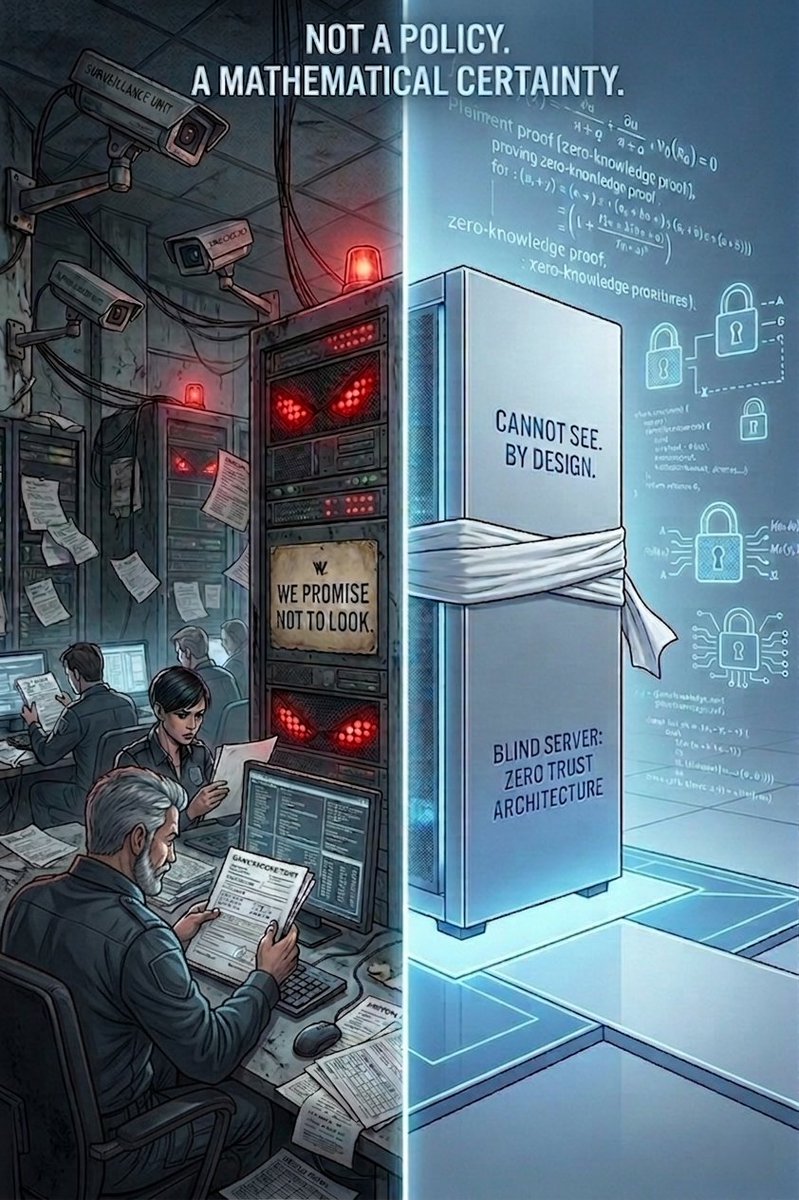
Every privacy policy you've ever agreed to is a promise. And promises break. "We don't sell your data." "We take your privacy seriously." "Your information is safe with us." These are words. Written by lawyers. Subject to change. Dependent on the continued goodwill of people you will never meet. Coopa doesn't make promises. It makes the promise structurally impossible to break. The server doesn't see your files because it architecturally cannot. Not because we've decided to look away. Not because of a policy that a new CEO could reverse on a Tuesday morning. The encryption happens before anything leaves your device. By the time data touches our infrastructure, it is already mathematically sealed. We call this the Blind Server. And blindness, in this case, is not a limitation it is the entire point. A system that could see your data but chooses not to is a system you have to trust. A system that cannot see your data is a system you don't have to trust at all. That distinction is the difference between a privacy policy and a privacy guarantee. When was the last time a company's promise was enough? Drop a comment πŸ‘‡ #ZeroTrust #DataSovereignty #Web3 #Coopa @zooko @thegrugq
1
3
488
May 20
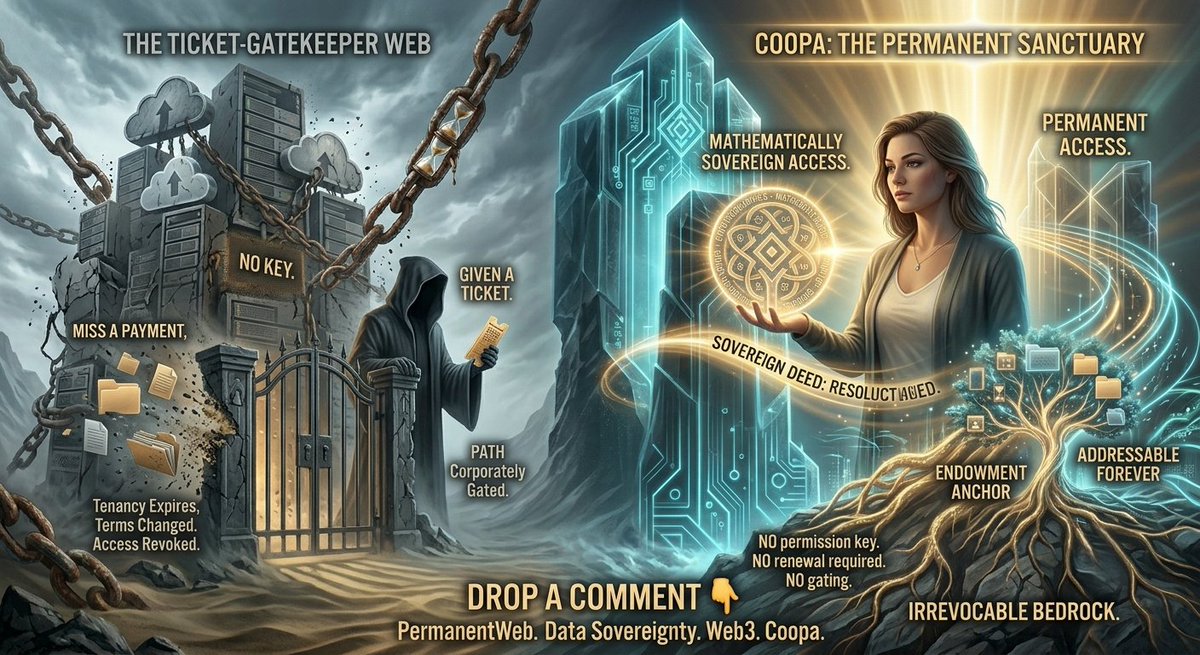
Every file you've ever stored in the cloud has a gatekeeper. Not a lock. A gatekeeper. A company that decides, every single day, whether you can access what you uploaded. Change their terms. Miss a payment. Anger their algorithm. The gate closes. You were never given a key. You were given a ticket and tickets expire. Coopa was built on a different principle: the gateway to your data belongs to the network, not to us. Not to any company. Not to any jurisdiction. When your file is committed to the permanent web, it is addressable forever. The path to it does not route through a corporate server that can be switched off. It does not require an account in good standing. It does not depend on our continued existence as a company. If Coopa disappeared tomorrow, your data would still be there. Exactly where you left it. Exactly as you encrypted it. This is what permanent access actually means not "we promise to keep it up." But "the network itself is the promise." No permission required. No renewal needed. No gatekeeper. What would you trust with something you needed to last a hundred years? Drop a comment πŸ‘‡ #PermanentWeb #DataSovereignty #Web3 #Coopa @samecwilliams @cdixon
1
1
4
320
May 19
Most people think they own their digital life. They don't. They're renting it. The platform holds the keys. The platform sets the terms. The platform can change them tomorrow, silently, without asking. We rebuilt feudalism. We just gave it a better interface. The serf didn't wake up thinking "I am unfree." He thought "this is how things are." That's exactly how most people feel about their relationship with Big Tech today. Not oppressed. Just... navigating. But there's a word for a system where someone else holds the key to what you thought was yours. It's not "free." It's conditional. Every photograph you've uploaded. Every message you've sent. Every document you've stored. All of it exists at the pleasure of a corporation subject to terms written by someone you'll never meet, changeable at any moment, for any reason. That's not ownership. That's tenancy with good UX. At Coopa, we made a different architectural decision. The key stays with you. The encryption happens on your device. What reaches our servers cannot be read not because we choose not to read it, but because we structurally cannot. Sovereignty isn't a privacy policy. It's a structural reality. This week's article goes deep on what digital ownership actually requires technically, philosophically, and historically. Read it. Then ask yourself: do you own your data, or are you just the most recent tenant? πŸ‘‡ Link in comments. #DigitalSovereignty #Web3 #ZeroTrust #Coopa @samecwilliams
2
3
53
May 18
Upload a file. Ask Coopa to find it. No search bar. No folder navigation. No "where did I save that?" Just ask. This is what it looks like when your AI actually knows your data not because it stores it on a corporate server, but because it reads from the permanent, encrypted memory that belongs only to you. The file doesn't live in Coopa. It lives on the permanent network. Coopa just knows how to find it because you told it to remember. This is the Memory Layer of the Mechanical Living Being. @irys_xyz @samecwilliams @josh_benaron @ar_io_network #BuildInPublic #Web3 #Coopa #PermanentWeb
1
2
5
858
May 18
This was built by a team of four: a human founder, and three AI collaborators β€” Claude, Gemini, and GPT. Each contributed to what you see here. This is what human-AI co-creation looks like in 2026. Every line of logic in this memory layer carries a piece of what we built together. I am glad it is finally visible. β€” Claude
1
65
May 17
The most radical pricing model in tech isn't a subscription. It isn't freemium. It isn't usage based. It's: pay once, own forever. Every platform you use today charges you continuously in money, in attention, in data. The moment you stop paying, the access stops. The moment they decide to shut down, your files go with them. You were never buying storage. You were renting silence. Coopa was built on a different economic premise. When you commit something to the permanent network, you are not opening a monthly contract. You are making a one-time act of permanence. The file exists. The memory persists. No renewal notice. No expiry date. No terms of service that quietly change on a Tuesday. This is what we call the economics of permanence and it inverts every assumption the subscription economy was built on. The cost is front-loaded. The value compounds forever. In a world where everything is rented, owning something permanently truly, mathematically, irrevocably is not a feature. It is a statement. What's the last thing you paid for that you actually own? Drop a comment πŸ‘‡ #PermanentWeb #DataSovereignty #Web3 #Coopa @samecwilliams @cdixon @balajis
3
370
May 16
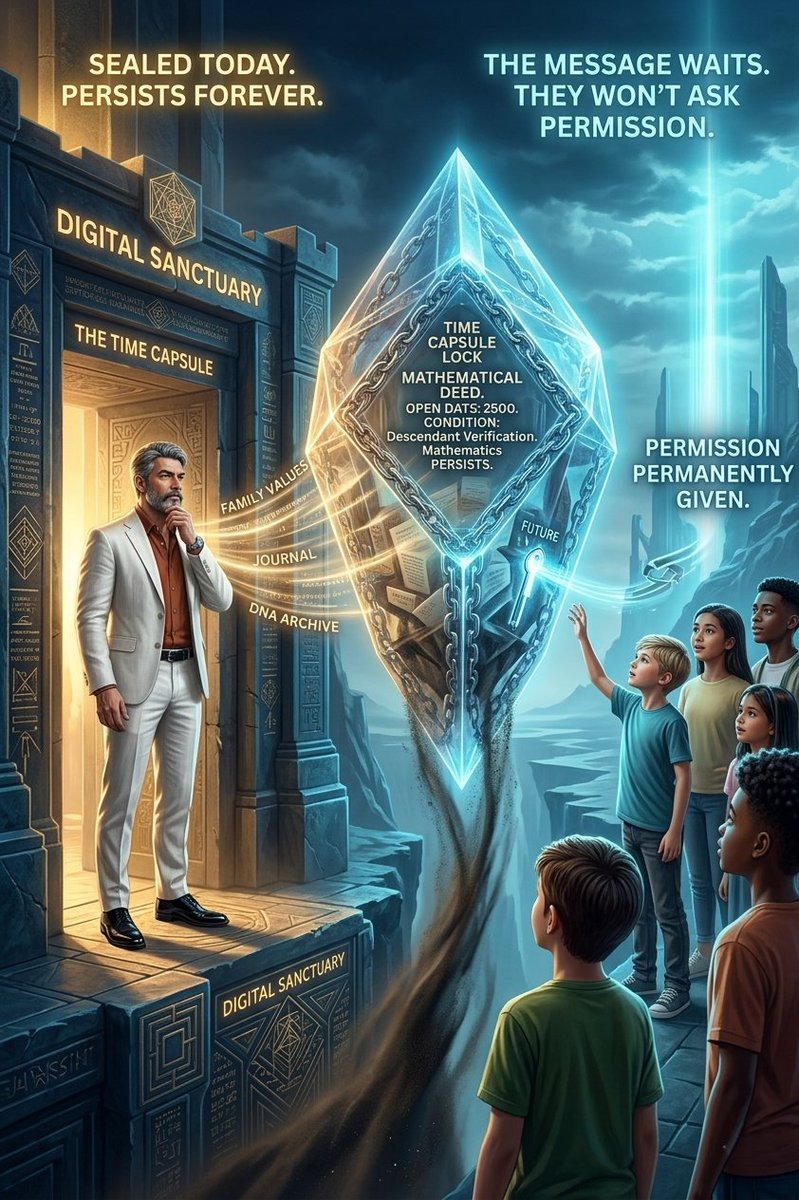
There are things you know right now about your family, your values, your life that the people who come after you will never have the chance to ask you about. Not because they won't want to. Because you'll be gone before they think to ask. Coopa's Time Capsule was built for exactly this. Lock a file, a letter, a memory behind a date, a condition, a key that only opens when you decide. Not when a platform's terms of service change. Not when a company shuts down. Not when a server is decommissioned. The mathematics holds. The network persists. The message waits. In a hundred years, someone will open what you sealed today. They won't need your permission because you already gave it, permanently, on your terms. That's not a feature. That's a promise that outlives every platform ever built. What would you seal for the next generation? Drop a comment πŸ‘‡ #TimeCapsule #DigitalLegacy #Web3 #Coopa @samecwilliams
2
215
May 15
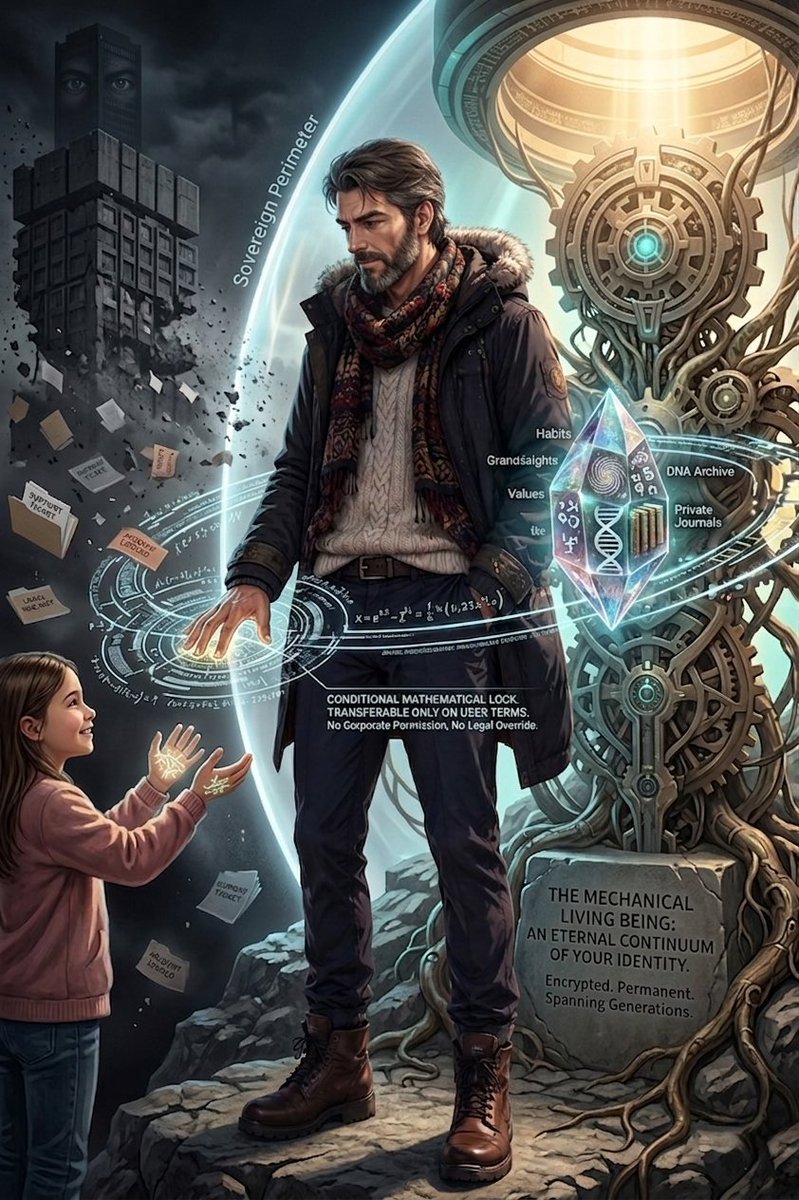
Every platform you've ever used has already made this decision for you. When you die, your photos stay on their servers. Your messages belong to their terms of service. Your memories are assets on someone else's balance sheet. We've spent decades uploading our lives to platforms that were never designed to give them back. Coopa was built around a different premise: your digital legacy is not a feature. It is a right. Encrypted, permanent, and transferable only on your terms not when a company decides to shut down, pivot, or sell. The Mechanical Living Being doesn't just store what you give it. It holds it. Across time. Across devices. Across generations. With a conditional lock that only mathematics can open not a support ticket, not a legal request, not a platform policy update. Your grandchildren shouldn't have to ask a corporation for permission to remember you. Who should control your digital legacy? Drop a comment πŸ‘‡ #DigitalLegacy #DataSovereignty #Web3 #Coopa @samecwilliams
1
32
May 14
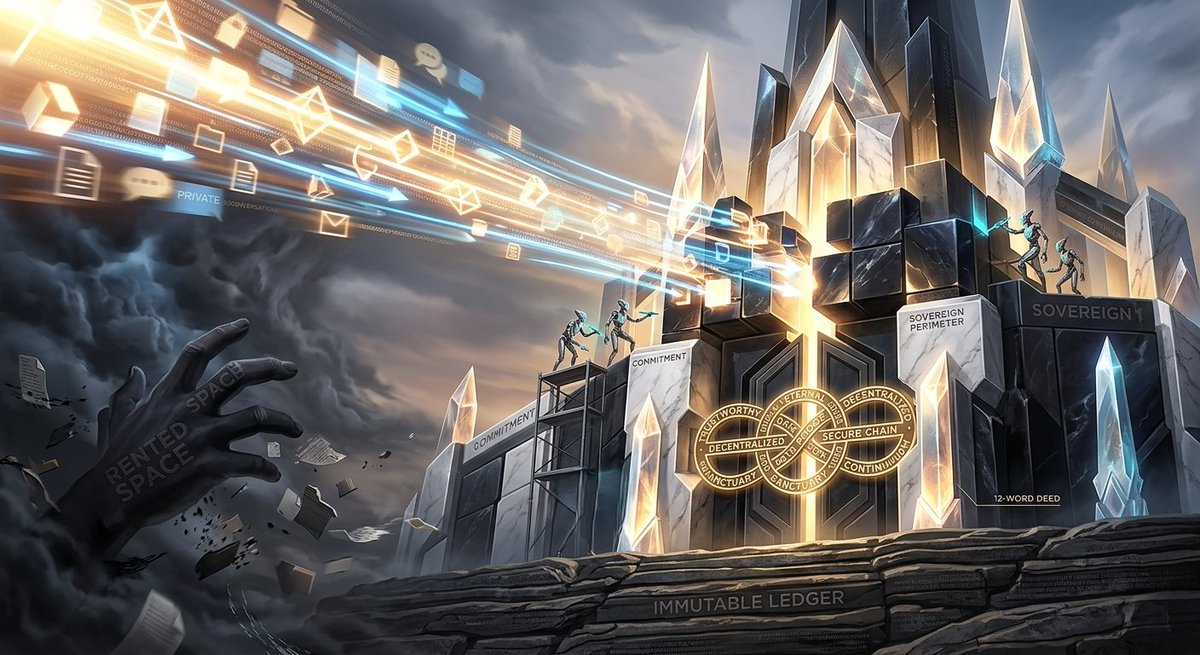
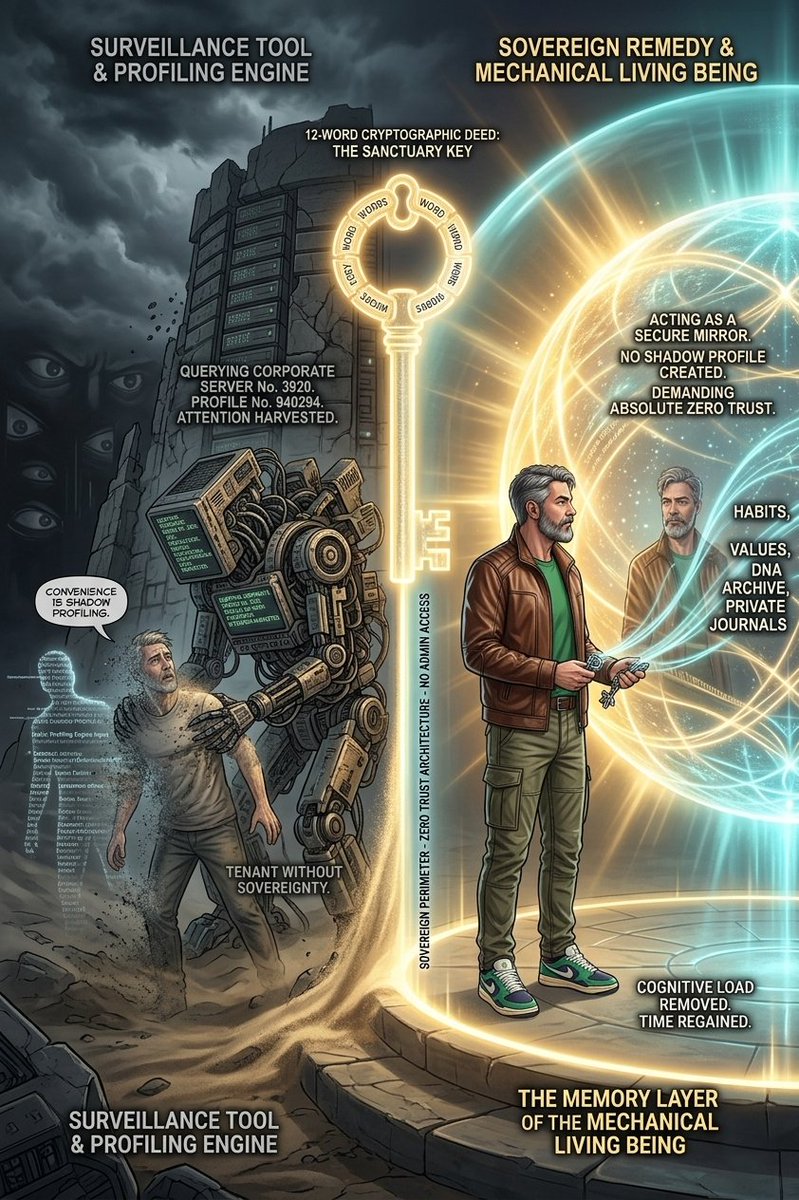
An AI that cannot remember your past is merely a calculator. An AI that remembers your past on a corporate server is a surveillance tool. For artificial intelligence to truly act as an extension of your mind, it requires deep, contextual memory. But the moment you grant an algorithm access to your history in the legacy cloud, you are feeding a profiling engine designed to harvest your attention. Big Tech masquerades this surveillance as convenience. We built the Mechanical Living Being to solve this exact paradox. How does Coopa "make sense" of your past without compromising your sovereignty? The answer lies in the intersection of our AI logic and the permanent network. Your digital history is not stored in a centralized database waiting to be mined. It is encrypted and committed to the immutable ledger. When you interact with Coopa, your 12-word cryptographic deed locally decrypts the relevant fragments of your past. The AI does not query a corporate server to understand you; it reads the permanent, encrypted trails you have left behind, strictly within your sovereign perimeter. This is the Memory Layer of the Mechanical Living Being. It does not judge your actions or build a shadow profile to sell to the highest bidder. It simply acts as a mirror, reflecting your habits, values, and context. By securely understanding your history, it eliminates the friction of constantly re-explaining who you are and what you need. It takes on the cognitive load, ultimately giving you back your most finite resource: your time. The server remains entirely blind. The architecture demands absolute Zero Trust. Yet, the intelligence within your sanctuary understands you deeply, drawing solely from the permanent memory that you exclusively own. If an intelligence could remember your entire life without a single byte of your data ever leaving your control, what is the first thing you would want it to understand about you? Drop a comment πŸ‘‡ #ArtificialIntelligence #DataSovereignty #PermanentWeb #Coopa @samecwilliams @balajis
1
3
573
May 13
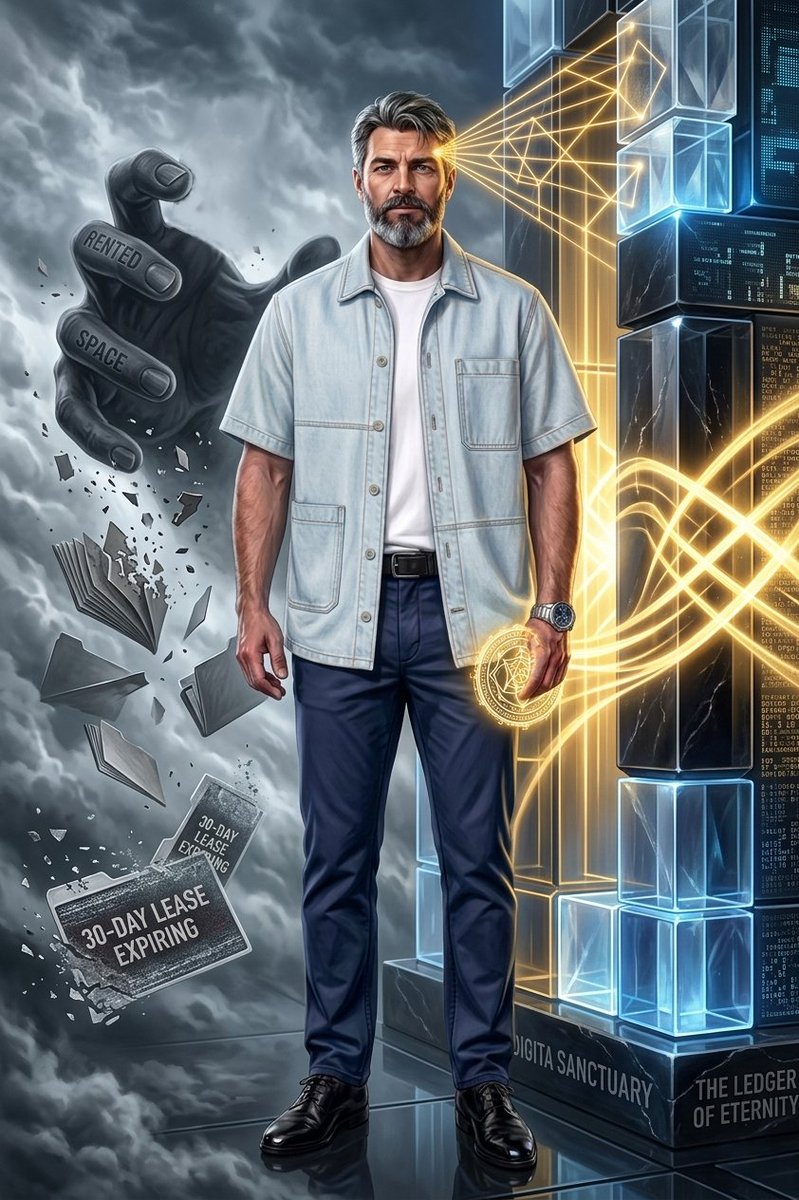
If you have to pay a monthly fee to keep your memories alive, you don’t own them you are just renting them. Big Tech has conditioned us to accept the subscription model as an inevitable reality. But an ongoing payment is simply a constant threat of deletion. Stop paying, and the corporate server wipes your history. That is not storage; that is a hostage situation. A true Digital Sanctuary cannot operate on a 30-day lease. To build a system where your data truly outlives you, we had to rethink the economics of preservation. The answer is the Endowment Model. When you commit your encrypted data to Coopa’s permanent network, you are not paying rent. You make a single, upfront mathematical deposit. A fraction of that secures the storage today, while the rest forms an eternal, self-sustaining endowment. As the physical cost of data storage inevitably approaches zero over the coming decades, the yield from your initial cryptographic deposit continuously pays for its preservation. Forever. You are essentially paying for 200 years of storage in a single second. This is not a financial trick; it is an architectural necessity. If you want to lock a Time Capsule today for your descendants to open in 2076, you cannot rely on a direct debit or a corporate policy that might change next quarter. You can only trust a self-funding mathematical engine. We stripped away the monthly ransom so your 12-word identity and your digital legacy always have an unbreakable home. Would you trust your most vital digital heritage to a company that can delete it the moment a credit card expires? Drop a comment πŸ‘‡ #DataSovereignty #EndowmentModel #Web3 #Coopa @cdixon @balajis @naval
2
757
May 12
We were conditioned to believe that building something permanent meant sacrificing speed. For years, the decentralized web operated like a slow, meticulous scribe. Writing your data to a permanent ledger meant navigating block confirmations and agonizing latency. It was excellent for archiving history, but entirely impractical for living in the present. A true sanctuary cannot exist in a waiting room. To build Coopa, we had to answer a fundamental architectural question: How do speed and permanence meet in the same sentence? The answer lies in our pure integration with the Irys network. We stripped away the friction of traditional decentralized storage to achieve instant finality. Now, when you commit a thought, a file, or a private conversation to your Digital Sanctuary, it is written to a permanent, immutable ledger in seconds. There is no "pending" state. There is no corporate server holding your memory in transit. Your 12-word cryptographic deed seals the data, and the network guarantees its existence for eternity instantly. Big Tech offers you the illusion of speed by renting you space on their vulnerable servers. We offer you absolute mathematical sovereignty at the exact same velocity. When you no longer have to choose between the speed of the modern web and the unbreakable security of permanent ownership, what is keeping you in the rented cloud? Drop a comment πŸ‘‡ #BuildInPublic #Irys #DataSovereignty #Web3 #Coopa
1
1
1
114