
Digital asset investing since 2017. Fair launch, open networks, sovereign internet culture. Not financial advice, opinions our own. @nakamining | peng, milady
Joined March 2019
- Tweets 4,737
- Following 3,156
- Followers 4,115
- Likes 21,341
445 Photos and videos
















Jun 13
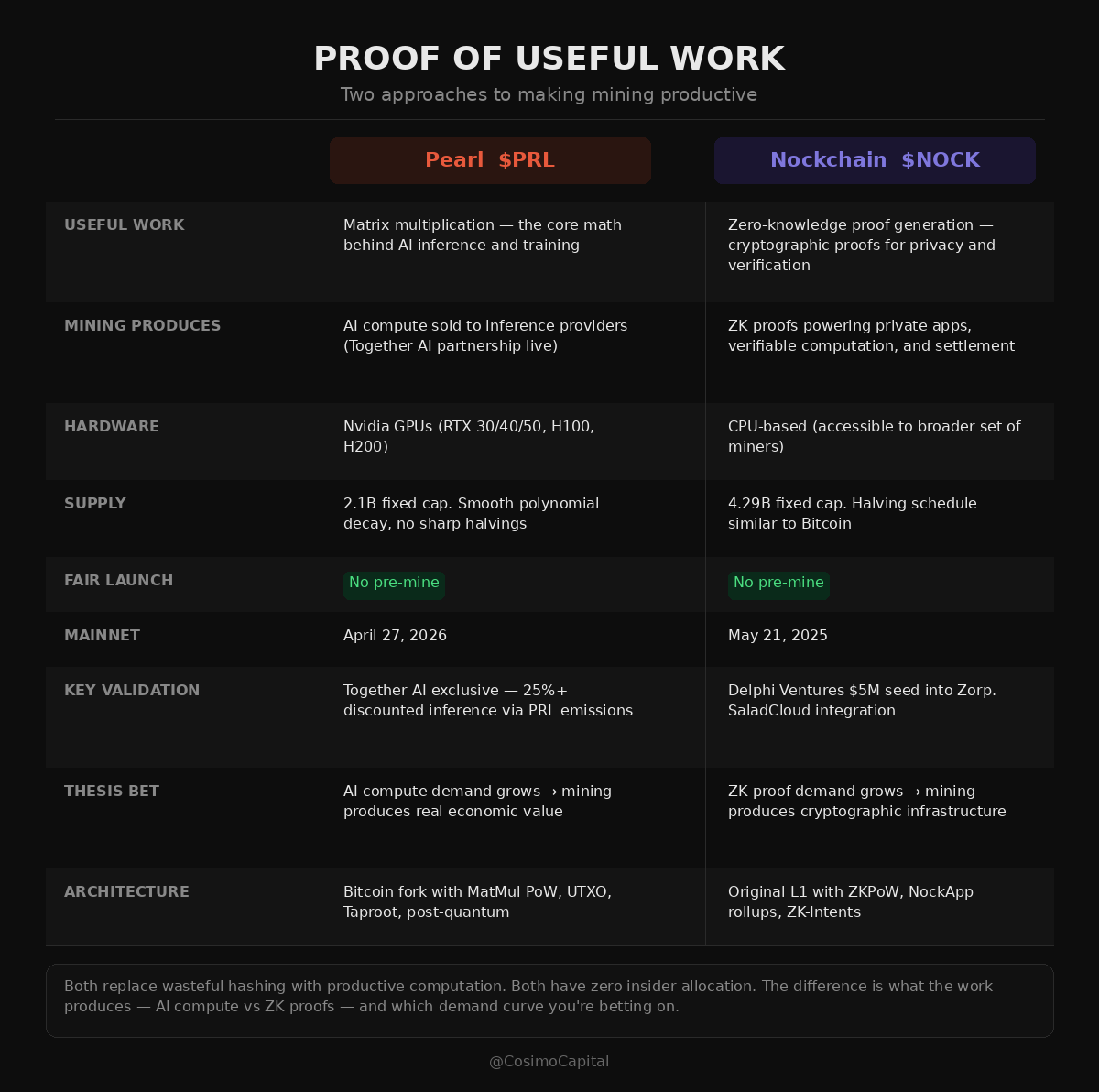
Proof of useful work is quietly becoming one of the most interesting categories in crypto.
Two projects taking different approaches to the same thesis: mining should produce something valuable, not burn energy on arbitrary puzzles.
Pearl ($PRL) turns mining into AI compute. The same matrix multiplication that powers every modern AI model. Together AI already partnered to offer 25% discounted inference because PRL emissions offset compute costs.
Nockchain ($NOCK) turns mining into zero-knowledge proofs. The cryptographic infrastructure that powers privacy, verifiable computation, and scalable settlement.
Both are fair launch. No pre-mine. No founder allocation. Bitcoin-style monetary policy with fixed supply caps.
The difference is the demand curve you're betting on. PRL bets AI compute demand keeps scaling. NOCK bets ZK proof demand keeps scaling. Both are reasonable. Both are early.
The shared thesis matters more than the individual implementations. Mining energy that produces economic value rather than waste is a structural improvement over traditional proof of work. These are the first two serious attempts to make it work in production.
1
5
280
Jun 12
Folks the next chapter of crypto is built around sound tokenomics and founders that understand the principles crypto was built on. canton-network:native
Jun 11

DA entire business is build around canton-network:native burn.
2
157
Jun 12
The most important word here is 'public'. This investment does not mean a sweetheart $CC allocation or a dual equity/token deal. Canton Coin is still public, doing real transactions, earning real revenue. Anyone can participate.
Jun 11

Impressive from Canton. For years, banks talked about creating private blockchain consortiums. Canton has effectively created a public blockchain consortium by getting most of Wall Street on the Digital Asset balance sheet. Impressive strategy, technology, and execution.
1
3
391

Jun 10
The bear market doldrums feel like the tail end of every other bear market. Lots of cool stuff happening on the fringes but the majors look terrible. We're close folks
1
3
149
The narratives that still have traction in a bear market are pretty clear:
privacy
RWAs
stablecoins
fair launch
real usage
Canton Coin has all of these and somehow is still not in the mainstream conversation.
That gap won’t last forever. canton-network:native
1
1
208
One thing people still underappreciate about $HYPE:
New holders have 2 forces working for them:
Native staking = earn more HYPE for staking
Buyback burn = protocol activity creates a recurring bid and reduces supply
More tokens a soft demand floor is a rare combo.
You don’t just own the asset.
You own the machine buying the asset.
1
3
326
May 28
1: We love brand new fair launch coins, especially ones as unique as Pearl ($PRL).
If you are a bittensor:native /$TIG fan, Pearl is interesting to look at.
It sits in the same broad family of ideas: open networks, compute incentives, mining, AI, and a token tied to useful work instead of pure speculation.
3
11
1,663
May 28
9/ That is the big Pearl thesis:
$PRL as the “oil price” of AI compute.
Data centers hedge future PRL emissions.
AI labs hedge future compute costs.
Capital markets finance GPU buildouts against expected compute yield.
PRL becomes the native pricing layer for machine intelligence.
1
1,068
May 28
10: The chasm is simple:
From PRL as a rebate
to PRL as the oil price of AI compute.
From petroleum jelly
to petroleum.
That is the dream.
@ZanaVentures wrote a great long form breakdown here: x.com/ZanaVentures/status/20…

2
358
May 27
Pendle just had one of the cleanest tokenomic shifts in DeFi and nobody is connecting it to where it goes next.
Pendle separates yield-bearing tokens into Principal Tokens and Yield Tokens. Lock in fixed yield by holding PT. Speculate on yield rates by trading YT. The protocol earns fees on every trade.
In May 2025 they switched fee payouts from ethereum:0x808507121b80c02388fad14726482e061b8da827 to stablecoins. In January 2026 they launched sPENDLE which is replacing vePENDLE with a model that includes protocol revenue buybacks. A third of supply is locked.
The fee base is substantial. $880M in tokenized consumer credit from Figure and Saturn Credit routes through Pendle on Ethereum. $17B in actual loan originations underneath the trading. Not recursive DeFi leverage. Real credit markets.
Now lets connect this to Venice:
$DIEM is Venice's tokenized inference credit. Stake $VVV, mint DIEM, earn $1/day of perpetual AI compute. DIEM is a yield-bearing token where the yield is denominated in compute rather than dollars.
If Pendle were to list DIEM, AI compute yield becomes tradeable. Buy PT-DIEM to lock in fixed inference credit. Buy YT-DIEM to bet that inference demand scales.
The same DeFi mechanics that produced billions in looped ETH staking strategies applied to a new substrate.
Holding PENDLE captures fees from yield markets. Holding DIEM captures Venice inference growth.
Holding both captures the layer where Pendle's primitive expands DIEM's utility and DIEM's yield creates new Pendle trading volume.
The DeFi primitives from the last cycle are being applied to AI infrastructure in this cycle.
They become complementary when they meet.
4
561