
1,303 Photos and videos










Kevin C retweeted

Apr 16
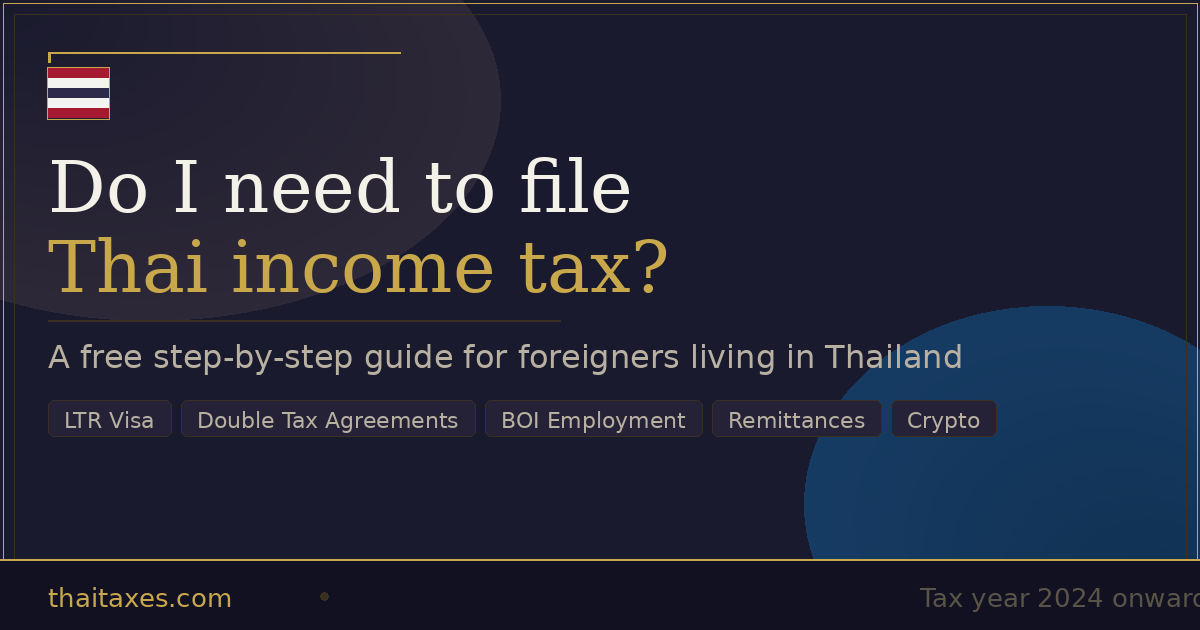
After having 100s of online discussions where non Thais are confused (or plain wrong) on Thai tax and filing liabilities yesterday I decided to knock up a free info tool.
thaitaxes.com
The reason this question is confused online is because everyone's position is unique, you answer one persons question and someone else will come back with 'thats wrong because (eg) my rental income is already taxed overseas' or 'my pension is a military pension' etc etc. You cant apply one answer to everyone in every position and people frequently dont give the vital info when asking.
I think I have now covered the variables but I am sure someone will prove me wrong and have some unique edge cases. I will try to adapt the logic gates as these get reported. Its also worth saying I have kept the guidance simple enough that if you are claiming a DTA exemption, or a Thai deduction, it is on the user to understand what they are claiming. I will probably add a few more warning or disclaimers.
Use it, share it, try to break it, prove me incorrect. I want to know what I have missed.
Obviously if you want to ignore Thai tax liability, thats totally fine, I am not here to argue that enforcement is happening. These are the rules, following them or not is up to each individual.
15
5
49
6,350
Kevin C retweeted

29 Nov 2025
🇹🇭 𝗪𝗵𝗮𝘁 𝗥𝗲𝗮𝗹𝗹𝘆 𝗛𝗮𝗽𝗽𝗲𝗻𝘀 𝗪𝗵𝗲𝗻 𝗬𝗼𝘂 𝗗𝗶𝗲 𝗶𝗻 𝗧𝗵𝗮𝗶𝗹𝗮𝗻𝗱
This video provides an essential and detailed guide for foreigners in Thailand, covering the personal, administrative, and legal processes that occur when an expatriate passes away.
The host, Jonny, speaks with two experts: Andy Oswald, who has practical experience assisting friends, and Marita "Rita," a registered Thai lawyer.
👉 The video stresses that preparation—specifically having a will—is the single most important action to simplify the extremely complex process for those left behind.
👉 Andy Oswald, who has helped dozens of foreigners, highlights the vast difference in outcomes based on preparation:
🔺 With a Will: The case of a friend named Ian Royale was "quite straightforward" because he had a Thai will and a pre-planned funeral, which streamlined the legal process significantly.
🔺 Without a Will: A tragic case took 12 months just to obtain power of attorney because the deceased did not have a will. The process was exceptionally hard for the family and friends.
🔺The Crucial Document: The foreign embassy (e.g., British, Australian) issues a "letter of authority" (written in Thai) after confirming next-of-kin. This letter is mandatory for getting a death certificate, arranging a funeral with a temple or undertaker, and accessing personal belongings.
👉 Top Advice:
🔺 Have a Thai Will to deal with Thai assets.
🔺 Create a "When I Die Document" listing all passwords, pin numbers (for bank accounts, ATM, etc.), and instructions for digital and social media accounts.
🔺 Choose a trusted, responsible local friend to act as a point of contact, as it is nearly impossible for family abroad to manage the process alone.
Thai lawyer Marita (Rita) provides the legal requirements and procedures:
👉Death Documentation:
🔺 Hospital Death: The hospital issues a death notification, which is taken to the District Office (Amper) to receive the Death Certificate.
🔺 Accidental/Suspicious Death: Requires a police report and possibly a forensic autopsy report before going to the District Office.
🔺The Thai Death Certificate is issued in Thai only and must be translated and legalized by the Ministry of Foreign Affairs for legal use abroad.
👉 Wills and Estates:
🔺With a Thai Will: The court appoints an estate executor (as named in the will) to distribute assets according to the deceased's intention.
🔺 No Will: Assets are distributed automatically to statutory heirs in a specific order (descendants, parents, siblings, etc.).
🔺 Foreign Wills: While they can be recognized if they follow the Thai form, it is strongly recommended to make a separate Thai Will for Thai assets to ensure the intent is followed, as Thai law does not have "forced heirship" (a requirement to leave assets to a spouse or children).
🔺 Unmarried Thai partners are not legal heirs by law. A Last Will is required to bequeath assets to a non-legally married partner.
👉 Preventative Legal Advice:
🔺 Last Will: Focuses on distributing assets after death.
🔺 Living Will: Focuses on medical treatment decisions (e.g., procedures you do or do not want) in case you are incapacitated.
🔺Power of Attorney: Allows a trusted person to withdraw money from your bank to cover immediate expenses (like medical bills) while you are in the hospital.
youtu.be/2AzYx9xgHx4
1
6
23
5,909
Kevin C retweeted

10 May 2024
Bloody marvellous ! Incredible #magic act , no idea how she did it !! 😳😳😳
18
10
110
15,296

Kevin C retweeted

22 Sep 2023
When you pose no obvious threat, Nature often wants to take a closer look. 👀
495
7,921
63,485
4,012,145

8
1,366
Kevin C retweeted

14 Oct 2021
Whale Shark has learned how to steal food from fishing nets.
#TiredEarth
2,280
8,668
53,869



Kevin C retweeted

11 Oct 2018
Tiger walking on thin ice
101
4,748
17,053