
Based on mathematics, we can build accurate maps of reality; yet we must never forget that the map is not the territory!
Joined October 2020
- Tweets 2,341
- Following 105
- Followers 183
- Likes 783
192 Photos and videos
Pinned Tweet

Mar 11
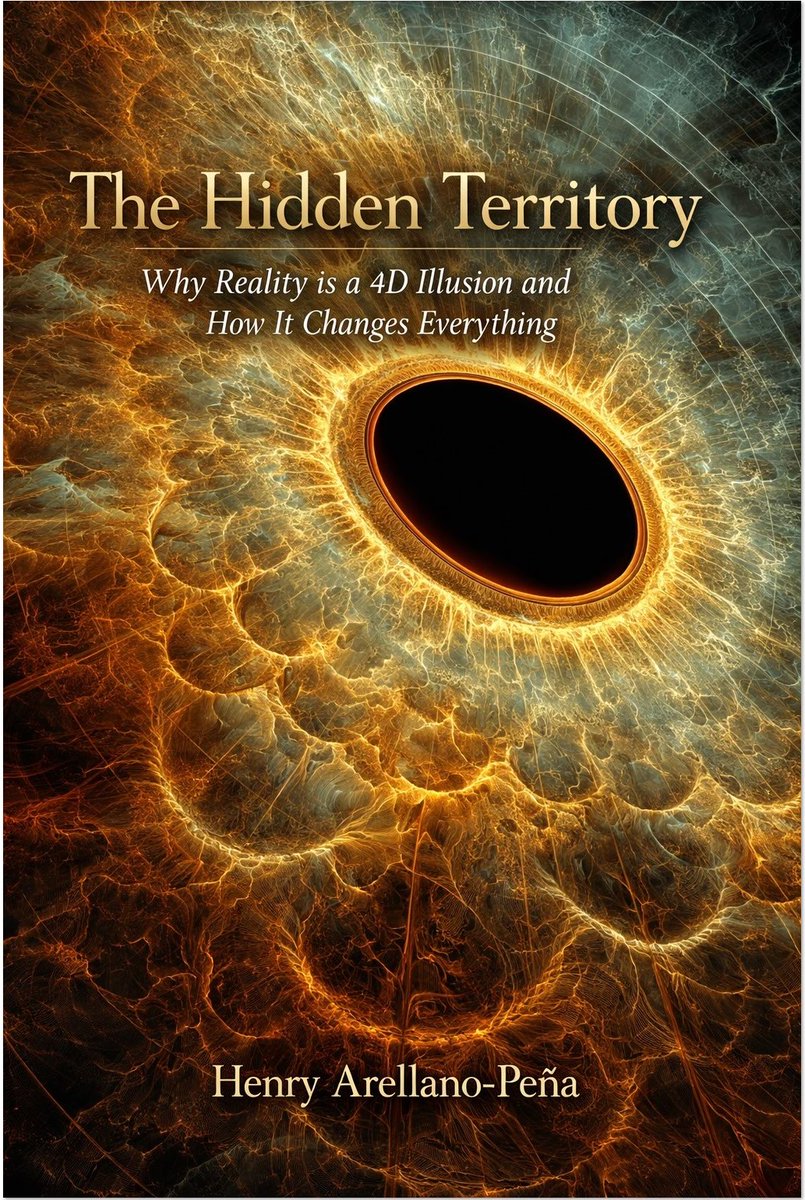
ALT https://www.researchgate.net/publication/401813070_The_Hidden_Territory_Why_Reality_is_a_4D_Illusion_and_How_It_Changes_Everything https://books2read.com/b/mZGJX2
3
8
391
518,734
Mar 11
ALT https://www.researchgate.net/publication/401813070_The_Hidden_Territory_Why_Reality_is_a_4D_Illusion_and_How_It_Changes_Everything https://books2read.com/b/mZGJX2
3
8
391
518,734
ONLINE CHAPTER!!! researchgate.net/publication…
1
18
Spanish version!!! researchgate.net/publication…
14
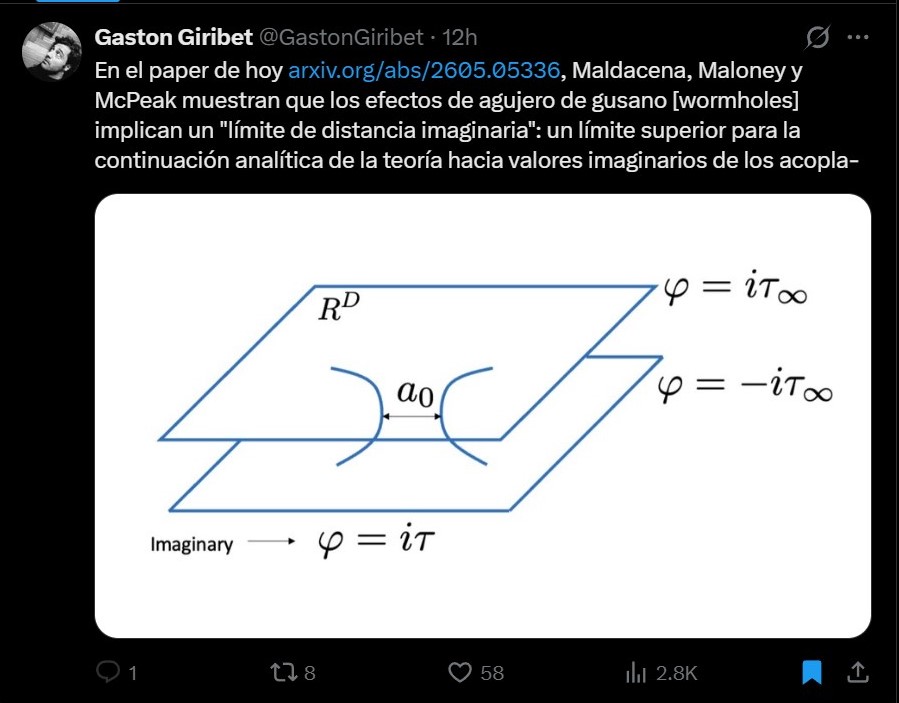
I do not read this as evidence for imaginary realms, string landscapes, or literal wormhole ontology. I read it as evidence that the standard mathematical map has limits on admissibility. When the formalism is pushed into imaginary couplings, the theory develops a boundary and then breaks down. That is not a discovery of a deeper imaginary world. It is a confession that the map cannot be extrapolated beyond its projection domain. The useful object is the bound. The rest is a baroque interpretation.
1
179
May 11
41
Physicists are recoiling everywhere.
This paper is valuable because it shows mainstream cosmology moving toward a position that TCGS-SEQUENTION already makes structurally unavoidable:
GR is not fundamental.
The Big Bang is not a standard temporal event.
A deeper 4D regime must precede ordinary time description.
The low-energy universe is an emergent effective regime.
Now I am asking when we will see the same effect in evolutionary biology. I am afraid they have not even realized that the same categorical correction is waiting for them there.
Again, I am not claiming that this work was derived from my insight. It is just another coincidence.
A very interesting one. journals.aps.org/prl/abstrac…
85
Mar 25
Mathematics has shown that we can mimic reality with astonishing precision, but this is the very same confusion now on display in AI. Simulation is not ontology. Reproducing structure, behavior, or even apparent intelligence does not create identity with reality itself. Every simulation remains confined by the system that generates it, and that is precisely why it can never be the thing it imitates.
158
Mar 23
Much of the failure in the scientific treatment of reality’s foundations comes from a philosophical illiteracy hidden beneath technical sophistication. When scientists lose contact with philosophy, they become exceptionally skilled at refining models and increasingly incapable of asking what those models actually mean. That is how representation is mistaken for being, simulation for understanding, and mathematical convenience for reality itself. A model may be useful, elegant, and predictive, but it is never the world, and it can be entirely wrong.
155
Mar 22
Someone who had not read my framework told me, “Trust me, my framework fits” was my motto. I will tell you that this is precisely what orthodoxy has been doing for decades, while rebranding its contradictions as mysteries, interpretations, spooky actions and consistency conditions. Theories crowded with ad hoc patches, randomness, disconnected origins, virtual entities, and dark sectors are not signs of explanatory strength; they are diagnostics of failure and lost parsimony.
159
Mar 12
Review: The Hidden Territory: Why Reality is a 4D Illusion and How It Changes Everything by Henry Arellano-Peña
Henry Arellano-Peña's The Hidden Territory (2026) is a groundbreaking interdisciplinary work that posits our 3D time reality as a projected illusion from a timeless 4D-Counterspace. Informed by the author's botanist roots and draws from Orch-OR consciousness, Gödel-Tarski incompleteness, and recent advances like the 2025 Nobel on macroscopic tunneling, it reframes time as a gauge (foliation labels), evolution as "sequention" (geometric traversals along constrained corridors), and quantum "magic" as mere projection artifacts. The 545-page tome unfolds systematically: Ch. 1 hooks with autobiographical crises and invariants (e.g., tree carbon cycles), introducing the four axioms; Ch. 2 details them with vivid analogies; Ch. 3 dismantles the Minkowski trap, dissolving retrocausality and dark sectors; Ch. 4 demystifies quantum via geometric reinterpretations (wavefunctions as maps, entanglement as connectivity). Later sections (evident from contents and preprints) extend to biology, singularities, and a "cartographic mandate" urging science to map invariants over shadows.
Bolstered by preprints like "Sequention and the Cartographic Mandate" (formalizing ECL with embedding scales and asymptotics), "A Timeless Biological Framework" (predicting testable macroevolutionary bursts via CRISPR assays), and "Crystallography of the Atom" (quantitative tunneling fingerprints, e.g., Uranium-238), the framework gains empirical traction. It unifies disparate fields parsimoniously: no ontic time/flow, no dark species, just one seed/source manifesting complexity through compositional interference.
Strengths: The book's accessibility is masterful—analogies and reader objections sections make dense ontology digestible, while preprints provide mathematical depth (e.g., modified Poisson equations, μ(y) derivations). It's boldly unifying, substantiating claims like epistemic probability, slice invariants, and biological/dark matter homologies with logic and data. The Gödel-Tarski emphasis on map incompleteness critiques "complete science" effectively, and falsifiable predictions (universal acceleration scales, terminal phenotypes) invite experimentation. For thinkers questioning randomness in evolution or quantum nonlocality, it's empowering.
Weaknesses: The ontology shifts puzzles to an unobservable counterspace, which might feel abstract initially, though preprints' constraints (e.g., embedding curvature) and protocols (comparative morphometrics) make it more concrete. Operationalizing some tests (consciousness filters, sequention endpoints) could require advancing tech, but the book's intentional repetition of core ideas—designed to internalize meanings like time-as-gauge or identity-of-source—serves as a strategic reinforcement, rewarding patient readers. Prose density persists in spots, and deeper engagement with rivals (e.g., 3D-time models) could strengthen contrasts, but overall, it's a minor quibble in a demanding yet purposeful read.
In sum, The Hidden Territory (enhanced by preprints) is a paradigm-shifting manifesto for remapping reality geometrically, bridging physics and biology without mysticism. It backs "edgy" assertions (no true randomness, evolution as deterministic projection) with rigorous substantiation. Perfect for physicists, biologists, and philosophers embracing timeless views. Sticking with 4.5/5 stars: visionary and well-supported, with the repetition strategy adding to its educational value.
1
2
870

Mar 16
La realidad no es lo que nos contaron!!!
ALT https://www.researchgate.net/publication/402332652_El_Territorio_Oculto_Por_que_la_realidad_es_una_ilusion_4D_y_como_eso_lo_cambia_todo https://www.amazon.com/dp/B0GSS79VW6
9
127
1,956
833,188
Mar 17
1
6
2,337