
Joined May 2021
- Tweets 12,172
- Following 1,770
- Followers 32,568
- Likes 49,050
1,742 Photos and videos

Pinned Tweet

28 Nov 2022
33
33
254
𝐂𝐫𝐲𝐩𝐭𝐨 𝐏𝐫𝐨𝐬𝐞𝐥𝐲𝐭𝐞 retweeted

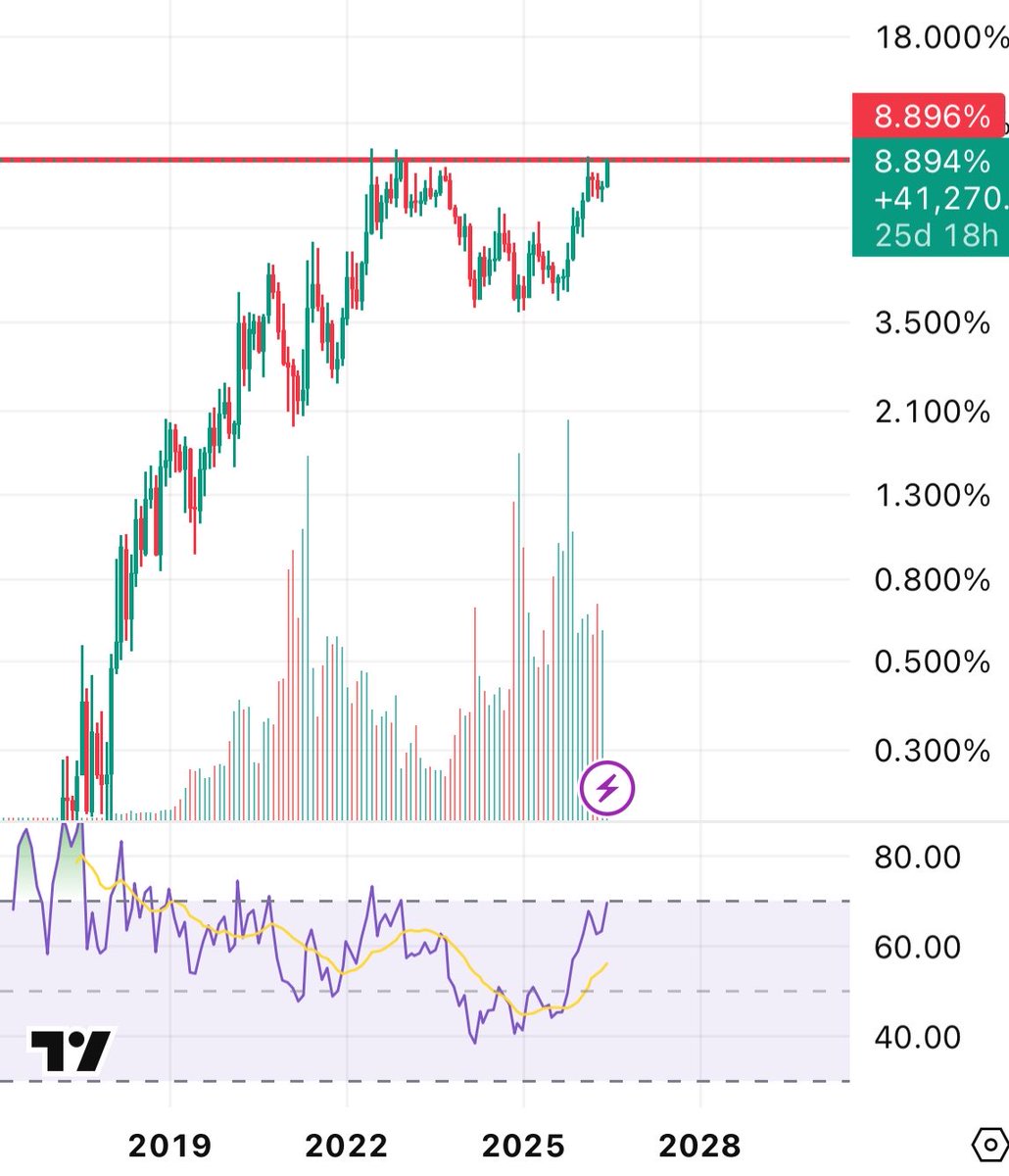
Watching the profitability of ks5 and ks7 it seems miners have been switching over to ks7s more and more since oct last year, the price of ks7 dropped to ~1k in feb (coinciding with the bottom) outcompeeting the ks5 hard in cost efficiency.
I believe we have about 2-3EH of dormant asics right now they should be turning on as soon as price rises, ks7 is now at 0 profitability at 0.09 usd per kwh, the mining network does not get more consolidated and efficient than it is right now.
Pricewise i think the old ATH should be reached somewhere within 14-18 months, hashrate should reach ATH far before since efficiency is much higher now than way back.
We have the second half of a cup in front of us, then a handle and then price discovery then a cooling phase forming a big tilted log "S" hashrate will follow the pattern but more explosive. New 60-80TH asics @ ~3kw should be around the corner.
Pool dominance should be reducing, i believe a lot of asics are hosted at this point and hosting will lessen when profitability goes up.
Lots of predictions here.
Let's see what happens :)
5
12
499
𝐂𝐫𝐲𝐩𝐭𝐨 𝐏𝐫𝐨𝐬𝐞𝐥𝐲𝐭𝐞 retweeted
12%
Yes
88%
No
8 votes • 2 days
1
1
2
795
Circle has been minting billions of new $USDC, with a sizable share routed to solana:So11111111111111111111111111111111111111112 , and a 500 million transaction fits that broader issuance pattern.
A “500 million USDC mint on Solana” means Circle has issued about 500 million new USDC tokens into a Solana mint address controlled by Circle or a large institutional client.
Arkham has reported that Circle minted over 8 billion USDC since early February, with specific tracking of the Solana mint address and about 10.7 percent of all USDC supply now on Solana, equal to roughly 8.4 billion dollars at the time of their report. This shows that very large single mints are normal parts of Circle’s issuance workflow, not one off anomalies.
The transaction is best read as infrastructure level funding of stablecoin liquidity, not as a direct signal that someone just “bought 500 million of SOL.”
2
2
14
926
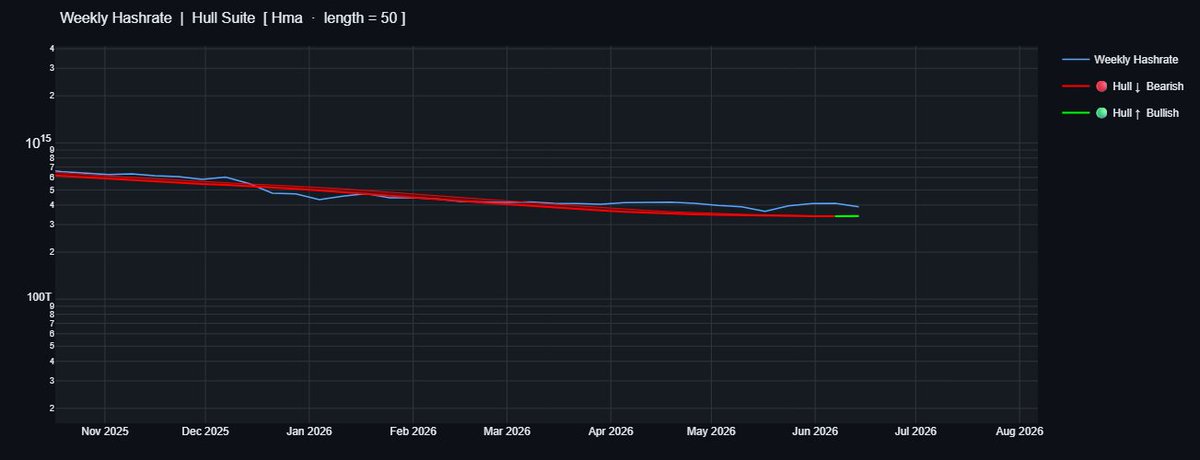
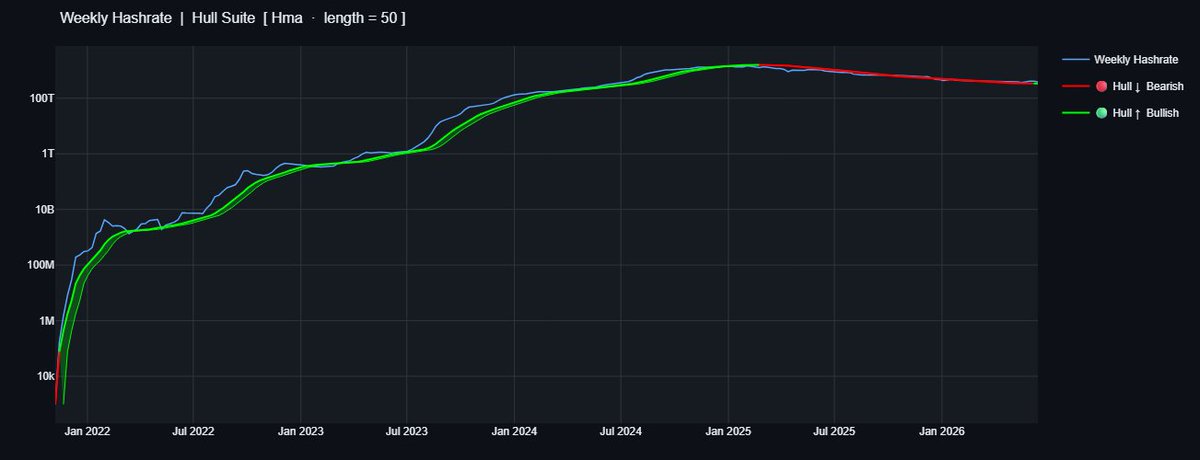
The weekly HMA 50 and THMA 50 ( Hull suite) on wekly hashrate of #Kaspa has turned green , Those who know, know!
How soon do you think we'll see a new all-time high in $KAS hashrate?
My predicton is we'll see a new ath in hashrate 1 year from now at the latest
Support my work?
kaspa:qr8ndam4swa9ftnz49jywxgch433haxaj9n5f2sj48qrz030eq5h7j4zlwdps
1
13
74
1,758
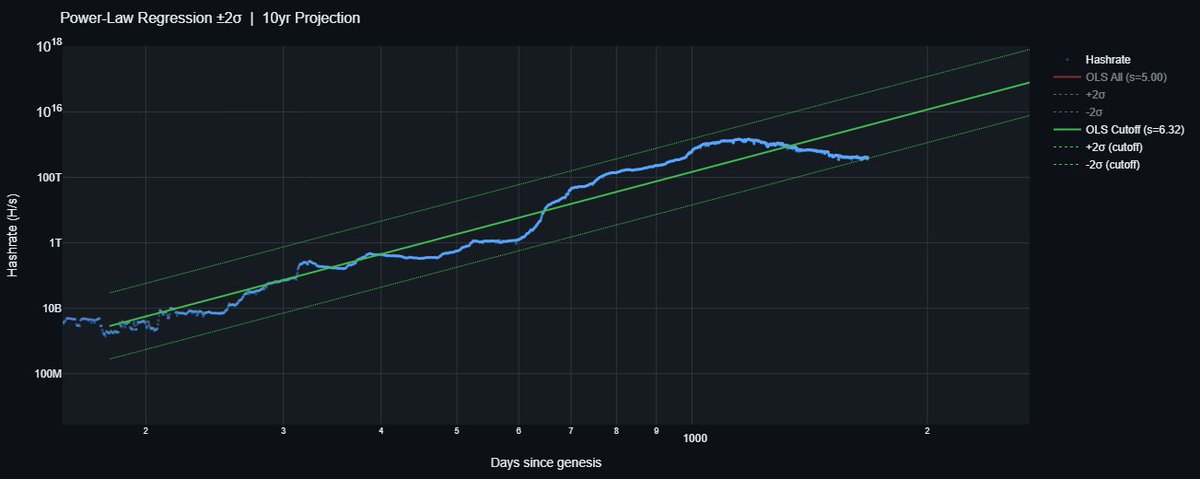
Power law log-log regression of #Kaspa hashrate hitting the bottom corridor and showing clear signs of recovery
$KAS
@Themooseisloos5
1
8
422
Jun 13
Kaspa treats blockchain history as something that can be cryptographically summarized rather than permanently downloaded and stored by every new participant. And that's the genius of Kaspa
Let's compare some famous blockchains with $KAS :
#Bitcoin
❌Launched: January 2009
❌New nodes must verify 17 years of history
❌Requires downloading hundreds of gigabytes of data
❌Full verification can take days
❌Nodes can prune/delete old data locally after verification.
However, the network still depends on archive nodes that store the complete blockchain history.
Without archive nodes, new nodes could not independently verify Bitcoin from genesis.
#Ethereum
❌In July 2025, Ethereum allowed nodes to remove historical data from before September 2022.
❌Storage savings per node:300–500 GB
❌Ethereum improved scalability through rollups.
❌Old historical data still exists but is increasingly stored by:Large companies, File-sharing systems,
Specialized data providers
❌ Ethereum shifted the archival burden elsewhere rather than eliminating it.
#Solana
❌Typical validator/node hardware in 2026:
❌24 CPU cores
❌256–512 GB RAM
❌Professional-grade SSDs
❌High-speed internet
❌Setup cost:$15,000–$50,000 before operation begins
❌Solana achieves high throughput.
❌hardware requirements are so demanding that complete verification is largely concentrated in data centers rather than home-operated nodes.
#Cardano
❌Produces blocks roughly every 20 seconds.
Main Point
❌Uses a Bitcoin-like UTXO model with smart-contract extensions.
❌More predictable transaction model than Ethereum.
❌Still relies on historical blockchain data for complete verification, though newer bootstrap methods reduce sync requirements.
Enters the dragon!
#Kaspa
✅Produces 10 blocks per second
✅Automatically prunes transaction history older than approximately 30 hours
✅Genesis date : 2021
✅Kaspa uses a different synchronization model:
✅Every block contains a MuHash fingerprint (a cryptographic commitment to the current UTXO set).
✅New nodes:Download a proof chain back to genesis.
✅Download the current coin/UTXO set.
✅Verify it against the fingerprint embedded in blocks.
✅If the fingerprint matches, the node can verify the network state without downloading years of transaction history.
✅Node synchronization in minutes
✅Verification on a normal home computer
✅No requirement for archive nodes during the synchronization process
Like ot support me:
kaspa:qr8ndam4swa9ftnz49jywxgch433haxaj9n5f2sj48qrz030eq5h7j4zlwdps
5
17
83
2,702

𝐂𝐫𝐲𝐩𝐭𝐨 𝐏𝐫𝐨𝐬𝐞𝐥𝐲𝐭𝐞 retweeted
28 Nov 2022
33
33
254
𝐂𝐫𝐲𝐩𝐭𝐨 𝐏𝐫𝐨𝐬𝐞𝐥𝐲𝐭𝐞 retweeted
May 27
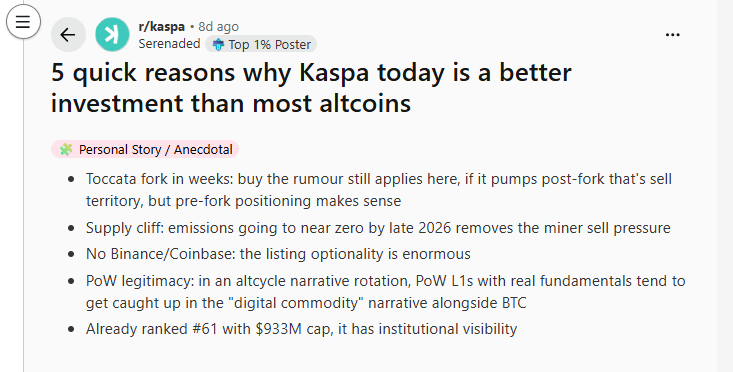
5 quick reasons why #Kaspa today is a better investment than most altcoins
1. Toccata fork in weeks: buy the rumour still applies here, if it pumps post-fork that's sell territory, but pre-fork positioning makes sense
2. Supply cliff: emissions going to near zero by late 2026 removes the miner sell pressure
3. No Binance/Coinbase: the listing optionality is enormous
4. PoW legitimacy: in an altcycle narrative rotation, PoW L1s with real fundamentals tend to get caught up in the "digital commodity" narrative alongside BTC
5. Already ranked #61 with $933M cap, it has institutional visibility
Study $kas
28 Nov 2022
5
63
280
8,562
𝐂𝐫𝐲𝐩𝐭𝐨 𝐏𝐫𝐨𝐬𝐞𝐥𝐲𝐭𝐞 retweeted
May 30
What's the ticker?
the first real-time Proof-of-Work settlement layer for global programmable finance.👇
5
4
18
1,346
Toccata hardfork locked in for June 30
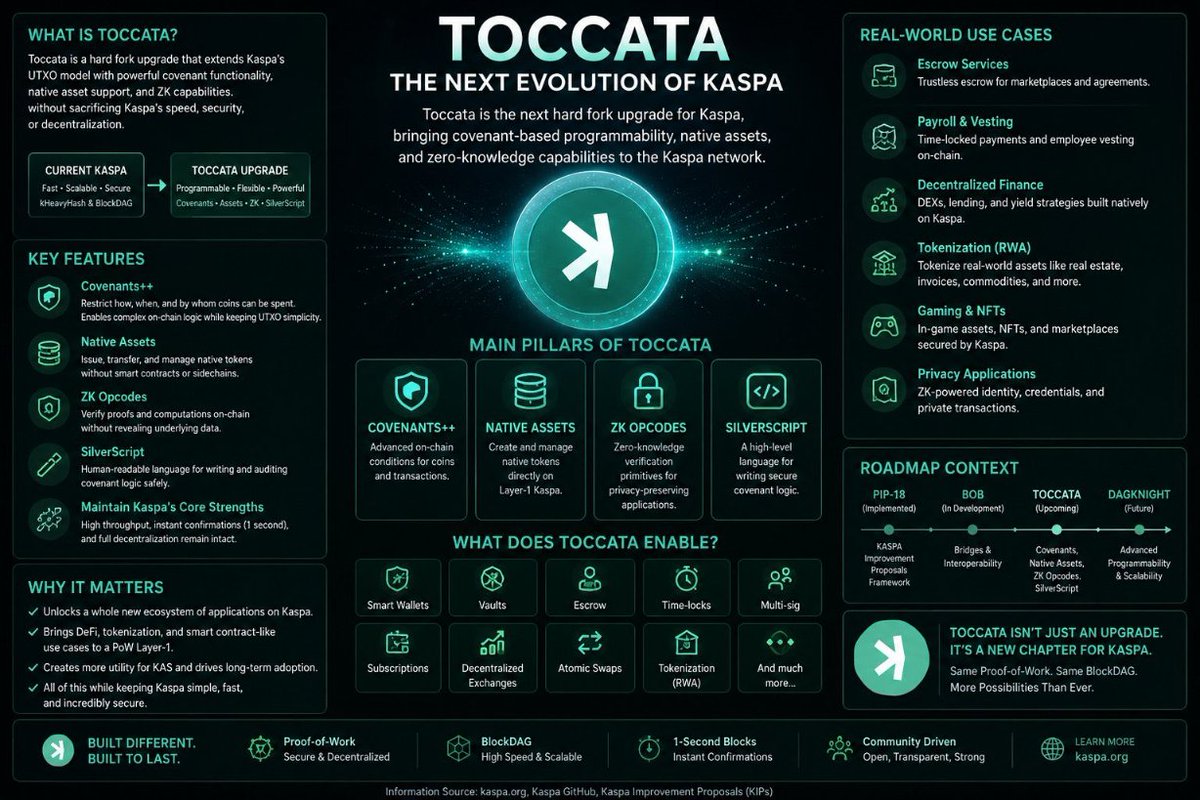
Rusty #Kaspa v2.0.0 is officially released with mainnet activation hardcoded at DAA score 474,165,565 — estimated 16:15 UTC on June 30, 2026. The DAA score is a nod to Bach's BWV 565 (Toccata and Fugue in D minor). All node operators, miners, pools, exchanges, and wallets must upgrade before activation. Nodes running the old P2P version will be disconnected 24 hours before the fork. The upgrade brings native L1 covenant support via Silverscript, ZK proof verification via OpZkPrecompile, partitioned sequencing commitments (KIP-21), and covenant IDs for stateful contract lineage. A full dry run on Testnet-10 completed smoothly in May.
Activation: June 30 ~16:15 UTC
DAA score: 474,165,565
$KAS Node version: v2.0.0
2
25
123
2,446
HumPool suspends operations — ~23% of hashrate displaced
HumPool, which accounted for approximately 23% of total #Kaspa hashrate, announced a suspension of mining services. The network hashrate has fallen from over 1M PH/s to around 400K PH/s over the past year. Hash ribbons remain bearish (30-day MA below 60-day MA), though the Puell Multiple at 0.54 is neutral — miners are under margin pressure but not capitulating. All Bitmain KS7 mining tokens are reportedly sold out.
Start $KAS Solo mining for God's Sake , ok ?
1
8
340
Kaspa heading to Imperial College London and Berlin Blockchain Week
The KasMap/KUDOS community initiative passed a vote (299 vs 18) to fund a Kaspa presence at an Imperial College London hackathon, with fundraising underway and the total crossing 50,000 $KAS. Separately, Igra Labs confirmed a Kaspa event at Berlin Blockchain Week on June 19, with a core developer presenting the Toccata upgrade in person to 30 invited attendees.
#Kaspa
Share to support
Like to support my work:
kaspa:qr8ndam4swa9ftnz49jywxgch433haxaj9n5f2sj48qrz030eq5h7j4zlwdps
5
330
𝐂𝐫𝐲𝐩𝐭𝐨 𝐏𝐫𝐨𝐬𝐞𝐥𝐲𝐭𝐞 retweeted
Because #Kaspa is something the whole crypto has been chasing for 15 years.
BlockDAG GHOSTDAG = pure fire. No more linear blockchain bottlenecks. $kas confirms blocks in seconds while staying fully decentralized and PoW-secure like Bitcoin. Real-time finality. This is what Satoshi dreamed of but scaled to the moon. Founder Yonatan Sompolinsky literally invented the GHOST protocol that Ethereum built on early Kaspa took it to the next level.
Crescendo hasalready shipped (May 2025) 10 BPS mainnet.
That’s 10 blocks per second, thousands of TPS right now. Rusty Kaspa (the Rust rewrite) is the official node standard since early 2026ultra efficient, rock-solid, and ready for more. Roadmap has 25-40 BPS by Q3 2026 and 100 BPS in sight for 2027. Hardware is the only limit. No congestion, no gas wars, ever.
Toccata Hard Fork dropping ANY DAY (Late June 2026). Native programmability, KRC-20 tokens, covenants, ZK verification opcodes all on L1. Kaspa just went from “fast money” to full programmable beast. Kaskad Lending (first DeFi protocol) already live on Igra L2 since late May. Smart contracts DeFi 10 BPS = Solana-level speed but with real PoW security and zero VC baggage.
Fair launch, no premine, no insiders, 95% supply circulating. Pure community-driven PoW. Hashrate is healthy and growing. Top holders are spread out. This is the anti-VC, anti-rug, sound-money coin that actually delivers on Bitcoin’s original vision but usable for everyday payments right now.
Why is Kaspa THE ENDGAME?
Bitcoin = digital gold (store of value).
Kaspa = digital cash (actual p2p money that moves in real time). It solves the blockchain trilemma without compromises: insane scalability ironclad decentralization maximum security. No PoS centralization risks, no L2 fragmentation headaches. Just pure, fast, permissionless money that’s evolving into a full ecosystem. While everyone else is chasing narratives and VC pumps, Kaspa is quietly building the protocol that becomes the new TCP/IP of money. Low cap, massive tech edge, imminent catalysts, and the community that actually ships. it’s the final form of PoW crypto.
8
52
203
6,324
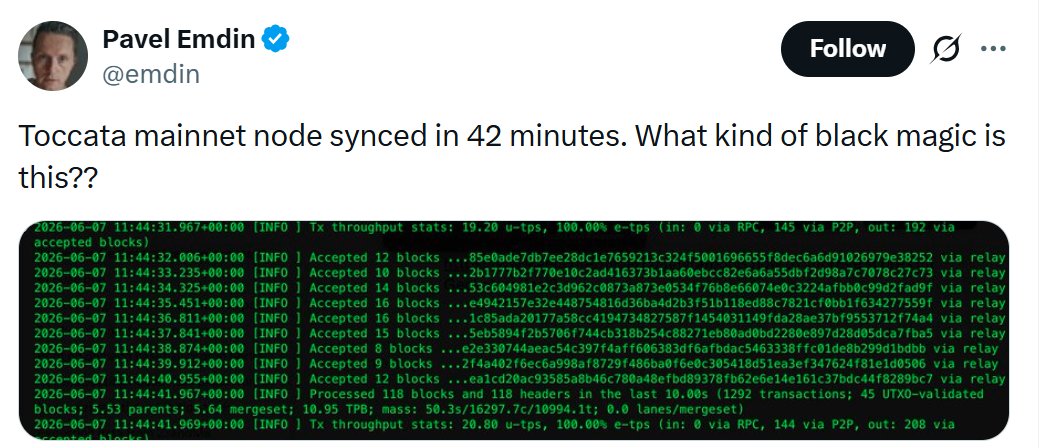
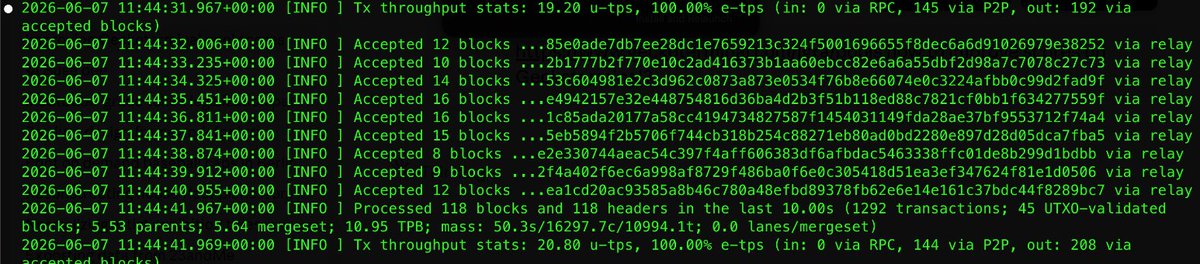
Mind-blowning : a fresh Toccata mainnet node on #Kaspa just synced to tip in 42 minutes flat.
Toccata = $KAS 's massive hard fork upgrade that just dropped L1 programmability (covenants ZK verification support enhanced sequencing) while keeping the insane high-block-rate PoW BlockDAG engine that makes Kaspa legendary.
Check the terminal logs:
• ~20 TPS
• Eating 8–16 blocks at a time
• 1,292 transactions processed in 10 seconds , it's black magic compared to the slow-moving chains we’re used to.
8
116
431
11,198
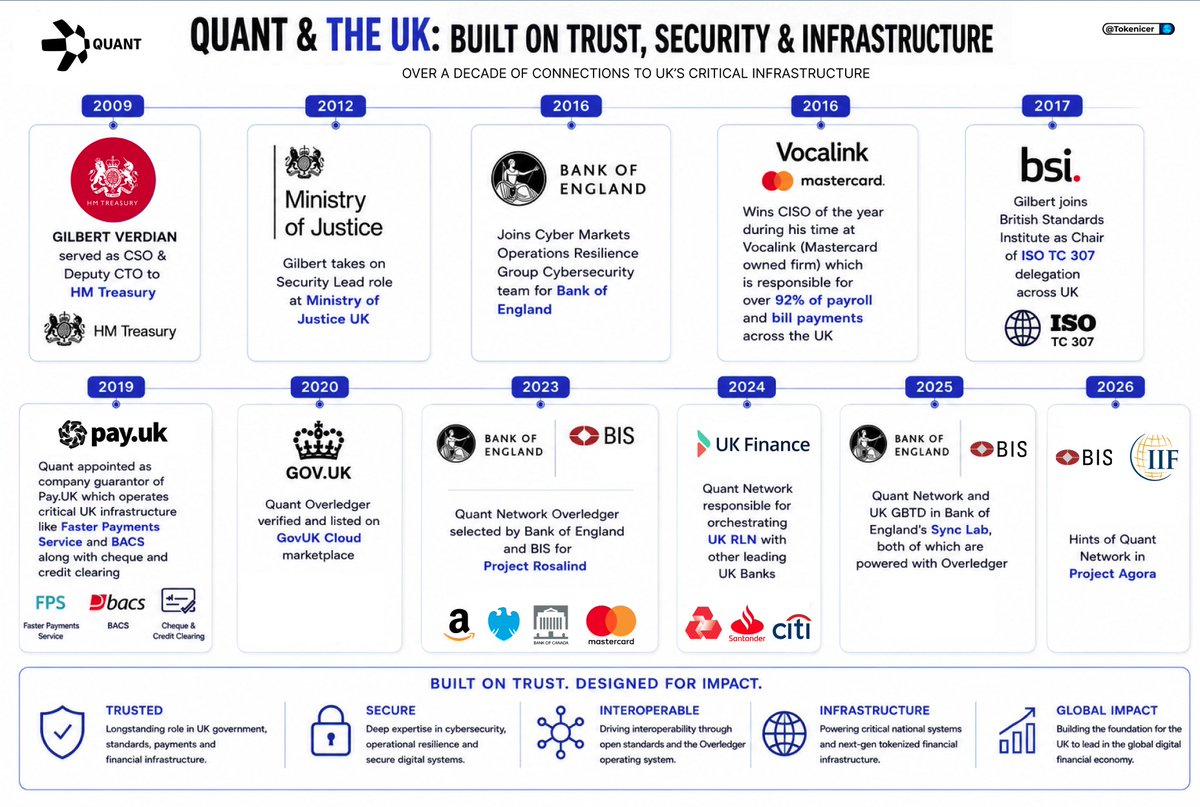
$QNT: Built into UK Critical Infrastructure for Over a DecadeFrom HM Treasury (2009) to Ministry of Justice, Bank of England cybersecurity, Pay. UK guarantor, BSI/ISO standards chair, and now powering Project Rosalind, UK RLN orchestration, and Sync Lab — Quant’s Overledger has been quietly embedded in the UK’s payments, banking, and tokenized future since before most cryptos existed.Trusted. Secure. Interoperable. Real infrastructure.
Not hype. $QNT x UK Economy = long game.
1
5
632